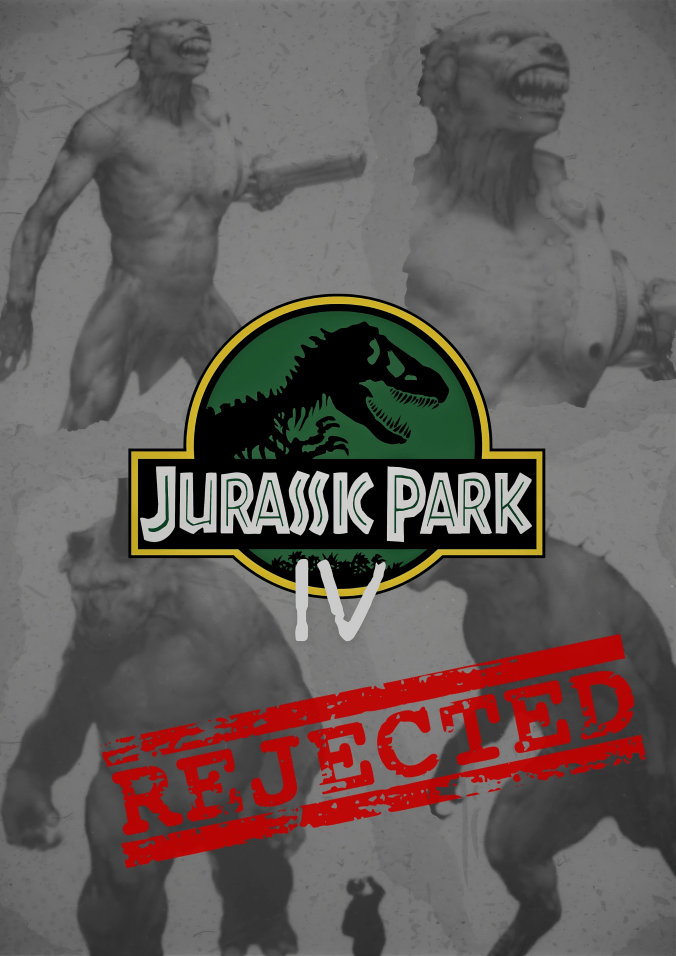
Before 2015’s Jurassic World brought dinosaurs back to the silver screen in the form of a glossy soft reboot, an earlier, radically different concept was drawn up for the fourth instalment of the franchise, with the aptly titled; Jurassic Park IV, set for release in mid-2005. This scrapped, now-long-forgotten sequel would’ve taken the series in a bold and contentious direction, concentrating its narrative on a crazed storyline revolving around genetically engineered dinosaur-human hybrids being deployed worldwide as weaponised combatants by a sinister organisation. While this ludicrous idea did reach the concept art and early scripting stages, the project was ultimately discarded, with executives fearing it would undermine the cinematic legacy and relatively grounded tone of the franchise’s earlier instalments, relegating the unproduced film to become an obscure yet fascinating piece of the franchise’s history, following the success of the 1993 classic that began its journey.
From the information currently available, this hybrid storyline seemingly first came about as a result of esteemed director and the series’ executive producer Steven Spielberg’s supposed dissatisfaction with the prior entry in the franchise; Jurassic Park III (2001), wanting the subsequent sequel to be more daring and worthy of being part of the renowned franchise, hence the jump towards more outrageous concepts. The previously mentioned hybrids were to be intelligent, humanoid, combat-capable creatures that blended human and dinosaur physiology. Among the early illustrations was a Triceratops hybrid, a fully upright, green-skinned creature with humanoid proportions, three toes on each foot and one prominent horn atop its head, the other broken. A Tyrannosaurus Rex hybrid, which stood upright like a human and bore reddish-brown and charcoal-black skin, retaining the creature’s stubby, two-fingered hands, now with more muscular, human-like arms. And, lastly, a Velociraptor hybrid, which went through numerous iterations, with concept artist Carlos Huante, who developed many of the designs, once referring to the creature as the “Raptor-Man” in a since-deleted post on Instagram. Depicting the creature as agile and lean with a humanoid frame augmented by raptor-like features, the Velociraptor hybrid was perhaps the most unsettling of the early designs, blurring the line between futuristic horror and evolutionary fantasy, with one design even bearing a high-tech weapon on its left arm.
Carlos Huante later claimed that the concept of the dinosaur-human hybrids was shut down almost immediately after Steven Spielberg and executives at Amblin Entertainment reviewed the artwork, as they believed the idea strayed too far from the franchise’s core identity, shifting its focus from scientific plausibility and natural wonder to over-the-top, militarised science fiction. Nevertheless, whether intentional or not, the first public hint of this odd creative decision came in October 2003, when palaeontologist and longtime franchise dinosaur consultant Jack Horner appeared on Minnesota Public Radio. In response to a caller’s question regarding the speculative “Dinosauroid,” a hypothetical, intelligent descendant of the omnivore Troodon, a relatively small, bird-like theropod, Horner cryptically answered that the caller should; “Keep Thinking About That for a Couple of Years,” adding; “Go See Jurassic Park IV,” suggesting the franchise would explore the notion of dinosaur evolution.
Interestingly, despite this concept of dinosaur-human hybrids eventually being axed along with this iteration of the series’ fourth instalment, a similar idea had actually appeared during Universal Studios’ Halloween Horror Nights in 2002, an annual scare event often featuring well-known franchises from the horror and sci-fi genres, within the attraction; Project Evilution. In the story of the tropical jungle-themed scare maze, Dr. Burton, a deranged InGen scientist, had conducted twisted experiments, mixing human and dinosaur DNA to create dinosaur-human hybrids that would terrorise visitors, which may have influenced or prefigured many of the illustrations that emerged during the development of Jurassic Park IV.
Outside of the central dinosaur-human hybrid concept, the story of Jurassic Park IV would have focused on ex-Navy Seal Nick Harris, as he is covertly enlisted by John Hammond to travel to the now-restricted island of Isla Nublar to locate Dennis Nedry’s missing canister of dinosaur embryos, lost during the events of Jurassic Park (1993). After landing on the island, avoiding threats and recovering the canister, however, Nick would be captured and taken to an archaic castle in the Swiss Alps. There, Baron Herman Von Drax, the CEO of the corrupt organisation, the Grendel Corporation, would reveal they had created dinosaur hybrids that partially shared DNA with both humans and domestic dogs, which Von Drax had supposedly found a way to control utilising radio signals. From there, the rest of the story follows Nick as he is forced to train the dinosaur-human hybrids to obey Von Drax further, concluding with Nick obtaining complete control of the hybrids, leading to a gigantic action sequence where the carnivorous creatures chase down Von Drax, some even sporting bulletproof armour.
In summary, though shelved, this sequel and, by extension, the notion of dinosaur-human hybrids, remain one of the most absurd yet intriguing ‘what-if’ chapters in the franchise’s history. And, whilst this rendition of Jurassic Park IV never came to fruition, many of its concepts actually did via the eventual, aforementioned soft-reboot; Jurassic World, converting the idea of dinosaur-human hybrids to Jurassic World scientists combining various strands of dinosaur/animal DNA in an attempt to manufacture a formidable, marketable beast, inadvertently resulting in blood-thirsty creatures like the Indominus Rex and the Indoraptor, the latter of which even maintaining the idea of being used as a weapon, but in a manner that felt more grounded in the world established by earlier franchise installments. Additionally, protagonist Nick Harris shares several similarities with Chris Pratt’s ensuing character, Owen Grady, with the two not only sharing the same military background, but also serving as trainers to a squad of carnivorous dinosaurs. Still, in my opinion, discarding this original storyline for the franchise’s fourth instalment was definitely a wise move, narrowly avoiding a creative decision that could have morphed the series into something laughably ludicrous and utterly unrecognisable from what it once was.
 Joe Baker - Film Reviews