Men in Black: International (2019) – Film Review

“Always Remember: The Universe Has a Way of Leading You to Where You’re Supposed to Be at the Moment You’re Supposed to Be There.” – Agent High T

Emerging several years after the entertaining yet faulty; Men in Black 3Men in Black: International, released in 2019, serves as a soft reboot of the series, aiming to bring the undisclosed extraterrestrial defenders back for another similarly amusing, alien-blasting adventure. However, predominantly due to its outlandish story, trite humour and absurdly horrendous dialogue, Men in Black: International rarely reaches the heights of the 1997 sci-fi-comedy classic, nor the later, lesser entries in the well-known franchise, even with its noteworthy stars of Chris Hemsworth and Tessa Thompson carrying over much of their on-screen chemistry from 2017’s Thor: Ragnarok.

Plot Summary: After sharing an eye-opening encounter with an extraterrestrial as a child, Agent M, the M.I.B.’s newest probationary recruit, finds herself under the wing of Agent H, a past-his-prime hero of the closemouthed organisation, operating at the London branch. Meanwhile, a duo of shape-shifting alien assassins arrive on Earth, seeking a devastating super-weapon that could place the entire galaxy at risk…

Based on The Men in Black comic book series, created and written by Lowell Cunningham, Men in Black: International is the first film in the franchise not directed by Barry Sonnenfeld. Instead, the film was directed by F. Gary Gray (FridayThe NegotiatorStraight Outta Compton), making Men in Black: International the second Gray-directed sequel to a Sonnenfeld flick, the first being; Be Cool in 2005, a sequel to 1995’s Get Shorty. Needless to say, this change in leadership (and screenwriters) could be seen as more of a negative than a positive, as the film lacks much of the disturbing violence and revolting practical effects present in the original trilogy as extensively as the satire. Furthermore, Men in Black: International‘s narrative leaves much to be desired, appearing overly simplistic and somehow equally convoluted, barring a couple of interesting concepts, such as a portal for transporting alien refugees or a mole within the M.I.B. organisation. The film is dragged down further by its ever-present cringey dialogue, which is near vomit-inducing in its many attempts to seem relevant. To its credit, Men in Black: International does, at least, manage to expand the universe of the films by introducing various international branches of the covert organisation, as its title suggests.

With Will Smith and Tommy Lee Jones openly stating they would not return to the franchise for Men in Black: International, new leading actors/actresses had to be chosen. Still, they do appear in the film briefly, having long passed into legend as agents in a dramatised painting in the M.I.B. London head office. Regrettably, however, the revamped cast of Chris Hemsworth, Tessa Thompson, Liam Neeson, Rafe Spall and Rebecca Ferguson are continually overblown in their performances, bouncing from scene to scene with ample energy regardless of tone. This issue is only made worse by the characterisation, which frequently forgets to provide the characters with motivations for their actions or any semblance of depth beyond the basics we learn of them, with Agent H being the foolish, once-hotshot agent of M.I.B. having previously saved Earth from an extraterrestrial invasion, whilst Agent M has desired to be an agent of the organisation since she was young.

Immaculate and radiant yet unimaginative, the cinematography by Stuart Dryburgh shares more of a visual resemblance to superhero blockbusters from the Marvel Cinematic Universe than any previous Men in Black instalment. Likewise, dissimilar to earlier entries in the franchise, Men in Black: International‘s plethora of extraterrestrial designs are dreadfully cartoonish in appearance, lacking the individuality and repulsive naturality of the series’ previous designs, all of which are unfortunately brought to life exclusively via CGI, with very few costumes/prosthetic make-up pieces employed. Having said that, there is one exception to this defect; the designs of the primary antagonists, the Hive, who retain a visually striking design, taking on the appearance of luminous, orange star clusters in a human physique.

In keeping with the rest of the Men in Black series, the original score is composed by Danny Elfman and newby Chris Bacon, who strive to capture the same musical spirit as previous franchise instalments through tracks like Job InterviewHere Comes Trouble and End Credits. And, for the most part, the composers are successful in this goal as the score sounds reminiscent of the original trilogy’s soundtracks while thankfully avoiding any lousy endeavours to modernise the series’ iconic theme.

When it comes to the humour, it’s apparent that there is a hefty deficiency of wit and surprise within the screenplay. As a result, most of the jokes throughout the runtime are either sluggish, irritating or immature. Additionally, during one particular scene, set within a hidden, extraterrestrial-filled nightclub, there is a weirdly out-of-place gag where Agent H attempts to spitefully manipulate Agent M into pleasuring Vungus, a party-hungry alien visiting Earth, which will surely make some audience members feel uncomfortable.

In summary, the mere notion of a Men in Black revival without the presence of Smith or Jones seems like an unmistakably terrible idea, comparable to how another swashbuckling Pirates of the Caribbean sequel without Johnny Depp’s inclusion would seem incomplete, stand-alone story or not. Even with its original cast in attendance, however, Men in Black: International likely still would’ve failed on account of its many other shortcomings, grinding its cast’s chemistry through the gears of a sci-fi franchise running low on reasons to persist. Rating: 3/10.

men_in_black_international-p1107879

Oz the Great and Powerful (2013) – Film Review

“I Don’t Want to Be a Good Man, I Want to Be a Great One.” – Oscar ‘Oz’ Diggs

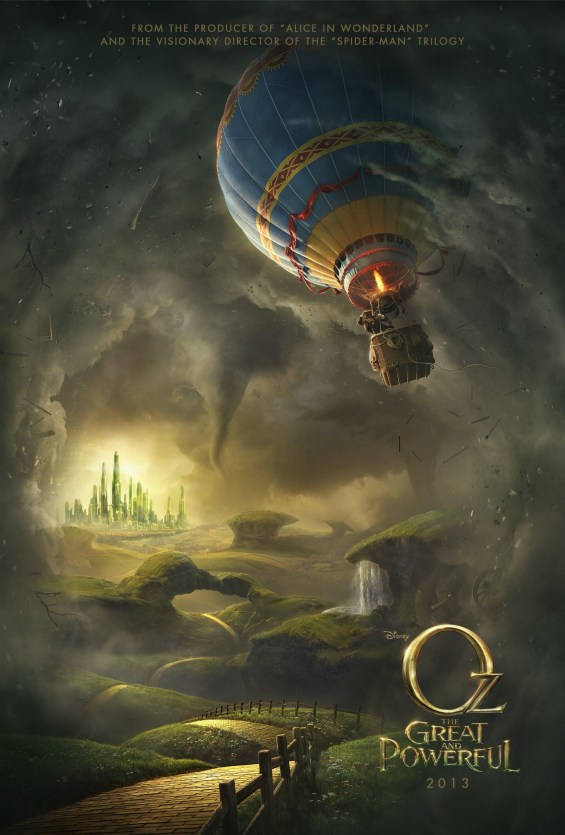
Since its release in 1939, the illustrious fantasy-musical; The Wizard of Oz, an adaptation of L. Frank Baum’s beloved children’s novel; The Wonderful Wizard of Oz, has been engraining itself into the memories of adults and youngsters alike through its catchy melodies, imaginative world-building and groundbreaking practical effects. In 2013, Walt Disney Pictures sought to return to the Land of Oz with Oz the Great and Powerful, a prequel to the novel and, in a way, its silver screen counterpart (despite ownership of the harmonious classic belonging to Warner Bros. Pictures), with celebrated director Sam Raimi (The Evil DeadSpider-ManDoctor Strange in the Multiverse of Madness) attached to helm the project, ascertaining its potential as an enchanted prequel. Shortly after its release, however, most seem to forget about the film, which is unfortunate given that Oz the Great and Powerful is a largely enjoyable fantasy adventure that pays homage to the iconography and timeless sense of wonder present in the original musical while avoiding an absence of its own, unique ideas.

Plot Summary: After Oscar ‘Oz’ Diggs, a small-time circus magician with dubious ethics, is hurled away from his dusty abode in Kansas to the vibrant Land of Oz, he believes he’s hit the jackpot as he’s told to assume his rightful place as monarch of Emerald City. But, when Oscar meets the sisters of Theodora and Evanora, who aren’t entirely convinced that he is the great wizard their prophecy has spoken of, Oscar is summoned on a quest to slay the Wicked Witch that threatens Oz and prove his worth…

Whilst Oz the Great and Powerful may seem like just another cinematic interpretation of the whimsical Land of Oz, Walt Disney Pictures actually had to be very cautious with what aspects of the story they utilised, on account of Warner Bros. Pictures owning the rights to specific elements of The Wizard of Oz, as previously mentioned, including the ruby slippers Dorothy Gale dons throughout the runtime. These restrictions even extended to the particular shade of green used for the Wicked Witch’s skin, for which Disney employed what its legal department considered a sufficiently different shade dubbed; “Theostein,” a portmanteau of Theodora and Frankenstein, yet Disney could not use the signature chin mole from Margaret Hamilton’s renowned portrayal of the Wicked Witch of the West.

In terms of the actual narrative, Oz the Great and Powerful tells the origin of the titular Wizard of Oz, whom we all know from previous iterations to be a fraud. Before he was viewed as a mythical wizard, Oscar Diggs was merely a talented illusionist and an egotistical, womanising con man performing at a travelling circus in Kansas. ‘Oz’ (as his friends call him) underpays his assistant and recruits many beautiful women to appear in his performances, manipulating them with lies and empty romantic gestures. However, while Oscar receives an abundance of characterisation during the story and is evidently a gifted magician, James Franco’s performance is primarily to blame for the character’s shortcomings, as Oscar suffers from an underbaked character arc and a lack of empathy in certain scenes, suggesting that Franco lacks the charisma necessary to win over the audience amid Oscar’s immense arrogance. Dissimilarly, the supporting cast of Mila Kunis, Rachel Weisz, Michelle Williams, Zach Braff and Joey King are all sufficient in their varied roles, human and otherwise.

Recreating imagery like the Yellow Brick Road and the Emerald City in addition to introducing a handful of never-before-seen locations, such as a miniature village compromised of larger-than-life crockery and ceramic residents, known as China Town. Oz the Great and Powerful impressively brings the Land of Oz to life via a combination of expansive sets and green screens. Similar to the original musical, Oz the Great and Powerful also opens in a colourless, tight aspect ratio for the Kansas sequences before widening out and blossoming into colour once Oscar enters the Land of Oz, making for an unforgettable visual juncture. Moreover, the cinematography by Peter Deming is frequently effective in implementing Sam Rami’s familiar style of camerawork, as the camera is repeatedly rocketing towards characters’ faces, particularly when they’re reacting to the surprising number of jump-scares.

Although the original score for Oz the Great and Powerful by Danny Elfman isn’t one of the composer’s finest, nor is it exceedingly memorable, tracks, like Main TitlesA Strange World and The Bubble Voyage are all remarkably uplifting, whereas the orchestral tracks; Bad Witch and Witch Fight, are much more ominous in tone, allowing Elfman to exhibit his grand, gothically melodic roots.

On a separate note, all of the CG effects throughout Oz the Great and Powerful hold up well for their age, aside from a few wide shots where the environment surrounding the characters appears excessively distant and overly bright. And, whenever physical sets are employed instead of green screens, they are magnificently multicoloured and extensive.

In summary, while Oz the Great and Powerful suffers from some tonal inconsistency and an underdeveloped character arc for its protagonist, the film retains enough spectacle, wit and creativity to be entertaining in its own right as a bewitched prequel. Faithfully reproducing iconic imagery like flying primates, a golden-bricked road and a cackling, broom-riding Wicked Witch, I feel nearly every fanatic of The Wizard of Oz (and/or its source material) will find amusement in this non-musical, fantasy blockbuster. Rating: low 7/10.

oz_the_great_and_powerful-p680832

The Happytime Murders (2018) – Film Review

“Do You Have the Latest Issue of Puppet Pussy Party?” – Phil Philips

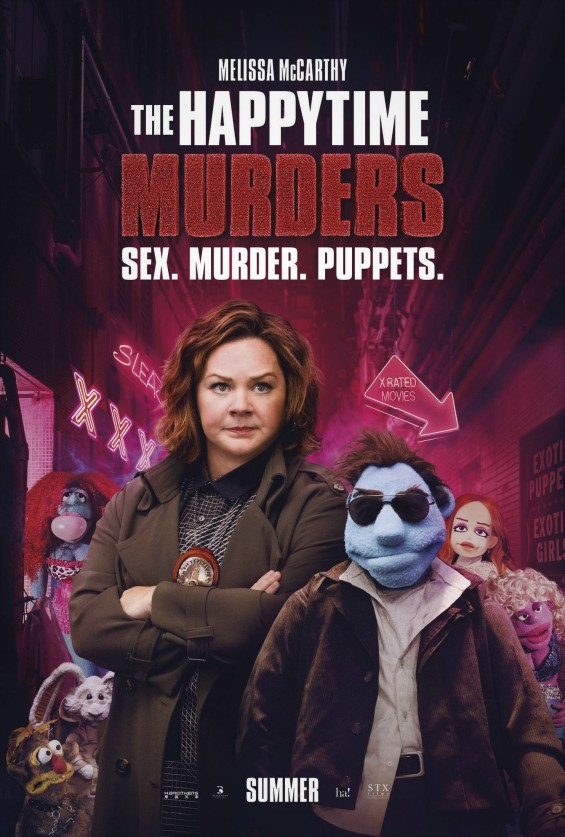
Released in 2018, The Happytime Murders was a long-in-development project from the adult-geared alternative arm of the Jim Henson Company, the famed production company behind The Muppet ShowFraggle RockDinosaurs and many other beloved, family-friendly projects. Yet, unlike those projects, The Happytime Murders squanders its imaginative premise on a witless and raunchy crime-comedy that blindly pushes buttons instead of attempting to tell an entertaining story, to the extent that even under the proficient direction of Brian Henson (The Muppet Christmas CarolMuppet Treasure Island), son of the late Jim Henson, the film never manages to escape its dreadfully lethargic humour or its foreseeable buddy-cop storyline.

Plot Summary: When the cast of a 1990s sitcom is murdered one by one at the hands of a mysterious figure, Phil Philips, once the Los Angeles Police Department’s first puppet police officer, now a weary private investigator, finds himself dragged into the case. But, as the investigation becomes more and more bewildering, Phil is forced to bury the hatchet with his former human partner, Detective Connie Edwards, in order to prevent more past-their-prime puppets from meeting a grisly end…

Curiously, before the film was released, Sesame Workshop, the non-profit organisation behind the cherished children’s television series; Sesame Street, actually tried to sue The Happytime Murders‘ marketing team on account of one of the film’s taglines; “No Sesame. All Street.” Claiming the film tarnished their child-friendly reputation. However, the suit was ultimately rejected. In many ways, this amusing piece of behind-the-scenes drama is more interesting than the actual narrative of The Happytime Murders, which primarily serves as a witty yet predictable detective mystery where Phil and his partner, Connie, are driven to scour for clues across the sunlit, puppet-populated metropolis of Los Angeles, in the hope of exposing the unbeknownst serial killer. Through this investigation, the film makes many attempts at humour, 90% of which falls short as most of the comedy lazily stems from adorable puppets merely cursing or enjoying more adult activities, such as smoking, sex or drinking alcohol. On a more positive note, the film does, at least, feature a few fragments of absorbing world-building, most notably with how puppets are considered second-class citizens compared to humans, hence why so many puppets eventually become addicts, numbing themselves to the misery of their lives, a detail that is clearly intended as underlying (and underdeveloped) social commentary.

As mentioned previously, The Happytime Murders is, at its core, a parody of classic buddy-cop crime-thrillers, with the alcoholic, blue-felt gumshoe, Phil Philips, skillfully portrayed by Bill Barretta, reluctantly pairing up with his abrasive former partner, Detective Connie Edwards, clumsily portrayed by Melissa McCarthy, after his thespian brother gets inexplicably murdered by an individual intent on wiping out the entire cast of the Happytime Gang, a prevalent ’90s sitcom. All of whom were puppets, aside from the token human cast member, Jenny, portrayed by Elizabeth Banks. And thanks to the spectacular puppetry on display, you quickly forget that Phil, one-half of this investigative tandem, is a glorified hand in a sock. Alas, the characterisation isn’t nearly as impressive as beyond some basic character traits and chucklesome one-liners, both members of the central duo lack depth and frequently come across as obnoxious, especially McCarthy. Regrettably, this issue also extends to the under-utilised supporting cast of Maya Rudolph, Leslie David Baker and Joel McHale.

Akin to many other puppeteering projects, all of the elevated sets utilised during production were built so that the puppeteers could stand on the ground and operate the puppets as if they were standing with straight arms. Yet, even with this information in mind, every set that appears on-screen feels like a real, lived-in location. Unfortunately, the rest of the visuals aren’t as remarkable, as the cinematography by Mitchell Amundsen is immensely bland, over-relying on over-lit close-ups and mid-shots that barely enrich the satire or mystery of the narrative.

Relatively tedious and generic, the bass-heavy original score by Christopher Lennert tries to reflect the jazzy scores of ’70s crime-thrillers yet rarely succeeds in forming any truly memorable tracks of its own. Similarly, songs like Sexy and I Know It and Low Rider seem almost arbitrary in their placements within the runtime, usually throwing off the tone of whatever scenes where they are featured.

In regard to the puppets themselves, it’s intriguing to note that a grand total of one hundred and twenty-five puppets were used during the film’s production, with around forty of those puppets being created specifically for the film. As a result, every puppet that emerges from scene to scene is visually unique, retaining its own colour, fabric, style, and personality. Once again, it’s just a shame that the gags and dialogue that emit from each felt character’s mouth are so sluggish, continuously giving off the impression that the film is trying far too hard to be risqué.

In summary, The Happytime Murders is a crime-comedy harbouring far too many lousy jokes, with the genuinely clever gags being few and far between. As such, the only thing that can be declared for certain when it comes to The Happytime Murders is the fact that with its countless scenes of drug-snorting and depraved puppet sex (not to mention an extremely drawn-out ejaculation sequence), it’s worth emphasising that this puppet-led comedy is not one for youngsters. Still, it’s not as if they’re missing out on much. Rating: low 4/10.

happytime_murders_ver2_xxlg

The Devil All the Time (2020) – Film Review

“Blessed Are Those That Hunger and Thirst for Righteousness.” – Reverend Preston Teagardin

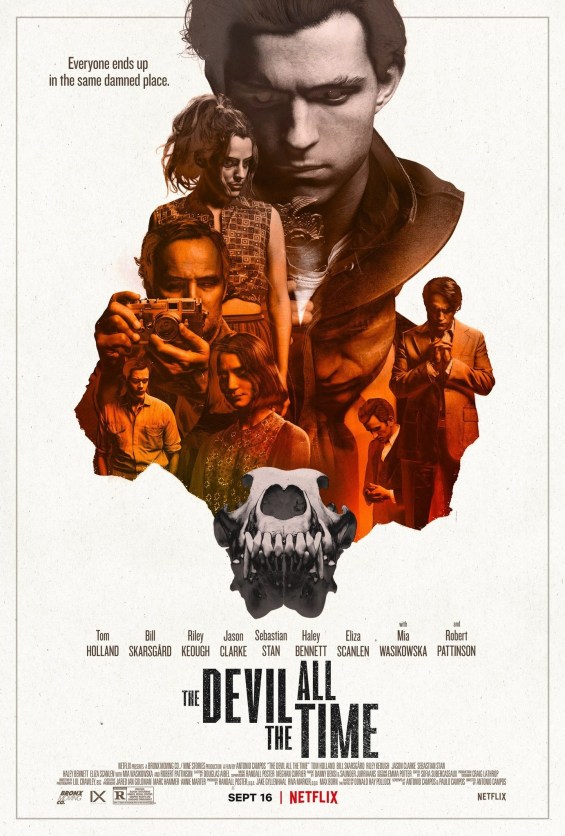
A gripping yet troubling exposé of a period in history that frequently appears overly sanitised, 2020’s The Devil All the Time is a superb Netflix Original that utilises its relentlessly grim narrative, stellar all-star cast and period-accurate song choices to explore an underused setting in cinema; Southern Ohio in the 1950s. And, as a result, the film crafts an engaging and thought-provoking tale of backwoods preachers, religious zealots and broken, weathered souls witnessing the atrocities of a post-war world, replenished with sins that even faith is unable to wash away.

Plot Summary: In 1950s-era rural Southern Ohio, an assortment of crooked and sinister individuals intersect paths in the Midwestern town of Knockemstiff, a rustic, sparsely-populated cesspool teeming with corruption and brutality…

Co-written and directed by Antonio Campos (Buy It NowSimon KillerChristine), the screenplay for The Devil All the Time was adapted from the novel of the same name by Donald Ray Pollock, who, interestingly, actually performed the narration for the film, making the role his first-ever narrating position as he avoided performing the voiceover work for his own audiobooks. Similar to the original novel, a large majority of the story revolves around the real-life town of Knockemstiff, Ohio. Here, the non-linear narrative, which examines the violent vestiges of religious iconography, thrusts an array of devilish characters to encounter one another through differing scenarios, often resulting in horrific outcomes. In particular, the opening three arcs produce a distressing first act where death is seemingly always lurking around the corner. However, while most of the characters and their individual storylines are captivating, certain characters (and their continually fiendish actions) can appear somewhat underdeveloped due to a lack of screen-time, along with a few narrative details, namely, the subplot of Deputy Lee Bodecker accepting payments as a corrupt officer, not falling into place.

Regarding one of the finest aspects of the film, the central cast of Tom Holland, Robert Pattinson, Harry Melling, Bill Skarsgård and Sebastian Stan (among many others) are all exceptional in their various roles, with most of the cast’s accents seeming flawless, barring Holland and Pattinson’s accents, which come across as inconsistent and wildly over-the-top, respectively. The cast’s performances are only enriched by their usually well-written characters, however, as their unanswered prayers seem to eventually lead each of them to turmoil as they exist at a bleak point in history where treatments for diseases were scarce and a devastating World War had just wiped out millions, rendering religion to serve as the only recourse for most. What makes the characters more intriguing is that The Devil All the Time is also a multigenerational tale, beginning with the semi-protagonist, Arvin Russell, as a youngster before concluding the story with Arvin as an adult in his early twenties, all the while propelling Arvin and his step-sister, Lenora, to reckon with the ghosts of their parents’ past. That is not to say that any character is represented as exemplary, though, as during the final act, the primarily benevolent Arvin exercises his father’s vengeful tactics for a satisfyingly violent payoff.

In a rather bothersome decision, The Devil All the Time repeatedly feels compelled to remind the audience of earlier sequences in the story that mirror later moments. Yet, most of the time, these flickers of earlier scenes in the film are thoroughly unnecessary and quickly begin to grate on the audience. Aside from this annoyance, the editing and cinematography by Lol Crawley are serviceable, continually being enhanced by the terrific set design and set dressing, which makes every inch of the rundown town of Knockemstiff appear worn and ripe with religious imagery.

Alongside the original score by Danny Bensi and Saunder Jurriaans, which remains nuanced and unpretentious whilst still adding to the cruelty and suspense on-screen at many points, The Devil All the Time employs an extensive selection of traditional gospel tunes and ’50s-era songs, such as Washed in the BloodThe Three Bells and Honeycomb, all beneficially playing into the setting and underlying religious themes of the story with some of the more upbeat songs even prompting certain scenes to develop a moderately satirical tone.

Returning to the visuals, momentarily, crucifixion is a recurring image throughout the runtime, relating to the film’s central underlying theme of the conflict between belief and the horrors of the real world. For example, in the first act, Willard Russell discovers a bloodied, fly-infested serviceman crucified during his deployment on the Solomon Islands during World War II. This image changes the once godly soldier to a religiously apathetic, but more importantly, makes it apparent how closely savagery and sacrifice are exemplified through the image of Jesus Christ tortured on the cross. Later in the film, there is also a painting of Jesus Christ on the cross hanging on the wall in Arvin’s room, reminding the audience of this subtext.

In summary, whilst The Devil All the Time‘s ruthlessly pessimistic narrative can occasionally be harrowing to the point of punishment, much of the dour storytelling is offset by the strong work from the outstanding cast, whose performances are often so compelling they even redeem the rather conventional style of filmmaking the film adopts, which is unlikely to leave any audience member in awe. Still, The Devil All the Time is an effective, religion-centred thriller. Rating: 7/10.

devil_all_the_time_ver2_xxlg

Welcome to Marwen (2018) – Film Review

“I Was a Hell of a Good Artist, an Illustrator. I Loved to Draw, and Now, I Can Barely Write My Name…” – Mark Hogancamp

Co-written and directed by Robert Zemeckis (Back to the FutureForrest GumpCast Away), Welcome to Marwen, released in 2018, is a dramatisation of the 2010 documentary; Marwencol, which recounted the true story of Mark Hogancamp, who, on April 8th, 2000, was brutally assaulted by five men who beat him almost to death, thrusting Mark into a nine-day coma and a forty-day hospitalisation period before he was discharged, woefully bearing severe brain damage that left him with little memory of his past life. Welcome to Marwen takes the tragic story of Mark Hogancamp and aims to provide it with a tint of optimism, romance and fantasy through its unique storytelling approach and dazzling visual effects. Yet, the film ultimately falls flat due to its confused tone and graceless screenplay, making Zemeckis’ invitation to enter the village of Marwen a leisurely one to decline.

Plot Summary: After being ruthlessly assaulted by five men who left him for dead outside a bar in Kingston, New York State, yielding severe memory loss and trauma. Aspiring artist, Mark Hogancamp, constructs a remarkable therapeutic outlet on his property known as Marwen, a miniature World War II-era Belgium village compromised of period-dressed dolls. But, when Mark is requested to attend the court hearing of the men who mutilated him, his anguish returns to torment him…

Mark Hogancamp, the real individual upon whom the film is based, suffered injuries on every part of his body following the assault, subsequently placing him into a coma for nine straight days. As a result, most of the memories of his life before the assault were virtually extinguished, and the limitations of his health insurance prevented his continued rehabilitation. Sadly, only three of his assailants ever went to prison, with all three getting released within two years. Welcome to Marwen ignores many of these bleak details and outcomes, however, instead attempting to lace the story with more sanguinity and merriment as the film plays out over two planes; Mark’s plane of existence (our own) and that of the dolls, who, are enlivened via CGI in a fashion that could be described, as a more photo-realistic version of Toy Story (1995). It’s an admirable method of trying to infuse Mark’s despairing reflection of his assault with a dash of imagination and humour, but it’s predominantly an unsuccessful one, as this approach renders the film immensely inconsistent in terms of its pacing, tone and authenticity to the actual account of Mark’s horrific assault.

In a somewhat bizarre casting choice, Mark Hogancamp is portrayed by Steve Carell, who, whilst not awful, by any means, feels as if he lacks the acting aptitude required to depict Mark’s agonising trauma and isolation. But, Carrell does (of course) prevail with the more comedic moments, even if the gags themselves generally flop as Capt. Hogie (Mark’s gallant, plastic alter-ego) has a plethora of oddly placed witticisms. The supporting cast of Merritt Wever, Diane Kruger, Janelle Monáe, Eiza González and Gwendoline Christie all deliver passable performances (barring Christie’s overbearing Russian accent) yet possess little characterisation as the so-called; Women of Marwen, dolls that populate the tiny, make-believe village of Marwen, inspired by the powerful women Mark knows in his real life. Leslie Mann also makes an appearance in the film as Mark’s friendly, inexplicably curious neighbour, Nicol, who eventually becomes an object of affection for Mark in both his worlds, which occasionally comes across as rather uncomfortable as Mark lives out some of his romantic fantasies with Nicol through his dolls.

Despite spending almost half of the runtime in the imaginary village of Marwen, Mark’s fantasies of himself and his female companions as heroes of the Second World War are often short on memorable shots. Lacking stimulating action sequences or grand set pieces to truly justify how much screen-time is spent in the village of Marwen, the rarely inventive cinematography by C. Kim Miles makes the scenes of the dolls socialising or firing at Nazis relatively visually flat, that is, barring the well-rendered visual effects.

On the more positive side of things, the original score by Alan Silvestri is equally adventurous and diverse, with tracks such as MagicYou Got ThisBeautiful Moon and Marwencol, all harmoniously balancing sorrow, yearning and genuine tension while featuring a snare drum to further play into the World War II setting of Marwen. The score also includes some auditory references to Zemeckis’ earlier filmography, including a callback to the signature motif of the Back to the Future trilogy.

Nevertheless, the finest aspect of Welcome to Marwen is, by far, its CG effects, which brilliantly utilise motion capture to employ the faces and body movements of its cast onto plastic figurines clothed in World War II-era outfits/uniforms. As such, every scene within Mark’s fantasy world oozes with detail and toy-related visual gags, even if the animation of the dolls periodically appears overly fluid compared to the somewhat rigid reality of poseable figurines.

In summary, the current stage of Zemeckis’ career has long been repressed by his obsession with visual effects, repeatedly concentrating on style over substance. Welcome to Marwen is no exception to this rule, with the numerous sequences set within Mark’s fictitious world being the film’s most enjoyable moments. Thus, Welcome to Marwen fails to flourish as a wonderous, period-set adventure or a rumination of violent hate crimes and personal trauma, merely existing as a creatively ambitious misfire. Rating: low 5/10.

welcome_to_marwen_ver10_xxlg

Deepwater Horizon (2016) – Film Review

“I’d Think You Money-Hungry Sons of Bitches Would at Least Be Good at Math…” – Mike Williams

The Deepwater Horizon Oil Spill, commonly referred to as the BP Oil Spill, is, to this day, regarded as one of the widest-reaching environmental disasters in human history. An industrial catastrophe that began on April 20th, 2010, off the coast of the United States in the Gulf of Mexico, the event caused the deaths of eleven oilfield workers and was estimated to have spilt over two hundred and ten million gallons of oil into the ocean, forcing industry giant BP to pay more than $60 billion in criminal and civil penalties, natural resource damages, economic claims and cleanup costs for their reckless corporate culture of cost-cutting and excessive risk-taking. The 2016 cinematic interpretation of this true-to-life tale; Deepwater Horizon, makes effective use of its titular location and subsequent tragedy to deliver a lamentable yet nevertheless gripping thriller, admiring the bravery of those who escaped with their lives whilst never losing sight of the affliction and distress they endured on that faithful day.

Plot Summary: Manned by one hundred and twenty-six workers, the semi-submersible, offshore oil-drilling rig, Deepwater Horizon, operates as usual over the Gulf of Mexico, forty-one miles southeast of the Louisiana Coast. But, before long, chief electronics technician, Mike Williams, and seasoned rig supervisor, Jimmy Harrell, discover that the critical examination of Deepwater Horizon’s cement foundation was bypassed by BP’s frugal executives, consequently inducing a devastating explosion that kills several oilfield workers and traps Mike and his remaining colleagues on the cadaverous rig amidst the flames…

Upon its announcement, many oilfield workers from the Gulf of Mexico were against the production of Deepwater Horizon, declaring that they believed the film would dishonour the men who sadly perished during the event. However, Mike Williams (one of the survivors) thoroughly supported the film, assisting the crew throughout production alongside another survivor, as they felt it was a suitable method of depicting the terrifying circumstances they and the other oilfield workers endured, with the leading intent of director Peter Berg (HancockLone SurvivorPatriots Day) being to make the disaster feel as real as possible for the audience, encapsulating the sensation of workers’ shared dread in 2010.

In keeping with this sense of realism, the dialogue throughout Deepwater Horizon remains authentic to the vocabulary of oilfield workers, repeatedly tossing around the shorthand terminology of the position. Similarly, the screenplay is precise in defining the various components of the oil rig without becoming overwhelmed, making the eventual catastrophe that unfolds appear merited and tangible. Regrettably, however, even with most of the central cast, including Mark Wahlberg, Kurt Russell and Gina Rodriguez, being introduced before they set foot on the rig through an assortment of brief, home-set sequences, the majority of these preliminary scenes only provide insight into their industrial roles along with some clumsy exposition concerning the Deepwater Horizon, conveying that each of the oilfield workers has loved ones, but not much else.

For the production of Deepwater Horizon, an extensive oil rig set was constructed in Chalmette, Louisiana (where filming predominantly took place). One of the largest-scale sets ever built at the time, the rig-inspired set was assembled using over three million pounds of steel in a two-million-gallon water tank. And while this commitment to building an expansive set is indeed impressive, appearing immensely accurate to the actual Deepwater Horizon, the set design is partially hindered by the cinematography by Enrique Chediak, which remains relatively uninspired throughout the runtime, primarily consisting of hand-held mid-shots and the occasional sweeping wide shot of the rig and surrounding ocean.

The third instance composer Steve Jablonsky has collaborated with Peter Berg following 2012’s Battleship and 2013’s Lone Survivor. Berg and Jablonsky’s staple as a director-composer duo seems to be taking sampled mechanical sounds and using them as the cornerstones of each original score. On Battleship, this sound was the whining, clanging cacophony of a medical MRI machine whereas, on Deepwater Horizon, it’s the incessant ping of an active SONAR alongside a combination of electronic tones and instruments. As such, the score lacks melody and harmony, yet successfully creates suspense through tracks like The RigNegative Pressure Test and Cut the Pipe, up to when the rig explodes.

Once the rig does eventually burst into flames, it’s suitably nightmarish as Peter Berg doesn’t attempt to ‘wow’ the audience with impressive visual effects or exhilarating set pieces, but rather never lets the audience forget that this is a man-made disaster, pointing the finger squarely at BP for their monumental mistake and proving that while there may have been some temptation to provide the story with a glossy finish, Berg found a way to present blockbuster-level effects without sacrificing any of the realism or torment of the actual event.

In summary, whilst most disaster flicks are usually guilt-free confections, given that they often centralise on an act of nature and feature destruction so grandiose in appearance that it lessens the impact of the on-screen devastation to the point that the audience can relish in the utter mayhem. Deepwater Horizon takes a drastically different approach to the disaster genre, with its story being based on true events. By embracing this realism, the cataclysm that occurs within the film becomes more immediate and horrifying. And while there are feats of courage here and there, Deepwater Horizon is predominantly presented as a real-world calamity, not a comforting tale of heroism and optimism. Rating: 7/10.

deepwater_horizon_ver7_xxlg

Jupiter Ascending (2015) – Film Review

“I Will Harvest That Planet Tomorrow Before I Let Her Take It From Me.” – Balem Abrasax

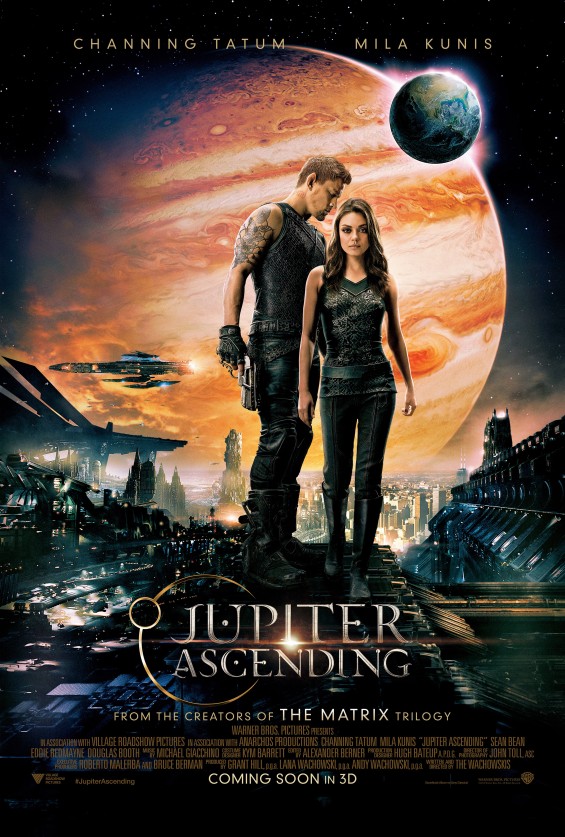
A sci-fi blockbuster from the writer-directors behind; Cloud AtlasV for Vendetta and The Matrix trilogy, Lana Wachowski and Lilly Wachowski, a.k.a. the Wachowskis. 2015’s Jupiter Ascending is a rarely exciting, often laughable science fiction flick that attempts to explore a number of interesting concepts yet frequently fails on almost every other front. Unquestionably the singular work of the Wachowskis, Jupiter Ascending exhibits many of the filmmakers’ worst tendencies, recounting a campy, overblown spectacle of a story that retains barely any of the visionary leadership that drove some of their earlier filmographies to be held in such high regard.

Plot Summary: Born under a night sky, with signs predicting she was destined for great things, Jupiter Jones dreams of the stars but awakens to the cold reality of a dead-end cleaning job in Chicago. But, when Caine Wise, a genetically engineered ex-military bounty hunter, arrives on Earth to track her down, Jupiter begins to realise what the universe has in store for her as she is marked next in line for a royal inheritance that could alter the balance of the cosmos…

Originally slated to release on July 25th, 2014, before the production slipped over six months to provide more time for the visual effect team to complete the elaborate effects. Jupiter Ascending possesses many attributes that commonly make for an entertaining sci-fi epic, with large-scale set pieces, thrilling action sequences and moments of world-building all appearing throughout its runtime. However, similar to The Matrix sequels, where the sheer scale of the storytelling seemed to overwhelm the Wachowskis, Jupiter Ascending frequently appears unfocused and carries little dramatic weight as it places all of its attention on exploring its vast universe, with the plot itself resembling planet-hopping stories like Dune and the Star Wars prequel trilogy, revolving around various factions grasping for power. It’s a serviceable story, to be sure, but it usually feels secondary to the world-building which, as previously mentioned, comes across as cluttered and forces countless characters to serve as exposition dumps for Jupiter, even if there are some interesting ideas at play, such as humans not originating from Earth and being sighted as cattle to species that consider themselves superior.

On a screenplay level, Jupiter Ascending is hardly revolutionary, depicting the protagonist, Jupiter Jones, as a young, seemingly insignificant woman who discovers she actually holds the key to extraordinary power. Yet, the screenplay rarely treats Jupiter as anything more than a damsel in distress, constantly needing to be protected by the fearless soldier turned bounty hunter, Caine Wise. As a result, the central duo of Mila Kunis and Channing Tatum deliver rather bland performances, occasionally wisecracking as they travel from location to location, continually in danger and continually underdeveloped, especially when they develop feelings for one another. In keeping with their surroundings, the supporting cast of Sean Bean, Eddie Redmayne, Douglas Booth and Tuppence Middleton turn in similarly lacklustre performances, with Redmayne’s performance as the antagonist, Balem Abrasax, being the true standout (unintentionally so), whispering some lines and shrieking others.

The visuals of Jupiter Ascending are one of the film’s best aspects, as the cinematography by John Toll captures the majesty of outer space in several creative ways, presenting the universe with much more colour and lavishness than many other sci-fi blockbusters. Speaking of other science fiction franchises, unlike Stark Trek or Battlestar Galactica, all of the spaceship designs throughout the film are pristine and elegant, almost comparable to floating cathedrals, as they maintain a golden colour scheme to play into the idea of the proprietors of said ships (and accompanying opulent costumes) belonging to a royal bloodline. Many of the interiors of the spaceships even appear inspired by European architecture, specifically Renaissance architecture, massively deviating from the grey, metallic interiors seen in most of the sci-fi genre. Sadly, however, it’s difficult to fully concentrate on the myriad of beautiful visuals due to the abysmal dialogue, which ranges from dull and overly expositional to unconsciously hilarious.

On another cynical note, the original score by Michael Giacchino is regrettably one of the composer’s weakest scores to date. Moving from thunderous, brassy statements to a deeply menacing voice choir that evokes memories of The Emperor’s Theme from Star Wars: Episode VI – Return of the Jedi, released in 1983, the soundtrack for Jupiter Ascending certainly fits within the science fiction genre, yet never feels distinguishable or greatly adds to the emotion/excitement playing out on-screen.

In terms of action, Jupiter Ascending makes the most of its few action sequences by having Caine Wise and the assorted adversaries he goes against cleverly utilise a selection of futuristic weapons and gadgets. In particular, one early sequence of Jupiter and Caine escaping an extraterrestrial attack squad in a chase above the twilight streets of Chicago is both eye-catching and exhilarating.

In summary, at its heart, Jupiter Ascending is a jumbled wish-fulfilment narrative whereby a despondent cleaner turns out to be the secret proprietor of Earth. And with so many heroes’ journey-type franchises existing nowadays, it is a bold stroke to make the ‘chosen one’ a respected monarch. But, on account of the sheer magnitude of the story and world-building, Jupiter Ascending quickly crumbles under its only weight, only being saved from total collapse by its impressive visual effects and stimulating action set pieces, subsequently failing to start what would have been yet another big-budget science fiction franchise. Rating: low 4/10.

jupiter_ascending-p914589

The Green Knight (2021) – Film Review

“One Year Hence…” – The Green Knight

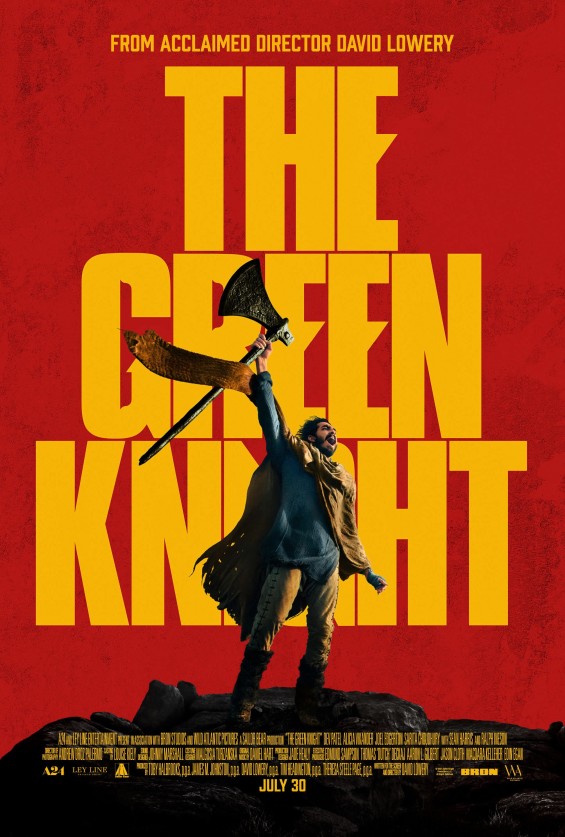
Written, produced, edited and directed by David Lowery (Pete’s DragonA Ghost StoryThe Old Man & the Gun), The Green Knight, released in 2021, is a visually stunning fantasy odyssey based on the 14th-century Middle English poem; Sir Gawain and the Green Knight by the Gawain Poet. Steered by a spectacular performance from Dev Patel, The Green Knight takes the timeless legends of King Arthur and the Knights of the Round Table and deconstructs many aspects of the famed fables, leaving a lot of its story open to interpretation while casting a captivating spell on its audience through a slow-paced, mature and stylistic fantasy adventure.

Plot Summary: On Christmas Day, before the noble King Arthur and his loyal Knights of the Round Table, the King’s headstrong nephew, Sir Gawain, agrees to a challenge from a formidable foe; in a year’s time, travel to the remote Green Chapel and face its ghastly lord, the Green Knight. But, as the one-year milestone arrives, Gawain embarks on his peril-laden journey with great apprehension, traversing the land in an effort to honour his promise and prove his mettle…

A large majority of The Green Knight‘s narrative revolves around the five traditional knightly virtues of friendship, generosity, chastity, courtesy and piety. Throughout the runtime, Gawain, when tested, fails at all five of these virtues through a variety of situations, demonstrating that Gawain is not yet ready to be a knight and adding to the subtext of his journey. Moreover, in order to make his vision of the Arthurian world appear more distinct, Lowery’s screenplay freely capitalises on folk elements derived from Welsh, Irish and English stories, as well as the French chivalric tradition of the Middle Ages to flesh out the world-building and Gawain’s mystical encounters that are only alluded to in the original verse.

Whilst the supporting cast of Alicia Vikander, Joel Edgerton, Sean Harris, Barry Keoghan and Erin Kellyman are all sublime in their various roles, Dev Patel truly knocks it out of the park performance-wise, portraying Sir Gawain as a troubled yet well-intending relative of the celebrated hero and monarch, King Arthur, evidently anxious about overcoming his personal flaws to find his honour and live up to the legacy left by his uncle and his faithful Knights, all in the hope of one day becoming the monarch himself. Patel is simply a magnet for the audience’s sympathy and the protagonist Gawain is a character anyone can get behind, with his journey of trials, temptations, trouble and self-discovery only adding to his subtle characterisation.

Primarily shot in Ireland, presumably to capture much of the island’s natural beauty. Practically all of the cinematography by Andrew Droz Palermo is visually astonishing, depicting a grounded and eerie fantasy world that makes fantastical concepts like spirits, giants and a talking fox seem almost ordinary. From soggy marshes to lonely mountain roads and extensive forests wrapped in mist, the camerawork never fails to visually grasp the looming dread that grips the land, mirroring Gawain’s fear of the Green Knight. The set design is also remarkably impressive, assuring the shadowy interiors of each structure are equally atmospheric. The only real downside concerning the visuals would be the CG effects, which often appear too glossy and clean when compared to the rest of the unkept visual aesthetic. Still, all of this is somewhat to be expected, as Lowery has always been a gifted visual storyteller, especially when it comes to colour usage, and The Green Knight is no exception, retaining a wildly diverse colour palette of earthly tones, making the film perhaps Lowery’s most sumptuous work to date.

Similarly, the original score by Daniel Hart manages to convey the setting, time period and action/emotion without performing the same tricks too many times over. Through tracks like Excalibur and Now I’m Ready, I’m Ready Now, the Pagan-like percussion and xylophone come and go, frequently followed by a whistle or pipe lead and rattling backing, making for an almost medieval-like dance rhythm. The score also utilises acoustic drums, bass strings, angelic vocals, bottles and harps. And it’s this unique combination of instruments that allows the soundtrack to expertly back up Gawain’s journey across numerous scenes, whether triumphant or fearful.

Given that the character’s name is the very title of the film, the Green Knight needed to leave an impact on the story and the audience. Luckily, he does just that. Sporting overgrown, corroded armour engraved with the Sabaic alphabet (Sabaic being a South Arabian language spoken from 1000 BC to 6th Century AD), the Green Knight has a tremendous on-screen presence, appearing ancient, imposing and authentic as a result of his flawless costuming and prosthetic make-up, the Green Knight’s towering appearance only being rivalled by his baritone voice, well-provided by actor, Ralph Ineson.

In summary, The Green Knight is a visually breathtaking fantasy flick, in addition to another exceptional release from production company; A24 Films, outside of its usual brand of horror and drama-centric films. Although its pacing is occasionally too slow for its own good, and many audience members will undoubtedly be turned off by its assortment of interpretive scenes and heavy emphasis on underlying themes, David Lowery employs almost every ounce of his imagination to craft an audacious and demanding Arthurian adaptation that warrants multiple viewings to increase its allure. Rating: low 8/10.

green_knight_ver8_xxlg

The Lighthouse (2019) – Film Review

“Why’d Ya Spill Yer Beans?” – Thomas Wake

A psychological horror only in the vaguest sense, 2019’s The Lighthouse is a strange yet wondrous cinematic venture, incomparable to many other modern releases due to its distinct visual aesthetic and often genre-defying narrative. Led by an outstanding pair of performances from Robert Pattinson and Willem Dafoe, The Lighthouse is the type of film that relentlessly sears itself into its audience’s memory, employing striking visuals, Lovecraftian influences and ominous, atmospheric sound design to craft an unnerving flick that closely resembles the fever-induced night terrors many actual lighthouse keepers endured during their lonesome, off-shore excursions tending to a beacon.

Plot Summary: Off the coast of late 19th-century New England, two lighthouse keepers, the taciturn former lumberjack, Ephraim Winslow, and the elderly lighthouse caretaker, Thomas Wake, set foot on a remote island to begin their monthly duties. But, as the tight-lipped men spend more and more time in each other’s company, a mutual resentment begins to arise as their collective sanity unravels…

Co-written and directed by Robert Eggers (The Witch, The Northman), the story of The Lighthouse is loosely based on a real-life affair that occurred in 1801 known as the Smalls Lighthouse Tragedy, during which two Welsh lighthouse keepers, sharing the name Thomas, became trapped at their station during a storm. When one of the men died, it is said to have driven the other insane. The story also takes some influence from the seafaring literature of renowned authors, including Herman Melville, Robert Louis Stevenson and H.P. Lovecraft, all of which lends the film a sense of historical accuracy and unseen oceanic horror. According to Eggers, earlier versions of the screenplay were more coherent, however, this was later changed as Eggers’ felt the best way to approach the film was to make the audience feel like they were losing their minds alongside the characters. As a result, The Lighthouse can occasionally be quite difficult to follow, yet this ultimately works in the narrative’s favour as the audience, much like the characters, struggle to tell reality from delusion. Even the very concept of time gets thrown out the window by the end of the second act, as it becomes almost impossible to tell how much time has passed between certain scenes, forcing the characters (and the audience) to question exactly how long they have been on the secluded island.

As the only two cast members, Robert Pattinson and Willem Dafoe are superb throughout the runtime as fellow lighthouse keepers, Ephraim Winslow and Thomas Wake. Simultaneously appearing layered and accurate to the time period, both characters flourish on-screen thanks to Pattinson and Dafoe’s electric performances, which are only enhanced when combined with the continuously compelling dialogue. This period-accurate dialogue bleeds through every scene, with the screenplay’s emphasis on 19th-century terminology and expressions instantly transporting the audience to the time and setting of the story, enriching Ephraim and Thomas’ persistent back-and-forths as they become increasingly infuriated at their situation. What makes the characters even more interesting is that neither one can be sighted as a reliable point-of-view, no matter how much they claim the other to be untrustworthy or deranged under their boozy breath.

Shot on Double-X stock, which requires much more light to get exposure. So much so, that the crew had to use about fifteen to twenty times more lights on set when filming at night or indoors to successfully capture footage. The cinematography by Jarin Blaschke is imposing and hypnotic, exhaustively utilising the isolated location of the treeless, storm-susceptible island along with its adjoining greyscale colour palette to create an array of hauntingly beautiful shots. Many of the visuals almost seem like depictions of a sailor’s nightmare, with the dense black-and-white grain of 35mm capturing every shadow and contour, lending the visuals a sensation of 19th-century expressionist horror, where even the tight aspect ratio proves to be claustrophobic. Furthermore, The Lighthouse employs several exceptional practical effects to depict the story’s more fantastical elements, such as its visual references to Greek mythology and seafarer folklore, like mermaids, sirens and the mighty Kraken.

Moving onto the original score, composer Mark Korven adds to the film’s foreboding atmosphere through doomy tracks, like ArrivalCurse Your Name and Stranded. However, much of the unsettling atmosphere could also be attributed to the immersive sound design, central to which is a bellowing foghorn, which sound designer, Damian Volpe, turned to J.J. Jamieson to create; a craftsman in Shetland, Scotland, who makes YouTube tutorials on operating and maintaining foghorns. Using Jamieson’s samples, Volpe manipulated the sound to create a period-accurate foghorn that was suitably startling and memorable.

Another favourable aspect of The Lighthouse is its authenticity, not merely in relation to its time period, but in regard to its restraint to filming on-location, which allows the film to retain a consistent level of practicality throughout, similar to its sense of dread, both of which are only broken up by the handful of well-timed, darkly comedic moments.

In summary, disorientation is clearly the primary intent of The Lighthouse as Eggers offers hints towards a grander narrative, but never fully commits to a sweeping, readable story, even avoiding an easily discernible conclusion. As such, instead of being a straightforward psychological horror or a disturbing historic folk tale, The Lighthouse is more of a surreal exploration of masculinity, guilt and seclusion, in addition to standing as another impressive showcase of Robert Eggers’ screenwriting and filmmaking abilities. Rating: 9/10.

lighthouse_ver2_xxlg

Thirteen Lives (2022) – Film Review

“We Do Nothing, We’ll Be Bringing Them Out Dead for Sure. But, if They Die While We’re Bringing Them Out, at Least We Will Have Tried.” – Rick Stanton

Suspenseful, meticulous and gripping, Thirteen Lives is a diverting, claustrophobic drama/thriller and a hidden gem of the straight-to-streaming releases of 2022. Offering an incomplete yet engrossing dramatisation of an incredible true-to-life tale, Thirteen Lives succeeds in recounting the real story of a global effort to rescue a Thai soccer team who became entrapped in a flooding cave system in 2018. And while some aspects of the film appear rather drab, thanks to director Ron Howard (Apollo 13A Beautiful MindSolo: A Star Wars Story) and his somewhat ‘vanilla’ manner of filmmaking, it’s an immersive and engaging recount, nonetheless.

Plot Summary: Faced with insurmountable odds, a team of the world’s most proficient divers navigate a treacherous maze of flooded, narrow cave tunnels in an attempt to rescue a Thai soccer team of twelve children and their coach after they become trapped in the Tham Luang cave in Thailand following an unexpected rainstorm…

Even though the real story behind Thirteen Lives has been recounted before, most notably in the National Geographic documentary, The Rescue, released in 2021. Thirteen Lives is a similarly fact-based account that holds true to what really occurred, rarely playing with the details to manipulate the audience’s emotions or adhere to a more conventional story structure. The film even retains the involvement of numerous countries in the almost three-week-long rescue as, in reality, multiple nations took part alongside Thailand, such as Australia, Denmark, Japan, China, Laos, Myanmar (Burma), Great Britain and the United States. In fact, around ten thousand people contributed to the rescue effort, including more than one hundred divers, nine hundred police officers, two thousand soldiers and numerous volunteers.

Viggo Mortensen, Colin Farrell, Joel Edgerton, Tom Bateman and Paul Gleeson portray written interpretations of the actual heroes who ventured into Tham Luang cave, portraying them as modest and down-to-Earth and never representing them as hero-like archetypes, despite their unquestionably brave actions. Unfortunately, however, the screenplay doesn’t do so well at detailing who the individuals are outside of their adept diving skills, which is inexcusable given the film’s rather excessive runtime. The only specific trait any of the divers exhibit is their distinctly British obsession with Custard Creams, which I’m assuming was written into the screenplay to make the divers seem more relatable.

Similar to the rest of Ron Howard’s filmography, the cinematography throughout the film is rather bland, as cinematographer Sayombhu Mukdeeprom largely falls back on hand-held close-ups and mid-shots. Yet, in spite of that, the film usually thrives visually due to its enveloping set design and dim lighting, which make the submerged cave tunnels appear tight, precarious and dingy. For many of these scenes, Mukdeeprom actually used the actors themselves as a lighting source, requesting them to lift their heads and look around after delivering a line to throw some light into the cave. This technique (and others) helped with lighting the sets, which were built in an enormous hangar-sized studio using double Olympic-size water tanks. The film also employs an array of on-screen schematics to visually inform the audience of what segment of the cave the children/divers are currently in, as well as text to notify the audience of how much time has passed between certain scenes on account of the film covering most of the three-week-long rescue.

Through tracks like Tham LuangRainDive and Oxygen, the original score by Benjamin Wallfisch predominantly defies musical norms as the filmmakers sought to avoid overly sentimental or manipulative pieces when it came to the soundtrack, concentrating instead on using the score as a tool of abstraction and disorientation. Interestingly, Ron Howard initially sought to work with his collaborator of many years, Hans Zimmer, who subsequently recommended Wallfisch for the project as he was preoccupied. Together Howard and Wallfisch hashed through strategic approaches to the score over several months, seeking ways to incorporate Thai influences and experimental electronic suspense techniques. All to the score’s benefit, I might add. With that said, a few scenes do suffer due to the original score’s presence, where I feel atmospheric sound design would’ve been far more effective.

In regard to realism, professional diver, Rick Stanton, praised the film’s accuracy, stating that one of the only cinematic changes was that the cave water was muddy. In reality, the divers had zero visibility, but “That Would Be Impossible to Demonstrate Because Then the Viewers Would Not See Anything.” Furthermore, the young actors portraying the trapped Thai soccer team were all cast from Northern Thailand, so if they wound up improvising any dialogue the unique dialect and accent would be authentic. This emphasis on accuracy is always something I admire when it comes to adapting true stories, and Thirteen Lives is no exception.

In summary, Thirteen Lives is a predominantly compelling drama/thriller with its own unique selection of minor flaws. While the first half of the film feels like it’s simply treading water, waiting for its tense final act. The second half is a riveting depiction of a daring, foolhardy rescue, capturing much of the same fear, confusion and determination the actual divers must have felt during those fateful few weeks in 2018. As such, even if you already know how the story ends, Thirteen Lives largely prevails in plunging its audience into a submerged rescue scenario. Rating: 7/10.

thirteen_lives-p1174327