A Quiet Place (2018) – Film Review

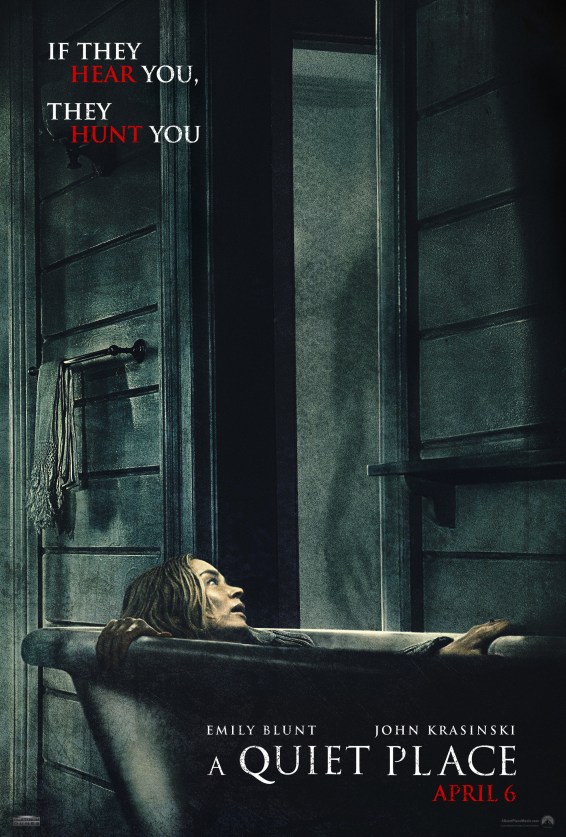
John Krasinski’s directorial debut quickly puts him as one of the most intriguing upcoming directors currently working, as he directs himself, his real-life wife Emily Blunt and two very talented child actors, in this incredibly tense and original horror flick. Taking on a unique story that’s sure to spark an interest in any horror/thriller fan by its concept alone, and yet ‘A Quiet Place’ also manages to elevate itself over many other films within the horror genre through its attractive visuals and great sound design.

Plot Summary: In a post-apocalyptic world where noises can kill, a family of four must navigate their lives in silence after terrifying creatures that hunt by sound threaten their very survival. But, with a pregnant wife soon to give birth, now more than ever, the family must remain unheard…

Continuously throughout the runtime, ‘A Quiet Place’ builds on the concept of its story perfectly, focusing on the various ways the family has adjusted to their new way of silent life as everything from the family not using cutlery anymore, to the children using pieces of cotton pieces rather than wooden pieces for a board game, to even having the father place down paths of sand everywhere the family walks, all displaying the clear understanding John Krasinski has for this fleshed out world. Of course, with an idea such as this one, many of the film’s scenes can be nitpicked in small ways, but with a plot as unique and as engaging as this one is, I personally don’t feel these tiny issues take much away from the general experience.

Emily Blunt and John Krasinski both give amazing performances as ‘Evelyn’ and ‘Lee Abbott,’ with Emily Blunt being the true stand out of the cast, mostly due to her intense performance during one of the film’s most memorable scenes. In which, ‘Evelyn’ attempts to stay quiet whilst going through the agonising pain of childbirth, all the while one of the creatures stalks the nearby area. The two children within the film are also brilliant, being portrayed by Millicent Simmonds and Noah Jupe. Millicent Simmonds’ character; ‘Regan,’ is deaf, similar to the actress herself in real life, which actually benefited the rest of the cast enormously with helping them learn sign language as there is actually very little dialogue spoken throughout the film, due to the family’s restriction on making noise, so sign language is their main form of communication.

Charlotte Bruus Christensen handles the cinematography for ‘A Quiet Place,’ and does so extremely well, as the gorgeous shots really compliment the beautiful yet eerie and isolated locations of this new post-apocalyptic world, with a majority of shots containing large amounts of movement alongside the bleak yet still appealing colour palette of the film, which surprisingly allows more colour than many other modern horrors that rely mostly on dark greys and blacks.

Throughout the narrative, the film’s tense atmosphere never dies off, as Krasinski uses the fantastically unsettling original score by Marco Beltrami as well as the effective sound design/sound editing to their best extent, resulting in a compelling watch for any audience member, as the film almost feels as if it’s placing its audience in the position of the protagonists, dreading even the slightest sound. However, as great as the tension building is, the film does have quite a heavy reliance on jump-scares, similar to most modern horrors today, which does sadly drag down the film with how frequent they soon become.

Despite not having an enormous amount of screen-time, the creatures within ‘A Quiet Place’ are also quite memorable, as from even their first appearance, the film’s monsters are always both incredibly menacing and enthralling. This is not only due to the tense atmosphere they create whenever on-screen, however, but also due to their otherworldly design, which actually shares many similarities to the inside of a human ear, which is obviously very suitable for creatures that hunt only by sound. Interestingly, Krasinski actually portrayed some of the creatures himself whilst on set through motion capture, if only for a few scenes.

In summary, ‘A Quiet Place’ is surely one of my favourite films of 2018, as the film manages to take its audience through a tense yet still emotional story of parents attempting to protect their children in a newly dangerous world, all whilst featuring some visually pleasing cinematography and scenes brimming with tension whenever it can. The film even manages to contain a decent character arc for a few of the family members, propelling the film even further forward over you’re standard horror flick, and although there is a bit of an overreliance on jump-scares, as well as the odd narrative nitpick that stops the film from being flawless, ‘A Quiet Place’ is still an excellent choice for anyone looking for a gateway into this genre. Final Rating: 8/10.
quiet_place_xxlg

What’s Wrong With Modern Horror? – Film Discussion

What’s wrong with the majority of modern horror films?

In my opinion, there are many different issues that modern horrors/thrillers suffer from nowadays, although there are a few films that manage to avoid these problems, such as ‘It Follows,’ ‘The Descent,’ ‘A Quiet Place,’ ‘Don’t Breathe’ and ‘The Void,’ to name a few. The majority of modern horrors follow a very similar formula, a group of stereotypical teenagers do something they shouldn’t, e.g. find a certain object (an Ouija board, a cursed book or a dead friend/relative’s photo), or a loving family moves into their new home only for it to be haunted by ghosts/demons. These two plot lines are the go-to for most of the new horror releases, despite being unbelievably drawn out by this point.

Similar to how nearly every horror plot of the 1980s involved a group of teenagers visiting a cabin deep in the woods only to get slaughtered one by one at the hands of a psychotic serial killer. Sticking to stories that we have become so familiar with means that there is little surprise left for the audience, and the narrative soon becomes very predictable. Another issue with the majority of the stories that are told is the weak characters, nearly every modern horror has such bland characters it’s difficult to get invested in the story at all. Just because these characters may be killed off doesn’t mean you don’t have to write for them, having some likeable or interesting characters actually makes the audience care whether they live or die, therefore increasing the film’s tension. Of course, hiring unknown actors who aren’t the most amazing at their craft also doesn’t help this issue.

Another thing that’s always bothered me in regards to the characters in most modern horrors, is the character’s extreme stupidity. The film actually falls less out of reality due to the characters being so unbelievably oblivious to everything around them. It’s understandable the characters would have some doubts the first time one of their friends dies. But, after two or three, it’s ridiculous the characters still haven’t figured out what the audience has half an hour ago, even if they’re curious but not concerned, it’s nothing but frustrating and less believable. This unbelievability also applies to the attractiveness of the cast, as although I think a film featuring a few attractive cast members is perfectly fine, casting nothing but models pulls the audience out of the narrative. A film particularly guilty of both of these things is the Blumhouse supernatural flick; ‘Truth or Dare.’ As this film is a perfect example of the problems I have with most modern horrors, both in regard to their characters, actors and screenplays.

It isn’t just the screenplay or actors that are an issue when it comes to modern horror, however, as the overall filmmaking of the picture is usually extremely bland. Again, due to the genre, some people may believe that filmmaking isn’t important. This isn’t true. The filmmaking can still be impressive while building tension and fear. ‘It Follows’ is a great example of this, the beautiful lighting, cinematography and original score all give the film style without taking anything away from the eerie atmosphere. Horror soundtracks are a huge issue for me when it comes to most films, as it is possible to create a great memorable score without making it just sound eerie, e.g. ‘Halloween’ or ‘The Shining.’

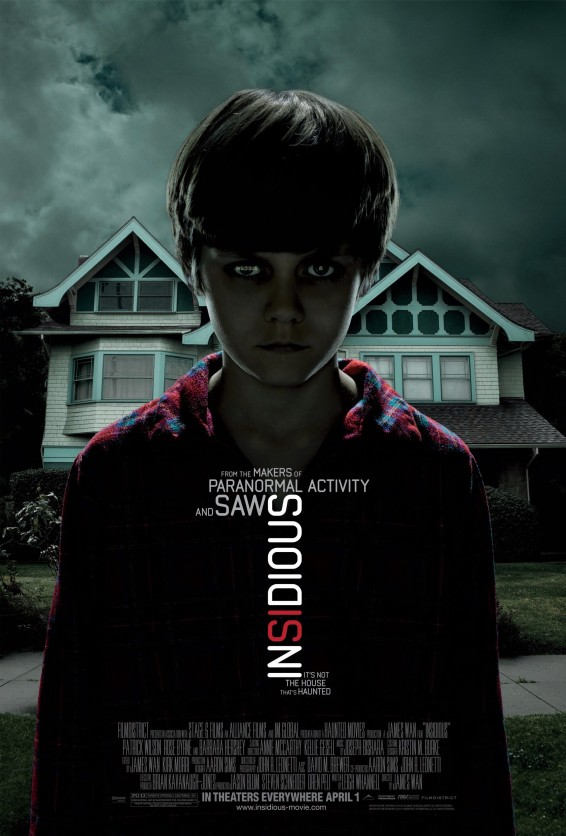
Finally, we get to the biggest problem with modern horror, the classic; jump-scare. Jump-scares only really came around in the early 2000s, but since then they have completely invaded the film industry. Not only appearing in horror but everything from action to sci-fi to even superhero films, they’ve now become almost a staple of modern filmmaking. I don’t believe they are an entirely awful idea, they can be used correctly every so often to shock the audience and give them a quick rush before the next scene. However, most modern horrors now essentially rely on jump-scares (most James Wan films are particularly guilty of this, in my opinion) and I believe this is incredibly lazy. Horror should be about creating an eerie atmosphere, having creepy visuals and giving the audience some likeable characters to fear for, essentially placing the audience in that situation themselves. ‘Pyewacket’ from 2016 is a terrific example of this, drawing out shots and using dim lighting/shadows and silhouettes, can all help build fear in the audience, rather than just throwing ‘frightening’ faces at the screen alongside loud noises to see what sticks.

The primary reason all these bad decisions are made when it comes to the horror/thriller genre is mostly due to money, no matter how awful the majority of these horrors are, the reality is that they make money as these films can be made on modest budgets as they utilise mostly unknown actors and very little CGI or make-up effects, with a target audience consisting of teenagers or horror fanatics who will pay to see the film, no matter how terrible the trailers may look. For example, the first ‘Paranormal Activity’ had a budget of only £11,800 and grossed over £151 million. The film only has an hour and twenty-minute runtime, along with very few ‘ghosts’ even being displayed on-screen. ‘The Bye Bye Man’ also being another example, harbouring a tiny budget of £6 million, with a total gross of £21 million, despite awful reviews from both critics and audiences.

In summary, modern horror films are suffering due to both a lack of creativity and a heavy focus on profit. I’m, of course, aware that film is a business, but, in my opinion, creativity is the most important aspect, as without creativity film doesn’t exist. Horror is a fantastic genre that isn’t reaching its full potential a majority of the time due to production companies/directors not caring. There’s a reason a lot of indie horrors are praised, as they don’t set out to only make money, many of them are extremely creative and make amazing use of their micro-budgets. Although horror also wasn’t perfect in the past, I definitely preferred it. At least back in the ’80s/’90s we still had some creative concepts, from killers invading their victim’s dreams to murderous children’s dolls to even a hand-held documentary on teenagers finding an ancient evil witch in a forest. The possibilities were (and still are) truly endless. Hopefully soon, filmmakers and producers alike will look past the profit and truly see this.

insidious_xxlg