Winchester (2018) – Film Review

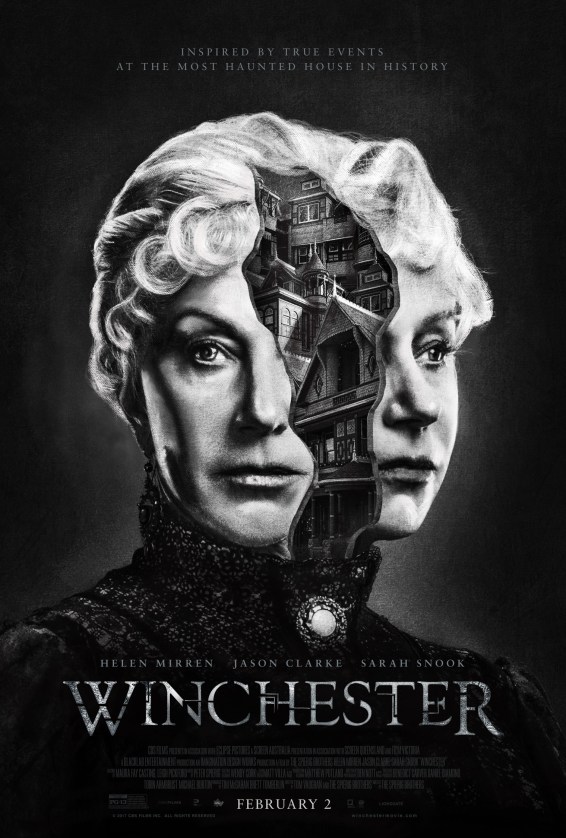
Although slightly better than some other modern horrors, ‘Winchester’ is nothing incredibly memorable. Despite the film’s story being based on true events and having some decent performances throughout, the film still suffers from mostly a bland atmosphere and enormous overreliance on jump-scares, resulting in a mostly boring experience.

Plot Summary: In 1906, ‘Sarah Winchester’ the firearm heiress mourning the loss of her family. Begins to believe she is being haunted by the souls of people killed by the ‘Winchester’ repeating rifle. So, ‘Dr. Eric Price’ is sent by order of her company to her ever-growing home in California in order to inspect her sanity, discovering for himself the disturbing history of ‘Sarah’s home…

A story like this isn’t anything new for sure, we’ve all heard the ‘based on a true story’ or ‘haunted by my past’ storyline a thousand times before. However, they were a few elements of this story I did enjoy, the main two protagonists of the film, that being ‘Dr. Eric Price’ portrayed by Jason Clark and ‘Sarah Winchester’ portrayed by Helen Mirren, are both given some depth. The same cannot be said for the side characters of ‘Marion Marriott’ and ‘Henry Marriott,’ however, as these characters are given no characterisation barley and do so little within the narrative I was constantly questioning their inclusion.

The film overall has an extremely bland look, as the dim grey colour palette alongside the mostly still and uninventive cinematography by Ben Nott make the film very dull visually. The original score by Peter Spierig also doesn’t benefit the film much as the soundtrack is you usual horror score with nothing really interesting about it, other than the occasional moment when it becomes uncomfortably loud. There is the occasional pleasing shot or interesting idea here, but it’s definitely few and far between.

Despite the location and the time-period of the film actually being some of the main draws towards it (considering most horrors are usually set in modern-day) and with the ‘Winchester Mansion’ being a real haunted attraction in America. I was very disappointed to find the location barley utilised, as aside from one short scene in the film where ‘Eric’ explores a dark hallway, what we see of the mansion is mostly confined to a few different rooms throughout the runtime.

The film also (as usual) has a heavy reliance on jump-scares, which means the film barely even makes an attempt to build tension. The film seems more in favour of fading out all of the audio before leading into a loud screeching sound while a ‘terrifying’ face appears on-screen. This is an issue with many modern horrors in all fairness, and feels like nothing other than laziness on the part of the filmmakers.

In summary, ‘Winchester’ is certainly not one of the worst horrors I’ve ever seen. However, it is a big waste of potential, as I feel a story set within the walls of the ‘Winchester Mansion’ could have been really interesting if the film would’ve gotten inventive with the iconic location they had at their disposal. But, as is, the weak characters, bland visuals and dull atmosphere add-up to a very forgettable modern horror. Final Rating: 3/10.

winchester_the_house_that_ghosts_built_ver5_xxlg

Don’t Breathe (2016) – Film Review

Truly a visual treat when it comes to the film’s lighting and attractive colour palette, ‘Don’t Breathe’ is the second big-screen outing for director Fede Alvarez after he took on the extremely gory ‘Evil Dead’ remake a few years prior. Through its original story, incredibly tense atmosphere, brilliant cast as well as iconic horror director Sam Raimi on board as a producer, ‘Don’t Breathe’ manages to constantly remain both entertaining and thrilling in spite of nearly all its runtime taking place within a single location.

Plot Summary: When a trio of thieves break into an elderly blind man’s home in an attempt to steal the loan given to him as a settlement for his daughter’s death. They soon begin to realise that the old man isn’t as helpless as first seems, leaving the group to find a way out before it’s too late…

This simple yet unique plot is truly ripe for creating tense moments, as the film utilises its main location of the ‘Blind Man’s house to the best of its advantage. Having the trio of characters make their way through the house’s tight corridors and dark rooms with plenty of extremely close encounters with the blind old man. Even having to hold their breath at points so he can’t hear them breathe (as the title of the film implies). Alongside this, ‘The Blind Man’ also has a pet Rottweiler, which lends itself to creating even more intense scenes as the characters get pursed by the vicious canine. Who was actually portrayed by three different dog actors, named; Athos, Astor, and Nomad, respectively.

Stephen Lang, best known for his role as ‘Colonel Miles Quaritch’ in 2009’s ‘Avatar,’ portrays the film’s antagonist only ever known as ‘The Blind Man,’ and does a phenomenal job of it. Giving the audience an almost sympathetic view of the character through his innocent performance early on before then quickly becoming far more unhinged and incredibly intimidating every-time he is on-screen. The rest of the cast of Jane Levy, Dylan Minnette and Daniel Zovatto also give remarkable performances as the young group of thieves, despite their characters only receiving a small amount of characterisation near the beginning of the film.

The cinematography by Pedro Luque is surprisingly inventive throughout, as in addition to the film’s array of visually-pleasing shots. ‘Don’t Breathe’ actually uses its cinematography to allude to moments that come later within the narrative. In particular, in the scene where the trio first break into ‘The Blind Man’s house, as the camera glides through the various different rooms focusing on key objects or areas for reasons that are revealed later down the line. However, the real visual flair of the film is definitely the stunning lighting and colour palette as already mentioned, from dirty blues and greens to overly bright oranges. Each location (whether inside or out) is always given its own distinct appeal, sometimes even replicating what the audience should be feeling at that point, whether that is fear or relief.

Roque Baños, the same composer who previously worked with director Fede Alvarez on the ‘Evil Dead’ remake, returns to work alongside him once again. This time around crafting an original score which is both eerie and memorable, as the score uses metallic bangs and crashes to fit with the story’s location, giving the soundtrack a real personality similar to the film itself. ‘Don’t Breathe’ also uses its score very effectively, only placing it within more fast-paced moments after the tension has already risen, rather than overusing the original score in scenes where silence is mostly required.

When it comes to its runtime, ‘Don’t Breathe’ is actually quite short, as due to the film wanting to keep its viewer on edge throughout nearly the entirety of its narrative, ‘Don’t Breathe’ is cautious not to overstay its welcome, an issue that many horror flicks have suffered from as many horrors in the past have overplayed their concepts, eventually making them far less frightening/interesting by the time the credits roll. That being said, I couldn’t help but feel a few more scenes with our protagonists wouldn’t have gone amiss, as there were actually a number of more character-focused scenes shot for the film before inevitably being cut.

In summary, I deeply enjoy ‘Don’t Breathe,’ as this horror/thriller is, in my opinion, a genuine pleasure to watch every time. As, aside from desiring a little more characterisation for the protagonists, I have very few issues with this one, as Stephen Lang’s sensational performance, in addition to the film’s great visuals and large number of tension-filled moments, leave ‘Don’t Breathe’ one of the most memorable lower-budget horrors made in quite some time, and I personally am really looking forward to seeing what other stories director Fede Alvarez has up his sleeve, horror or not. Final Rating: high 8/10.

dont_breathe_ver4_xlg

The Shape of Water (2017) – Film Review

Without question one of my favourite films from director Guillermo del Toro (Hellboy, Pacific Rim, Crimson Peak), ‘The Shape of Water’ is for sure not a film that everyone will enjoy, but for those who do, this strange story of a woman falling in love with an otherworldly fish creature inspired by the horror classic; ‘Creature from the Black Lagoon,’ will truly push visuals and storytelling to their limits. Combining some outstanding cinematography with stunning make-up effects and plenty of absorbing performances from Sally Hawkins, Doug Jones and Michael Shannon, all equalling to one truly incredible cinematic experience.

Plot Summary: In the midst of the 1960s, inside a high-security government facility, lonely cleaner, ‘Elisa,’ is trapped in a life of silence and isolation, stuck in a familiar and mundane routine. But, when the facility she works within captures a mysterious fish creature in order to study its unique physiology, ‘Elisa’s life changes forever as she becomes more and more attached to the creature…

‘The Shape of Water’ is undoubtedly a Guillermo del Toro film through and through, as with another director at the helm, I could definitely see this film not working, as the completely bazaar plot is no doubt an instant turn-off for some viewers. But, del Toro truly brings his ‘A’ game here, bringing every inch of his creativity and passion to the film. And, as such, the film is an absolute pleasure to watch from beginning-to-end, which is even more impressive considering both of the film’s protagonists, a.k.a. ‘Elisa’ and ‘The Amphibian Man,’ are completely mute for the entirety of the runtime. In fact, one of Octavia Spencer’s favourite things about the film was that by the main couple being mute, most of the dialogue comes from a black woman and a closeted gay man, who would’ve both experienced real oppression during the 1960s setting of the film.

Despite actor Doug Jones being in heavy make-up prosthetics to portray ‘The Amphibian Man’ for all his screen-time, he actually is able to invoke a variety of emotions, and shares plenty of chemistry with his co-star Sally Hawkins as ‘Elisa,’ with the supporting cast of Michael Shannon, Richard Jenkins, Octavia Spencer and Lauren Lee Smith also being surprisingly excellent given their character’s limited time on-screen. As well as the marvellous cast, the writing throughout the film is also fantastic, as del Toro writes the screenplay almost like poetry. Forming a romantic bond between the two main protagonists as the film progresses, all the while integrating plenty of social commentary on the time-period, backing-up the film’s main theme of what makes us different, whether that be because we are deaf, blind or possibly, not even human, which I personally found very compelling.

The phenomenal cinematography by Dan Laustsen elevates ‘The Shape of Water’ drastically, which contains an unbelievable amount of beautiful shots throughout the narrative, with the film’s dark blue/green colour palette only helping to add to the film’s visuals. Furthermore, many shots within the film play into aspects of various characters, most notably, ‘Elisa’s isolated life, displaying the facility where she works as a cold, dirty and segregating place.

Additionally, ‘The Shape of Water’ adds another remarkable score to composer Alexandre Desplat’s already-overflowing catalogue of work, as this unusually-beautiful romantic score with an almost French-esque feel, is very impactful in many moments throughout the film. Particularly with the opening scene however, as the opening shot glides slowly through a flooded room set to the my personal favourite track of the film; ‘The Shape of Water,’ preparing the viewer for the strange story that lies ahead. Desplat also provided recordings of his own whistling to be featured in the soundtrack, as del Toro wanted the score to feature whistling so it could contrast with the film’s many scenes that feature water.

One of my personal favourite elements of the film is definitely the make-up and prosthetics, as every second of screen-time we get with ‘The Amphibian Man’ the make-up effects look completely flawless, with many aspects of the strange and original design being inspired by real animals. Which is nothing new to this director however, as del Toro has always been known for creating incredible creatures of dark fantasy, such as in ‘Pan’s Labyrinth’ and the ‘Hellboy’ series. Although used less than what many may initially think, the CGI throughout the film is also very effective, amplifying many of the small effects around the creature rather than distracting from (or overpowering) them.

In summary, I honestly believe ‘The Shape of Water’ may be one of my all-time favourite films, and certainly one of favourite films of 2017, as the relationship between the two protagonists and the journey their relationship represents is truly memorising from start-to-finish. Backed-up by some amazing cinematography, a great original score as well as the make-up and CG effects, whilst perhaps not a film for every cinephile, it is an extremely well-made film regardless, and one that I would surely recommend. Final Rating: 9/10.

shape_of_water_ver3_xxlg