Jumanji: Welcome to the Jungle (2017) – Film Review

“A Game for Those Who Seek to Find… a Way to Leave Their World Behind…” – Spencer

Seeking to modernise the premise of the 1995 fantasy-adventure classic; Jumanji, a striking premise first presented in the children’s picture book of the same name, written and illustrated by Chris Van Allsburg. 2017’s Jumanji: Welcome to the Jungle switches the concept of an enchanted, four-piece board game for a ’90s-style video game cartridge, rooting itself in well-known video game tropes. And while not quite as enjoyable as the original flick, in my opinion, Jumanji: Welcome to the Jungle is still an entertaining yet undemanding soft reboot that manages to stand on its own two feet as a jungle-set adventure, utilising its charming cast and humorous moments effectively under the capable direction of Jake Kasdan (Zero EffectOrange CountrySex Tape).

Plot Summary: After Jumanji, the bewitched jungle-themed board game, receives a mysterious modification, converting the wooden parlour game into a 1990s video game cartridge, the game is stumbled upon by high school students; Spencer, Martha, Fridge and Bethany, who are promptly pulled into its perilous world. Now, in order to return home, the group must inhabit their chosen avatars, survive the cadaverous creatures and complete the game…

Despite the original Jumanji receiving fairly mixed-to-positive reviews both when it was initially released and in the years since, recounting the simple yet captivating story of Alan Parrish, a troubled boy who comes across a cursed board game that releases lions, elephants, giant spiders and carnivorous plants into the real world to pursue its unsuspecting players. Jumanji: Welcome to the Jungle remains in the same continuity, continuing on from Alan, Sarah, Judy and Peter’s adventure by having a separate group of characters unwillingly play the game. To keep the franchise feeling fresh, however, Jumanji: Welcome to the Jungle cleverly inverts the premise of the original, transporting the characters (and, by extension, the audience) into the treacherous world of Jumanji, where many references to the original flick can be seen, including a cluster of overgrown statues modelled after the iconic board game pieces and a handcrafted hut that Alan resided inside when he was trapped in Jumanji, serving as a sweet yet modest tribute to the late Robin Williams, who portrayed the older iteration of the character.

This time around, the protagonists consist of four high schoolers serving detention together before they are transported into Jumanji following their discovery of the video game’s cartridge in their school’s storage room. Spencer, a skinny, awkward gamer becomes Dr. Smolder Braveston, portrayed by Dwayne “The Rock” Johnson, the introverted, Martha, becomes Ruby Roundhouse, portrayed by Karen Gillan, the tall and muscular jock, Fridge, becomes Franklin “Moose” Finbar, portrayed by Kevin Hart, and the would-be popular girl, Bethany, becomes Professor Shelly Oberon, portrayed by Jack Black. As can be expected with an all-star cast such as this, everyone possesses terrific chemistry with each other and embodies their real-world counterparts sufficiently whilst playing into the obvious humour in each of the teens altering into entirely different individuals, particularly in the case of Bethany, who transforms from an Instagram-obsessed teenage girl to an overweight, middle-aged cartography professor. Unfortunately, the film’s power-hungry antagonist, Van Pelt, doesn’t fare as well, lacking depth, fearfulness and presence in spite of Bobby Cannavale’s serviceable performance.

Taking advantage of the naturally beautiful scenery of Honolulu, Hawaii, specifically within the Kualoa Ranch nature reserve, Jumanji: Welcome to the Jungle makes exceptional use of its true-to-life locations and vibrant sets to immerse the audience in the precarious world of Jumanji, exhibiting the immense jungles, massive waterfalls and vast pastures that are only hinted towards in the original flick, even if the actual cinematography by Gyula Pados is somewhat flavourless.

Through tracks such as Brantford High and A Test of FriendshipJumanji: Welcome to the Jungle‘s original score by Henry Jackman constructs a clear contrast between Jumanji and the real world, as the formerly-mentioned tracks are contemporary and uplifting in nature, while tracks like Digging Up the PastThe Legend of the Jewel and The Power of Bravestone, are much more exhilarating and adventure-esque, going so far as to bring back the “Jumanji Drums,” a staple of the original Jumanji soundtrack.

When it comes to action sequences, Jumanji: Welcome To The Jungle isn’t likely to impress anyone, leaning more on the amusing moments between its cast than its scenes of hand-to-hand combat or hippopotamus ambushes. Nevertheless, most of the action throughout the runtime is passable, with one fight sequence featuring Dr. Braveston even playing into the video game truism of fighting off multiple enemies at once as the playable character. Additionally, although almost all of the CGI in the film is convincing, it’s regrettable that Jumanji: Welcome to the Jungle harbours very few practical effects, given how heavily praised the physical elements of renowned adventure flicks like The Goonies (1985) and the first three instalments of the Indiana Jones franchise are today.

In summary, whilst it’s doubtful that Jumanji: Welcome to the Jungle will be recognised for years to come as a groundbreaking 2010s blockbuster, it is a comical flick with defects, functioning as a superficial yet enjoyable soft reboot/stand-alone sequel that innovatively expands on the ideas introduced in the original Jumanji. In a bizarre way, Jumanji: Welcome to the Jungle almost feels like a self-actualisation teen flick set against the unusual backdrop of an adventurous video game due to its infrequent high school setting and marginal character growth. Rating: 6/10.

JMNJ_INTL_FNL_1SHT_LK4_04.indd

Winnie-the-Pooh: Blood and Honey (2023) – Film Review

“Pooh, You’ve Got to Help Me! Something’s Wrong With Piglet, He Killed My Wife!” – Christopher Robin

Shot in a mere ten days, Winnie-the-Pooh: Blood and Honey, released in 2023, is a British-American-produced micro-budget slasher that takes a more despicable approach to the beloved characters of Winnie-the-Pooh, Piglet and the other inhabitants of the Hundred Acre Wood, morphing the convivial critters into bloodthirsty, savage killers. Unsurprisingly, due to its laughable concept, terrible screenplay, amateurish filmmaking and general lack of any genuine horror or satire, Winnie-the-Pooh: Blood and Honey serves as nothing more than a bargain-basement slasher that fails to exhibit even a passing interest in the source material it’s adapting. As such, the film is only really notable for its title, simply existing as a bizarre, mismatched amalgamation of the horror genre and classic children’s literature.

Plot Summary: When Christopher Robin, now a young man, departs the Hundred Acre Wood to attend university, leaving Winnie-the-Pooh and his furred friends to fend for themselves, their days of merriment and adventure quickly come to an end as they become feral and enraged, soon acquiring a taste for flesh that steers them on a bloody rampage…

The creation of Winnie-the-Pooh: Blood and Honey became feasible at the start of 2022 after the 1926 children’s book; Winnie-the-Pooh by A. A. Milne, entered the public domain in the United States, voiding its copyright, and therefore Disney’s media exclusivity over the titular character. This meant that the filmmakers behind Winnie-the-Pooh: Blood and Honey were free to use characters like Pooh, Piglet and Eeyore, as long as they did not resemble their animated, Disney-owned counterparts, which were still actively protected by copyright. Nevertheless, I feel that most would agree that a malicious interpretation of Milne’s cuddly animal characters is undoubtedly a poorly-conceived concept from the get-go, with the film doing little to prove its critics wrong in this respect throughout the exceptionally brief runtime, even if it is commendable that this is the first live-action adaptation of Winnie-the-Pooh not produced by the Walt Disney Company, as well as the first adaptation geared towards mature audiences.

Regarding the film’s surplus of shortcomings, Winnie-the-Pooh: Blood and Honey‘s most significant issues lie within its screenplay, as the film crams several unwarranted scenes and overly dramatic subplots into a formulaic slasher framework, like having the underwritten protagonist Maria, portrayed by Maria Taylor, be suffering from serve PTSD, following a night where an anonymous sexual deviant broke into her home. These details add little to the narrative and generally come across as screen-time wasters. The rest of the characters, including Christopher Robin, Jessica, Alice, Zoe and Lara, portrayed by Nikolai Leon, Natasha Rose Mills, Amber Doig-Thorne, Danielle Ronald and Natasha Tosini, respectively, are all tremendously underdeveloped, delivering tedious exposition dumps that lead nowhere through performances that frequently present the cast as if they are uncomfortable in their various roles, underselling or overselling their reactions at every turn.

With the exception of the creative opening sequence, which sets the stage for this darker rendition of the honey-hungry yellow bear via pencil-doodled animation, Winnie-the-Pooh: Blood and Honey is a rather shoddy horror flick that lazily relies on its handful of admirable practical effects to avoid attempting anything visually or audibly impressive, as the cinematography by Vince Knight is relatively dull when it isn’t chaotically unstable during chase sequences, whilst the editing haphazardly slaps scenes together without any consideration for continuity or pacing. Furthermore, the film utilises plenty of editing trickery to get around its poor direction, namely, a ludicrous quantity of fade-to-black transitions and an assortment of abysmal CG blood effects.

One of the more mildly charming aspects of Winnie-the-Pooh: Blood and Honey, however, is its original score by Andrew Scott Bell, as tracks like In Which We Are Introduced to Winnie-the-PoohTogether Forever and Silly Old Bear, while generic, are, at least, of a relatively high-quality thanks to Bell’s innovative approach to the whimsical yet eerie score, employing a variety of instruments in the composition of the soundtrack, such as a “Beehiveolin,” a combination of a beehive and a violin.

Interestingly, writer-director Rhys Frake-Waterfield (The Area 51 IncidentThe Killing TreeFirenado) originally wanted Tigger to appear in the film, but the character ultimately didn’t on account of copyright. Some may say this was a favourable outcome, as Winnie-the-Pooh: Blood and Honey evidently doesn’t strive for faithful recreations of the cherished characters of the Hundred Acre Wood. Instead, the film opportunistically coasts on the novelty of placing the loveable critters in a macabre context, bringing the characters to live-action through rubbery, full-face masks that display no hair or visible mouths, allowing for minimal expressions, meaning Pooh and Piglet may as well be murderous individuals sporting animal-themed masks.

In summary, Winnie-the-Pooh: Blood and Honey is exactly what many anticipated it to be following the release of its viral trailer in mid-2022; an atrocious slasher, an appalling adaptation, and an all-around execrable piece of cinema. Still, that’s not to say that Winnie-the-Pooh: Blood and Honey was a commercial failure, as the film actually grossed over £4 million on a budget of around £79,000, despite its near-universally negative reviews. Consequently, this suggests that with many other children’s literary works soon making their way into the public domain, we will regrettably be receiving far more lousy, horror-centric renditions of long-established characters in the near future, with Winnie-the-Pooh: Blood and Honey 2Bambi: The Reckoning and Peter Pan’s Neverland Nightmare, being just some of the projects already announced. Rating: 2/10.

winniethepooh_blood_and_honey_xxlg

Spy Kids: All the Time in the World (2011) – Film Review

“No One Ever Notices Time, Until It’s Gone…” – Tick Tock

One of the rare releases to incorporate scents into the cinema experience, 2011’s Spy Kids: All the Time in the World is the fourth instalment of the Spy Kids franchise, the well-known family-oriented espionage series created, written and directed by Robert Rodriguez (El MariachiPlanet TerrorAlita: Battle Angel). Once again produced by Double R Productions (then-Troublemaker Studios), Spy Kids: All the Time in the World serves as somewhat of a soft reboot, attempting to appeal to a new generation of aspiring juvenile spies. Unlike the original Spy Kids trilogy, however, Spy Kids: All the Time in the World falls short in nearly every regard as the less-prevalent issues of previous franchise instalments are intensified, plaguing the film with a misbegotten screenplay, awful visual effects and a barrage of scatological humour that suggests the Spy Kids series has truly run its course.

Plot Summary: On the surface, Marissa Wilson is your typical suburban mother, caring for her newborn daughter and step-children, Rebecca and Cecil Wilson, whilst supporting their father, Wilbur Wilson, in his career as a spy-hunting television star. But, in reality, Marissa is a retired spy whose life is turned upside-down when the maniacal Timekeeper threatens to take over the world, thrusting her back into action. Meanwhile, after discovering that their stepmother was once a top agent of the O.S.S., Rebecca and Cecil put their bickering aside to assist her in thwarting the Timekeeper’s sinister scheme…

The conception of Spy Kids: All the Time in the World, unfortunately, did not arise from a place of creativity but, instead, was contractual. As, in truth, Rodriguez didn’t want to make another entry in the Spy Kids franchise, partially because he still blamed producer Harvey Weinstein for the failure of his collaboratively-directed 2007 project; Grindhouse. Nevertheless, Rodriguez contractually owed Weinstein one more film. Unsurprisingly, this lack of ambition for the project can be felt throughout the runtime, as the film largely boils down to an endless string of inferior visuals and potty jokes that sap the charm out of almost every scene. However, that is not to say that the film doesn’t carry any positives, as the film does feature a handful of minor, amusing gags and a few fragments of endearing fan service for those who grew up with the Spy Kids series, including appearances from Carmen and Juni Cortez.

In terms of the cast, Rowan Blanchard, Mason Cook, Jessica Alba, Joel McHale, Jeremy Piven and Ricky Gervais all deliver rather overblown performances, playing up many of their actions/movements to ‘add’ to the humour or aggressively pry for an emotional moment. Regrettably, the characters themselves don’t fare much better, as Marissa and Wilbur Wilson barely make it past their basic traits, while the latest generation of youthful agents, Rebecca and Cecil Wilson, are effectively just duplicates of Carmen and Juni with little individuality. Lastly, there is the mysterious miscreant, the Timekeeper, who, despite his shoddily-designed costume, receives more development than many would expect during the final act. Yet, this growth is somewhat spoilt by his associate, Tick Tock, who is immensely grating as he speaks in a high-pitched voice, uttering time puns to an outrageous extent, like “Time Flies When You’re Having Fun.”

Visually, Spy Kids: All the Time in the World occasionally demonstrates its knack for vibrant, imaginative production design with the facilities and weaponry of the Timekeeper, which seem inspired by the illustrious steampunk aesthetic and the innards of antique clocks. The remainder of the visuals, however, such as the cinematography by Jimmy Lindsey and Robert Rodriguez, are low-grade, with a substantial amount of the CG effects being of matching quality.

Similar to previous instalments in the franchise, the original score by Carl Thiel and Robert Rodriguez is playful and electric guitar-led, integrating the classic Spy Kids theme where it can through tracks like Carmen Cortez and Spy Kids 2.0. As such, the film’s soundscape remains colourful, even if it sometimes becomes too skewed and cartoonish for its own good.

Peculiarly, one of the aspects that Spy Kids: All the Time in the World marketed itself upon was being in “Aroma-Scope,” a gimmick that allowed the film to contain a “4D” in some iterations of its title. In 2011, when audiences watched the film in cinemas, they were provided scratch-and-sniff cards and prompted to scratch them throughout their screening. These cards featured circles numbered one to eight, and at various points, a number would appear in the corner of the screen, indicating it was time to scratch off the corresponding circle. When scratched, the intention was that the card would release a smell related to what was on-screen, like vomit or confectionaries, etc. Yet, whilst this was a fascinating idea, these cards rarely worked as they were made from a similar material to lottery tickets, ensuring little grit and thus no smell.

In summary, while Spy Kids: All the Time in the World falters as a family flick, the film falters even more as a Spy Kids soft reboot/stand-alone sequel. Retaining hardly any of the allure or creativity of earlier entries in the franchise, Spy Kids: All the Time in the World may, at the very least, entertain toddlers through its numerous scenes of vomiting, farting and nose-picking. But, any other audience member will likely sit in frustration, wishing for a well-crafted animated flick instead. Rating: low 3/10.

spy_kids_4_all_the_time_in_the_world-p547361

The Lost World: Jurassic Park (1997) – Film Review

“Oh, Yeah. Oooh, Ahhh, That’s How It Always Starts. Then Later There’s Running and Screaming…” – Dr. Ian Malcolm

Strangely dubbed; The Lost World: Jurassic Park, a title that appears to be out of order in its literary arrangement. This adventurous sequel to the timeless classic; Jurassic Park, released in 1993, was once among the most anticipated films of the 1990s. Yet, upon its initial release in 1997, The Lost World: Jurassic Park disappointed many for not living up to the lofty expectations set by the original, including Spielberg himself, who expressed disappointment with the film after becoming increasingly disenchanted with it during production. Nevertheless, I have always considered The Lost World: Jurassic Park somewhat underrated, harbouring an intriguing story and a more foreboding tone/aesthetic, which offsets some of its screenplay-centric faults.

Plot Summary: Four years after the catastrophe of Jurassic Park, the now-humbled John Hammond, strives to redeem himself by studying the well-being of the dinosaurs roaming free on InGen’s secondary site for bio-engineering, the secluded island of Isla Sorna. While assembling his team for this study, Hammond contacts the reluctant Dr. Ian Malcolm to convince him to join the expedition. Meanwhile, Hammond’s ignorant nephew, Peter Ludlow, intends to use his newly-obtained position as the CEO of InGen to capture as many of the island’s prehistoric species as possible for a new attraction opening in central San Diego…

Similar to the original film, The Lost World: Jurassic Park is loosely based on the novel of the same name by Michael Crichton and helmed by celebrated director Steven Spielberg. So, as is to be expected, under this masterful direction, The Lost World: Jurassic Park boasts several edge-of-your-seat moments, the stand outs of which are a scene that features a Tyrannosaurus Rex tandem bashing a mobile trailer over a cliff, as well as a sequence in which a Tyrannosaurus Rex rampages through San Diego destroying everything in its path, morphing the audience’s perception of dinosaurs from captivating, awe-inspiring creatures to truly terrifying prehistoric beasts, following the incident on Isla Nublar. However, as the runtime continues, it becomes increasingly evident that Spielberg desperately wanted to integrate as many of his own ideas into the framework of Crichton’s sequel novel as he could. A desire that ultimately results in the narrative becoming unfocused, eventually losing itself almost entirely near the end of the second act to concentrate on exciting dinosaur sequences.

Returning from the original film is Jeff Goldblum as Dr. Ian Malcolm, the remarkably entertaining pessimistic mathematician with a dry sense of humour. Accompanying Malcolm this time around is his adolescent daughter, Kelly Curtis, portrayed by Vanessa Lee Chester, and his palaeontologist girlfriend, Sarah Harding, portrayed by Julianne Moore, in addition to the other members of Hammond’s research team; wildlife photographer, Nick Van Owen, portrayed by Vince Vaughn, and tech expert, Eddie Carr, portrayed by Richard Schiff. Whilst every cast member turns in a solid performance, however, there is undoubtedly a lack of well-defined characters in The Lost World: Jurassic Park, as every character has a shortage of development beyond the dexterities they bring to their team. Roland Tembo, portrayed by the late Pete Postlethwaite, is perhaps the most compelling character of this particular entry in the series, being depicted as a jaded big-game hunter, determined to capture a male Tyrannosaurus Rex, single-handedly.

Swapping out the tidied facilities and tropical foliage of Jurassic Park for dim lighting, expansive forests and more intense violence, The Lost World: Jurassic Park‘s visuals are substantially darker than its predecessor, corresponding with the more downbeat tone of the narrative. Furthermore, the cinematography by Janusz Kaminski retains a tremendous sense of movement, while the film’s abundant use of marvellous CG effects, detailed miniatures and impressive life-sized animatronics effectively bring the dinosaurs (and a handful of locations) to life, all whilst demonstrating how far CGI had come since the first instalment in the franchise in ’93.

Once again composed by John Williams, the original score for The Lost World: Jurassic Park only contains minor hints towards the iconic theme and secondary motifs of Jurassic Park. Instead, the score houses much of its own appeal (not too dissimilar to how the visuals differ from the original film) as Williams constructs a different thematic and textural landscape for InGen’s Site B, a.k.a. Isla Sorna. As such, the soundtrack sheds much of the amazement and beauty of John Hammond’s prehistoric theme park for a more ominous soundscape. Excluding the film’s unfairly neglected theme; The Lost World, which is more wildlife adventure-inspired.

On a separate note, whilst its amusing to see franchise-staple dinosaurs like the Tyrannosaurus Rex and the Velociraptors return in The Lost World: Jurassic Park, I’ve always felt its a shame the filmmakers didn’t attempt to introduce a selection of lesser-known dinosaurs, especially with how many fantastic choices there are, as the carnivorous Alioramus, Majungasaurus and Spinosaurus (which would later appear in 2001’s Jurassic Park III), all would’ve served as significant threats and upped the ante for this much-anticipated sequel.

In summary, while it truthfully does pale in comparison to the original film, there is plenty to appreciate about The Lost World: Jurassic Park when viewed from a different perspective, as the film retains an overabundance of spectacle and exceptional visual effects, affirmed by the film’s Academy Award nomination for Best Visual Effects in 1998. Essentially, The Lost World: Jurassic Park is a perfect example of just how difficult it can be to craft an engaging sequel to a beloved cinema-altering blockbuster. Rating: 6/10.

the_lost_world_jurassic_park-p196804

The Place Beyond the Pines (2012) – Film Review

“If You Ride Like Lightning, You’re Going to Crash Like Thunder.” – Robin

Successively suspenseful and dramatic, The Place Beyond the Pines, released in 2012, is a thrilling crime-drama recounting a tale of fatherly sins visited by their descendants. Efficiently co-written and directed by Derek Cianfrance (Blue ValentineThe Light Between OceansSound of Metal), The Place Beyond the Pines utilises its decade-spanning story and outstanding performances from its extensive cast to construct a film that succeeds both as a high-stakes crime-thriller, and a far quieter, more empathetic character study of enraged, solitary men, ascertaining Cianfrance’s penchant for bold storytelling and eye for sighting the cast members to carry his stories through to their climax.

Plot Summary: When Luke, a high-wire motorcycle stuntman, passes through Schenectady, New York, as part of a travelling carnival, he reconnects with his former lover, Romina, discovering that, in his absence, she has given birth to their son, Jason. Determined to give his son the upbringing he never had, Luke renounces his life on the road to provide for his new family, taking an underpaid job as a car mechanic before committing a series of bank robberies aided by his exceptional motorcycle skills, eventually placing him on a collision course with the ambitious police officer, Avery Cross…

Unfolding over fifteen years, the actual narrative of The Place Beyond the Pines is undoubtedly one of the film’s finest aspects, disclosing an engaging and dreary tale, all within the confines of Schenectady and its surrounding woodland. The first two acts of the story, which almost feel like distinct ‘chapters,’ are consistently compelling and narratively unpredictable. Unfortunately, however, the strengths of the first two acts are diluted in the somewhat meandering third act, which is admittedly weaker than those that precede it, concluding the story with something of an anticlimax. Nevertheless, it is a uniquely structured plot, conforming to the notion of generational sins.

In the first act, the story revolves around the travails of Luke, portrayed by Ryan Gosling, a heavily-tattooed motorcycle stuntman living a freeing life on the road before he learns his former lover, Romina, portrayed by Eva Mendes, has given birth to their son. Given something to care about in his life, Luke decides to abandon his trivial lifestyle to become a suitable father figure, plunging into a dead-end job before taking a friend’s suggestion to rob banks. From here, Luke rides the line between logical and immoral, performing vile acts in the hope of earning money to fuel better ones, making for an instantly compelling character as Gosling suitably delivers a nuanced, moody performance riddled with pathos. Likewise, Avery Cross, excellently portrayed by Bradley Cooper, is a captivating protagonist in the second act. Serving as one of the police officers tasked with finding Luke, Avery is a well-educated officer keen to prove himself and move up the ranks of law enforcement. But, as his time in the force grows, Avery begins to see the deep level of corruption within his department, conveying underlying social commentary that is even more relevant today. Lastly, in the third act, the narrative switches focus to the sons of Luke and Avery, Jason and AJ, portrayed by Dane DeHaan and Emory Cohen, respectively, fifteen years after the previous acts. And despite DeHaan and Cohen delivering admirable performances as both characters inherit some of their father’s traits, this act and its protagonists are less gripping than the previous two, as previously mentioned.

When it comes to the visuals, the cinematography of The Place Beyond the Pines is largely dominated by hand-held shots. Fortunately, these shots are considerably less distracting (and motion sickness-inducing) than many other flicks where this style of camerawork is employed. However, Sean Bobbitt’s cinematography is undoubtedly at its most effective in one particularly exhilarating chase sequence, seemingly accomplished in one unbroken take as it’s shot entirely through the window screen of a police car pursuing Luke on his motorcycle.

In spite of the many moments of violence and tension, the original score by Mike Patton is unexpectedly soothing. Patton, who is most known as the lead singer of the alternative metal band, Faith No More, made his debut composing for film with the action sequel; Crank: High Voltage, in 2009, The Place Beyond the Pines being his third score, and easily his most impressive to date. A combination of electronic tones, electric and acoustic guitar accents and a sampled choir, the soundtrack retains many beautiful tracks, the most notable being; The Snow Angel, a lonesome piano-led motif that is only heard once during the runtime yet is exceptionally memorable, even appearing in one of the film’s trailers.

Intriguingly, Derek Cianfrance claims that his financier would only provide him with the budget he desired if he reduced the one hundred-and-fifty-eight-page screenplay to one hundred and ninety pages. Without removing anything, Cianfrance sneakily used a smaller font and extended the margins, which I’m thankful for as, in my opinion, virtually every scene throughout The Place Beyond the Pines is important.

In summary, in trying to convey such a monumental amount of story, The Place Beyond the Pines does sometimes spread itself too thin and leave some strands incomplete, but when the film is at its best, it is an enthralling and well-written piece of storytelling. And while its underlying themes are weighty, Derek Cianfrance’s strong direction and surprisingly effective use of hand-held camerawork result in a disquieting style that snappily underplays the drama and uncertainty. Rating: low 8/10.

place_beyond_the_pines_xxlg (1)

Men in Black: International (2019) – Film Review

“Always Remember: The Universe Has a Way of Leading You to Where You’re Supposed to Be at the Moment You’re Supposed to Be There.” – Agent High T

Emerging several years after the entertaining yet faulty; Men in Black 3Men in Black: International, released in 2019, serves as a soft reboot of the series, aiming to bring the undisclosed extraterrestrial defenders back for another similarly amusing, alien-blasting adventure. However, predominantly due to its outlandish story, trite humour and absurdly horrendous dialogue, Men in Black: International rarely reaches the heights of the 1997 sci-fi-comedy classic, nor the later, lesser entries in the well-known franchise, even with its noteworthy stars of Chris Hemsworth and Tessa Thompson carrying over much of their on-screen chemistry from 2017’s Thor: Ragnarok.

Plot Summary: After sharing an eye-opening encounter with an extraterrestrial as a child, Agent M, the M.I.B.’s newest probationary recruit, finds herself under the wing of Agent H, a past-his-prime hero of the closemouthed organisation, operating at the London branch. Meanwhile, a duo of shape-shifting alien assassins arrive on Earth, seeking a devastating super-weapon that could place the entire galaxy at risk…

Based on The Men in Black comic book series, created and written by Lowell Cunningham, Men in Black: International is the first film in the franchise not directed by Barry Sonnenfeld. Instead, the film was directed by F. Gary Gray (FridayThe NegotiatorStraight Outta Compton), making Men in Black: International the second Gray-directed sequel to a Sonnenfeld flick, the first being; Be Cool in 2005, a sequel to 1995’s Get Shorty. Needless to say, this change in leadership (and screenwriters) could be seen as more of a negative than a positive, as the film lacks much of the disturbing violence and revolting practical effects present in the original trilogy as extensively as the satire. Furthermore, Men in Black: International‘s narrative leaves much to be desired, appearing overly simplistic and somehow equally convoluted, barring a couple of interesting concepts, such as a portal for transporting alien refugees or a mole within the M.I.B. organisation. The film is dragged down further by its ever-present cringey dialogue, which is near vomit-inducing in its many attempts to seem relevant. To its credit, Men in Black: International does, at least, manage to expand the universe of the films by introducing various international branches of the covert organisation, as its title suggests.

With Will Smith and Tommy Lee Jones openly stating they would not return to the franchise for Men in Black: International, new leading actors/actresses had to be chosen. Still, they do appear in the film briefly, having long passed into legend as agents in a dramatised painting in the M.I.B. London head office. Regrettably, however, the revamped cast of Chris Hemsworth, Tessa Thompson, Liam Neeson, Rafe Spall and Rebecca Ferguson are continually overblown in their performances, bouncing from scene to scene with ample energy regardless of tone. This issue is only made worse by the characterisation, which frequently forgets to provide the characters with motivations for their actions or any semblance of depth beyond the basics we learn of them, with Agent H being the foolish, once-hotshot agent of M.I.B. having previously saved Earth from an extraterrestrial invasion, whilst Agent M has desired to be an agent of the organisation since she was young.

Immaculate and radiant yet unimaginative, the cinematography by Stuart Dryburgh shares more of a visual resemblance to superhero blockbusters from the Marvel Cinematic Universe than any previous Men in Black instalment. Likewise, dissimilar to earlier entries in the franchise, Men in Black: International‘s plethora of extraterrestrial designs are dreadfully cartoonish in appearance, lacking the individuality and repulsive naturality of the series’ previous designs, all of which are unfortunately brought to life exclusively via CGI, with very few costumes/prosthetic make-up pieces employed. Having said that, there is one exception to this defect; the designs of the primary antagonists, the Hive, who retain a visually striking design, taking on the appearance of luminous, orange star clusters in a human physique.

In keeping with the rest of the Men in Black series, the original score is composed by Danny Elfman and newby Chris Bacon, who strive to capture the same musical spirit as previous franchise instalments through tracks like Job InterviewHere Comes Trouble and End Credits. And, for the most part, the composers are successful in this goal as the score sounds reminiscent of the original trilogy’s soundtracks while thankfully avoiding any lousy endeavours to modernise the series’ iconic theme.

When it comes to the humour, it’s apparent that there is a hefty deficiency of wit and surprise within the screenplay. As a result, most of the jokes throughout the runtime are either sluggish, irritating or immature. Additionally, during one particular scene, set within a hidden, extraterrestrial-filled nightclub, there is a weirdly out-of-place gag where Agent H attempts to spitefully manipulate Agent M into pleasuring Vungus, a party-hungry alien visiting Earth, which will surely make some audience members feel uncomfortable.

In summary, the mere notion of a Men in Black revival without the presence of Smith or Jones seems like an unmistakably terrible idea, comparable to how another swashbuckling Pirates of the Caribbean sequel without Johnny Depp’s inclusion would seem incomplete, stand-alone story or not. Even with its original cast in attendance, however, Men in Black: International likely still would’ve failed on account of its many other shortcomings, grinding its cast’s chemistry through the gears of a sci-fi franchise running low on reasons to persist. Rating: 3/10.

men_in_black_international-p1107879

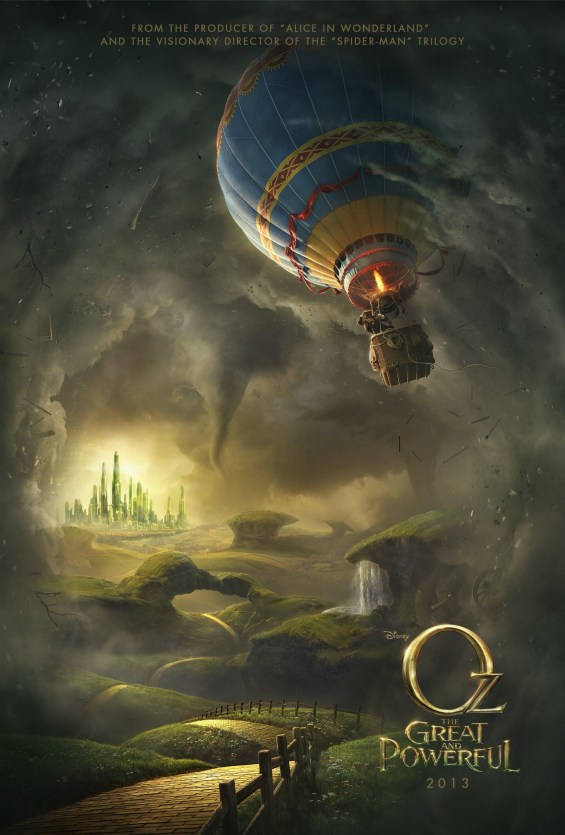
Oz the Great and Powerful (2013) – Film Review

“I Don’t Want to Be a Good Man, I Want to Be a Great One.” – Oscar ‘Oz’ Diggs

Since its release in 1939, the illustrious fantasy-musical; The Wizard of Oz, an adaptation of L. Frank Baum’s beloved children’s novel; The Wonderful Wizard of Oz, has been engraining itself into the memories of adults and youngsters alike through its catchy melodies, imaginative world-building and groundbreaking practical effects. In 2013, Walt Disney Pictures sought to return to the Land of Oz with Oz the Great and Powerful, a prequel to the novel and, in a way, its silver screen counterpart (despite ownership of the harmonious classic belonging to Warner Bros. Pictures), with celebrated director Sam Raimi (The Evil DeadSpider-ManDoctor Strange in the Multiverse of Madness) attached to helm the project, ascertaining its potential as an enchanted prequel. Shortly after its release, however, most seem to forget about the film, which is unfortunate given that Oz the Great and Powerful is a largely enjoyable fantasy adventure that pays homage to the iconography and timeless sense of wonder present in the original musical while avoiding an absence of its own, unique ideas.

Plot Summary: After Oscar ‘Oz’ Diggs, a small-time circus magician with dubious ethics, is hurled away from his dusty abode in Kansas to the vibrant Land of Oz, he believes he’s hit the jackpot as he’s told to assume his rightful place as monarch of Emerald City. But, when Oscar meets the sisters of Theodora and Evanora, who aren’t entirely convinced that he is the great wizard their prophecy has spoken of, Oscar is summoned on a quest to slay the Wicked Witch that threatens Oz and prove his worth…

Whilst Oz the Great and Powerful may seem like just another cinematic interpretation of the whimsical Land of Oz, Walt Disney Pictures actually had to be very cautious with what aspects of the story they utilised, on account of Warner Bros. Pictures owning the rights to specific elements of The Wizard of Oz, as previously mentioned, including the ruby slippers Dorothy Gale dons throughout the runtime. These restrictions even extended to the particular shade of green used for the Wicked Witch’s skin, for which Disney employed what its legal department considered a sufficiently different shade dubbed; “Theostein,” a portmanteau of Theodora and Frankenstein, yet Disney could not use the signature chin mole from Margaret Hamilton’s renowned portrayal of the Wicked Witch of the West.

In terms of the actual narrative, Oz the Great and Powerful tells the origin of the titular Wizard of Oz, whom we all know from previous iterations to be a fraud. Before he was viewed as a mythical wizard, Oscar Diggs was merely a talented illusionist and an egotistical, womanising con man performing at a travelling circus in Kansas. ‘Oz’ (as his friends call him) underpays his assistant and recruits many beautiful women to appear in his performances, manipulating them with lies and empty romantic gestures. However, while Oscar receives an abundance of characterisation during the story and is evidently a gifted magician, James Franco’s performance is primarily to blame for the character’s shortcomings, as Oscar suffers from an underbaked character arc and a lack of empathy in certain scenes, suggesting that Franco lacks the charisma necessary to win over the audience amid Oscar’s immense arrogance. Dissimilarly, the supporting cast of Mila Kunis, Rachel Weisz, Michelle Williams, Zach Braff and Joey King are all sufficient in their varied roles, human and otherwise.

Recreating imagery like the Yellow Brick Road and the Emerald City in addition to introducing a handful of never-before-seen locations, such as a miniature village compromised of larger-than-life crockery and ceramic residents, known as China Town. Oz the Great and Powerful impressively brings the Land of Oz to life via a combination of expansive sets and green screens. Similar to the original musical, Oz the Great and Powerful also opens in a colourless, tight aspect ratio for the Kansas sequences before widening out and blossoming into colour once Oscar enters the Land of Oz, making for an unforgettable visual juncture. Moreover, the cinematography by Peter Deming is frequently effective in implementing Sam Rami’s familiar style of camerawork, as the camera is repeatedly rocketing towards characters’ faces, particularly when they’re reacting to the surprising number of jump-scares.

Although the original score for Oz the Great and Powerful by Danny Elfman isn’t one of the composer’s finest, nor is it exceedingly memorable, tracks, like Main TitlesA Strange World and The Bubble Voyage are all remarkably uplifting, whereas the orchestral tracks; Bad Witch and Witch Fight, are much more ominous in tone, allowing Elfman to exhibit his grand, gothically melodic roots.

On a separate note, all of the CG effects throughout Oz the Great and Powerful hold up well for their age, aside from a few wide shots where the environment surrounding the characters appears excessively distant and overly bright. And, whenever physical sets are employed instead of green screens, they are magnificently multicoloured and extensive.

In summary, while Oz the Great and Powerful suffers from some tonal inconsistency and an underdeveloped character arc for its protagonist, the film retains enough spectacle, wit and creativity to be entertaining in its own right as a bewitched prequel. Faithfully reproducing iconic imagery like flying primates, a golden-bricked road and a cackling, broom-riding Wicked Witch, I feel nearly every fanatic of The Wizard of Oz (and/or its source material) will find amusement in this non-musical, fantasy blockbuster. Rating: low 7/10.

oz_the_great_and_powerful-p680832

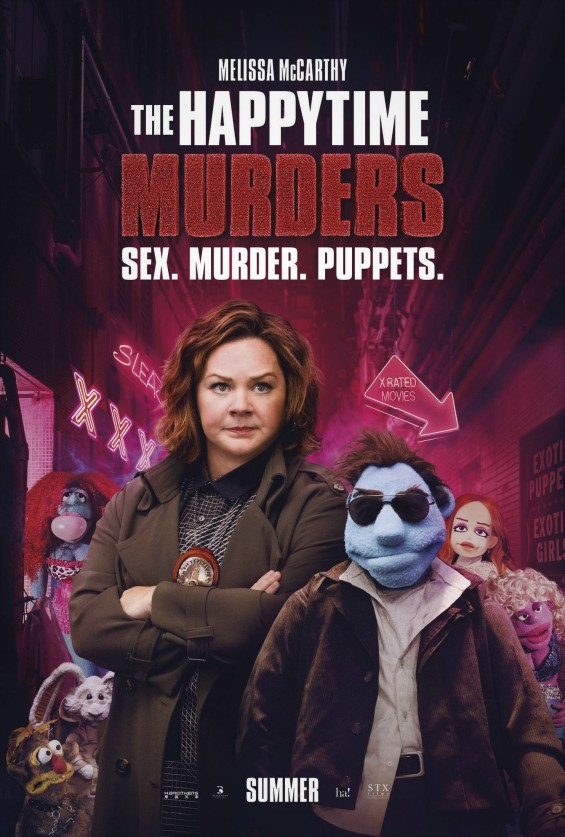
The Happytime Murders (2018) – Film Review

“Do You Have the Latest Issue of Puppet Pussy Party?” – Phil Philips

Released in 2018, The Happytime Murders was a long-in-development project from the adult-geared alternative arm of the Jim Henson Company, the famed production company behind The Muppet ShowFraggle RockDinosaurs and many other beloved, family-friendly projects. Yet, unlike those projects, The Happytime Murders squanders its imaginative premise on a witless and raunchy crime-comedy that blindly pushes buttons instead of attempting to tell an entertaining story, to the extent that even under the proficient direction of Brian Henson (The Muppet Christmas CarolMuppet Treasure Island), son of the late Jim Henson, the film never manages to escape its dreadfully lethargic humour or its foreseeable buddy-cop storyline.

Plot Summary: When the cast of a 1990s sitcom is murdered one by one at the hands of a mysterious figure, Phil Philips, once the Los Angeles Police Department’s first puppet police officer, now a weary private investigator, finds himself dragged into the case. But, as the investigation becomes more and more bewildering, Phil is forced to bury the hatchet with his former human partner, Detective Connie Edwards, in order to prevent more past-their-prime puppets from meeting a grisly end…

Curiously, before the film was released, Sesame Workshop, the non-profit organisation behind the cherished children’s television series; Sesame Street, actually tried to sue The Happytime Murders‘ marketing team on account of one of the film’s taglines; “No Sesame. All Street.” Claiming the film tarnished their child-friendly reputation. However, the suit was ultimately rejected. In many ways, this amusing piece of behind-the-scenes drama is more interesting than the actual narrative of The Happytime Murders, which primarily serves as a witty yet predictable detective mystery where Phil and his partner, Connie, are driven to scour for clues across the sunlit, puppet-populated metropolis of Los Angeles, in the hope of exposing the unbeknownst serial killer. Through this investigation, the film makes many attempts at humour, 90% of which falls short as most of the comedy lazily stems from adorable puppets merely cursing or enjoying more adult activities, such as smoking, sex or drinking alcohol. On a more positive note, the film does, at least, feature a few fragments of absorbing world-building, most notably with how puppets are considered second-class citizens compared to humans, hence why so many puppets eventually become addicts, numbing themselves to the misery of their lives, a detail that is clearly intended as underlying (and underdeveloped) social commentary.

As mentioned previously, The Happytime Murders is, at its core, a parody of classic buddy-cop crime-thrillers, with the alcoholic, blue-felt gumshoe, Phil Philips, skillfully portrayed by Bill Barretta, reluctantly pairing up with his abrasive former partner, Detective Connie Edwards, clumsily portrayed by Melissa McCarthy, after his thespian brother gets inexplicably murdered by an individual intent on wiping out the entire cast of the Happytime Gang, a prevalent ’90s sitcom. All of whom were puppets, aside from the token human cast member, Jenny, portrayed by Elizabeth Banks. And thanks to the spectacular puppetry on display, you quickly forget that Phil, one-half of this investigative tandem, is a glorified hand in a sock. Alas, the characterisation isn’t nearly as impressive as beyond some basic character traits and chucklesome one-liners, both members of the central duo lack depth and frequently come across as obnoxious, especially McCarthy. Regrettably, this issue also extends to the under-utilised supporting cast of Maya Rudolph, Leslie David Baker and Joel McHale.

Akin to many other puppeteering projects, all of the elevated sets utilised during production were built so that the puppeteers could stand on the ground and operate the puppets as if they were standing with straight arms. Yet, even with this information in mind, every set that appears on-screen feels like a real, lived-in location. Unfortunately, the rest of the visuals aren’t as remarkable, as the cinematography by Mitchell Amundsen is immensely bland, over-relying on over-lit close-ups and mid-shots that barely enrich the satire or mystery of the narrative.

Relatively tedious and generic, the bass-heavy original score by Christopher Lennert tries to reflect the jazzy scores of ’70s crime-thrillers yet rarely succeeds in forming any truly memorable tracks of its own. Similarly, songs like Sexy and I Know It and Low Rider seem almost arbitrary in their placements within the runtime, usually throwing off the tone of whatever scenes where they are featured.

In regard to the puppets themselves, it’s intriguing to note that a grand total of one hundred and twenty-five puppets were used during the film’s production, with around forty of those puppets being created specifically for the film. As a result, every puppet that emerges from scene to scene is visually unique, retaining its own colour, fabric, style, and personality. Once again, it’s just a shame that the gags and dialogue that emit from each felt character’s mouth are so sluggish, continuously giving off the impression that the film is trying far too hard to be risqué.

In summary, The Happytime Murders is a crime-comedy harbouring far too many lousy jokes, with the genuinely clever gags being few and far between. As such, the only thing that can be declared for certain when it comes to The Happytime Murders is the fact that with its countless scenes of drug-snorting and depraved puppet sex (not to mention an extremely drawn-out ejaculation sequence), it’s worth emphasising that this puppet-led comedy is not one for youngsters. Still, it’s not as if they’re missing out on much. Rating: low 4/10.

happytime_murders_ver2_xxlg

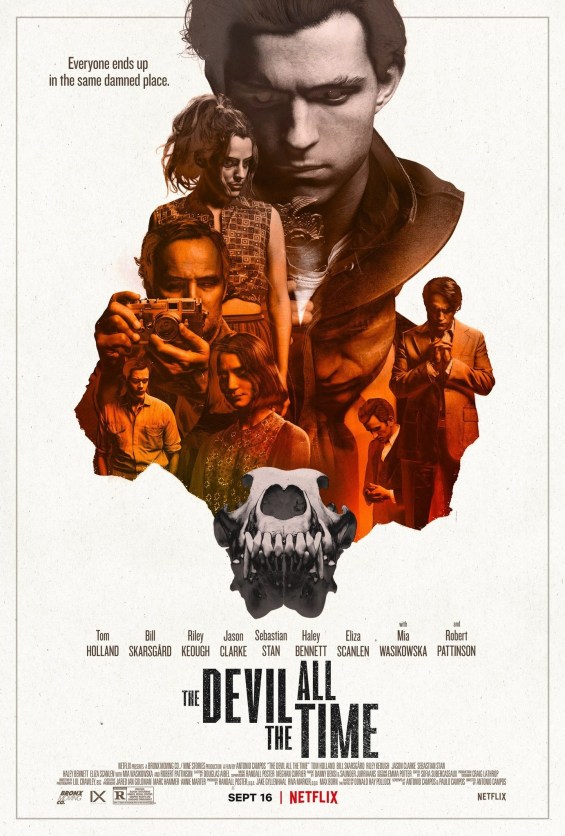
The Devil All the Time (2020) – Film Review

“Blessed Are Those That Hunger and Thirst for Righteousness.” – Reverend Preston Teagardin

A gripping yet troubling exposé of a period in history that frequently appears overly sanitised, 2020’s The Devil All the Time is a superb Netflix Original that utilises its relentlessly grim narrative, stellar all-star cast and period-accurate song choices to explore an underused setting in cinema; Southern Ohio in the 1950s. And, as a result, the film crafts an engaging and thought-provoking tale of backwoods preachers, religious zealots and broken, weathered souls witnessing the atrocities of a post-war world, replenished with sins that even faith is unable to wash away.

Plot Summary: In 1950s-era rural Southern Ohio, an assortment of crooked and sinister individuals intersect paths in the Midwestern town of Knockemstiff, a rustic, sparsely-populated cesspool teeming with corruption and brutality…

Co-written and directed by Antonio Campos (Buy It NowSimon KillerChristine), the screenplay for The Devil All the Time was adapted from the novel of the same name by Donald Ray Pollock, who, interestingly, actually performed the narration for the film, making the role his first-ever narrating position as he avoided performing the voiceover work for his own audiobooks. Similar to the original novel, a large majority of the story revolves around the real-life town of Knockemstiff, Ohio. Here, the non-linear narrative, which examines the violent vestiges of religious iconography, thrusts an array of devilish characters to encounter one another through differing scenarios, often resulting in horrific outcomes. In particular, the opening three arcs produce a distressing first act where death is seemingly always lurking around the corner. However, while most of the characters and their individual storylines are captivating, certain characters (and their continually fiendish actions) can appear somewhat underdeveloped due to a lack of screen-time, along with a few narrative details, namely, the subplot of Deputy Lee Bodecker accepting payments as a corrupt officer, not falling into place.

Regarding one of the finest aspects of the film, the central cast of Tom Holland, Robert Pattinson, Harry Melling, Bill Skarsgård and Sebastian Stan (among many others) are all exceptional in their various roles, with most of the cast’s accents seeming flawless, barring Holland and Pattinson’s accents, which come across as inconsistent and wildly over-the-top, respectively. The cast’s performances are only enriched by their usually well-written characters, however, as their unanswered prayers seem to eventually lead each of them to turmoil as they exist at a bleak point in history where treatments for diseases were scarce and a devastating World War had just wiped out millions, rendering religion to serve as the only recourse for most. What makes the characters more intriguing is that The Devil All the Time is also a multigenerational tale, beginning with the semi-protagonist, Arvin Russell, as a youngster before concluding the story with Arvin as an adult in his early twenties, all the while propelling Arvin and his step-sister, Lenora, to reckon with the ghosts of their parents’ past. That is not to say that any character is represented as exemplary, though, as during the final act, the primarily benevolent Arvin exercises his father’s vengeful tactics for a satisfyingly violent payoff.

In a rather bothersome decision, The Devil All the Time repeatedly feels compelled to remind the audience of earlier sequences in the story that mirror later moments. Yet, most of the time, these flickers of earlier scenes in the film are thoroughly unnecessary and quickly begin to grate on the audience. Aside from this annoyance, the editing and cinematography by Lol Crawley are serviceable, continually being enhanced by the terrific set design and set dressing, which makes every inch of the rundown town of Knockemstiff appear worn and ripe with religious imagery.

Alongside the original score by Danny Bensi and Saunder Jurriaans, which remains nuanced and unpretentious whilst still adding to the cruelty and suspense on-screen at many points, The Devil All the Time employs an extensive selection of traditional gospel tunes and ’50s-era songs, such as Washed in the BloodThe Three Bells and Honeycomb, all beneficially playing into the setting and underlying religious themes of the story with some of the more upbeat songs even prompting certain scenes to develop a moderately satirical tone.

Returning to the visuals, momentarily, crucifixion is a recurring image throughout the runtime, relating to the film’s central underlying theme of the conflict between belief and the horrors of the real world. For example, in the first act, Willard Russell discovers a bloodied, fly-infested serviceman crucified during his deployment on the Solomon Islands during World War II. This image changes the once godly soldier to a religiously apathetic, but more importantly, makes it apparent how closely savagery and sacrifice are exemplified through the image of Jesus Christ tortured on the cross. Later in the film, there is also a painting of Jesus Christ on the cross hanging on the wall in Arvin’s room, reminding the audience of this subtext.

In summary, whilst The Devil All the Time‘s ruthlessly pessimistic narrative can occasionally be harrowing to the point of punishment, much of the dour storytelling is offset by the strong work from the outstanding cast, whose performances are often so compelling they even redeem the rather conventional style of filmmaking the film adopts, which is unlikely to leave any audience member in awe. Still, The Devil All the Time is an effective, religion-centred thriller. Rating: 7/10.

devil_all_the_time_ver2_xxlg

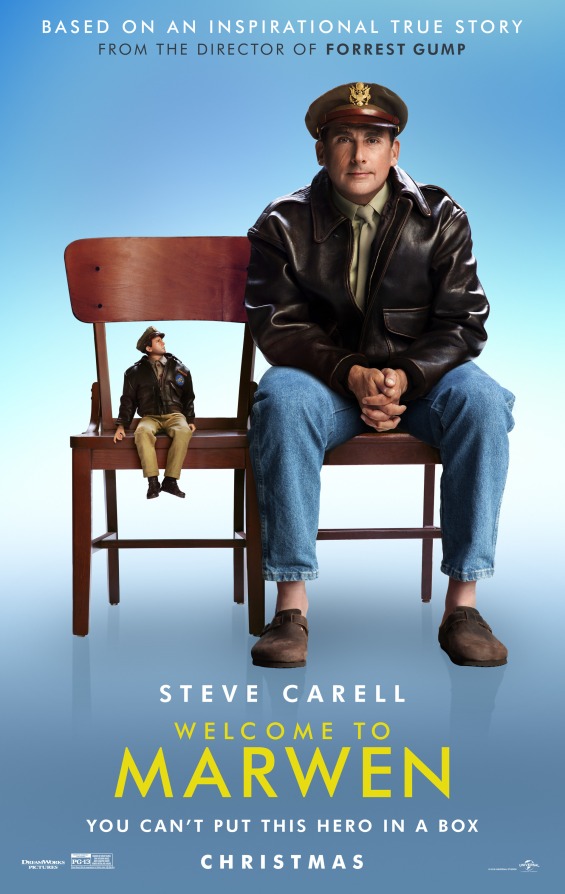
Welcome to Marwen (2018) – Film Review

“I Was a Hell of a Good Artist, an Illustrator. I Loved to Draw, and Now, I Can Barely Write My Name…” – Mark Hogancamp

Co-written and directed by Robert Zemeckis (Back to the FutureForrest GumpCast Away), Welcome to Marwen, released in 2018, is a dramatisation of the 2010 documentary; Marwencol, which recounted the true story of Mark Hogancamp, who, on April 8th, 2000, was brutally assaulted by five men who beat him almost to death, thrusting Mark into a nine-day coma and a forty-day hospitalisation period before he was discharged, woefully bearing severe brain damage that left him with little memory of his past life. Welcome to Marwen takes the tragic story of Mark Hogancamp and aims to provide it with a tint of optimism, romance and fantasy through its unique storytelling approach and dazzling visual effects. Yet, the film ultimately falls flat due to its confused tone and graceless screenplay, making Zemeckis’ invitation to enter the village of Marwen a leisurely one to decline.

Plot Summary: After being ruthlessly assaulted by five men who left him for dead outside a bar in Kingston, New York State, yielding severe memory loss and trauma. Aspiring artist, Mark Hogancamp, constructs a remarkable therapeutic outlet on his property known as Marwen, a miniature World War II-era Belgium village compromised of period-dressed dolls. But, when Mark is requested to attend the court hearing of the men who mutilated him, his anguish returns to torment him…

Mark Hogancamp, the real individual upon whom the film is based, suffered injuries on every part of his body following the assault, subsequently placing him into a coma for nine straight days. As a result, most of the memories of his life before the assault were virtually extinguished, and the limitations of his health insurance prevented his continued rehabilitation. Sadly, only three of his assailants ever went to prison, with all three getting released within two years. Welcome to Marwen ignores many of these bleak details and outcomes, however, instead attempting to lace the story with more sanguinity and merriment as the film plays out over two planes; Mark’s plane of existence (our own) and that of the dolls, who, are enlivened via CGI in a fashion that could be described, as a more photo-realistic version of Toy Story (1995). It’s an admirable method of trying to infuse Mark’s despairing reflection of his assault with a dash of imagination and humour, but it’s predominantly an unsuccessful one, as this approach renders the film immensely inconsistent in terms of its pacing, tone and authenticity to the actual account of Mark’s horrific assault.

In a somewhat bizarre casting choice, Mark Hogancamp is portrayed by Steve Carell, who, whilst not awful, by any means, feels as if he lacks the acting aptitude required to depict Mark’s agonising trauma and isolation. But, Carrell does (of course) prevail with the more comedic moments, even if the gags themselves generally flop as Capt. Hogie (Mark’s gallant, plastic alter-ego) has a plethora of oddly placed witticisms. The supporting cast of Merritt Wever, Diane Kruger, Janelle Monáe, Eiza González and Gwendoline Christie all deliver passable performances (barring Christie’s overbearing Russian accent) yet possess little characterisation as the so-called; Women of Marwen, dolls that populate the tiny, make-believe village of Marwen, inspired by the powerful women Mark knows in his real life. Leslie Mann also makes an appearance in the film as Mark’s friendly, inexplicably curious neighbour, Nicol, who eventually becomes an object of affection for Mark in both his worlds, which occasionally comes across as rather uncomfortable as Mark lives out some of his romantic fantasies with Nicol through his dolls.

Despite spending almost half of the runtime in the imaginary village of Marwen, Mark’s fantasies of himself and his female companions as heroes of the Second World War are often short on memorable shots. Lacking stimulating action sequences or grand set pieces to truly justify how much screen-time is spent in the village of Marwen, the rarely inventive cinematography by C. Kim Miles makes the scenes of the dolls socialising or firing at Nazis relatively visually flat, that is, barring the well-rendered visual effects.

On the more positive side of things, the original score by Alan Silvestri is equally adventurous and diverse, with tracks such as MagicYou Got ThisBeautiful Moon and Marwencol, all harmoniously balancing sorrow, yearning and genuine tension while featuring a snare drum to further play into the World War II setting of Marwen. The score also includes some auditory references to Zemeckis’ earlier filmography, including a callback to the signature motif of the Back to the Future trilogy.

Nevertheless, the finest aspect of Welcome to Marwen is, by far, its CG effects, which brilliantly utilise motion capture to employ the faces and body movements of its cast onto plastic figurines clothed in World War II-era outfits/uniforms. As such, every scene within Mark’s fantasy world oozes with detail and toy-related visual gags, even if the animation of the dolls periodically appears overly fluid compared to the somewhat rigid reality of poseable figurines.

In summary, the current stage of Zemeckis’ career has long been repressed by his obsession with visual effects, repeatedly concentrating on style over substance. Welcome to Marwen is no exception to this rule, with the numerous sequences set within Mark’s fictitious world being the film’s most enjoyable moments. Thus, Welcome to Marwen fails to flourish as a wonderous, period-set adventure or a rumination of violent hate crimes and personal trauma, merely existing as a creatively ambitious misfire. Rating: low 5/10.

welcome_to_marwen_ver10_xxlg