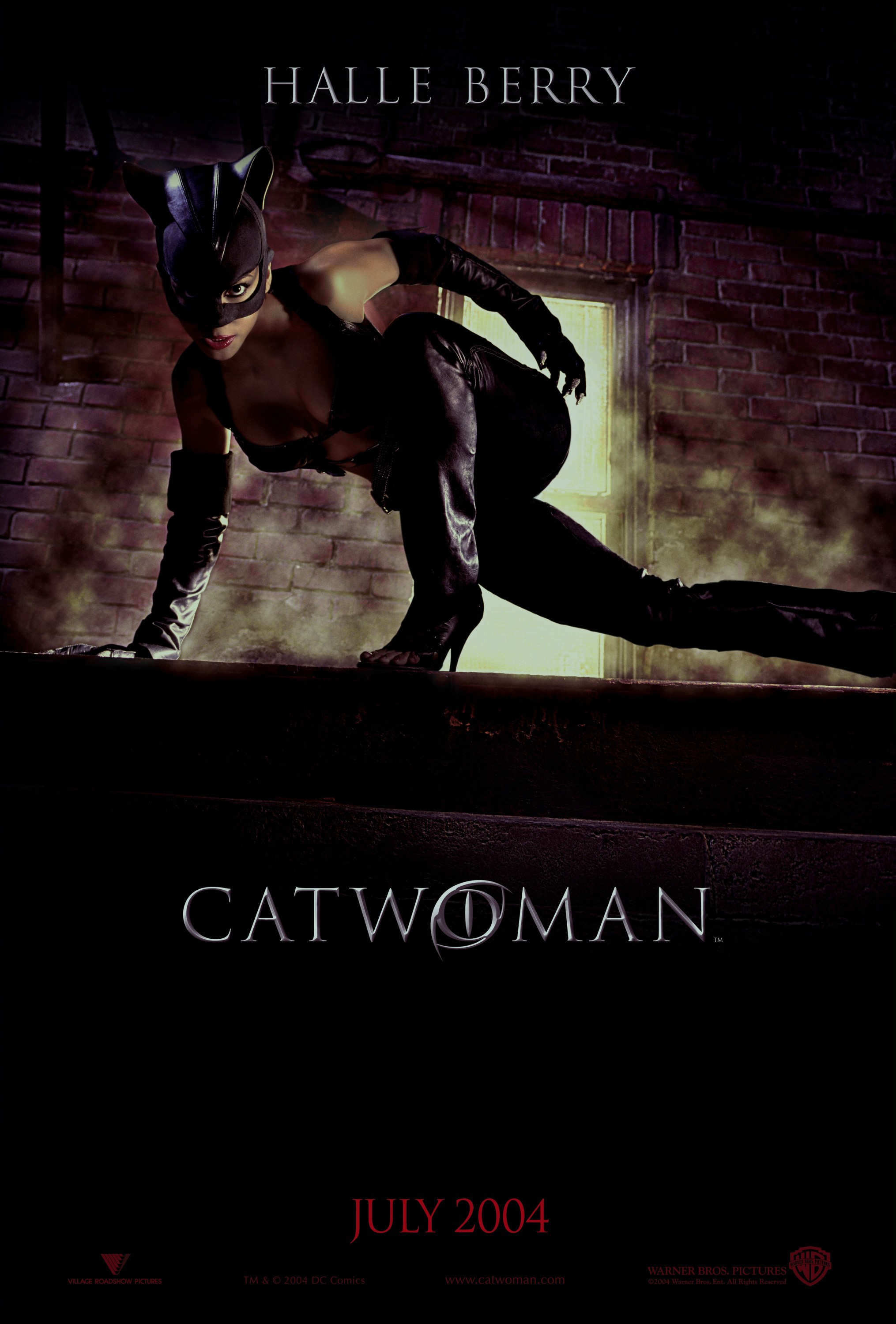
Catwoman (2004) – Film Review

“White Russian… No Ice, No Vodka, Hold the Kahlua.” – Catwoman

Widely considered one of the worst superhero blockbusters of all time, the notorious Catwoman from 2004 is a horrendous combination of an edgy 2000s music video and all of the worst aspects of a modern superhero flick. Harbouring immensely cringey, pun-based dialogue, terrible CG effects and a forced romantic subplot, among many other issues, Catwoman is a nosedive in quality from many of the beloved comic book stories featuring the famed cat burglar of the DC Universe. Still, for those who are fans of the character, there is little concern of character assassination here, as the protagonist of Catwoman is so distant from the feline that debuted in 1940 that she is virtually unrecognisable outside of the signature ears, whip and black leather outfit. As such, this seedy superhero flick is only worth seeing if you can tolerate a thrown-together story and hideous visuals merely for an ironic laugh.

Plot Summary: While toiling as a graphic designer for the cosmetics company Hedare Beauty, a mammoth corporation on the verge of releasing a revolutionary anti-ageing lotion, the shy and sensitive Patience Philips inadvertently happens upon a dark secret regarding the ointment, soon finding herself in the middle of a corporate conspiracy that eventually takes her life. But, after mysteriously reawakening with the newfound abilities of immense speed, strength, agility and ultra-keen senses, Patience transforms into Catwoman, a skilled and stealthy vigilante determined to foil her former employer’s devilish ploy…

Aside from the central (and rather superficial) underlying theme of the film, which relates to the harmful side of the cosmetics industry, naturally depicted in an over-the-top fashion with inhumane suits eager to make a profit, regardless of consumer harm, the plot of Catwoman is a formulaic yet underdeveloped superhero origin story, with most of the film revolving around the corny sequences of Patience (renamed from Selena Kyle in this iteration) discovering her numerous abilities. Similar to the unwarranted rename, this iteration of the character also possesses unexplained, supernatural abilities, unlike the original version of the character, who shared many similarities to her occasional associate, occasional foe, Batman, sporting an imposing outfit, a secret identity and exceptional fighting capabilities, yet no actual superpowers.

Becoming one of only six actors in history to own both an Oscar and a Razzie after her ‘win’ for her infamous performance in the film, Halle Berry also became the first actress to accept her Razzie in person, stepping out on stage proudly holding both Oscar and Razzie aloft, delivering the brief acceptance speech of; “I’d Like to Thank Warner Brothers for Making Me Do this Godawful, Piece of Shit Movie.” With this in mind, it’s likely not a surprise that Berry portrays Catwoman with all of the comic book cheesiness as other superhero performances of the era, from Ben Affleck’s Daredevil to Wesley Snipes’ Blade, over-delivering every line of dialogue and showcasing the cinematic sexualisation (and animalisation) of the titular character to an absurd degree, despite Catwoman’s sexually provocative side being a key part of her character in most media she appears. That said, Halle Berry does commit to her performance, and commendably so, considering that Patience spends most of her time wide-eyed and humiliatingly unhinged with a profound love of tuna. The supporting cast of Benjamin Bratt, Sharon Stone and Lambert Wilson don’t fare much better, with their performances frequently coming across as either lifeless or cartoonish.

Previously set in Catwoman’s usual home of Gotham City, with Michelle Pfeiffer reprising her role from the blockbuster sequel Batman Returns (1992) before this concept was scrapped when Pfeiffer refused to sign on, Catwoman takes place in an anonymous, grimy city that greatly resembles Gotham, yet is never confirmed to be so. Nevertheless, this iconic, fictional city’s aesthetic barely enhances the film’s visuals in the grand scheme, as the cinematography by Thierry Arbogast is continuously cluttered and visually displeasing, a flaw only exacerbated by the equally unpleasant viridescent colour palette. Moreover, the CG effects throughout the runtime are beyond appalling, appearing weightless and unconvincing, namely during scenes where Patience leaps up walls and across rooftops or when a cat is depicted via uncanny CGI, even though forty-three cats were actually trained and used for the film, seemingly removing the need for CG effects in this respect.

On another note, the soundtrack for Catwoman, primarily relying on not-so-timely songs such as Scandalous, Outrageous and Crazy in Love, is just as nostalgic as it is corny and excessively distracting. Likewise, the original score by Klaus Badelt is loud and overbearing, often unintentionally emphasising the film’s poor sound mixing, like with the clamorous track; Felineious Assault.

With Catwoman, it’s clear that the strangely mononymous French director Pitof (Vidocq, Fire & Ice: The Dragon Chronicles) set out to make a film as stylish and sensual as possible within the boundaries of its rating. And, while much of the film’s style is evidently influenced by Pitof’s background in outlandish, sultry music videos, blockbusters generally don’t rely on constant hyperactive shots, and Catwoman is a testament to why.

In summary, Catwoman is a baffling, dated mess of a superhero-led blockbuster, which is unfortunate, given how significant of a character Catwoman is, repeatedly playing a pivotal role in stories across the DC Universe, both featuring the Caped Crusader and otherwise. Thus, it’s not an exaggeration to say that Catwoman is a ‘cat-astrophe’ in practically every aspect, but definitely as an adaptation. Rating: 1/10.
catwoman_ver2_xxlg

The Darkest Hour (2011) – Film Review

“What’s the Dress Code for the End of the World? Jacket, No Tie?” – Sean

Initially intriguing yet ultimately vacuous, 2011’s The Darkest Hour is an apocalyptic blockbuster that will seem like familiar territory for most with its relatively straightforward premise of a group of survivors escaping a hostile, extraterrestrial foe, its only genuinely innovative ideas appearing in the form of its setting; Moscow, and the unique, electricity-based abilities/appearance of its unworldly invaders. Rammed with immensely corny dialogue, uninteresting characters and cheap-looking set design, The Darkest Hour fails on most fronts, leaving its title to ironically reference the fact that the film’s initial release may have been the ‘darkest hour’ for all the careers of those involved in its production.

Plot Summary: When American software developers Sean and Ben travel to Moscow to sell their latest program to investors, their Swedish associate Skyler double-crosses them, forcing them out of the deal. In an attempt to drown their sorrows, the duo head to a nightclub. Until, out of the blue, the Russian population is startled by the appearance of mysterious rays in the sky, soon discovering that the lights are, in actuality, an extraterrestrial force invading Earth and utilising our power supply to eradicate all mankind…

The inclusion of the Russian setting and, by proxy, Russian crew/extras can be attributed to producer Timur Bekmambetov, who after becoming involved in the project, allowed the production to use Moscow as a backdrop instead of the typical U.S. locations, predominantly due to Bekmambetov owning his own production company in the city, known as Bazelevs, where the majority of the film was shot, with the crew consisting of roughly 30% Americans and 70% Russians. In conjunction with director Chris Gorak (Right at Your Door), who ordinarily serves as an art director/production designer on sets, harbouring minimal experience as a director, the duo aimed to make a film that would thrill audiences and feel distinct via its foremost setting, but evidently, they did not achieve this.

The central cast of Emile Hirsch, Max Minghella, Olivia Thirlby, Rachael Taylor and Joel Kinnaman are strong names, but unfortunately, all portray rather simplistic and indistinguishable characters. Fortunately, the audience is provided with a few leads that hint towards the impending extraterrestrial invasion as protagonists Sean and Ben prepare to close the deal for a party-spot program they’ve created, only to find that their alleged business associate, Skyler, has ripped them off, stealing their idea and pushing them out. Supposedly, after putting much time and effort into their project, the pair idiotically did nothing to protect their intellectual property, merely moping around a nightclub until they encounter American traveller, Natalie, her Australian friend Anne, as well as Skyler, whom they shepherd into their group during the initial raid in spite of his earlier betrayal with next-to-no drama.

Shot in 3D as opposed to going through post-conversion. The Darkest Hour‘s production was originally fifty-eight days, with a further eight to nine days being added onto the production schedule once it was decided the film would be shot in 3D. Yet, throughout the runtime, these 3D effects barely register due to so much of the film taking place in dimly-lit environments (frequently depicted by shabby sets), the only real highlight of the 3D effects being the eye-catching opening title sequence. Furthermore, despite The Darkest Hour‘s constant attempts to bombard the audience with disintegrating civilians, handcrafted weapons and adrenalin-fulled chases across deserted, dust-covered streets, many of the film’s action sequences are fairly lacklustre, with the cinematography by Scott Kevan doing little to enhance the cinematic ennui.

From tracks like Northern Lights to Here’s Our Mission and Man Overboard, the film’s orginal score by Tyler Bates is occasionally effective but not all that memorable, often feeling just as gaudy yet creatively uninspired as the visuals, barring the score’s recurring use of bellowing electronic rhythms and propulsive synthesised experiments, serving, in a way, as an audible extension of the eerie, electrical sound design that accompanies the belligerent extraterrestrials.

As mentioned many times, the film’s unusual alien species only ever appear in some form of electrolocation, sensing the electricity in living beings by generating electrical fields. A downside of this ability, however, is that the extraterrestrials cannot see through any type of glass, as the transparent material is a poor conductor of electricity. This fascinating concept is what makes the aliens stand out when compared to invaders from other sci-fi blockbusters, especially since they are protected by electrical shields and can vaporise their victims instantaneously. As such, this imperceptible, seemingly unstoppable force draws the audience in through mystery and uncertainty, eliminating much of the population of Moscow overnight. That said, the extraterrestrial’s unpredictable, electrical abilities do begin to break down the longer the central group of survivors outwit them, given the group should lack any of the skills or knowledge needed to find a way out of their precarious situation. Of course, another minor issue arises in their colour as the aliens take on a glowing golden appearance, whereas electricity, in reality, is colourless.

In summary, The Darkest Hour is a sci-fi blockbuster that falters in its many attempts to propel its audience past their inevitable plot-related questions, the occasional wobbly acting and the easily foreseeable climax. While the film does include a handful of intriguing ideas and excellent electricity-affiliated visuals (alongside a periodic usage of real-world science), The Darkest Hour is obviously not the ‘electrifying’ experience the filmmakers intended it to be. Rating: 3/10.

darkest_hour_ver3_xxlg-transformed

Terminator: Dark Fate (2019) – Film Review

“Come With Me or You’ll Be Dead in Thirty Seconds…” – Grace

After bringing the titular, wise-cracking anti-hero to the silver screen with his 2016 directorial debut; Deadpool, filmmaker Tim Miller lept onto a series with evenly iconic characters, the Terminator franchise. Kicking off with the original sci-fi-action classic in 1984, Miller’s entry in the series; Terminator: Dark Fate, released in 2019, functions as both a sequel to the first two installments and a reboot of the franchise, aiming to breathe new life into this ageing sci-fi saga. Unfortunately, however, Terminator: Dark Fate is an unremarkable, mean-spirited and overly familiar affair, lacking thrilling, fast-paced action sequences and imaginative concepts, all whilst occasionally spitting in the face of the series’ most dedicated fans through its handful of baffling creative decisions.

Plot Summary: Twenty-five years after the elimination of Cyberdyne, the company that would one day create the world-ending network of supercomputers known as Skynet, another seemingly unimportant human, this time car assembly worker, Dani Ramos, is inexplicably targeted by a Terminator from the future as the shapeshifting, nearly indestructible, REV-9, is sent to eliminate her in present-day Mexico City. Luckily for Dani, a fearless protector also arrives from the future, the bionically-enhanced Resistance solider, Grace, along with a custodian from the past, a bitter, armed-to-the-teeth Sarah Connor…

Disappointed and uninvolved with Terminator 3: Rise of the Machines (2003), Terminator Salvation (2009) and Terminator Genisys (2015), producer James Cameron considers Terminator: Dark Fate to be a direct sequel to his projects; The Terminator (1984) and Terminator 2: Judgment Day (1991), remarking that while he was generally supportive of those films due to his close friendship with actor Arnold Schwarzenegger, he jumped at the offer to produce Terminator: Dark Fate, seeing it as an opportunity to oversee his franchise’s future. However, Cameron’s inherently controlling attitude did come with drawbacks as he claimed that, although he was involved in the writing process, he didn’t interfere with Miller’s oversight and never visited the set. Yet, Miller recalls things differently, claiming Cameron stepped in for some uncredited editing, finding his cut somewhat rough and prolonged. Cameron also admitted that he and Miller had their share of disagreements, ultimately leading Miller to state it’s unlikely he would work with Cameron again. These creative differences are noticeable in the final product as there is a shortage of polish in some areas, primarily in the subpar CGI and conversational dialogue, which is often corny and crass.

Blending the original’s cast with fresh faces, the central cast of Linda Hamilton, Arnold Schwarzenegger, Mackenzie Davis and Gabriel Luna all do a serviceable job of portraying their respective characters, regardless of whether they are humans or machines, newcomers or returning legends. That is, excluding Natalia Reyes as Dani Ramos, who frequently fails to believably portray Dani as a fearless and firm figure due to her short stature and rather weak line delivery.

Standing as the only Terminator film where none of the action takes place in Los Angeles, Ken Seng’s cinematography is one of the few positive aspects of Terminator: Dark Fate, as the camerawork is dynamic and favourably supports the numerous action sequences, making extensive use of the latest setting for the sci-fi saga; Mexico City. Alas, the action set pieces aren’t as arresting, lacking the physicality and grittiness of the series’ first two entries, despite the admirable inclusion of their bloody brutality.

The original score by Tom Holkenborg (a.k.a. Junkie XL) is habitually loud and imposing, initiating with the track; Terminated, and continuing with tracks like My Name Is Dani, The Wall and Screaming Turbines, the foremost of which softens the score up via Mexican-style guitars, lending a lighter tone to some scenes. Still, it likely goes without saying that, although adequate, the soundtrack doesn’t hold a candle to the original Terminator score, even if the film attempts to earn nostalgia points by implementing its well-known mix of synth, drums and electronics whenever possible, including the audible motif; “Dun Dun Dun Dun Dun.”

Spoilers ahead in this section for those who wish to go into their viewing blind, but I’m sure many are wondering where the significant character, John Conner, is in all of this. Well, in the opening scene of the film, young John is actually shot dead by a Terminator. Whilst shocking, this moment not only deprives the audience of any screen-time with the fan-favourite character, but also renders the conclusion of the second entry meaningless. Moreover, with Skynet no longer existing, thanks to the events of that film, the screenplay conjures up a ‘new’ antagonist with Legion. This almost indistinguishable, equally hostile A.I. force is just far too similar to what the series has attempted previously to appear innovative, alongside its use of an already comparable narrative structure.

In summary, Terminator: Dark Fate is just as uninspired as its bland sub-title suggests, often feeling like a sequel/reboot made out of obligation than anything else. And, with the franchise’s previous restart attempts in Terminator Salvation and Terminator Genisys, each written to be the first of a trilogy before that idea was scrapped due to a lack of critical and commercial success. Terminator: Dark Fate is yet another series revamp succumbing to a disappointing box office gross and lacklustre reviews, the rough outline written for its two sequels being discarded, leaving the future of the franchise uncertain and, in my opinion, indicating that the Terminator franchise needs to be ‘terminated’ itself, evidently running low on ingenuity and relevance. Rating: 3/10.

terminator_dark_fate_xxlg

Love and Monsters (2020) – Film Review

“I Didn’t Really Have Your Typical Upbringing. I Mean, I Did at First… but Then the World Ended.” – Joel Dawson

Originally titled; Monster Problems, the Netflix Original, Love and Monsters, released in 2020, is a comedic, post-apocalyptic romance filled with plenty of heart, humour, clever world-building and, as its title suggests, gigantic monsters. Despite housing a few blemishes here and there, Love and Monsters covers an abundance of emotional ground throughout its story, standing as an entertaining, monster-filled adventure, the sort of film that delivers wit, excitement and creativity all in generous portions, making for an amusing time during ‘the end of times,’ as it were.

Plot Summary: Seven years after the world-ending event known as the “Monsterpocalypse,” twenty-three-year-old Joel Dawson, along with the rest of humanity, is wearily living underground in a hidden bunker since colossal mutated monsters took control of the surface. But, after reconnecting over the radio with his high school girlfriend, Aimee, who is now eighty miles away at a coastal colony, Joel courageously decides to venture out into the monstrous open-air to find her…

Demonstrating his storytelling capability almost immediately, director Michael Matthews (Five Fingers for Marseilles) artfully lays out the film’s premise during the opening sequence, employing a voiceover from Joel and a variety of animated illustrations made to appear as if they were pencil-sketched by Joel in his notebook. Through this opening, we learn that several years ago, the human race fired a series of rockets into space to destroy an impending asteroid nicknamed; “Agatha 616,” which successfully blew the rock to smithereens. However, this action had consequences, as the chemical compounds used to launch the missiles rained back down to Earth and transformed the cold-blooded wodge of the animal kingdom into mutated monstrosities, forcing the human race to flee underground. From this point on, Love and Monsters continually explores its unique world, building upon the notion of the “Monsterpocalypse” in several ways whilst also taking cues from 2009’s Zombieland by not taking itself too seriously, avoiding the common concern of its post-apocalyptic setting feeling ‘played out.’ Of course, this does mean that Love and Monsters includes a number of tonal shifts, some of which occur rather suddenly, similar to how many of the film’s gags vary in quality.

In terms of characters, the timid, self-deprecating protagonist of Joel Dawson is perfectly cast with Dylan O’Brien, as the screenplay allows the young actor to flex every acting muscle he possesses, toeing the line between weighty and light-hearted scenes through his myriad of interactions with the other survivors of his monster-infested world. For Joel, the world-ending cataclysm was particularly bad timing as he was on a date with his girlfriend Aimee when the pair were separated and shipped to different colonies. While terrified of almost everything at first, Joel eventually pushes himself out of love, serving as a likeable yet dimwitted guide through a world of horrors and devastation, discovering more about himself along the way. In addition to O’Brien, the cast is studded with some great talent, from Jessica Henwick, who manages to make Aimee seem capable and sympathetic in spite of her limited screen-time, to the unlikely pairing of Michael Rooker and Ariana Greenblatt as Clyde and Minnow, two world-weary survivors travelling together after their respective families were killed by undisclosed creatures. Moreover, whilst on his journey, Joel encounters the grieving, intelligent canine, Boy, who is remarkably well-portrayed on-screen by the two Australian kelpies, Hero and Dodge.

Given that much of the film is a voyage across post-apocalyptic America, Love and Monsters is almost episodic in its visual presentation, following Joel as he treks past devastated, overgrown suburbs, corroded fairgrounds and expansive meadows, all of which are wrapped in impressive details like spider-like webbing enfolding the rooftops and trickling egg sacks sprouting on trees. Lachlan Milne’s cinematography and the film’s wonderful production design (considering its modest budget for a premise of this scale) lend themselves brilliantly to this concept with an ample amount of wide shots, thoroughly embracing the strange beauty and vibrant colours of the “Monsterpocalypse.”

Drawing inspiration from the scores of larger-than-life science fiction classics from the 1950s and 1960s, composers Marco Beltrami and Marcus Trumpp provide Love and Monsters with a grand, stimulating and highly vigorous orchestral score. Through tracks such as; Bunker Breach, Wisdom of the Wild, Amiee’s Colony and End Credits, the original score works in tandem with practically all the scenes it can be heard, whether they are stirring or unsettling.

As you’d hope for a monster-centric flick, the titular creatures of Love and Monsters are widely imaginative, with oversized centipedes, frogs, snails and crabs all featured throughout the runtime, all outlandish and intimidating in design, yet still recognisable to their real-world counterparts, brought to life via exquisite practical and CG effects, ultimately leading the film to become an Oscar nominee in 2021’s Best Visual Effects category, alongside Tenet (2021) and The Midnight Sky (2021).

In summary, Love and Monsters is an enjoyable, earnest and comforting flick, packed with splendid creature designs, charming characters and a delightful cast. In many ways, the film is a high school rom-com that just so happens to be set in a post-apocalyptic world, serving as a terrific template for crafting a leaner, less bloated summer flick that virtually all can enjoy. And, for once, with the film leaving things open-ended enough for a sequel, this is the rare scenario where, I’d say, another instalment would actually be welcome. Rating: low 8/10.

love_and_monsters_xlg

Gods of Egypt (2016) – Film Review

“Every Night the Battle Between Chaos and Creation Must Go On. Otherwise, the World Will Be Destroyed…” – Ra

Based on the Egyptian myth; The Contendings of Horus and Set, a mythological tale from the Twentieth Dynasty of Egypt found in the pages of a biblical text, recounting a battle between Horus, a god who takes the form of a falcon, and Set, a sky god, lord of the desert and master of storms, disorder and warfare, Gods of Egypt, released in 2016, is a visually overblown, poorly plotted and needlessly CGI-heavy fantasy blockbuster. Playing fast and loose with its world-building and the Egyptian mythology it’s based upon, Gods of Egypt squanders much of its talented cast and admirable visual effects in exchange for shallow, action-lead spectacle. As a result, the film has largely (and unsurprisingly) been lost to the sands of time, similar to many other lustreless blockbusters of the 2010s.

Plot Summary: In an alternate Ancient Egypt where the world is flat and Egyptian gods live amongst humans, differing from mortals by their tremendous height, golden blood and ability to transform into their animalistic forms, a young thief, Bek, and his beloved girlfriend, Zaya, are attending the coronation of Horus. But, during the ceremony, Horus’ father, Osiris, is murdered by his envious brother, Set, who seizes the throne and declares a new, brutal regime…

Directed by Alex Proyas (The Crow, Dark City, I, Robot), Gods of Egypt is, as of now, Proyas’ most recent directorial effort, as the critical and commercial failure of the film (along with its casting controversy, as the film was criticised for casting predominantly caucasian actors), seriously hindered his reputation. Consequently, he has only directed a couple of short films since. While this is a cruel turn of fate for Proyas, who has demonstrated in the past that he can helm entertaining blockbusters, Gods of Egypt is evidently desultorily directed, frequently lacking polish, dramatic weight, comedic timing and vital fragments of exposition, especially when considering the film’s immense budget of over £110 million.

Ranging from uninspired to cringe-worthy, the performances throughout Gods of Egypt are inconsistent, to say the least, as Nikolaj Coster-Waldau’s valiant Horus lacks the balance of arrogance and self-pity many of his previous performances retain, whilst the performances of Brenton Thwaites, Elodie Yung, Rufus Sewell and the late Chadwick Boseman come across as superficial and exaggerated, further facilitated by their half-baked characterisation. Moreover, as the detestable Set, Gerard Butler struts, growls and bellows like an enraged grizzly bear, possessing none of the self-awareness that could have made such an over-the-top performance more enjoyable.

Primarily shot in the Australian desert, as filming in the Sahara Desert was considered too dangerous, the cinematography by Peter Menzies Jr. occasionally allows for pleasant shots of the desert landscapes and their imposing Egyptian structures. However, many of these shots are often spoilt by the enormous barrage of CGI, making every frame appear glossy and oddly sterile, even during scenes where gigantic crowds are present. Additionally, while terrifyingly indelible creatures are not as frequent in Egyptian mythology as they are in, say, Greek or Norse mythology, Gods of Egypt still features a handful of stately creature designs, namely, the massive, serpentine creature known as Apophis, an Egyptian deity of chaos that is commonly depicted as a snake in Egyptian hieroglyphs.

On another note, it’s fascinating how, despite having no evidence as to what music in Ancient Egypt sounded like, composers have adopted a specific style to depict that location and era, likely beginning with 1954’s The Egyptian, before enduring through dozens of other scores over the years, including Land of the Pharaohs (1955), The Prince of Egypt (1998) and The Mummy (1999). In regard to the orginal score for Gods of Egypt, composer Marco Beltrami weaves several Egyptian-esque themes in and around each other, as the two central deities, Horus and Set, harbour their own motifs, with Horus’ motif sounding valiant, conveying him as the more sympathetic of the two, whilst Set’s motif is far darker and shares many similarities to your more typical ‘villain themes,’ built around intense, descending brass lines. The problem, however, is that all of these tracks aren’t that memorable or unique in spite of their functionality, with most of the score just consisting of staggeringly generic action pieces. 

Due to nearly all of the film heavily utilising visual effects, it’s not surprising that the considerable CG effects implemented throughout the runtime are one of the few shining aspects of Gods of Egypt. Aside from a handful of shots which have aged questionably, most of the visual effects are impressive. In fact, one of the more unusual challenges the visual effects team faced during post-production was placing the cast inside an array of virtual environments, as most of the scenes were shot against a bluescreen. An added complexity came in the form of the size differences between gods and mortals, as the gods stand around nine feet tall, so the visual effects team had to constantly consider these size variations.

In summary, Gods of Egypt is an insipid blockbuster lacking originality, excitement and entertainment value. The film merely meanders through waves of corny dialogue, mind-numbing, CGI-reliant action sequences and a monotonous, drawn-out story brimming with contrivances and the odd interesting concept. Once again proving, alongside other poorly-received blockbusters, such as Justice League (2017), Independence Day: Resurgence (2016) and Transformers: The Last Knight (2017), that an enormous budget doesn’t necessarily yield enormous success. Rating: low 3/10.

gods_of_egypt-p1025720

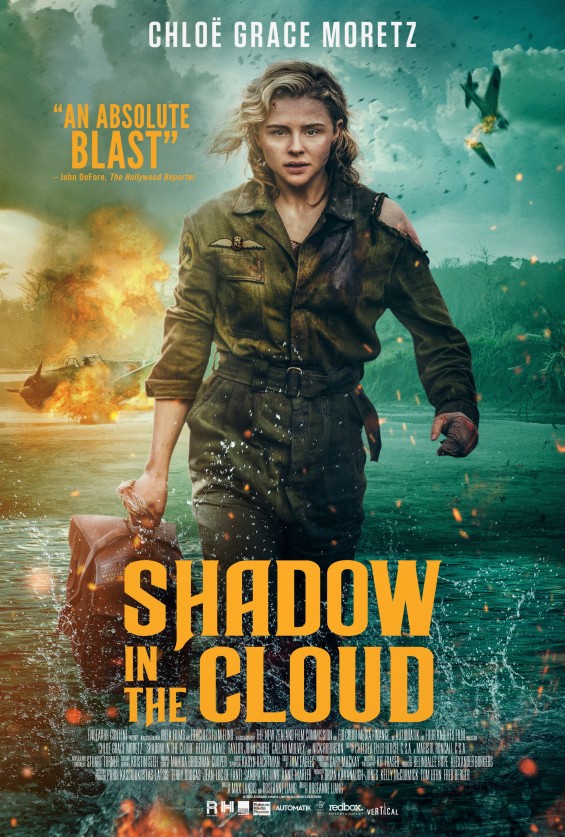
Shadow in the Cloud (2020) – Film Review

“I Saw… I Saw Something Move on the Right Wing…” – Maude Garrett

Shadow in the Cloud, released in 2020, is an action-thriller with a remarkably intriguing premise, playing into the fables of the mischievously dangerous creature known as the “Gremlin,’ a folkloric rodent that originated in the 20th century to explain malfunctions with aircraft operations, primarily during World War II. Depictions of these creatures have varied widely over the years, with their most well-known incarnation being in the 1984 horror-comedy classic; Gremlins. Before that film’s release, however, stories regarding the creatures often referenced them as the cause of the inexplicable technical and psychological tribulations many pilots faced during the Second World War, Shadow in the Cloud being one of those stories. Yet, despite this potential, aside from some impressive set design and the earnest attempt by its leading actress, Chloë Grace Moretz, to schlep the film as a ‘one-woman show,’ it’s largely a chore to make it through the entire runtime of Shadow in the Cloud, fleeting though it may be.

Plot Summary: In the throes of World War II, pilot officer, Maude Garrett, joins the all-male crew of the B-17 bomber, the Fool’s Errand, with a top-secret package. Caught off-guard by the presence of a woman on their military flight, the crew tests Maude’s every move. But, before they can enquire further about her assignment, Maude notices something sinister clinging onto the underside of their aircraft…

Co-written and directed by Roseanne Liang (Banana in a NutshellMy Wedding and Other Secrets), the somewhat clunky screenplay for Shadow in the Cloud was originally penned by Max Landis, but was later heavily rewritten during pre-production by Liang due to sexual harassment allegations made against Landis at the time. Liang and Moretz claim that Landis was distanced from the production, with his screenplay being rewritten several times before filming began. But, after watching the film, Landis argued that about 90-95% of the screenplay is still his.

Chloë Grace Moretz undertakes the role of the film’s protagonist, adept pilot, Maude Garrett, or at least, that’s how she introduces herself, as Maude’s true identity and the nature of her assignment is actually a mystery for much of the runtime. Nevertheless, Moretz does a great job carrying the acting load, while Maude receives a serviceable amount of characterisation. The rest of the crew, portrayed by Taylor John Smith, Callan Mulvey, Nick Robinson, Beulah Koale, Byron Coll, Joe Witkowski and Benedict Wall, are well-acted yet lack any real depth or distinct character traits, only serving to hammer home the film’s underlying feminist themes as masculine caricatures. So much so, that as soon as Maude steps aboard the aircraft, she’s immediately met with sexist wisecracks and condescending nicknames.

Given that the majority of the film takes place aboard an aircraft amidst the clouds, it’s understandable that much of Shadow in the Cloud‘s visuals are confined to Maude and the camera crammed into the ball turret on the underside of the aircraft after the crew shove her down there to keep her out of their way during take off. From that point on, almost every shot maintains a steady level of motion to match the constant turbulence of the aircraft in the thick of the vicious storms and enemy fighters that surround it. Simply put, whilst the cinematography by Kit Fraser isn’t anything unprecedented, it is exceptionally accurate to the film’s wavering setting.

However, the same cannot be said for the original score by Mahuia Bridgman Cooper, which is bewilderingly inappropriate for both the narrative and its time period, beginning as a melodious yet out-of-place synthetic score before transitioning into something far more chaotic and tumultuous by the third act, draining away much of the suspense through tracks, like True Stories and Dangerous Feelings. Similarly, the film’s stylistic choice of occasionally cutting away from Maude in the ball turret to see the other crew mates in a blackened space with kaleidoscopic lighting feels at odds with the remainder of the visuals, especially since it obscures much of the aircraft’s detailed set design.

On a more positive note, the film’s opening does feature a nifty animated sequence based on the cartoon shorts of Private Snafu, a series of 1940s adult-oriented instructional videos meant to educate enlisted personnel on army discretion, hygiene, combat readiness and daily life. While the designs of the gremlins in these shorts might appear playful, the design of the actual creature in Shadow in the Cloud leans into a more lifelike approach, admirably constructing a creature that possesses a grey-haired, monkey-like body structure with minor traits of bats and rats. Unfortunately, the visual effects for the creature often do the film more harm than good, as although certain shots of the gremlin are passable, almost all of the shots of Maude on the exterior of the aircraft via green screen look dreadful, likely suffering as a result of a stretched-thin effects budget.

In summary, whilst Shadow in the Cloud bears a fantastic premise, it’s continuously so poorly executed that it becomes difficult to appreciate it, forcing its audience to significantly suspend their disbelief even more than you’d expect for an action-centric creature-feature, frequently coming across as pulpy and overly dramatic. Thus, by the time Shadow in the Cloud trots out historical footage of real servicewomen alongside an inspiring pop song during the end credits, the film has essentially veered into self-parody in spite of the tremendous conviction Moretz conveys in her performance. Rating: 4/10.

shadow_in_the_cloud_ver2_xxlg

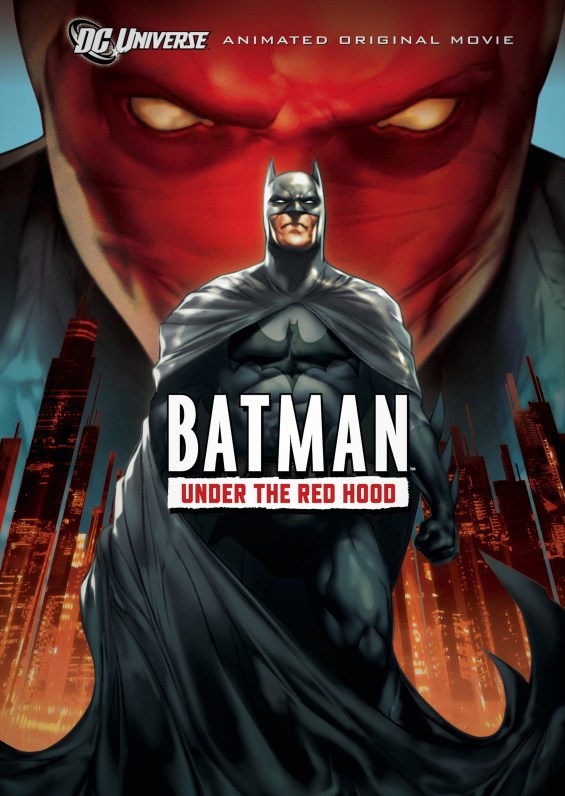
Batman: Under the Red Hood (2010) – Film Review

“Those Are the Heads of All of Your Lieutenants, That Took Me Two Hours. You Wanna See What I Get Done in a Whole Evening?” – The Red Hood

In 1988, the iconic DC Comics storyline; Batman: A Death in the Family, written by Jim Starlin and illustrated by Jim Aparo, was released to a mixture of acclaim and controversy, later becoming the bestselling comic of that year. This particular comic was unique, as readers were encouraged to vote for an ending to the narrative via a pay-per-call service number, deciding to either save or kill Batman’s youthful sidekick, Jason Todd, the second Robin. In the end, over ten thousand votes were cast, with a seventy-two-vote majority choosing to kill Jason, leading to one of the most recognisable comic book panels in literary history. Eventually, however, Jason Todd was brought back as part of a 2005 storyline entitled; Batman: Under the Red Hood, with an animated adaptation following in 2010, employing elements from both storylines to formulate a gripping, swarthy and exhilarating animated flick that examines the Dark Knight’s abiding moral code and its many drawbacks.

Plot Summary: When the mysterious vigilante, Red Hood, emerges in Gotham City, taking the streets by storm with the efficiency and aptitude of Batman without obeying the same moral code of never taking life, the Caped Crusader is forced to go toe-to-toe with the illusive outsider, reopening old wounds as once-buried memories resurface…

For those who haven’t read the source material, I won’t spoil any major plot points of Batman: Under the Red Hood, all I’ll say is that most of the story’s twists and turns won’t come as a shock to those paying attention. Fortunately, this level of predictability doesn’t matter much in the grand scheme, as Batman: Under the Red Hood is at its most compelling when it isn’t focusing on its revelations, but on how the characters endure them, as Red Hood takes Batman’s concept of vigilante justice and pushes it further toward the line between exemplary and immoral, despite his goal of ridding Gotham City of criminal filth being remarkably similar to that of the Cowled One. In fact, compared to many of Batman’s other adversaries, the Red Hood’s objectives are understandable and even somewhat valid, his crooked logic making sense as he asks Batman the formidable questions, forcing him to ask them of himself. Director Brandon Vietti (Superman: DoomsdayScooby-Doo! WrestleMania MysteryBatman: Death in the Family) and writer Judd Winick also seem to understand this, as it’s where the majority of their fixation goes, even if the fleeting runtime is too short to explore some of the film’s underlying themes in greater detail.

For the most part, the central voice cast of Bruce Greenwood, Jensen Ackles, Neil Patrick Harris, Jason Isaacs and Wade Williams portray their characters skillfully, delivering weighty yet not excessively intense vocal performances that embody their esteemed comic book characters, whether heroic or corrupt. For me, the cast has only one weak link, John DiMaggio as the Joker, who, aside from the character’s prominent laugh, doesn’t feel suited to the role, seeming somewhat miscast as he lacks the unvaryingly threatening, psychotic persona of the Clown Prince of Crime.

Visually, while still in line with the typical animation style of the DC Animated Original Movies assemblage, the animation/animated cinematography for Batman: Under the Red Hood is striking and distinctive. From the sharp angles of Batman to the meaty, menacing smile of the Joker, to the gloomy atmosphere of Gotham City with its shady warehouses and towering skyscrapers, usually depicted through enchanting wide shots that exhibit the illuminance of Gotham’s dominating skyline. In many ways, Batman: Under the Red Hood harbours the appearance of a literal animated comic book, rarely exhibiting its age or its undersized animation team.

Perceived as a powerhouse in the realms of both animation and video games, Christopher Drake, the composer for Batman: Under the Red Hood, has previously composed for many DC projects as Warner Bros. Animation frequently entrusts Drake to bolster many of their animated superhero flicks, most notably with projects like the adaptation of the seminal graphic novel; Batman: Year One (2011), as well as Batman: Gotham Knight (2008), Superman/Batman: Public Enemies (2009) and Green Lantern: Emerald Knights (2011). As such, it’s no surprise that Drake also does a terrific job with the original score for Batman: Under the Red Hood, starting the soundtrack off strong with the brooding opening track; Main Title, before supplying the film with further dramatic tracks, all of which seamlessly blend with the crime-ridden metropolis of Gotham City and its shadowy defender.

Intriguingly, Batman: Under the Red Hood was originally intended to be geared towards older audiences, bearing more violence. However, due to the low sales of DC projects in 2009, Warner Bros. Animation ordered the team behind the film to make edits to reduce its brutality and thus, its age rating. Yet, even with these cuts, the myriad of well-executed, easy-to-follow action sequences are thrilling, swift and surprisingly bloody.

In summary, more so than most animated DC projects, Batman: Under the Red Hood truly aims for cinematic storytelling over shallow spectacle and/or vibrance. With its stimulating action sequences, intricate animation and emotional underpinnings, Batman: Under the Red Hood is one of the finest entries in the DC Animated Original Movies catalogue. So much so, that in spite of Warner Bros. Animation continuously overusing the Dark Knight over their many other superheroes and villains, Batman: Under the Red Hood still manages to reveal a largely unexplored side of the celebrated character. Rating: high 7/10.

batman_under_the_red_hood-p527654

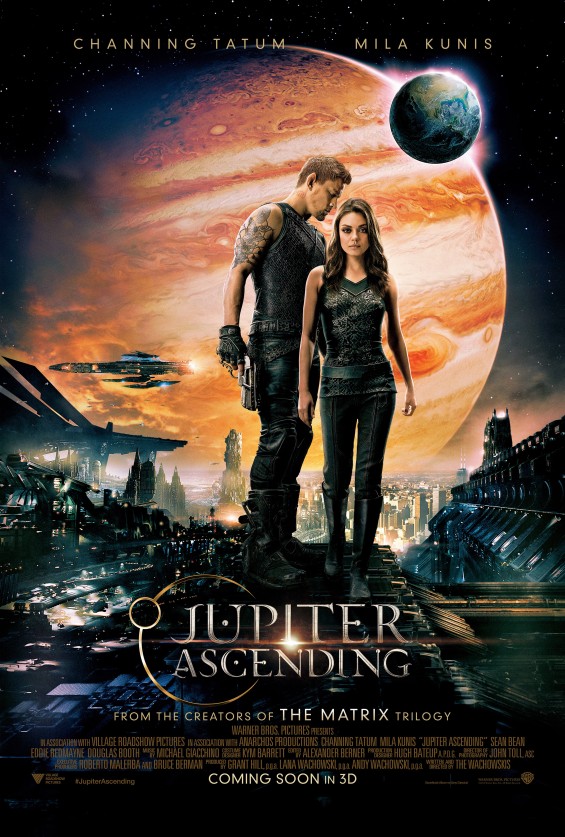
Jupiter Ascending (2015) – Film Review

“I Will Harvest That Planet Tomorrow Before I Let Her Take It From Me.” – Balem Abrasax

A sci-fi blockbuster from the writer-directors behind; Cloud AtlasV for Vendetta and The Matrix trilogy, Lana Wachowski and Lilly Wachowski, a.k.a. the Wachowskis. 2015’s Jupiter Ascending is a rarely exciting, often laughable science fiction flick that attempts to explore a number of interesting concepts yet frequently fails on almost every other front. Unquestionably the singular work of the Wachowskis, Jupiter Ascending exhibits many of the filmmakers’ worst tendencies, recounting a campy, overblown spectacle of a story that retains barely any of the visionary leadership that drove some of their earlier filmographies to be held in such high regard.

Plot Summary: Born under a night sky, with signs predicting she was destined for great things, Jupiter Jones dreams of the stars but awakens to the cold reality of a dead-end cleaning job in Chicago. But, when Caine Wise, a genetically engineered ex-military bounty hunter, arrives on Earth to track her down, Jupiter begins to realise what the universe has in store for her as she is marked next in line for a royal inheritance that could alter the balance of the cosmos…

Originally slated to release on July 25th, 2014, before the production slipped over six months to provide more time for the visual effect team to complete the elaborate effects. Jupiter Ascending possesses many attributes that commonly make for an entertaining sci-fi epic, with large-scale set pieces, thrilling action sequences and moments of world-building all appearing throughout its runtime. However, similar to The Matrix sequels, where the sheer scale of the storytelling seemed to overwhelm the Wachowskis, Jupiter Ascending frequently appears unfocused and carries little dramatic weight as it places all of its attention on exploring its vast universe, with the plot itself resembling planet-hopping stories like Dune and the Star Wars prequel trilogy, revolving around various factions grasping for power. It’s a serviceable story, to be sure, but it usually feels secondary to the world-building which, as previously mentioned, comes across as cluttered and forces countless characters to serve as exposition dumps for Jupiter, even if there are some interesting ideas at play, such as humans not originating from Earth and being sighted as cattle to species that consider themselves superior.

On a screenplay level, Jupiter Ascending is hardly revolutionary, depicting the protagonist, Jupiter Jones, as a young, seemingly insignificant woman who discovers she actually holds the key to extraordinary power. Yet, the screenplay rarely treats Jupiter as anything more than a damsel in distress, constantly needing to be protected by the fearless soldier turned bounty hunter, Caine Wise. As a result, the central duo of Mila Kunis and Channing Tatum deliver rather bland performances, occasionally wisecracking as they travel from location to location, continually in danger and continually underdeveloped, especially when they develop feelings for one another. In keeping with their surroundings, the supporting cast of Sean Bean, Eddie Redmayne, Douglas Booth and Tuppence Middleton turn in similarly lacklustre performances, with Redmayne’s performance as the antagonist, Balem Abrasax, being the true standout (unintentionally so), whispering some lines and shrieking others.

The visuals of Jupiter Ascending are one of the film’s best aspects, as the cinematography by John Toll captures the majesty of outer space in several creative ways, presenting the universe with much more colour and lavishness than many other sci-fi blockbusters. Speaking of other science fiction franchises, unlike Stark Trek or Battlestar Galactica, all of the spaceship designs throughout the film are pristine and elegant, almost comparable to floating cathedrals, as they maintain a golden colour scheme to play into the idea of the proprietors of said ships (and accompanying opulent costumes) belonging to a royal bloodline. Many of the interiors of the spaceships even appear inspired by European architecture, specifically Renaissance architecture, massively deviating from the grey, metallic interiors seen in most of the sci-fi genre. Sadly, however, it’s difficult to fully concentrate on the myriad of beautiful visuals due to the abysmal dialogue, which ranges from dull and overly expositional to unconsciously hilarious.

On another cynical note, the original score by Michael Giacchino is regrettably one of the composer’s weakest scores to date. Moving from thunderous, brassy statements to a deeply menacing voice choir that evokes memories of The Emperor’s Theme from Star Wars: Episode VI – Return of the Jedi, released in 1983, the soundtrack for Jupiter Ascending certainly fits within the science fiction genre, yet never feels distinguishable or greatly adds to the emotion/excitement playing out on-screen.

In terms of action, Jupiter Ascending makes the most of its few action sequences by having Caine Wise and the assorted adversaries he goes against cleverly utilise a selection of futuristic weapons and gadgets. In particular, one early sequence of Jupiter and Caine escaping an extraterrestrial attack squad in a chase above the twilight streets of Chicago is both eye-catching and exhilarating.

In summary, at its heart, Jupiter Ascending is a jumbled wish-fulfilment narrative whereby a despondent cleaner turns out to be the secret proprietor of Earth. And with so many heroes’ journey-type franchises existing nowadays, it is a bold stroke to make the ‘chosen one’ a respected monarch. But, on account of the sheer magnitude of the story and world-building, Jupiter Ascending quickly crumbles under its only weight, only being saved from total collapse by its impressive visual effects and stimulating action set pieces, subsequently failing to start what would have been yet another big-budget science fiction franchise. Rating: low 4/10.

jupiter_ascending-p914589

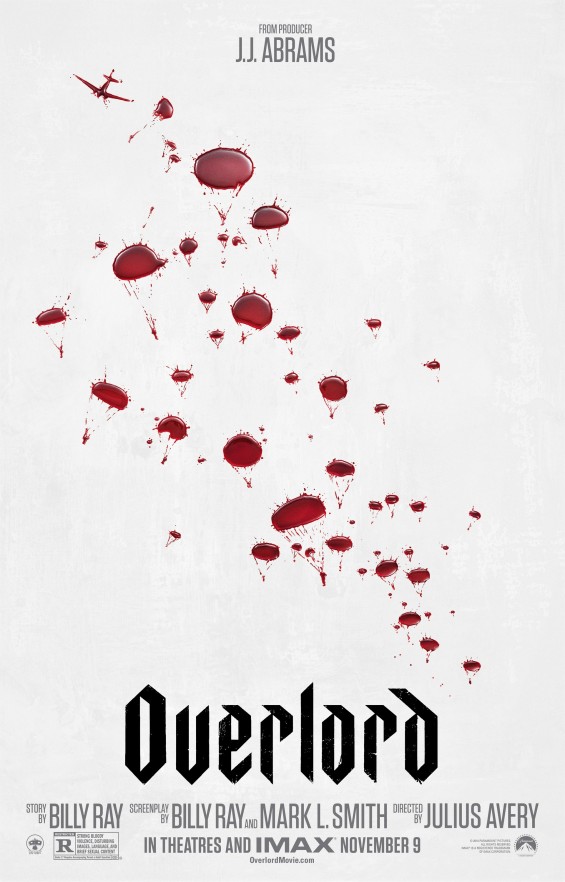
Overlord (2018) – Film Review

“Three Months Ago, I Was Cutting Grass On My Front Yard. The Mailman Shows up With a Letter From the Army. Now, I’m Here, and I Have No Idea Where I’m Going to End Up.” – Private. Edward Boyce

Initially thought to be the fourth instalment in the Cloverfield franchise, an anthology-like series featuring the projects of Cloverfield10 Cloverfield Lane and The Cloverfield Paradox. Producer J.J Abrams later confirmed at New York City CinemaCon in 2018 that the war-horror hybrid flick, Overlord, would not be part of the series, despite being produced under the same production company, Bad Robot Productions. In a similar vein to the Cloverfield franchise, however, Overlord frequently appears disjointed and underwhelming in its effort to combine many diverse genres and ideas in a World War II gore-fest.

Plot Summary: On the eve of D-Day, a squad of American paratroopers is dropped behind enemy lines with the mission of penetrating the walls of a fortified local church and destroying the radio-jamming tower inside. But, as the soldiers approach their target, they soon discover that the Nazis are conducting a series of ungodly experiments in a hidden laboratory beneath the church. Experiments that could change the tide of the Second World War…

Evidently inspired by the renowned video game multiplayer mode, Call of Duty: ZombiesOverlord, directed by Julius Avery (Son of a GunSamaritan), grounds its absurdist story around a real military operation; “Operation: Overlord,” a code name for the Allied mission for the Battle of Normandy, which launched the successful invasion of Nazi-occupied Europe. This procedure, alongside “Operation: Neptune,” would become known as D-Day. This connection to the factual history of World War II does add some depth to the narrative, in addition to playing into a number of conspiracy theories regarding Nazi experimentation and the classified missions many American soldiers embarked upon during the Second World War. However, a downside to this sort of approach is that Overlord is repeatedly in a tonal conflict with itself, as the first hour of the runtime is a largely straightforward war epic, whilst the final half-hour is a plethora of blood, bullets and superhuman, zombie-like creatures. As such, the film feels as if it’s split into two halves, both at odds with each other. Still, at least Overlord ditches the irritating use of storytelling mystery boxes, a J.J. Abrams staple.

While the performances of Jovan Adepo, Wyatt Russell, Mathilde Ollivier, John Magaro and Pilou Asbæk continually range from serviceable to immensely hammy. The dialogue and characterisation throughout Overlord are somehow much worse, often coming across as cheesy, and in the case of the characterisation, wildly inconsistent. For example, Private. Edward Boyce is initially portrayed as quiet, nervous and hesitant to kill. But, as the runtime continues, Boyce soon changes his disposition almost entirely to become confident and adept on the battlefield, having no issue killing others, all without any semblance of a character arc. Corporal. Lewis Ford suffers from a different issue as the squad’s ruthless leader, wanting to ensure that his unit completes its mission at any cost. Yet, his no-nonsense attitude and bleak outlook are never explained beyond the reasoning of ‘war changes people.’

Primarily relying on hand-held mid-shots and close-ups, many of Overlord‘s finest shots can be seen whenever the squad are outdoors amongst the burning fields and aircraft-filled skies of the small French village where their target resides. Outside of these outdoor shots, the cinematography by Laurie Rose isn’t all that impressive. However, the various sets and locations chosen for the film are rather impressive, appearing period-accurate and extremely unsanitary in regard to the undisclosed Nazi laboratory and connecting subterranean access tunnels.

When it comes to the original score by Jed Kurzel, tracks like Mist PatrolDevil DogsApproaching the Church and Re-Animation, do a respectable job of adding to the tension and brutality of many scenes, yet rarely feel distinguishable or noteworthy by themselves. The film’s end credits song; Bridging the Gap by Naz, is also a peculiar choice given that the well-known jazz-rap song doesn’t fit the time period, tone or even location of Overlord on account of its lyrical references to Mississippi and New York City.

On a more positive note, unlike many modern horror releases, Overlord actually features a reasonable amount of practical effects. One scene in which practical effects were utilised is the opening sequence, which sees soldiers leaping from a burning aircraft as it plummets to the ground. This thrilling moment was accomplished by rigging an aircraft-themed set on a tilting gimbal and then having stuntmen tumble through real flames via its back portion. Sadly, however, many of these effect-filled sequences are somewhat tainted by the film’s need to place CG enchantments on top of its practical effects. Most of which make many of the effects (including a gruesome scene in which a soldier’s neck snaps back so quickly bones pierce out of his chest) appear as if they were achieved purely through CGI.

In summary, when it was first announced many years ago, Overlord seemed practically destined for cult status, appealing to fanatics of war epics, zombie thrillers and gory, low-budget horror flicks alike. But, looking at it now, it’s clear that Overlord doesn’t fully dedicate itself to its bonkers premise, preferring to be a predominately solemn war piece instead of the outrageous, violent homage to the niche horror subgenre of Nazi zombies. As a result, whether it’s your first viewing or your fifth, it’s hard not to wonder how much stronger Overlord would’ve been should it have stuck the landing. Rating: low 4/10.

overlord_ver2_xxlg

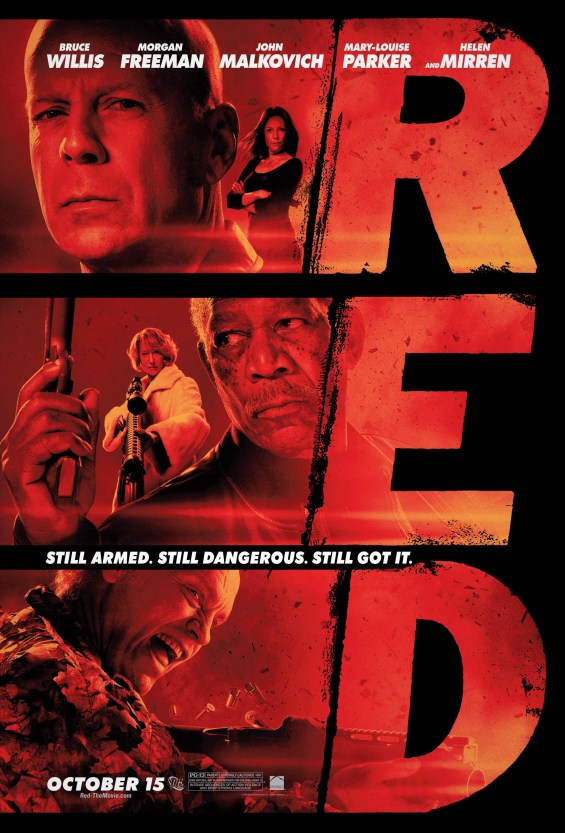
RED (2010) – Film Review

“You Just Had Your Ass Handed to You by a Goddamned Retiree.” – Cynthia Wilkes

Loosely based on the comic book mini-series of the same name by Warren Ellis, RED, released in 2010, is a fast-paced and humourous action-comedy with an all-star cast of ageing actors and actresses. Yet, despite everything the film has going for it, RED never quite reaches the soaring heights of exhilaration most would expect to see from an action flick with a cast of this calibre. Still, at the very least, RED doesn’t just rely on its renowned performers to impress, as director Robert Schwentke (The Family JewelsR.I.P.D.The Captain) integrates a sufficient amount of both style and wit into the adaptation.

Plot Summary: When his peaceful life becomes threatened by persistent attacks from squads of heavily armed, masked assailants. Former black ops agent, Frank Moses, reassembles his old team of highly-trained assassins in a last-ditch effort to uncover who his assailants work for and why they are hunting him…

One of the few DC Comics properties not based around superheroes and/or supervillains. RED was surprisingly the first widely-released adaptation of a DC Comics series not produced by Warner Bros. Pictures, as Batman, released in 1966 by Twentieth Century Fox, was a spin-off from the television series. Whereas Superman, released in 1948 by Columbia Pictures, was technically a serial. These comic book roots factor into the film in a number of ways, some visual, some not. For instance, when it comes to the narrative, the pacing often seems unnecessarily quick, making the constant location-jumping of the characters feel overwhelming at points. On top of this, there is an abundance of scenes throughout RED that seem to serve little-to-no purpose, such as a moment in the opening montage of Frank’s day-to-day life where he positions Christmas decorations, implying the festive season will somehow play a part in the story. Yet, from that scene onward, Christmas isn’t even mentioned, so why is it there?

The leading component to the enjoyability of RED is undoubtedly its formerly mentioned cast and their respective characters. From Bruce Willis as the hard-boiled protagonist; Frank Moses, to Morgan Freeman as the capable yet cancer-ridden; Joe Matheson, along with John Malkovich and Helen Mirren as Marvin Boggs and Victoria, a paranoid nut-job and sophisticated assassin, respectfully. All of the characters that are part of the central team known as R.E.D. (an acronym for “Retired and Extremely Dangerous”) are well-defined and sufficiently likeable. Outside of this primary team, however, some of the characters suffer from a lack of development. Most notably, William Cooper, portrayed by Karl Urban, a misguided CIA agent assigned the task of capturing Frank and his team. Frank’s love interest, Sarah Ross, portrayed by Mary-Louise Parker, is, unfortunately, just as bland, with her character arc of maturing from a fearful, reluctant companion to an adrenaline junkie relishing in her time beside Frank, being corny and unbelievable.

Evidently inspired by the comic book mini-series it’s based upon, RED is generally rather creative with its visuals, implementing a considerable number of innovative shots that rotate around the characters as they perform various tasks. Nevertheless, the cinematography by Florian Ballhaus isn’t impeccable, as the film is frequently impaired by the jerky, hand-held style of camerawork that plagued many action sequences in the early 2010s. Furthermore, while I appreciate the attempt to add some flair to the visuals by integrating a string of imaginative location transitions, a few of these transitions come across as somewhat cheesy, particularly whenever they revolve around a screen-spreading postcard.

In a quirky little detail, all of the tracks throughout RED‘s original score are titled to fit the acronym of R.E.D. Some of these titles include; Rotating Enforcement DeviceRegular Easygoing Dudes and Rehash Every Detail. However, even when ignoring this minor detail, the original score by Christophe Beck is rather impressive, adding to the film’s appeal as a lively and stimulating guitar-led soundtrack that more than fits the quick pacing and sharp wit seen throughout the rest of the runtime.

When it comes to the action sequences, it may surprise many to learn that RED largely spreads out its rousing set pieces. If truth be told, the film’s most interesting narrative decision is that every act feels different in its approach. The first act, for example, predominantly focuses on humour, whilst the second act takes on a more serious tone, and the third act bursts into an exhilarating display of discharged firearms and downed adversaries. That’s not to say that the first two acts don’t retain any of their own exciting moments, however, as they certainly do. Interestingly, actress Helen Mirren had to learn how to fire a gun without blinking to appear more like an experienced assassin in her action sequences. This is actually an issue that has troubled cast members of the action genre for years. In fact, blinking was one of the main reasons why the cast of The Matrix trilogy wore sunglasses, concealing their involuntary reactions.

In summary, whilst RED is an action-comedy endowed with prominent names, most will come away imbued with the reassuring thought that all of the cast left their egos at home to assemble something amusing and easily digestible. Although the film isn’t anything extraordinary and definitely has its fair share of flaws, RED does have some of the makings of an entertaining action-comedy, pleasing fanatics of the veteran actors/actresses whose names litter the film’s promotional material, especially. Rating: high 5/10.

Red Teaser 1sht.Rev.1:Red Teaser 1sht.Rev.1