The Darkest Hour (2011) – Film Review

“What’s the Dress Code for the End of the World? Jacket, No Tie?” – Sean

Initially intriguing yet ultimately vacuous, 2011’s The Darkest Hour is an apocalyptic blockbuster that will seem like familiar territory for most with its relatively straightforward premise of a group of survivors escaping a hostile, extraterrestrial foe, its only genuinely innovative ideas appearing in the form of its setting; Moscow, and the unique, electricity-based abilities/appearance of its unworldly invaders. Rammed with immensely corny dialogue, uninteresting characters and cheap-looking set design, The Darkest Hour fails on most fronts, leaving its title to ironically reference the fact that the film’s initial release may have been the ‘darkest hour’ for all the careers of those involved in its production.

Plot Summary: When American software developers Sean and Ben travel to Moscow to sell their latest program to investors, their Swedish associate Skyler double-crosses them, forcing them out of the deal. In an attempt to drown their sorrows, the duo head to a nightclub. Until, out of the blue, the Russian population is startled by the appearance of mysterious rays in the sky, soon discovering that the lights are, in actuality, an extraterrestrial force invading Earth and utilising our power supply to eradicate all mankind…

The inclusion of the Russian setting and, by proxy, Russian crew/extras can be attributed to producer Timur Bekmambetov, who after becoming involved in the project, allowed the production to use Moscow as a backdrop instead of the typical U.S. locations, predominantly due to Bekmambetov owning his own production company in the city, known as Bazelevs, where the majority of the film was shot, with the crew consisting of roughly 30% Americans and 70% Russians. In conjunction with director Chris Gorak (Right at Your Door), who ordinarily serves as an art director/production designer on sets, harbouring minimal experience as a director, the duo aimed to make a film that would thrill audiences and feel distinct via its foremost setting, but evidently, they did not achieve this.

The central cast of Emile Hirsch, Max Minghella, Olivia Thirlby, Rachael Taylor and Joel Kinnaman are strong names, but unfortunately, all portray rather simplistic and indistinguishable characters. Fortunately, the audience is provided with a few leads that hint towards the impending extraterrestrial invasion as protagonists Sean and Ben prepare to close the deal for a party-spot program they’ve created, only to find that their alleged business associate, Skyler, has ripped them off, stealing their idea and pushing them out. Supposedly, after putting much time and effort into their project, the pair idiotically did nothing to protect their intellectual property, merely moping around a nightclub until they encounter American traveller, Natalie, her Australian friend Anne, as well as Skyler, whom they shepherd into their group during the initial raid in spite of his earlier betrayal with next-to-no drama.

Shot in 3D as opposed to going through post-conversion. The Darkest Hour‘s production was originally fifty-eight days, with a further eight to nine days being added onto the production schedule once it was decided the film would be shot in 3D. Yet, throughout the runtime, these 3D effects barely register due to so much of the film taking place in dimly-lit environments (frequently depicted by shabby sets), the only real highlight of the 3D effects being the eye-catching opening title sequence. Furthermore, despite The Darkest Hour‘s constant attempts to bombard the audience with disintegrating civilians, handcrafted weapons and adrenalin-fulled chases across deserted, dust-covered streets, many of the film’s action sequences are fairly lacklustre, with the cinematography by Scott Kevan doing little to enhance the cinematic ennui.

From tracks like Northern Lights to Here’s Our Mission and Man Overboard, the film’s orginal score by Tyler Bates is occasionally effective but not all that memorable, often feeling just as gaudy yet creatively uninspired as the visuals, barring the score’s recurring use of bellowing electronic rhythms and propulsive synthesised experiments, serving, in a way, as an audible extension of the eerie, electrical sound design that accompanies the belligerent extraterrestrials.

As mentioned many times, the film’s unusual alien species only ever appear in some form of electrolocation, sensing the electricity in living beings by generating electrical fields. A downside of this ability, however, is that the extraterrestrials cannot see through any type of glass, as the transparent material is a poor conductor of electricity. This fascinating concept is what makes the aliens stand out when compared to invaders from other sci-fi blockbusters, especially since they are protected by electrical shields and can vaporise their victims instantaneously. As such, this imperceptible, seemingly unstoppable force draws the audience in through mystery and uncertainty, eliminating much of the population of Moscow overnight. That said, the extraterrestrial’s unpredictable, electrical abilities do begin to break down the longer the central group of survivors outwit them, given the group should lack any of the skills or knowledge needed to find a way out of their precarious situation. Of course, another minor issue arises in their colour as the aliens take on a glowing golden appearance, whereas electricity, in reality, is colourless.

In summary, The Darkest Hour is a sci-fi blockbuster that falters in its many attempts to propel its audience past their inevitable plot-related questions, the occasional wobbly acting and the easily foreseeable climax. While the film does include a handful of intriguing ideas and excellent electricity-affiliated visuals (alongside a periodic usage of real-world science), The Darkest Hour is obviously not the ‘electrifying’ experience the filmmakers intended it to be. Rating: 3/10.

darkest_hour_ver3_xxlg-transformed

Leave the World Behind (2023) – Film Review

“A Conspiracy Theory About a Shadowy Group of People Running the World Is Far Too Lazy of an Explanation… Especially When the Truth Is Much Scarier.” – G. H. Scott

Suspenseful, intriguing and enigmatic, 2023’s Leave the World Behind is an adaptation of the novel of the same name by Rumaan Alam. Steadily drawing its audience in through its engaging premise and stunning camerawork, this stylish Netflix Original is an apocalyptic thriller centred around the idea of humanity’s destruction being brought about by our distrust of others, our overreliance on modern technology and our lack of control over the planet. And, although not perfect, the film is a predominantly engrossing and intricate original flick for the streaming service in more ways than one.

Plot Summary: Exchanging New York City for a much-needed family getaway at a luxurious, remote rental home, couple Amanda and Clay Sanford are shaken by the late-night arrival of the sharply-dressed stranger, G. H. Scott, and his daughter, Ruth, bearing troubling news of a regional blackout and communication issues. But, as the pair are invited inside and speculate on why this rapid technological breakdown is occurring, all signs begin to point to more than a temporary malfunction…

Written and directed by Sam Esmail (Comet), creator of the incredibly gripping and considerably underrated crime-thriller television series; Mr. Robot, through which Esmail proves his extraordinary talent as a screenwriter and director. Leave the World Behind proves, once again, that Esmail is an absurdly talented filmmaker, governing the film’s pacing, upsurge in tension and consistently dour tone to an astonishing degree, all whilst enveloping the story in an unpredictable and surprisingly close to reality ‘end of the world’ scenario, even if the narrative unnecessarily harbours a lengthy runtime of almost two and a half hours. I can, however, see some taking issue with the film as a result of its conclusion, which is rather inconclusive and underwhelming after all the film’s build-up, even though the climax does answer many of the questions the audience likely possesses at that time.

The central cast of Julia Roberts, Mahershala Ali, Ethan Hawke, Myha’la, Farrah Mackenzie, Charlie Evans and Kevin Bacon all hold their own throughout the runtime, authentically portraying a concerned family, a pair of fairly unwelcomed guests and a distrustful neighbour with the appropriate dose of awkwardness and apprehension. Yet, the characters themselves aren’t given enough to make them appear memorable or complex, merely functioning as viewpoints for the audience as they piece together the sprinklings of clues and information they uncover in relation to the circumstances that are transpiring around them.

Utilising its colour palette to represent specific characters, like the colour blue, for example, being employed around the Sanford family, with their bedroom, car, clothes and other minor details all sharing this colour. The visuals, specifically the sleek cinematography by Tod Campbell, are inventive and attractive, visually conveying much of the paranoia the characters are feeling while implementing Esmail’s signature style of filmmaking via uncomfortable close-ups on the characters, positioning them in the corner of the frame to further put the audience on edge, with even the wall art in the master bedroom altering over time as Amanda and Clay’s temperament intensifies. Additionally, Leave the World Behind houses a few moments of fairly impressive CGI whenever the characters encounter a CG flamboyance of flamingos or a herd of deer near their rental home, which is certainly abnormal and visually interesting, yet the animals’ significance in the grander narrative is largely lost on me.

Crafting an outstanding score for all four series of Mr. Robot, Mac Quayle is a superb composer and continues to prove his worth with his nail-biting, horror-esque score for Leave the World Behind, continuously adding to the suspense of each and every scene, whether there is any physical peril at that time or not. During tracks such as; Beach Day and Cyberattack, Quayle’s orginal score is led by an isolated, eerie piano piece, placing the audience (for a brief moment) amid the film’s impending apocalypse and the human drama unfurling within. However, as much as the score attempts to immerse the audience in the narrative, some of the licensed songs chosen for the film have the counter effect, seeming unsuitable and irrelevant to both the tone and the story, despite the stylish opening animated sequence where one of these songs is featured, serving as an electrifying curtain-raiser.

On another note, Leave the World Behind interestingly contains several references to Esmail’s previously mentioned television series, including Amanda’s laptop and the yellow emergency kits the character, Danny, purchases both being produced by E-Corp, a fictional corporation featured in the series, as well as a book written by the Mr. Robot character, Irving, also appearing, suggesting that the stories may take place in the same universe, which would make sense, given the stories’ shared notions of hackers, cyberattacks and theories regarding online terrorist groups.

In summary, Leave the World Behind is a Netflix Original that will undoubtedly divide its audience, taking an unconventional approach to the well-known formula of the apocalyptic scenario, leaning more into the isolated paranoia and scepticism of an ordinary American family rather than the grand destruction of famed cities and their associated landmarks across the globe. Even so, whilst not quite as polished or as compelling as Esmail’s masterwork of a television series, Leave the World Behind definitely has its notable elements, in my opinion, grounding itself in reality as much as possible. Rating: 7/10.

leave_the_world_behind_xxlg

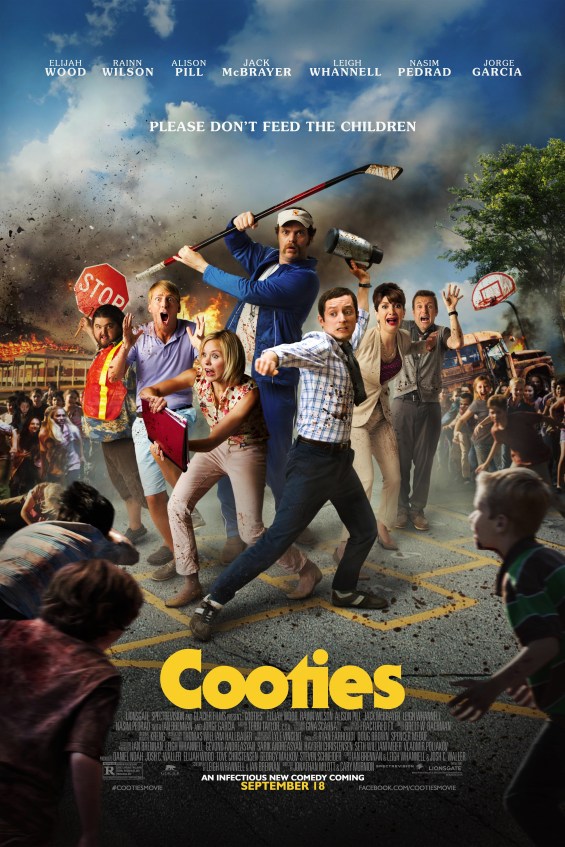
Cooties (2014) – Film Review

“Nap Time, Motherfuckers…” – Wade

For many, children can seem like loud, disease-infested monsters, and it’s not difficult to see why. There’s usually something leaking out their noses, their meals are often encrusted around their mouths, and they care little for social decorum or personal space. As such, it’s not too surprising that a horror-comedy like Cooties would come along in 2014 to take this waggish status to a more terrifying level, altering children into nimble monstrosities hungry for human flesh. Yet, in spite of how much potential a concept like this holds, Cooties ultimately squanders many of its favourable qualities, never fully committing to its absurd premise and the horror/humour it holds.

Plot Summary: When a mysterious virus originating from contaminated chicken nuggets hits an isolated elementary school, transforming the children within into a feral swarm of flesh-eating monsters. A group of misfit teachers are forced to band together as they attempt to flee the bloody, juvenile carnage…

Directed by Jonathan Milott and Cary Murnion (BushwickBecky), Cooties undoubtedly harbours a remarkable premise, and the screenplay effectively sets itself up as a hybrid of both comedy and horror in its first act, balancing conversational witticisms and light moments of characterisation, with violent sequences of teachers and parents being torn apart by the infected children. However, the screenplay quickly turns sour once the second act arrives, as a number of plot conveniences/inconsistencies arise to make the perilous situation of the central group of characters survivable. Moreover, as the virus spreads and the teachers become trapped inside the school, the story begins to feel rather generic as the screenplay moves between uninteresting plot points from the chintzy jokes that preceded them.

While the characters featured throughout Cooties aren’t what I’d describe as particularly memorable or unique, they are, at least, well-defined and have their respective witty moments. A fair portion of this character appeal could also be attributed to the cast, however, as Elijah Wood, Alison Pill, Rainn Wilson, Leigh Whannel, Jack McBrayer and Jorge Garcia all deliver excellent performances as self-centred educators who are evidently displeased with how their lives have turned out. For example, Clint (the protagonist), who formerly moved to New York City in an attempt to become a novelist, reluctantly finds himself back in his hometown of Fort Chicken, Illinois, as a substitute teacher. The only positive outcome of his return home is his reconciliation with his childhood crush, Lucy, who now works at the same school. But, any chance of sparking a connection with her is swiftly stomped out by P.E. teacher, Wade, her loathsome boyfriend. Presumably, leaving many audience members grateful they don’t lead a life as a downtrodden, small-town elementary school teacher.

Aside from the truly nauseating opening title sequence at a chicken farm, which is sure to turn many audience members into vegetarians. Thanks in part to its use of vile close-ups, sludgy green colour palette and singular chicken nugget stuffed with an ominous black gloop. The rest of Lyle Vincent’s cinematography is relativity drab, relying on monotonous mid-shots to depict the puerile chaos. Outside of a handful of moments where close-ups are effectively employed to display the fantastic practical effects, that is, including a darkly comedic sequence in which the infected children pull the hapless school principal apart, using his intestines as a skipping rope, soon thereafter.

Cooties‘ original score, composed by Kreng, a.k.a. Pepijn Caudron, is an interesting musical composition, a quirky mix of electronic horror and childlike innocence, much like the film itself. And whilst the score is occasionally too synth-heavy, which can seem a little odd given the film’s lack of 1980s influences. Cooties‘ soundtrack does make space for haunting vocals and violins where it can, blending comforting and madcap cues to create splendid tracks like Opening Titles and Rick’s Tape.

As previously mentioned, Cooties does appear fairly derivative following its first act, relying on no end of familiar tropes for the zombie subgenre. In addition to caving into an array of plot convinces, such as the sex-ed teacher, Doug, possessing a significant amount of knowledge on viruses and the human brain alike, so he can explain to the others that adults cannot be infected. Still, that isn’t where the writing-related issues cease, as towards the end of the third act (spoilers ahead in this section for those who wish to go in blind), the story becomes virtually aimless, providing no resolution as the characters scurry through the barren, nearby town of Danville until the credits roll. Of course, there is always the possibility that this sudden discontinuation was a result of the film’s limited budget, but it’s a less-than-satisfying way of concluding the narrative, nonetheless.

In summary, Cooties‘ screenplay is largely what drags the rest of the project down, appearing almost confined in its storytelling as if the screenwriters couldn’t reach beyond the typical traits of a zombie flick. Once the teachers hunker down inside a classroom, the story grinds to a tedious halt, merely observing the characters as they crawl through air ducts and suit up with school equipment to escape, scenes you’ve seen a thousand times before in other zombie-centric stories. But, what’s most disappointing, is that Cooties wastes such an inspired idea, as teachers surviving against a horde of infected children is an imaginative and amusing concept that could’ve easily made for an enjoyable, low-budget horror-comedy if it was executed skillfully. Rating: 4/10.

cooties-p1005972

Left Behind (2014) – Film Review

“I Don’t Have All the Answers, but for Now, Faith Is Enough.” – Buck Williams

Awkwardly combining religious proselytising with a number of well-worn tropes from the disaster genre. Left Behind, released in 2014, is an apocalyptic thriller with a fascinating idea at its core, depicting the events that would transpire if millions of people suddenly vanished off the face of the Earth. A brilliant concept that is utterly squandered due to its horrendous execution, with subpar production values, bewildering dialogue and appalling performances, being just some of the many issues this overtly religious thriller suffers from. As such, Left Behind presents one of the most unintentionally hilarious depictions of the apocalypse ever committed to film, which more often than not, devolves into enunciated Christian propaganda.

Plot Summary: When millions of people suddenly disappear without a trace, throwing the world into disarray as unmanned vehicles crash, planes fall from the sky and mass riots break out. Airline pilot, Ray Steele, struggles to keep composure aboard his proceeding flight to London as he and his passengers try to comprehend the inexplicable scenario they find themselves within. Meanwhile, Ray’s daughter, Chloe Steele, braves the chaos of the city streets below in search of her mother and brother…

If the Left Behind title sounds familiar, that’s likely because the film is actually a reboot of a relatively well-known series, with Left Behind: The Movie, Left Behind II: Tribulation and Left Behind III: World at War being released prior in 2000, 2002 and 2005, respectively. All of them are based on the best-selling series of apocalyptic novels by Jerry B. Jenkins and Tim LaHaye; a series that is essentially a modern-day rendition of the biblical rapture, where all Christians are transported to Heaven as divine forces decimate the Earth. 2014’s Left Behind adapts a small portion of the first book in the series, setting the majority of the story aboard an airliner piloted by Ray Steele, which for an apocalyptic thriller, isn’t the most exciting location to view a large-scale catastrophe from.

Speaking of the protagonist, despite the uproarious actor, Nicolas Cage, portraying the central character of Ray Steele. Left Behind never manages to get an entertaining performance out of the actor as for most of the runtime, Cage, who in interviews has stated that he took the role at the urging of his pastor brother, seems practically sedated, even when his character is convinced that the plane is heading towards certain doom. Regrettably, none of the supporting cast is much better, with Chad Michael Murray, Cassi Thomson, Nicky Whelan and Gary Grubbs (among others) all portraying one-dimensional characters continually reciting unnatural dialogue. From the Southern entrepreneur, Dennis Beese, to Cameron ‘Buck’ Williams, a renowned news reporter, who inadvertently becomes Ray’s co-pilot, none of the characters throughout Left Behind are indelible or significantly developed outside of their lack of devotion to Christianity.

In regard to the visuals, Left Behind doesn’t exhibit much improvement over its dialogue and performances as the set pieces appear small and chintzy, the lighting is flat, Jack Green’s cinematography is largely styleless and the editing between the drama on board Ray’s flight and the disorder on the ground below is a monotonous back-and-forth of plot points with no scene being given enough time to sink in. Moreover, the CG effects for the airliner itself are rather poor, particularly during one of the film’s final moments, where Ray is forced to land the plane on a makeshift runway.

Likewise, the original score by Jack Lenz has no identity or anything even remotely unique about it, subsequently causing the soundtrack to dissolve into the background where the majority of audience members will forget it even exists. Quite surprising considering that Lenz has proven himself to be a capable composer in the past, penning many respectable scores, including the theme for the Goosebumps television series.

Yet, even when overlooking all of the flick’s shortcomings in terms of filmmaking, the film continues to stutter as there are plenty of moments within the film that can be mocked. But, by far the easiest scene that illustrates just how uniquely awful Left Behind is would be the moment in which Irene Steele stares adoringly at a terribly photoshopped picture of her family. It is possible, however, that the film’s flawed execution could be a result of a lack of experience on the part of director Vic Armstrong (Joshua TreeA Sunday Horse), as Armstrong is known for his work as a stunt coordinator/stunt performer, not as a director.

In summary, while Left Behind‘s premise is undoubtedly an interesting one that could’ve made for a compelling apocalyptic thriller, if placed in the hands of the right director and/or screenwriter. The version of Left Behind we did receive is far from compelling as its flaws are nearly endless, consequently leading the film to be panned by critics and perform poorly at the box office. Still, this wasn’t the end for Left Behind as not long after, the producers of the film decided to finance the sequel through an Indiegogo campaign, simply titled; “Help Us Make Left Behind 2.” The campaign received £61,558 out of the half a million asked, with the last update on the project being on May 7th 2015. So, more than likely, the project was cancelled, which I’d say is for the best. Rating: 2/10.

left_behind_ver3_xxlg

World War Z (2013) – Film Review

Very loosely based on the novel of the same name by Max Brooks, ‘World War Z,’ directed by Marc Forster, attempts to tell an enormous globe-trotting story of a spreading zombie virus, and although it does have a few entertaining elements here and there, so much so that it was one of the highest-grossing films of 2013. I personally found the film to be extremely messy, and overall, pretty forgettable.

Plot Summary: After narrowly escaping an attack in Philadelphia, former United Nations employee, ‘Gerry Lane,’ traverses the world in a race against time to stop a zombie pandemic that is toppling armies and governments, soon threatening the survival of humanity itself…

Even with a pretty standard plot for a zombie flick, the film unfortunately is still brimming with plenty of cliché moments and jump-scares throughout, in addition, of course, to the film’s overall lack of style. Making the entire experience really struggle to stand on its own amongst the many other films within its genre, which I do feel can be mostly put down to the director Marc Forster (Finding Neverland, Stranger Than Fiction, Christopher Robin).

Brad Pitt, Mireille Enos both do a decent job as ‘Gerry’ and ‘Karin Lane’ within the film, despite their characters having pretty much no characterisation outside of them being a loving family. Their children, however, portrayed by Sterling Jerins and Abigail Hargrove. I found very irritating, as aside from their constant screaming and crying, their child performances weren’t very convincing to me at all. Strangely, Peter Capaldi also has a small role within the film, despite barley adding anything to the story.

Ben Seresin handles the cinematography throughout the film, and aside from a few scenes were hand-held camera techniques are used to reflect the chaos we see during many of the zombie attacks, many of the visuals are extremely flat, as the cinematography is very bland and uninspired, usually sticking to very standard shots and never really experimenting with anything incredibly interesting. The CG effects throughout the film’s runtime are also very inconsistent, as in some scenes the visual effects work perfectly fine. Whereas in others, they look truly awful, with many of the zombies bouncing around as if they were made out of rubber. I do appreciate the various aerial shots which are used during many of these scenes, however, as I feel these shots really incapsulate the enormous scale of the film’s devastating pandemic.

The film’s original score by Marco Beltrami is decent overall, it works within the film to increase what tension and drama there is on-screen. But, outside of the film, it isn’t memorable in the slightest. Coming off as your standard blockbuster soundtrack with the occasional ‘Inception’ noise thrown in for good measure, it is very possible the score was rushed, as for those who may not know, ‘World War Z’ actually went through a very troubled production process, as multiple different directors, writers and producers were brought-on and then dropped off constantly. This is mostly why the film sometimes feels very unconnected and messy (which also isn’t helped by its quick pacing). Taking this into account, the film definitely could’ve been far worse, but I still found it very noticeable.

Despite all of this, the film does still have some elements I enjoy, as it is simply fun to watch the madness ensue at various points during the film, as the hordes of zombies bring chaos to the streets of whatever city the film finds itself in. My favourite scene within the film is definitely near it’s ending, as the film takes a very different direction in choosing to focus on a small tension-filled scene, which I thought was pretty well-executed for the most part.

In summary, ‘World War Z’ isn’t the worst big-budget film you could spend your time watching, it definitely has a variety of problems. From the predictable and generic plot, to the boring characters and the mix of poor CG effects and writing. Which all ensured that I wasn’t such a huge fan, but if you enjoy a mindless zombie blockbuster every so often, then there may be some enjoyment in this for you. But, for me personally, ‘World War Z’ simply felt like a hollow experience, and is nothing more than a generic zombie flick. Final Rating: 3/10.

world_war_z_ver3_xlg

Bird Box (2018) – Film Review

‘Bird Box’ is based on the novel of the same name by Josh Malerman, which mostly aims to be a dark horror/thriller with an original and twisted story as well as a few other interesting aspects in regards to its filmmaking. Unfortunately, however, the film soon falls into a pit of disappointment which it really struggles to escape from, resulting in ‘Bird Box’ becoming nothing more than another generic Netflix fright-fest.

Plot Summary: In the wake of an unknown global terror, a mother must find the strength to flee with her two children down a treacherous river in search of safety. Yet, due to the unseen deadly forces pursuing them, the perilous journey must be made blind-folded…

As the film jumps back-and-forth between the two different time-periods, the film’s structure can become very frustrating at points, as I personally found the initial chaotic event far more entertaining than the other time-period the film provides, yet this was always cut short as the film continuously cuts between the two at unusual points. The film also chooses to wrap the majority of its story in mystery, never really exploring what the monsters actually are, or how their abilities work. The film even chooses to never actually show the creatures on-screen at all throughout the runtime, and although I agree that not everything has to be explained within a story, the way ‘Bird Box’ presents it makes it nothing but frustrating as the film introduces questions without answers.

Sandra Bullock portrays a struggling mother alongside Danielle Macdonald, Trevante Rhodes and John Malkovich who all portray people attempting to survive in a brutal world, and they do their best considering the weak characters they had to work with. The majority of the supporting cast are also decent, with Sarah Paulson even having a short appearance within the film. However, I actually found she was incredibly wasted in the small (and mostly pointless) role she had within the narrative.

In spite of the film’s many wilderness scenes being shot near the beautiful Smith River in the far north of California. Nearly the entire visual presentation of ‘Bird Box,’ is extremely dull, as the cinematography by Salvatore Totino and editing Ben Lester never really excel beyond ‘okay.’ Usually having scenes consist of many boring shots which never really add much to the tension or atmosphere aside from the occasional moment, this, of course, also alongside the extremely bland grey colour palette.

This is also the case when it comes to the original score by Trent Reznor and Atticus Ross, coming across as nothing more than your standard score for any modern horror/thriller with a slight technological twist, which is very surprising, considering these composers did excellent work on the soundtrack for ‘The Social Network,’ back in 2010.

Although the novel obviously came out before last year’s ‘A Quiet Place,’ I also couldn’t help but notice many similarities between the two films. Such as the lack of a certain sense, the apocalyptic setting, a theme of family and the eerie atmosphere/tone (despite the idea of the monsters making you kill yourself being very original). I also couldn’t help but feel the film never made enough use of its concept of simply witnessing the creatures drives characters to suicide, as this is a terrifying idea, and could’ve provided some very gory and truly shocking moments.

In summary, ‘Bird Box’ is one of those few films that gets a large amount of attention for reasons I’m not entirely sure of, as personally, I thought the film was nothing but bland and forgettable in many aspects. Aside from perhaps the main performance by Sandra Bullock and the original idea of its story. There wasn’t much I enjoyed about this adaptation, perhaps give it a watch if you’re really interested, but, in my opinion, there are many similar films which explore these same ideas just with a much better execution. Final Rating: 3/10.

bird_box_xxlg