Spree (2020) – Film Review

The world of social media influencers vying for clicks, likes, views and retweets all to achieve viral fandom is a twisted one, and ‘Spree’ is far from the first film to delve into this subject matter with a satirical lens. What makes the film different is its secondary inspiration, being based on the true story of an Uber driver who went on a killing spree in early 2016, ‘Spree’ has plenty of comically violent scenes to accompany its social media commentary. Yet, even in spite of Joe Keery’s magnetic screen presence, ‘Spree’ is a film that always feels as if it’s on the verge of being something exceptional, but its reach far exceeds its grasp.

Plot Summary: Desperate for an online following, twenty-three-year-old wannabe influencer and rideshare driver; ‘Kurt Kunkle,’ devises a malicious scheme to go viral, installing a series of cameras inside his rideshare car in order to film his unsuspecting victims as they meet a gruesome end…

Co-written and directed by Eugene Kotlyarenko (A Wonderful Cloud, Wobble Palace, We Are), ‘Spree’ was initially envisioned as a claustrophobic horror based around the story of the previously mentioned serial killing Uber driver, who claimed a “Devil Figure” inside of the rideshare app was controlling his actions. And, although this terrifying true story would have certainly provided enough inspiration for an indie horror flick, Kotlyarenko and co-writer Gene McHugh soon began to swerve more into dark comedy after giving the killer an intense craving for attention. This eventually evolved into the film’s central theme of social media obsession, which while often used to great effect to mock online influencers, does frequently feel underdeveloped and retracts from the film’s tension, pushing ‘Kurt’s killing spree into the background in exchange for awkward character moments, which will inevitably disappoint those hoping to see plenty of grisly kills.

Joe Keery portrays the film’s psychotic protagonist; ‘Kurt Kunkle,’ who is suitably just as upbeat and inappropriate as many real-world influencers. This realism is most likely a result of Eugene Kotlyarenko and Joe Keery’s research, as the pair watched many cringe compilations of people online without a big following to help create the character, and this comes across through Keery’s body movements and relentless optimism, making for an occasionally irritating yet charismatic protagonist as ‘Kurt’ always remains hopeful his night of murder will increase his follower count after trying (and failing) for the past decade. It’s just unfortunate that ‘Kurt’ doesn’t receive much development over the course of the runtime aside from one or two scenes, with much of ‘Kurt’s life outside of the internet being left a mystery.

The cinematography by Jeff Leeds Cohn is obviously in the style of found-footage, but rather than simply having ‘Kurt’ film his every move similar to most found-footage flicks, the camera itself takes on numerous forms as the story is seemingly spliced together through iPhone cameras/screens, dash-cams, body-cams and even CCTV footage. Yet, despite this ever-changing camerawork ensuring ‘Spree’s visuals stay varied, there does come a point when it begins to feel as if the film is simply piling on footage, even sometimes having three shots displayed at once through a split-screen effect which does become slightly overwhelming, especially when combined with the film’s rapid editing.

Whilst there are a few found-footage films that have successfully integrated an original score without taking away the sense of realism the subgenre provides, ‘Spree’ is most definitely not one of those films, as although the pulsing electronic score composed by James Ferraro does help to build excitement, the film’s soundtrack repeatedly plays over scenes with no clear in-world source, which greatly dampens the illusion of the film being found-footage.

Of course, with ‘Spree’ having a heavy focus on all things social media, it would be crucial that the film stays truthful to what the internet is actually like (even through its cynical view). And, while the film does have many scenarios that feel as though they lack realism, whether that’s due to incredibly forced dialogue or ‘Kurt’s beyond moronic actions when trying to avoid the Los Angeles police force, anytime the film displays a phone screen there is a certainty that every app/website will be a real brand and will be overflowing with detail. For example, ‘Kurt’s constant live streaming never shies away from reality, meaning his stream’s comments are always rapidly unfurling with insults, jokes, and questions all from distinct usernames, which according to Eugene Kotlyarenko, took him over forty nights to type out.

In summary, Joe Keery’s entertaining performance can’t distract from ‘Spree’s shallow critique of social media, as whilst some may argue the story’s lack of depth is precisely the point as the film feels as if it’s unsure as to what to do with its concept, which is greatly disappointing. As, I personally think a dark comedy revolving around the obsessive culture of social media is ingenious, and films, like ‘Ingrid Goes West’ prove this idea can be executed well. ‘Spree,’ however, fails to deliver on this or its even promise of a violent and comedic thrill ride. So, while I do still believe the film will have a niche appeal, ‘Spree’s apparent flaws are likely to stop most from hitting the subscribe button. Final Rating: 4/10.

spree-p1102551

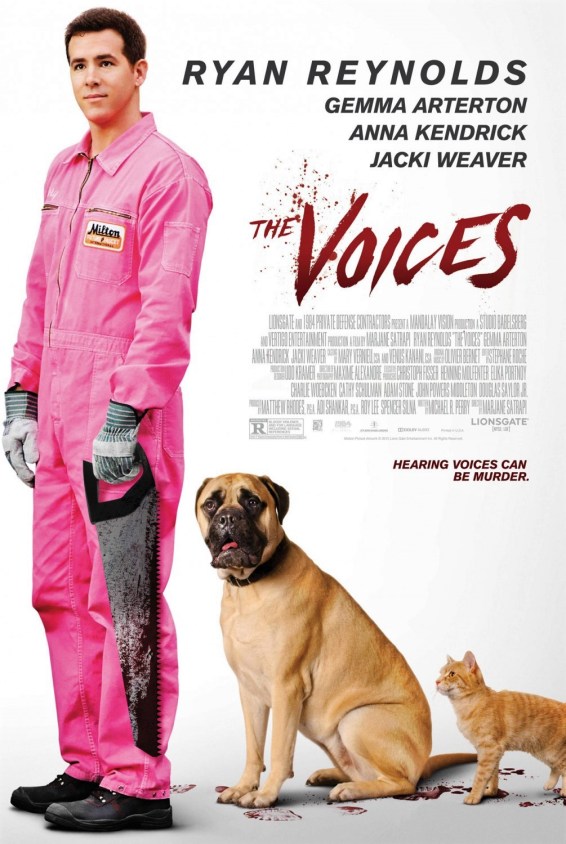
The Voices (2014) – Film Review

This obscure horror-comedy released in late 2014 will certainly make for a divisive viewing, as while ‘The Voices’ does feature an inspired use of colour and set design alongside a stand out performance from Ryan Reynolds, the film is also far more disturbing than much of its marketing would lead you to believe, swerving from absurd moments of humour to visceral moments of gore in a heartbeat. The resulting film essentially becoming a parody/throwback of/to classic horrors, like ‘American Psycho,’ and is a far-cry from a realistic study of psychosis for better, and for worse.

Plot Summary: After working a nine-to-five job at his local bathtub factory, the mentally ill; ‘Jerry,’ finds comfort in returning home to his beloved pets; ‘Bosco’ and ‘Mr. Whiskers.’ Until one day, with the help of his psychiatrist, ‘Jerry’ decides to pursue his office crush; ‘Fiona.’ But, when their relationship takes a sudden, murderous turn leaving ‘Jerry’ with the corpse of his co-worker, he tries desperately to strive for normalcy, only to fall deeper into instability…

Early in the pre-production of ‘The Voices,’ director Mark Romanek, best known for the 2002 drama/thriller; ‘One Hour Photo,’ was attached as the film’s director, before Marjane Satrapi (Persepolis, Chicken With Plums, Radioactive), later took over as the head of the project. And, whilst ‘The Voices’ does feel like quite a large shift from Satrapi’s usual work, it’s hard to know exactly which director would’ve excelled with a screenplay as original as this one is, as while ‘The Voices’ does share some similarities to other serial killer flicks, many of the film’s ideas are just brimming with personality, as everything from ‘Jerry’ showing symptoms of OCD when slicing up the bodies of his victims, to ‘Jerry’ living above an abandoned bowling alley, the film just has such a unique appeal.

Ryan Reynolds really gets a chance to shine portraying the film’s mentally ill protagonist, as whilst ‘Jerry’ does commit many horrible acts over the course of the runtime, Reynolds manages to capture the idea of ‘Jerry’ being a man forced down a road of violence. He is a distinct serial killer in the sense that he desires companionship and happiness, and doesn’t receive any pleasure from killing. So, when it’s eventually revealed what happened to him as a child, you can’t help but sympathise with him, evoking a level of emotion that many murderous characters struggle to achieve. But, unfortunately, the film’s side characters, portrayed by Gemma Arterton, Anna Kendrick, and Jacki Weaver, all feel quite thin as a result of them only being in the story to serve as ‘Jerry’s potential victims.

Maxime Alexandre handles the film’s cinematography well, as the camerawork throughout ‘The Voices’ remains fairly creative. The film’s visuals are most impressive most, however, when it comes to the film’s colour palette, set design, and set dressing, as with nearly the entirety of the story being seen through ‘Jerry’s perspective, the film displays the true extent of ‘Jerry’s delusions through its use of colour/sets. For example, when not on his prescribed medication, ‘Jerry’ views his apartment as very clean and organised, giving the location a much more comfortable feel, whereas when ‘Jerry’ does take his medication, he sees the grim reality of his soiled home.

The original score by Olivier Bernet is similar, never reaching into full on horror, but being a mixture of cartoonish, dream-like tracks, such as ‘In the Woods’ and ‘Jesus Dad,’ before then moving onto more upbeat tracks, like ‘Don’t Mess with Milton.’ A seemingly ironic track focused around the fictional woodland town of ‘Milton,’ where the story takes place, comically claiming the town to be nothing but a friendly and welcoming place.

The main aspect of ‘The Voices’ that I feel could make or break the film for many is likely to be its comedy, as whilst it is revealed fairly early on that many of the film’s bizarre moments, such as ‘Jerry’s pets speaking to him or ‘Jesus’ appearing on a forklift are all taking place within his mind, much of this strange humour is very hit-or-miss. However, an interesting yet small detail regarding the talking pets is that Ryan Reynolds actually voices each one of the animals himself, with each pet having a different accent, furthering ‘Jerry’s delusions. In fact, Reynolds actually modelled the voice of ‘Mr. Whiskers,’ a.k.a. ‘Jerry’s cat, after a Scottish friend he knew for over twenty years.

In summary, while ‘The Voices’ is overflowing with both charm and wit, it also has many issues. From its quickly altering tone and many jokes that fall flat, the film is far from a perfect horror-comedy. But, it does redeem many of its faults through its great performances and eccentric style, all playing into the film’s quirky personality. And, it’s due to all of this that the film feels as if its made for a very niche audience, yet for those ‘The Voices’ does appeal to, there is a fair amount to enjoy here. Final Rating: low 7/10.

voices_ver2_xlg

Krampus (2015) – Film Review

Whilst most Christmas films get across their message about how family is the true meaning of the holiday in a wholesome and light-hearted fashion, ‘Krampus’ takes quite a different approach as director Michael Dougherty (Trick ‘r Treat, Godzilla: King of the Monsters) crafts a cynical and amusing horror-comedy based around ‘Krampus,’ a creature from European folklore with origins stretching back to the days before Christianity, serving as essentially the sinister twin of jolly ‘Saint Nicholas,’ punishing those who misbehave in various odious ways. And, while the film is far from perfect, ‘Krampus’ creative ideas and impressive practical effects make the film worth its runtime.

Plot Summary: When his dysfunctional family clash over the holidays, young ‘Max’ finally decides to turn his back on Christmas, tearing up his letter to ‘Santa Claus’ in a fit of rage. Little does he know, his lack of Christmas spirit has unleashed the wrath of ‘Krampus,’ an ancient demon who punishes those who don’t celebrate the festive season. Forcing ‘Max’ and the rest of his family to fight for one another if they hope to survive…

Although there are plenty of enjoyable films out there to watch over the festive season, I usually always find myself craving something new around the Christmas period, as the cliché narrative of children helping ‘Santa Claus’ save Christmas gets very old quick. ‘Krampus’, however, does certainly attempt something new, even if it isn’t always successful. While the original outline for the film was closer to a straightforward horror, focusing mostly on ‘Krampus’ picking people off throughout ‘Max’s town, it was eventually decided to make it more of a dark retelling of a traditional Christmas film. This is why the plot is kicked off with a letter to ‘Santa,’ and why the film’s first act begins much like a family film would before then having a drastic turn towards horror and dark fantasy.

The film’s large cast of Adam Scott, Toni Collette, Emjay Anthony, David Koechner, Allison Tolman, Stefania LaVie Owen, Conchata Ferrell and Krista Stadler are all serviceable in their roles, even though many of their characters aren’t developed nowhere near enough. Additionally, ‘Tom Engel,’ a.k.a. ‘Max’s father, also has many moments where he doesn’t seem to take their life-threatening situation that seriously, almost as if he is acknowledging how bizarre the story is, which diminishes the film’s tension at points. But, with ‘Krampus’ featuring moments of humour and fright alike, the film obviously has many shifts in tone between scenes.

Jules O’Loughlin’s cinematography is nothing amazing altogether, as in spite of the film having quite a few memorable and attractive shots, there are also a large number of bland shots whenever the camera is focusing on the actors themselves. What is far more admirable though is how the camerawork enhances the film’s set design, making the audience believe that the film was shot inside a real house and outside on a real wintry street. When, in reality, over 95% of the film was shot on a soundstage, with the snow covering the ground being made from a material that’s commonly used for making nappies.

Composer Douglas Pipes handles the film’s original score, and he described his soundtrack as “A Collection of Twisted Christmas Carols With Pagan Thrown in,” as the score incorporates everything from the sounds of chains, bells, bones and animal-skin drums in addition to having choirs chant and whisper in different tongues, making for a foreboding but suitably Christmassy score. The track; ‘A Cold Wind,’ also does a phenomenal job of reiterating ‘Krampus’ as the ominous shadow of ‘Santa Claus’ through its use of sleigh bells. However, the film’s actual sound design features some incredibly strange choices for horror, as many cartoonish sound effects can be heard within the film, feeling immensely out of place every time they are.

One of the finest aspects of ‘Krampus’ as a film has to be its effects, as rather than having an overreliance on CG visuals, ‘Krampus’ brings all of its uniquely creepy creatures to life through detailed costumes and animatronics, harkening back to classic ’80s horror-comedies, like ‘Gremlins’ and ‘Fright Night.’ Many of the film’s terrifying monsters also share wonderfully horrific designs, with the final design for ‘Krampus’ and his elves being distilled from various postcards and illustrations seen over time. Or, in the case of the malevolent toys, taking inspiration from the 1992 low-budget horror, ‘Demonic Toys,’ with the angel ornament, teddy bear, robot and Jack-in-a-box that attack the family sharing many similarities to the toys seen in that obscure horror flick.

In summary, ‘Krampus’ is a rollicking ride of a Christmas film even if it isn’t quite as polished as Dougherty’s Halloween flick; ‘Trick ‘r Treat,’ as the film’s excellent practical effects, menacing creature designs and great original score all lend themselves very well to the distinctive story, despite the narrative itself often feeling like wasted potential considering ‘Krampus’ doesn’t full appear until near the end of the runtime. Regardless, this horror-comedy is still, in my opinion, the best on-screen interpretation of ‘Krampus’ and his devilish minions as of yet. Final Rating: 7/10.

krampus_ver3_xxlg

The Babysitter (2017) – Film Review

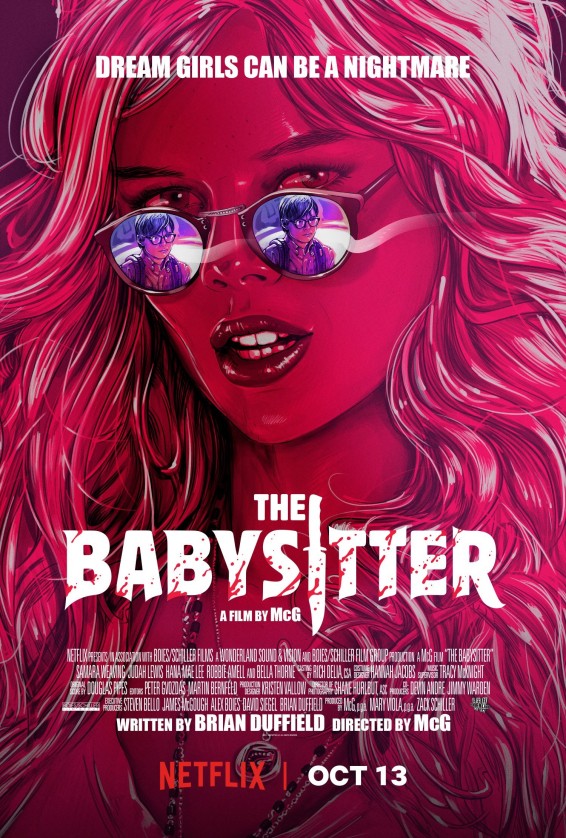
Originally filmed in 2015 with the intention of playing in cinemas, the horror-comedy; ‘The Babysitter,’ wasn’t seen by any horror fanatics until it released late 2017 after Netflix acquired the rights to the film for streaming. And, although ‘The Babysitter’ doesn’t exactly break any of the rules we’ve come to expect within the horror genre, this horror-comedy with splatterings of style must’ve been entertaining enough for those who decided to watch it, as the film would eventually spawn a Netflix-exclusive franchise with a later sequel.

Plot Summary: Riddled with anxiety, twelve-year-old; ‘Cole,’ has always been bullied and picked on due to his constant panicking, only finding comfort around the one person who understands him, his attractive babysitter, ‘Bee.’ That is, until one night, after ‘Cole’ secretly stays up past his bedtime to discover she’s actually part of a satanic cult, forcing ‘Cole’ to spend the rest of his evening evading ‘Bee’s band of killers who will stop at nothing to prevent him from spilling their dark secret…

Directed by Joseph McGinty Nichol (Charlie’s Angels, Terminator: Salvation, This Means War) or ‘McG’ as he more commonly goes by, ‘The Babysitter’ is a film that has received a number of alterations (both big and small) since even the early stages of its pre-production. For example, in the original screenplay for the film, ‘Sonya’ was actually a cheerleader, ‘Allison’ was a journalist for her high school newspaper, and ‘Max’ had dreadlocks, but eventually it was decided that ‘Bee’s cult followers should be reimagined to more closely reflect the stereotypical characters seen in classic slasher flicks, only in this film, they’re the antagonists. And, this idea is one of the film’s best aspects in terms of its writing, as it gives the film a real sense of self-awareness in addition paying respect to what came before it. Most notably, the ‘Friday the 13th’ series, which ‘Max’ references directly at one point when he chants; “Ch-Ch-Ch-Ah-Ah-Ah,” whilst chasing ‘Cole.’

Judah Lewis does manage to leave an impression in his first film role, portraying protagonist ‘Cole’ as an innocent twelve-year-old with few friends aside from ‘Bee,’ even if a large portion of his anxious characterisation feels far too over-the-top. Then there is also Samara Weaving as the titular babysitter; ‘Bee,’ and her cult followers; ‘Max,’ ‘Allison,’ ‘Sonya’ and ‘John,’ portrayed by Robbie Amell, Bella Thorne, Hana Mae Lee, and Andrew Bachelor, respectively. Who, are all wonderfully devilish throughout the film, having plenty of dark comedic moments between them making their deaths quite unfortunate, as while I’m sure most could’ve guessed their characters do die at some point within the narrative, we don’t get to spend enough time with any of them to get a strong grasp on their exaggerated personalities or any understanding of their malevolent cult.

In spite of the usually dull cinematography by Shane Hurlbut, ‘The Babysitter’ still manages to be one of the more visually interesting Netflix Originals through its unique style, as the film continuously implements different text, graphics and colours to give it a distinct stylistic appeal, not too dissimilar from (although nowhere near impressive as) ‘Scott Pilgrim vs. The World’ from 2010. Many of these editing decisions also help to redeem the film’s humour, which is extremely inconsistent, bouncing from hilarious cutaways and meta horror jokes to embarrassing lines of dialogue which try far too hard.

Whilst composer Douglas Pipes has crafted some great scores in the past, like ‘Monster House’ and ‘Trick ‘r Treat,’ ‘The Babysitter’ is certainly not one of them, as even with the film having many serviceable tracks. The soundtrack in general just lacks anything distinctive, and I believe that if it was ever compared to any other score from Pipes, or even just a handful of random horror scores, I doubt most would be able to tell it apart. The film also throws in the iconic Queen song; ‘We Are the Champions,’ nearing the runtime’s end, which feels immensely out-of-place and comes out of nowhere.

For a large duration of its tight runtime (which the film breezes through as a result of its unrelentingly fast pacing), ‘The Babysitter’s story is predominantly just one long chase sequence, and whilst occasionally tense, I couldn’t help but feel that the film’s screenplay could’ve taken better advantage of its evil babysitter concept or its few supernatural elements, despite the series second entry; ‘The Babysitter: Killer Queen,’ delving much further into the latter. Yet, the film doesn’t disappoint when it comes to its violence, having plenty of fantastically gruesome gore effects which are all successfully played for comedy.

In summary, I could see ‘The Babysitter’ being an enjoyable experience for some and possibly just a boring viewing for others, as when ignoring the film’s graphic gore and fun stylistic choices, the story leaves a lot to be desired, and can often feel derivative of horror classics even if this was the film’s intention to an extent with its focus on horror tropes/clichés. For me, although I do admire the film’s ridiculous tone and dark humour, the disappointing story can often feel sluggish, diminishing the film’s memorability and rewatchability. Final Rating: 5/10.

babysitter_xxlg

Happy Death Day (2017) – Film Review

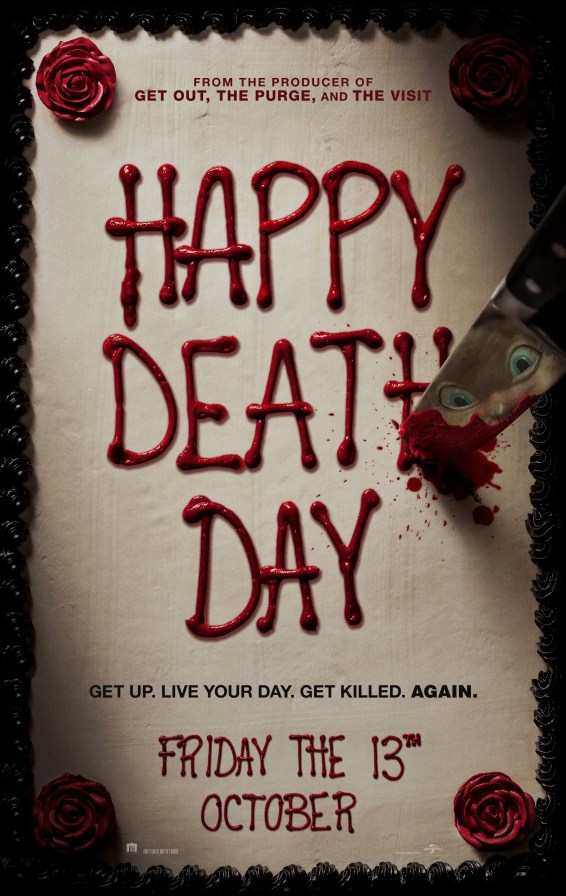
Another horror flick from production company Blumhouse Pictures, ‘Happy Death Day,’ released in 2017, does at least extend out of the usual range of Blumhouse horrors to become more of a horror-comedy than just a straightforward teen slasher. But, similar to the rest of their associated franchises, e.g. ‘Insidious,’ ‘The Purge’ and ‘Paranormal Activity,’ both ‘Happy Death Day’ and it’s sequel, have their fair share of issues, with some being far more severe than others.

Plot Summary: Waking up in the dorm room of a boy whose name she can’t remember after a night of heavy drinking, self-centered college student; ‘Tree Gelbman,’ intends to continue her trend of avoiding her birthday, but little does she know that later that night on her way to another party, someone is waiting to murder her. Only after being killed, ‘Tree’ awakens in the same dorm room, soon realising she is being forced to relive her brutal night of murder over-and-over again until she discovers her killer’s identity…

‘Happy Death Day’ similar to many other day-repeating stories in the past, takes most of its inspiration from the comedy classic; ‘Groundhog Day,’ from 1993. Yet, unlike many of the other films that are inspired by this beloved comedy flick, it becomes clear over time that ‘Happy Death Day’ is quite derivative of ‘Groundhog Day,’ as the film’s story not only utilises the comedy’s plot without much innovation (only throwing a killer into the mix). But, the film even steals the main point of the narrative, that being its main character and their correlating character arc, using the time-looping concept to in a way punish the protagonist for their cruel behaviour towards others.

In spite of this, however, the protagonist; ‘Tree,’ portrayed by Jessica Rothe, is by far the best element of the film, as while ‘Tree’ does go through a character arc that is all-too-familiar as previously mentioned, Rothe makes a fantastic first outing as an actress through her very enjoyable performance. Then, of course, there is the killer, whose identity remains a mystery throughout most of the runtime, known as ‘The Babyface Killer,’ the killer’s outfit is actually the mascot of ‘Bayfield University,’ where the film takes place, and although the costume itself is far more goofy then intimidating, the mask/costume was actually designed by Tony Gardner. The costume designer behind the now-iconic; ‘Ghostface,’ costume from the ‘Scream’ series, which does help redeem to the killer’s undoubtedly petty motivation.

The film’s cinematography by Toby Oliver isn’t anything amazing, but does back up the story effectively in a variety of scenes. Whether that’s through its use of wide sweeping shots when the characters are in an intense chase, or when more shaky hand-held camerawork is used to reflect ‘Tree’s breakdown when she first realises she is stuck in her current crisis. Yet, similar to much of its story, the film never leans enough into a more outlandish/experimental nature when considering what the film could accomplish with its cinematography.

Talented composer Bear McCreary handles the film’s original score, which isn’t very distinctive from most of his other work within the horror genre. But, despite the score’s lack of memorability, it still does feel as if there is a decent amount of effort put into it, as the soundtrack actually has quite a lot of range even if some of the tracks don’t always fit with the tone of the film. This also goes for many of the songs used throughout ‘Happy Death Day,’ as nearly all of the film’s song choices massively differ in both genre and general popularity.

Still, the biggest problem ‘Happy Death Day’ suffers from is the inconsistency of its tone, as although the film does attempt to have scenes featuring both scares and humour, alike, many of the film’s jump-scares and jokes range in quality, and occasionally even cancel each other out. Additionally, the film also takes an unusual approach to its violence, as while ‘Tree’ dies countless times throughout the film in a number of different ways. The film never allows for any creative or darkly amusing deaths, due to its lack of any blood or gore. Yet, this wasn’t always the case, as the original screenplay for the film did actually include more violence, so much so, in fact, that it would have gained the film a higher age rating, with plenty of scenes having much grislier deaths that were later altered by director Christopher Landon (Paranormal Activity: The Marked Ones, Scouts Guide to the Zombie Apocalypse) during pre-production.

In summary, whilst the signature performance from Jessica Rothe does help to make ‘Happy Death Day’ a far more enjoyable viewing, in addition to the film’s idea of a protagonist being repeatedly murdered having plenty of potential for a horror-comedy. The film just doesn’t do enough with its story, feeling almost as if its a little restrictive on itself, never delving enough into being either funny or freighting respectively. So, if you desire an amusing horror-comedy to stick on one evening, maybe just go back to your more accustomed choices over this mediocre slasher. Final Rating: 5/10.

happy_death_day_xxlg

Seven Psychopaths (2012) – Film Review

This slick self-aware crime-comedy from writer and director Martin McDonagh (In Bruges, Three Billboards Outside Ebbing, Missouri) may not appeal to everyone as a result of its over-the-top violence and occasionally absurdist tone. Yet, for me, due to its great cast, fantastic writing, and endless list of quotable lines, ‘Seven Psychopaths’ is certainly worth its runtime, and then some, as the film always remains just as entertaining as it is unconventional, even if ‘Seven Psychopaths’ isn’t quite as pristinely crafted as the rest of McDonagh’s work.

Plot Summary: Struggling alcoholic screenwriter, Marty, in the process of writing a screenplay based around seven separate psychopaths, soon becomes inadvertently entangled in the Los Angeles criminal underworld after his oddball friends accidently kidnap a psychopathic gangster’s beloved Shih Tzu…

Filled with plenty of sly, witty, and memorable dialogue throughout, ‘Seven Psychopaths’ constantly uses its clever writing to create an array of stories within the main narrative, as the screenplay writing protagonist; ‘Marty,’ reels off many of his early ideas for different psychos to get his friend’s opinions on them before implementing them into his latest screenplay. The film also uses this structure to engage in plenty of meta humour, as the characters continuously list off various tropes and clichés of similar action and crime flicks, which the film itself actively avoids, resulting in a well-written film. In fact, the screenplay for ‘Seven Psychopaths’ was actually featured in a 2006 blacklist of the ‘most liked’ unmade screenplays of that year, before it was greenlit many years later.

One of the best elements of the film is undeniably its cast, as Colin Farrell, Sam Rockwell and Christopher Walken as ‘Marty,’ ‘Billy,’ and ‘Hans,’ never fail to be hilarious together, as all three of them share some excellent chemistry, portraying their characters as if they’ve been friends for many years before the current story begins. Woody Harrelson and musician Tom Waits both also make an appearance within the film as the mostly intimidating criminal; ‘Charlie,’ and ‘Zachariah,’ one of the psychopaths that inspires ‘Marty’s screenplay, who is constantly creepy and bizarre whenever he is on-screen. Yet, despite the film’s admirable performances and writing, the female characters within the film are noticeably quite poor, as while the main cast do point this out through some sarcastic dialogue, the few female characters that do appear receive barley any development and feel mostly pointless in the long run.

Although ‘Seven Psychopaths’ cinematography is nowhere near as impressive as the camerawork throughout ‘Three Billboards Outside Ebbing, Missouri,’ for example. The cinematography by Ben Davis is serviceable, with the occasional pleasing shot in between many of the more average ones. However, this is where another one of my criticisms comes into play, this being the story’s setting, as whilst I understand the film’s protagonist is a screenplay writer so it links to the idea of building a career in Hollywood. McDonagh’s other films both manage to make exceptional use of their beautiful and distinct locations, which makes the city of Los Angeles, where ‘Seven Psychopaths’ takes place, feel fairly dull in comparison.

The original score by Carter Burwell isn’t overly memorable yet does suitably fit the film, adding tension to scenes where necessary in addition to feeling quite subtle when in contrast to the film’s outrageous self-aware humour, as according to composer Carter Burwell, his intent with the soundtrack revolved more around wanting to create an emphatic ambience for the film rather than just being your standard, generic action score, this is most obvious in the tracks; ‘Zachariah’ and ‘Billy’s Diary,’ my personal favourite tracks.

Personally, although the story works fine without, I would have desired a little more style when it comes to the film’s visual presentation, in particular, in the editing and title graphics, as with the exception of the typewriter text that is utilised to inform the audience of each psychopath from one through to seven, the filmmaking actually displays barley any style throughout. That being said, ‘Seven Psychopaths’ does still feature a number of dark comedic moments similar to the rest of McDonagh’s filmography, displaying a couple of dramatic scenes alongside plenty of extremely graphic deaths.

In summary, ‘Seven Psychopaths’ definitely isn’t the best director Martin McDonagh has to offer, with both ‘In Bruges’ and ‘Three Billboards Outside Ebbing, Missouri’ being far superior films, in my opinion. ‘Seven Psychopaths’ still delivers on a creative plot and some tremendous writing and performances, even in spite of its lack of style and weak female characters. If you’re a fan of this director’s other films, I’d say ‘Seven Psychopaths’ is worth a watch, just don’t have your expectations too high when going in for the first time. Final Rating: 7/10.

seven_psychopaths_xxlg

Mom and Dad (2018) – Film Review

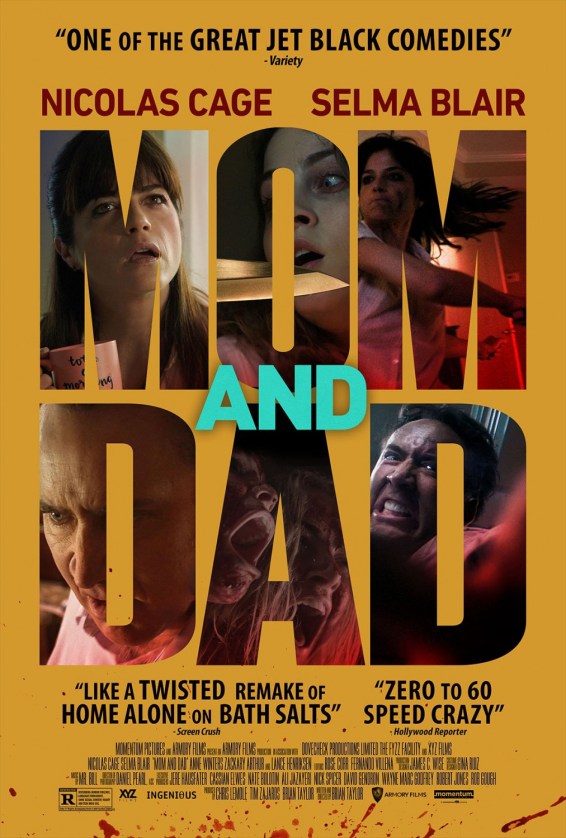
I was very disappointed upon my initial watch of ‘Mom and Dad,’ as I originally went into this one anticipating an extremely funny, gory and over-the-top dark comedy, featuring an equally over-the-top performance by the infamous Nicolas Cage. However, I soon found out this wasn’t the case at all, as the film didn’t deliver enough on most of the elements I was expecting, resulting in an extremely weird film for all the wrong reasons.

Plot Summary: When a teenage daughter returns home after a day at school, she and her younger brother must try to survive a twenty-four-hour period in which a mass hysteria of unknown origins causes parents to violently kill their own children…

Although it’s never fully explored, I personally feel this strange yet unique idea for a narrative is one of the best elements of the film. But, with a plot sounding this insane, and, of course, featuring Nicolas Cage (a man known for his crazy and very memorable performances) I expected something truly special for the comedy-horror genre. Yet, I was very underwhelmed, as the film didn’t really deliver on any of it’s best aspects for me, with the story is very simple and barely getting any development beyond the initial idea, with the same sadly being said for the characters.

The film also gives nowhere near enough screen-time to Nicholas Cage, as although he does have a few memorable moments throughout the story. It’s his co-star Selma Blair, who takes up the majority of the runtime, and considering his name is all over the marketing, and his over-the-top style of acting would suit a film like this perfectly, it’s not unfair to have expected more from him. The children in the film, portrayed by Anne Winters and Zackary Arthur, are both decent but very forgettable characters.

In regards to the actual filmmaking, the film is nothing too impressive, as film contains mostly bland cinematography by Daniel Pearl, relying on large amounts of shaky-cam for the majority of the runtime. The editing in the film is also very distracting, as aside from the opening title sequence of the film which is framed similar to the opening of a family sitcom, which I found quite amusing. Unfortunately, everything after this intro I did not, as the film’s editing comes across as very messy and out-of-time at points, as it feels to me like director Bryan Taylor was trying to capture a similar tone to his ‘Crank’ series of films. With the film feels very energetic and fast-paced, but it simply comes across as unusual to me.

One of the element of the film I did somewhat enjoy, however, is the original score composed by ‘Mr. Bill,’ as the film’s soundtrack does help to build tension during many of the chase scenes. However, although I do like this score for its originality, it doesn’t always fit within the film or it’s pacing. Alongside this, the film also seems to shy away from more violent scenes, as we only see a few actual deaths on-screen. The remainder of the violence is usually off-screen, only showing small bits of blood to the audience now and then, for a fun comedy-horror like this, I believe that’s a huge mistake, as I feel the film should have gone all-in on the gore/fun factor.

In summary, I wasn’t very impressed with ‘Mom and Dad,’ I feel a film like this would’ve been extremely entertaining if done correctly, but the film really falls short of being the fun gore-fest it set out to be. If the film was more along the lines of something, like ‘Shaun of the Dead’ or ‘Tucker and Dale vs. Evil,’ I think it could’ve been something really enjoyable, as I believe director Bryan Taylor is talented, being both the director and writer of this film, I could see him directing another strange comedy like this in the future, but hopefully one that’s a little better. Final Rating: 3/10.

mom_and_dad_xlg

Ghost Stories (2018) – Film Review

Based on the West End play of the same name written by Jeremy Dyson, ‘Ghost Stories’ is a British horror directed by Jeremy Dyson and Andy Nyman, featuring many tension-filled scenes and plenty of clever story elements throughout, it’s not quite the cliché horror you might expect, as the film definitely takes a unique approach with its storytelling and ideas, and I would say I enjoyed the film quite a bit due to this, although I feel this may not be the same for everyone.

Plot Summary: Sceptical professor; ‘Phillip Goodman,’ embarks on a trip into the terrifying world of the paranormal, after he is given a file with details of three unexplained cases of apparitions to investigate…

Whilst nothing incredibly original for a horror narrative, this story does allow the film to have almost an anthology-like structure in a way, with the three separate case files all being their own contained story. The film also takes a very interesting direction for the majority of its runtime, mostly focusing on the paranoia and imagination of the human mind, and how certain tragic events throughout life can lead the mind to wander. Whilst I personally think this is a very creative way to explore paranormal encounters and the horror genre in general, I can definitely say not every horror fan would enjoy this element, as I can see many hating this film mainly due to its exploration of these ideas. This concept even plays-into title of the film, which was misspelled as ‘Ghost Stories’ in much of the pre-release media. This was done to accord with the film’s tagline; ‘The Brain Sees What it Wants to See.’

Andy Nyman portrays the main protagonist of the film (Phillip Goodman), and I’d say he does a pretty great job with the arrogant character he is given, especially being a mostly unknown actor. Then, of course, we also have Phil Whitehouse, Alex Lawther and Martin Freeman as the various victims of the cases, who I also quite enjoyed watching. All the performances here are also backed-up by the writing in the film, as I feel the writing is pretty on point here. Having many elements of dark comedy along with giving some development to the various characters and having some little pieces of information hidden within dialogue for later in the narrative.

The cinematography by Ole Bratt Birkeland is pretty impressive throughout, only having a few shots throughout the runtime which I thought were a little bland. ‘Ghost Stories’ also utilises many wide shots throughout the film which really lend themselves to the eerie atmosphere, alongside the hauntingly beautiful original score which also lends itself to the film. This time being handled by Haim Frank Ilfman, a composer who I actually hadn’t heard of before this film. But, I do hope to see his name in credits more following on from this, as the soundtrack works perfectly throughout the film, changing from emotional to tense, to chaotic, without ever feeling rushed.

My main criticism of the film is the usual issue I have with modern horrors, as while I do feel this film builds-up a lot more of an eerie atmosphere than many other horrors. The film is still littered with jump-scares, and while I do believe jump-scares can work if used to a minimal extent, here I felt many of them were just thrown in a points without much reason, the film does have plenty of visual horror however which I appreciate. Another small issue I have is the design of one of the creatures we see in the film, as to me it’s design felt very out-of-place when compared to the other paranormal entities we see within the story, but again, this is only a small issue.

In summary, ‘Ghost Stories’ is a very distinct horror film, as while I don’t think the film is perfect, I did find it pretty entertaining for the majority of my watch. Having an original story and great direction as well as many attractive shots along with some great writing and a terrific original score, I’d say the film is a definite watch for someone seeking something a little different from the horror genre. Final Rating: low 8/10.

ghost_stories_ver3_xxlg

The Belko Experiment (2016) – Film Review

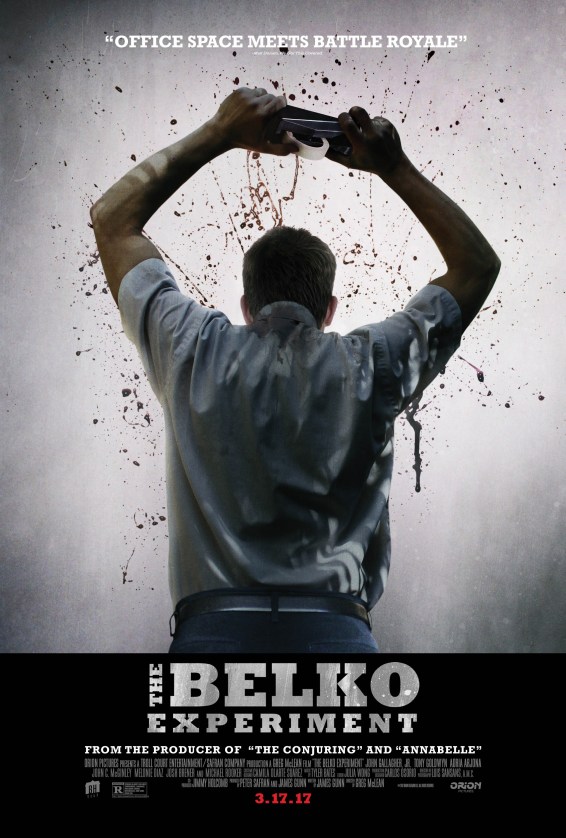
An intense thriller with elements of dark comedy thrown-in for good measure, ‘The Belko Experiment’ is written by ‘Guardians of the Galaxy’ and ‘Slither’ director James Gunn, and directed by Greg McLean (Wolf Creek, Rogue, Jungle). A strange combination which works surprisingly well, in my opinion, as it results in a tense, unique and fast-paced corporate thriller.

Plot Summary: In a twisted social experiment, eighty American employees are locked in their high-rise corporate office building in Bogotá, Colombia, and ordered by an unknown voice coming from the company’s intercom system to participate in a deadly game of kill or be killed. Throwing every employee into a state of panic and a question of morals…

As you can probably guess from a quick pitch of the plot, the film doesn’t hold back from throwing the audience straight into the gory chaos after only about ten to fifteen minutes of screen-time. From here, the film continues to build tension and a dreading atmosphere throughout the remainder of the film. At many points, ‘The Belko Experiment’ also dips its toes into the realm of dark comedy, not too surprising as writer James Gunn was originally set to direct as well. However, when it was time to begin filming, Gunn withdrew, deciding he didn’t want to spend several months working on such a violent film, leaving Greg McLean to bring his screenplay to the big screen.

John Gallagher Jr and Adria Arjona are the main two protagonists of the film, as well as Tony Goldwyn and John C. McGinley as the antagonists, who, are all great in their varied roles, due to there being an entire building worth of employees involved in the story, however, there’s an enormous amount of characters, which, of course, means barley any of characterisation for most of them aside from a couple of lines or the occasional scene.

Whilst the cinematography by Luis David Sansans isn’t any overly impressive, it is decently pleasing throughout the runtime and does manage to show off many of the practical gore effects within the film to their best extent. The same can not be said for the CG effects throughout the film, however, as despite not always being noticeable, there are a few moments where the CGI becomes extremely obvious due to the film’s smaller budget and can take the viewer out of the film for a moment or two. In addition to this, the original score by Tyler Bates is not very memorable or unique despite doing a decent job of building tension throughout the film, as the soundtrack rises and changes over time to fit the more tense and chaotic feel of the narrative. However, the score can also feel a little out-of-place when some of the more comedic scenes come into play, but this issue is also noticeable when it comes to the tone of the film, as despite much of the comedy actually working fairly well, the film sometimes changes from horrific imagery to humour a little too quickly.

One of the main elements of the film is obviously the gory deaths, as the story resolves pretty much completely around the deaths of the various characters, and while the film does have a few memorable moments and kills. I was a little dissatisfied with the variety, as the majority of the characters seem to die simply from gunshots, rather than the film getting creative and making better use of the office location it’s set in, perhaps by having characters use office/everyday equipment and supplies as improvised weapons.

As you may also expect with a violent setup such as this one, ‘The Belko Experiment’ also delivers on plenty of underlying themes and messages. Focusing mostly on how we react as humans to traumatic events and give in to our most primal instincts and selfish desires, and while I do wish these ideas were delved into a little further. They are present throughout the film regardless, and I did find the way the film explored the ideas of human survival pretty interesting. Even my personal favourite scene in the film (which takes place in the main reception of the building) excels at expressing these themes in pretty a brutal way.

In summary, if all you’re searching for on your Saturday night is a bit of gory, comedic excitement with a few underlying themes mixed in good measure. Then, ‘The Belko Experiment’ happily delivers, as the film is an enjoyable thrill-ride with some quick pacing and practical gore effects, regardless of some of its weak characters, CG effects and relatively simplistic story. Although it may not appeal to all, for me, I feel it’s a decent viewing experience. Final Rating: 7/10.

belko_experiment_xxlg

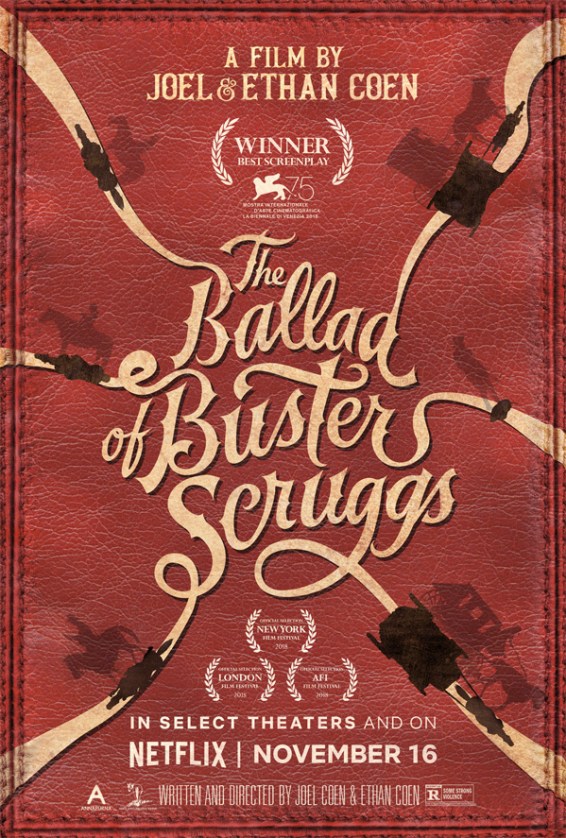
The Ballad of Buster Scruggs (2018) – Film Review

The western genre used to be extremely popular back in the golden age of Hollywood, but in recent years the western genre has mostly died off, as aside from a few honourable mentions, such as ‘True Grit,’ ‘The Sisters Brothers,’ and ‘Django Unchained.’ The western genre as a whole has run mostly dry, until now that is, as iconic directors Joel Coen and Ethan Coen (The Big Lebowski, Fargo, No Country for Old Men) return to the silver screen for this brilliant western anthology.

Plot Summary: Consisting of six different stories of life and violence in the Old West, including the tales of a singing gunslinger, a bank robber, a travelling impresario, an elderly prospector, a wagon train and a perverse pair of bounty hunters…

This diverse set of stories and characters really keep the film engaging from start-to-finish, as the film constantly jumps between characters and locations, all whilst ensuring that it keeps its decent pacing and usual Coen Brothers’ dark sense of humour intact. Resulting in the film feeling extremely refreshing, as superhero blockbusters and jump-scare filled horrors have really taken over the film industry in recent years. So, revisiting an old yet classic genre (especially with this modern spin and the Coen Brothers’ brilliant direction) is truly a breath of fresh air.

The performances by every member of the enormous cast are pretty excellent all around, as Tim Blake Nelson, James Franco, Liam Neeson, Thomas Waits, Zoe Kazan, Jonjo O’Neill and Brendan Gleeson (just to name a few) are all brilliant when portraying their varied and interesting characters, with Tim Blake Nelson definitely being the clear stand out for me with his extremely funny and charming portrayal of the title character; ‘Buster Scruggs.’

Throughout the runtime, the cinematography by Bruno Delbonnel is almost flawless, as the film utilises a variety of beautiful shots which perfectly capture the visual appeal of classic westerns. The original score by Carter Burwell is also great, as the soundtrack uses slow guitar strings and an enormous list of classic country songs to build up atmosphere, with the best of these definitely being ‘When a Cowboy Trades His Spurs for Wings.’

One aspect of the film I absolutely adore is the Coen’s usual style of writing, as every character throughout the film is given plenty of comedic moments and memorable lines, which really helped make many of the characters with slightly less development more likeable. Another element that also really drew my attention during my first viewing was the incredible sets and costumes the film had on full display, as considering the locations/costumes are some of the main factors of engaging the audience into the story and it’s time-period. It was clear they were pulling out all the stops, as every location always feels real and lived in, with the character’s costumes being no different.

My personal favourite narrative of the six would most likely be the opening story, sharing the same name as the title of the film; ‘The Ballad of Buster Scruggs.’ This opening was just such as joy to watch, balancing dark humour with a classic western setup brilliantly, in addition to the fantastic performance from Tim Blake Nelson as already mentioned. However, this is also where my biggest criticism of the film comes in, as although they definitely aren’t awful, the last two stories are easily the weakest of the film, as although we do get some great character moments and fun scenes within these stories, I couldn’t help but feel they simply weren’t as memorable or as charming as the others leading up to them. Perhaps if these two stories we’re placed earlier in the film it wouldn’t be such an issue, but it simply leaves the viewer with a bad taste in their mouth afterwards.

In summary, ‘The Ballad of Buster Scruggs’ proves once again that westerns are far from gone when it comes to film, as the Coen brothers once again take the audience for a trip into the wild west with complete success, as this anthology is just as hilarious as it is visually impressive and well-acted, regardless of whether or not the stories are quite on the same level. Final Rating: low 8/10.

busterscruggsredfinalposterbig59902