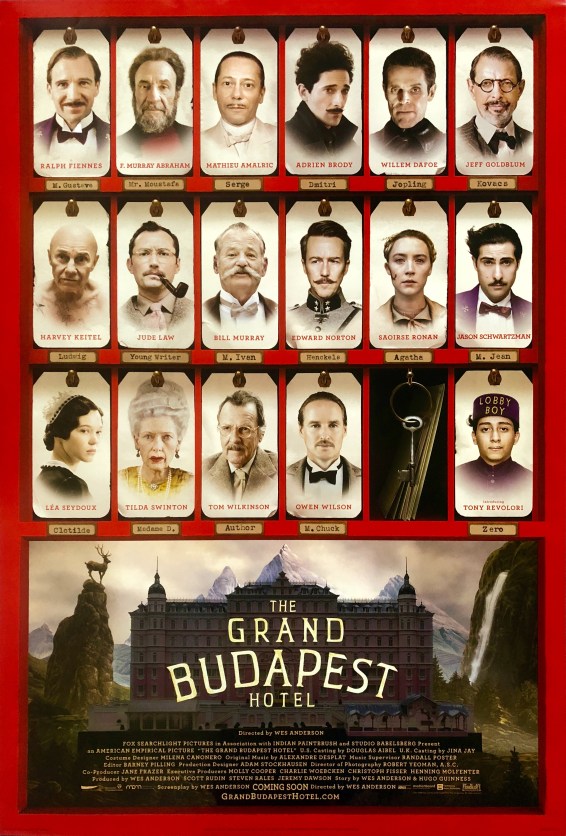
The Grand Budapest Hotel (2014) – Film Review

Wes Anderson’s visually spectacular tale of murder, elegance and crime is far more light-hearted than I was initially expecting. Utilising a bright colour palette, unique cinematography and a wonderful score by Alexandre Desplat, the film brings all the usual elements of Wes Anderson’s style that I adore, especially coming straight off the back of Anderson’s animated flicks.

Plot Summary: ‘Gustave H,’ a concierge of the legendary ‘Grand Budapest Hotel,’ alongside his new lobby boy, ‘Zero.’ Embark on a dangerous journey following a mysterious murder and the disappearance of a priceless Renaissance painting, soon leading them into the middle of a feud over an enormous family fortune…

The film definitely does have a particular artistic flair which his animated flicks do not carry, as in nearly every wide shot in the film we are greeted with what almost looks like a painting. These paintings are almost used as backdrops throughout the film, and blend seamlessly with the bright pale colour palette of the film. Even with this colour palette and mostly upbeat tone, however, the film is not afraid to dive into darker territory if needed in order to serve the story.

In addition to his style, Anderson also does a brilliant job when it comes to the writing, as the film is gushing with hilarious and memorable lines throughout. Many of the comedic lines caught me completely off-guard, with some of the humour being extremely dark. But, with a cast this large and talented, you’re almost guaranteed to get comedic gold. In particular, I really enjoyed the performances by Ralph Fiennes, Bill Murray and Willem Dafoe, who you could really tell they enjoyed their time on-set.

Robert D. Yeoman handles the cinematography within the film, which is, of course, brilliant, as not only does it contain the usual style expected from Anderson, but the cinematography even backs-up the narrative of the film, as many characters within the story feel isolated, and as a result are framed completely alone. But, pretty much all the cinematography throughout the runtime is fantastic. The original score by Alexandre Desplat is also a great aspect of the film, as he creates a very memorable soundtrack here which fits the tone of the film perfectly and really backs up many of the comedic scenes, with the tracks; ‘Mr. Moustafa’ and ‘The Cold-Blooded Murder of Deputy Vilmos Kovacs,’ being my personal favourites.

For the most part, the protagonists of the film are well-written, we understand who they are within the early stages of the story. Yet, as the story continues along, we continue to learn more about them. However, if I had to point out a flaw in the film it’s definitely the antagonists of the film, Willem Dafoe does an excellent job as the deadly hitman, whilst Adrien Brody also does a decent job as his boss. Beyond that, however, the characters are very flat and are given little to no development throughout the film.

Wes Anderson once again also pays serious attention to detail, as in many shots there’s always small hidden gags or visual references hidden away to spot. The filmmaking itself is also used for a lot of visual storytelling, e.g. the lonely characters and their framing within the shots, as already mentioned.

In summary, I was very impressed with ‘The Grand Budapest Hotel,’ as aside from the issue I have with the antagonists of the narrative, the film succeeds in nearly every category for me, and was a very enjoyable watch throughout. Combining Wes Anderson’s great visual style with a brilliant main and supporting cast as well as many comedic moments, the film is certainly worth a watch, and it’s fair to say that Wes Anderson will always have a viewer in me going forward in his career. Final Rating: 9/10.
IMG_3176

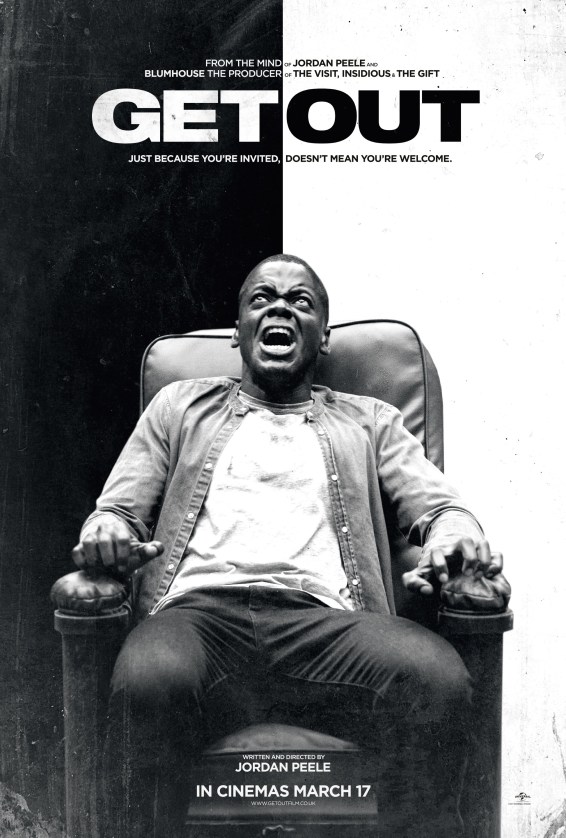
Get Out (2017) – Film Review

Actor and comedian Jordan Peele tests his hand at directing for the first time with this intelligent thriller, as ‘Get Out’ utilises its original story and some great performances to become a definite step-up from Blumhouse Productions’ usual standard for films. However, although many viewers think this film is phenomenal throughout it’s most of its runtime, I personally don’t agree, as I actually feel there is more than a few areas in need of some improvement.

Plot Summary: When a young African-American man visits his white girlfriend’s parents for the weekend, his simmering uneasiness about their reception of him eventually reaches an extreme boiling point. Leading ‘Chris’ to believe more sinister forces may be at work…

As already mentioned, the film’s narrative is original, and any regardless of quality, I always appreciate originality when it comes to storytelling. Despite ‘Get Out’ being initially pitched and advertised a horror, however, the film is really anything but, as the film actually has many inclines of comedy mixed-in with some tension-filled moments here and there, and although the film is entertaining, ‘Get Out’ never really manages to build-up an eerie atmosphere or becomes particularly creepy, which is why I believe that the film is now classed as a thriller rather than a horror by most.

The best aspect of the film for me is by far the performances by the cast, as Daniel Kaluuya, Allison Williams, Bradley Whitford, and Catherine Keener are all exceptional throughout, with Daniel Kaluuya as the protagonist; ‘Chris Washington,’ in particular, really keeping me engaged, as he delivers a very ranged performance, managing to portray a very likeable and realistic character within only a short period of time. Unfortunately, not all of the supporting cast quite level-up to this standard.

The cinematography by Toby Oliver is a decent throughout the film, as although there are plenty of attractive shots (most of which make great use of the large open spaces the majority of the story takes place in (especially in the opening scene of the film, which is executed perfectly). There are also a variety of fairly bland shots, this may also be due to the film’s colour palette, however, as throughout the film the use of a very restrictive colour palette results in the film feeling a little visually dull, rather than using its colours to play into its story or genre.

Personally, the weakest element of the film for me is the original score by Michael Abels, as the entire soundtrack itself feels very unusual, and although unique, it usually comes off as incredibly distracting throughout many scenes within the film. Using an orchestra as well as vocals, the score attempts to reflect some of the more surreal scenes nearing the end of the film, and although I appreciate the attempt, I simply don’t think it works, with the track; ‘Sikiliza Kwa Wahenga,’ feeling particularly out-of-place as a result of its bizarre lyrics.

Although the original score may be lacking, the writing throughout the film is brilliant throughout, as writer and director Jordan Peele balances the screenplay’s comedy and horror, in addition to building-up an engaging mystery throughout the story, as every piece of dialogue contains many subtle clues and hidden meanings which come into play later in the narrative. Of course, with a plot such as this one, there is also an enormous amount of themes and social commentary underneath the story itself, and while I did find the majority of the film’s ideas very interesting and thought-provoking, I also found that some of the themes of racism and social issues can often overshadow the film’s main story.

In summary, ‘Get Out’ is a decent thriller, as despite the fact that the performances and writing on display throughout the film is definitely impressive, I still feel the lack of an eerie atmosphere in addition to a suitable original score for the film’s tone really hurt the film. Regardless of this, ‘Get Out’ is still a thriller will plenty of entertainment value, while nothing absolutely amazing, the film definitely has its moments, and I would say the film is a solid watch if you enjoy the occasional thriller. Final Rating: 7/10.

get_out_ver4_xxlg

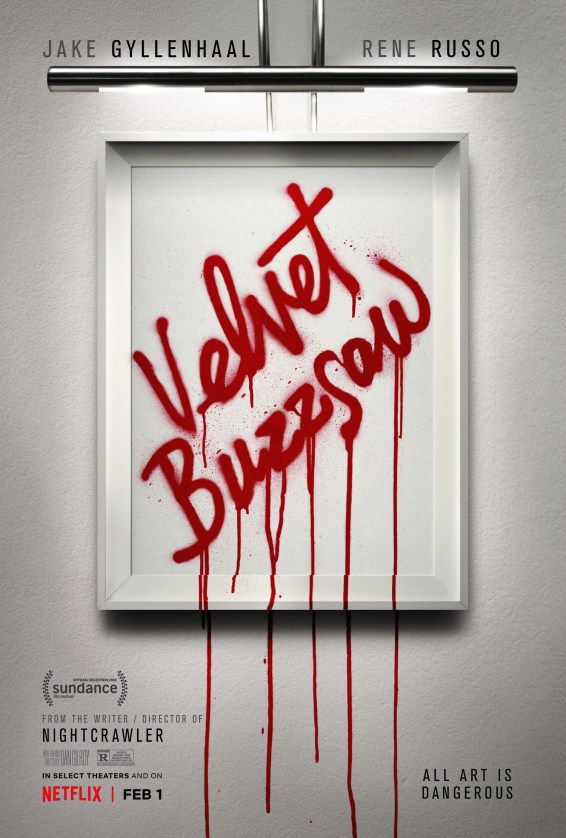
Velvet Buzzsaw (2019) – Film Review

A strange, violent, and very unpredictable film, Dan Gilroy director of one of my all-time favourite flicks; ‘Nightcrawler,’ works all his charm and creativity into this horror/drama/mystery/black comedy? It’s difficult to pinpoint exactly what the genre of this film is. Alongside this, similar to some other films I’ve reviewed, I’d say this is definitely not a film for everyone. But for those to who it will appeal, you will surely enjoy yourself.

Plot Summary: Following the discovery of a series of foreboding paintings by an unknown artist, a supernatural force enacts revenge on those who have allowed their greed to get in the way of art…

‘Velvet Buzzsaw’ is mostly built around the shocking deaths throughout the film, as various characters get killed off in different ways. Leaving the rest of the characters in a state of confusion and panic, this allows the film to delve into bits and pieces of characterisation (granted not a lot) in addition to exploring various ideas of what ‘art’ actually is and we criticise and commercialise it, and despite the film not going incredibly in depth with these ideas, I did still find many of them and the themes of greed and ego interesting.

Jake Gyllenhaal is essentially the main protagonist of the film: ‘Morf Vandewalt’ a very eccentric and strange character who seems to be a parody of over-the-top art critics. Rene Russo, Zawe Ashton, Toni Collette, Natalia Dyer, and John Malkovich also all lend their talents to the film. Along with the decent writing, their great performances really help give each character a distinct personality. Unexpectedly, however, Zawe Ashton is a true stand out of the cast for me, only really knowing her from Channel 4’s ‘Fresh Meat,’ here she portrays a very different character than ones before.

The cinematography by Robert Elswit also gives the film a very clean look, utilising many different shots throughout. I still think the film could’ve done more with the camerawork, however, especially when compared to Dan Gilroy’s previous films. The does also combine cinematography well with the beautiful sets and locations, giving the film a great visual appeal. The original score by Marco Beltrami and Buck Sanders also lends its hand to the creepy atmosphere at multiple points throughout the film, yet can also change to more calming or light-hearted when it needs to.

Although the tone can vary throughout the film, it never comes off as unbalanced. Comedy is used at points during the story but never to the point of ruining the eerie atmosphere or character moments. However, when the film does shift into full on horror, we get easily my favourite moments of the film, as it’s these moments we get some interesting CG effects and unique visuals, as well as a great build up of intrigue and tension, with the eventual death at the end of the scene usually being very creative, despite not always being very gory.

My main two issues with the film resolve mostly around the pacing of the film, as the film can come off as very slow and can drag the story down at points, as well as the use of John Malkovich’s character, ‘Piers,’ as this character appears in the very first scene of the film and then again later into the runtime. However, he doesn’t really have any impact on the narrative, and felt to me like the film was just using his bland character to fill up screen-time.

In summary, I couldn’t decide as to what I thought of ‘Velvet Buzzsaw’ upon my initial viewing of the film, and I’m still not entirely sure now, as whilst the film does suffer from a fair amount of problems and isn’t the incredibly entertaining piece of gory fun I was hoping it would be. But, I still enjoyed myself due to its weird atmosphere and interesting ideas, and it is a film I could maybe see myself returning to at some point. Final Rating: 5/10.

velvet_buzzsaw_xxlg

The Cabin in the Woods (2011) – Film Review

A personal favourite horror classic of mine, Drew Goddard (Bad Times at the El Royale) directs his first feature film with this creepy yet hilarious original story. The plot alone is enough to watch this film, as without spoiling anything, it near enough becomes impossible to predict where this film is going. The more ‘The Cabin in the Woods’ unravels, the more interested you become, and by twenty minutes in I found myself incredibly entertained.

Plot Summary: A group of teenage friends all fitting the stereotypes of typical slasher victims, head-up to an old cabin deep in the woods for a weekend of partying. But, things soon turn-out to not be what they seem, as it appears someone, or something, is manipulating events…

‘The Cabin in the Woods’ is basically a dissection of horror films and the clichés that come with them, whilst also being a horror film at the same time. However, although the film does build-up a decent atmosphere throughout, the horror aspect of the film is easily its weakest element, as I always found myself laughing far more at its comedic scenes, rather than finding myself on-edge over during the tension-filled ones.

Being a typical horror story like this, however, always comes the risk of using young unknown actors for the teens, with the exception of maybe Chris Hemsworth, of course (who was mostly unknown at this point). Yet, I think the entire cast did a phenomenal job, especially Fran Kranz as ‘Marty,’ who got many laughs out of me and completely nailed the ‘Stoner’ type attitude, mostly as a result of the extensive prop and behaviour training he went through before filming in order to further fit his character. Richard Jenkins from ‘Step Brothers’ and ‘The Shape of Water’ is also great within the film as ‘Sitterson,’ as for his role in the story, I’ll leave that a mystery for now…

Many of the visuals in the film come off as your usual standard horror flick, alongside the cinematography by Peter Deming, which, of course, is nothing special. But, there is the occasional pleasing shot, or even a throwback shot to classic horror film every so often, with ‘Friday the 13th’ being the most noticeable. However, the actual design of the cabin set itself, as well as many of the creatures throughout the film, is easily one of my favourite elements, as the costumes are nothing short of incredibly detailed, and help give each creature it’s own distinct look and feel.

The original score by David Julyan is your standard horror film soundtrack, further playing into the idea of a dissection of the genre, and despite being rather bland it does back-up many of the eerie scenes regardless. The editing is also nothing phenomenal, but with a narrative this original and the writing being as hilarious as it is. I’m willing to give them a thumbs-up. Especially when you consider the last twenty minutes of the film, which is probably some of the most fun I’ve ever had watching a horror flick.

Another weaker aspect of the film is also related to the visuals, as the film was made on a smaller budget, the CG effects in many scenes is quite noticeable, and although it doesn’t completely ruin a scene, it can take you out of the film for a second or two. Thankfully, CGI isn’t used very heavily throughout the film. I also feel this smaller-budget might have had an impact of the runtime, as the film feels a little short to me and could’ve done with being slightly longer to further flush elements out.

In summary, I adore ‘The Cabin in the Woods,’ from the wonderfully crafted creatures to the way the story unfolds, to the various nods to previous entries in the horror genre. I think Goddard has made a flawless dissection of why we love horror films and the traits within them. Although not perfect, I’m still eagerly anticipating his next film and I really hope he keeps this trend of interesting filmmaking going. Final Rating: low 8/10.

cabin_in_the_woods_ver4_xxlg