Malcolm & Marie (2021) – Film Review

“Cinema Doesn’t Need to Have a Message. It Needs to Have a Heart!” – Malcolm Elliott

A contained and regaling monochrome drama, 2021’s Malcolm & Marie was one of the first feature-length films produced amidst the COVID-19 global pandemic. Written and directed by Sam Levinson (Another Happy Day, Assassination Nation), best known as the creator and lead writer of the hit teen-drama series; Euphoria, Malcolm & Marie was shot during the U.S. COVID-19 lockdown between June and July of 2020, with the approval of the Writers’ Guild of America, Directors’ Guild of America, Screen Actors’ Guild of America, and the American Federation of Television and Radio Artists, as the production followed strict safety protocols to ensure the cast and crew could work safely. With this in mind, Malcolm & Marie makes the best of challenging circumstances, utilising a singular location, minimal cast and sleek visuals to craft a captivating flick that examines how volatile personalities can clash, especially when tangled in a long-standing relationship.

Plot Summary: After returning home from the premiere of his debut project, filmmaker Malcolm Elliott and his girlfriend, Marie Jones, await what is sure to be an imminent critical and financial success. But, as the evening transpires, their celebratory night takes a turn for the worse as revelations begin to surface, testing the strength of their devotion to one another…

Between Marcel Rév’s scrumptious black-and-white cinematography and the no-holds-barred verbal brawl delivered by the central duo of Washington and Zendaya, it’s impossible to discuss Malcolm & Marie without drawing comparisons to the cinematic adaptation of Who’s Afraid of Virginia Woolf? (1966). Like the stage play the film is based upon, first staged in 1962, Who’s Afraid of Virginia Woolf? explores the complexities of the marriage of middle-aged couple Martha and George, where, late one evening, after a university faculty party, they receive an unwitting younger couple, Nick and Honey, as guests and are drawn into their bitter and frustrated relationship. Although Malcolm & Marie only focus on the two titular characters, both stories have more than a few similarities. One element of Malcolm & Marie that is unique to the film, however, is its underlying theme of the essence of cinema, examining this concept through the eyes of Malcolm as a passionate Black filmmaker who loathes the politics surrounding Black filmmakers. In fact, Malcolm’s intense dislike of an anonymous female critic from the L.A. Times is believed to be a reference to L.A. Times writer Katie Walsh, who once wrote an unfavourable review of one of Levinson’s prior directorial outings.

As the sole cast members, John David Washington and Zendaya hold the entire weight of the film on their shoulders. Thankfully, both share amazing chemistry and receive countless chances to let their talent shine as they each deliver lengthy monologues exploding with emotion. Through these monologues and the sharp dialogue, it quickly becomes apparent that the titular, well-defined couple exist in different rhythms, with Malcolm exuberantly (and obnoxiously) extolling the delights of premiering his first film as a writer and director, which pushes him to the cusp of newfound power and prestige, while Marie appears sullen, bored and utterly over Malcolm and his prickly, delicate ego that repeatedly puts strain on the pair’s relationship, often failing to acknowledge Marie’s support. However, this constant back-and-forth does come at a cost, as both characters can come across as somewhat unlikable through their many imperfections being blatantly illustrated on-screen at all times.

One of the few Netflix Originals shot to be on 35mm, the cinematography by Marcell Rév is elegant and sheeny. Yet, what makes these visuals even more impressive is that for the entirety of the runtime, the titular couple never once leave the house, as previously mentioned, merely strolling to different rooms or into the garden with a cigarette in hand as their bickering continues. Some may think this sounds dull, but I feel this approach ensnares much of the tension between the two characters and the heavy air that flows through their temporary, luxurious home. Furthermore, with both characters being chic and sophisticated, as well as returning from the premiere in their formal evening wear, there is a suave feel to the visuals of Malcolm & Marie, making the film seem like a romance from the 1930s, with tight camerawork to intensify the drama.

Likewise, the film’s original score, helmed by British musician Labrinth, reunited with Sam Levinson after composing much of the score for Euphoria, retains a similar tone to that of a 1930s drama, with the delicate, jazzy score meshing flawlessly with cleverly selected needle drops. Famed songs, like I Forgot to Be Your Lover and Get Rid of Him, are also baked into the runtime, doing much of the talking when the characters aren’t.

Interestingly, because Malcolm & Marie was produced during the COVID-19 pandemic, none of the cast or crew associated with the film received any kind of payment or entered into any agreement with the depiction of tobacco products, which is certainly admirable given the current state of cinema, where many films are greenlit purely for the sake of profit.

In summary, due to its entire runtime taking place in one location with a heavy reliance on dialogue, Malcolm & Marie will likely be a divisive flick that won’t please everyone. But, for those it will, I feel it’s more than entertaining, even if the film isn’t as layered or as tightly-knit as it thinks it is. Rating: 7/10.

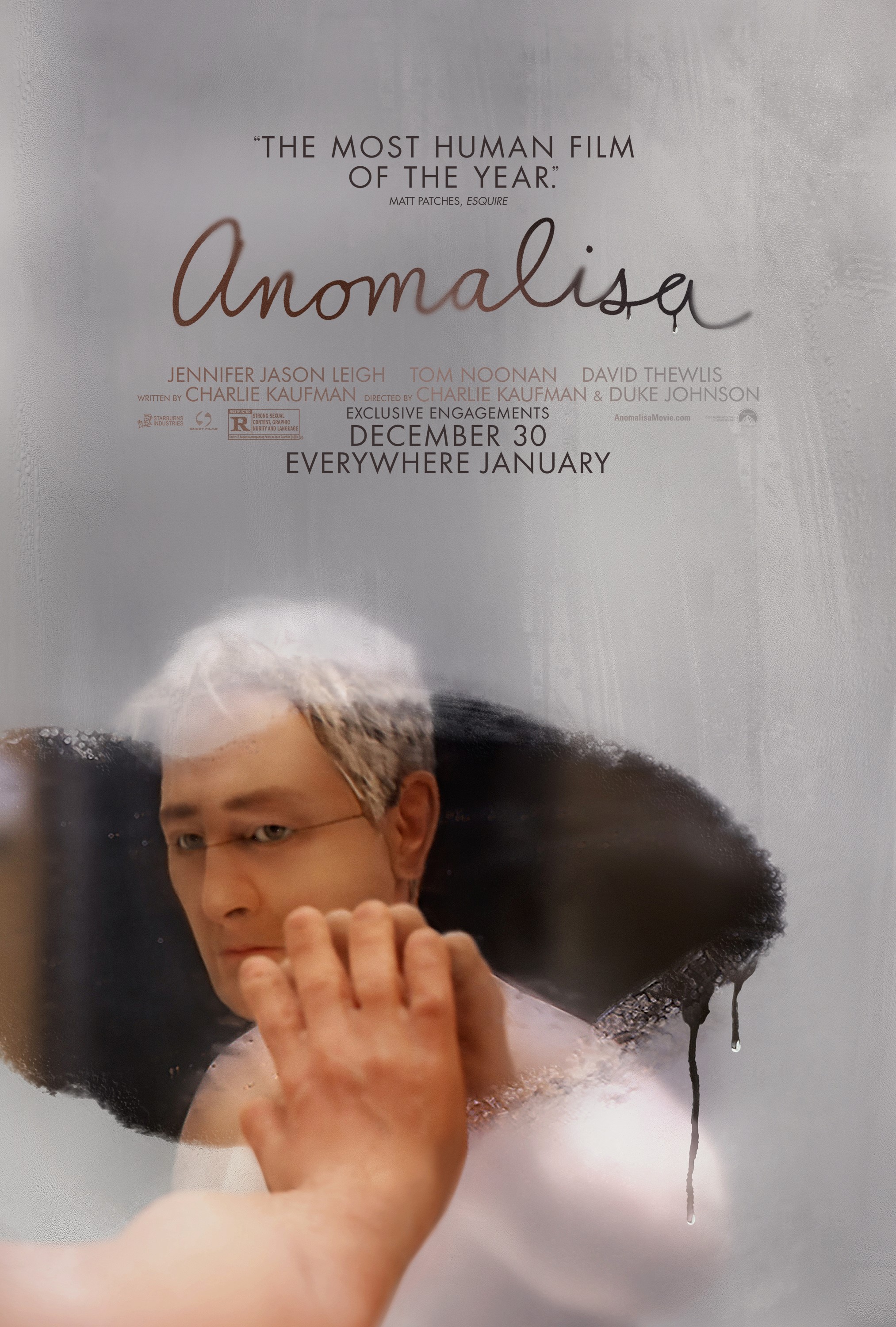
Anomalisa (2015) – Film Review

“Sometimes There’s No Lesson. That’s a Lesson in Itself.” – Michael Stone

Originally planned to be a short film, roughly forty minutes in length, with the large sum of funds later gathered from a crowd-funder on Kickstarter pivoting the project to become feature-length, 2015’s Anomalisa is a technically impressive and exceptionally humane stop-motion drama that marks another distinctive highlight in writer and co-director Charlie Kaufman’s filmography. Serving as a thought-provoking treat for fans of introspective cinema, Anomalisa is a quirky and mesmerising exploration of mental illness seen through the eyes of a middle-aged author trapped beneath the weight of his mundane life, integrating memorable characters and dry wisecracks wherever possible to craft a story that is just as captivating as it is interpretive.

Plot Summary: After travelling to Cincinnati, Ohio, to deliver a speech at the Fregoli Hotel, motivational writer and customer service expert Michael Stone encounters Lisa, a seemingly unremarkable woman who immediately enchants him, shaking up his mundane existence after many years of feeling disconnected from his family and those around him…

Directed by Duke Johnson and Charlie Kaufman, the latter also being the screenwriter, Anomalisa is one of those films that will click with some audience members sometime after the credits roll, dwelling on many of the concepts the film focuses on through its relatively simple, yet accessible and melancholic story, a narrative made more interesting by how it’s told. Blending Kaufman’s caustic sense of humour with genuine moments of human connection, Anomalisa is stuffed with true-to-life, awkward interactions, naturalistic dialogue and numerous subtle touches, similar to many of his previous written works, such as Being John Malkovich (1999) and Eternal Sunshine of the Spotless Mind (2004). Moreover, Anomalisa acts as a direct challenge to the notion that many still seem to hold; that animated films are solely for children, combating this belief by conveying a mature story via charming stop-motion, never shying away from harsh language, nudity or even a graphic scene in which two of the lifelike, puppeteered characters engage in lovemaking.

On the topic of characters, the robust central duo of David Thewlis and Jennifer Jason Leigh are terrific, delivering superb vocal performances that (along with the dialogue) deliver characterisation to the audience, quickly making it apparent that Michael has mental baggage related to Cincinnati, bearing the scars of a love life he left behind. Right from the opening scene, it also becomes apparent that Michael is one of the only uniquely designed puppets, as every other character he encounters seems to have an identical facial structure and a similar voice with a comically flat tone, continually voiced by Tom Noonan. All of these analogous characters (male or female, adult or child) illustrate how Michael, despite his career, struggles to interact with those around him, desiring to do anything but talk to others, including his wife and son, with certain details regarding his behaviour suggesting the character is going through a mid-life crisis and/or implying he may have serious mental issues. Yet, both are merely theories, as nothing is ever confirmed.

Visually, the film’s stop-motion animation is stunning, with the felt-faced puppets lending personality to every scene. Each character lives and breathes on-screen in a way that I feel visual effects couldn’t achieve, making the fact that every character was brought to life via thousands of tiny adjustments all the more extraordinary. The animation is utilised to spectacular effect during one nightmarish dream sequence, where Michael is confronted by his seemingly deteriorating mental state, even drawing attention to his puppet’s prominent facial slit in a bizarrely humorous fourth-wall-breaking moment. On top of the animation, the cinematography by Joe Passarelli is visually striking, frequently appearing as if it has been carried over from a live-action drama.

Often coming across as a forty-minute audible representation of the film itself, the original score by Carter Burwell is a slow-paced and downcast soundtrack that occasionally features snippets of dialogue from the film’s various characters, an eccentricity that is sometimes effective and sometimes irritating, with the score’s finest track; Overture, thankfully being dialogue-free, allowing its nuanced sweetness to flourish.

Further playing into the previously mentioned theories surrounding the film, it’s interesting to note that the hotel Michael stays at, the Fregoli Hotel, is actually named after “The Fregoli Delusion,” also known as “The Delusion of Doubles,” a rare disorder in which a person holds the misconception that those around them are a single person who changes appearance or is in disguise. While Kaufman has confirmed in the past that Michael doesn’t suffer from this exact disorder, the Fregoli Delusion did serve as an inspiration for the film and functions as a reasonable explanation for some of Michael’s peculiar visions, but still doesn’t answer every inquiry an audience member may have about his mental state.

In summary, although the exquisite sop-motion animation automatically makes the film worth a viewing for anyone with even the slightest interest in stop-motion storytelling, Anomalisa will likely have its naysayers, given the film is a rather cyclical drama featuring a cynical protagonist, with perhaps too few gags mixed-in to oppose the constant cynicism. Nevertheless, the film is a well-conceived character study exploring loneliness and mental illness, impressively interpreted through a painstaking style of animation, painting a different shade of drama, a drama that I personally believe wouldn’t work as well should it have been produced with CGI or in live-action. Rating: 8/10.

Sorry to Bother You (2018) – Film Review

“This Is Telemarketing. We’re Not Mapping the Fucking Human Genome Here. I Don’t Care if You Have Experience for This… I’ll Hire Damn Near Anyone.” – Anderson

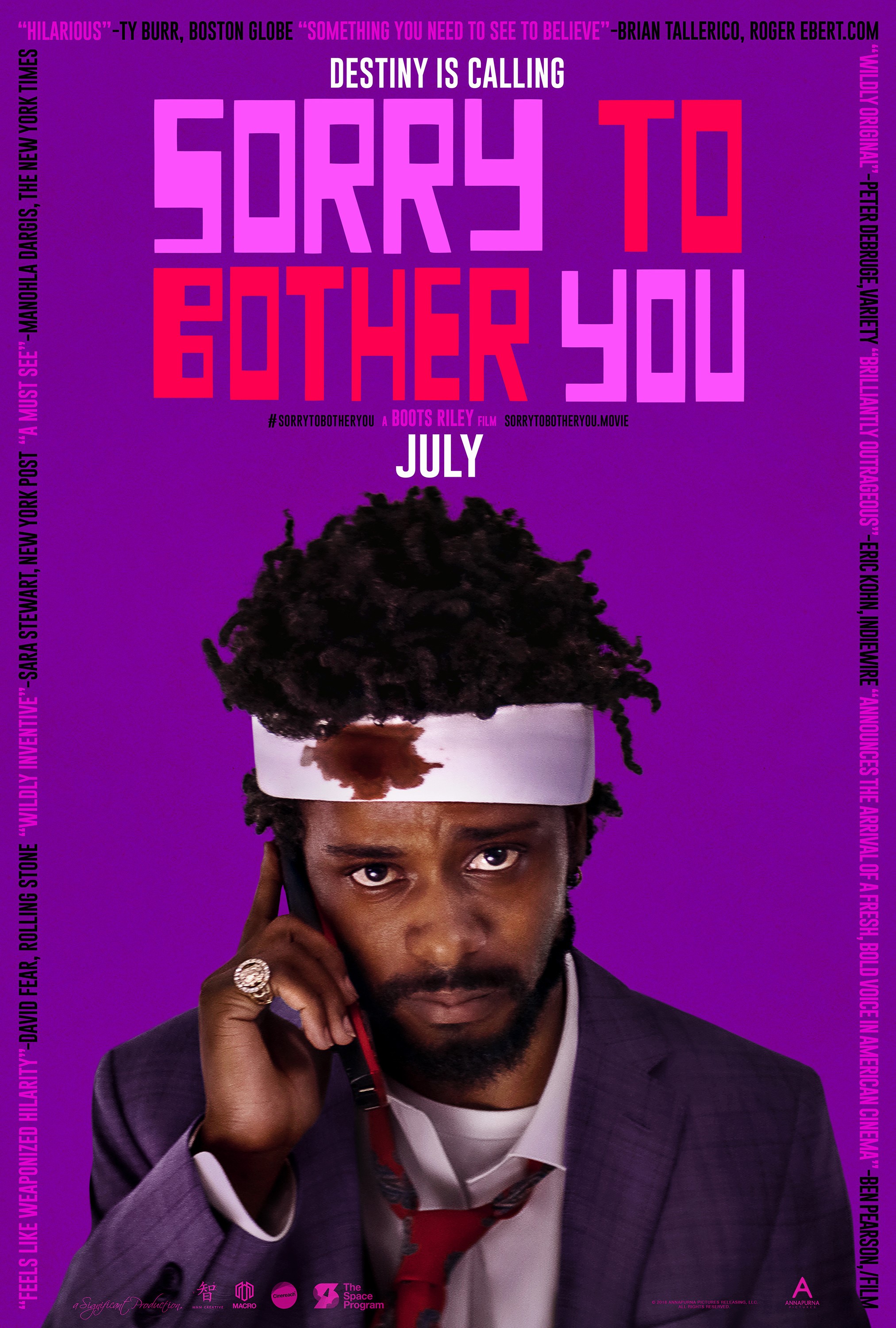
Full of surprises and thoroughly embracing its weirdness at every turn, the 2018 social satire Sorry to Bother You serves as a fantastically refreshing flick that announces writer-director Boots Riley as a radical upcoming voice in the realm of cinema. Harbouring a captivating premise, memorable characters (both benign and despicable) and dialogue that is both snappy and humourous, Sorry to Bother You is a stylish indictment of capitalism, consumerism and cultural appropriation, all executed in a rather unconventional fashion that will likely cause some audience members to lose interest.

Plot Summary: In an alternate, present-day version of Oakland, bumbling jobseeker Cassius Green acquires a low-level position at a telemarketing firm, only to find it a dispiriting struggle as a Black man selling to predominately White customers. But, when a telemarketing veteran advises him to use his “White Voice” to make himself more appealing to potential buyers, that all changes. Now, with his newfound talent, Cassius thrives in his profession, soon being promoted to a “Power Caller,” peddling morally abhorrent yet incredibly lucrative services as he further climbs the corporate ladder…

As you might expect from its introduction, there are a lot of big ideas in Sorry to Bother You, from the power of influence ravenous corporations possess to the dehumanisation of human labour and how they are both inextricably tied to everyday racism, Sorry to Bother You juggles an assortment of relevant, weighty and thought-provoking themes. Still, the film is far from your standard social commentary, but rather a raucous, surreal mockery that remains outlandish until its last few minutes, especially regarding one particular aspect of its narrative, which could be considered a step too far into absurdity for some.

Originally, famed actor and musician Donald Glover was penned for the lead role of Cassius Green, but was ultimately unable to assume the role due to scheduling conflicts with 2018’s Solo: A Star Wars Story. Instead, Glove recommended his co-star LaKeith Stanfield from the comedy-drama television series; Atlanta, for the role. Thankfully, Stanfield holds his own as Cassius, portraying a goofy klutz who lives in his uncle’s garage, lacks conviction and often suffers from existential anxiety, frequently fretting about the sun exploding and his life bearing no significance, much to the displeasure of his activist and performance artist girlfriend, Detroit, equally well-portrayed by Tessa Thompson. Moreover, despite Cassius’ many sordid acts throughout the runtime, you never stop rooting for him on account of Stanfield’s charm, even when he’s led into making vile choices purely on his desire for more money and success, making for an entertaining character arc aided by repeatedly witty dialogue.

Aesthetically, Sorry to Bother You is just as crazed as its zany tone, with visual diversions regularly transpiring from an early sequence where Cassius converses with potential buyers over the phone before he quite literally (and creatively) crashes into their lives with his desk. Occasionally, however, these off-the-wall stylistic choices can become a little too much and hard to keep up with, with even the lustrous colour palette and cinematography by Doug Emmett being constantly vibrant and energised.

Composed by the indie art pop band, Tune-Yards, Sorry to Bother You‘s original score largely consists of bouncy techno tracks that effectively lend themselves to the film’s peculiar style, namely via tracks like Transformative Experience. On top of the original score, the film also features a variety of songs from Boots Riley himself, as Riley was previously the lead vocalist of the hip-hop group, The Coup, during which time the band produced the identically-named album; Sorry to Bother You, which he then implemented into the film, presumably for its shared title.

Spoilers ahead in this section for those who wish to go in blind, but near the end of the runtime, Cassius’ conscience arises anew as he finds himself amid his boss’ morally bankrupt world of condescending decadence and his sinister plan to create a subservient, mutated workforce, these oddball, horse-like creatures, known as the “Equisapiens,” are impressively brought to life via practical effects, with the suit and animatronic headpieces being built and designed by Amalgamated Dynamics (ADI), well-known for creating effects for sci-fi blockbusters, such as Tremors (1990), Evolution (2001) and Alien vs. Predator (2004), among many others. Interestingly, while numerous headpieces, hair patches and tattoos were employed to visually differentiate the myriad of Equisapiens, only a single suit was utilised and modified across scenes as puppeteers operated the headpieces, including one operator solely for the eyes. Whilst some may find this plot deviation ludicrous, truthfully, I feel it works in the film’s favour, given it comically plays into the notion of money-hungry higher-ups employing any method they can to increase profits and reduce labour costs.

In summary, Sorry to Bother You is a bonkers film that handles its many underlying themes with great care in spite of its lasting strangeness and general lack of subtlety. Thanks to its endless inventiveness and impressive lead performance from LaKeith Stanfield, lending his acting dexterities to a well-defined character that is equal parts endearing and loathsome, Sorry to Bother You is a distinctive flick that not only succeeds in what it’s trying to do, but also functions as a flag being unapologetically planted by its filmmaker, not only in the film industry, but in all of the industries its screenplay repeatedly ridicules and scrutinises. Rating: low 8/10.

sorry_to_bother_you_ver9_xxlg

Leave the World Behind (2023) – Film Review

“A Conspiracy Theory About a Shadowy Group of People Running the World Is Far Too Lazy of an Explanation… Especially When the Truth Is Much Scarier.” – G. H. Scott

Suspenseful, intriguing and enigmatic, 2023’s Leave the World Behind is an adaptation of the novel of the same name by Rumaan Alam. Steadily drawing its audience in through its engaging premise and stunning camerawork, this stylish Netflix Original is an apocalyptic thriller centred around the idea of humanity’s destruction being brought about by our distrust of others, our overreliance on modern technology and our lack of control over the planet. And, although not perfect, the film is a predominantly engrossing and intricate original flick for the streaming service in more ways than one.

Plot Summary: Exchanging New York City for a much-needed family getaway at a luxurious, remote rental home, couple Amanda and Clay Sanford are shaken by the late-night arrival of the sharply-dressed stranger, G. H. Scott, and his daughter, Ruth, bearing troubling news of a regional blackout and communication issues. But, as the pair are invited inside and speculate on why this rapid technological breakdown is occurring, all signs begin to point to more than a temporary malfunction…

Written and directed by Sam Esmail (Comet), creator of the incredibly gripping and considerably underrated crime-thriller television series; Mr. Robot, through which Esmail proves his extraordinary talent as a screenwriter and director. Leave the World Behind proves, once again, that Esmail is an absurdly talented filmmaker, governing the film’s pacing, upsurge in tension and consistently dour tone to an astonishing degree, all whilst enveloping the story in an unpredictable and surprisingly close to reality ‘end of the world’ scenario, even if the narrative unnecessarily harbours a lengthy runtime of almost two and a half hours. I can, however, see some taking issue with the film as a result of its conclusion, which is rather inconclusive and underwhelming after all the film’s build-up, even though the climax does answer many of the questions the audience likely possesses at that time.

The central cast of Julia Roberts, Mahershala Ali, Ethan Hawke, Myha’la, Farrah Mackenzie, Charlie Evans and Kevin Bacon all hold their own throughout the runtime, authentically portraying a concerned family, a pair of fairly unwelcomed guests and a distrustful neighbour with the appropriate dose of awkwardness and apprehension. Yet, the characters themselves aren’t given enough to make them appear memorable or complex, merely functioning as viewpoints for the audience as they piece together the sprinklings of clues and information they uncover in relation to the circumstances that are transpiring around them.

Utilising its colour palette to represent specific characters, like the colour blue, for example, being employed around the Sanford family, with their bedroom, car, clothes and other minor details all sharing this colour. The visuals, specifically the sleek cinematography by Tod Campbell, are inventive and attractive, visually conveying much of the paranoia the characters are feeling while implementing Esmail’s signature style of filmmaking via uncomfortable close-ups on the characters, positioning them in the corner of the frame to further put the audience on edge, with even the wall art in the master bedroom altering over time as Amanda and Clay’s temperament intensifies. Additionally, Leave the World Behind houses a few moments of fairly impressive CGI whenever the characters encounter a CG flamboyance of flamingos or a herd of deer near their rental home, which is certainly abnormal and visually interesting, yet the animals’ significance in the grander narrative is largely lost on me.

Crafting an outstanding score for all four series of Mr. Robot, Mac Quayle is a superb composer and continues to prove his worth with his nail-biting, horror-esque score for Leave the World Behind, continuously adding to the suspense of each and every scene, whether there is any physical peril at that time or not. During tracks such as; Beach Day and Cyberattack, Quayle’s orginal score is led by an isolated, eerie piano piece, placing the audience (for a brief moment) amid the film’s impending apocalypse and the human drama unfurling within. However, as much as the score attempts to immerse the audience in the narrative, some of the licensed songs chosen for the film have the counter effect, seeming unsuitable and irrelevant to both the tone and the story, despite the stylish opening animated sequence where one of these songs is featured, serving as an electrifying curtain-raiser.

On another note, Leave the World Behind interestingly contains several references to Esmail’s previously mentioned television series, including Amanda’s laptop and the yellow emergency kits the character, Danny, purchases both being produced by E-Corp, a fictional corporation featured in the series, as well as a book written by the Mr. Robot character, Irving, also appearing, suggesting that the stories may take place in the same universe, which would make sense, given the stories’ shared notions of hackers, cyberattacks and theories regarding online terrorist groups.

In summary, Leave the World Behind is a Netflix Original that will undoubtedly divide its audience, taking an unconventional approach to the well-known formula of the apocalyptic scenario, leaning more into the isolated paranoia and scepticism of an ordinary American family rather than the grand destruction of famed cities and their associated landmarks across the globe. Even so, whilst not quite as polished or as compelling as Esmail’s masterwork of a television series, Leave the World Behind definitely has its notable elements, in my opinion, grounding itself in reality as much as possible. Rating: 7/10.

leave_the_world_behind_xxlg

The Hateful Eight (2015) – Film Review

“One of Them Fellas Is Not What He Says He Is…” – John ‘The Hangman’ Ruth

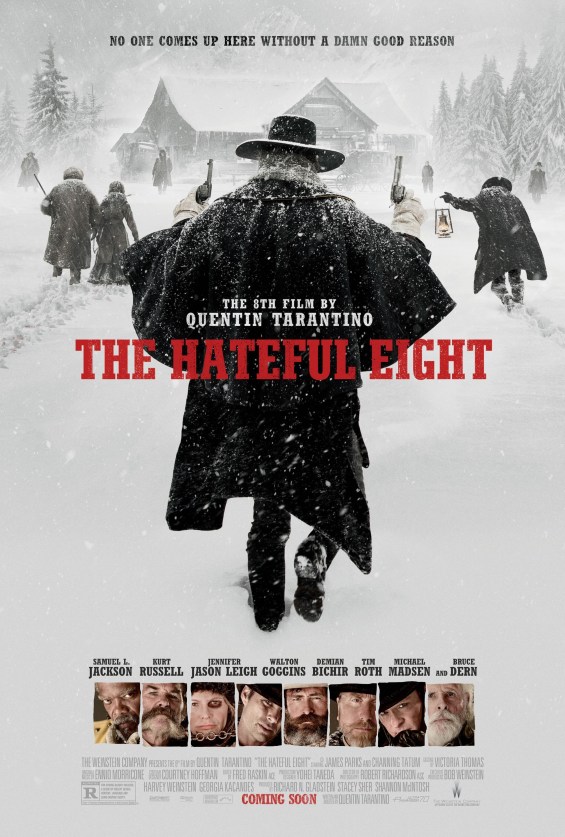
Written and directed by legendary filmmaker Quentin Tarantino (Reservoir Dogs, Pulp Fiction, Inglourious Basterds), 2015’s The Hateful Eight is appropriately Tarantino’s eighth cinematic masterwork and his second western following Django: Unchained in 2012. Loaded with astounding performances, captivating dialogue and a story that seems to fly by even with a runtime of almost three hours, The Hateful Eight is a suspenseful and darkly comedic flick where every character is shrouded in mystery and distrust. And, whilst not quite as iconic or as influential as some of Tarantino’s other work, I feel the film is rather underrated when it comes to his esteemed catalogue of entertainingly violent projects, standing firm as a gripping mystery-thriller with a wintry western backdrop.

Plot Summary: While heading toward the town of Red Rock in post-Civil War Wyoming, bounty hunter John ‘The Hangman’ Ruth and his fugitive prisoner, Daisy Domergue, come upon another bounty hunter and a drifter claiming to be Red Rock’s newest sheriff. Despite their distrust for one another, the group travels to a nearby stagecoach stopover, seeking shelter from an approaching blizzard. Greeted there by four other nomads, their shared scepticism reaches its peak as the weary travellers realise they may not reach their destination

From beginning to end, The Hateful Eight is oozing with tension and Tarantino’s signature style of filmmaking, quickly proving itself to be just as enjoyable as his many other critically acclaimed projects. The story itself bears many similarities to the sci-fi-horror; The Thing (1982), as both stories take place in an isolated location, concentrating on a collection of rugged characters who doubt each others’ intentions. Additionally, both films retain an atmosphere of dread and mistrust that builds almost imperceptibly, concluding with a thrilling climax. Of course, dissimilar to the 1980s classic, The Hateful Eight doesn’t feature an extraterrestrial creature mimicking its victims. Instead, much of the characters’ distrust comes from their varying beliefs and sinful histories, especially since Tarantino doesn’t play it safe in regard to the many racist sentiments that populated America during the post-Civil War era.

With two bounty hunters, a fugitive prisoner, a drifter who claims to be the newest sheriff of the small town of Red Rock, Bob “The Mexican,” enthusiastic hangman Oswaldo Mobray, lonesome cowpoke Joe Gage and the elderly war general Sandy Smithers, all expertly portrayed by Samuel L. Jackson, Kurt Russell, Jennifer Jason Leigh, Walton Goggins, Demián Bichir, Tim Roth, Michael Madsen and Bruce Dern, The Hateful Eight has no shortage of compelling characters and equally compelling performances. As a result of the characters’ myriad of slow-burning conversations, the film consistently retains a solid level of tension via the characters’ interactions, with Jackson being at his best, whilst Roth warrants merit for his performance as his character Oswaldo delivers a number of comedic moments due to his eccentric British accent and joyful outlook on the justice system.

Aside from the film’s occasional use of slow-motion, which appears corny and needless, nearly all of the visuals throughout The Hateful Eight are spectacular, as the cinematography by Robert Richardson effortlessly captures the seclusion of the setting of a stagecoach stopover caught in a blizzard. Providing a pleasant aesthetic change, not only from Tarantino’s prior western, but the western genre in general, visually differentiating itself as a result of the vast whiteness of the creeping cold just outside the stopover’s wooden doorway. Across many scenes, The Hateful Eight also possesses an almost theatre-like quality, which is an intriguing concept that is taken one step too far, in my opinion, when the story is interrupted by a short ‘interval,’ where Tarantino himself narrates what transpired in the past fifteen minutes after a jump cut, instantly yanking the audience out of the immersion of the narrative.

Known for his many western scores, as well as his arrangements for the previously mentioned sci-fi-horror; The Thing, composer Ennio Morricone similarly backs up many of the film’s suspenseful moments flawlessly through tracks like Overture and Neve. In fact, according to Tarantino, some of Morricone’s compositions for the film are actually unused pieces from the gruesome ’80s masterpiece. As brilliant as the original score is, however, The Hateful Eight conversely makes effective use of audible restraint during many scenes, with the blistering wind of the approaching blizzard pounding the stopover’s walls only escalating the build-up of tension.

On another note, cinephiles familiar with the director’s illustrious filmography will have a field day checking off the countless Tarantino tropes, from the chapter headings to the Red Apple tobacco reference and a final act full of glorious blood and guts. However, one lesser-known tidbit is Tarantino’s continuous collaboration with practical effects artist Greg Nicotero, the effects guru behind the post-apocalyptic television series; The Walking Dead, along with an array of Quentin Tarantino’s other projects, including Kill Bill: Vol. 1 (2003), Inglourious Basterds (2009) and Django: Unchained (2012). Comparable to those flicks, the practical effects throughout The Hateful Eight are brutal and virtually cartoonish in design, lending themselves to some of the film’s most memorable moments.

In summary, The Hateful Eight unsurprisingly offers another well-crafted jewel from Quentin Tarantino, integrating his signature blend of suspense, humour, snappy dialogue and over-the-top ultra-violence, all whilst demonstrating his grip on the filmmaking craft has in no way diminished amidst his many years of operating in the ever-evolving film industry. As such, The Hateful Eight is certainly not one to be missed. Rating: 8/10.

hateful_eight_ver10_xxlg

Rear Window (1954) – Film Review

“We’ve Become a Race of Peeping Toms. What People Ought to Do Is Get Outside Their Own House and Look in for a Change.” – Stella

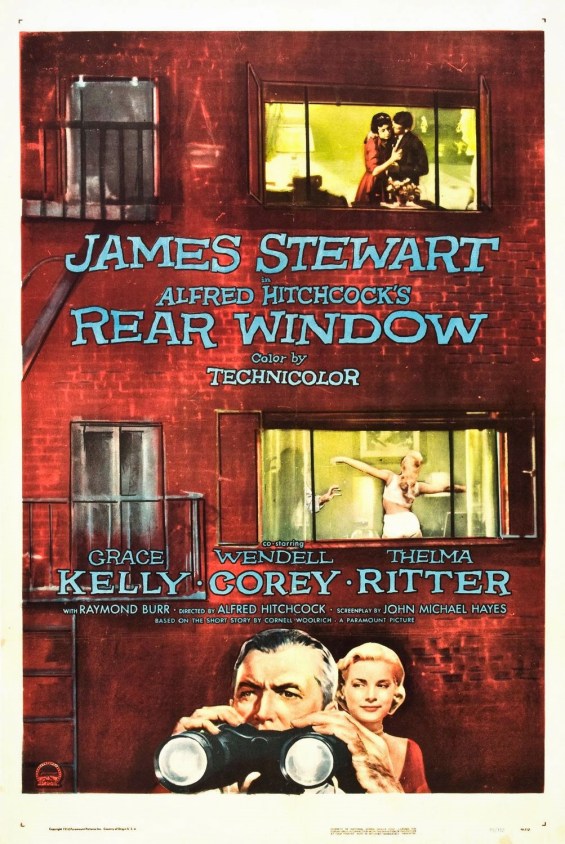
A refined combination of acting, cinematography, editing, blocking and set design, Rear Window, released in 1954, is a mystery-thriller with a terrific premise that brims with suspense and intrigue. Supposedly based (very loosely so) on the short story of the same name by Cornell Woolrich, as well as the details of two grisly real-world murder cases, Rear Window provides a compelling narrative with an extensive amount of visual storytelling, exuding tension throughout its runtime alongside a handful of well-written, amusing characters who are easy to understand and get behind.

Plot Summary: When professional photographer, L.B. ‘Jeff‘ Jefferies, breaks his leg while obtaining a shot at an auto race, he finds himself confined to his New York apartment during a discomfiting heatwave, spending his time peering out of his rear window observing his neighbours. But, when Jefferies begins to suspect that a man across the courtyard may have murdered his wife, he enlists the help of his fashion model girlfriend, Lisa Fremont, to investigate

Helmed by one of cinema’s greatest and most recognisable filmmakers, the late Sir Alfred Hitchcock (VertigoPsychoThe Birds), Rear Window stands as one of Hitchcock’s lesser-known films, despite its still overly positive reception from critics and audiences alike, which I feel is unfair, as the film contains much of the same cultivated and innovative directing Hitchcock was known for. For example, every cast member in the apartments facing Jefferies’ window wore an earpiece through which they could receive directions, allowing for lengthy extracts where Jefferies observes others as their gestures and body language reveal what is occurring in their lives behind closed doors. Furthermore, Hitchcock cleverly uses cuts to imply things about Jefferies’ neighbours and himself. For instance, when Jefferies is discussing his potential future with Lisa, specifically if he should propose to her, we follow his perspective as he observes a newlywed couple before his eyes turn to another apartment where another couple’s marriage has become distant and lifeless. Equivalent to much of Hitchcock’s filmography, Rear Window also possesses underlying themes of voyeurism, repeatedly questioning Jefferies’ actions as he snoops on the private affairs of those around him, valiant intentions or not.

The late central cast of James Stewart, Grace Kelly, Thelma Ritter, Wendell Corey and Raymond Burr are all fantastic. The protagonist, L.B. ‘Jeff‘ Jefferies, is portrayed with such snark and conviction by Stewart, relishing his life of risk, reward and travel with no plans to settle down anytime soon. Equally, Kelly as Lisa Fremont perfectly embodies beauty and elegance in contrast to Jefferies’ ruggedness, yet is still capable in her own right, eager to disprove Jefferies’ assumption that she could never fit into his world, hoping he will someday propose to her. After taking notice of Jefferies’ obsessive behaviour with his neighbour across the courtyard, however, Lisa agrees to put aside their relationship issues to assist in his investigation, along with Jefferies’ transient nurse, Stella, whom Ritter lends an excellent sense of intellect and dry wit via her performance.

Shot entirely on one set, which required months of planning and construction, the apartment courtyard set measured ninety-eight feet wide, one hundred eighty-five feet long and forty feet high, consisting of thirty-one apartments, eight of which were completely furnished. As a result, the cinematography by the late Robert Burks permits an array of creative and distance-spanning shots that move from apartment to apartment with ease, noticeably in the film’s rightly celebrated opening shot, a prolonged and sinuous tracking shot that sweeps across the whole courtyard, spending a moment in each of the six featured apartments before pulling back into Jefferies’ apartment to find him dozing in his wheelchair. Additionally, the lighting throughout Rear Window is remarkable for a film shot in a soundstage, with around one thousand arc lights being used to simulate sunlight. And, thanks to the extensive pre-lighting of the set, the crew could impressively change the lighting from day to night in under forty-five minutes.

Moving from the visuals to the audio, all of the sound in Rear Window is diegetic, meaning that all of the music, speech and other noises come from within the world of the film, excluding the non-diegetic original score heard in the opening scene by the late Franz Waxman, the most prominent piece of which is the orchestral track; Prelude, a jazzy, relatively lively track with a subtle aura of mystery.

On a more cynical note, whilst the foremost characters are well-defined and even have clear character arcs, not all of Jefferies’ neighbours are written equal, with some members of the apartment courtyard, such as the “Hearing Aid Lady” (a nickname given by Jefferies as he doesn’t know her real name), residing in one of the ground-floor apartments, receiving little to no development and only a single prominent action.

In summary, Rear Window is a captivating flick that, while perhaps not as iconic as some of Hitchcock’s other work, is just as delightful. Meticulous, gripping and surprisingly humorous, Rear Window is just one of the many films that hit that mark with Hitchcock at the wheel, employing elements that couldn’t be carried out in any art form other than film. And, true to his eclectic form, Hitchcock switched gears drastically for his next release, the 1955 romantic mystery; To Catch a Thief, proving he could lend his hand to almost any genre in cinema. Rating: 8/10.

rear_window_ver2_xlg

The Plague Dogs (1982) – Film Review

“They’re Not Masters. I Had a Master Once and I Know. Whatever the White Coats Are, They’re Not Masters…” – Snitter

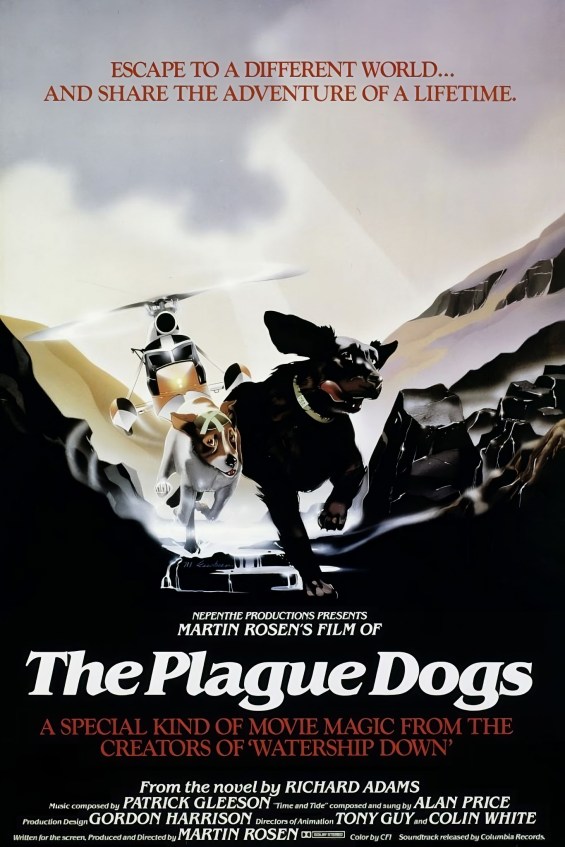
One of the longest British animated films ever released, 1982’s The Plague Dogs is an extraordinarily bleak yet emotionally resonant film that tackles the uncomfortable subject matter of animal testing, particularly in the case of canines. A beautifully melancholy and poignant story about hope, companionship and scientific boundaries, many will undoubtedly find The Plague Dogs a long-winded and generally unpleasant experience. Whereas, for those who can stomach its harrowing storytelling, The Plague Dogs will be as captivating as it is heart-rending, standing as an underappreciated, well-crafted piece of hand-drawn ’80s animation.

Plot Summary: When Snitter and Rowf, a pair of tormented dogs, manage to escape from a remote animal testing facility in Northwestern England, the facility director attempts to keep their escape quiet. But, as an increasing amount of local livestock are found dead, word soon leaks out, along with rumours that the dogs may be potential carriers of the bubonic plague…

The second animated film to be based on a novel by Richard Adam and written/directed by Martin Rosen, following the release of Watership Down in 1978, The Plague Dogs is similarly aimed at an adult audience despite its charming animal protagonists. In fact, alongside The Last Unicorn (1982) and The Secret of Nimh (1982), The Plague Dogs is amongst the darkest and most violent animated films of the late twentieth century. As such, if, like me, you’re a dog lover, many scenes throughout The Plague Dogs will be supremely challenging to watch as the canines suffer at many points, both mentally and physically, to thrust the underlying themes of the film onto the audience. And, as the film’s title would suggest, the protagonists’ daring journey is not as morally straightforward as it first may seem, as via a series of conversations between scientists, journalists and government officials, it’s suggested that Snitter and Rowf may carry a variant of the bubonic plague, thanks to the facility “White Coats,” but this is never entirely confirmed, leaving the rumours (as well as the ambiguous ending) up for interpretation.

The central voice cast of the late Sir John Hurt, Christopher Benjamin and James Bolam are all terrific in their assorted roles, delivering vocal performances that are empathic yet never too intense for the steady pacing. Moreover, the foremost duo of Snitter and Rowf are swiftly established and supplied with plenty of characterisation, as Rowf, a labrador retriever mix breed, begrudgingly follows the lead of Snitter, a determined and optimistic fox terrier, frequently acting as a foil for his mystical sanguinity, combating it with world-weary nihilism. Rowf’s pessimism is hardly irrational, however, as the pair’s horrific experiences in the facility have left them scarred, striving to use their escape as a chance to heal from those hellish experiences, with the survival guidance of a cunning fox known only as the “Tod.” Snitter is seemingly the heart of the film, though, formerly belonging to an affectionate owner who tragically died in an accident. Snitter underwent surgery of some kind during his time in the facility, resulting in a crown of bloodstained bandages around his head, ghostly hallucinations and persistent moments of distress due to a clamouring noise that only he can hear.

To match the relentlessly sombre tone, The Plague Dogs retains a shady colour palette throughout its runtime for both its stunning, watercoloured backgrounds and astonishingly realistic animation for the dogs, continuously prompting frames to resemble aged landscape paintings, complete with expansive fields, derelict farmhouses and cloud-covered peaks, which is even more impressive when considering no rotoscoping was utilised during production. Furthermore, the animated cinematography is dynamic and visually engaging as the camera glides around the dogs and their environment(s), often passing through windows and over stone walls, inadvertently helping to redeem the irksome amount of fade-to-black transitions in between.

Influenced by the techniques of American minimalism as well as the scores of Polish composer, Witold Lutosławski, Patrick Gleeson’s orginal score for The Plague Dogs conforms to the style of Rosen’s uncompromising filmmaking for the most part, as tracks, such as FreedomWondering and In the Pens, are suitably dour and fine-drawn, rarely flaring up to create room for the atmospheric sound design.

Unfortunately, regarding its reception, The Plague Dogs performed incredibly poorly critically and commercially upon its initial release, failing to live up to expectations as a follow-up to Martin Rosen’s last feature. Shortly after its UK premiere, the film’s distributor, Embassy Pictures, decided not to pursue any further theatrical releases, meaning many American animators never saw the result of their hard work, one of whom was actually a young Brad Bird, eventual writer-director of The Incredibles (2004), before he was fired during production.

In summary, the entire duration of The Plague Dogs is undeniably oozing with despair and dread. So much so, it wouldn’t be misleading to say the film is a “Prolonged Howl of Helplessness.” Still, in my opinion, the film and Rosen as a writer/director are unfairly unrecognised in the realm of animation, as while Rosen may have only orchestrated two films throughout his career, finding any animated flicks that can be compared to his filmography is virtually impossible. Rosen was a pioneer in animation, taking bold risks in his narratives and imagery alike to delve into topics the medium of animation is usually afraid to tackle, something The Plague Dogs does favourably and uncompromisingly. Rating: low 8/10.

MV5BNDA1ZDU3M2ItNTdmZC00NjlkLWJhN2UtYjY3YWI3Y2FhMThhXkEyXkFqcGdeQXVyMTQxNzMzNDI_._V1_-transformed

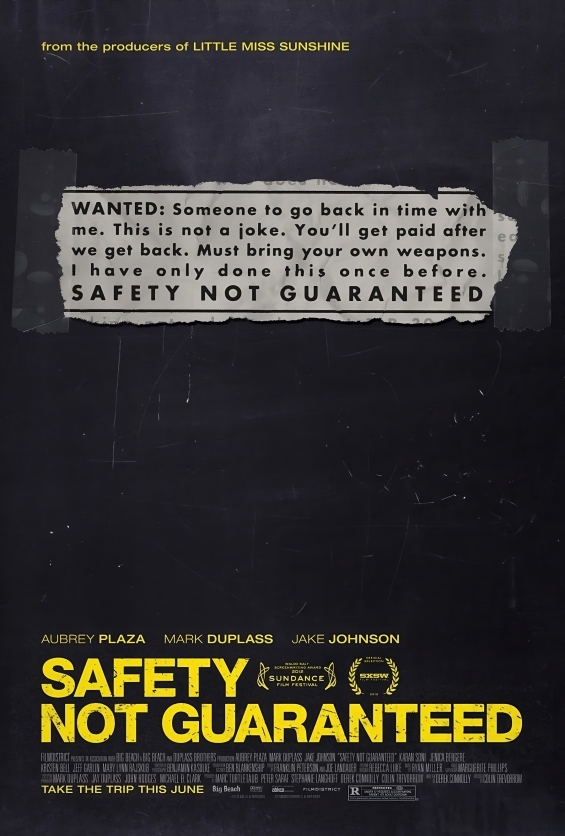
Safety Not Guaranteed (2012) – Film Review

“Stormtroopers Don’t Know Anything About Lasers or Time Travel. They’re Blue-Collar Workers.” – Arnau

Inspired by the infamous “Time Travel Companion” advert printed in a 1997 issue of Backwoods Home Magazine and written as a joke/last-minute slot filler by John Silveira, an employee of the magazine, who is actually credited in the film as a “Time Travel Consultant.” 2012’s Safety Not Guaranteed is a beguiling, low-budget comedy-drama with a minimal sci-fi twist, utilising its mirthful real-world inspiration to compose an austere story with relatively modest ambitions and a shortage of memorability that is, thankfully, enriched by its strong performances, quirky charm and heartfelt underlying themes of love, loss and altering the past.

Plot Summary: When an opportunity arises to turn an outrageous magazine advert into an investigative journalism opportunity, pessimistic intern, Darius Britt, jumps at the prospect, joining her superior, Jeff, and fellow intern, Arnau, as they set out to uncover whether the advert’s proprietor, Kenneth, is a deranged misfit or has truly discovered the secret to time travel…

Based on the previously mentioned printed magazine advert, which was even featured on The Tonight Show With Jay Leno in 1992 during the “Headlines” segment before transforming into an internet meme, Safety Not Guaranteed harbours a straightforward yet well-paced narrative, combining its subplots, twists and turns effectively as director Colin Trevorrow (Jurassic WorldThe Book of HenryJurassic World: Dominion) and writer Derek Connolly, waste little time. That’s not to say that the film has no deeper meaning(s), however, as despite the foundation of the story being a question of thought-to-be impossible technology vs. the drab confines of reality, Safety Not Guaranteed features many relevant themes of love in all its forms, as the various characters each have their own outlooks on intimacy and heartache, many of which are preconceived notions, similar to how the characters initially perceive Kenneth to be a delusional, sci-fi-obsessed oddball before becoming acquainted with him.

In regard to the central cast, each actor, whether that be Aubrey Plaza, Mark Duplass, Jake Johnson or Karan Soni, consistently remains within the realm of their character’s traits, emotionally developing whilst remaining true to the heart of their character. As such, Plaza and Duplass are immensely enjoyable to watch as there’s a sweet sadness in the characters’ focus on lost dreams, missed chances and the truism that we all long for a time machine every once in a while, which is best seen in Darius’ backstory as she has become cynical about life since the death of her mother, causing her to flounder, burdened with sorrow and self-blame. Yet, upon her arrival in Ocean View, Washington, she is met with more than meets the eye in Kenneth, a paranoid and suspicious yet affable man. Believing himself to be followed by government agents, Kenneth manoeuvres around town with his interpretation of covert ops, stealing lasers from local laboratories and immersing himself in technical calculations and physical training, all in pursuit of his time-travelling mission. Immediately drawn to each other as divergent outcasts, Kenneth gradually takes Darius into his circle of trust. Interestingly, the role of Darius was actually written with Aubrey Plaza in mind, as Derek Connolly wanted to work with her. Likewise, Jake Johnson was Colin Trevorrow’s first choice for the role of Jeff.

Visually, Safety Not Guaranteed is passable but not all that impressive, as cinematographer Ben Kasulke predominantly relies on hand-held shots in an attempt to personalise the viewing experience, providing the story with a pleasant layer of intimacy. Nevertheless, the film’s use of the drizzling, forest-shrouded location of Ocean Shores (along with a handful of other areas within thirty minutes of Seattle) is terrific, appearing visually interesting yet never overwhelming, specifically whenever a scene takes place at sunrise or sunset.

For a story revolving around time travel, Safety Not Guaranteed has a surprisingly emotional core for what could have easily been a corny low-budget flick. It’s no surprise, then, that its soundtrack, composed by Ryan Miller, helps to capture that same emotional palette, not only accentuating the themes of the film, but adding an aura of reflection and hopefulness that helps to make the film’s eccentric protagonist someone to root for rather than feel sorry for, such as in the foremost track; Opening. Aside from Miller’s original tracks, Safety Not Guaranteed also features songs from numerous indie bands, including Summer Fiction and Guster, making for an all-in-all well-rounded soundtrack.

On the topic of the humour throughout Safety Not Guaranteed, some gags land, others do not, with some scenes also seeming rather bare comedy-wise. However, I applaud the film’s decision to avoid turning Kenneth into a cartoonishly strange character just for the sake of a few cheap laughs, as well as how natural the cast’s witty improvisation feels, particularly in the scene where Jeff advises Arnau to raise his collar and sport sunglasses to look like a “Pilot That Drives Jets.”

In summary, Safety Not Guaranteed is an endearingly zany indie flick. While the film is obviously low-budget and not exceedingly memorable when placed alongside many other light-hearted comedy-dramas, Safety Not Guaranteed possesses a clever screenplay, earnest moments and a genuine sense of sentiment for those who would like to turn back the clock. Not to mention the film’s plethora of excellent performances from its cast (primarily its three leads), ensuring the film will hold up in the future. Rating: 6/10.

safety_not_guaranteed_ver2_xlg-transformed Continue reading

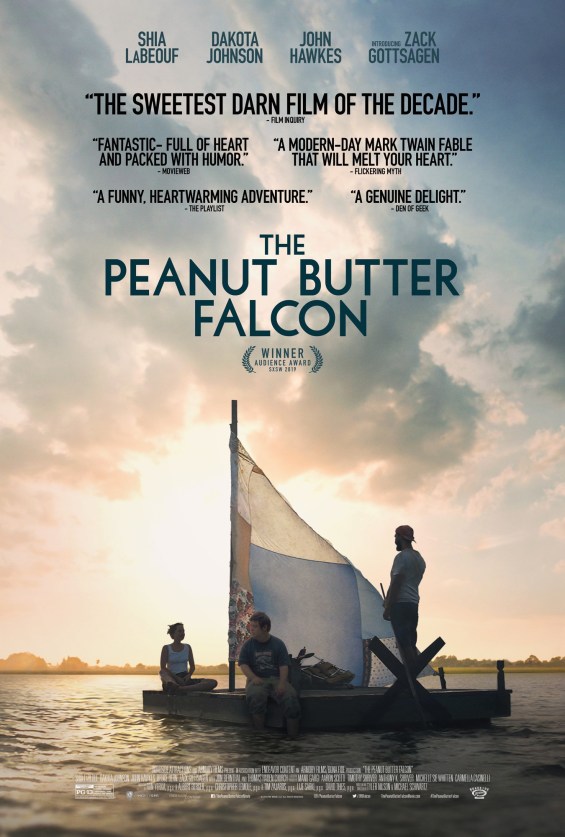
The Peanut Butter Falcon (2019) – Film Review

“Friends Are the Family You Choose.” – Carl

Warm-spirited, humorous and well-acted, 2019’s The Peanut Butter Falcon is a feel-good, modern-day comedy-drama inspired by the celebrated literature of author Samuel Langhorne Clemens, best known by his pen name Mark Twain, who challenged many of the fundamental issues of his time, including racism, evolving landscapes, class barriers and access to education, through notable publications like his renowned novel; The Adventures of Tom Sawyer, and his 1883 memoir; Life on the MississippiThe Peanut Butter Falcon specifically elicits Twain’s 1884 book; Adventures of Huckleberry Finn, finding modern resonance in the classic piece of American literature by incorporating a raft, assorted riverine ventures and luscious swampy landscapes into its entertaining (if occasionally meandering) story, which is frequently elevated by the film’s admirable camerawork and plethora of superb performances.

Plot Summary: When Zak, a twenty-two-year-old orphan with Down Syndrome, escapes the state-run care facility where he resides to pursue his dream of becoming a professional wrestler by attending a wrestling school headed by his favourite grappler, the Salt Water Redneck, he incidentally runs into Tyler, a fisherman turned delinquent fleeing to Florida. Together, the pair embark on a journey of camaraderie as they evade capture, slowly morphing Tyler into an unexpected ally and coach…

The concept for The Peanut Butter Falcon first came about when writer-directors Tyler Nilson and Michael Schwartz, who before this film’s release had only written/directed short films, such as The Moped Diaries (2014), Alex Honnold’s Urban Ascents (2014) and Alex Honnold: At Home Off the Wall (2015), met its forthcoming lead actor, Zack Gottsagen, at a camp for disabled and non-disabled individuals, where he expressed his yearning to be a “Movie Star,” this prompted Nilson and Schwartz to write a screenplay around him, knowing many locals would allow them to film for free, without permits. Given that the story is set within Southern America and features a protagonist with Down Syndrome as a result of this, The Peanut Butter Falcon plays it relatively safe with its judgmental setting to maintain an upbeat tone, only harbouring a few brief moments where Zak is lightly mocked for his disability. Moreover, many of these abusive characters are counterbalanced by jovial individuals who aid Zak and Tyler in their journey, like Blind Jasper John, portrayed by Wayne Dehart, a blind and Black evangelical preacher, who could be seen as somewhat cartoonish and stereotypical, depending on your background.

The remarkable central cast of Shia LaBeouf, Dakota Johnson and Thomas Haden Church (along with a surprise appearance from Jon Bernthal) are all exceptional in their assorted roles, conforming to their surroundings without appearing excessive in their Southern characteristics. However, Zack Gottsagen is understandably the stand out of the cast, as in spite of having only a handful of acting credits to his name, Gottsagen portrays Zak with a cordial, childlike innocent, providing his lonesome character with moments of goofiness and naivety without ever making him seem mindless. Zak is also pivotal to the film’s narrative, as his role in the story is ultimately to redeem Tyler, a flawed yet affable delinquent, who learns to be a better person thanks to Zak’s modest influence. Eventually, Tyler strikes up a serviceable romantic subplot with Zak’s pursuing, kind-hearted carer, Eleanor, but this never detracts from the prominent bond between Tyler and Zak, which remains meaningful and gratifying throughout the runtime.

Beautifully flaunting the rural Georgia landscape (which stands in for the Outer Banks of North Carolin), the cinematography by Nigel Bluck expertly captures the essence of the murky, backwater creeks, decrepit shacks, over-priced gas stations and sludgy shores with grounded boats that serve as the story’s setting, constructing an appealing visual aesthetic that feels naturalistic in its details, but also celebrates the American region for its prominent natural beauty and devil-may-care lifestyle.

Much of the score throughout The Peanut Butter Falcon bears a stripped-down approach to its arrangements, as composers Zachary Dawes, Noam Pikelny, Jonathan Sadoff and Gabe Witcher utilise acoustic instruments and minimal orchestration to provoke the audience with the calming sensation of standing in the open countryside. This is especially true of the tracks; Cold OpenTravelling Theme and Love Me in Kind, which possess simplistic yet breezy banjo-led melodies that correspond with the soothing, swampy visuals.

Interestingly, although The Peanut Butter Falcon received no Academy Award nominations in the face of its positive reception from critics and audiences alike, Gottsagen actually became the first-ever individual with Down Syndrome to present an Academy Award when he and LaBeouf announced the Best Live-Action Short Film on February 9th, 2020, which is an accomplishment in itself.

In summary, The Peanut Butter Falcon‘s triumph as a sleeper hit, becoming the highest-grossing independent film of 2019, was, in my opinion, rightfully deserved, as this low-budget comedy-drama is, above all else, charming, despite its sometimes corny and overly optimistic storyline. And whilst the film is admittedly far from a precise, poignant representation of a community that is rarely represented on-screen, The Peanut Butter Falcon is a step forward with its casting of an unknown lead actor with Down Syndrome, as opposed to acquiring a ‘bigger name’ to boast the film’s notoriety. Nevertheless, if you’d like to see an authentic, cinematic portrait of a life with Down Syndrome, I’d recommend seeking out the 2016 low-budget British drama; My Feral Heart, or the Irish drama; Sanctuary, also released in 2016. Rating: 7/10.

peanut_butter_falcon_xxlg

The Place Beyond the Pines (2012) – Film Review

“If You Ride Like Lightning, You’re Going to Crash Like Thunder.” – Robin

Successively suspenseful and dramatic, The Place Beyond the Pines, released in 2012, is a thrilling crime-drama recounting a tale of fatherly sins visited by their descendants. Efficiently co-written and directed by Derek Cianfrance (Blue ValentineThe Light Between OceansSound of Metal), The Place Beyond the Pines utilises its decade-spanning story and outstanding performances from its extensive cast to construct a film that succeeds both as a high-stakes crime-thriller, and a far quieter, more empathetic character study of enraged, solitary men, ascertaining Cianfrance’s penchant for bold storytelling and eye for sighting the cast members to carry his stories through to their climax.

Plot Summary: When Luke, a high-wire motorcycle stuntman, passes through Schenectady, New York, as part of a travelling carnival, he reconnects with his former lover, Romina, discovering that, in his absence, she has given birth to their son, Jason. Determined to give his son the upbringing he never had, Luke renounces his life on the road to provide for his new family, taking an underpaid job as a car mechanic before committing a series of bank robberies aided by his exceptional motorcycle skills, eventually placing him on a collision course with the ambitious police officer, Avery Cross…

Unfolding over fifteen years, the actual narrative of The Place Beyond the Pines is undoubtedly one of the film’s finest aspects, disclosing an engaging and dreary tale, all within the confines of Schenectady and its surrounding woodland. The first two acts of the story, which almost feel like distinct ‘chapters,’ are consistently compelling and narratively unpredictable. Unfortunately, however, the strengths of the first two acts are diluted in the somewhat meandering third act, which is admittedly weaker than those that precede it, concluding the story with something of an anticlimax. Nevertheless, it is a uniquely structured plot, conforming to the notion of generational sins.

In the first act, the story revolves around the travails of Luke, portrayed by Ryan Gosling, a heavily-tattooed motorcycle stuntman living a freeing life on the road before he learns his former lover, Romina, portrayed by Eva Mendes, has given birth to their son. Given something to care about in his life, Luke decides to abandon his trivial lifestyle to become a suitable father figure, plunging into a dead-end job before taking a friend’s suggestion to rob banks. From here, Luke rides the line between logical and immoral, performing vile acts in the hope of earning money to fuel better ones, making for an instantly compelling character as Gosling suitably delivers a nuanced, moody performance riddled with pathos. Likewise, Avery Cross, excellently portrayed by Bradley Cooper, is a captivating protagonist in the second act. Serving as one of the police officers tasked with finding Luke, Avery is a well-educated officer keen to prove himself and move up the ranks of law enforcement. But, as his time in the force grows, Avery begins to see the deep level of corruption within his department, conveying underlying social commentary that is even more relevant today. Lastly, in the third act, the narrative switches focus to the sons of Luke and Avery, Jason and AJ, portrayed by Dane DeHaan and Emory Cohen, respectively, fifteen years after the previous acts. And despite DeHaan and Cohen delivering admirable performances as both characters inherit some of their father’s traits, this act and its protagonists are less gripping than the previous two, as previously mentioned.

When it comes to the visuals, the cinematography of The Place Beyond the Pines is largely dominated by hand-held shots. Fortunately, these shots are considerably less distracting (and motion sickness-inducing) than many other flicks where this style of camerawork is employed. However, Sean Bobbitt’s cinematography is undoubtedly at its most effective in one particularly exhilarating chase sequence, seemingly accomplished in one unbroken take as it’s shot entirely through the window screen of a police car pursuing Luke on his motorcycle.

In spite of the many moments of violence and tension, the original score by Mike Patton is unexpectedly soothing. Patton, who is most known as the lead singer of the alternative metal band, Faith No More, made his debut composing for film with the action sequel; Crank: High Voltage, in 2009, The Place Beyond the Pines being his third score, and easily his most impressive to date. A combination of electronic tones, electric and acoustic guitar accents and a sampled choir, the soundtrack retains many beautiful tracks, the most notable being; The Snow Angel, a lonesome piano-led motif that is only heard once during the runtime yet is exceptionally memorable, even appearing in one of the film’s trailers.

Intriguingly, Derek Cianfrance claims that his financier would only provide him with the budget he desired if he reduced the one hundred-and-fifty-eight-page screenplay to one hundred and ninety pages. Without removing anything, Cianfrance sneakily used a smaller font and extended the margins, which I’m thankful for as, in my opinion, virtually every scene throughout The Place Beyond the Pines is important.

In summary, in trying to convey such a monumental amount of story, The Place Beyond the Pines does sometimes spread itself too thin and leave some strands incomplete, but when the film is at its best, it is an enthralling and well-written piece of storytelling. And while its underlying themes are weighty, Derek Cianfrance’s strong direction and surprisingly effective use of hand-held camerawork result in a disquieting style that snappily underplays the drama and uncertainty. Rating: low 8/10.

place_beyond_the_pines_xxlg (1)