Southpaw (2015) – Film Review

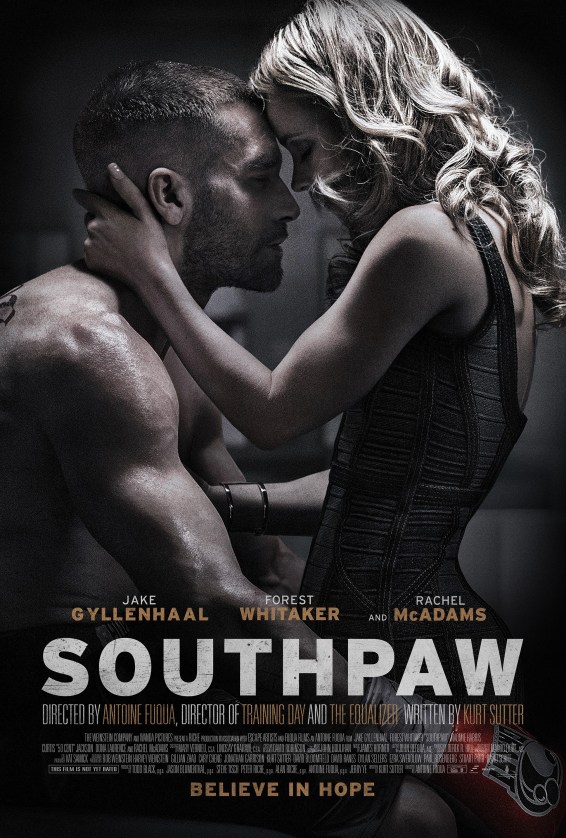
Raw, dramatic, and gripping, ‘Southpaw,’ released in 2015, may suffer from feeling a little too familiar at points, following an almost identical structure to many other boxing flicks, like ‘Rocky,’ ‘Warrior,’ and ‘The Fighter,’ in addition to featuring some fairly bland filmmaking. But, through Jake Gyllenhaal’s powerhouse performance alongside the story’s strong grasp on realism, ‘Southpaw’ rolls with the punches to become a mostly enthralling watch throughout its typical rags-to-riches narrative.

Plot Summary: Professional boxer; ‘Billy Hope,’ lives a life of luxury with his supportive wife; ‘Maureen,’ and their daughter; ‘Leila,’ after winning forty-three consecutive fights in a row, becoming a world-famous champion in light-heavyweight boxing. But, after the zealous contender; ‘Miguel Escobar,’ publicly challenges ‘Billy,’ a violent confrontation breaks out between the two, during which, ‘Maureen’ is fatally shot, sending ‘Billy’ down a rampant path of self-destruction. Months later, ‘Billy’ is forced back into the ring, now fighting to revive his career and reclaim his daughter from child protective services…

Directed by Antoine Fuqua (Training Day,  The Equalizer, The Magnificent Seven), ‘Southpaw’ is quite a diversion from Fuqua’s usual trend of directing action-heavy blockbusters. However, strangely, ‘Southpaw’ was originally conceived as an unofficial follow-up to the drama; ‘8 Mile,’ which was based on the real-life story of renowned rapper; ‘Eminem,’ with the rapper himself also set to return as the film’s protagonist. But, as a result of the evolution of the film’s screenplay and ‘Eminem’s music career conflicting with ‘Southpaw’s production schedule, the idea was eventually scrapped. Yet, ‘Eminem’ still has an appearance within the film having worked on the soundtrack, performing the songs; ‘Phenomenal’ and ‘Kings Never Die,’ alongside being an executive producer for the rest of the film’s music.

Jake Gyllenhaal’s performance is for most, the best element of ‘Southpaw’ as a whole, and it’s clear to see why, as Gyllenhaal makes the film far more engaging through his portrayal of ‘Billy Hope,’ displaying a huge range of emotions for the boxer from intense rage to devastating loneliness. Gyllenhaal’s performance even hints to the idea his character may be suffering from a traumatic brain injury, as early on in the film, after ‘Billy’ is brutally beaten during a fight, he struggles to have a simple conversation with his wife or answer questions from the press. Gyllenhaal has stated that he was inspired by real-world boxer Miguel Cotto, which might explain why his portrayal is so accurate. Forrest Whitaker, Rachel McAdams, and Oona Laurence are all also excellent within the film, with each character undertaking an important role within the story.

When it comes to ‘Southpaw’s editing or it’s cinematography by Mauro Fiore, the film doesn’t really allow for anything overly creative or surprising, as while many close-ups are effectively utilised for when ‘Billy’ fights his opponents within the ring, with the camera paying close attention to the sheer amount of sweat, spit and blood that protrudes from the pugilists. Most of the film’s camerawork consists of standard close-ups of character’s reactions or mid-shots of dimly-lit environments. That is, before the story travels to the Las Vegas and Madison Square Garden stadiums, which are both much larger in scale and therefore, also spectacle.

Sadly, the second-to-last film to have a score composed by James Horner. ‘Southpaw’s original score doesn’t receive too much focus during the runtime, despite being a decently emotional and impactful score even if it isn’t all that memorable. Interestingly, director Antoine Fuqua actually had no money to pay James Horner to compose the film as a result of ‘Southpaw’s budget running short. However, Horner didn’t care as he adored the film’s screenplay, and eventually (and generously) decided he’d compose the film for free.

In spite of the film pummelling it’s audience with genre clichés, I admittedly did find a few of ‘Southpaw’s story-beats engrossing. Most notably, the notion of ‘Billy’ dealing with his emotions, as the boxer faces everything from severe grief to bitter rage throughout the film, ultimately leading him to drug abuse and the eventual loss of his daughter, as I felt these personality flaws made ‘Billy’ a more realistic and in some ways relatable character, appearing as a struggling father rather than just a boxing champion who fails to beat an opponent due to his pride. The screenplay also gives the impression that writer Kurt Sutter did his research into the world of professional boxing, as the film continuously displays how unforgiving the sport can be, with ‘Billy’ receiving serious bruises/wounds after each fight, and when training, has to perform an abundance of techniques beyond just repeatedly hitting a punching bag.

In summary, although ‘Southpaw’ does have its issues and isn’t likely to become a drama recognised for generations to come, Jake Gyllenhaal’s spectacular performance certainly raises the film higher, and makes for an enjoyable time whether you’re a fanatic of sport-orientated dramas or not, with the film’s grimy realism and commentary on the harsh world of boxing (as underdeveloped as it may be) simply being extra additions to the mixture. Final Rating: low 7/10.
southpaw_ver2_xxlg

Jojo Rabbit (2019) – Film Review

From Taika Waititi, the now-esteemed comedy director behind modern comedy classics, like ‘What We Do in the Shadows,’ ‘Hunt for the Wilderpeople,’ and ‘Thor: Ragnarok,’ comes a beautifully crafted war film with a strangely pleasant sense of humour, as ‘Jojo Rabbit’ really stands out within the war genre for being one of the first films set during World War II to be an anti-hate satire, telling it’s heartwarming and optimistic story in an amusing yet respectful fashion. Soon cementing itself as one of the most noteworthy releases of 2019.

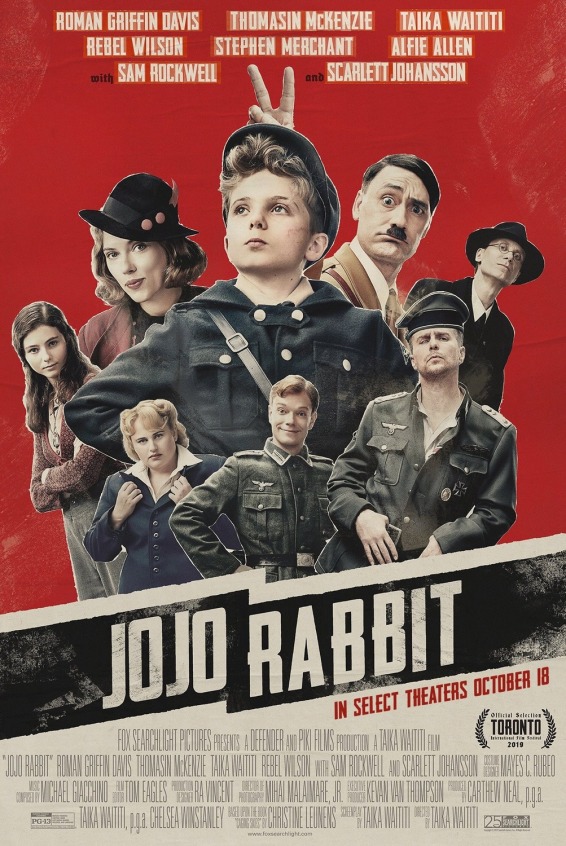
Plot Summary: Nearing the end of the Second World War, a lonely German boy named: ‘Jojo’ aspires to be a Nazi, hoping to one day fight on the frontline. But, ‘Jojo’ soon finds his worldview turned upside-down when he discovers his mother is hiding a young Jewish girl in their attic. Aided only by his idiotic imaginary friend, who takes the form of ‘Adolf Hitler,’ ‘Jojo’ must confront the unexpected guest in his home, and in doing so, confront his blind nationalism…

Partly based on the novel; ‘Caging Skies’ by Christine Leunens, the screenplay for ‘Jojo Rabbit’ was actually written back in 2011, putting it in-between ‘Boy,’ released in 2010, and ‘What We Do in the Shadows,’ released in 2014, in the chronology of Taika Waititi-penned films. And, while ‘Jojo Rabbit’ is certainly one of Waititi’s finest films to-date, it is also one of his most controversial, as whilst I personally feel the film goes about its comedy in a tasteful manner, never undercutting the story’s message and mostly just poking-fun at ridiculous Nazi protocols and beliefs. ‘Jojo Rabbit’ did receive plenty of flack from critics as soon as it was even announced the film would contain any kind of humour, which I find quite unfair on behalf of the film, as it’s clear to me that the humour is crucial in what the story is trying to accomplish.

The young and impressive Roman Griffin Davis leads the cast excellently as ‘Jojo,’ portraying the young boy as simply a regular kid who has a fascination with this ideology the Nazis are fighting for, even though he has little understanding of it nor its horrific consequences. Then there is Thomasin McKenzie, who portrays the opposite side of this, as her character; ‘Elsa,’ is a resourceful and intelligent Jewish girl who attempts to open ‘Jojo’s eyes to the real-world, rather than the warped-reality his fellow Nazis have burned into him. Scarlett Johansson is also fantastic in the film as ‘Jojo’s mother, ‘Rosie,’ having the most consistent German accent of the cast by far. But, it’s the director himself, Taika Waititi, who takes the short straw portraying the infamous Adolf Hitler, or at least ‘Jojo’s imaginary interpretation of him, as ‘Hitler’ is always presented in a very discriminating way, with Waititi portraying the dictator like a complete tool, only ever having as much information and maturity as ‘Jojo’ does, and occasionally, even less so.

Oppose to many other war films, ‘Jojo Rabbit’ features a very vibrant colour palette, as Waititi actually discovered through much of his research that Germany during World War II was both colourful and fashionable, and was interested in shying away from war films only ever displaying World War II as dark and dreary. So, through this, as well as the fairly creative cinematography by Mihai Malaimare, ‘Jojo’s small town is presented as a seemingly celebratory place with stylishly dressed citizens. Almost as if the town is trying to ignore the impending threat, only semi-aware that the Third Reich is crumbling beneath them.

The film’s original score by Michael Giacchino is another wonderful effort from the composer, as the score features a number of memorable tracks, from ‘Jojo’s Theme’ to ‘A Butterfly’s Wings,’ and ‘Rosie’s Nocturne.’ In many ways, the score for ‘Jojo Rabbit’ almost sounds as if it’s a military march composed by a group of children, which works perfectly considering the film’s story is told through a child’s perspective. Furthermore, the original score also utilises German vocals to more accurately fit with the story’s setting.

Although the supporting cast of Archie Yates, Rebel Wilson, Stephen Merchant, and Alfie Allen are all brilliant within the film, I really do wish their characters were featured more throughout the narrative. As, aside from Sam Rockwell’s ‘Captain Klenzendorf,’ who receives a respectable amount of screen-time, many of the story’s side characters are seemingly only in the film for the sake of a couple of humorous scenes, which is unfortunate, as every member of the cast portrays their Nazi characters as hilariously over-the-top as possible.

In summary, ‘Jojo Rabbit’ isn’t only another extraordinary entry into Taika Waititi’s catalogue of comedy flicks. But, I’d argue it’s his best project thus far, a daring and charming film that simultaneously explores the horrors of war, yet also the compassion in people. And, while the film may not be for everyone, with many reviews clearly indicating how divisive the film is with its implementation of comedy, I feel the film juggles its humour and emotional moments immensely well, with its remarkable original score and bright colour palette only helping the film stand further out from the crowd. Final Rating: 8/10.

jojo_rabbit_ver2_xlg

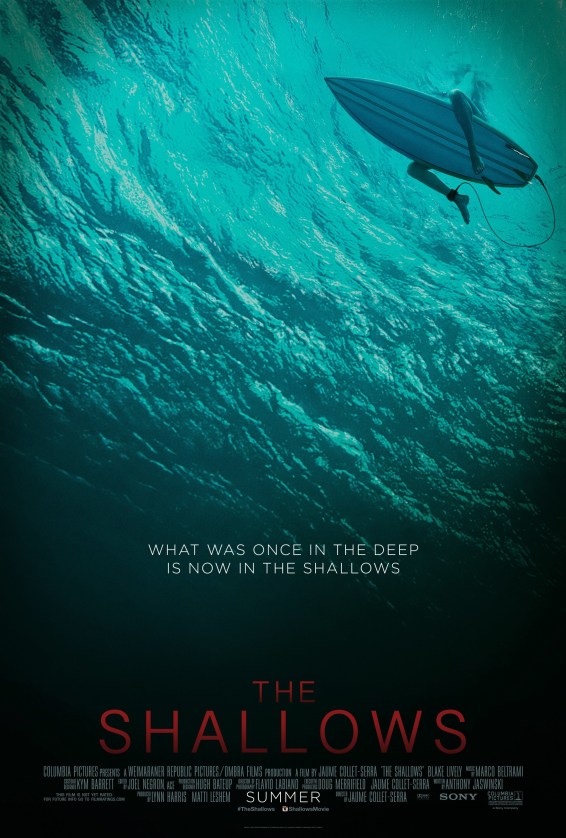
The Shallows (2016) – Film Review

Ever since the release of the original blockbuster; ‘Jaws,’ in the summer of 1975, shark films have never quite managed to reach the same heights, with flops such as ‘Deep Blue Sea,’ ‘Bait,’ ’47 Meters Down,’ and ‘Shark Night’ feeling quite distant from reality, as they present the animals as nothing but bloodthirsty monsters that devour brain dead characters. And, while ‘The Shallows’ does feel like a slight improvement over many of these other flicks (mostly in regards to its protagonist), the film still falters at many turns.

Plot Summary: After losing her mother in an accident, medical student; ‘Nancy,’ dumps her responsibilities in Galveston and travels to Mexico, hitchhiking a ride to a hidden beach that her mother loved when she was young. But, following her discovery of a whale carcass whilst surfing, ‘Nancy’ is attacked by a great white shark, leaving her tired, bleeding and stranded on a small rock, with no sign of rescue…

Releasing in 2016 to great success, ‘The Shallows’ was one of the first major shark films released into cinemas in quite some-time, but as well as being a creature-feature, ‘The Shallows’ also serves as a modern-day survival-thriller along the same lines of ‘127 Hours Later,’ as ‘Nancy’ has to face not only the great white shark stalking her, but also hunger, thirst, weather, and, of course, the severe leg injury she receives when she first encounters the apex-predator. Yet, despite this focus making for a far more engaging experience, the narrative simultaneously tries its hand at character development, with ‘Nancy’ receiving plenty of characterisation in the film’s first act, which is sadly made less interesting as its delivered through some immensely corny dialogue.

Blake Lively, who is by no means a renowned actress, with only two films throughout her career featuring her in the top-billed cast, carries the film solo, and her commitment to this role is certainly admirable, as Lively gives a very intense performance as a result of ‘Nancy’ being in agonising pain for most of the runtime. Furthermore, Lively did most of her own stunts for the film aside from her character’s surfing. In fact, in one particular scene where ‘Nancy’ crushes a crab and then proceeds to eat it raw, Lively is actually eating a real crab that the production crew found dead on a nearby beach that morning, so her reactions of disgust are genuine, even though the crab initially being crushed was achieved through CGI. This is all made even more impressive by the fact that Lively was pregnant with her second child at the time of filming. 

Flavio Martínez Labiano’s cinematography does provide a handful of attractive and memorable shots when not focusing on the characters, these usually being when the shots revolve more around the shark lurking beneath the water, or when the camerawork effectively uses framing to display how far ‘Nancy’ is from safety. And, of course, with the film being shot off the Gold Coast of Australia (excluding a few scenes which were shot in a large water-tank), the film’s signature beach and crystal clear waves are always an alluring sight, which is a superb visual clash with the horror that lies within.

The original score by Marco Beltrami serves the story well enough, as the film’s soundtrack drifts from beautiful calming tracks, like ‘Paddle In’ and ‘Nancy and Dad Facetime,’ to much more tense tracks, such as ‘Main Title’ and ‘Towards the Dead Whale.’ However, its when the story shifts into full on threat that the score begins to feel extremely generic, most notably, the track; ‘Underwater Attack,’ which is barely distinguishable from any other thriller soundtrack as it doesn’t encapsulate either the beauty or isolation of the ocean as many of the other tracks do.

Unlike ‘Jaws’ or even ‘Deep Blue Sea’ during a few moments, ‘The Shallows’ exclusively uses CGI to bring its shark to life, which is unfortunate, as while there is clearly a huge level of detail put into the shark as director Jaume Collet Serra (Orphan, Unknown, Non-Stop) worked closely with the film’s visual effects artists to ensure a sense of realism in the shark’s design, having the team do thousands of hours of research. This all sadly goes to waste though due to the demands of the film’s screenplay, as the shark in ‘The Shallows’ rarely acts like a real animal, often feeling like just a hulking murderous monster whose CG effects drastically vary depending on the shot.

In summary, ‘The Shallows’ is a step-up from a number of other shark flicks, but even with its above-average filmmaking and solid performance from Blake Lively. The film still falls into many of the common issues shark films do, as the story favours the idea of using its shark as a monster of the ocean and that alone, and this on top of the film’s occasionally strange stylistic choices, shoddy CG effects and cheesy dialogue, result in the film becoming just another poor attempt at revitalising the great white shark as a cinematically enthralling antagonist. Final Rating: 4/10.

shallows_xxlg

The Perks of Being a Wallflower (2012) – Film Review

Dealing with heavy themes of loneliness, mental health and suicide, ‘The Perks of Being a Wallflower’ may not astonish when it comes to its visuals. Yet, through its strong performances, heartfelt story and well-written screenplay (aside from one or two cliché lines), the film soon becomes a very sincere and captivating adaptation of the acclaimed coming-of-age novel many grew up with when it released in 1999, now being seen as one of the best teenage dramas in recent years.

Plot Summary: Fifteen-year-old; ‘Charlie,’ a socially awkward teenager heading into his first year of high school, used to watching life from the sidelines, ‘Charlie’ soon discovers the joys of friendship, love and music as the free-spirited; ‘Sam,’ and her stepbrother; ‘Patrick,’ open his eyes to the real world. But, when his friends prepare to leave for college after graduating high school, ‘Charlie’s inner sadness threatens to shatter his newly-found confidence…

In a rare scenario, the film adaptation of ‘The Perks of Being a Wallflower’ is not only based on the novel of the same name by Stephen Chbosky, but is actually written and directed by Chbosky himself. As, originally, beloved writer-director John Hughes, the comic genius behind; ‘The Breakfast Club’ and ‘Sixteen Candles,’ amongst many other ’80s teen flicks, was intended to direct the adaptation, initially wanting to make the film into more of a dark comedy with Shia LaBeouf set to play ‘Charlie,’ Kirsten Dunst as ‘Sam,’ and Patrick Fugit as ‘Patrick.’ But, with Hughes sudden death in 2009 stalling the project, his screenplay was eventually scrapped as he’d not completed it before his passing, leaving Chbosky to take the reins.

Throughout the entirety of the film, the central trio of friends are portrayed wonderfully by Logan Lerman, Ezra Miller and Emma Watson, in one of her first roles following the end of the ‘Harry Potter’ series, as each member of the young cast display plenty of range with their respective characters receiving an almost absurd amount of characterisation alongside, resulting in all three of the central protagonists soon forming a real bond with the audience through their lovable yet realistic portrayals of high school teenagers. Well-known comedy actor Paul Rudd also appears within the film as ‘Mr. Anderson,’ using his natural charisma to portray a genuinely kind-hearted teacher, guiding ‘Charlie’ to what he believes is his future career as a writer.

The film’s cinematography by Andrew Dunn is noticeably where the filmmaking dips in quality, as despite the camerawork occasionally allowing for some interesting framing, such as when ‘Charlie’ is framed alone with only bare walls surrounding him, visually presenting him as an outcast due to his anxiety when interacting with others. Most of the film’s cinematography feels fairly mundane, with the colour palette, in particular, seeming very confined, always utilising quite warm/calming colours regardless of what’s happening within the narrative. With that said, near the end of the runtime, the film does manage to impress with its editing as ‘Charlie’ begins to suffer from a panic-attack, represented through the film cutting rapidly between an array of previous scenes, ensuring a feeling of being overwhelmed within any viewer whilst watching. 

From iconic songs, such as: ‘Heroes’ and ‘Come on Eileen,’ to the beautifully somber original score by Michael Brook. The entire soundtrack for ‘The Perks of Being a Wallflower’ is both graceful and immensely underappreciated, capturing the film’s many alternating tones, whether that’s its unrelenting isolation, or its upbeat bliss. But, my personal two favourite tracks have to be ‘Charlie’s First Kiss’ and ‘Shard,’ a pair of tracks that are both truly touching pieces of music, evoking emotion in any listener in spite of their simplicity.

Another aspect of the film I adore is how it represents high school, as while many coming-of-age flicks usually lean into the idea of high school being an often chaotic, but satisfying experience, ‘The Perks of Being a Wallflower’ never glorifies school, refusing to represent it as either a positive or negative place. This all backed up, of course, by the story’s interesting themes which the film handles with care, never overemphasising it’s concepts in a similar fashion to the source material. Also, in line with the original novel is the film’s nostalgic 1990s setting. Yet, with the exception of the numerous mix-tapes the characters listen to, you’d be forgiven for being unaware that the film even takes place within this time-period, as it’s never mentioned nor plays into the film’s style.

In summary, ‘The Perks of Being a Wallflower’ is deserving of the praise it receives, as while the film’s uninspired cinematography does leave some room for improvement, for a directorial debut, Stephen Chbosky really knocks it out of the park here, with some brilliant performances and very underrated original score, the film is truly an adaptation to be admired. And, regardless of whatever time-period its story is set within, many of its themes/messages are timeless, and I personally believe this is what any other films focusing on troubled teenage characters should strive to be. Final Rating: 8/10.

perks_of_being_a_wallflower_xxlg

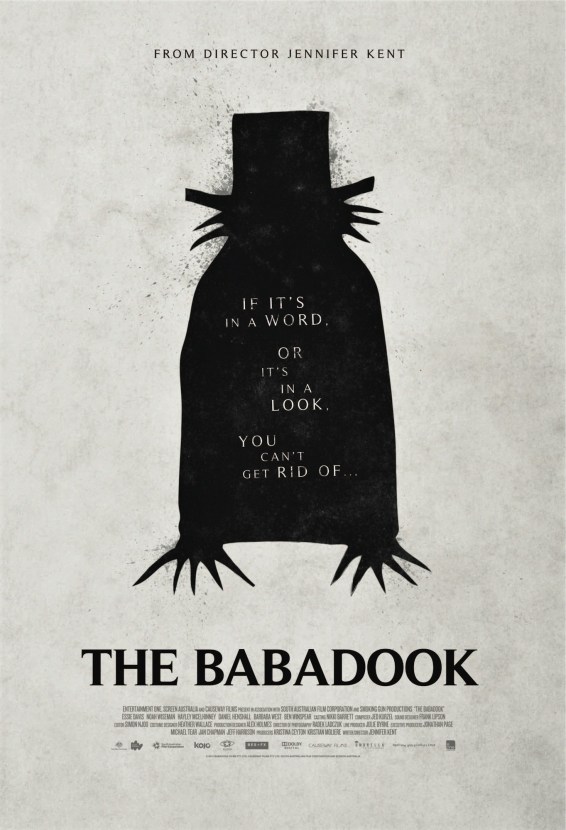
The Babadook (2014) – Film Review

Surreal, engrossing and truly terrifying during some scenes, ‘The Babadook’ is, in my opinion, one of the best modern horrors released in quite some time. Through its excellent filmmaking, astounding performances and horrifying yet also intriguing creature, ‘The Babadook’ attempts to do something different with its horror, going about its story with far more depth than many other films within its genre, soon becoming an experience that’s just as immersive as it is disturbing for anyone who stumbles upon it.

Plot Summary: Following the sudden death of her husband in a car crash, the now-widow; ‘Amelia,’ struggles to cope as a single mother, as her son’s chaotic behaviour and constant paranoia of monsters makes her friends become distant and even her sanity begin to fade. Until, one night, after the pair read a mysterious pop-up book, titled; ‘Mister Babadook,’ they soon discover a malevolent creature has manifested itself into the dark corners of their home…

Directed by Jennifer Kent (The Nightingale), ‘The Babadook’ is a horror film that has much more to offer beneath its surface, with themes of family, grief and trauma throughout. Based on the short film; ‘Monster,’ also directed by Jennifer Kent, ‘The Babadook’ actually takes much of its inspiration from one of Kent’s real-world friends, a single mother whose son was traumatised by a monstrous figure he thought he saw everywhere in the house. So, Kent imagined a scenario in which this creature was real, eventually leading her to create her short film, before then wanting to expand on the idea further.

The main area ‘The Babadook’ excels where most modern horrors fail is the characters. Only featuring a main cast of two terrific actors, Essie Davis and Noah Wiseman, with Wiseman only being six-years-old at the time of filming. The mother and son of the film are both compelling characters for very different reasons, as the mother ‘Amelia’ struggles to cope as a single parent. Alienating her friends/colleagues and becoming more lonely and sexually frustrated as time passes, mostly due to her son; ‘Samuel,’ who continuously struggles with anxiety and the absence of a real father, which makes it challenging for him to mix with other children. This all adding up to making the film just as effective as a family drama as it is a supernatural horror.

Although Radek Ladczuk’s cinematography isn’t quite as impressive as the film’s magnificent editing, which allows for plenty of quick visual storytelling and gives the film a level of style that I didn’t expect. ‘The Babadook’ does still feature a number of stunning shots, which are enormously enhanced by the film’s dread-inducing lighting. As, not too dissimilar to the horror flick; ‘Lights Out,’ from 2016, ‘The Babadook’ himself only appears within the shadows. So, with nearly the entire runtime being set within a dark run-down house (usually also at night), the creature could be lurking within any shot, and occasionally, even is…

Slightly fairytale-esque in parts, the original score by Jed Kurzel may not be a stand out horror score up there with the likes of ‘Halloween’ or the original ‘Psycho.’ But, the score is still a fair amount more creative than many other modern horror scores, with tracks, such as ‘Trippy Television’ and ‘It’s Only a Story,’ giving the film a very dream-like quality, sounding almost as if they were composed for a Tim Burton-penned project at points. That is before the soundtrack becomes a little more of the standard horror affair with tracks, like ‘The Playground’ and ‘Re-Writing the Story,’ despite these tracks still helping to build tension throughout.

Immensely creepy throughout the film, ‘The Babadook’ himself is a very memorable and frightening presence in spite of his somewhat goofy moniker, as every one of his appearances is always elevated by his bone-chilling sound design, which is very uncanny in a similar fashion to the original score. The only major issue I take with the film is the lack of encounters the characters actually have with the creature, as while many of his scenes are extremely well-executed, ‘Mister Babadook’ just doesn’t have quite enough screen-time for me. However, this problem also extends to nearly all of the film’s side characters, as ‘Claire,’ ‘Robbie’ and ‘Mrs. Roach,’ all feel underutilised within the narrative, even though the story’s main focus is very clearly the mother and son relationship.

In summary, ‘The Babadook’ is a brilliantly crafted horror, mostly as a result of its atmospheric cinematography/lighting and masterful editing, alongside its great performances and array of tension-filled moments. Whilst perhaps not for every horror addict, due to its sparse amount of jump-scares and very low body count. Jennifer Kent’s directorial debut is certainly a horror flick I’d recommend to most, and considering Kent has stated that the film will never receive a sequel, it’s clear the film was a true passion project that won’t fall into the trap that many successful horrors do of milking themselves into an over-blown franchise. Final Rating: 8/10.

babadook_xxlg

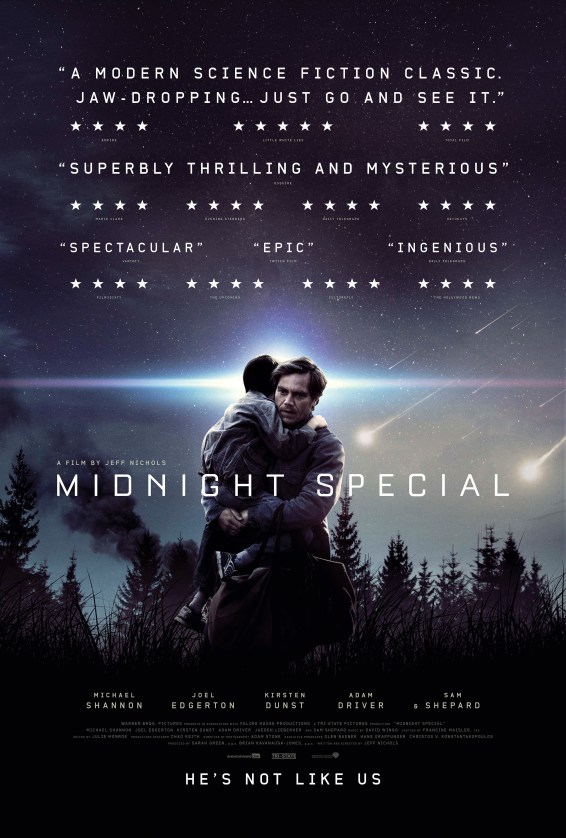
Midnight Special (2016) – Film Review

Written and directed by Jeff Nichols (Take Shelter, Mud, Loving), ‘Midnight Special’ may not be one of the most original or imaginative science fiction films to be released in recent years. Yet, regardless of its many recycled story elements and unexplored ideas, this low-budget sci-fi drama/thriller still manages to retain a sufficient amount of entertaining scenes, impressive CG effects and terrific performances to boot. All equalling to a fairly enjoyable experience, even if the film never quite reaches its full potential.

Plot Summary: ‘Alton Meyer’ is a boy unlike any other, a child with powerful abilities and strange weaknesses, alike. But, after ‘Alton’s abilities attract the attention of both an isolated cult and the U.S. government, ‘Alton’s father; ‘Roy,’ vows to protect his son as the two rival forces pursue the pair across the country…

Although ‘Midnight Special’ was Nichols’ first film made in conjunction with a large production company, Nichols wanted to ensure he had full creative control over the project just as he had previously with his low-budget indie films. So, despite Nichols originally considering making the film with an independent film studio rather than with Warner Bros. Pictures during his last meeting with the company, the producers actually agreed to all his demands, due to the small budget needed for the film. Meaning Nichols got his complete control, and the film was more successful at the box-office as a result of its wider release. This did, however, mean many audience members were left a little dissatisfied with the film, as ‘Midnight Special’ doesn’t follow the usual sci-fi clichés many would expect.

Michael Shannon leads the film as the concerned father; ‘Roy Meyer,’ and as per usual, excels in his role as this simple yet engaging character, wanting to protect his son at any cost, occasionally even at the expense of others. Playing into the age-old theme of doing anything to protect your child. Then there is also Jaeden Martell as ‘Alton’ himself, who considering his young age of twelve at the time of filming, delivers a competent performance, as even though ‘Alton’ may look like a normal child, he acts in a very robotic and eccentric manner. And, whilst this is completely intentional, this type of performance does sometimes make it quite difficult to resonate with ‘Alton’ as effectively as his father. The supporting cast of Joel Edgerton, Kirsten Dunst and Adam Driver, are all also great additions to the film, even though their characters don’t add much to the narrative.

Well-shot throughout, Adam Stone’s cinematography for ‘Midnight Special’ may not be some of the most astounding camerawork ever seen within the sci-fi genre, but due to the film mostly being set at night, the film does manage to enhance many of its already attractive shots through its dim lighting. In addition to the cinematography, the film also makes fantastic use of its many CG effects, with the majority of them being used quite sparsely to ensure they all appear as detailed as possible without going over budget.

The original score by David Wingo also isn’t too memorable when compared to some other scores composed for science fiction flicks, but it still greatly adds to the film. Alternating from slow piano-focused tracks to more electronic pulse-pounding tracks when necessary, the entire soundtrack is both atmospheric and suitably sci-fi, with my two personal favourite tracks; ‘Doak and Levi’ and ‘New World,’ being the perfect two examples of this change in tone when it comes to the score. The film also features a new rendition of the classic folk song; ‘Midnight Special,’ during its end credits, which is actually where the film gets its title.

Yet, in spite of its appealing cinematography and remarkable original score, the area where ‘Midnight Special’ falls flat is its story, as whilst many stories similar to this have been executed well in film before, most notably the sci-fi classic; ‘Starman,’ from 1984. ‘Midnight Special’ revels in not providing its audience with much information, keeping many aspects of ‘Alton’s character, his abilities, and the world the story takes place within a mystery. This is most evident when it comes to the (presumably) sinister cult known as ‘The Ranch,’ as while the cult does play a small role in the story, they remain mostly underdeveloped throughout the film, and as the runtime approaches its end, soon disappear entirely.

In summary, ‘Midnight Special’ is a sci-fi film that will appeal to a far more niche audience, as whilst a simple pitch of the plot may sound both familiar and interesting to many fans of the genre, it’s the way ‘Midnight Special’ goes about its story that will divide many viewers. If the film was to provide a little more backstory/exposition here and there, perhaps the story would’ve felt more fleshed out and matched with the brilliant efforts of its filmmaking. But, as it is, ‘Midnight Special’ feels like a bit of a wasted opportunity, as it remains a decent film that could’ve been so, so much more. Final Rating: high 6/10.

MIDNIGHT-SPECIAL-ONE-SHEET

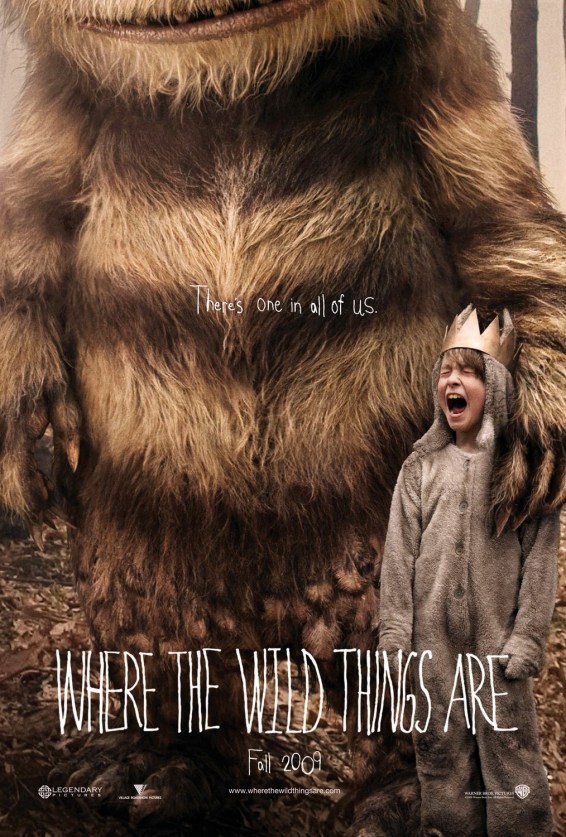
Where the Wild Things Are (2009) – Film Review

Although its themes and ideas may go over many younger viewers’ heads, 2009’s ‘Where the Wild Things Are’ feels like a film that reflects what many felt whilst being a child themselves, as writer-director Spike Jonze (Being John Malkovich, Adaptation, Her) creates a moving, thoughtful, and occasionally even woeful experience that dramatically elevates its original source material. With a charming soundtrack compiled by musician; ‘Karen O,’ and plenty of wonderful creature designs and stunning locations, ‘Where the Wild Things Are’ is truly a unique yet uncompromising film that sends its audience back to the innocent days of childhood.

Plot Summary: Following a fight with his mother and yearning for adventure, young ‘Max’ runs away from home and sails to a mysterious island filled with creatures, who take him in as their king after ‘Max’ makes a promise to solve all their problems…

As previously mentioned, the film adaptation of ‘Where the Wild Things Are’ is a large step-up from the original children’s book it’s based on by Maurice Sendak, as while the classic story of a young boy visiting a land of fantastical creatures in order to escape reality has always been a staple of children’s literature, Jonze manages to deepen the narrative with his adaptation. Having themes of maturity, imagination and balancing one’s own emotions (all of which are presented in a mature and subtle way). In fact, the film’s production company, Warner Bros. Pictures were initially so unhappy with the final film (as it was far less family-friendly than they imagined) that they wanted Jonze to start from scratch. Instead, the two eventually agreed to satisfy both parties by giving the film more time in production.

Max Records leads the cast as the excitable and resentful; ‘Max,’ who gives a genuinely brilliant performance considering the actor’s young age at the time of filming. Alongside him, of course, is the group of creatures portrayed by the voice cast of Lauren Ambrose, Chris Cooper, Catherine O’Hara, Forest Whitaker and Paul Dano, whose voices all match their respective characters flawlessly. It’s the late James Gandolfini as ‘Carol’ who really shines throughout the film, however, having the most memorable design of the all the creatures within the original book, ‘Carol’ serves as a reflection of ‘Max’s childish attributes, from his tantrums to his jealousy and sadness, all of which is given such life through Gandolfini’s performance.

While the film’s colour palette remains fairly vibrant throughout, despite featuring a large amount of beiges and browns, the cinematography by Lance Acord is sadly the weakest aspect of the film. As, ignoring the large array of stunning sunrise and sunset shots, ‘Where the Wild Things Are’ utilises hand-held camera for the majority of its runtime, which when combined with the film’s occasionally chaotic editing can make some scenes feel a little impetuous. Yet, in spite of not having a massive budget, the film’s CG effects do still hold up remarkably well, with all of the facial expressions of the creatures and extensions to many of the island’s locations not seeming even remotely out-of-place.

The film’s soundtrack, compiled by musician; ‘Karen O,’ really benefits the film’s already calming and mature presentation. From the opening track; ‘Igloo,’ through to the more upbeat tracks; ‘Rumpus’ and ‘Sailing Home,’ to even the film’s more lyric-based tracks with ‘All is Love’ and ‘Hideaway.’ The soundtrack for ‘Where the Wild Things Are’ doesn’t feel like a traditional film score in the best possible sense, giving more of an impression of a slow-paced yet beautiful acoustic guitar album, which just like the film itself, is immensely underappreciated.

However, one of my personal favourite elements of the film and certainly the most visually striking has to be the many different designs of the creatures who live on the island, as not only do the designs fit each character’s personality, but every design is also a perfect live-action recreation of the creature’s original appearances within the pages of the book, with all of the creatures being brought to life using enormous and heavily detailed suits from the Jim Henson Company rather than just simply using CGI. The Jim Henson Company are known, of course, for the creation of ‘The Muppets,’ whose familiar charm isn’t lost here.

In summary, ‘Where the Wild Things Are’ is to me, an underrated modern classic, as despite its few flaws, the film surpasses its source material and then some, creating a genuinely gut-wrenching experience at points. Whilst the film has been criticised by some since its release mostly as a result of being seen as too mature and possibly even a little frightening/disturbing for younger viewers. I believe the film gets across a number of important messages for children, and I appreciate the film’s more in depth approach to crafting an imaginative family adventure. So, although Jonze may not have an extensive catalogue of films as a director, the films he has made never cease to impress me, and ‘Where the Wild Things Are’ fits as just another piece of the puzzle. Final Rating: 8/10.

where_the_wild_things_are_xlg

To All the Boys I’ve Loved Before (2018) – Film Review

Based on the novel of the same name by Jenny Han and releasing around the same time-frame as many other Netflix teen rom-coms, such as ‘The Kissing Booth,’ ‘Tall Girl’ and ‘Sarah Burgess is a Loser.’ ‘To All the Boys I’ve Loved Before’ may have a fairly formulaic structure in addition to feeling a little cliché at points as it closely follows its source material, but mostly through its charm and great cast, this light-hearted teenage romantic-comedy manages to retain some entertainment value for any admirers of the genre.

Plot Summary: Since she was young, ‘Lara Jean’ has always lacked the confidence to tell any of the boys she liked her true feelings, choosing instead to write them down within individual letters for her eyes only. Until, one day, the letters meant for her alone are publicly released, throwing her life into chaos as her foregoing loves confront her one-by-one…

Although definitely not a must-see for Netflix subscribers, ‘To All the Boys I’ve Loved Before’ does feel like a slight improvement over the other previously mentioned attempts Netflix has made within the realm of romantic flicks. As, while the story is far from original, the film’s basic concept of a teenage girl locking away her thoughts and feelings only for them to eventually be released, is at the very least, a plot that entices some interest into how things will turn out for her in the end, and interestingly, all of the letters seen throughout the film were physically written by Lana Condor herself whilst on set, with the actress writing a total of seven copies for each letter, as ‘Lara’ later tears them up.

This leads into the best aspect of the film for me, Lana Condor’s portrayal of the film’s protagonist; ‘Lara Jean,’ as much of the film’s overall charm is really owed to Condor’s lead performance, as the actress excellently balances ‘Lara’s timidity with her likability without much issue. Noah Centineo also shares quite a large role within the film as ‘Peter,’ one of ‘Lara’s earliest loves, and while Centineo does give a decent performance throughout the film, he does ultimately play the same character he has portrayed countless times before in other rom-coms both before and after, the same also goes for Israel Broussard as another of the ‘Lara’s past love interests.

The cinematography by Michael Fimognari is serviceable, with the film’s thought out editing usually making up for the large number of bland shots through its clever cutting from past to present. The film also tries to implement a little style into its filmmaking by having text and emojis appear on-screen whenever ‘Lara’ is texting, which, unfortunately, is executed sloppily, as whilst I understand what the filmmakers were going for, the final design they chose is quite odd, as rather than having ‘Lara’s phone screen appear beside her, or have text bubbles appear above her head, the text is simply displayed in the same font as the film’s opening titles, which I feel is both distracting and confusing. Bizarrely, the film also contains a few shots of Subway product placement, which are very distracting even if they are fairly minimal.

Expectedly, the original score by Jon Wong is quite forgettable, but does still serve the film’s narrative well. It’s the huge variety of modern pop songs that rule over most of the soundtrack, however, with next to nearly every scene featuring at least one or two different songs, and whilst some scenes do benefit from this, a large majority of the time it does feel as if there is an overabundance of songs thrown into a singular scene.

Yet, the most obvious flaw the film suffers from is the way it utilises its supporting characters, as although the film does remain focused on the life of ‘Lara Jean,’ for the most part, the film also places emphasis on many of ‘Lara’s friends and family, and even though the film tries its best to convince its audience otherwise, many of the supporting characters serve very little purpose to the story, and by the end of the film, are virtually forgotten as most are given no conclusive scene with ‘Lara.’ But, its ‘Lara’s sister and father who I personally found the most obnoxious, as these two characters deliver a large portion of the film’s occasionally cheesy dialogue and cringey humour, as sadly the film does feature plenty of awkward comedic moments in-between its few successful jokes.

In summary, while certainly not as diverting or as original as many other reviews may lead you to believe, ‘To All the Boys I’ve Loved Before’ does still have some value, as the film retains many of the novel’s faults as well as its merits, and in spite of many of its problems, I imagine most fans of upbeat romantic-comedies will be satisfied with the film by its end. If you don’t usually drift towards rom-coms, however, I’d probably suggest you check-out some of the other original films Netflix has to offer. Final Rating: 5/10.

to_all_the_boys_ive_loved_before_xxlg

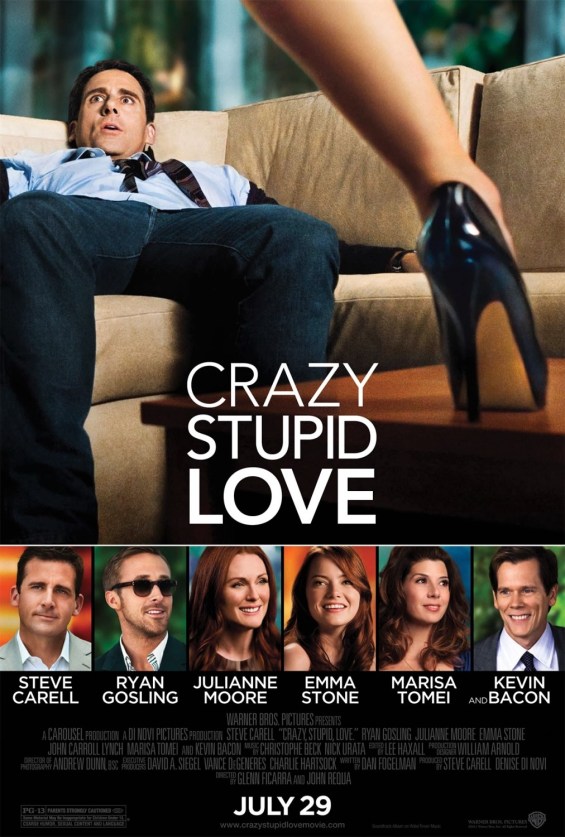
Crazy, Stupid, Love (2011) – Film Review

An unexpectedly memorable romantic-comedy from 2011, ‘Crazy, Stupid, Love’ tells an engaging and touching story of a selection of good-hearted people finding love in their lives and experiencing the many hardships that come along with it, and although romance has always been one of the lesser-interesting genres of film for me personally, ‘Crazy, Stupid, Love’ almost acknowledges what kind of film it is. Always taking a simple yet effective approach to its filmmaking and placing its well-written characters and narrative before anything else.

Plot Summary: When middle-aged husband; ‘Cal Weaver,’ discovers that his wife has had an affair with one of her co-workers, his perfect life quickly begins to unravel. But, after encountering the handsome womaniser; ‘Jacob,’ in a bar, ‘Cal’ is soon taken on as his wingman and protégé as he opens ‘Cal’s eyes to the many opportunities that lie before him…

Directed by Glenn Ficarra and John Requa (I Love You Phillip Morris, Focus, Whiskey Tango Foxtrot) and written by Dan Fogelman, ‘Crazy, Stupid, Love’ actually has a fairly strong screenplay for a rom-com, and although this shouldn’t be too surprising considering Fogelman has written a number of superb animated Disney/Pixar flicks in the past, such as ‘Bolt,’ ‘Cars’ and ‘Tangled,’ before later moving on to more adult-focused comedies with ‘Last Vegas’ and ‘The Guilt Trip.’ ‘Crazy, Stupid, Love’ only features a handful of characters, with everyone of them receiving a decent amount of characterisation and becoming quite likeable over the course of the runtime. The film even manages to feature a couple of unexpected reveals later on within the story, which only further elevates the film’s screenplay.

The all-star cast of Ryan Gosling, Julianne Moore, Emma Stone and Marisa Tomei are all brilliant in their respective roles, but of course, with three Oscar-winners as well as two Oscar-nominees among them, this isn’t much of a shock. It’s the film’s protagonist; ‘Cal,’ portrayed by Steve Carell that is the obvious stand out though, as ‘Crazy, Stupid, Love’ was actually one of the first films that Carell put aside his usual goofball schtick in exchange for a more grounded character, as he portrays a miserable divorcee now with little direction in his life, before his eventual transformation into an ego-driven womaniser similar to ‘Jason’ himself. However, on the opposite side of this, Kevin Bacon as ‘David Lindhagen’ (a.k.a. The romantic rival) is the obvious weak link of the cast, as aside from only two shorts scenes, his character and the threat that he poses to ‘Cal’s ruptured marriage is barely utilised, making his inclusion in the story feel quite pointless.

The cinematography by Andrew Dunn never displays anything that will leave the viewer in awe, yet does still feel like a slight step-up from the usual bland camera work of many other romantic-comedies. The cinematography truly reaches its peak in the scene: ‘Great Dress,’ however, in which, ‘Cal’ (now with his newly found manhood) flirts with various different women on a number of different nights, all the while the camera gently glides through the bar displaying the passage of time through ‘Cal’s large wardrobe of stylish outfits.

Christophe Beck and Nick Urata take on the original score for the film, which, for the most part, does suitably back up the film’s story and displays a large amount of range in regards to instruments that are used, despite the score overall being far from astonishing. Yet, bizarrely, the film’s soundtrack was never officially released by production company Warner Bros. Pictures, resulting in many fans of the film having to create their own playlists on Spotify/Apple Music, etc., to bring together the film’s many recognisable songs once again.

Although ‘Crazy, Stupid, Love’ does primarily focus on its aspects of romance and comedy, the film also handles its drama fairly well. Never interrupting any of its more serious moments with scenes of over-the-top humour, most of which usually coming from the film’s main subplot which focuses on ‘Cal’s son; ‘Robbie,’ as he lusts after his older babysitter. Occasionally, the film also indulges in a variety of more self-aware jokes, as the film references some of the many overdone clichés that infest films, like ‘Notting Hill’ and ‘Love Actually,’ through its dialogue, e.g. an immediate rainstorm after a heartbreaking argument/break up.

In summary, ‘Crazy, Stupid, Love’ is more than successful in its attempt to craft an emotional and amusing story even in spite of the little innovation the film displays when it comes to its cinematography or original score, as the film’s upbeat approach to its tight plot leaves it an enjoyable flick that fully embraces what genre it’s only a small piece of, serving as somewhat of a homage alongside remaining quite a leisurely watch itself. So, whether you usually drift towards this genre or not, I feel most viewers would struggle to dislike ‘Crazy, Stupid, Love’, as simply put, the film is just a delightful experience to sit through. Final Rating: 8/10.

crazy_stupid_love_xlg

Hidden Figures (2016) – Film Review

Based on the book of the same name by Margot Lee Shetterly, the film adaptation of ‘Hidden Figures’ serves as a compelling and entertaining delve into the past as it tells the true story of the mostly unknown women who helped push forward the space program. Through its brilliant performances from Taraji P. Henson and Kevin Costner (among the rest of the cast) alongside its magnificent writing, the film manages to keep its audience constantly invested in spite of its occasionally bland filmmaking.

Plot Summary: Katherine G. Johnson, Dorothy Vaughan, and Mary Jackson, three brilliant African-American women working at NASA during the 1960s cross all race and gender barriers within their workplace to follow their dreams and inspire generations, serving as the brain force to help send astronaut; John Glenn, into Earth’s orbit…

Despite focusing on three separate stories of three independent women, ‘Hidden Figures’ never feels unfocused, as each of the three protagonists receive a decent amount of development as well as at least one or more memorable scenes between them, as the film displays its main theme of female and Black empowerment proudly, without ever becoming overly cliché as it avoids many of the over-done tropes that other films built around the racist barriers of the ’60s can begin to rely on. For example, the film’s opening scene in which the trio of women are confronted by a white police officer, as this moment could’ve easily felt like overly familiar ground should it have been handled poorly, yet aside from some inappropriate stereotyping at first, the scene actually results in the three of them heading to NASA without any horrific racial ridiculing.

The three protagonists, portrayed by Taraji P. Henson, Octavia Spencer and Janelle Monáe, are all excellent throughout the film, as each of them remains determined and outgoing, despite the world’s many attempts to drag them down, always fighting against the unfair judgement of them simply for the way they look, repeatedly with a lack of preachy dialogue. Alongside them, the supporting cast of Kevin Costner, Jim Parsons, Kirsten Dunst, and Mahershala Ali are all great even if some of their characters are a little underutilised within the narrative. One of the reasons the performances within the film are as accurate as they are is, due to some of the cast actually being given the opportunity to meet with the story’s icons before production began. Most notably, Taraji P. Henson met with the real Katherine Johnson (who was ninety-eight years old at the time) after she signed onto the project.

The cinematography by Mandy Walker is serviceable overall, as while the film features a good number of attractive shots, they are dragged down by its many mundane ones. However, ‘Hidden Figures’ does actually make effective yet subtle use of colour throughout its runtime, as the film’s colour palette constantly reflects the mood within each scene, with many of the sets at NASA where calculations and preparations take place utilising mostly pure whites, greys, and silvers, which creates a sharp contrast to the warm/inviting colours of the ladies’ homes.

Hans Zimmer and Benjamin Wallfisch handle the original score for the film, which is an incredibly mixed bag. As, whilst the score does feature some decent tracks. such as ‘Katherine,’ ‘Mission Control,’ and ‘Hidden Figures,’ the soundtrack also features a number of pop songs by Pharrell Williams, which don’t fit the tone of the film or the story’s time-period. Usually resulting in it feeling very forced and sometimes even taking away from the film’s dramatic moments. This is most likely a result of Pharrell Williams overseeing all aspects of the film’s soundtrack, which I personally feel is a huge misstep as his style of music truly isn’t at all suited for a drama such as this.

In addition to portraying the female heroes of the real-life story as accurately as possible, the film also makes substantial use of its time period, as to keep the audience up-to-date with what knowledge the American public had at the time, ‘Hidden Figures’ occasionally cuts away to archive footage of rocket testings or then-president John F. Kennedy making public announcements, both of which are surprisingly effective despite not being used continuously. Personally, however, I still would’ve preferred a bigger presence of songs from the 1960s rather than the constant barrage of pop songs the film contains, as mentioned previously.

In summary, I feel ‘Hidden Figures’ is an important film many should experience, as whilst there has been an array of films based around the misogynistic/racist nature of the 1950s/1960s, ‘Hidden Figures’ is for sure a stand out through its engaging and thought-provoking narrative. Although films, like ‘Do the Right Thing’ and ‘BlacKkKlansman’ may be slightly more powerful with their message(s), I feel ‘Hidden Figures’ is fairly underrated when it comes to historical dramas, as the film is simultaneously both informing and touching. Final Rating: 7/10.

hidden_figures_ver2_xxlg