Absolutely Anything (2015) – Film Review

“Absolute Power Doesn’t Corrupt, It Just Drives You Bloody Mad!” – Neil Clarke

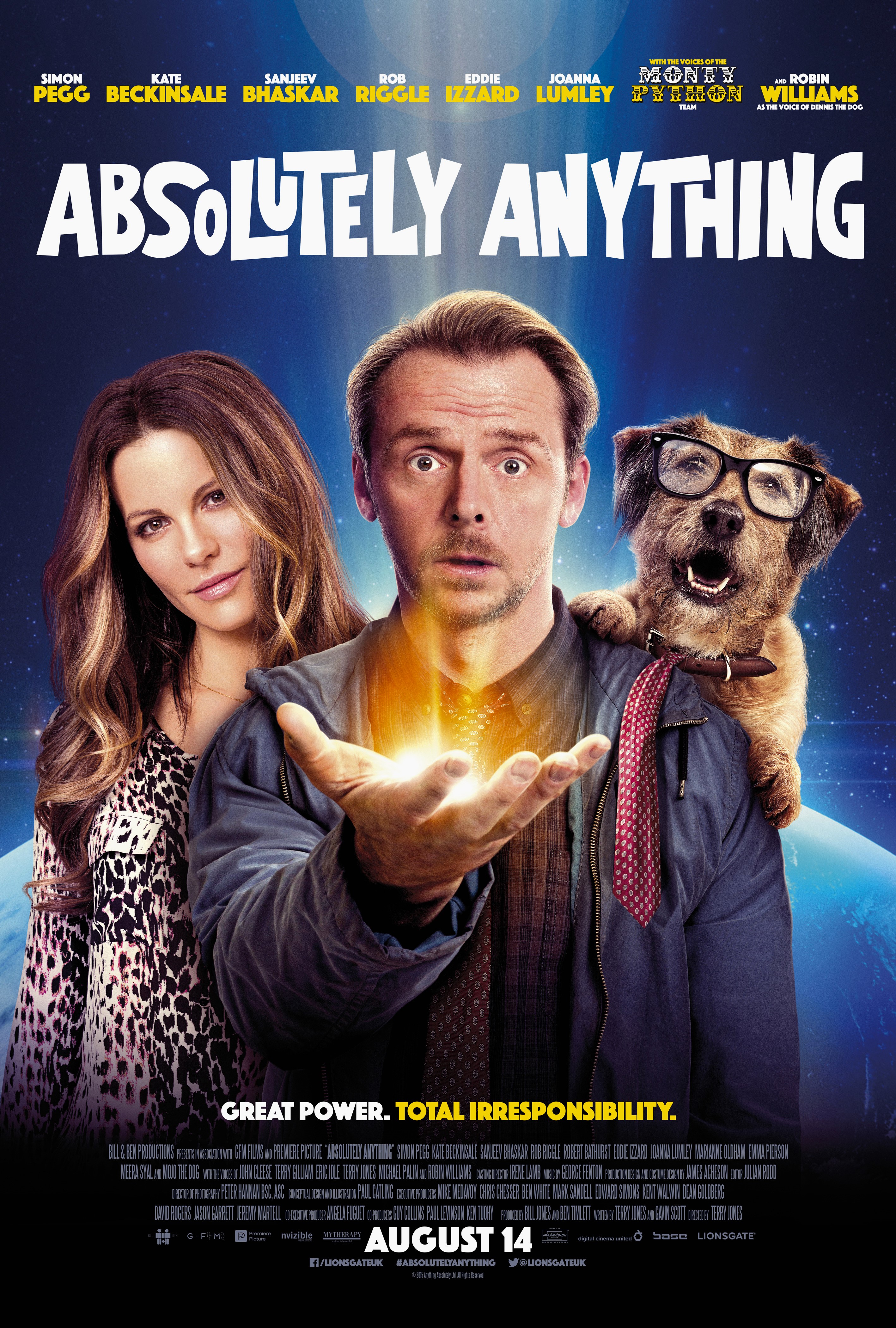
Released in 2015, Absolutely Anything is a zany sci-fi-comedy that explores the age-old fantasy of unlimited wish fulfillment, a concept historically associated with gods, genies and mythical beings. In this instance, however, the power rests in the hands of omnipotent extraterrestrials, who, believing in their superiority, bestow their boundless ability upon a single unsuspecting human. Alas, aside from this inventive alternative, Absolutely Anything misuses its limitless premise and affable lead, Simon Pegg, for a typical rom-com setup, offering mild, light-hearted entertainment over consistent gags, creative visuals or lasting impact.

Plot Summary: As part of an interplanetary experiment, an extraterrestrial council traverse the universe in search of intelligent life. Upon reaching Earth, they initiate their usual test of granting one randomly selected inhabitant the ability to do anything to determine whether humanity is worthy of joining their intergalactic community or should be annihilated. A test that likely spells doom for humanity as the council haphazardly selects Neil Clarke, a washout British school teacher, as their subject…

Co-written and directed by the late Terry Jones (Monty Python and the Holy Grail, Personal Services, The Wind in the Willows), Absolutely Anything draws inspiration from the 1898 short story; The Man Who Could Work Miracles, by H.G. Wells, as both stories centre on an ordinary man suddenly granted reality-altering abilities. However, the leading discrepancy between the two is how Absolutely Anything leans heavily into comedy, delivering a string of farcical scenarios that allow Pegg’s energetic performance to shine. As such, the tone throughout the film remains consistently blithe as the screenplay shies away from any deep philosophical exploration of its central concept or even any long-term consequences to Neil’s actions, as when a situation veers into chaos, Neil merely waves his hand to undo the damage, undercutting any disorder his newfound power might trigger.

As the leading man, Simon Pegg infuses Neil Clarke with an endearing blend of immaturity and dopey charm, rendering the character’s misguided desires and naïve missteps more forgivable. Still, the film undoubtedly misses the opportunity to examine how absolute power might affect the average person, for better or worse. Instead, Neil uses his ability almost entirely for petty or farcical purposes, with one of his more amusing decisions granting his loyal dog, Dennis, the capacity to speak, leading the canine to be energetically voiced by the late Robin Williams. The result is a delightfully giddy sidekick, whose witticisms often relate to the amusing traits of his species. Less enjoyable is the romantic subplot between Neil and his downstairs neighbour Catherine, portrayed by Kate Beckinsale, as despite Neil’s fascination with Catherine being at the core of the story, her character is underwritten and uninteresting, making their relationship (and her inclusion) feel obligatory rather than organic, a criticism that applies to many of the side characters.

Visually, Absolutely Anything is an odd mix of British realism and low-budget science fiction, with the majority of the film shot in and around an abandoned building that was formerly a school, cleverly repurposed to serve as Neil’s flat and the secondary school where he teaches. While these Earthbound settings help ground the otherwise outlandish story in a familiar, everyday backdrop, many of the sets throughout the runtime appear cheap and flavourless, especially when combined with the American sitcom-esque lighting and cinematography by Peter Hannan. The most jarring disparity in the film’s visuals, however, comes with the subpar CG effects, from the splicing of Simon Pegg’s head onto different bodies to the space-bound sequences of the extraterrestrial council debating; the CGI is noticeably lacking, even if the aliens’ designs exhibit visual variety.

Contrarily, the original score by George Fenton brings a whimsical energy to the film, as his compositions underscore the comedic beats with light piano melodies, lively orchestration and plucky strings that reflect Neil’s bemused reactions to his newfangled ability. For example, during the scene where Neil begins experimenting with his powers, commanding a bottle of whiskey to exchange itself only to witness it bouncing down the stairs towards the front door, the accompanying track is fittingly bouncy and eccentric.

Upon its initial release, Absolutely Anything was frequently compared to Bruce Almighty (2003), another male-led comedy about divine empowerment. But, their distinctions are actually quite significant, as Bruce Nolan, the titular character, cannot override free will, whereas Neil can. Moreover, Bruce Almighty centres on a theological framework with God as an active character, whereas Neil’s powers come from extraterrestrials he never encounters, exuberantly voiced by the surviving members of the Monty Python series. In fact, Absolutely Anything notably marks the first on-screen reunion of the Monty Python cast since The Meaning of Life (1983), and, according to Terry Jones, might be their last collaborative outing. There’s also a nod to their comedic legacy during the opening sequence, as the camera pans across space to an orbital scrapyard of discarded spaceships, one of which is from 1979’s Life of Brian.

In summary, Absolutely Anything is a comedy buoyed by its bewitching premise and the charisma of its lead. Yet, it is frustratingly superficial, opting for a low-stakes story, cartoonish gags and rom-com tropes rather than exploring the satirical or existential dimensions its narrative invites. Whilst the film does contain some moments of wit, Absolutely Anything never lives up to the potential promised by its title or the strong comedic talent it harbours. Rating: 4/10.
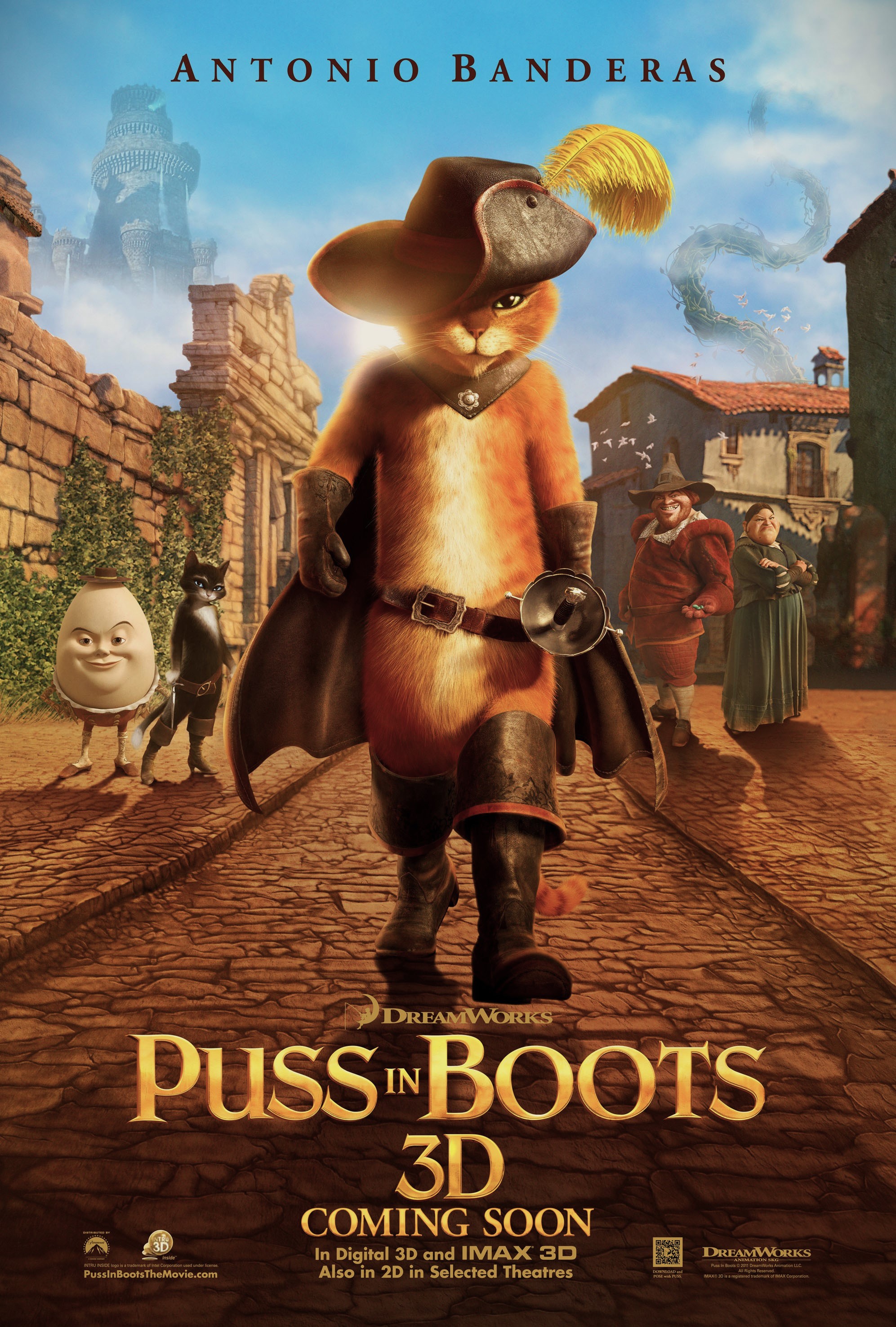
Puss in Boots (2011) – Film Review

“Fear Me, if You Dare!” – Puss in Boots

Released in 2011, one year after the highly-praised Shrek series supposedly concluded with Shrek Forever After (2010), Puss in Boots acts as a spin-off and prequel to the endearing ogre’s renowned franchise, retaining its emphasis on parodying fairy tales whilst supplying the titular heroic feline with an amusing, stand-alone adventure that frequently pays tribute to Spanish cinema. While not profound in terms of storytelling nor revolutionary in terms of animation, for what it lacks in depth, Puss in Boots, directed by Chris Miller (Shrek the Third), makes up for with an abundance of family-friendly wit and excitement, in spite of the initial plan to turn the film into a mere direct-to-DVD spin-off.

Plot Summary: Long before meeting Shrek and Donkey, the adorable yet cunning vigilante Puss in Boots aimed to clear his name, striving to escape his notoriety as the suspected thief of his hometown, San Ricardo. Then, one faithful night, after overhearing that the murderous outlaws Jack and Jill have come into possession of magic beans, Puss senses a window of opportunity, setting out to steal the beans in pursuit of the treasure they lead to, eventually crossing paths with an old friend

In contrast to the Shrek films, which were in production for around three years (except for the first, which was in production for almost five), Puss in Boots took over seven years to produce, entering development just after the release of Shrek 2 (2004). The film also differs from the Shrek series in other ways, most notably in its inspirations. Where the Shrek franchise became recognised for its parodying of classic fairy tales and modern pop culture, Puss in Boots is more reminiscent of Spanish cinema, namely, Spanish action and adventure flicks, harbouring references to well-known flicks, like The Mask of Zorro (1998), a film which interestingly, also featured Antonio Banderas as the lead, and Desperado (1995), another release featuring Banderas as well as his co-star Salma Hayek. As such, Puss in Boots operates as a successful mish-mash of ideas, blending elements of fairy tale fantasy with solid action sequences reminiscent of traditional vigilante flicks. The majority of the story, though, is a riff on the famed fable of Jack and the Beanstalk, a fairy tale adapted time and again. Thankfully, the writers were aware of this, implementing a handful of original ideas to form their own take on the well-worn story.

The central cast of Antonio Banderas, Salma Hayek, Zach Galifianakis, Billy Bob Thornton and Amy Sedaris are superb in their vocal performances, with the newly-introduced characters being well-defined and entertaining, from Humpty Dumpty, Puss’ intelligent yet untrustworthy ally, to Jack and Jill, an amusingly fiendish pair of villains, and the skilled thief Kitty Softpaws, who bears a fairly moving backstory. Truly, the only character that lacks interesting characterisation is Puss himself, who is essentially the same character he was in 2004, with little difference in his personality despite being younger, less experienced and more independent, harbouring no major distinctions or a compelling character arc.

For this film, an admirable decision was made to make the world of Puss in Boots appear very different from that depicted in the Shrek series. In the latter, the environments were similar to classic fairy tale illustrations, often featuring extravagant kingdoms and vibrant forests, with even the earliest appearance of Puss in Boots himself being depicted in clean, pencilled illustrations in a vast woodland environment amidst the book; Histories or Tales of Past Times, Told By Mother Goose, written by Italian author Giovanni Francesco Straparola in 1551. However, the film has a distinctly Spanish feel, with most of the runtime being set in deserts and rural towns sporting Colonial architecture, in addition to a warmer, more terracotta colour palette. The animated cinematography and the animation itself also go a long way in enhancing the film’s many action sequences and visual gags, including one set piece with a gigantic creature wreaking havoc, undoubtedly inspired by the Godzilla series.

Capturing the spirit of adventure much like the film at large, the original score by Henry Jackman is rousing, occasionally even harbouring a slight western feel. Furthermore, tracks such as Chasing Tail and Farewell San Ricardo convey Puss’ heroism and vigilante persona flawlessly, whilst Jack and Jill are granted a monstrously malicious melodic cue with the plainly-named track; Jack and Jill. The end credits song; Americano by Lady Gaga, seems rather out-of-place among the rest of the soundtrack, however, given that Puss in Boots never employed contemporary songs in its fantastical setting before this moment, unlike the Shrek franchise.

Humorously, the animators behind Puss in Boots didn’t bring any cats into the studio to study their movements for the various felines that appear throughout the runtime. Instead, they simply watched some of the millions of widespread cat videos on YouTube to make each cat’s movements as lifelike as possible and take inspiration for some of the film’s cat-related antics.

In summary, Puss in Boots is a delightful adventure with enough entertainment value to keep both younger and older audience members engaged, even if the film isn’t as memorable as some of the entries from the series its protagonist originated. Still, it likely goes without saying the film’s late-to-the-party sequel; Puss in Boots: The Last Wish (2022), was an improvement over its predecessor in almost every way. Rating: 6/10.

Gods of Egypt (2016) – Film Review

“Every Night the Battle Between Chaos and Creation Must Go On. Otherwise, the World Will Be Destroyed…” – Ra

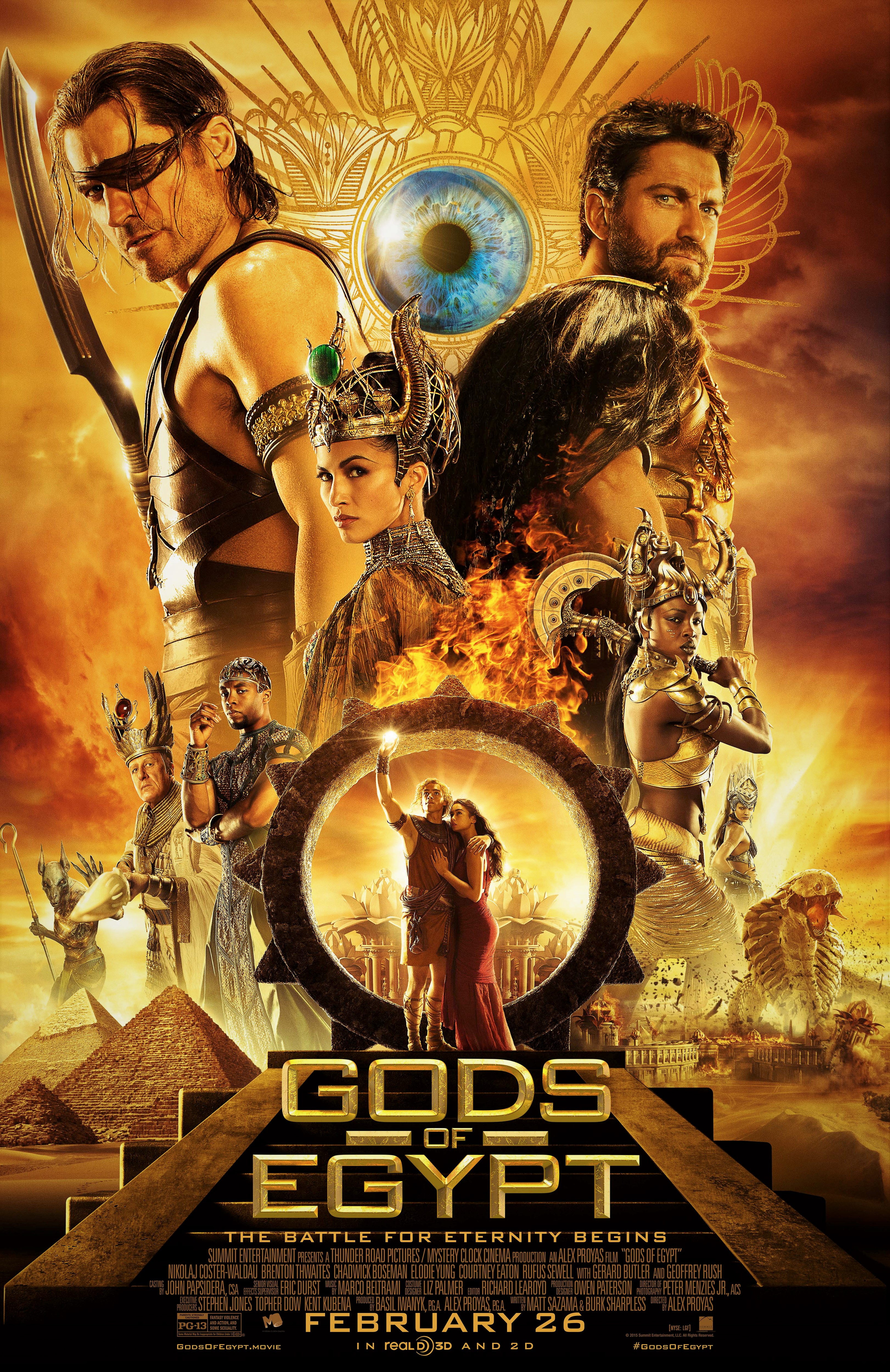
Based on the Egyptian myth; The Contendings of Horus and Set, a mythological tale from the Twentieth Dynasty of Egypt found in the pages of a biblical text, recounting a battle between Horus, a god who takes the form of a falcon, and Set, a sky god, lord of the desert and master of storms, disorder and warfare, Gods of Egypt, released in 2016, is a visually overblown, poorly plotted and needlessly CGI-heavy fantasy blockbuster. Playing fast and loose with its world-building and the Egyptian mythology it’s based upon, Gods of Egypt squanders much of its talented cast and admirable visual effects in exchange for shallow, action-lead spectacle. As a result, the film has largely (and unsurprisingly) been lost to the sands of time, similar to many other lustreless blockbusters of the 2010s.

Plot Summary: In an alternate Ancient Egypt where the world is flat and Egyptian gods live amongst humans, differing from mortals by their tremendous height, golden blood and ability to transform into their animalistic forms, a young thief, Bek, and his beloved girlfriend, Zaya, are attending the coronation of Horus. But, during the ceremony, Horus’ father, Osiris, is murdered by his envious brother, Set, who seizes the throne and declares a new, brutal regime…

Directed by Alex Proyas (The Crow, Dark City, I, Robot), Gods of Egypt is, as of now, Proyas’ most recent directorial effort, as the critical and commercial failure of the film (along with its casting controversy, as the film was criticised for casting predominantly caucasian actors), seriously hindered his reputation. Consequently, he has only directed a couple of short films since. While this is a cruel turn of fate for Proyas, who has demonstrated in the past that he can helm entertaining blockbusters, Gods of Egypt is evidently desultorily directed, frequently lacking polish, dramatic weight, comedic timing and vital fragments of exposition, especially when considering the film’s immense budget of over £110 million.

Ranging from uninspired to cringe-worthy, the performances throughout Gods of Egypt are inconsistent, to say the least, as Nikolaj Coster-Waldau’s valiant Horus lacks the balance of arrogance and self-pity many of his previous performances retain, whilst the performances of Brenton Thwaites, Elodie Yung, Rufus Sewell and the late Chadwick Boseman come across as superficial and exaggerated, further facilitated by their half-baked characterisation. Moreover, as the detestable Set, Gerard Butler struts, growls and bellows like an enraged grizzly bear, possessing none of the self-awareness that could have made such an over-the-top performance more enjoyable.

Primarily shot in the Australian desert, as filming in the Sahara Desert was considered too dangerous, the cinematography by Peter Menzies Jr. occasionally allows for pleasant shots of the desert landscapes and their imposing Egyptian structures. However, many of these shots are often spoilt by the enormous barrage of CGI, making every frame appear glossy and oddly sterile, even during scenes where gigantic crowds are present. Additionally, while terrifyingly indelible creatures are not as frequent in Egyptian mythology as they are in, say, Greek or Norse mythology, Gods of Egypt still features a handful of stately creature designs, namely, the massive, serpentine creature known as Apophis, an Egyptian deity of chaos that is commonly depicted as a snake in Egyptian hieroglyphs.

On another note, it’s fascinating how, despite having no evidence as to what music in Ancient Egypt sounded like, composers have adopted a specific style to depict that location and era, likely beginning with 1954’s The Egyptian, before enduring through dozens of other scores over the years, including Land of the Pharaohs (1955), The Prince of Egypt (1998) and The Mummy (1999). In regard to the orginal score for Gods of Egypt, composer Marco Beltrami weaves several Egyptian-esque themes in and around each other, as the two central deities, Horus and Set, harbour their own motifs, with Horus’ motif sounding valiant, conveying him as the more sympathetic of the two, whilst Set’s motif is far darker and shares many similarities to your more typical ‘villain themes,’ built around intense, descending brass lines. The problem, however, is that all of these tracks aren’t that memorable or unique in spite of their functionality, with most of the score just consisting of staggeringly generic action pieces. 

Due to nearly all of the film heavily utilising visual effects, it’s not surprising that the considerable CG effects implemented throughout the runtime are one of the few shining aspects of Gods of Egypt. Aside from a handful of shots which have aged questionably, most of the visual effects are impressive. In fact, one of the more unusual challenges the visual effects team faced during post-production was placing the cast inside an array of virtual environments, as most of the scenes were shot against a bluescreen. An added complexity came in the form of the size differences between gods and mortals, as the gods stand around nine feet tall, so the visual effects team had to constantly consider these size variations.

In summary, Gods of Egypt is an insipid blockbuster lacking originality, excitement and entertainment value. The film merely meanders through waves of corny dialogue, mind-numbing, CGI-reliant action sequences and a monotonous, drawn-out story brimming with contrivances and the odd interesting concept. Once again proving, alongside other poorly-received blockbusters, such as Justice League (2017), Independence Day: Resurgence (2016) and Transformers: The Last Knight (2017), that an enormous budget doesn’t necessarily yield enormous success. Rating: low 3/10.

gods_of_egypt-p1025720

Jumanji: Welcome to the Jungle (2017) – Film Review

“A Game for Those Who Seek to Find… a Way to Leave Their World Behind…” – Spencer

Seeking to modernise the premise of the 1995 fantasy-adventure classic; Jumanji, a striking premise first presented in the children’s picture book of the same name, written and illustrated by Chris Van Allsburg. 2017’s Jumanji: Welcome to the Jungle switches the concept of an enchanted, four-piece board game for a ’90s-style video game cartridge, rooting itself in well-known video game tropes. And while not quite as enjoyable as the original flick, in my opinion, Jumanji: Welcome to the Jungle is still an entertaining yet undemanding soft reboot that manages to stand on its own two feet as a jungle-set adventure, utilising its charming cast and humorous moments effectively under the capable direction of Jake Kasdan (Zero EffectOrange CountrySex Tape).

Plot Summary: After Jumanji, the bewitched jungle-themed board game, receives a mysterious modification, converting the wooden parlour game into a 1990s video game cartridge, the game is stumbled upon by high school students; Spencer, Martha, Fridge and Bethany, who are promptly pulled into its perilous world. Now, in order to return home, the group must inhabit their chosen avatars, survive the cadaverous creatures and complete the game…

Despite the original Jumanji receiving fairly mixed-to-positive reviews both when it was initially released and in the years since, recounting the simple yet captivating story of Alan Parrish, a troubled boy who comes across a cursed board game that releases lions, elephants, giant spiders and carnivorous plants into the real world to pursue its unsuspecting players. Jumanji: Welcome to the Jungle remains in the same continuity, continuing on from Alan, Sarah, Judy and Peter’s adventure by having a separate group of characters unwillingly play the game. To keep the franchise feeling fresh, however, Jumanji: Welcome to the Jungle cleverly inverts the premise of the original, transporting the characters (and, by extension, the audience) into the treacherous world of Jumanji, where many references to the original flick can be seen, including a cluster of overgrown statues modelled after the iconic board game pieces and a handcrafted hut that Alan resided inside when he was trapped in Jumanji, serving as a sweet yet modest tribute to the late Robin Williams, who portrayed the older iteration of the character.

This time around, the protagonists consist of four high schoolers serving detention together before they are transported into Jumanji following their discovery of the video game’s cartridge in their school’s storage room. Spencer, a skinny, awkward gamer becomes Dr. Smolder Braveston, portrayed by Dwayne “The Rock” Johnson, the introverted, Martha, becomes Ruby Roundhouse, portrayed by Karen Gillan, the tall and muscular jock, Fridge, becomes Franklin “Moose” Finbar, portrayed by Kevin Hart, and the would-be popular girl, Bethany, becomes Professor Shelly Oberon, portrayed by Jack Black. As can be expected with an all-star cast such as this, everyone possesses terrific chemistry with each other and embodies their real-world counterparts sufficiently whilst playing into the obvious humour in each of the teens altering into entirely different individuals, particularly in the case of Bethany, who transforms from an Instagram-obsessed teenage girl to an overweight, middle-aged cartography professor. Unfortunately, the film’s power-hungry antagonist, Van Pelt, doesn’t fare as well, lacking depth, fearfulness and presence in spite of Bobby Cannavale’s serviceable performance.

Taking advantage of the naturally beautiful scenery of Honolulu, Hawaii, specifically within the Kualoa Ranch nature reserve, Jumanji: Welcome to the Jungle makes exceptional use of its true-to-life locations and vibrant sets to immerse the audience in the precarious world of Jumanji, exhibiting the immense jungles, massive waterfalls and vast pastures that are only hinted towards in the original flick, even if the actual cinematography by Gyula Pados is somewhat flavourless.

Through tracks such as Brantford High and A Test of FriendshipJumanji: Welcome to the Jungle‘s original score by Henry Jackman constructs a clear contrast between Jumanji and the real world, as the formerly-mentioned tracks are contemporary and uplifting in nature, while tracks like Digging Up the PastThe Legend of the Jewel and The Power of Bravestone, are much more exhilarating and adventure-esque, going so far as to bring back the “Jumanji Drums,” a staple of the original Jumanji soundtrack.

When it comes to action sequences, Jumanji: Welcome To The Jungle isn’t likely to impress anyone, leaning more on the amusing moments between its cast than its scenes of hand-to-hand combat or hippopotamus ambushes. Nevertheless, most of the action throughout the runtime is passable, with one fight sequence featuring Dr. Braveston even playing into the video game truism of fighting off multiple enemies at once as the playable character. Additionally, although almost all of the CGI in the film is convincing, it’s regrettable that Jumanji: Welcome to the Jungle harbours very few practical effects, given how heavily praised the physical elements of renowned adventure flicks like The Goonies (1985) and the first three instalments of the Indiana Jones franchise are today.

In summary, whilst it’s doubtful that Jumanji: Welcome to the Jungle will be recognised for years to come as a groundbreaking 2010s blockbuster, it is a comical flick with defects, functioning as a superficial yet enjoyable soft reboot/stand-alone sequel that innovatively expands on the ideas introduced in the original Jumanji. In a bizarre way, Jumanji: Welcome to the Jungle almost feels like a self-actualisation teen flick set against the unusual backdrop of an adventurous video game due to its infrequent high school setting and marginal character growth. Rating: 6/10.

JMNJ_INTL_FNL_1SHT_LK4_04.indd

Oz the Great and Powerful (2013) – Film Review

“I Don’t Want to Be a Good Man, I Want to Be a Great One.” – Oscar ‘Oz’ Diggs

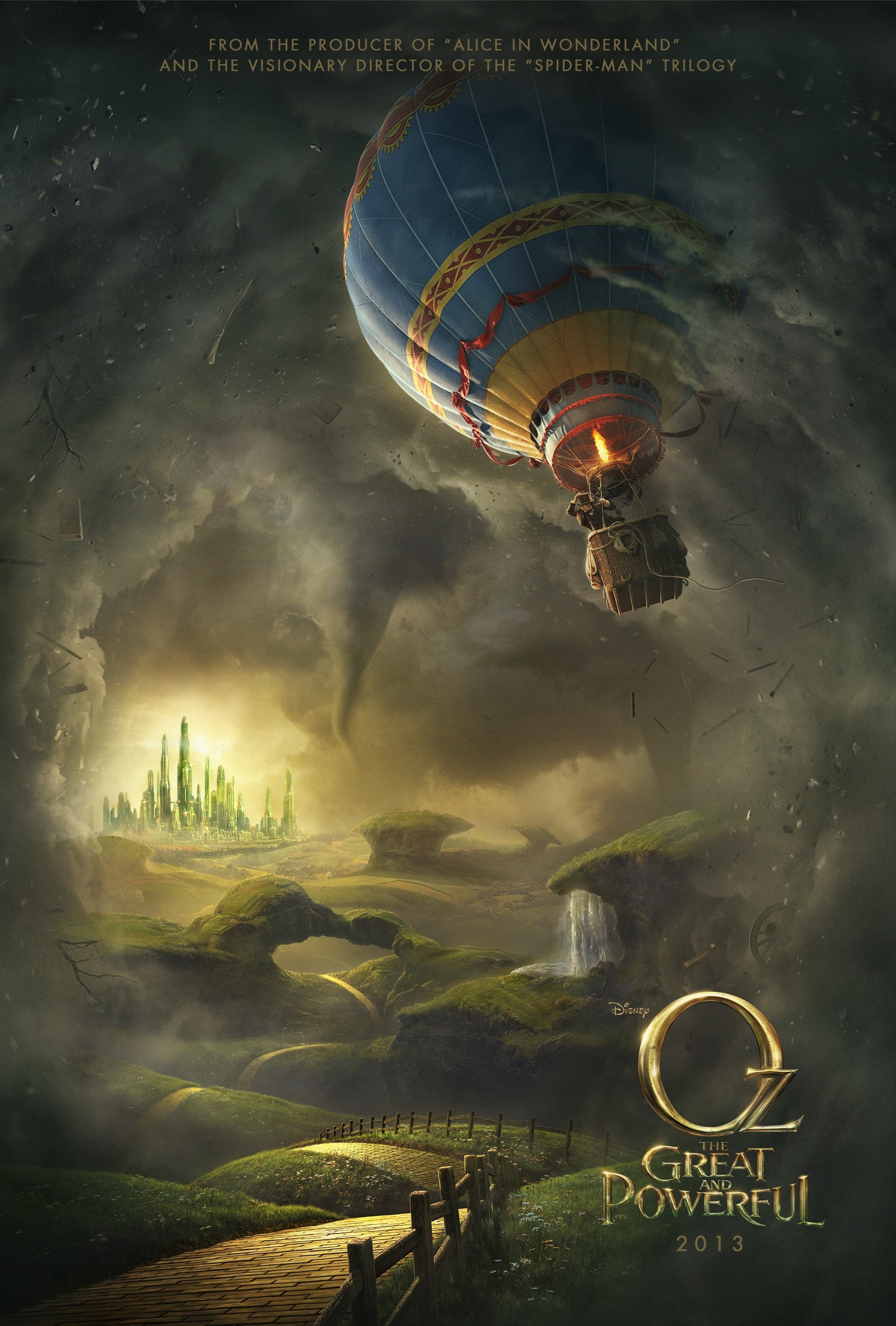
Since its release in 1939, the illustrious fantasy-musical; The Wizard of Oz, an adaptation of L. Frank Baum’s beloved children’s novel; The Wonderful Wizard of Oz, has been engraining itself into the memories of adults and youngsters alike through its catchy melodies, imaginative world-building and groundbreaking practical effects. In 2013, Walt Disney Pictures sought to return to the Land of Oz with Oz the Great and Powerful, a prequel to the novel and, in a way, its silver screen counterpart (despite ownership of the harmonious classic belonging to Warner Bros. Pictures), with celebrated director Sam Raimi (The Evil DeadSpider-ManDoctor Strange in the Multiverse of Madness) attached to helm the project, ascertaining its potential as an enchanted prequel. Shortly after its release, however, most seem to forget about the film, which is unfortunate given that Oz the Great and Powerful is a largely enjoyable fantasy adventure that pays homage to the iconography and timeless sense of wonder present in the original musical while avoiding an absence of its own, unique ideas.

Plot Summary: After Oscar ‘Oz’ Diggs, a small-time circus magician with dubious ethics, is hurled away from his dusty abode in Kansas to the vibrant Land of Oz, he believes he’s hit the jackpot as he’s told to assume his rightful place as monarch of Emerald City. But, when Oscar meets the sisters of Theodora and Evanora, who aren’t entirely convinced that he is the great wizard their prophecy has spoken of, Oscar is summoned on a quest to slay the Wicked Witch that threatens Oz and prove his worth…

Whilst Oz the Great and Powerful may seem like just another cinematic interpretation of the whimsical Land of Oz, Walt Disney Pictures actually had to be very cautious with what aspects of the story they utilised, on account of Warner Bros. Pictures owning the rights to specific elements of The Wizard of Oz, as previously mentioned, including the ruby slippers Dorothy Gale dons throughout the runtime. These restrictions even extended to the particular shade of green used for the Wicked Witch’s skin, for which Disney employed what its legal department considered a sufficiently different shade dubbed; “Theostein,” a portmanteau of Theodora and Frankenstein, yet Disney could not use the signature chin mole from Margaret Hamilton’s renowned portrayal of the Wicked Witch of the West.

In terms of the actual narrative, Oz the Great and Powerful tells the origin of the titular Wizard of Oz, whom we all know from previous iterations to be a fraud. Before he was viewed as a mythical wizard, Oscar Diggs was merely a talented illusionist and an egotistical, womanising con man performing at a travelling circus in Kansas. ‘Oz’ (as his friends call him) underpays his assistant and recruits many beautiful women to appear in his performances, manipulating them with lies and empty romantic gestures. However, while Oscar receives an abundance of characterisation during the story and is evidently a gifted magician, James Franco’s performance is primarily to blame for the character’s shortcomings, as Oscar suffers from an underbaked character arc and a lack of empathy in certain scenes, suggesting that Franco lacks the charisma necessary to win over the audience amid Oscar’s immense arrogance. Dissimilarly, the supporting cast of Mila Kunis, Rachel Weisz, Michelle Williams, Zach Braff and Joey King are all sufficient in their varied roles, human and otherwise.

Recreating imagery like the Yellow Brick Road and the Emerald City in addition to introducing a handful of never-before-seen locations, such as a miniature village compromised of larger-than-life crockery and ceramic residents, known as China Town. Oz the Great and Powerful impressively brings the Land of Oz to life via a combination of expansive sets and green screens. Similar to the original musical, Oz the Great and Powerful also opens in a colourless, tight aspect ratio for the Kansas sequences before widening out and blossoming into colour once Oscar enters the Land of Oz, making for an unforgettable visual juncture. Moreover, the cinematography by Peter Deming is frequently effective in implementing Sam Rami’s familiar style of camerawork, as the camera is repeatedly rocketing towards characters’ faces, particularly when they’re reacting to the surprising number of jump-scares.

Although the original score for Oz the Great and Powerful by Danny Elfman isn’t one of the composer’s finest, nor is it exceedingly memorable, tracks, like Main TitlesA Strange World and The Bubble Voyage are all remarkably uplifting, whereas the orchestral tracks; Bad Witch and Witch Fight, are much more ominous in tone, allowing Elfman to exhibit his grand, gothically melodic roots.

On a separate note, all of the CG effects throughout Oz the Great and Powerful hold up well for their age, aside from a few wide shots where the environment surrounding the characters appears excessively distant and overly bright. And, whenever physical sets are employed instead of green screens, they are magnificently multicoloured and extensive.

In summary, while Oz the Great and Powerful suffers from some tonal inconsistency and an underdeveloped character arc for its protagonist, the film retains enough spectacle, wit and creativity to be entertaining in its own right as a bewitched prequel. Faithfully reproducing iconic imagery like flying primates, a golden-bricked road and a cackling, broom-riding Wicked Witch, I feel nearly every fanatic of The Wizard of Oz (and/or its source material) will find amusement in this non-musical, fantasy blockbuster. Rating: low 7/10.

oz_the_great_and_powerful-p680832

The Green Knight (2021) – Film Review

“One Year Hence…” – The Green Knight

Written, produced, edited and directed by David Lowery (Pete’s DragonA Ghost StoryThe Old Man & the Gun), The Green Knight, released in 2021, is a visually stunning fantasy odyssey based on the 14th-century Middle English poem; Sir Gawain and the Green Knight by the Gawain Poet. Steered by a spectacular performance from Dev Patel, The Green Knight takes the timeless legends of King Arthur and the Knights of the Round Table and deconstructs many aspects of the famed fables, leaving a lot of its story open to interpretation while casting a captivating spell on its audience through a slow-paced, mature and stylistic fantasy adventure.

Plot Summary: On Christmas Day, before the noble King Arthur and his loyal Knights of the Round Table, the King’s headstrong nephew, Sir Gawain, agrees to a challenge from a formidable foe; in a year’s time, travel to the remote Green Chapel and face its ghastly lord, the Green Knight. But, as the one-year milestone arrives, Gawain embarks on his peril-laden journey with great apprehension, traversing the land in an effort to honour his promise and prove his mettle…

A large majority of The Green Knight‘s narrative revolves around the five traditional knightly virtues of friendship, generosity, chastity, courtesy and piety. Throughout the runtime, Gawain, when tested, fails at all five of these virtues through a variety of situations, demonstrating that Gawain is not yet ready to be a knight and adding to the subtext of his journey. Moreover, in order to make his vision of the Arthurian world appear more distinct, Lowery’s screenplay freely capitalises on folk elements derived from Welsh, Irish and English stories, as well as the French chivalric tradition of the Middle Ages to flesh out the world-building and Gawain’s mystical encounters that are only alluded to in the original verse.

Whilst the supporting cast of Alicia Vikander, Joel Edgerton, Sean Harris, Barry Keoghan and Erin Kellyman are all sublime in their various roles, Dev Patel truly knocks it out of the park performance-wise, portraying Sir Gawain as a troubled yet well-intending relative of the celebrated hero and monarch, King Arthur, evidently anxious about overcoming his personal flaws to find his honour and live up to the legacy left by his uncle and his faithful Knights, all in the hope of one day becoming the monarch himself. Patel is simply a magnet for the audience’s sympathy and the protagonist Gawain is a character anyone can get behind, with his journey of trials, temptations, trouble and self-discovery only adding to his subtle characterisation.

Primarily shot in Ireland, presumably to capture much of the island’s natural beauty. Practically all of the cinematography by Andrew Droz Palermo is visually astonishing, depicting a grounded and eerie fantasy world that makes fantastical concepts like spirits, giants and a talking fox seem almost ordinary. From soggy marshes to lonely mountain roads and extensive forests wrapped in mist, the camerawork never fails to visually grasp the looming dread that grips the land, mirroring Gawain’s fear of the Green Knight. The set design is also remarkably impressive, assuring the shadowy interiors of each structure are equally atmospheric. The only real downside concerning the visuals would be the CG effects, which often appear too glossy and clean when compared to the rest of the unkept visual aesthetic. Still, all of this is somewhat to be expected, as Lowery has always been a gifted visual storyteller, especially when it comes to colour usage, and The Green Knight is no exception, retaining a wildly diverse colour palette of earthly tones, making the film perhaps Lowery’s most sumptuous work to date.

Similarly, the original score by Daniel Hart manages to convey the setting, time period and action/emotion without performing the same tricks too many times over. Through tracks like Excalibur and Now I’m Ready, I’m Ready Now, the Pagan-like percussion and xylophone come and go, frequently followed by a whistle or pipe lead and rattling backing, making for an almost medieval-like dance rhythm. The score also utilises acoustic drums, bass strings, angelic vocals, bottles and harps. And it’s this unique combination of instruments that allows the soundtrack to expertly back up Gawain’s journey across numerous scenes, whether triumphant or fearful.

Given that the character’s name is the very title of the film, the Green Knight needed to leave an impact on the story and the audience. Luckily, he does just that. Sporting overgrown, corroded armour engraved with the Sabaic alphabet (Sabaic being a South Arabian language spoken from 1000 BC to 6th Century AD), the Green Knight has a tremendous on-screen presence, appearing ancient, imposing and authentic as a result of his flawless costuming and prosthetic make-up, the Green Knight’s towering appearance only being rivalled by his baritone voice, well-provided by actor, Ralph Ineson.

In summary, The Green Knight is a visually breathtaking fantasy flick, in addition to another exceptional release from production company; A24 Films, outside of its usual brand of horror and drama-centric films. Although its pacing is occasionally too slow for its own good, and many audience members will undoubtedly be turned off by its assortment of interpretive scenes and heavy emphasis on underlying themes, David Lowery employs almost every ounce of his imagination to craft an audacious and demanding Arthurian adaptation that warrants multiple viewings to increase its allure. Rating: low 8/10.

green_knight_ver8_xxlg

The Lighthouse (2019) – Film Review

“Why’d Ya Spill Yer Beans?” – Thomas Wake

A psychological horror only in the vaguest sense, 2019’s The Lighthouse is a strange yet wondrous cinematic venture, incomparable to many other modern releases due to its distinct visual aesthetic and often genre-defying narrative. Led by an outstanding pair of performances from Robert Pattinson and Willem Dafoe, The Lighthouse is the type of film that relentlessly sears itself into its audience’s memory, employing striking visuals, Lovecraftian influences and ominous, atmospheric sound design to craft an unnerving flick that closely resembles the fever-induced night terrors many actual lighthouse keepers endured during their lonesome, off-shore excursions tending to a beacon.

Plot Summary: Off the coast of late 19th-century New England, two lighthouse keepers, the taciturn former lumberjack, Ephraim Winslow, and the elderly lighthouse caretaker, Thomas Wake, set foot on a remote island to begin their monthly duties. But, as the tight-lipped men spend more and more time in each other’s company, a mutual resentment begins to arise as their collective sanity unravels…

Co-written and directed by Robert Eggers (The Witch, The Northman), the story of The Lighthouse is loosely based on a real-life affair that occurred in 1801 known as the Smalls Lighthouse Tragedy, during which two Welsh lighthouse keepers, sharing the name Thomas, became trapped at their station during a storm. When one of the men died, it is said to have driven the other insane. The story also takes some influence from the seafaring literature of renowned authors, including Herman Melville, Robert Louis Stevenson and H.P. Lovecraft, all of which lends the film a sense of historical accuracy and unseen oceanic horror. According to Eggers, earlier versions of the screenplay were more coherent, however, this was later changed as Eggers’ felt the best way to approach the film was to make the audience feel like they were losing their minds alongside the characters. As a result, The Lighthouse can occasionally be quite difficult to follow, yet this ultimately works in the narrative’s favour as the audience, much like the characters, struggle to tell reality from delusion. Even the very concept of time gets thrown out the window by the end of the second act, as it becomes almost impossible to tell how much time has passed between certain scenes, forcing the characters (and the audience) to question exactly how long they have been on the secluded island.

As the only two cast members, Robert Pattinson and Willem Dafoe are superb throughout the runtime as fellow lighthouse keepers, Ephraim Winslow and Thomas Wake. Simultaneously appearing layered and accurate to the time period, both characters flourish on-screen thanks to Pattinson and Dafoe’s electric performances, which are only enhanced when combined with the continuously compelling dialogue. This period-accurate dialogue bleeds through every scene, with the screenplay’s emphasis on 19th-century terminology and expressions instantly transporting the audience to the time and setting of the story, enriching Ephraim and Thomas’ persistent back-and-forths as they become increasingly infuriated at their situation. What makes the characters even more interesting is that neither one can be sighted as a reliable point-of-view, no matter how much they claim the other to be untrustworthy or deranged under their boozy breath.

Shot on Double-X stock, which requires much more light to get exposure. So much so, that the crew had to use about fifteen to twenty times more lights on set when filming at night or indoors to successfully capture footage. The cinematography by Jarin Blaschke is imposing and hypnotic, exhaustively utilising the isolated location of the treeless, storm-susceptible island along with its adjoining greyscale colour palette to create an array of hauntingly beautiful shots. Many of the visuals almost seem like depictions of a sailor’s nightmare, with the dense black-and-white grain of 35mm capturing every shadow and contour, lending the visuals a sensation of 19th-century expressionist horror, where even the tight aspect ratio proves to be claustrophobic. Furthermore, The Lighthouse employs several exceptional practical effects to depict the story’s more fantastical elements, such as its visual references to Greek mythology and seafarer folklore, like mermaids, sirens and the mighty Kraken.

Moving onto the original score, composer Mark Korven adds to the film’s foreboding atmosphere through doomy tracks, like ArrivalCurse Your Name and Stranded. However, much of the unsettling atmosphere could also be attributed to the immersive sound design, central to which is a bellowing foghorn, which sound designer, Damian Volpe, turned to J.J. Jamieson to create; a craftsman in Shetland, Scotland, who makes YouTube tutorials on operating and maintaining foghorns. Using Jamieson’s samples, Volpe manipulated the sound to create a period-accurate foghorn that was suitably startling and memorable.

Another favourable aspect of The Lighthouse is its authenticity, not merely in relation to its time period, but in regard to its restraint to filming on-location, which allows the film to retain a consistent level of practicality throughout, similar to its sense of dread, both of which are only broken up by the handful of well-timed, darkly comedic moments.

In summary, disorientation is clearly the primary intent of The Lighthouse as Eggers offers hints towards a grander narrative, but never fully commits to a sweeping, readable story, even avoiding an easily discernible conclusion. As such, instead of being a straightforward psychological horror or a disturbing historic folk tale, The Lighthouse is more of a surreal exploration of masculinity, guilt and seclusion, in addition to standing as another impressive showcase of Robert Eggers’ screenwriting and filmmaking abilities. Rating: 9/10.

lighthouse_ver2_xxlg

Red Riding Hood (2011) – Film Review

“Full Moon. Lock up Tonight. Better the Wolf Takes the Pig Than You…” – The Reeve

A reinterpretation/modernisation of the centuries-old fairy tale; Little Red Riding Hood; a children’s story centering on a young girl as she encounters the Big Bad Wolf on a journey to visit her grandma. Red Riding Hood, released in 2011, retains the framework of the original story, but not much else, as this reinterpretation aims to be a dark fantasy with elements of romance and gothic horror thrown in. Yet, in almost all of these genres, the film falls flat as a result of its subpar screenplay and direction. That’s not to say that Red Riding Hood doesn’t have any positives, however, as this fantasy flick undoubtedly deserves praise for its outstanding production design and dreary fantasy aesthetic.

Plot Summary: For years, the residents of a remote mountain village have maintained an uneasy truce with a fearsome werewolf by offering the bloodthirsty beast a monthly animal sacrifice. But, when the wolf violates their trust by taking a human life, the village falls into hysteria, prompting the arrival of the famed werewolf hunter, Father Solomon, to assist in their hunt. Meanwhile, Valerie, a beautiful young woman torn between two viable fiancés, begins to suspect that the beast may be someone she knows…

Similar to most European fairy tales, the origins of Little Red Riding Hood lie within the folk tradition of oral storytelling. So, no singular author can be credited for the story’s creation. However, the two most prominent renditions of the fairy tale are proclaimed to have been written by Charles Perrault and the Brothers Grimm in the 17th century. Despite this history, Red Riding Hood seems to largely disregard the various iterations of the fairy tale, to instead take influence from the first instalment of the infamous Twilight series, as the two films share a number of similarities. For example, the opening title sequence where the camera majestically glides over vast snowy landscapes closely resembles the opening title sequence of Twilight. Furthermore, Taylor Lautner, who previously appeared in Twilight, was considered for the role of Peter early in pre-production. Still, these similarities shouldn’t be that surprising, considering that director Catherine Hardwicke (ThirteenLords of DogtownMiss You Already) helmed the first entry in the series in 2008.

In regard to the cast, Amanda Seyfried portrays the titular character of Valerie/Red Riding Hood sufficiently, but her performance is somewhat hindered on account of her placement between Shiloh Fernandez and Max Irons as her love interests, Peter and Henry, whose performances leave a lot to be desired coming across as drab and rather wooden for the majority of their screen-time. As per usual, the highlight of the cast is undoubtedly Gary Oldman as the morally-grey werewolf hunter, Father Solomon. Though Oldman doesn’t get to exhibit immense amounts of emotion (despite his character having a tragic backstory), the veteran actor does stay committed to his detestable character.

Aside from some outlandish CGI and a handful of moments where cast members/props that should seemingly be in focus are not, the cinematography by Mandy Walker is one of the finest components of Red Riding Hood. From the glowing red of Valerie’s hood contrasting against the white snow to the blood-red moon gradually emerging over the village rooftops, Red Riding Hood is a visually stunning fantasy at points. What’s more is that the set, costume and prop design are all exceptional, as every location feels rustic yet fantastical, whilst every costume/prop appears worn and functional. From a design standpoint, even the trees that appear throughout the runtime are visually unique as they harbour cadaverous spikey branches, giving the impression that merely wandering through any of the dense forests surrounding the village could result in a wound and subsequently a trail of blood.

Unsuitable yet well-crafted, the original score by Alex Heffes and Brian Reitzell begins rather promisingly with the track; Towers of the Void, which Reitzell co-wrote with musician, Anthony Gonzalez, of the electronic band; M83. As such, the ominous track contains waves of strings and industrial-sounding electronics, these instruments then persist onto the second track; Kids, where they are accompanied by ghostly vocals and moody synth. Essentially, while not a bad soundtrack, by any means, the score for Red Riding Hood is simply so unfit for a story set in this time period and genre, that it’s difficult to overlook when reviewing the score.

For a significant portion of the runtime, the story of Red Riding Hood unfolds like a mystery, with the human identity of the werewolf being kept a secret to keep the audience guessing. And whilst many suspects are immediately dismissed, the screenplay does a serviceable job of introducing red herrings without seeming overly conspicuous. When the truth is finally revealed, however, the answer as to who is behind the beastly slayings is rather disappointing, especially since the reveal is quickly followed up by an equally disappointing climax and epilogue.

In summary, as far as gloomy retellings of classic fairy tales go, Red Riding Hood is certainly one of them. While Amanda Seyfried and Gary Oldman are magnetic in their respective roles, the unremarkable leading men along with the painfully formulaic screenplay, continuously devalue the beautiful production design and often spectacular visuals. So, whilst it’s possible that the Twilight crowd will find a specific appeal in Red Riding Hood, outside of that devoted fanbase, I doubt many others will. Rating: low 5/10.

red_riding_hood-p509441

Strange Magic (2015) – Film Review

“Send More Goblins to Cut Down Every Primrose! No Primroses, No Potion. No Potion, No Love. Because Love Is Dangerous. It Weakens… It Rots.” – The Bog King

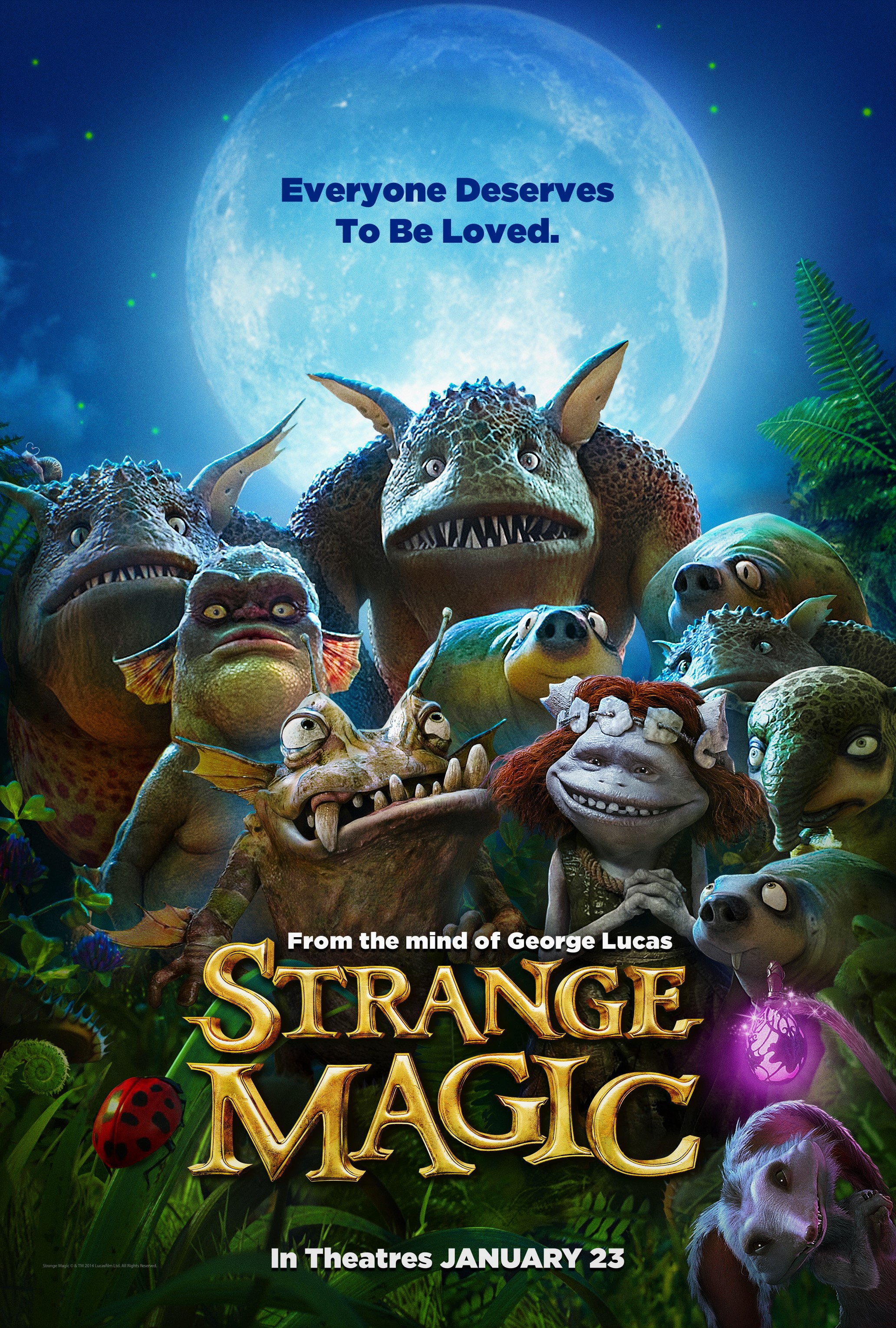
After selling Lucasfilm to the Walt Disney Company in late 2012, well-established writer-director George Lucas (THX 1138American GraffitiStar Wars: Episode IV – A New Hope) turned his attention away from the mega franchises of Star Wars and Indiana Jones to produce many of his long-gestating passion projects. This ambitious new turn began with the war epic; Red Tails in 2012 and shortly after Strange Magic in 2015, an animated fantasy musical that Lucas had long wanted to produce for his three daughters, having written an early draft of the story fifteen years earlier. Upon its eventual release, however, Strange Magic was deemed a colossal failure, earning only £9 million at the box office on a budget of approximately £74 million, along with receiving largely negative reviews from critics and audiences alike due to its predictable story, dreadful humour and bizarre song choices. All of which, I feel, are valid criticisms.

Plot Summary: In a mystical woodland realm where primrose flowers mark the border between two regions; the Fairy Kingdom and the Dark Forest. The undesirable, Bog King, rules over his gloomy domain without love, going so far as to imprison the Sugar Plum Fairy, who is capable of mixing love potions through the use of primroses, in a bid to permanently cease adoration across his domain…

Technically the first Lucasfilm production to be distributed by the Walt Disney Company following its acquisition. The story of Strange Magic is predominantly based on William Shakespeare’s A Midsummer Night’s Dream, as both narratives are romantic-comedies that involve misunderstandings and cross-purposes between different races or, in this case, species. The film also takes inspiration from many well-known fairy tales, including The Ugly Duckling and Beauty and the Beast for its central underlying theme, which concentrates on the belief that beauty is only skin deep and internal beauty is far more meaningful. An important message for children, to be sure. But, as a result of this subtext being delivered with zero charm or subtlety, the message itself comes across as incredibly forced and even somewhat contradictory, thanks to some of the screenplay’s ill-timed gags.

The central voice cast of Alan Cumming, Evan Rachel Wood, Elijah Kelley, Sam Palladio and Meredith Anne Bull all do a sufficient job of lending some personality to their respective characters. Especially since Strange Magic supplies very little in the way of characterisation, with a majority of the animated characters only being set apart from one another by what species they are, e.g. a fairy, elf or goblin, etc. Quite unfortunate, as for many characters, there is a solid foundation alluding to what they could’ve been should they have been further developed. For example, Marianne (the closet thing the story has to a protagonist) becomes distrustful of men once she witnesses her fiancée, Roland, cheating on her on the day of their wedding, quickly vowing to never love again and instead dedicate her life to protecting her family, specifically her sister, Dawn, who supposedly falls in love with every man she meets.

Aside from the flavourless designs of the fairies, which appear as if they’ve been yanked from any generic fantasy flick of the early 2000s, the visuals of Strange Magic are by far the film’s finest component, with nearly every shot retaining plenty of colour and ingenuity on account of the animated cinematography and the animation itself, which exhibits even the smallest of details right down to the threads on a characters’ clothing or patches of watery moss on tree branches. Yet, this isn’t too surprising, considering that Strange Magic was animated by famed visual effects company, Industrial Light & Magic, standing as their first fully animated feature since Rango in 2011.

Moving from the visuals to the music, Strange Magic is what’s known as a jukebox musical. This means that rather than creating original songs for the film, all of the songs heard throughout Strange Magic are popular songs from past decades. From Can’t Help Falling in Love to Love is Strange and I Can’t Help Myself (Sugar Pie Honey Bunch), the film’s continuous use of on-the-nose songs is undoubtedly what will make or break Strange Magic for most, as older audiences will feel as if they are being pandered to whilst younger audiences will simply be confused as to why none of the songs directly relate to any of the characters/locations within the film. Furthermore, the original score by Marius De Vries is barely distinguishable from any other fantasy score.

On a separate note, although the first entry in the Star Wars saga rarely lacked in world-building when it first introduced audiences to a galaxy far, far away. Strange Magic seems to actively avoid developing its world beyond one or two throwaway lines, establishing the two unimaginatively named regions that reside side-by-side and not much else as to how this fantastical world functions.

In summary, Strange Magic is a film that feels far too familiar to sing its own tune, with its derivative story coming across as a hodgepodge of well-worn elements from other animated and fantasy films. Most evidently, 2013’s Epic and the everlasting series of animated Tinker Bell flicks. As such, there’s virtually nothing about this fractured fairy tale that feels remotely fresh aside from some of its attractive visuals. There are enjoyable moments, of course, but, for the most part, Strange Magic is simply half-hearted and creatively lazy. Rating: high 3/10.

strange_magic-p940629

Paddington (2014) – Film Review

“Mrs. Brown Says That in London Everyone Is Different and That Means Anyone Can Fit in. I Think She Must Be Right Because Although I Don’t Look Like Anyone Else, I Really Do Feel at Home…” – Paddington

Inspired by a lone teddy bear author, Michael Bond, noticed on a store shelf near Paddington Station on Christmas Eve 1956. The literature debut of the loveable little bear known as Paddington came in the children’s book; A Bear Called Paddington, in 1958. And has since been featured in more than twenty books written by Bond and illustrated by Peggy Fortnum, among other artists. In 2014, writer-director Paul King (Under One RoofBunny and the BullPaddington 2) brought the darling bear to the silver screen in a film that affectionately honours its source material while simultaneously delivering a family-friendly fable that is just as heart-warming and amusing as its marmalade-munching protagonist.

Plot Summary: After a devastating earthquake destroys his home in the Peruvian rainforest, a young bear with an affection for all things British travels to London in search of a new home. Finding himself lost and alone at Paddington Station, he begins to realise that city life is not all he had imagined it to be until he encounters the Brown family, who after reading the label around his neck, offer him a temporary haven. But, just as things seem to be looking up for the Peruvian bear, he soon catches the eye of a fiendish museum taxidermist…

As it happens, the story of Paddington actually shares many similarities to the creation of the character; as the idea of a lonely bear sitting in Paddington Station can be linked back to old newsreels depicting child evacuees leaving London during World War II with labels around their necks and their possessions packed in small suitcases. Indicating that King understands the importance of this character in British pop culture, yet the film can’t be criticised for playing things too safe with this narrative as it does update the Peruvian bear where it can to stay relevant within modern times. Additionally, as a family comedy, Paddington hits all the right notes as the film’s gags range from laugh-out-loud observations regarding the transformative effects of fatherhood to slapstick bathroom antics, satisfying any audience member regardless of their age or affiliation with the character.

The voice of Paddington is provided by Ben Whishaw, who it turns out is the perfect voice for the beloved bear as his line delivery is naive yet charming, portraying Paddington as an innocent character who always sees the positive in any given situation. Moreover, the supporting cast of Hugh Bonneville, Sally Hawkins and Nicole Kidman are all delightful and are given an unexpected amount of characterisation, with Henry Brown being an uptight, risk analyst who is reluctant to take Paddington in, whilst his kind, artistic wife, Mary Brown, treats Paddington almost as if he is their own child. But, it’s Kidman who truly steals the show as the film’s antagonist, Millicent, riding the line between sinister and playfully over-the-top in her portrayal of a museum taxidermist who catches and stuffs exotic animals in her spare time.

Continuously imaginative and vibrant, the cinematography by Erik Wilson is ceaselessly innovative, assembling many visually pleasing shots with equally pleasant bursts of colour, especially when snow begins to fall over London during the final act. It also becomes apparent when examining the camerawork that Paddington is just as much a love letter to the city of London as it is an adaptation of a classic child-friendly character. So, of course, there’s the usual display of postcard locations, from the London Eye to Buckingham Palace, along with a stream of light-hearted wisecracks surrounding taxis, the underground and the mundanity of modern life in the British capital.

On a separate note, the original score for the film is by no means a work of art, but composer, Nick Urata, does manage to craft a score that remains both diverse and playful through tracks like Arrival in LondonThis Will Do Nicely, Millicent’s Lab and Theif Chase. While the more tender tracks, such as Journey from Peru and The Letter Home, blend austere piano melodies with subtle strings, making for an altogether cheerful if slightly prosaic score.

When it comes to Paddington himself, the film brings the character to life via the use of CGI. And whilst this information may worry a few fans of the character, the CG effects used throughout the film are almost faultless, as Paddington expresses a range of emotions and seamlessly interacts with the environments/objects around him. Furthermore, Paddington’s outfit is an exact replica of what he wears in the book series, including his iconic blue duffel coat and red Peruvian hat. However, producer David Heyman dismissed his well-known red Wellington boots as they weren’t actually part of the character’s original design, but were added over the years by toy manufacturers to ensure that the real-life Paddington bears were able to stand on their feet.

In summary, even though Paddington follows a formula seen in numerous other family flicks, the film is understandably more concerned with making its audience laugh and cry than it is reinventing the genre (something it achieves with aplomb). And with a heart as big as its protagonist’s appetite for marmalade, I feel Paddington deserved the successful franchise it later received, with its superb humour, pitch-perfect performances and incidental details proudly cementing the film as an adaption that could go hand-to-hand with some of the finest adaptions of children’s literature. Rating: 8/10.

paddington-p901792