Winnie-the-Pooh: Blood and Honey (2023) – Film Review

“Pooh, You’ve Got to Help Me! Something’s Wrong With Piglet, He Killed My Wife!” – Christopher Robin

Shot in a mere ten days, Winnie-the-Pooh: Blood and Honey, released in 2023, is a British-American-produced micro-budget slasher that takes a more despicable approach to the beloved characters of Winnie-the-Pooh, Piglet and the other inhabitants of the Hundred Acre Wood, morphing the convivial critters into bloodthirsty, savage killers. Unsurprisingly, due to its laughable concept, terrible screenplay, amateurish filmmaking and general lack of any genuine horror or satire, Winnie-the-Pooh: Blood and Honey serves as nothing more than a bargain-basement slasher that fails to exhibit even a passing interest in the source material it’s adapting. As such, the film is only really notable for its title, simply existing as a bizarre, mismatched amalgamation of the horror genre and classic children’s literature.

Plot Summary: When Christopher Robin, now a young man, departs the Hundred Acre Wood to attend university, leaving Winnie-the-Pooh and his furred friends to fend for themselves, their days of merriment and adventure quickly come to an end as they become feral and enraged, soon acquiring a taste for flesh that steers them on a bloody rampage…

The creation of Winnie-the-Pooh: Blood and Honey became feasible at the start of 2022 after the 1926 children’s book; Winnie-the-Pooh by A. A. Milne, entered the public domain in the United States, voiding its copyright, and therefore Disney’s media exclusivity over the titular character. This meant that the filmmakers behind Winnie-the-Pooh: Blood and Honey were free to use characters like Pooh, Piglet and Eeyore, as long as they did not resemble their animated, Disney-owned counterparts, which were still actively protected by copyright. Nevertheless, I feel that most would agree that a malicious interpretation of Milne’s cuddly animal characters is undoubtedly a poorly-conceived concept from the get-go, with the film doing little to prove its critics wrong in this respect throughout the exceptionally brief runtime, even if it is commendable that this is the first live-action adaptation of Winnie-the-Pooh not produced by the Walt Disney Company, as well as the first adaptation geared towards mature audiences.

Regarding the film’s surplus of shortcomings, Winnie-the-Pooh: Blood and Honey‘s most significant issues lie within its screenplay, as the film crams several unwarranted scenes and overly dramatic subplots into a formulaic slasher framework, like having the underwritten protagonist Maria, portrayed by Maria Taylor, be suffering from serve PTSD, following a night where an anonymous sexual deviant broke into her home. These details add little to the narrative and generally come across as screen-time wasters. The rest of the characters, including Christopher Robin, Jessica, Alice, Zoe and Lara, portrayed by Nikolai Leon, Natasha Rose Mills, Amber Doig-Thorne, Danielle Ronald and Natasha Tosini, respectively, are all tremendously underdeveloped, delivering tedious exposition dumps that lead nowhere through performances that frequently present the cast as if they are uncomfortable in their various roles, underselling or overselling their reactions at every turn.

With the exception of the creative opening sequence, which sets the stage for this darker rendition of the honey-hungry yellow bear via pencil-doodled animation, Winnie-the-Pooh: Blood and Honey is a rather shoddy horror flick that lazily relies on its handful of admirable practical effects to avoid attempting anything visually or audibly impressive, as the cinematography by Vince Knight is relatively dull when it isn’t chaotically unstable during chase sequences, whilst the editing haphazardly slaps scenes together without any consideration for continuity or pacing. Furthermore, the film utilises plenty of editing trickery to get around its poor direction, namely, a ludicrous quantity of fade-to-black transitions and an assortment of abysmal CG blood effects.

One of the more mildly charming aspects of Winnie-the-Pooh: Blood and Honey, however, is its original score by Andrew Scott Bell, as tracks like In Which We Are Introduced to Winnie-the-PoohTogether Forever and Silly Old Bear, while generic, are, at least, of a relatively high-quality thanks to Bell’s innovative approach to the whimsical yet eerie score, employing a variety of instruments in the composition of the soundtrack, such as a “Beehiveolin,” a combination of a beehive and a violin.

Interestingly, writer-director Rhys Frake-Waterfield (The Area 51 IncidentThe Killing TreeFirenado) originally wanted Tigger to appear in the film, but the character ultimately didn’t on account of copyright. Some may say this was a favourable outcome, as Winnie-the-Pooh: Blood and Honey evidently doesn’t strive for faithful recreations of the cherished characters of the Hundred Acre Wood. Instead, the film opportunistically coasts on the novelty of placing the loveable critters in a macabre context, bringing the characters to live-action through rubbery, full-face masks that display no hair or visible mouths, allowing for minimal expressions, meaning Pooh and Piglet may as well be murderous individuals sporting animal-themed masks.

In summary, Winnie-the-Pooh: Blood and Honey is exactly what many anticipated it to be following the release of its viral trailer in mid-2022; an atrocious slasher, an appalling adaptation, and an all-around execrable piece of cinema. Still, that’s not to say that Winnie-the-Pooh: Blood and Honey was a commercial failure, as the film actually grossed over £4 million on a budget of around £79,000, despite its near-universally negative reviews. Consequently, this suggests that with many other children’s literary works soon making their way into the public domain, we will regrettably be receiving far more lousy, horror-centric renditions of long-established characters in the near future, with Winnie-the-Pooh: Blood and Honey 2Bambi: The Reckoning and Peter Pan’s Neverland Nightmare, being just some of the projects already announced. Rating: 2/10.

winniethepooh_blood_and_honey_xxlg

Mad God (2021) – Film Review

“If You Disobey Me and Remain Hostile to Me, I Will Act Against You in Wrathful Hostility. I, for My Part, Will Discipline You Sevenfold for Your Sins…” – Opening Quotation

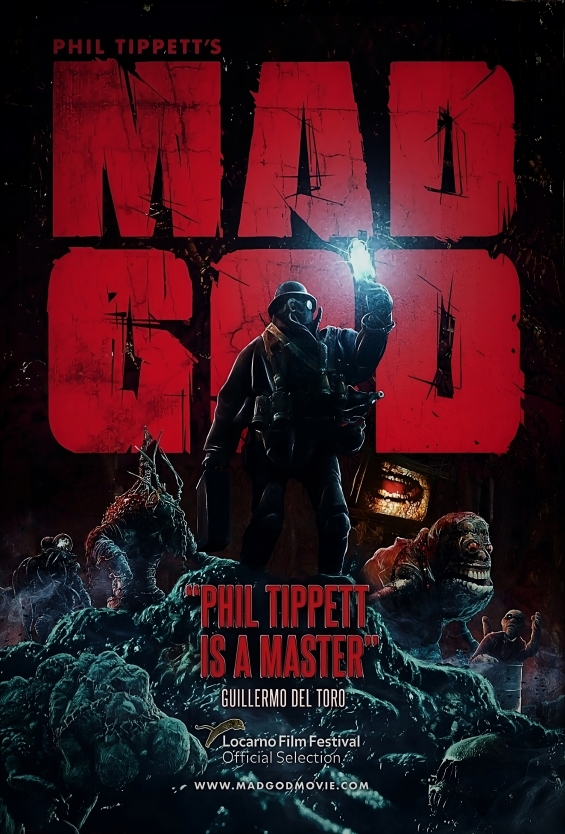
Written, produced and directed (among many other credits) by Phil Tippett, the founder and namesake of Tippett Studio, whose varied career in visual effects has spanned more than thirty years and includes two Academy Award wins and six nominations. Mad God, released in 2021, is a rich visual treat for enthusiasts of horror and stop-motion animation alike, serving as a harrowing delve into a post-apocalyptic hellscape that is both unique and disturbing. Harbouring a cinematic allure that is equal parts unsettling and mesmerising, Mad God proves that even in the age of CGI, the art form of stop-motion remains strong, even if the story and characters it’s bringing to life are far from well-developed.

Plot Summary: Equipped with a gas mask and an ageing map, the Assassin, a lone iron-clad humanoid, descends into an underworld of tortured souls, ruined cities and wretched monstrosities on a covert mission to reach the heart of this nightmarish realm of suffering…

First starting work on the project in the late 1980s, shortly after creating effects for RoboCop 2, released in 1990. Mad God has been Tippett’s pet project for over thirty years, despite the filmmaker almost considering abandoning the project when Jurassic Park was released in 1993, as CG effects appeared to make stop-motion a thing of the past. After some urging from those around him, however, Tippett decided to create a Kickstarter campaign that allowed him to complete the project. In the following years, three parts of Mad God were released online, which made up around half of the full eighty-two-minute version that was eventually screened at various film festivals. And whilst this story behind the film’s creation is certainly intriguing, Mad God‘s biggest shortcoming is that it lacks a narrative itself, or at least a coherent one. Instead, the film relies on visual storytelling and world-building as the audience follows the Assassin on his lengthy journey, encountering many distinct creatures, locations and civilisations on a mission that is never disclosed. As such, watching Mad God requires a lot of concentration to get the most out of it, much like how the project was crafted, I suppose.

With no dialogue or characterisation to speak of, Mad God‘s characters hinge entirely on their design. Thankfully, every character/creature that appears throughout the runtime is visibly repulsive, unnerving and eccentric. At the core of Mad God‘s story is a character only known as the Assassin, a silent, gas mask-wearing humanoid who also receives no characterisation, instead functioning as an audience surrogate through Tippett’s fever dream of a post-apocalyptic world. As the film features no dialogue, the central cast, including Alex Cox, Niketa Roman and Satish Ratakonda, only appear in a handful of live-action sequences, which similar to the scenes of stop-motion, are grimy and discomforting whilst relying on visuals over direct storytelling. While these sequences are interesting and count towards what little plot there is, many of these moments also pull you out of the experience and are often plagued by the film’s need to implement oral sounds to ensure the human characters don’t appear mute, meaning noises like “Eh?” and “Hmmm” become rather repetitious.

The cinematography by Chris Morley and Phil Tippett allows for spectacular framing within every scene, lending to the atmosphere and intrigue of each setting, whether its an oxidised factory of greasy machinery or a society of helpless slaves ruled over by an electronic screen that speaks in childlike gibberish. Furthermore, each of the surroundings the Assassin treks across is distinguished by the film’s colour palette, which seamlessly jumps from cold blues to vile greens and blood reds, making the stop-motion appear incredibly cinematic. Interestingly, one scene, which features a mountain of dead soldiers, was actually accomplished by melting thousands of plastic army men together on a wire. This scene took six animators around three years to complete, demonstrating the substantial amount of dedication required to animate even a single scene of Mad God.

Through prolonged tracks like Long Way Down and ConveyanceMad God‘s original score by Dan Wool enhances many of the surreal visuals in a relatively nuanced fashion, making for a soundtrack that isn’t all that memorable, but avoids becoming overbearing as to let the visuals speak for themselves. However, the sound design is where the film’s audio truly shines as the countless animalistic growls of the mutated creatures that roam Mad God‘s mystifying world are ghastly and add audible depth to whichever location the Assassin finds himself.

As most would expect from Tippett Studio, the animation itself is smooth yet appropriately unearthly, providing every creature with its own jittery method of walking/crawling that feels remarkably natural. What’s even more impressive is that, according to Tippett, a considerable amount of the animation on Mad God was actually conducted by novice students who wanted to gain some filmmaking experience.

In summary, Mad God will likely be a very divisive film on account of its largely interpretive narrative and absence of well-defined characters. But, these annoyances ultimately don’t matter that much in the grand scheme, as Mad God thrives in what it’s trying to do. Presenting itself as a love letter to stop-motion that could only be realised by a legendary visual effects artist like Phil Tippett. And with stop-motion animation in such short supply nowadays, an outstanding piece of artsy like Mad God will always be a joy to behold, faults or not. Rating: 7/10.

w1cnVYUNJU3NPYh6FBeq0voXD15-transformed

Cooties (2014) – Film Review

“Nap Time, Motherfuckers…” – Wade

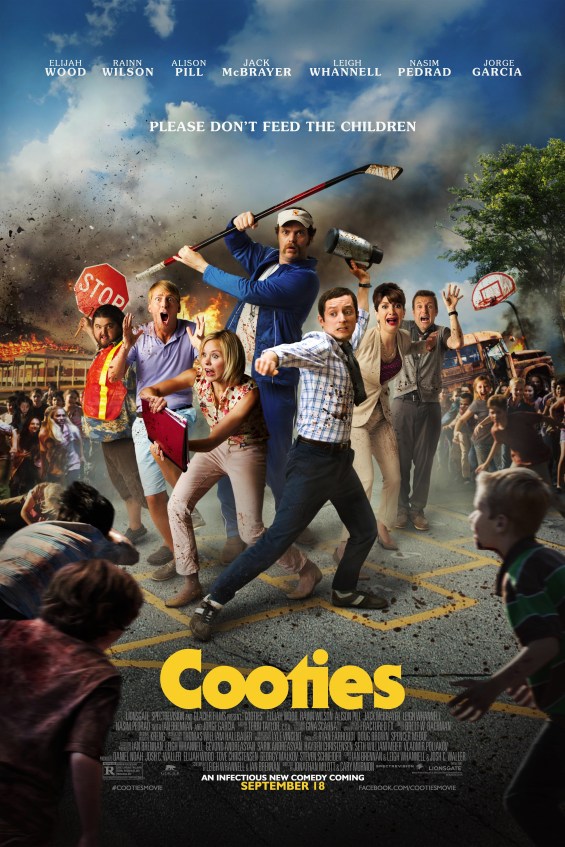
For many, children can seem like loud, disease-infested monsters, and it’s not difficult to see why. There’s usually something leaking out their noses, their meals are often encrusted around their mouths, and they care little for social decorum or personal space. As such, it’s not too surprising that a horror-comedy like Cooties would come along in 2014 to take this waggish status to a more terrifying level, altering children into nimble monstrosities hungry for human flesh. Yet, in spite of how much potential a concept like this holds, Cooties ultimately squanders many of its favourable qualities, never fully committing to its absurd premise and the horror/humour it holds.

Plot Summary: When a mysterious virus originating from contaminated chicken nuggets hits an isolated elementary school, transforming the children within into a feral swarm of flesh-eating monsters. A group of misfit teachers are forced to band together as they attempt to flee the bloody, juvenile carnage…

Directed by Jonathan Milott and Cary Murnion (BushwickBecky), Cooties undoubtedly harbours a remarkable premise, and the screenplay effectively sets itself up as a hybrid of both comedy and horror in its first act, balancing conversational witticisms and light moments of characterisation, with violent sequences of teachers and parents being torn apart by the infected children. However, the screenplay quickly turns sour once the second act arrives, as a number of plot conveniences/inconsistencies arise to make the perilous situation of the central group of characters survivable. Moreover, as the virus spreads and the teachers become trapped inside the school, the story begins to feel rather generic as the screenplay moves between uninteresting plot points from the chintzy jokes that preceded them.

While the characters featured throughout Cooties aren’t what I’d describe as particularly memorable or unique, they are, at least, well-defined and have their respective witty moments. A fair portion of this character appeal could also be attributed to the cast, however, as Elijah Wood, Alison Pill, Rainn Wilson, Leigh Whannel, Jack McBrayer and Jorge Garcia all deliver excellent performances as self-centred educators who are evidently displeased with how their lives have turned out. For example, Clint (the protagonist), who formerly moved to New York City in an attempt to become a novelist, reluctantly finds himself back in his hometown of Fort Chicken, Illinois, as a substitute teacher. The only positive outcome of his return home is his reconciliation with his childhood crush, Lucy, who now works at the same school. But, any chance of sparking a connection with her is swiftly stomped out by P.E. teacher, Wade, her loathsome boyfriend. Presumably, leaving many audience members grateful they don’t lead a life as a downtrodden, small-town elementary school teacher.

Aside from the truly nauseating opening title sequence at a chicken farm, which is sure to turn many audience members into vegetarians. Thanks in part to its use of vile close-ups, sludgy green colour palette and singular chicken nugget stuffed with an ominous black gloop. The rest of Lyle Vincent’s cinematography is relativity drab, relying on monotonous mid-shots to depict the puerile chaos. Outside of a handful of moments where close-ups are effectively employed to display the fantastic practical effects, that is, including a darkly comedic sequence in which the infected children pull the hapless school principal apart, using his intestines as a skipping rope, soon thereafter.

Cooties‘ original score, composed by Kreng, a.k.a. Pepijn Caudron, is an interesting musical composition, a quirky mix of electronic horror and childlike innocence, much like the film itself. And whilst the score is occasionally too synth-heavy, which can seem a little odd given the film’s lack of 1980s influences. Cooties‘ soundtrack does make space for haunting vocals and violins where it can, blending comforting and madcap cues to create splendid tracks like Opening Titles and Rick’s Tape.

As previously mentioned, Cooties does appear fairly derivative following its first act, relying on no end of familiar tropes for the zombie subgenre. In addition to caving into an array of plot convinces, such as the sex-ed teacher, Doug, possessing a significant amount of knowledge on viruses and the human brain alike, so he can explain to the others that adults cannot be infected. Still, that isn’t where the writing-related issues cease, as towards the end of the third act (spoilers ahead in this section for those who wish to go in blind), the story becomes virtually aimless, providing no resolution as the characters scurry through the barren, nearby town of Danville until the credits roll. Of course, there is always the possibility that this sudden discontinuation was a result of the film’s limited budget, but it’s a less-than-satisfying way of concluding the narrative, nonetheless.

In summary, Cooties‘ screenplay is largely what drags the rest of the project down, appearing almost confined in its storytelling as if the screenwriters couldn’t reach beyond the typical traits of a zombie flick. Once the teachers hunker down inside a classroom, the story grinds to a tedious halt, merely observing the characters as they crawl through air ducts and suit up with school equipment to escape, scenes you’ve seen a thousand times before in other zombie-centric stories. But, what’s most disappointing, is that Cooties wastes such an inspired idea, as teachers surviving against a horde of infected children is an imaginative and amusing concept that could’ve easily made for an enjoyable, low-budget horror-comedy if it was executed skillfully. Rating: 4/10.

cooties-p1005972

Upgrade (2018) – Film Review

“You Upgraded. Now, You’re Stronger, Faster, Better Than Everyone Else.” – Fisk

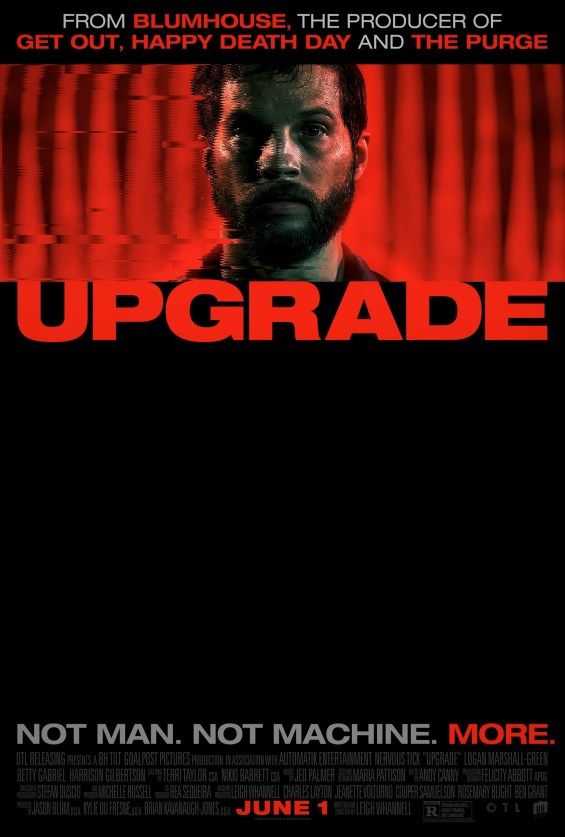
Recently gaining a large amount of traction through his reinterpretation of the horror classic; The Invisible Man in 2020, writer-director Lee Whannell first proved himself a talented filmmaker with Upgrade in 2018. A riveting sci-fi-thriller that combines elements of the acclaimed British television series; Black Mirror, 2002’s Minority Report and 1990s action flicks to construct a gripping yet dreary tale of revenge, morality and technology through detailed world-building and stimulating action sequences, promptly overcoming its handful of minor glitches.

Plot Summary: In the near future, technology controls almost every aspect of day-to-day life as the world relies on artificial intelligence to complete even the most basic of tasks. As a result, the old-school, tech-shy mechanic, Grey Trace, feels like a fish out of water in an ever-changing world. But, after a brutal assault leaves Grey paralysed and his beloved wife dead, he’s approached by the reclusive tech mogul, Eron Keen, who offers him a solution; the powerful microchip, STEM, that will bridge the gap between his mind and unresponsive limbs. Now able to walk again, Grey decides to seek revenge against the thugs who destroyed his life…

Originally titled; STEM, Upgrade was Whannell’s first project outside of the horror genre, best known beforehand for his collaborations with writer-director James Wan, co-writing and starring in both the Saw and Insidious series. And for being the first time Whannell has truly stepped out of Wan’s shadow, Upgrade immediately proves Whannell to be a more than capable director with a distinct style, a style that certainly wasn’t displayed in his directorial debut; Insidious: Chapter 3, three years prior. Upgrade also exhibits Whannell’s almost tongue-in-cheek approach to writing, with some scenes feeling as if they’ve been ripped straight from an ’80s buddy-cop comedy as Grey humorously argues with the artificial intelligence residing inside his head. This isn’t to say that the film is light-hearted, however, as Upgrade is, in reality, quite the opposite, never shying away from bloody, squirm-inducing violence, even with its surprisingly modest budget.

With regard to the cast, Logan Marshall-Green gives a remarkably ranged performance as the protagonist, Grey Trace, who is quickly established as a technophobe whose main devotions in life are mechanical tinkering and his beautiful wife, Asha Grey. That is before the seemingly unprompted assault leaves him crippled, alone and infuriated by his situation to the point of attempted suicide. Then, once receiving STEM, Grey begins to express far more concern regarding how much bodily control he’s handed over, with Marshall-Green’s performance becoming far more physically demanding as he slowly loses control of his own body. Harrison Gilbertson and Simon Maiden as Eron Keen and the voice of STEM, respectively, also play their parts well, with Maiden doing a particularly terrific job of providing STEM with a soothing yet simultaneously menacing voice.

One of the greatest components of Upgrade is by far its zestful cinematography by Stefan Duscio, as after obtaining STEM, the camera itself visually mirrors Grey’s newly acquired agility/coordination by wildly tilting with every movement Grey makes, keeping him in the centre of the frame at all times to provide the audience with a unique perspective without sacrificing visibility as a result. Furthermore, despite the story being set in America, Upgrade was actually filmed in Melbourne, Australia. This location was chosen in order to take advantage of the city’s gothic architecture, giving the film an expansive backdrop not too dissimilar to that of The Matrix sequels. However, unlike those films, Upgrade does occasionally run into the issue of its sci-fi world feeling slightly inconsistent between shots as the city’s slick, looming skyscrapers almost seem out-of-place when compared to the graffitied and dilapidated warehouses on street level, but perhaps that’s intentional.

Managing to be moody, suspenseful and tranquil (sometimes all at the same time), Jed Palmer’s original score is more than fitting for a film like Upgrade as the electronic score echoes films like Blade Runner during its quieter moments through tracks, such as Aftermath and A Better Place before the more action-orientated cues kick in, that is, with tracks like We Can’t Let Them Win and Control. The sound design throughout the film is equally excellent, with every thrust and slash hitting hard during the numerous, intense action sequences.

On that note, Upgrade‘s absurdly well-executed action set pieces are possibly some of the finest the sci-fi genre has seen in a long time. As not only does the camera ceaselessly track Grey, as previously mentioned, but the fight choreography is almost faultless. It’s also during these scenes that the cutting-edge technology of Upgrade‘s criminal underworld first appears, from bio-mechanically-implanted firearms to memory-retaining contact lenses and even a weaponised nanotech sneeze, “The Upgraded,” as they are nicknamed, are essentially seen as the next stage of human evolution, blatantly showing the audience the true extent to which humanity now relies on technology.

In summary, even though Upgrade is guilty of playing into some overly familiar ideas with its story being based around the well-trodden concept of artificial intelligence outmatching humanity. There are enough twists and turns within its narrative to ensure that the film will hold up upon multiple viewings, serving as an exciting and stylish sci-fi-thriller in addition to providing undeniable evidence that exchanging one genre for another is a risky yet rewarding road when it comes to certain filmmakers. Rating: 8/10.

upgrade-p1046488

Beneath (2013) – Film Review

 “There’s Something Out There!” – Deb

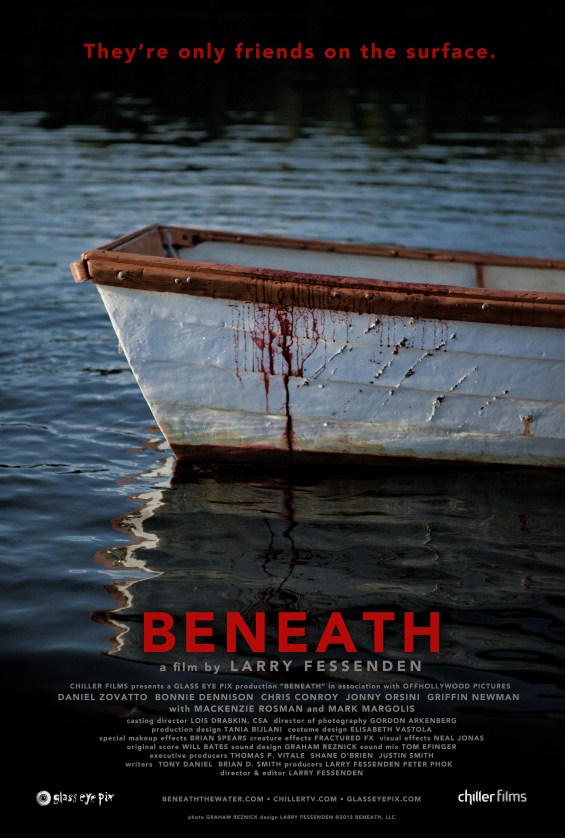
Directed by Larry Fessenden (HabitWendigoDepraved) and distributed by the horror-centric production company, Chiller Films, a now-defunct television network responsible for many low-budget supernatural horrors, including Siren (2016), Animal (2014) and Dead Souls (2012). Beneath, released in 2013, may have sounded like an estimable idea during its conception, being pitched as a minimalist creature feature that explores the direful outcomes of human behaviour under the influence of extreme isolation and fear. As a result of its overemphatic performances, mindless screenplay and frequently mishandled visuals, however, whatever little tension and intrigue Beneath manages to build up is completely capsized by the time the end credits roll.

Plot Summary: Following their high school graduation, a group of friends decide to spend one last summer outing together at Black Lake before going their separate ways. But, when their rowboat is struck by an amphibious creature, subsequently killing a member of the group and destroying their oars, the five remaining friends find themselves trapped in the middle of the reservoir, contemplating whether one of them should be thrown overboard as a distraction…

While the original screenplay for the film had flashbacks that further developed the characters and explored their individual journeys throughout high school, Fessenden ultimately decided to remove them. This allowed the entire project to be shot in a mere eighteen days, which certainly shows, as Beneath is a largely dull affair, following the usual formula for a creature feature outside of one or two subversive moments. Given Fessenden’s past work, it would also make sense that the film could go so far as to suggest that the creature in the lake doesn’t actually exist and is, in reality, just a physical manifestation of the characters’ ulterior motives. Yet, regrettably, this is not the case, and Beneath opts to play things relatively straight, with the characters being devoured one by one in equally idiotic ways.

On a similar note, the title of the film doesn’t just refer to what lurks in the tranquil water, but is also a guide to where Beneath‘s substance lies with the film’s unbearable roster of characters, compromising of Johnny, a brooding, long-haired loner, Kitty, the rotating object of desire for practically every male character in the film, Matt, the golden-boy jock whose prospects seem to be going downhill since graduating, his younger, less athletic but more intelligent brother, Simon, along with Kitty’s best friend, Deb, and the hyperactive filmmaker, Zeke, each having a respective outburst as simmering high school grudges, rivalries and romantic betrayals factor into the survival stakes. But, on account of the exceptionally awful dialogue, the prospect of any tension within the story soon becomes virtually non-existent, even with the cast of Daniel Zovatto, Bonnie Dennison, Chris Conroy, Jon Orsini, Mackenzie Rosman and Griffin Newman sharing their fleeting moments of promise in a film brimming with atrocious performances. Moreover, the friendship between the characters feels so unnatural from the outset, considering their vastly different backgrounds and personalities.

Cinematographer Gordon Arkenberg tries his best at keeping the solitary setting of a stranded rowboat visually interesting, which beyond some oddly framed shots and sequences that can only be described as ‘visual disarray,’ is a goal he somewhat succeeds in, particularly whenever the camera is pointed towards the beautiful scenery, where the stillness of the lake accentuates the ominous threat of the creature prowling just beneath its surface. Nevertheless, these shots are soon defaced by harsh shadows and a bleached colour palette due to the whole film being shot with natural light. Judging by the editing, you would also be forgiven for thinking that Black Lake is the largest lake in America as the characters spend hours upon hours rowing with their broken oars (and eventually hands) only to make zero progress in a poor attempt of elongating the runtime.

Even though there is next to no emphasis placed on the original score by Will Bates, the score for Beneath is competent, if very forgettable, making a fair effort to enhance the supposed tension on-screen. Except for the semi-final track; Last Stand, that is, which sounds as if it’s from another soundtrack entirely, mimicking the score from a light-hearted romantic-comedy more than any horror flick.

As for the film’s main feature, the creature itself closely resembles the appearance of a giant anglerfish. And whilst I can respect this decision given the anglerfish is one of the most naturally frighting animals on the planet, this choice also displays a great deal of laziness on behalf of the filmmakers as taking what is already an intimidating-looking animal and simply enlarging it is a rather indolent approach to designing your marketable monstrosity. Having said that, the combination of animatronics and puppetry that brings the creature to life is impressive, despite its limited range of movements.

In summary, while some may get an ironic laugh out of this ninety-minute trainwreck, I feel most will agree that Beneath is above all else just a frustrating experience, with one of the film’s only positives being its commendable reliance on practical effects over CGI. But, truthfully, the effects alone don’t even come close to rectifying what are the film’s many, many other shortcomings, distinguishing Beneath from other films within the genre solely on how moronic and tiresome of a horror/thriller it is, paling in comparison to Fessenden’s other low-budget efforts. Rating: low 2/10.

beneath-p823208

Hush (2016) – Film Review

“I Can Come in Any Time I Want, and I Can Get You Anytime I Want. But, I’m Not Going To. Not Until It’s Time.” – The Masked Man

Exceptionally gripping in the face of its simplicity, Hush, released in 2016, navigates the bloody waters of the home invasion subgenre to tremendous results. With only five characters and a single location to speak of, the performances and sound design of Hush are both key components in the film’s goal of establishing a disquieting tone, captivating its audience while simultaneously making them dread that the story they are witnessing on-screen could realistically transpire in the most peaceful of surroundings. Certifying Hush as a concise and well-executed horror/thriller, despite the film’s continuous cat-and-mouse pursuits growing a little tiresome by the third act.

Plot Summary: When Maddie, a deaf and mute author, moves to a secluded woodland house in the hope of living a peaceful, solitary life as she writes her second novel, she soon finds her isolated home the target of a deranged, masked killer…

Co-written, directed and edited by Mike Flanagan, this talented director has been the face of modern horror for many years, crafting chilling and original genre pieces, such as Oculus (2013), Before I Wake (2016) and the horror/drama mini-series; The Haunting of Hill House in 2018, in addition to adapting much of Stephen King’s iconic catalogue of horror literature, with 2017’s Gerald’s Game and 2019’s Doctor SleepHush, however, was one of the director’s earlier projects, with Flanagan conceiving the storyline whilst on a dinner date with his co-writer/leading actress Kate Siegel in 2014, not long before the pair married in 2016. To get a better understanding of the film, Siegel and Flanagan even role-played each scene in their house before writing them into the screenplay, enabling them to envision how the characters would react in the face of danger, a method that I feel ultimately paid off.

Although the lead role of Hush seems tailor-made for a hearing-impaired actress, Kate Siegel portrays Maddie divinely as a quick-witted heroine who keeps the audience on her side at all times. Continuously thinking on her feet, overcoming some of the obstacles associated with her disability, and using her hearing impairment to her advantage whenever possible, it’s easy to root for Maddie to triumph over her assailant. John Gallagher Jr. is also stellar as the mysteriously motivated antagonist, a character only ever referred to as the “Masked Man,” who, throughout the runtime, enjoys playing mind games with his victims, receiving some kind of fetishistic pleasure from toying with those he’s about to slaughter. In many ways, the Masked Man shares similarities to the horror icon, Michael Myers, with his motivation for killing never being stated and his costume consisting primarily of an unadorned white mask, which only adds to the character’s intrigue.

Whilst a substantial portion of the cinematography by James Kniest is hand-held, removing the possibility of Hush standing as one of Mike Flanagan’s most visually impressive films. The fluidity of Hush‘s camerawork does allow the audience to follow Maddie as she wanders through her contemporary home, the camera tracking her every movement as she enters and exits various rooms on impulse. However, a major shortcoming of the film’s visuals is certainly it’s lighting, as due to all of the narrative taking place at night, it makes sense that Hush would be quite gloomy lighting-wise. Yet, most shots are seemingly over-lit, considering the characters are supposed to be in a dense woodland area in the dead of night.

At times peaceful, at times aggressive, the original score for Hush, composed by The Newton Brothers, greatly enhances the story at many points as tracks, like MaddieIntruderAgainst the Glass and Crossbow, are all incredibly atmospheric. And, even if the score lacks a predominant track that could be regarded as the film’s theme in years to come, Hush‘s soundtrack still more than serves its purpose, especially when taking into account the film’s reliance on sound as opposed to a non-diegetic score.

Since the protagonist of Hush is both deaf and mute, the film contains less than fifteen minutes of dialogue. Therefore, with a runtime of around eighty-two minutes, Hush harbours more than seventy minutes of screen-time without a single word spoken. This setup provides Mike Flanagan with a perfect opportunity to play with sound in creative ways, removing the audio entirely (except for an ultrasound machine) in some scenes to put the audience into Maddie’s position and deliver a sudden jolt when appropriate, thus, avoiding the common horror cliché of having nonsensical, ear-piercing jump-scares for no apparent reason. Through the sound design, we also learn more regarding Maddie’s character, as she hears the echoing voice of her deceased mother whispering to her. Her voice usually aids Maddie in conjuring up endings for her novels, but, in this case, her mother’s ghostly voice lays out her options on how to approach her current, precarious situation.

In summary, Hush is a sharp, violent and finely-tuned horror/thriller that goes down familiar paths yet with flair and skill, never reinventing the wheel, but proving that the genres it’s drawing from still have firm legs. From the Masked Man toying with Maddie, as he steals her phone and sends pictures to her laptop to Maddie rapidly locking all of her windows and doors before the killer can enter, Hush is undoubtedly a compelling story with an excess of suspenseful moments, its superb sound design only adding to its appeal as the film regularly comes close to being a sensory-deprivation experience. Rating: 7/10.

hush_xxlg

Terrifier (2016) – Film Review

“What? Did You Think He Was Gonna Hack Me up Into Little Pieces or Something?” – Dawn

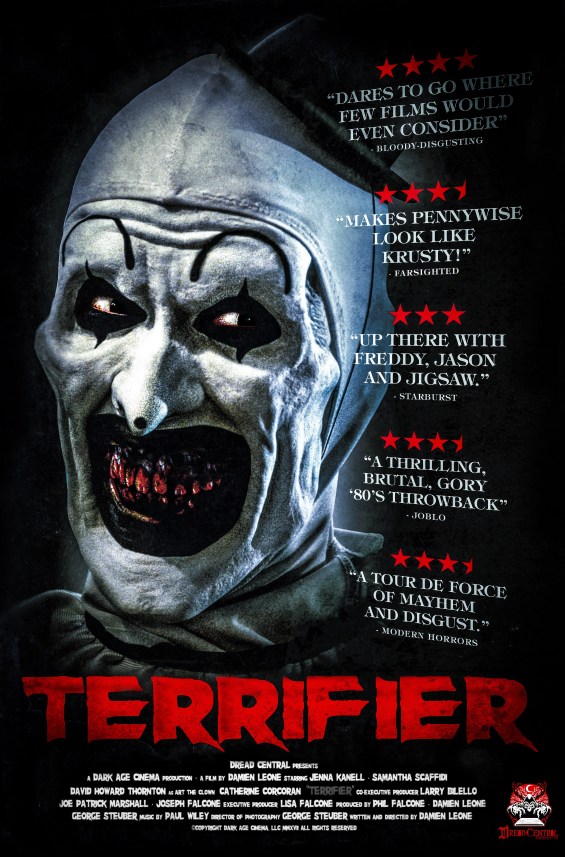
Grisly, taut and seasonally atmospheric, Terrifier, released in 2016, aims to pay homage to the inexpensive slasher flicks of the 1980s, relishing in the same simplistic approach and over-the-top gore that classic horrors like Friday the 13th and Blood Harvest specialised in. And while the film does admittedly fall prey to many of the usual limitations low-budget horrors tend to have, Terrifier is preserved through a genuinely terrifying performance from David Howard Thornton as Art the Clown, in addition to plenty of fantastically gruesome effects and a willingness from writer-director Damien Leone (All Hallows’ EveFrankenstein vs. The Mummy) to push on-screen violence to its limit.

Plot Summary: On Halloween night, Tara Heyes and her best friend, Dawn, find themselves in the wrong place at the wrong time as they become the unfortunate marks of Art the Clown, a demented serial killer with a morbid sense of humour…

With coulrophobia (the name allocated to the fear of clowns) being one of the most common phobias in the world, it makes sense that the horror genre would try to capitalise on this widespread fear of individuals with white face paint, comical horns and oversized shoes. And if there’s one area Terrifier more than thrives in, it’s fully realising this common phobia as Art the Clown is consistently frightening. The film jumps from moments of complete silence as Art stares down his victims to Art violently murdering the poor souls, showering the sadistic clown’s black and white costume with blood. Terrifier isn’t actually Art the Clown’s first appearance, however, as Damien Leone first introduced the character in his second short film, which not only shared the Terrifier title, but is practically the same storyline just condensed into a brief twenty-minute runtime.

Regarding the characters, the conceited Dawn, somewhat sensible Tara Heyes, and loyal sister, Victoria Heyes, portrayed by Catherine Corcoran, Jenna Kanell and Samantha Scaffidi, respectively, all serve an important purpose within the narrative. Yet, the characters themselves never attain a status beyond generic slasher victim, and although each of the actress’ screams of terror sound as suitably realistic as a director could hope for, the delivery of some lines (specifically from the supporting cast) feels rather clunky. But, the true star of the film is undoubtedly David Howard Thornton as Art the Clown, as Thornton ceaselessly stays in character as the psychotic, clown-dressed murderer, portraying Art as a fun-loving mime whose killings involve a combination of predatory sadism and joyful glee. So much so, that Art will make many audience members nervous purely due to his unpredictability, as the character’s manic actions make it almost impossible to predict what he’ll do next.

On a technical level, Terrifier is top-notch considering its thin budget, as whilst the cinematography by George Steuber is far from groundbreaking, the film has a reasonable amount of creative shots, the majority of which are enhanced by the film’s highly saturated colour palette, thin layer of granularity and scenes primarily lit by natural light, providing the film with an authentic low-budget ’80s appeal. And, as previously mentioned, Terrifier does not hold back when it comes to brutality and depravity, certifying the film as one not for the faint of heart as the gore effects are gut-churning and grotesque, with the amount of labour and detail that has gone into each effect being more than deserving of applause, especially when once again acknowledging the film’s budget, which is estimated to have been around £73,000.

The original score by Paul Wiley is a triumphant blend of 2010 and 1980s horror scores, with tracks such as In Pieces and Clown Car standing as daunting and metallic-sounding pieces similar to many modern horror scores, whereas tracks like Kill Horn and the film’s central theme, simply titled; Terrifier Theme, are reminiscent of the original Halloween score in more ways than one, which by no means a poor comparison when it comes to unnerving horror soundtracks.

These connections to past genre films continue further into the film’s visuals as Damien Leone inserts many explicit nods and visual tributes to everything from Psycho (1960) to Hostel (2005) to everything in-between. And, whilst some may not like when a film relies so heavily on pastiche, it never feels overdone in Terrifier, as the film strikes a satisfying balance between throwbacks and unique ideas, occasionally playing with the conventions of slashers by adding some twists to the killer and final girl dynamic, which will most definitely catch some audience members off-guard.

In summary, Terrifier has plenty of entertainment value should you fit into the film’s principal audience as this modern slasher is an unabashed reminder of the bloodthirsty horror films that populated the 1980s, a.k.a. the kind of nasty flicks that were banned during the video-nasty era. The film has its issue, undeniably, most notably with its shortage of interesting characters and often oversimplified story. But, Terrifier does make the most of its foreboding atmosphere and unsettling killer. While watching, it also quickly becomes clear that Damien Leone wants Art the Clown to join the ranks of Jason Voorhees and Michael Myers as a horror icon in the future, which I think is more than feasible given his appearance in Terrifier, so I’d say it really depends on how the horror community feel about the film years down the line. Rating: high 6/10.

terrifier-p1080489

The Wretched (2019) – Film Review

“I Like This House…” – Sara

When it comes to the horror genre, sometimes you don’t desire a film that sets out to rewrite the rules of spine-tingling storytelling. Instead, you occasionally find yourself simply wanting to dim the lights and ensconce with a low-budget popcorn flick, and 2019’s The Wretched is firmly one of those films. With appealingly modest ambitions, The Wretched utilises its cast of unknowns, unique creature design and admirable emphasis on body horror as effectively as its thin budget will allow. And, even though the film is far from a game-changer for the realm of supernatural horror, The Wretched still manages to overcome most of its flaws to serve as an engaging, if fairly foreseeable, tale of witchcraft and body-snatching.

Plot Summary: After being sent to live with his father for the summer on account of his parents’ imminent divorce, defiant teenager Ben begins to suspect there is something wrong with his father’s next-door neighbour, eventually discovering that there is an execrable entity lurking beneath her skin…

Originally titled; Hag, before being changed following negative feedback from test audiences. The Wretched was certainly a departure for writer-director duo Brett Pierce and Drew T. Pierce, as the pair’s prior film, Deadheads, released in 2011, was a zombie road-trip comedy. Even so, this leap in tone and genre rarely seems to impair The Wretched from a directorial standpoint, as the film leaps headfirst into its grim tone and horrifying visuals right from the opening scene. And, whilst the film struggles to balance its plot threads from time to time, it quickly becomes clear that the central source of inspiration for the story was the low-budget creature-features of the 1980s, tied together with a desire to create a newfangled interpretation of witchcraft and revitalise hags into terrifying antagonists.

Acting out since his parents’ separation, seventeen-year-old Ben, competently portrayed by John-Paul Howard, is the protagonist. And, while it’s always challenging to portray an angsty teenager, due to the concern of said character becoming incredibly abrasive, Howard pulls it off successfully, portraying Ben as a frustrated and confused adolescent struggling to come to terms with his altered life. Furthermore, The Wretched even aims to justify the common horror trope of parents not believing their children once the supernatural occurrences begin, as when Ben attempts to explain the situation to his father, Ben’s past transgressions of trespassing and stealing medicine come to light, prompting his father to dismiss his claims as either lies or delusions. The supporting cast, including Piper Curda, Jamison Jones, Azie Tesfai and Zarah Mahler, is also serviceable in their minor roles as members of the lakeside community where his father resides.

Shot near Omena and Northport, Michigan, close to the Pierce brothers’ hometown, the cinematography for The Wretched by Conor Murphy often ranges in quality as some scenes are beautifully shot, with a strong emphasis on close-ups, whereas others (usually during conversations between characters) merely rely on dull, hand-held shots. With that said, when working in synch with each other, the camerawork and lighting do a remarkable job of masking the creature early on in the story, only giving the audience brief glimpses of the witch in her contorted, feral state before later displaying the film’s full range of prosthetic make-up and practical effects.

Excluding the ominous theme for the titular witch heard in the tracks; Woods and The Wretched Appears, both of which feature avant-garde strings led by a manipulated sarangi, the original score by Devin Burrows admittedly has some room for improvement as tracks, like Don’t Let Her In, Honey… Beer? and Broken Window repeatedly overuse strings and brass horns to the point where the tracks become too disruptive to the narrative, often mismatching with whatever shot is on-screen.

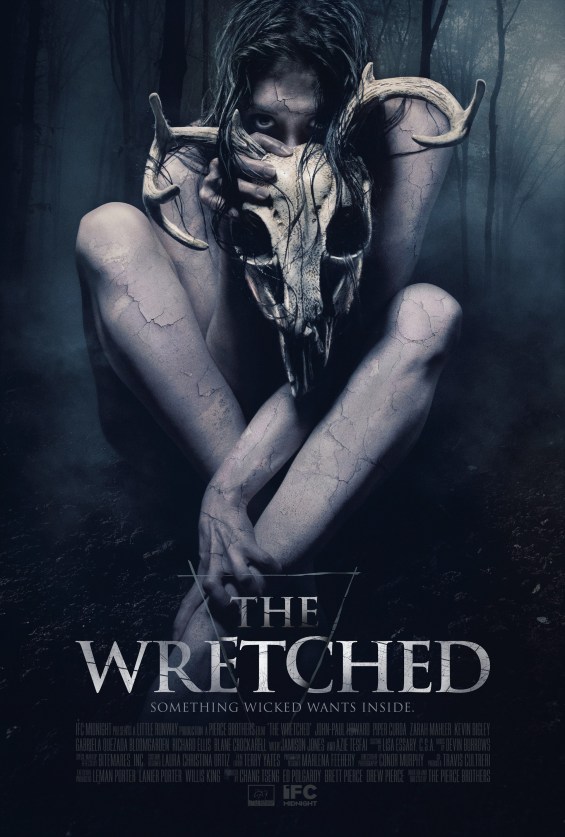
Of course, the witch herself is unquestionably the film’s primary draw, and The Wretched presents its titular creature with pride, making sure to include all of the most off-putting aspects of the creature’s devilish design and malicious nature. And, whilst the witch isn’t grounded in any specific mythology, with the screenplay only providing minor hints towards its origins, the witch’s carved symbols, salt fragility and quasi-religious shrines all give the creature an element of personality when outside of its human disguise. Speaking of which, the way the creature is presented when inside a body is just as disturbing as we, the audience, along with Ben, observe how the witch practically lives the life of the person whose skin she now inhabits, caring for her decaying body the best she can as the Wretched attempts to act human, each day climbing closer to feasting on the unfortunate children of the mother she is impersonating.

In summary, although The Wretched isn’t as polished as it could be in certain areas, I feel this well-paced horror flick will please most genre fanatics, even in spite of its occasional visual continuity errors, corny dialogue and lack of focus regarding the dual plot lines. The Wretched still delivers on its promise of a skin-crawling creature-feature reminiscent of ’80s cult classics. The film is also one of the few horror films I’d personally like to see a sequel or prequel to someday, as I feel the concept of a witch that feeds on the forgotten is an intriguing idea that doesn’t reach its full potential here, but undoubtedly could in a more refined film. Rating: 6/10.

wretched_ver2_xxlg

Adult Life Skills (2016) – Film Review

“I Think We Should Get Badges for Adult Life Skills; Changing a Car Tyre, Sewing, Sending Something Back at a Restaurant, Knitting…” – Brendan

Based on the BAFTA-nominated short; Emotional Fusebox, which premiered at the London Film Festival in 2014. 2016’s Adult Life Skills is the directorial debut of writer and director Rachel Tunnard, who was primarily an editor before writing and directing the original short film. And, while Tunnard’s lack of experience in these dual roles is evident, this low-budget coming-of-age comedy-drama hardly breaks new ground in its respective genres. The endearingly quirky story, distinct British charm, and tremendous performance from Jodie Whittaker all make Adult Life Skills well worth a watch.

Plot Summary: Deeply grieving from the death of her twin brother, twenty-nine-year-old Anna spends her days living in her mother’s shed, retreating into herself as she makes videos using homemade props and her thumbs as actors. But, on the eve of her 30th birthday, Anna meets a troubled little boy going through the same life-altering experience she did, a boy who may be the answer to getting her out of her year-long slump…

Originally titled; How to Live Yours (which has a reference in the film via the name of Anna’s website), Adult Life Skills first appeared at a film festival, just as its predecessor did. Only this time around, it was the 2016 Tribeca Film Festival, where Rachel Tunnard quickly won one of the top awards, the Nora Ephron Prize for Best Female Director. Yet, in my opinion, much of the allure of Adult Life Skills comes from its screenplay rather than Tunnard’s direction, as the dialogue is continuously both witty and dramatic, balancing moments of laughs and tears without ever feeling disjointed or unnatural, amplifying the film’s feeling of solace and upbeat tone thanks to its homespun, playful aesthetic.

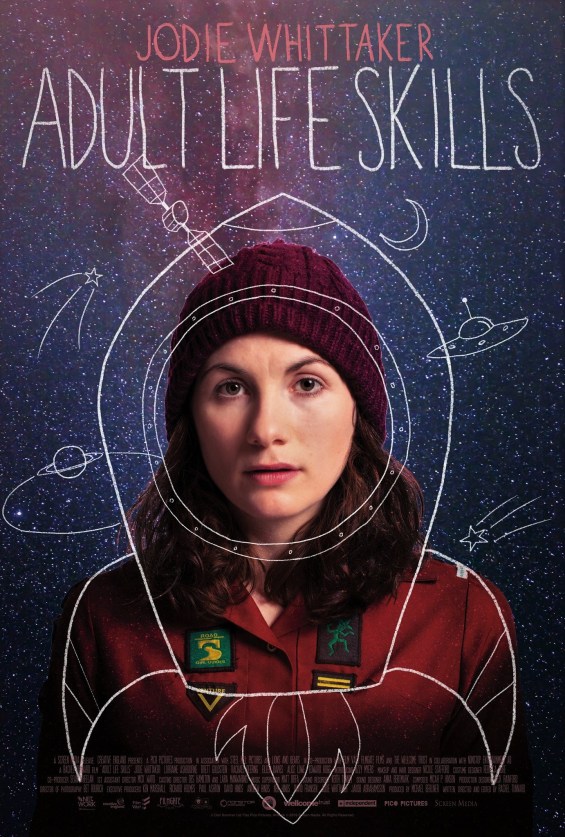
Jodie Whittaker, who reprises her role from Emotional Fusebox, portrays Anna magnificently, rapidly jumping from one emotion to another as Anna’s method of grieving often manifests in her hiding away from her own life, locking herself inside her mother’s shed as she cherishes her brother’s old clothes and watches videos the pair made together during their younger days. Essentially, Anna is a character whose growth has been stunted by grief, and the story explores this concept of a person growing into adulthood with a piece of their identity personified in a lost sibling. This brilliant idea is only enhanced by Whittaker’s sublime performance. Needless to say, it takes her mother’s grumbling, her grandmother’s wisdom, and her best friend’s guidance to help bring her back into the real world, restoring her life to what it once was, and the supporting cast of Lorraine Ashbourne, Eileen Davies and Rachael Deering all do a great job of bringing these characters to life, despite some of the side characters being woefully underdeveloped.

One advantage Adult Life Skills has over many other British stories is its setting, as the film truly feels as if it couldn’t be set anywhere else. Breaking away from the typical locations where stories within the United Kingdom tend to be set, such as London, or less commonly, Manchester or Birmingham, in exchange for the remote Yorkshire countryside, a unique location that even helps to redeem the film’s overreliance on hand-held techniques when it comes to the cinematography by Bet Rourich, as Yorkshire has more than its fair share of natural beauty, even when the weather is rather gloomy.

Although there is no original score for the film (most likely due to budgetary restrictions), Adult Life Skills features several songs, both well-known and obscure. From Jesus Came to My Birthday Party to You Lost Sight of Me, Champions of the River Nile and Here I Go Again, every song that can be heard throughout the runtime fits the tone remarkably well, never once feeling inappropriate or unsuitable to the specific scene they are featured within.

In addition to being a comedy-drama, Adult Life Skills makes a few (unsuccessful) attempts towards being a romantic-comedy, as one of Anna’s close friends, the soft-spoken estate agent, Brendan, portrayed by Brett Goldstein, persistently speaks to Anna, trying to impress her with his comforting charm and handmade gifts. His efforts are ultimately pointless, however, as Anna’s jaded reactions to his kind gestures are due to Anna believing Brendan is homosexual. And, whilst this misunderstanding does result in a winsome relationship, this subplot suffers due to not being given enough attention, as the story instead places far more emphasis on Anna’s relationship with her mother and the young boy, Clint, who is surprisingly well-portrayed by the then-eight-year-old Ozzy Myers.

In summary, Adult Life Skills is a film that wears its oddball eccentricities on its sleeve, tackling weighty themes of grief, loneliness, and dealing with one’s emotions, while simultaneously maintaining its optimistic outlook. In many ways, Adult Life Skills is an undemanding film for those in need of something ‘comforting’ to watch. An easily watchable comedy-drama that is sure to put a smile on most viewers’ faces, despite its overly familiar ideas. Still, there’s no denying that Jodie Whittaker is the best thing about Adult Life Skills, as whenever the screenplay is lacking, Whittaker appears on-screen with confidence, fleshing out Anna as a sympathetic character and ensuring the audience remains emotionally invested in what is occurring narratively. Rating: low 7/10.

adult_life_skills_ver2_xxlg

Please Stand By (2017) – Film Review

While in years gone by many films surrounding the subject of autism have been seen as overly simplistic or even offensive, with Hollywood often treating characters with ASD like an immeasurable burden upon their entire family, every now and then we receive a film, which presents its autistic character (or characters) with respect and authenticity, 2017’s ‘Please Stand By,’ being one such example. Directed by Ben Lewin (Georgia, The Sessions, Falling for Figaro) and based on the 2008 play of the same name by Michael Golamco, ‘Please Stand By’ may hit many familiar beats for a coming-of-age comedy-drama, but with an excellent cast and a subtle sci-fi twist, thanks to its focus around all things ‘Star Trek,’ ‘Please Stand By’ manages to keep its story diverting throughout its brief runtime.

Plot Summary: When ‘Wendy Welcott,’ a young autistic woman with a gift for writing, learns that Paramount Pictures is holding a screenwriting competition to celebrate ‘Star Trek’s 50th anniversary, she swiftly writes her own screenplay for submission. But, on account of her condition and a great deal of ignorance from those around her, ‘Wendy’ is unable to submit her screenplay in time. So, seeing no other option, ‘Wendy’ decides to leave her group home in Oakland and travel to Los Angeles to deliver her screenplay in person…

Although the film’s screenplay (which is actually written by Michael Golamco) rarely breaks the mould of your typical coming-of-age narrative, ‘Please Stand By’ still has more than its fair share of heartwarming moments. And, whilst some may argue that the film’s continuously upbeat tone robs the story of any real stakes, ‘Please Stand By’ isn’t really a film that aims to paint an incredibly dramatic tale of self-realisation, family and belonging, but instead a film that effectively balances all of those themes through a charming and light-hearted story of a woman embarking on a journey across California in dedication of her favourite science fiction franchise.

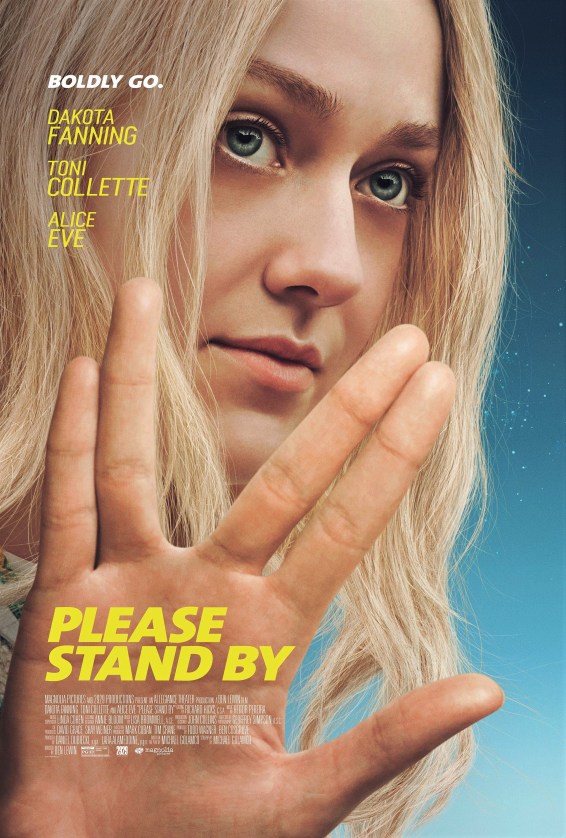
In what would’ve been the film’s most criticised performance should it have been executed poorly, Dakota Fanning’s performance as ‘Wendy’ is one of the more thoughtful and accurate portrayals of on-screen autism in quite some time. From her social awkwardness to her flailing arm movements and stiff dialogue readings, Fanning successfully captures the functional spectrum of autism in a delightful and intriguing expression of independence and passion, as due to ‘Wendy’ having few experiences outside of her sheltered routine, the road-trip she embarks upon makes her feel truly unconstrained for the first time in her entire life, both for better and for worse. Meanwhile, her caregiver and older sister wonderfully portrayed by Toni Collette and Alice Eve, respectively, attempt to track her down and bring her home, fearing for her safety and greatly doubting her abilities.

When it comes to visuals, despite the ceaselessly vibrant colour palette, the cinematography by Geoffrey Simpson hardly ever veers away from immobile close-ups and/or mid-shots. But, where the camerawork truly shines is during the scenes where the film attempts to recreate shots from classic ‘Star Trek’ episodes, as the Mediterranean climate of Los Angeles is quickly swapped out for the strange alien worlds of ‘Wendy’s imagination, all the while we hear ‘Wendy’ as she reads excerpts from her ‘Star Trek’ screenplay through calming voice-over.

In a similar sense to the visuals, the original score by Heitor Pereira rarely does anything exceedingly innovative as far as soundtracks go, with the majority of the runtime relying more on the use of lesser-known indie songs, such as ‘Take Me as I Am,’ ‘All or Nothing’ and ‘Waves.’ Yet, the score once again becomes much more interesting once we are transported into ‘Wendy’s screenplay, as the original score morphs into something that wouldn’t seem out-of-place in an actual ‘Star Trek’ episode.

Along with recreating shots, ‘Please Stand By’ also pays homage to ‘Star Trek’ history in nearly every aspect of its production. Firstly, the name tags of ‘Wendy’s work colleagues use the same font as the opening titles of ‘Star Trek: The Original Series.’ Secondly, the mountain ranges seen in the background of the screenplay sequence are the Vasquez Rocks located in Agua Dulce, California, this area has been an extensively used location for many ‘Star Trek’ films and series, but, most notably, for the 1966 episode; ‘Arena.’ Lastly, the suits worn by ‘Captain Kirk’ and ‘Spock’ during this same sequence are similar to suits worn by the characters in the 1968 episode; ‘The Tholian Web,’ visibly proving that the filmmakers did their research when it came to the franchise and its ardent followers.

In summary, whilst Golamco’s admittedly predictable screenplay does place the film more in the mid-range of coming-of-age comedy-dramas, by letting the talented actors simply do what they do best, director Ben Lewin does make ‘Please Stand By’ palatable, even in its most commonplace moments. And, although I obviously can’t speak for everyone in regard to how well the film truly portrays autism, given my position, in my eyes, this low-budget flick handles the potentially challenging concept adroitly, displaying the challenges of a life with ASD without ever devolving into a exaggerated collection of tics and quirks, insulting those who may be on the spectrum. Final Rating: 7/10.

please_stand_by_xxlg