Selfie From Hell (2018) – Film Review

“Something Evil Has Already Set Its Eyes on You…” – Hannah

In the horror genre, mystery plays a pivotal role in stories where the characters strive to uncover the cause behind the terrifying events they face, engaging the audience beyond scares via an instinctive desire for answers/explanations. However, in the case of 2018’s hilariously titled, low-budget horror; Selfie From Hell (or Selfieman in some regions), the central mystery frequently works to its detriment, yielding further questions and nonsensical moments rather than deepening the narrative or its underlying themes. Still, that’s not to say that a compelling mystery would’ve salvaged Selfie From Hell, as this social media-focused horror is an utter failure on every front, generally evoking boredom rather than fear.

Plot Summary: When influencer Julia falls mysteriously ill while visiting her cousin Hannah in Oregon, Hannah turns to Julia’s online content in search of an explanation for her unusual ailment. But, as she digs ever deeper, her cousin’s online activity reveals connections to the dark web, a twisted internet challenge and a malevolent, otherworldly force bleeding into reality…

Selfie From Hell, written and directed by Erdal Ceylan (Demon’s Dawn), was expanded from his earlier short film of the same name, also featuring Meelah Adams. The two-minute short consists of Adams’ character taking selfies in her home before noticing a dark figure behind her in the images, which then consumes her. As a concept for a short film, the idea is serviceable, if a little cheesy, yet doesn’t retain nearly enough depth for a feature-length undertaking, even if Ceylan makes a feeble attempt to incorporate an underlying theme of social media addiction and the dangers of careless internet usage, similar to other gimcrack social media-centric horrors, such as Smiley (2012), #Horror (2015) and Friend Request (2016). Furthermore, the previously mentioned ‘mystery’ at the centre of the film is neither intriguing nor well-constructed, presenting conundrums to the audience with little allure or clarity.

The small cast of Alyson Walker, Tony Giroux, Meelah Adams and Ian Butcher delivers fairly lacklustre performances across the board, in part due to the shoddy dialogue and characterisation, which lack depth, intrigue and any semblance of intentional humour. Regarding the characters’ relation to the plot, Hannah’s investigation into her cousin’s ailment leads her down a rabbit hole linked to a secretive website on the dark web. Here, she meets an enigmatic, patently untrustworthy individual, who gives the Selfieman (the titular creature of the film) a run for his money in the absurd name department with the online handle, F34R3473R, or “FearEater,” a character so cartoonishly malicious that his handful of appearances are rarely taken seriously. Outside of her investigation, there is a dreary romantic subplot between Hannah and her tech-savvy friend Trevor, who aids her in her exploration while secretly harbouring a crush on her, which is as predictable as it is vapid.

Visually, the cinematography by Jeremy Walter Cox is somewhat amateurish, seldom allowing for appealing shots. Other elements of the production, such as the lighting and audio, however, are adequate, which is worth noting as this isn’t always the case with low-budget flicks, especially when they place such strong emphasis on the sights and sounds surrounding their characters. What’s more, the design of the supernatural entity, the Selfieman, is rather generic, appearing only a handful of times as a towering, spindly figure with skeletal features, whilst his abilities, motivation, and the rules he abides by never receive any explanation amidst the fleeting runtime.

Being a low-budget project, Selfie From Hell didn’t have an original score composed for it, despite Peter Allen getting credited as the film’s composer. Instead, the Selfie From Hell employs an assortment of stock music, all of which are hackneyed horror tracks. In many instances, the score also telegraphs each character’s actions, often unnecessarily so, with every moment intended to be frightening or impactful, retaining a bothersome sound cue, whether that be a message arising on a laptop screen or catching a glimpse of a figure in the background of an image, which consistently fails to make these instances startling.

Even with a runtime of only seventy-three minutes, Selfie From Hell feels dragged out and overstuffed with too many ideas, all of them poorly illustrated and vying for attention, mainly because the film would rather focus on pushing a vareity of cheap, bombastic jump-scares instead of making the effort to earn its frights, some of which appear even worse as a result of the inclusion of janky, low-grade CGI to depict the Selfieman and several other supernatural elements. While some of these issues could be attributed to the film’s low budget, others certainly cannot.

In summary, clearly hoping to follow in the footsteps of Lights Out, a 2013 short film later expanded into a feature-length horror release, Selfie From Hell was, in actuality, released to little fanfare, and deservedly so. Candidly low-budget and struggling to sustain its runtime, Selfie From Hell was flawed from its very inception, being based on a short film with a rather tacky concept that only functions as a cheap thrill for horror fans. A one-trick pony with dreadful dialogue, bland performances, and a monumental overreliance on jump-scares, leading me to believe that the filmmakers didn’t give much thought to how a short film building up to a single scare could develop into a feature-length project. Rating: 1/10.

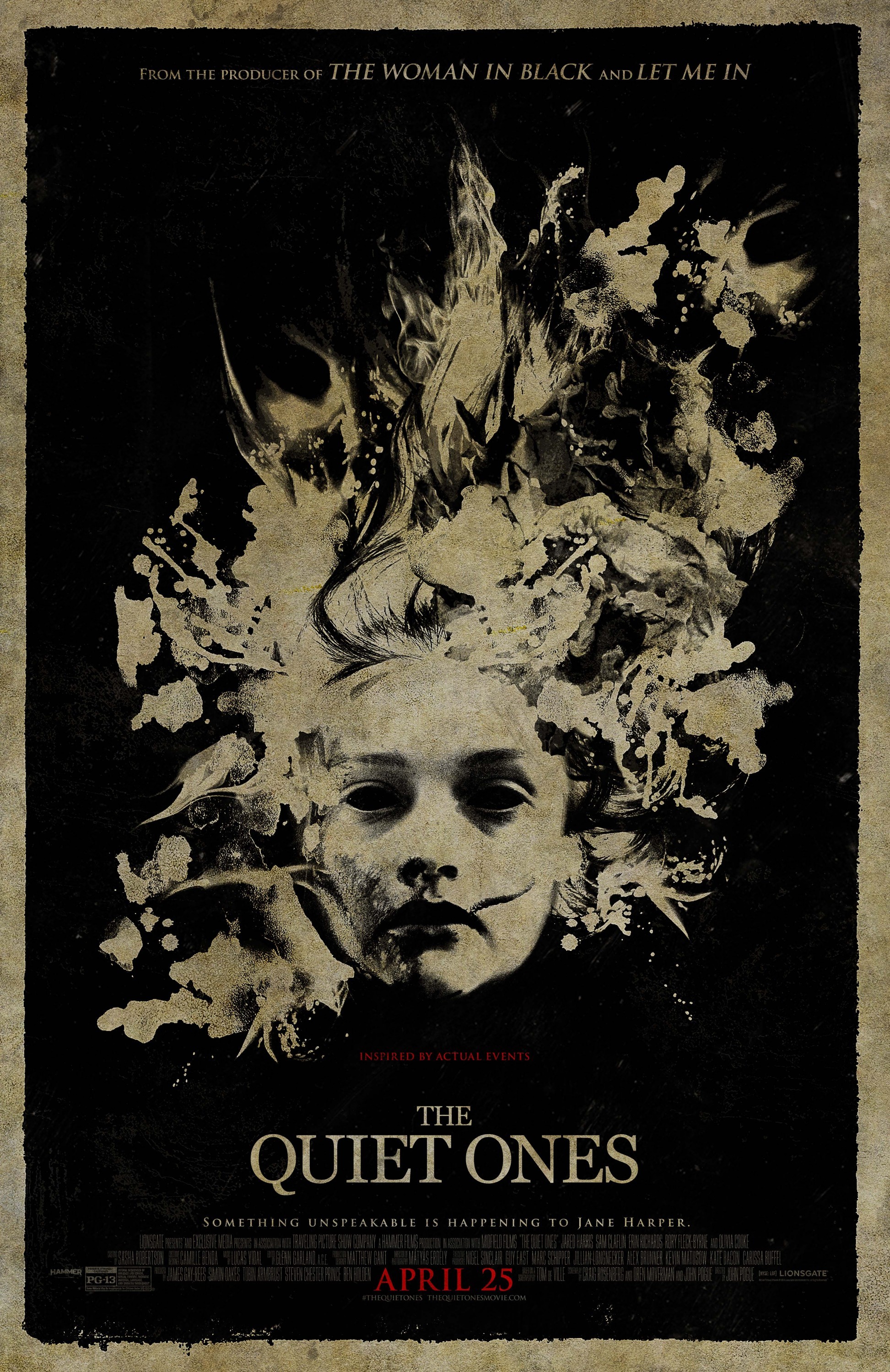
The Quiet Ones (2014) – Film Review

“What if You Could Prove That the Supernatural Was Merely a Manifestation of What Alreadly Exists in the Mind; the Subconscious?” – Professor Joepsh Coupland

Shot in 2012 yet not released until 2014, The Quiet Ones is a 1970s-set, melancholic horror loosely based on the Philip Experiment, a 1972 parapsychology experiment conducted in Toronto, Ontario, made to determine whether living subjects can communicate with fictionalised ghosts through expectations of human will. Led by mathematical geneticist Dr. A.R. George Owen and overseen by psychologist Dr. Joel Whitton, their goal was to create a fictional character through a purposeful methodology and then ‘attempt’ to communicate with it through a séance. The created character was anointed; “Philip Aylesford,” referred to as “Philip” during the test. Although participants did report feeling a ghostly presence, table vibrations, breezes, unexplained echoes and eerie noises, matching responses to questions about Philip’s life, an apparition ultimately never appeared. Nevertheless, director John Pogue (Quarantine 2: The Terminal, Blood Brother, Deep Blue Sea 3) set out to take this real-world trial and twist it into an unnerving horror flick to, regrettably, minimal success.

Plot Summary: Summoning his top students to a secluded estate on the outskirts of Oxford in 1974, the unorthodox Professor Joseph Coupland proposes to the deeply troubled orphan Jane Harper that they perform a risky experiment to manifest the darkness within her. Operating under the theory that paranormal activity is triggered by negative human energy, Joseph and his team employ a series of tests to push the young woman to the brink of sanity. But, as the morally questionable experiment continues, the professor and his ambitious students soon realise they may have unwillingly released an unrelenting horror…

Heavily rewritten during production for budgetary reasons, The Quiet Ones does have a captivating piece of inspiration at its core, with the Philip Experiment being historically regarded as one of the most promiscuous and unsettling experiments of the 1970s, often playing into the configuration of conventional séances as Dr. A.R. George Owen sat his participants around a table, dimming the lights and requesting no communication between the group, even if the experiment has been criticised in recent years for lacking systematic management and clear results due to the unreliability of séances. Similar tests were conducted in the years following creating further make-believe characters, known as “Lilith” and “Humphrey,” producing near-identical results that were eventually deemed inconclusive. Regardless, it’s a bewitching real-world event for a horror flick, mashing up elements of science and the supernatural as frightening occurrences get underway, leading the researchers to admit their understanding of life and death isn’t as accurate as they once thought.

Portraying the zealous research team, Jared Harris, Sam Claflin, Olivia Cooke, Erin Richards and Rory Fleck Byrne are on all their A-game, with Harris being a particular highlight as the intelligent and self-assured Professor Joseph Coupland, portraying the character as equal parts unpredictable and oddly calming, it’s just a shame the character’s emotional backstory isn’t utilised to its full effect. In one of her first major roles, the then-upcoming actress, Olivia Cooke, is also a stand out, portraying Jane as an immensely tragic woman who has suffered from mental illness and uncanny events almost all of her life, being sent in and out of foster homes as a result of the malevolence enveloping her like a storm.

Continuously made to appear as if portions of the film were shot on ’70s-era cameras, The Quiet Ones is one of those horror flicks that feels as if it could have very easily been conceived as an entirely found-footage endeavour, but instead, the film uses the found-footage format sparingly, only employing the visual aesthetic at pivotal moments in the narrative. Most notably, during the scene with the Kirlian photography experiment (as seen through the lens of Brian’s 16mm camera), which was actually filmed by Sam Claflin himself, although not with an authentic 1970s camera, but with the contemporary camera of cinematographer Mátyás Erdély.

Comparable to how many of the film’s frights are your typical, lethargic jump-scares, such as windows slamming, doors knocking, beds breaking and chandeliers falling (each time, the deafening scare being preceded by an elongated silence), the orginal score by Lucas Vidal features the usual assortment of rackety, blaring tracks, like Not Scientific Proof and Bathtub Attack. Perhaps some of this audible bombardment was meant to conceal that there isn’t much depth to the story beyond the underlying theme of science and its relation to the supernatural.

In addition to The Quiet Ones, the infamous Philip Experiment also inspired the horror flick; The Apparition, released a few years prior in 2012, but that isn’t too surprising, given that a 2019 poll concluded that nearly half of the American populace believes that spirits and/or demons exist, despite overwhelming evidence that belief that life persists after death is declining.

In summary, The Quiet Ones is a horror flick that, in my opinion, is deserving of its largely overlooked status in the horror genre, as most of the film relies on cheap frights and visual trickery more than genuine dread to unnerve its audience. Though the film possesses an honourable cast, an appealing setting and an intriguing real-world influence, its rather lifeless execution holds it back. In essence, The Quiet Ones is much like the experiment in its narrative, throwing ideas into a beaker and praying it works as intended, yet it doesn’t achieve the desired outcome. Rating: low 5/10.

quiet_ones_xxlg

Leave the World Behind (2023) – Film Review

“A Conspiracy Theory About a Shadowy Group of People Running the World Is Far Too Lazy of an Explanation… Especially When the Truth Is Much Scarier.” – G. H. Scott

Suspenseful, intriguing and enigmatic, 2023’s Leave the World Behind is an adaptation of the novel of the same name by Rumaan Alam. Steadily drawing its audience in through its engaging premise and stunning camerawork, this stylish Netflix Original is an apocalyptic thriller centred around the idea of humanity’s destruction being brought about by our distrust of others, our overreliance on modern technology and our lack of control over the planet. And, although not perfect, the film is a predominantly engrossing and intricate original flick for the streaming service in more ways than one.

Plot Summary: Exchanging New York City for a much-needed family getaway at a luxurious, remote rental home, couple Amanda and Clay Sanford are shaken by the late-night arrival of the sharply-dressed stranger, G. H. Scott, and his daughter, Ruth, bearing troubling news of a regional blackout and communication issues. But, as the pair are invited inside and speculate on why this rapid technological breakdown is occurring, all signs begin to point to more than a temporary malfunction…

Written and directed by Sam Esmail (Comet), creator of the incredibly gripping and considerably underrated crime-thriller television series; Mr. Robot, through which Esmail proves his extraordinary talent as a screenwriter and director. Leave the World Behind proves, once again, that Esmail is an absurdly talented filmmaker, governing the film’s pacing, upsurge in tension and consistently dour tone to an astonishing degree, all whilst enveloping the story in an unpredictable and surprisingly close to reality ‘end of the world’ scenario, even if the narrative unnecessarily harbours a lengthy runtime of almost two and a half hours. I can, however, see some taking issue with the film as a result of its conclusion, which is rather inconclusive and underwhelming after all the film’s build-up, even though the climax does answer many of the questions the audience likely possesses at that time.

The central cast of Julia Roberts, Mahershala Ali, Ethan Hawke, Myha’la, Farrah Mackenzie, Charlie Evans and Kevin Bacon all hold their own throughout the runtime, authentically portraying a concerned family, a pair of fairly unwelcomed guests and a distrustful neighbour with the appropriate dose of awkwardness and apprehension. Yet, the characters themselves aren’t given enough to make them appear memorable or complex, merely functioning as viewpoints for the audience as they piece together the sprinklings of clues and information they uncover in relation to the circumstances that are transpiring around them.

Utilising its colour palette to represent specific characters, like the colour blue, for example, being employed around the Sanford family, with their bedroom, car, clothes and other minor details all sharing this colour. The visuals, specifically the sleek cinematography by Tod Campbell, are inventive and attractive, visually conveying much of the paranoia the characters are feeling while implementing Esmail’s signature style of filmmaking via uncomfortable close-ups on the characters, positioning them in the corner of the frame to further put the audience on edge, with even the wall art in the master bedroom altering over time as Amanda and Clay’s temperament intensifies. Additionally, Leave the World Behind houses a few moments of fairly impressive CGI whenever the characters encounter a CG flamboyance of flamingos or a herd of deer near their rental home, which is certainly abnormal and visually interesting, yet the animals’ significance in the grander narrative is largely lost on me.

Crafting an outstanding score for all four series of Mr. Robot, Mac Quayle is a superb composer and continues to prove his worth with his nail-biting, horror-esque score for Leave the World Behind, continuously adding to the suspense of each and every scene, whether there is any physical peril at that time or not. During tracks such as; Beach Day and Cyberattack, Quayle’s orginal score is led by an isolated, eerie piano piece, placing the audience (for a brief moment) amid the film’s impending apocalypse and the human drama unfurling within. However, as much as the score attempts to immerse the audience in the narrative, some of the licensed songs chosen for the film have the counter effect, seeming unsuitable and irrelevant to both the tone and the story, despite the stylish opening animated sequence where one of these songs is featured, serving as an electrifying curtain-raiser.

On another note, Leave the World Behind interestingly contains several references to Esmail’s previously mentioned television series, including Amanda’s laptop and the yellow emergency kits the character, Danny, purchases both being produced by E-Corp, a fictional corporation featured in the series, as well as a book written by the Mr. Robot character, Irving, also appearing, suggesting that the stories may take place in the same universe, which would make sense, given the stories’ shared notions of hackers, cyberattacks and theories regarding online terrorist groups.

In summary, Leave the World Behind is a Netflix Original that will undoubtedly divide its audience, taking an unconventional approach to the well-known formula of the apocalyptic scenario, leaning more into the isolated paranoia and scepticism of an ordinary American family rather than the grand destruction of famed cities and their associated landmarks across the globe. Even so, whilst not quite as polished or as compelling as Esmail’s masterwork of a television series, Leave the World Behind definitely has its notable elements, in my opinion, grounding itself in reality as much as possible. Rating: 7/10.

leave_the_world_behind_xxlg

The Hole in the Ground (2019) – Film Review

“Something’s Not Right With Him…” – Sarah O’Neill

Ominous and moderately compelling, The Hole in the Ground is a 2019 Irish horror flick that, whilst well-crafted, is overly reliant on many of the conventional aspects of similar horror outings, most notably within thesinister childsubgenre. Still, with the film drawing from notions of Irish folklore, such as the concept of Changelings (children being replaced by fairy folk) and Fairy Forts (the ruins of neolithic tombs scattered across Ireland, thought to be portals to the Otherworld), co-writer and director Lee Cronin (Minutes Past Midnight – Segment: Ghost Train, Evil Dead Rise) does a sufficient enough job with the tools he is provided, even if The Hole in the Ground generally lacks ingenuity.

Plot Summary: To escape her crooked past, single mother Sarah O’Neill travels to the fringes of a rural town in the Irish countryside with her young son, Chris, to start a new life. But, after a disturbing encounter with a local resident, Sarah begins to question things, attempting to uncover if the troubling changes in her little boy are somehow connected to a mysterious crater hidden within the forest that borders their new home

According to Cronin, in addition to Irish folklore, The Hole in the Ground takes inspiration from a news story he once overheard, stating;There Was a Particular News Story I Saw About a Man in Florida Watching TV in His Armchair and a Small Sinkhole Opened Up Beneath Him. He Was Unable to Be Rescued. He Fell Down Into the Earthand I Thought That Was Horrific.Due to this inspiration, The Hole in the Ground, in execution, is less of the spiritual and bloody interpretation of the ‘malevolent child‘ concept as seen in 1976’s The Omen and more of a cross between the 2014 cinematic interpretation of maternal grief, The Babadook, and another Irish horror of changelings and woodland spirits, 2015’s The Hallow, taking a more minimalistic and character-driven approach to much of its horror and violence.

The largely unknown cast of Seána Kerslake, James Quinn Markey, Simone Kirby and Kati Outinen all portray their respective characters with devotion and authenticity, which is particularly impressive in the case of Quinn Markey, given that child acting can often make or break a piece of cinema. Thankfully, although this role requires a lot from the young actor, Quinn Markey delivers, portraying Chris with a menacing aura of otherworldliness. Likewise, Kerslake provides an anchoring performance, portraying Sarah as a struggling mother beginning to question her parental instincts following her implied escape from Chris’ abusive father. An idea that also plays into the underlying themes of the story, as I’m sure Sarah’s uncertainty regarding her parental abilities is surprisingly close to reality for some, with many mothers/fathers sometimes looking at their children only to no longer recognise them as they develop, naturally evolving into a wide-reaching inner fear and scab for the horror genre to pick at. Of course, in this case, Sarah’s suspicions surrounding her son arise from a supernatural mystery that lingers throughout the runtime. Yet, this subtext never threatens to overthrow the story, instead feeding much of the dread that permeates almost every scene.

Alongside the suitably gloomy colour palette, the cinematography by Tom Comerford retains a visually pleasant, gothic-adjacent look, avoiding hand-held shots for the bulk of the runtime. Much of this visual aesthetic can be attributed to the photographs and filmography of American photographer Gregory Crewdson, which served as a primary influence for the camerawork, with Crewdson’s work being known for staging scenes of suburbia for dramatic effect, his surreal images frequently appearing melancholic, offering ambiguous narrative suggestions and blurring the boundaries between fiction and reality, a tremendous creative choice. However, the same cannot be said for the lighting, which, in some scenes, is so dim it becomes difficult to tell what is occurring.

Opening with the sound of a singular piano note and concluding with that same note, which is then repeated to correlate with the story’s motif of something beingduplicated,the original score by Stephen McKeon is fairly audibly engaging, coming across as eerie and dramatic yet never overbearing via tracks, like Main Titles, Run Into the Woods and Mental Health.

Intriguingly, The Hole in the Ground also features several nods to The Shining (1980), including a wallpaper pattern that resembles the famed hexagonal design of the Overlook Hotel’s carpet. Regrettably, however, dissimilar to that iconic flick and many other horrors, the creature design of The Hole in the Ground is rather lacklustre in spite of the detailed costumes that bring the creatures to life, failing to share much likeness with the fascinating folkloric critters that inspired them. Conversely, despite the film’s rather humble budget of roughly £1.5 million, the rarely employed visual effects are surprisingly convincing, like the titular crater, which is presented as foreboding, even though it is merely a muddy, root-laden pit.

In summary, The Hole in the Ground is not an astonishing indie horror, but it is a passable, non-controversial one, a reasonably unnerving, by-the-book horror flick crammed with an array of familiar flavours for those well-acquainted with the genre. Exploiting parental fears where it can and exhibiting splendid filmmaking for the most part, The Hole in the Ground redeems its considerable shortage of originality through its sheer craftsmanship and narrative safety net of Irish folklore, which has previously proven to be a safe bet within the horror genre. Rating: 6/10.

hole_in_the_ground_xxlg

The Hateful Eight (2015) – Film Review

“One of Them Fellas Is Not What He Says He Is…” – John ‘The Hangman’ Ruth

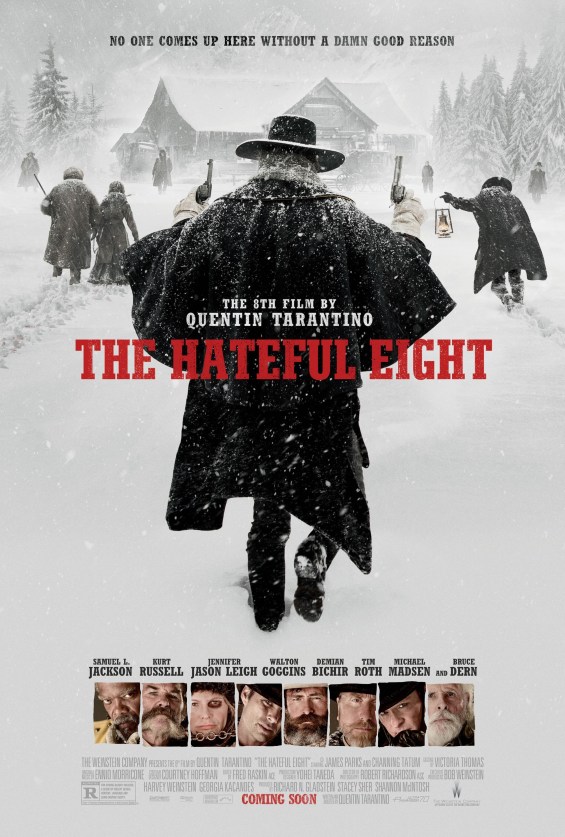
Written and directed by legendary filmmaker Quentin Tarantino (Reservoir Dogs, Pulp Fiction, Inglourious Basterds), 2015’s The Hateful Eight is appropriately Tarantino’s eighth cinematic masterwork and his second western following Django: Unchained in 2012. Loaded with astounding performances, captivating dialogue and a story that seems to fly by even with a runtime of almost three hours, The Hateful Eight is a suspenseful and darkly comedic flick where every character is shrouded in mystery and distrust. And, whilst not quite as iconic or as influential as some of Tarantino’s other work, I feel the film is rather underrated when it comes to his esteemed catalogue of entertainingly violent projects, standing firm as a gripping mystery-thriller with a wintry western backdrop.

Plot Summary: While heading toward the town of Red Rock in post-Civil War Wyoming, bounty hunter John ‘The Hangman’ Ruth and his fugitive prisoner, Daisy Domergue, come upon another bounty hunter and a drifter claiming to be Red Rock’s newest sheriff. Despite their distrust for one another, the group travels to a nearby stagecoach stopover, seeking shelter from an approaching blizzard. Greeted there by four other nomads, their shared scepticism reaches its peak as the weary travellers realise they may not reach their destination

From beginning to end, The Hateful Eight is oozing with tension and Tarantino’s signature style of filmmaking, quickly proving itself to be just as enjoyable as his many other critically acclaimed projects. The story itself bears many similarities to the sci-fi-horror; The Thing (1982), as both stories take place in an isolated location, concentrating on a collection of rugged characters who doubt each others’ intentions. Additionally, both films retain an atmosphere of dread and mistrust that builds almost imperceptibly, concluding with a thrilling climax. Of course, dissimilar to the 1980s classic, The Hateful Eight doesn’t feature an extraterrestrial creature mimicking its victims. Instead, much of the characters’ distrust comes from their varying beliefs and sinful histories, especially since Tarantino doesn’t play it safe in regard to the many racist sentiments that populated America during the post-Civil War era.

With two bounty hunters, a fugitive prisoner, a drifter who claims to be the newest sheriff of the small town of Red Rock, Bob “The Mexican,” enthusiastic hangman Oswaldo Mobray, lonesome cowpoke Joe Gage and the elderly war general Sandy Smithers, all expertly portrayed by Samuel L. Jackson, Kurt Russell, Jennifer Jason Leigh, Walton Goggins, Demián Bichir, Tim Roth, Michael Madsen and Bruce Dern, The Hateful Eight has no shortage of compelling characters and equally compelling performances. As a result of the characters’ myriad of slow-burning conversations, the film consistently retains a solid level of tension via the characters’ interactions, with Jackson being at his best, whilst Roth warrants merit for his performance as his character Oswaldo delivers a number of comedic moments due to his eccentric British accent and joyful outlook on the justice system.

Aside from the film’s occasional use of slow-motion, which appears corny and needless, nearly all of the visuals throughout The Hateful Eight are spectacular, as the cinematography by Robert Richardson effortlessly captures the seclusion of the setting of a stagecoach stopover caught in a blizzard. Providing a pleasant aesthetic change, not only from Tarantino’s prior western, but the western genre in general, visually differentiating itself as a result of the vast whiteness of the creeping cold just outside the stopover’s wooden doorway. Across many scenes, The Hateful Eight also possesses an almost theatre-like quality, which is an intriguing concept that is taken one step too far, in my opinion, when the story is interrupted by a short ‘interval,’ where Tarantino himself narrates what transpired in the past fifteen minutes after a jump cut, instantly yanking the audience out of the immersion of the narrative.

Known for his many western scores, as well as his arrangements for the previously mentioned sci-fi-horror; The Thing, composer Ennio Morricone similarly backs up many of the film’s suspenseful moments flawlessly through tracks like Overture and Neve. In fact, according to Tarantino, some of Morricone’s compositions for the film are actually unused pieces from the gruesome ’80s masterpiece. As brilliant as the original score is, however, The Hateful Eight conversely makes effective use of audible restraint during many scenes, with the blistering wind of the approaching blizzard pounding the stopover’s walls only escalating the build-up of tension.

On another note, cinephiles familiar with the director’s illustrious filmography will have a field day checking off the countless Tarantino tropes, from the chapter headings to the Red Apple tobacco reference and a final act full of glorious blood and guts. However, one lesser-known tidbit is Tarantino’s continuous collaboration with practical effects artist Greg Nicotero, the effects guru behind the post-apocalyptic television series; The Walking Dead, along with an array of Quentin Tarantino’s other projects, including Kill Bill: Vol. 1 (2003), Inglourious Basterds (2009) and Django: Unchained (2012). Comparable to those flicks, the practical effects throughout The Hateful Eight are brutal and virtually cartoonish in design, lending themselves to some of the film’s most memorable moments.

In summary, The Hateful Eight unsurprisingly offers another well-crafted jewel from Quentin Tarantino, integrating his signature blend of suspense, humour, snappy dialogue and over-the-top ultra-violence, all whilst demonstrating his grip on the filmmaking craft has in no way diminished amidst his many years of operating in the ever-evolving film industry. As such, The Hateful Eight is certainly not one to be missed. Rating: 8/10.

hateful_eight_ver10_xxlg

Rear Window (1954) – Film Review

“We’ve Become a Race of Peeping Toms. What People Ought to Do Is Get Outside Their Own House and Look in for a Change.” – Stella

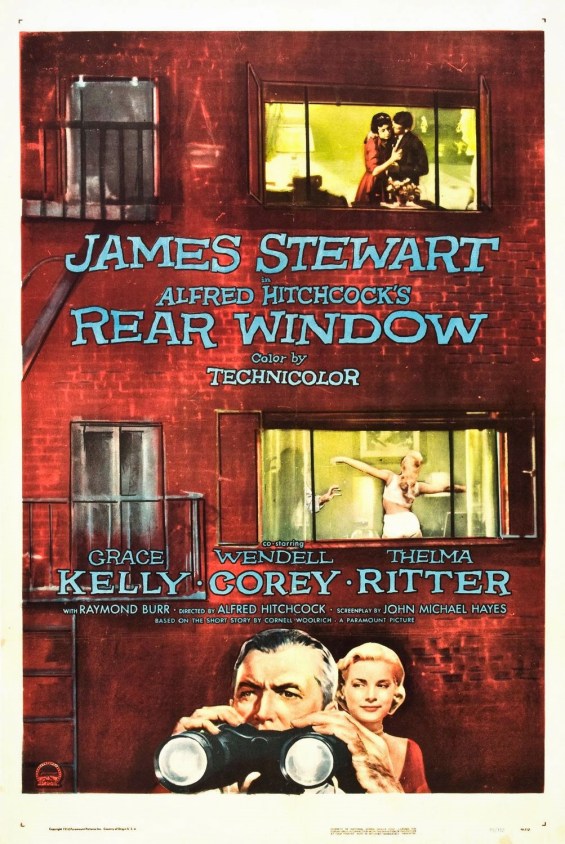
A refined combination of acting, cinematography, editing, blocking and set design, Rear Window, released in 1954, is a mystery-thriller with a terrific premise that brims with suspense and intrigue. Supposedly based (very loosely so) on the short story of the same name by Cornell Woolrich, as well as the details of two grisly real-world murder cases, Rear Window provides a compelling narrative with an extensive amount of visual storytelling, exuding tension throughout its runtime alongside a handful of well-written, amusing characters who are easy to understand and get behind.

Plot Summary: When professional photographer, L.B. ‘Jeff‘ Jefferies, breaks his leg while obtaining a shot at an auto race, he finds himself confined to his New York apartment during a discomfiting heatwave, spending his time peering out of his rear window observing his neighbours. But, when Jefferies begins to suspect that a man across the courtyard may have murdered his wife, he enlists the help of his fashion model girlfriend, Lisa Fremont, to investigate

Helmed by one of cinema’s greatest and most recognisable filmmakers, the late Sir Alfred Hitchcock (VertigoPsychoThe Birds), Rear Window stands as one of Hitchcock’s lesser-known films, despite its still overly positive reception from critics and audiences alike, which I feel is unfair, as the film contains much of the same cultivated and innovative directing Hitchcock was known for. For example, every cast member in the apartments facing Jefferies’ window wore an earpiece through which they could receive directions, allowing for lengthy extracts where Jefferies observes others as their gestures and body language reveal what is occurring in their lives behind closed doors. Furthermore, Hitchcock cleverly uses cuts to imply things about Jefferies’ neighbours and himself. For instance, when Jefferies is discussing his potential future with Lisa, specifically if he should propose to her, we follow his perspective as he observes a newlywed couple before his eyes turn to another apartment where another couple’s marriage has become distant and lifeless. Equivalent to much of Hitchcock’s filmography, Rear Window also possesses underlying themes of voyeurism, repeatedly questioning Jefferies’ actions as he snoops on the private affairs of those around him, valiant intentions or not.

The late central cast of James Stewart, Grace Kelly, Thelma Ritter, Wendell Corey and Raymond Burr are all fantastic. The protagonist, L.B. ‘Jeff‘ Jefferies, is portrayed with such snark and conviction by Stewart, relishing his life of risk, reward and travel with no plans to settle down anytime soon. Equally, Kelly as Lisa Fremont perfectly embodies beauty and elegance in contrast to Jefferies’ ruggedness, yet is still capable in her own right, eager to disprove Jefferies’ assumption that she could never fit into his world, hoping he will someday propose to her. After taking notice of Jefferies’ obsessive behaviour with his neighbour across the courtyard, however, Lisa agrees to put aside their relationship issues to assist in his investigation, along with Jefferies’ transient nurse, Stella, whom Ritter lends an excellent sense of intellect and dry wit via her performance.

Shot entirely on one set, which required months of planning and construction, the apartment courtyard set measured ninety-eight feet wide, one hundred eighty-five feet long and forty feet high, consisting of thirty-one apartments, eight of which were completely furnished. As a result, the cinematography by the late Robert Burks permits an array of creative and distance-spanning shots that move from apartment to apartment with ease, noticeably in the film’s rightly celebrated opening shot, a prolonged and sinuous tracking shot that sweeps across the whole courtyard, spending a moment in each of the six featured apartments before pulling back into Jefferies’ apartment to find him dozing in his wheelchair. Additionally, the lighting throughout Rear Window is remarkable for a film shot in a soundstage, with around one thousand arc lights being used to simulate sunlight. And, thanks to the extensive pre-lighting of the set, the crew could impressively change the lighting from day to night in under forty-five minutes.

Moving from the visuals to the audio, all of the sound in Rear Window is diegetic, meaning that all of the music, speech and other noises come from within the world of the film, excluding the non-diegetic original score heard in the opening scene by the late Franz Waxman, the most prominent piece of which is the orchestral track; Prelude, a jazzy, relatively lively track with a subtle aura of mystery.

On a more cynical note, whilst the foremost characters are well-defined and even have clear character arcs, not all of Jefferies’ neighbours are written equal, with some members of the apartment courtyard, such as the “Hearing Aid Lady” (a nickname given by Jefferies as he doesn’t know her real name), residing in one of the ground-floor apartments, receiving little to no development and only a single prominent action.

In summary, Rear Window is a captivating flick that, while perhaps not as iconic as some of Hitchcock’s other work, is just as delightful. Meticulous, gripping and surprisingly humorous, Rear Window is just one of the many films that hit that mark with Hitchcock at the wheel, employing elements that couldn’t be carried out in any art form other than film. And, true to his eclectic form, Hitchcock switched gears drastically for his next release, the 1955 romantic mystery; To Catch a Thief, proving he could lend his hand to almost any genre in cinema. Rating: 8/10.

rear_window_ver2_xlg

Shadow in the Cloud (2020) – Film Review

“I Saw… I Saw Something Move on the Right Wing…” – Maude Garrett

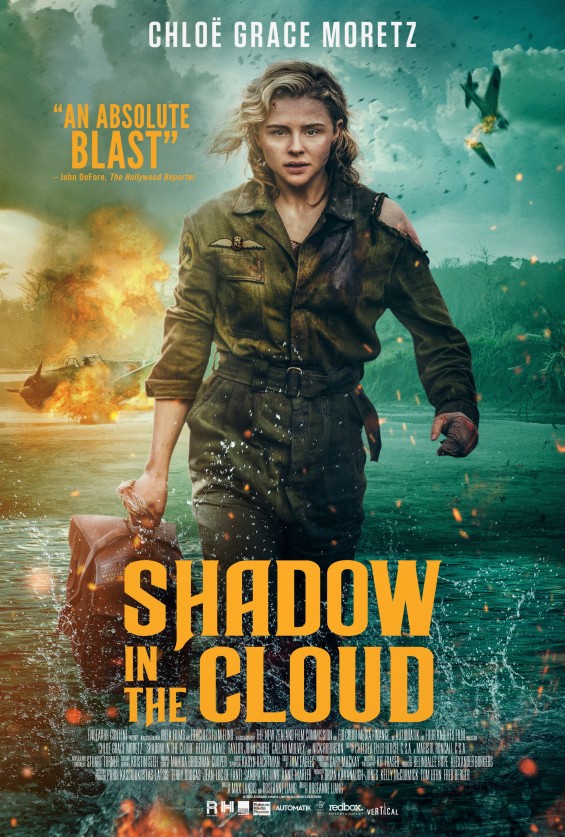
Shadow in the Cloud, released in 2020, is an action-thriller with a remarkably intriguing premise, playing into the fables of the mischievously dangerous creature known as the “Gremlin,’ a folkloric rodent that originated in the 20th century to explain malfunctions with aircraft operations, primarily during World War II. Depictions of these creatures have varied widely over the years, with their most well-known incarnation being in the 1984 horror-comedy classic; Gremlins. Before that film’s release, however, stories regarding the creatures often referenced them as the cause of the inexplicable technical and psychological tribulations many pilots faced during the Second World War, Shadow in the Cloud being one of those stories. Yet, despite this potential, aside from some impressive set design and the earnest attempt by its leading actress, Chloë Grace Moretz, to schlep the film as a ‘one-woman show,’ it’s largely a chore to make it through the entire runtime of Shadow in the Cloud, fleeting though it may be.

Plot Summary: In the throes of World War II, pilot officer, Maude Garrett, joins the all-male crew of the B-17 bomber, the Fool’s Errand, with a top-secret package. Caught off-guard by the presence of a woman on their military flight, the crew tests Maude’s every move. But, before they can enquire further about her assignment, Maude notices something sinister clinging onto the underside of their aircraft…

Co-written and directed by Roseanne Liang (Banana in a NutshellMy Wedding and Other Secrets), the somewhat clunky screenplay for Shadow in the Cloud was originally penned by Max Landis, but was later heavily rewritten during pre-production by Liang due to sexual harassment allegations made against Landis at the time. Liang and Moretz claim that Landis was distanced from the production, with his screenplay being rewritten several times before filming began. But, after watching the film, Landis argued that about 90-95% of the screenplay is still his.

Chloë Grace Moretz undertakes the role of the film’s protagonist, adept pilot, Maude Garrett, or at least, that’s how she introduces herself, as Maude’s true identity and the nature of her assignment is actually a mystery for much of the runtime. Nevertheless, Moretz does a great job carrying the acting load, while Maude receives a serviceable amount of characterisation. The rest of the crew, portrayed by Taylor John Smith, Callan Mulvey, Nick Robinson, Beulah Koale, Byron Coll, Joe Witkowski and Benedict Wall, are well-acted yet lack any real depth or distinct character traits, only serving to hammer home the film’s underlying feminist themes as masculine caricatures. So much so, that as soon as Maude steps aboard the aircraft, she’s immediately met with sexist wisecracks and condescending nicknames.

Given that the majority of the film takes place aboard an aircraft amidst the clouds, it’s understandable that much of Shadow in the Cloud‘s visuals are confined to Maude and the camera crammed into the ball turret on the underside of the aircraft after the crew shove her down there to keep her out of their way during take off. From that point on, almost every shot maintains a steady level of motion to match the constant turbulence of the aircraft in the thick of the vicious storms and enemy fighters that surround it. Simply put, whilst the cinematography by Kit Fraser isn’t anything unprecedented, it is exceptionally accurate to the film’s wavering setting.

However, the same cannot be said for the original score by Mahuia Bridgman Cooper, which is bewilderingly inappropriate for both the narrative and its time period, beginning as a melodious yet out-of-place synthetic score before transitioning into something far more chaotic and tumultuous by the third act, draining away much of the suspense through tracks, like True Stories and Dangerous Feelings. Similarly, the film’s stylistic choice of occasionally cutting away from Maude in the ball turret to see the other crew mates in a blackened space with kaleidoscopic lighting feels at odds with the remainder of the visuals, especially since it obscures much of the aircraft’s detailed set design.

On a more positive note, the film’s opening does feature a nifty animated sequence based on the cartoon shorts of Private Snafu, a series of 1940s adult-oriented instructional videos meant to educate enlisted personnel on army discretion, hygiene, combat readiness and daily life. While the designs of the gremlins in these shorts might appear playful, the design of the actual creature in Shadow in the Cloud leans into a more lifelike approach, admirably constructing a creature that possesses a grey-haired, monkey-like body structure with minor traits of bats and rats. Unfortunately, the visual effects for the creature often do the film more harm than good, as although certain shots of the gremlin are passable, almost all of the shots of Maude on the exterior of the aircraft via green screen look dreadful, likely suffering as a result of a stretched-thin effects budget.

In summary, whilst Shadow in the Cloud bears a fantastic premise, it’s continuously so poorly executed that it becomes difficult to appreciate it, forcing its audience to significantly suspend their disbelief even more than you’d expect for an action-centric creature-feature, frequently coming across as pulpy and overly dramatic. Thus, by the time Shadow in the Cloud trots out historical footage of real servicewomen alongside an inspiring pop song during the end credits, the film has essentially veered into self-parody in spite of the tremendous conviction Moretz conveys in her performance. Rating: 4/10.

shadow_in_the_cloud_ver2_xxlg

Batman: Under the Red Hood (2010) – Film Review

“Those Are the Heads of All of Your Lieutenants, That Took Me Two Hours. You Wanna See What I Get Done in a Whole Evening?” – The Red Hood

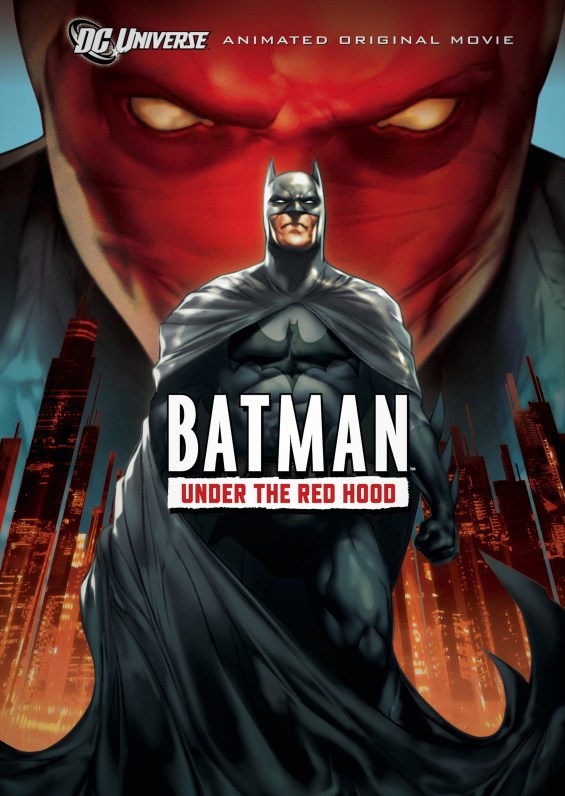
In 1988, the iconic DC Comics storyline; Batman: A Death in the Family, written by Jim Starlin and illustrated by Jim Aparo, was released to a mixture of acclaim and controversy, later becoming the bestselling comic of that year. This particular comic was unique, as readers were encouraged to vote for an ending to the narrative via a pay-per-call service number, deciding to either save or kill Batman’s youthful sidekick, Jason Todd, the second Robin. In the end, over ten thousand votes were cast, with a seventy-two-vote majority choosing to kill Jason, leading to one of the most recognisable comic book panels in literary history. Eventually, however, Jason Todd was brought back as part of a 2005 storyline entitled; Batman: Under the Red Hood, with an animated adaptation following in 2010, employing elements from both storylines to formulate a gripping, swarthy and exhilarating animated flick that examines the Dark Knight’s abiding moral code and its many drawbacks.

Plot Summary: When the mysterious vigilante, Red Hood, emerges in Gotham City, taking the streets by storm with the efficiency and aptitude of Batman without obeying the same moral code of never taking life, the Caped Crusader is forced to go toe-to-toe with the illusive outsider, reopening old wounds as once-buried memories resurface…

For those who haven’t read the source material, I won’t spoil any major plot points of Batman: Under the Red Hood, all I’ll say is that most of the story’s twists and turns won’t come as a shock to those paying attention. Fortunately, this level of predictability doesn’t matter much in the grand scheme, as Batman: Under the Red Hood is at its most compelling when it isn’t focusing on its revelations, but on how the characters endure them, as Red Hood takes Batman’s concept of vigilante justice and pushes it further toward the line between exemplary and immoral, despite his goal of ridding Gotham City of criminal filth being remarkably similar to that of the Cowled One. In fact, compared to many of Batman’s other adversaries, the Red Hood’s objectives are understandable and even somewhat valid, his crooked logic making sense as he asks Batman the formidable questions, forcing him to ask them of himself. Director Brandon Vietti (Superman: DoomsdayScooby-Doo! WrestleMania MysteryBatman: Death in the Family) and writer Judd Winick also seem to understand this, as it’s where the majority of their fixation goes, even if the fleeting runtime is too short to explore some of the film’s underlying themes in greater detail.

For the most part, the central voice cast of Bruce Greenwood, Jensen Ackles, Neil Patrick Harris, Jason Isaacs and Wade Williams portray their characters skillfully, delivering weighty yet not excessively intense vocal performances that embody their esteemed comic book characters, whether heroic or corrupt. For me, the cast has only one weak link, John DiMaggio as the Joker, who, aside from the character’s prominent laugh, doesn’t feel suited to the role, seeming somewhat miscast as he lacks the unvaryingly threatening, psychotic persona of the Clown Prince of Crime.

Visually, while still in line with the typical animation style of the DC Animated Original Movies assemblage, the animation/animated cinematography for Batman: Under the Red Hood is striking and distinctive. From the sharp angles of Batman to the meaty, menacing smile of the Joker, to the gloomy atmosphere of Gotham City with its shady warehouses and towering skyscrapers, usually depicted through enchanting wide shots that exhibit the illuminance of Gotham’s dominating skyline. In many ways, Batman: Under the Red Hood harbours the appearance of a literal animated comic book, rarely exhibiting its age or its undersized animation team.

Perceived as a powerhouse in the realms of both animation and video games, Christopher Drake, the composer for Batman: Under the Red Hood, has previously composed for many DC projects as Warner Bros. Animation frequently entrusts Drake to bolster many of their animated superhero flicks, most notably with projects like the adaptation of the seminal graphic novel; Batman: Year One (2011), as well as Batman: Gotham Knight (2008), Superman/Batman: Public Enemies (2009) and Green Lantern: Emerald Knights (2011). As such, it’s no surprise that Drake also does a terrific job with the original score for Batman: Under the Red Hood, starting the soundtrack off strong with the brooding opening track; Main Title, before supplying the film with further dramatic tracks, all of which seamlessly blend with the crime-ridden metropolis of Gotham City and its shadowy defender.

Intriguingly, Batman: Under the Red Hood was originally intended to be geared towards older audiences, bearing more violence. However, due to the low sales of DC projects in 2009, Warner Bros. Animation ordered the team behind the film to make edits to reduce its brutality and thus, its age rating. Yet, even with these cuts, the myriad of well-executed, easy-to-follow action sequences are thrilling, swift and surprisingly bloody.

In summary, more so than most animated DC projects, Batman: Under the Red Hood truly aims for cinematic storytelling over shallow spectacle and/or vibrance. With its stimulating action sequences, intricate animation and emotional underpinnings, Batman: Under the Red Hood is one of the finest entries in the DC Animated Original Movies catalogue. So much so, that in spite of Warner Bros. Animation continuously overusing the Dark Knight over their many other superheroes and villains, Batman: Under the Red Hood still manages to reveal a largely unexplored side of the celebrated character. Rating: high 7/10.

batman_under_the_red_hood-p527654

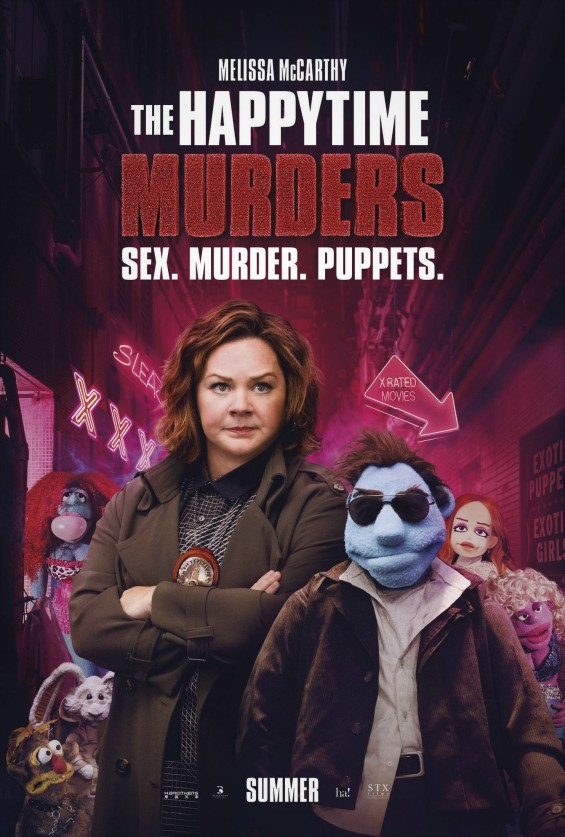
The Happytime Murders (2018) – Film Review

“Do You Have the Latest Issue of Puppet Pussy Party?” – Phil Philips

Released in 2018, The Happytime Murders was a long-in-development project from the adult-geared alternative arm of the Jim Henson Company, the famed production company behind The Muppet ShowFraggle RockDinosaurs and many other beloved, family-friendly projects. Yet, unlike those projects, The Happytime Murders squanders its imaginative premise on a witless and raunchy crime-comedy that blindly pushes buttons instead of attempting to tell an entertaining story, to the extent that even under the proficient direction of Brian Henson (The Muppet Christmas CarolMuppet Treasure Island), son of the late Jim Henson, the film never manages to escape its dreadfully lethargic humour or its foreseeable buddy-cop storyline.

Plot Summary: When the cast of a 1990s sitcom is murdered one by one at the hands of a mysterious figure, Phil Philips, once the Los Angeles Police Department’s first puppet police officer, now a weary private investigator, finds himself dragged into the case. But, as the investigation becomes more and more bewildering, Phil is forced to bury the hatchet with his former human partner, Detective Connie Edwards, in order to prevent more past-their-prime puppets from meeting a grisly end…

Curiously, before the film was released, Sesame Workshop, the non-profit organisation behind the cherished children’s television series; Sesame Street, actually tried to sue The Happytime Murders‘ marketing team on account of one of the film’s taglines; “No Sesame. All Street.” Claiming the film tarnished their child-friendly reputation. However, the suit was ultimately rejected. In many ways, this amusing piece of behind-the-scenes drama is more interesting than the actual narrative of The Happytime Murders, which primarily serves as a witty yet predictable detective mystery where Phil and his partner, Connie, are driven to scour for clues across the sunlit, puppet-populated metropolis of Los Angeles, in the hope of exposing the unbeknownst serial killer. Through this investigation, the film makes many attempts at humour, 90% of which falls short as most of the comedy lazily stems from adorable puppets merely cursing or enjoying more adult activities, such as smoking, sex or drinking alcohol. On a more positive note, the film does, at least, feature a few fragments of absorbing world-building, most notably with how puppets are considered second-class citizens compared to humans, hence why so many puppets eventually become addicts, numbing themselves to the misery of their lives, a detail that is clearly intended as underlying (and underdeveloped) social commentary.

As mentioned previously, The Happytime Murders is, at its core, a parody of classic buddy-cop crime-thrillers, with the alcoholic, blue-felt gumshoe, Phil Philips, skillfully portrayed by Bill Barretta, reluctantly pairing up with his abrasive former partner, Detective Connie Edwards, clumsily portrayed by Melissa McCarthy, after his thespian brother gets inexplicably murdered by an individual intent on wiping out the entire cast of the Happytime Gang, a prevalent ’90s sitcom. All of whom were puppets, aside from the token human cast member, Jenny, portrayed by Elizabeth Banks. And thanks to the spectacular puppetry on display, you quickly forget that Phil, one-half of this investigative tandem, is a glorified hand in a sock. Alas, the characterisation isn’t nearly as impressive as beyond some basic character traits and chucklesome one-liners, both members of the central duo lack depth and frequently come across as obnoxious, especially McCarthy. Regrettably, this issue also extends to the under-utilised supporting cast of Maya Rudolph, Leslie David Baker and Joel McHale.

Akin to many other puppeteering projects, all of the elevated sets utilised during production were built so that the puppeteers could stand on the ground and operate the puppets as if they were standing with straight arms. Yet, even with this information in mind, every set that appears on-screen feels like a real, lived-in location. Unfortunately, the rest of the visuals aren’t as remarkable, as the cinematography by Mitchell Amundsen is immensely bland, over-relying on over-lit close-ups and mid-shots that barely enrich the satire or mystery of the narrative.

Relatively tedious and generic, the bass-heavy original score by Christopher Lennert tries to reflect the jazzy scores of ’70s crime-thrillers yet rarely succeeds in forming any truly memorable tracks of its own. Similarly, songs like Sexy and I Know It and Low Rider seem almost arbitrary in their placements within the runtime, usually throwing off the tone of whatever scenes where they are featured.

In regard to the puppets themselves, it’s intriguing to note that a grand total of one hundred and twenty-five puppets were used during the film’s production, with around forty of those puppets being created specifically for the film. As a result, every puppet that emerges from scene to scene is visually unique, retaining its own colour, fabric, style, and personality. Once again, it’s just a shame that the gags and dialogue that emit from each felt character’s mouth are so sluggish, continuously giving off the impression that the film is trying far too hard to be risqué.

In summary, The Happytime Murders is a crime-comedy harbouring far too many lousy jokes, with the genuinely clever gags being few and far between. As such, the only thing that can be declared for certain when it comes to The Happytime Murders is the fact that with its countless scenes of drug-snorting and depraved puppet sex (not to mention an extremely drawn-out ejaculation sequence), it’s worth emphasising that this puppet-led comedy is not one for youngsters. Still, it’s not as if they’re missing out on much. Rating: low 4/10.

happytime_murders_ver2_xxlg

Red Riding Hood (2011) – Film Review

“Full Moon. Lock up Tonight. Better the Wolf Takes the Pig Than You…” – The Reeve

A reinterpretation/modernisation of the centuries-old fairy tale; Little Red Riding Hood; a children’s story centering on a young girl as she encounters the Big Bad Wolf on a journey to visit her grandma. Red Riding Hood, released in 2011, retains the framework of the original story, but not much else, as this reinterpretation aims to be a dark fantasy with elements of romance and gothic horror thrown in. Yet, in almost all of these genres, the film falls flat as a result of its subpar screenplay and direction. That’s not to say that Red Riding Hood doesn’t have any positives, however, as this fantasy flick undoubtedly deserves praise for its outstanding production design and dreary fantasy aesthetic.

Plot Summary: For years, the residents of a remote mountain village have maintained an uneasy truce with a fearsome werewolf by offering the bloodthirsty beast a monthly animal sacrifice. But, when the wolf violates their trust by taking a human life, the village falls into hysteria, prompting the arrival of the famed werewolf hunter, Father Solomon, to assist in their hunt. Meanwhile, Valerie, a beautiful young woman torn between two viable fiancés, begins to suspect that the beast may be someone she knows…

Similar to most European fairy tales, the origins of Little Red Riding Hood lie within the folk tradition of oral storytelling. So, no singular author can be credited for the story’s creation. However, the two most prominent renditions of the fairy tale are proclaimed to have been written by Charles Perrault and the Brothers Grimm in the 17th century. Despite this history, Red Riding Hood seems to largely disregard the various iterations of the fairy tale, to instead take influence from the first instalment of the infamous Twilight series, as the two films share a number of similarities. For example, the opening title sequence where the camera majestically glides over vast snowy landscapes closely resembles the opening title sequence of Twilight. Furthermore, Taylor Lautner, who previously appeared in Twilight, was considered for the role of Peter early in pre-production. Still, these similarities shouldn’t be that surprising, considering that director Catherine Hardwicke (ThirteenLords of DogtownMiss You Already) helmed the first entry in the series in 2008.

In regard to the cast, Amanda Seyfried portrays the titular character of Valerie/Red Riding Hood sufficiently, but her performance is somewhat hindered on account of her placement between Shiloh Fernandez and Max Irons as her love interests, Peter and Henry, whose performances leave a lot to be desired coming across as drab and rather wooden for the majority of their screen-time. As per usual, the highlight of the cast is undoubtedly Gary Oldman as the morally-grey werewolf hunter, Father Solomon. Though Oldman doesn’t get to exhibit immense amounts of emotion (despite his character having a tragic backstory), the veteran actor does stay committed to his detestable character.

Aside from some outlandish CGI and a handful of moments where cast members/props that should seemingly be in focus are not, the cinematography by Mandy Walker is one of the finest components of Red Riding Hood. From the glowing red of Valerie’s hood contrasting against the white snow to the blood-red moon gradually emerging over the village rooftops, Red Riding Hood is a visually stunning fantasy at points. What’s more is that the set, costume and prop design are all exceptional, as every location feels rustic yet fantastical, whilst every costume/prop appears worn and functional. From a design standpoint, even the trees that appear throughout the runtime are visually unique as they harbour cadaverous spikey branches, giving the impression that merely wandering through any of the dense forests surrounding the village could result in a wound and subsequently a trail of blood.

Unsuitable yet well-crafted, the original score by Alex Heffes and Brian Reitzell begins rather promisingly with the track; Towers of the Void, which Reitzell co-wrote with musician, Anthony Gonzalez, of the electronic band; M83. As such, the ominous track contains waves of strings and industrial-sounding electronics, these instruments then persist onto the second track; Kids, where they are accompanied by ghostly vocals and moody synth. Essentially, while not a bad soundtrack, by any means, the score for Red Riding Hood is simply so unfit for a story set in this time period and genre, that it’s difficult to overlook when reviewing the score.

For a significant portion of the runtime, the story of Red Riding Hood unfolds like a mystery, with the human identity of the werewolf being kept a secret to keep the audience guessing. And whilst many suspects are immediately dismissed, the screenplay does a serviceable job of introducing red herrings without seeming overly conspicuous. When the truth is finally revealed, however, the answer as to who is behind the beastly slayings is rather disappointing, especially since the reveal is quickly followed up by an equally disappointing climax and epilogue.

In summary, as far as gloomy retellings of classic fairy tales go, Red Riding Hood is certainly one of them. While Amanda Seyfried and Gary Oldman are magnetic in their respective roles, the unremarkable leading men along with the painfully formulaic screenplay, continuously devalue the beautiful production design and often spectacular visuals. So, whilst it’s possible that the Twilight crowd will find a specific appeal in Red Riding Hood, outside of that devoted fanbase, I doubt many others will. Rating: low 5/10.

red_riding_hood-p509441