Absolutely Anything (2015) – Film Review

“Absolute Power Doesn’t Corrupt, It Just Drives You Bloody Mad!” – Neil Clarke

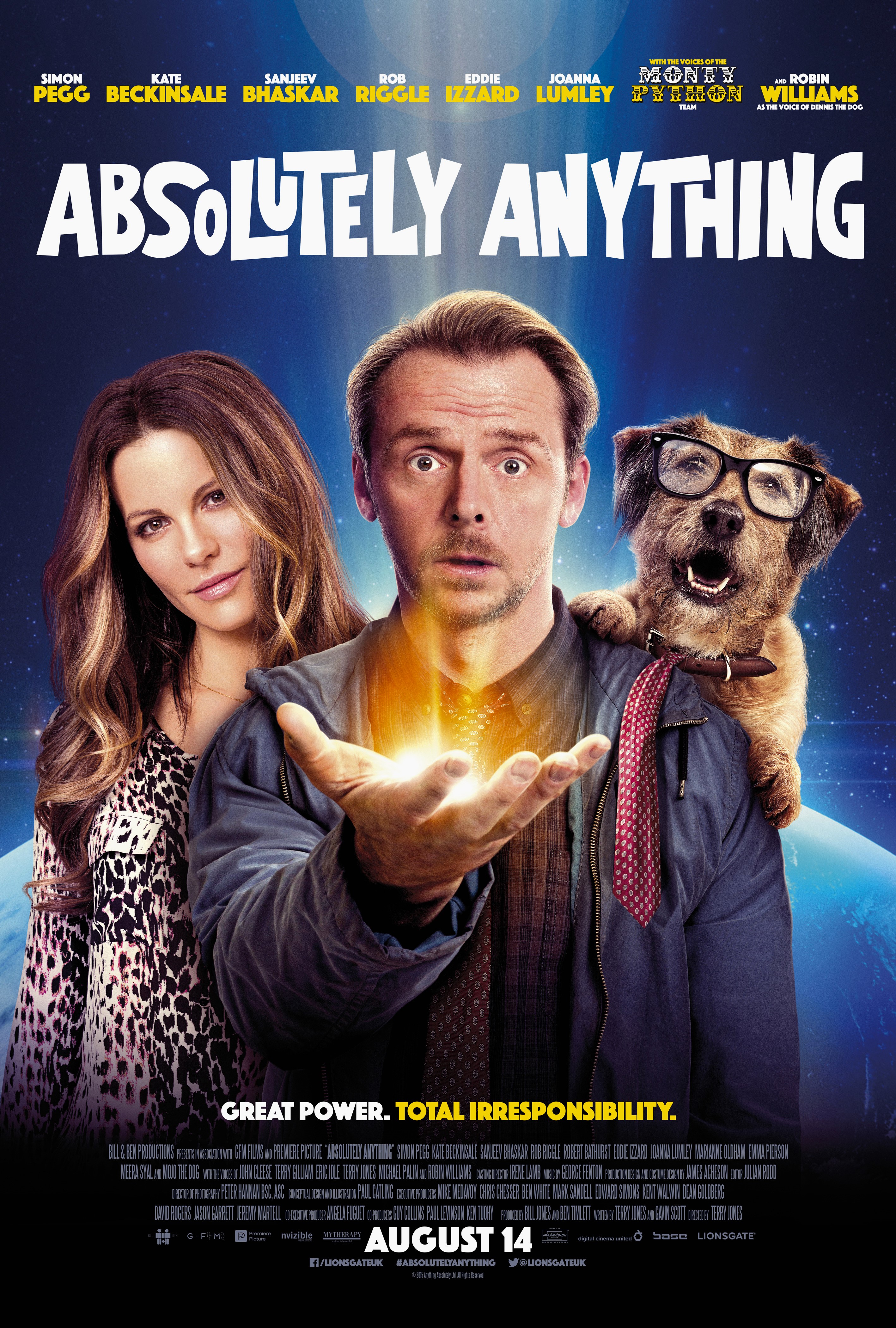
Released in 2015, Absolutely Anything is a zany sci-fi-comedy that explores the age-old fantasy of unlimited wish fulfillment, a concept historically associated with gods, genies and mythical beings. In this instance, however, the power rests in the hands of omnipotent extraterrestrials, who, believing in their superiority, bestow their boundless ability upon a single unsuspecting human. Alas, aside from this inventive alternative, Absolutely Anything misuses its limitless premise and affable lead, Simon Pegg, for a typical rom-com setup, offering mild, light-hearted entertainment over consistent gags, creative visuals or lasting impact.

Plot Summary: As part of an interplanetary experiment, an extraterrestrial council traverse the universe in search of intelligent life. Upon reaching Earth, they initiate their usual test of granting one randomly selected inhabitant the ability to do anything to determine whether humanity is worthy of joining their intergalactic community or should be annihilated. A test that likely spells doom for humanity as the council haphazardly selects Neil Clarke, a washout British school teacher, as their subject…

Co-written and directed by the late Terry Jones (Monty Python and the Holy Grail, Personal Services, The Wind in the Willows), Absolutely Anything draws inspiration from the 1898 short story; The Man Who Could Work Miracles, by H.G. Wells, as both stories centre on an ordinary man suddenly granted reality-altering abilities. However, the leading discrepancy between the two is how Absolutely Anything leans heavily into comedy, delivering a string of farcical scenarios that allow Pegg’s energetic performance to shine. As such, the tone throughout the film remains consistently blithe as the screenplay shies away from any deep philosophical exploration of its central concept or even any long-term consequences to Neil’s actions, as when a situation veers into chaos, Neil merely waves his hand to undo the damage, undercutting any disorder his newfound power might trigger.

As the leading man, Simon Pegg infuses Neil Clarke with an endearing blend of immaturity and dopey charm, rendering the character’s misguided desires and naïve missteps more forgivable. Still, the film undoubtedly misses the opportunity to examine how absolute power might affect the average person, for better or worse. Instead, Neil uses his ability almost entirely for petty or farcical purposes, with one of his more amusing decisions granting his loyal dog, Dennis, the capacity to speak, leading the canine to be energetically voiced by the late Robin Williams. The result is a delightfully giddy sidekick, whose witticisms often relate to the amusing traits of his species. Less enjoyable is the romantic subplot between Neil and his downstairs neighbour Catherine, portrayed by Kate Beckinsale, as despite Neil’s fascination with Catherine being at the core of the story, her character is underwritten and uninteresting, making their relationship (and her inclusion) feel obligatory rather than organic, a criticism that applies to many of the side characters.

Visually, Absolutely Anything is an odd mix of British realism and low-budget science fiction, with the majority of the film shot in and around an abandoned building that was formerly a school, cleverly repurposed to serve as Neil’s flat and the secondary school where he teaches. While these Earthbound settings help ground the otherwise outlandish story in a familiar, everyday backdrop, many of the sets throughout the runtime appear cheap and flavourless, especially when combined with the American sitcom-esque lighting and cinematography by Peter Hannan. The most jarring disparity in the film’s visuals, however, comes with the subpar CG effects, from the splicing of Simon Pegg’s head onto different bodies to the space-bound sequences of the extraterrestrial council debating; the CGI is noticeably lacking, even if the aliens’ designs exhibit visual variety.

Contrarily, the original score by George Fenton brings a whimsical energy to the film, as his compositions underscore the comedic beats with light piano melodies, lively orchestration and plucky strings that reflect Neil’s bemused reactions to his newfangled ability. For example, during the scene where Neil begins experimenting with his powers, commanding a bottle of whiskey to exchange itself only to witness it bouncing down the stairs towards the front door, the accompanying track is fittingly bouncy and eccentric.

Upon its initial release, Absolutely Anything was frequently compared to Bruce Almighty (2003), another male-led comedy about divine empowerment. But, their distinctions are actually quite significant, as Bruce Nolan, the titular character, cannot override free will, whereas Neil can. Moreover, Bruce Almighty centres on a theological framework with God as an active character, whereas Neil’s powers come from extraterrestrials he never encounters, exuberantly voiced by the surviving members of the Monty Python series. In fact, Absolutely Anything notably marks the first on-screen reunion of the Monty Python cast since The Meaning of Life (1983), and, according to Terry Jones, might be their last collaborative outing. There’s also a nod to their comedic legacy during the opening sequence, as the camera pans across space to an orbital scrapyard of discarded spaceships, one of which is from 1979’s Life of Brian.

In summary, Absolutely Anything is a comedy buoyed by its bewitching premise and the charisma of its lead. Yet, it is frustratingly superficial, opting for a low-stakes story, cartoonish gags and rom-com tropes rather than exploring the satirical or existential dimensions its narrative invites. Whilst the film does contain some moments of wit, Absolutely Anything never lives up to the potential promised by its title or the strong comedic talent it harbours. Rating: 4/10.

Monster Trucks (2016) – Film Review

“I Don’t Know Who’s Driving, Him or Me…” – Tripp

Spawned from the mind of the four-year-old son of Adam Goodman, the then-president of the production company behind the film, Paramount, Monster Trucks is a 2016 family flick harbouring flashes of inspiration yet ultimately lacking in execution. Frequently demonstrating that a wacky storyline and a mashup of creatures and clamorous vehicles don’t necessarily yield a rollicking family film, Monster Trucks goes about its narrative with all the grace of an off-road vehicle steamrolling a row of discarded automobiles, even when it faintly echoes the beloved 1982 sci-fi classic; E.T. the Extra-Terrestrial.

Plot Summary: Looking for a way to escape the mundane town he was born into, high school senior Tripp circumvents the discomfort of his home life by toying away in his local scrapyard, gradually assembling a truck of his own from bits and pieces of scrapped vehicles. But, when an accident at a nearby oil-drilling site displaces strange, subterranean creatures with immense strength and a liking for oil, Tripp believes he’s found his key to getting out of town, unaware that his slimy, tentacled friend is actively being pursued…

Initially set for release on May 29th, 2015, before the date was moved to December 25th, then March 18th, 2016, and finally, January 13th, 2017, after several setbacks. Monster Trucks received middling reviews and poor box office numbers upon its eventual release, with Viacom blaming unspecified failures in its motion picture division for the losses the company suffered in the 3rd quarter of 2016, with reporters later piecing together details in their statement, leading them to believe this film was blamed for the loss. While not strictly underserved as Monster Trucks does possess an abundance of flaws across both its screenplay and filmmaking, director Chris Wedge (Ice Age, Robots, Epic) manages to implement some humorous moments and exciting set pieces here and there, primarily whenever the film fully commits to its bonkers title, having the signature creature, nicknamed; Creech, squeeze himself into Tripp’s turquoise-coloured truck, using his multiple tentacles to propel the vehicle along and even leap over hazards across town.

Although the central cast of Lucas Till, Jane Levy, Rob Lowe, Danny Glover and Holt McCallany deliver adequate performances, their characters are either caricatured or underdeveloped, barring the antagonists, who sufficiently serve their purpose as vile, money-hungry suits eager to profit from the newly discovered creatures through whatever means necessary. This character issue is only made worse by the dialogue, the majority of which is cheesy and blatant, lacking any semblance of subtlety or originality, especially concerning the sour relationship between Tripp and Sheriff Rick, his new stepfather, who continually conveys his unjustified distaste for Tripp.

Whether by design or not, the small, pallid town in North Dakota where Monster Trucks takes place is remarkably dull, meaning the visuals suffer as a result, aside from the odd alluring shot of natural scenery. On a more positive note concerning the visuals, the designs of the many luminescent creatures that appear throughout the runtime are simplistic yet effectively cute and cuddly, resembling various aquatic animals, namely whales and octopi. However, it’s important to mention that one of the reasons the film’s release date was pushed back so drastically was the need to redesign the creatures and thus redo most effects shots, as originally, the creatures appeared more monstrous and less cartoonish. But, after a disastrous test screening, which reportedly frightened a large portion of the juvenile audience (despite the creatures’ friendly demeanour), their appearance was altered to the design seen in the final film. With this setback in mind, the CG effects are well-detailed, if imperfect.

Boasting a handful of decent tracks, if you’re searching for a more bass-friendly soundtrack, Monster Trucks‘ original score is weighty yet occasionally a tad overbearing, in addition to a couple of the song choices, like Home by Phillip Phillips, only adding to the corniness of the film due to their unwavering positivity. The sound design is also filled with much of what you’d expect from a story revolving around large vehicles, with booming engines and scrapyard ambience providing many scenes with an audible thump.

Returning to the faults of the screenplay, much of the humour throughout the runtime is immature, often relying on goofy audio effects and continuous slime gags to obtain a cheap laugh from younger audience members. Older audience members, however, may find something to admire in the film’s handful of truck-centric practical effects, such as the implementation of the five 1950s-era Dodge trucks which were built for the film, including one with its engine in the pickup bed so it could be driven from under the hood, similar to how Creech manoeuvres the vehicle.

In summary, Monster Trucks is an underwhelming film in several ways, making me think it might have been better served should it have been a stylistic animated release rather than a costly live-action one, allowing the film to further play into the central, ludicrous concept of subterranean creatures slithering their way into vehicles to experience the high-octane rush of driving across open fields and country roads, especially when considering Chris Wedge’s prior directing experience in that field. Still, I’m obviously not in the target demographic for this flick, and those who are (e.g. young boys with an affinity for monsters and mayhem) might enjoy this one in the face of its many shortcomings. Rating: 3/10.

Underwater (2020) – Film Review

“There’s a Comfort in Cynicism. There Is a Lot Less to Lose.” – Norah Price

Substituting deep space for the deep sea, Underwater is a 2020 sci-fi thriller that takes a hefty amount of inspiration from the illustrious Alien franchise, namely the original 1979 sci-fi-horror classic, with its story centring on a group of survivors navigating a dim, claustrophobic facility submerged deep beneath the ocean’s surface, all while a terrifying, otherworldly force stalks them, picking them off one by one. It’s a familiar format, to be sure, and whilst some will find this type of narrative worn out by this point, I have always enjoyed these sorts of unnerving stories, especially when filmmakers, like director William Eubank (The Signal, Paranormal Activity: Next of Kin, Land of Bad), repeatedly strive to integrate stylish visuals and elements of Lovecraftian horror to suppress the strong sense of déjà vu.

Plot Summary: Operating in the murky depths of the Mariana Trench, the Kepler 822, a research and drilling installation, slowly pushes its way towards the centre of the Earth. But, when a mysterious earthquake extensively damages much of the deep-water facility, mechanical engineer Norah Price, along with a handful of other survivors, band together and take action, faced with the immense task of suiting up and trekking across the ocean floor to safety as something sinister lurks among the facility’s scattered debris…

As a result of the Walt Disney Company’s takeover of 20th Century Fox as part of their acquisition of 21st Century Fox in 2019, Underwater‘s initial release date was drastically pushed back, with production occurring in early 2017. Due to this prolonged release and its skimpy marketing, Underwater was a financial failure, which is unfortunate, as while the film is nothing extraordinary, it is an entertaining flick that keeps up a relentless pace, clocking in at an agreeable nighty-six minutes. Still, it’s indisputable that Underwater wears its inspirations on its sleeve, both to its detriment and otherwise, sometimes appearing overly familiar, primarily through its numerous parallels to the previously mentioned Alien series, beginning straight from the opening scene as the camera slowly pans around the foreboding corridors of the Kepler Station with no dialogue spoken, similar to the opening scene of Alien (1979), where there is likewise no dialogue as the camera pans around the Nostromo, the spacecraft the central characters are aboard.

Evidently inspired by Ellen Ripley through her quick thinking and authority in the face of an unknown threat, Kristen Stewart portrays protagonist Norah Price, who, whilst not incredibly memorable or extensively developed, is given enough characterisation to make her an honourable lead, with Stewart appropriately conveying dread or courage whenever required. Furthermore, the supporting cast of Vincent Cassel, Mamoudou Athie, T.J. Miller, John Gallagher Jr. and Jessica Henwick are terrific, despite many of their characters being archetypes at best and paper-thin cutouts at worst. Yet, in all honesty, in a film such as this, I feel that is all you really need, given that most of the characters serve their purpose in merely portraying walking appetisers for the creatures that are stalking them, showcasing their fearsome capabilities. Additionally, Underwater does a splendid job whenever it delivers exposition, particularly during an early sequence between Norah and her colleague Rodrigo, where the audience is swiftly supplied with everything they need to know.

Presenting the ocean as just as frightening as the vast darkness of space, the cinematography by Bojan Bazelli is stellar for the most part, as Bazelli captures the claustrophobic atmosphere of the Kepler beautifully, supplying every moment with suspense, not only because of the creatures, but the unease induced by the opaque water and crushing pressure attempting to breach the ravaged walls of the facility, a notion amplified by the aquatic colour palette of blues, greys and greens. On top of the camerawork, the design of the creatures is meritorious, clearly taking visual influence from much of H.P. Lovecraft’s work, as well as well-known ocean-dwelling wildlife, such as anglerfish. Regrettably, however, these unsettling creature designs are partially spoilt by the second-rate CGI that perpetually represents them.

For its part, Marco Beltrami and Brandon Roberts’ original score is adept at provoking the asphyxiating claustrophobia one would feel being trapped in an underwater facility via tracks like The Bends, Sprung a Leak and Squid Market, again in a similar vein to the Alien franchise. Furthermore, the sound design throughout the runtime lends itself to the ominous atmosphere, as the submerged facility ceaselessly creaks from the damage it has endured. But, the sound design is undoubtedly at its most effective when heard during the point-of-view sequences from inside Norah’s diving suit.

Intriguingly, for the many underwater sequences, the cast sported heavy, airtight suits, each weighing around 63kg, they were then filmed on dimly lit soundstages utilising volumetric scanning. An interesting bit of trivia that, in my opinion, highlights how much effort was put into this flick outside of its undeniably poor marketing.

In summary, although Underwater is occasionally overly reminiscent (or reliant if you prefer) on renowned films across its primary genres, I don’t believe that means Underwater can’t be admired for what it is, as personally, I’d much rather see an original narrative heavily inspired by a beloved piece of cinema, than a remake or unwarranted sequel of/to one. As such, Underwater is a film that I feel will find a second life on streaming services, as this sci-fi-thriller is a pleasant watch for anyone looking to immerse themselves in some deep-sea storytelling. Rating: 6/10.

underwater_xxlg

The Darkest Hour (2011) – Film Review

“What’s the Dress Code for the End of the World? Jacket, No Tie?” – Sean

Initially intriguing yet ultimately vacuous, 2011’s The Darkest Hour is an apocalyptic blockbuster that will seem like familiar territory for most with its relatively straightforward premise of a group of survivors escaping a hostile, extraterrestrial foe, its only genuinely innovative ideas appearing in the form of its setting; Moscow, and the unique, electricity-based abilities/appearance of its unworldly invaders. Rammed with immensely corny dialogue, uninteresting characters and cheap-looking set design, The Darkest Hour fails on most fronts, leaving its title to ironically reference the fact that the film’s initial release may have been the ‘darkest hour’ for all the careers of those involved in its production.

Plot Summary: When American software developers Sean and Ben travel to Moscow to sell their latest program to investors, their Swedish associate Skyler double-crosses them, forcing them out of the deal. In an attempt to drown their sorrows, the duo head to a nightclub. Until, out of the blue, the Russian population is startled by the appearance of mysterious rays in the sky, soon discovering that the lights are, in actuality, an extraterrestrial force invading Earth and utilising our power supply to eradicate all mankind…

The inclusion of the Russian setting and, by proxy, Russian crew/extras can be attributed to producer Timur Bekmambetov, who after becoming involved in the project, allowed the production to use Moscow as a backdrop instead of the typical U.S. locations, predominantly due to Bekmambetov owning his own production company in the city, known as Bazelevs, where the majority of the film was shot, with the crew consisting of roughly 30% Americans and 70% Russians. In conjunction with director Chris Gorak (Right at Your Door), who ordinarily serves as an art director/production designer on sets, harbouring minimal experience as a director, the duo aimed to make a film that would thrill audiences and feel distinct via its foremost setting, but evidently, they did not achieve this.

The central cast of Emile Hirsch, Max Minghella, Olivia Thirlby, Rachael Taylor and Joel Kinnaman are strong names, but unfortunately, all portray rather simplistic and indistinguishable characters. Fortunately, the audience is provided with a few leads that hint towards the impending extraterrestrial invasion as protagonists Sean and Ben prepare to close the deal for a party-spot program they’ve created, only to find that their alleged business associate, Skyler, has ripped them off, stealing their idea and pushing them out. Supposedly, after putting much time and effort into their project, the pair idiotically did nothing to protect their intellectual property, merely moping around a nightclub until they encounter American traveller, Natalie, her Australian friend Anne, as well as Skyler, whom they shepherd into their group during the initial raid in spite of his earlier betrayal with next-to-no drama.

Shot in 3D as opposed to going through post-conversion. The Darkest Hour‘s production was originally fifty-eight days, with a further eight to nine days being added onto the production schedule once it was decided the film would be shot in 3D. Yet, throughout the runtime, these 3D effects barely register due to so much of the film taking place in dimly-lit environments (frequently depicted by shabby sets), the only real highlight of the 3D effects being the eye-catching opening title sequence. Furthermore, despite The Darkest Hour‘s constant attempts to bombard the audience with disintegrating civilians, handcrafted weapons and adrenalin-fulled chases across deserted, dust-covered streets, many of the film’s action sequences are fairly lacklustre, with the cinematography by Scott Kevan doing little to enhance the cinematic ennui.

From tracks like Northern Lights to Here’s Our Mission and Man Overboard, the film’s orginal score by Tyler Bates is occasionally effective but not all that memorable, often feeling just as gaudy yet creatively uninspired as the visuals, barring the score’s recurring use of bellowing electronic rhythms and propulsive synthesised experiments, serving, in a way, as an audible extension of the eerie, electrical sound design that accompanies the belligerent extraterrestrials.

As mentioned many times, the film’s unusual alien species only ever appear in some form of electrolocation, sensing the electricity in living beings by generating electrical fields. A downside of this ability, however, is that the extraterrestrials cannot see through any type of glass, as the transparent material is a poor conductor of electricity. This fascinating concept is what makes the aliens stand out when compared to invaders from other sci-fi blockbusters, especially since they are protected by electrical shields and can vaporise their victims instantaneously. As such, this imperceptible, seemingly unstoppable force draws the audience in through mystery and uncertainty, eliminating much of the population of Moscow overnight. That said, the extraterrestrial’s unpredictable, electrical abilities do begin to break down the longer the central group of survivors outwit them, given the group should lack any of the skills or knowledge needed to find a way out of their precarious situation. Of course, another minor issue arises in their colour as the aliens take on a glowing golden appearance, whereas electricity, in reality, is colourless.

In summary, The Darkest Hour is a sci-fi blockbuster that falters in its many attempts to propel its audience past their inevitable plot-related questions, the occasional wobbly acting and the easily foreseeable climax. While the film does include a handful of intriguing ideas and excellent electricity-affiliated visuals (alongside a periodic usage of real-world science), The Darkest Hour is obviously not the ‘electrifying’ experience the filmmakers intended it to be. Rating: 3/10.

darkest_hour_ver3_xxlg-transformed

Terminator: Dark Fate (2019) – Film Review

“Come With Me or You’ll Be Dead in Thirty Seconds…” – Grace

After bringing the titular, wise-cracking anti-hero to the silver screen with his 2016 directorial debut; Deadpool, filmmaker Tim Miller lept onto a series with evenly iconic characters, the Terminator franchise. Kicking off with the original sci-fi-action classic in 1984, Miller’s entry in the series; Terminator: Dark Fate, released in 2019, functions as both a sequel to the first two installments and a reboot of the franchise, aiming to breathe new life into this ageing sci-fi saga. Unfortunately, however, Terminator: Dark Fate is an unremarkable, mean-spirited and overly familiar affair, lacking thrilling, fast-paced action sequences and imaginative concepts, all whilst occasionally spitting in the face of the series’ most dedicated fans through its handful of baffling creative decisions.

Plot Summary: Twenty-five years after the elimination of Cyberdyne, the company that would one day create the world-ending network of supercomputers known as Skynet, another seemingly unimportant human, this time car assembly worker, Dani Ramos, is inexplicably targeted by a Terminator from the future as the shapeshifting, nearly indestructible, REV-9, is sent to eliminate her in present-day Mexico City. Luckily for Dani, a fearless protector also arrives from the future, the bionically-enhanced Resistance solider, Grace, along with a custodian from the past, a bitter, armed-to-the-teeth Sarah Connor…

Disappointed and uninvolved with Terminator 3: Rise of the Machines (2003), Terminator Salvation (2009) and Terminator Genisys (2015), producer James Cameron considers Terminator: Dark Fate to be a direct sequel to his projects; The Terminator (1984) and Terminator 2: Judgment Day (1991), remarking that while he was generally supportive of those films due to his close friendship with actor Arnold Schwarzenegger, he jumped at the offer to produce Terminator: Dark Fate, seeing it as an opportunity to oversee his franchise’s future. However, Cameron’s inherently controlling attitude did come with drawbacks as he claimed that, although he was involved in the writing process, he didn’t interfere with Miller’s oversight and never visited the set. Yet, Miller recalls things differently, claiming Cameron stepped in for some uncredited editing, finding his cut somewhat rough and prolonged. Cameron also admitted that he and Miller had their share of disagreements, ultimately leading Miller to state it’s unlikely he would work with Cameron again. These creative differences are noticeable in the final product as there is a shortage of polish in some areas, primarily in the subpar CGI and conversational dialogue, which is often corny and crass.

Blending the original’s cast with fresh faces, the central cast of Linda Hamilton, Arnold Schwarzenegger, Mackenzie Davis and Gabriel Luna all do a serviceable job of portraying their respective characters, regardless of whether they are humans or machines, newcomers or returning legends. That is, excluding Natalia Reyes as Dani Ramos, who frequently fails to believably portray Dani as a fearless and firm figure due to her short stature and rather weak line delivery.

Standing as the only Terminator film where none of the action takes place in Los Angeles, Ken Seng’s cinematography is one of the few positive aspects of Terminator: Dark Fate, as the camerawork is dynamic and favourably supports the numerous action sequences, making extensive use of the latest setting for the sci-fi saga; Mexico City. Alas, the action set pieces aren’t as arresting, lacking the physicality and grittiness of the series’ first two entries, despite the admirable inclusion of their bloody brutality.

The original score by Tom Holkenborg (a.k.a. Junkie XL) is habitually loud and imposing, initiating with the track; Terminated, and continuing with tracks like My Name Is Dani, The Wall and Screaming Turbines, the foremost of which softens the score up via Mexican-style guitars, lending a lighter tone to some scenes. Still, it likely goes without saying that, although adequate, the soundtrack doesn’t hold a candle to the original Terminator score, even if the film attempts to earn nostalgia points by implementing its well-known mix of synth, drums and electronics whenever possible, including the audible motif; “Dun Dun Dun Dun Dun.”

Spoilers ahead in this section for those who wish to go into their viewing blind, but I’m sure many are wondering where the significant character, John Conner, is in all of this. Well, in the opening scene of the film, young John is actually shot dead by a Terminator. Whilst shocking, this moment not only deprives the audience of any screen-time with the fan-favourite character, but also renders the conclusion of the second entry meaningless. Moreover, with Skynet no longer existing, thanks to the events of that film, the screenplay conjures up a ‘new’ antagonist with Legion. This almost indistinguishable, equally hostile A.I. force is just far too similar to what the series has attempted previously to appear innovative, alongside its use of an already comparable narrative structure.

In summary, Terminator: Dark Fate is just as uninspired as its bland sub-title suggests, often feeling like a sequel/reboot made out of obligation than anything else. And, with the franchise’s previous restart attempts in Terminator Salvation and Terminator Genisys, each written to be the first of a trilogy before that idea was scrapped due to a lack of critical and commercial success. Terminator: Dark Fate is yet another series revamp succumbing to a disappointing box office gross and lacklustre reviews, the rough outline written for its two sequels being discarded, leaving the future of the franchise uncertain and, in my opinion, indicating that the Terminator franchise needs to be ‘terminated’ itself, evidently running low on ingenuity and relevance. Rating: 3/10.

terminator_dark_fate_xxlg

Love and Monsters (2020) – Film Review

“I Didn’t Really Have Your Typical Upbringing. I Mean, I Did at First… but Then the World Ended.” – Joel Dawson

Originally titled; Monster Problems, the Netflix Original, Love and Monsters, released in 2020, is a comedic, post-apocalyptic romance filled with plenty of heart, humour, clever world-building and, as its title suggests, gigantic monsters. Despite housing a few blemishes here and there, Love and Monsters covers an abundance of emotional ground throughout its story, standing as an entertaining, monster-filled adventure, the sort of film that delivers wit, excitement and creativity all in generous portions, making for an amusing time during ‘the end of times,’ as it were.

Plot Summary: Seven years after the world-ending event known as the “Monsterpocalypse,” twenty-three-year-old Joel Dawson, along with the rest of humanity, is wearily living underground in a hidden bunker since colossal mutated monsters took control of the surface. But, after reconnecting over the radio with his high school girlfriend, Aimee, who is now eighty miles away at a coastal colony, Joel courageously decides to venture out into the monstrous open-air to find her…

Demonstrating his storytelling capability almost immediately, director Michael Matthews (Five Fingers for Marseilles) artfully lays out the film’s premise during the opening sequence, employing a voiceover from Joel and a variety of animated illustrations made to appear as if they were pencil-sketched by Joel in his notebook. Through this opening, we learn that several years ago, the human race fired a series of rockets into space to destroy an impending asteroid nicknamed; “Agatha 616,” which successfully blew the rock to smithereens. However, this action had consequences, as the chemical compounds used to launch the missiles rained back down to Earth and transformed the cold-blooded wodge of the animal kingdom into mutated monstrosities, forcing the human race to flee underground. From this point on, Love and Monsters continually explores its unique world, building upon the notion of the “Monsterpocalypse” in several ways whilst also taking cues from 2009’s Zombieland by not taking itself too seriously, avoiding the common concern of its post-apocalyptic setting feeling ‘played out.’ Of course, this does mean that Love and Monsters includes a number of tonal shifts, some of which occur rather suddenly, similar to how many of the film’s gags vary in quality.

In terms of characters, the timid, self-deprecating protagonist of Joel Dawson is perfectly cast with Dylan O’Brien, as the screenplay allows the young actor to flex every acting muscle he possesses, toeing the line between weighty and light-hearted scenes through his myriad of interactions with the other survivors of his monster-infested world. For Joel, the world-ending cataclysm was particularly bad timing as he was on a date with his girlfriend Aimee when the pair were separated and shipped to different colonies. While terrified of almost everything at first, Joel eventually pushes himself out of love, serving as a likeable yet dimwitted guide through a world of horrors and devastation, discovering more about himself along the way. In addition to O’Brien, the cast is studded with some great talent, from Jessica Henwick, who manages to make Aimee seem capable and sympathetic in spite of her limited screen-time, to the unlikely pairing of Michael Rooker and Ariana Greenblatt as Clyde and Minnow, two world-weary survivors travelling together after their respective families were killed by undisclosed creatures. Moreover, whilst on his journey, Joel encounters the grieving, intelligent canine, Boy, who is remarkably well-portrayed on-screen by the two Australian kelpies, Hero and Dodge.

Given that much of the film is a voyage across post-apocalyptic America, Love and Monsters is almost episodic in its visual presentation, following Joel as he treks past devastated, overgrown suburbs, corroded fairgrounds and expansive meadows, all of which are wrapped in impressive details like spider-like webbing enfolding the rooftops and trickling egg sacks sprouting on trees. Lachlan Milne’s cinematography and the film’s wonderful production design (considering its modest budget for a premise of this scale) lend themselves brilliantly to this concept with an ample amount of wide shots, thoroughly embracing the strange beauty and vibrant colours of the “Monsterpocalypse.”

Drawing inspiration from the scores of larger-than-life science fiction classics from the 1950s and 1960s, composers Marco Beltrami and Marcus Trumpp provide Love and Monsters with a grand, stimulating and highly vigorous orchestral score. Through tracks such as; Bunker Breach, Wisdom of the Wild, Amiee’s Colony and End Credits, the original score works in tandem with practically all the scenes it can be heard, whether they are stirring or unsettling.

As you’d hope for a monster-centric flick, the titular creatures of Love and Monsters are widely imaginative, with oversized centipedes, frogs, snails and crabs all featured throughout the runtime, all outlandish and intimidating in design, yet still recognisable to their real-world counterparts, brought to life via exquisite practical and CG effects, ultimately leading the film to become an Oscar nominee in 2021’s Best Visual Effects category, alongside Tenet (2021) and The Midnight Sky (2021).

In summary, Love and Monsters is an enjoyable, earnest and comforting flick, packed with splendid creature designs, charming characters and a delightful cast. In many ways, the film is a high school rom-com that just so happens to be set in a post-apocalyptic world, serving as a terrific template for crafting a leaner, less bloated summer flick that virtually all can enjoy. And, for once, with the film leaving things open-ended enough for a sequel, this is the rare scenario where, I’d say, another instalment would actually be welcome. Rating: low 8/10.

love_and_monsters_xlg

Safety Not Guaranteed (2012) – Film Review

“Stormtroopers Don’t Know Anything About Lasers or Time Travel. They’re Blue-Collar Workers.” – Arnau

Inspired by the infamous “Time Travel Companion” advert printed in a 1997 issue of Backwoods Home Magazine and written as a joke/last-minute slot filler by John Silveira, an employee of the magazine, who is actually credited in the film as a “Time Travel Consultant.” 2012’s Safety Not Guaranteed is a beguiling, low-budget comedy-drama with a minimal sci-fi twist, utilising its mirthful real-world inspiration to compose an austere story with relatively modest ambitions and a shortage of memorability that is, thankfully, enriched by its strong performances, quirky charm and heartfelt underlying themes of love, loss and altering the past.

Plot Summary: When an opportunity arises to turn an outrageous magazine advert into an investigative journalism opportunity, pessimistic intern, Darius Britt, jumps at the prospect, joining her superior, Jeff, and fellow intern, Arnau, as they set out to uncover whether the advert’s proprietor, Kenneth, is a deranged misfit or has truly discovered the secret to time travel…

Based on the previously mentioned printed magazine advert, which was even featured on The Tonight Show With Jay Leno in 1992 during the “Headlines” segment before transforming into an internet meme, Safety Not Guaranteed harbours a straightforward yet well-paced narrative, combining its subplots, twists and turns effectively as director Colin Trevorrow (Jurassic WorldThe Book of HenryJurassic World: Dominion) and writer Derek Connolly, waste little time. That’s not to say that the film has no deeper meaning(s), however, as despite the foundation of the story being a question of thought-to-be impossible technology vs. the drab confines of reality, Safety Not Guaranteed features many relevant themes of love in all its forms, as the various characters each have their own outlooks on intimacy and heartache, many of which are preconceived notions, similar to how the characters initially perceive Kenneth to be a delusional, sci-fi-obsessed oddball before becoming acquainted with him.

In regard to the central cast, each actor, whether that be Aubrey Plaza, Mark Duplass, Jake Johnson or Karan Soni, consistently remains within the realm of their character’s traits, emotionally developing whilst remaining true to the heart of their character. As such, Plaza and Duplass are immensely enjoyable to watch as there’s a sweet sadness in the characters’ focus on lost dreams, missed chances and the truism that we all long for a time machine every once in a while, which is best seen in Darius’ backstory as she has become cynical about life since the death of her mother, causing her to flounder, burdened with sorrow and self-blame. Yet, upon her arrival in Ocean View, Washington, she is met with more than meets the eye in Kenneth, a paranoid and suspicious yet affable man. Believing himself to be followed by government agents, Kenneth manoeuvres around town with his interpretation of covert ops, stealing lasers from local laboratories and immersing himself in technical calculations and physical training, all in pursuit of his time-travelling mission. Immediately drawn to each other as divergent outcasts, Kenneth gradually takes Darius into his circle of trust. Interestingly, the role of Darius was actually written with Aubrey Plaza in mind, as Derek Connolly wanted to work with her. Likewise, Jake Johnson was Colin Trevorrow’s first choice for the role of Jeff.

Visually, Safety Not Guaranteed is passable but not all that impressive, as cinematographer Ben Kasulke predominantly relies on hand-held shots in an attempt to personalise the viewing experience, providing the story with a pleasant layer of intimacy. Nevertheless, the film’s use of the drizzling, forest-shrouded location of Ocean Shores (along with a handful of other areas within thirty minutes of Seattle) is terrific, appearing visually interesting yet never overwhelming, specifically whenever a scene takes place at sunrise or sunset.

For a story revolving around time travel, Safety Not Guaranteed has a surprisingly emotional core for what could have easily been a corny low-budget flick. It’s no surprise, then, that its soundtrack, composed by Ryan Miller, helps to capture that same emotional palette, not only accentuating the themes of the film, but adding an aura of reflection and hopefulness that helps to make the film’s eccentric protagonist someone to root for rather than feel sorry for, such as in the foremost track; Opening. Aside from Miller’s original tracks, Safety Not Guaranteed also features songs from numerous indie bands, including Summer Fiction and Guster, making for an all-in-all well-rounded soundtrack.

On the topic of the humour throughout Safety Not Guaranteed, some gags land, others do not, with some scenes also seeming rather bare comedy-wise. However, I applaud the film’s decision to avoid turning Kenneth into a cartoonishly strange character just for the sake of a few cheap laughs, as well as how natural the cast’s witty improvisation feels, particularly in the scene where Jeff advises Arnau to raise his collar and sport sunglasses to look like a “Pilot That Drives Jets.”

In summary, Safety Not Guaranteed is an endearingly zany indie flick. While the film is obviously low-budget and not exceedingly memorable when placed alongside many other light-hearted comedy-dramas, Safety Not Guaranteed possesses a clever screenplay, earnest moments and a genuine sense of sentiment for those who would like to turn back the clock. Not to mention the film’s plethora of excellent performances from its cast (primarily its three leads), ensuring the film will hold up in the future. Rating: 6/10.

safety_not_guaranteed_ver2_xlg-transformed Continue reading

Spy Kids: All the Time in the World (2011) – Film Review

“No One Ever Notices Time, Until It’s Gone…” – Tick Tock

One of the rare releases to incorporate scents into the cinema experience, 2011’s Spy Kids: All the Time in the World is the fourth instalment of the Spy Kids franchise, the well-known family-oriented espionage series created, written and directed by Robert Rodriguez (El MariachiPlanet TerrorAlita: Battle Angel). Once again produced by Double R Productions (then-Troublemaker Studios), Spy Kids: All the Time in the World serves as somewhat of a soft reboot, attempting to appeal to a new generation of aspiring juvenile spies. Unlike the original Spy Kids trilogy, however, Spy Kids: All the Time in the World falls short in nearly every regard as the less-prevalent issues of previous franchise instalments are intensified, plaguing the film with a misbegotten screenplay, awful visual effects and a barrage of scatological humour that suggests the Spy Kids series has truly run its course.

Plot Summary: On the surface, Marissa Wilson is your typical suburban mother, caring for her newborn daughter and step-children, Rebecca and Cecil Wilson, whilst supporting their father, Wilbur Wilson, in his career as a spy-hunting television star. But, in reality, Marissa is a retired spy whose life is turned upside-down when the maniacal Timekeeper threatens to take over the world, thrusting her back into action. Meanwhile, after discovering that their stepmother was once a top agent of the O.S.S., Rebecca and Cecil put their bickering aside to assist her in thwarting the Timekeeper’s sinister scheme…

The conception of Spy Kids: All the Time in the World, unfortunately, did not arise from a place of creativity but, instead, was contractual. As, in truth, Rodriguez didn’t want to make another entry in the Spy Kids franchise, partially because he still blamed producer Harvey Weinstein for the failure of his collaboratively-directed 2007 project; Grindhouse. Nevertheless, Rodriguez contractually owed Weinstein one more film. Unsurprisingly, this lack of ambition for the project can be felt throughout the runtime, as the film largely boils down to an endless string of inferior visuals and potty jokes that sap the charm out of almost every scene. However, that is not to say that the film doesn’t carry any positives, as the film does feature a handful of minor, amusing gags and a few fragments of endearing fan service for those who grew up with the Spy Kids series, including appearances from Carmen and Juni Cortez.

In terms of the cast, Rowan Blanchard, Mason Cook, Jessica Alba, Joel McHale, Jeremy Piven and Ricky Gervais all deliver rather overblown performances, playing up many of their actions/movements to ‘add’ to the humour or aggressively pry for an emotional moment. Regrettably, the characters themselves don’t fare much better, as Marissa and Wilbur Wilson barely make it past their basic traits, while the latest generation of youthful agents, Rebecca and Cecil Wilson, are effectively just duplicates of Carmen and Juni with little individuality. Lastly, there is the mysterious miscreant, the Timekeeper, who, despite his shoddily-designed costume, receives more development than many would expect during the final act. Yet, this growth is somewhat spoilt by his associate, Tick Tock, who is immensely grating as he speaks in a high-pitched voice, uttering time puns to an outrageous extent, like “Time Flies When You’re Having Fun.”

Visually, Spy Kids: All the Time in the World occasionally demonstrates its knack for vibrant, imaginative production design with the facilities and weaponry of the Timekeeper, which seem inspired by the illustrious steampunk aesthetic and the innards of antique clocks. The remainder of the visuals, however, such as the cinematography by Jimmy Lindsey and Robert Rodriguez, are low-grade, with a substantial amount of the CG effects being of matching quality.

Similar to previous instalments in the franchise, the original score by Carl Thiel and Robert Rodriguez is playful and electric guitar-led, integrating the classic Spy Kids theme where it can through tracks like Carmen Cortez and Spy Kids 2.0. As such, the film’s soundscape remains colourful, even if it sometimes becomes too skewed and cartoonish for its own good.

Peculiarly, one of the aspects that Spy Kids: All the Time in the World marketed itself upon was being in “Aroma-Scope,” a gimmick that allowed the film to contain a “4D” in some iterations of its title. In 2011, when audiences watched the film in cinemas, they were provided scratch-and-sniff cards and prompted to scratch them throughout their screening. These cards featured circles numbered one to eight, and at various points, a number would appear in the corner of the screen, indicating it was time to scratch off the corresponding circle. When scratched, the intention was that the card would release a smell related to what was on-screen, like vomit or confectionaries, etc. Yet, whilst this was a fascinating idea, these cards rarely worked as they were made from a similar material to lottery tickets, ensuring little grit and thus no smell.

In summary, while Spy Kids: All the Time in the World falters as a family flick, the film falters even more as a Spy Kids soft reboot/stand-alone sequel. Retaining hardly any of the allure or creativity of earlier entries in the franchise, Spy Kids: All the Time in the World may, at the very least, entertain toddlers through its numerous scenes of vomiting, farting and nose-picking. But, any other audience member will likely sit in frustration, wishing for a well-crafted animated flick instead. Rating: low 3/10.

spy_kids_4_all_the_time_in_the_world-p547361

The Lost World: Jurassic Park (1997) – Film Review

“Oh, Yeah. Oooh, Ahhh, That’s How It Always Starts. Then Later There’s Running and Screaming…” – Dr. Ian Malcolm

Strangely dubbed; The Lost World: Jurassic Park, a title that appears to be out of order in its literary arrangement. This adventurous sequel to the timeless classic; Jurassic Park, released in 1993, was once among the most anticipated films of the 1990s. Yet, upon its initial release in 1997, The Lost World: Jurassic Park disappointed many for not living up to the lofty expectations set by the original, including Spielberg himself, who expressed disappointment with the film after becoming increasingly disenchanted with it during production. Nevertheless, I have always considered The Lost World: Jurassic Park somewhat underrated, harbouring an intriguing story and a more foreboding tone/aesthetic, which offsets some of its screenplay-centric faults.

Plot Summary: Four years after the catastrophe of Jurassic Park, the now-humbled John Hammond, strives to redeem himself by studying the well-being of the dinosaurs roaming free on InGen’s secondary site for bio-engineering, the secluded island of Isla Sorna. While assembling his team for this study, Hammond contacts the reluctant Dr. Ian Malcolm to convince him to join the expedition. Meanwhile, Hammond’s ignorant nephew, Peter Ludlow, intends to use his newly-obtained position as the CEO of InGen to capture as many of the island’s prehistoric species as possible for a new attraction opening in central San Diego…

Similar to the original film, The Lost World: Jurassic Park is loosely based on the novel of the same name by Michael Crichton and helmed by celebrated director Steven Spielberg. So, as is to be expected, under this masterful direction, The Lost World: Jurassic Park boasts several edge-of-your-seat moments, the stand outs of which are a scene that features a Tyrannosaurus Rex tandem bashing a mobile trailer over a cliff, as well as a sequence in which a Tyrannosaurus Rex rampages through San Diego destroying everything in its path, morphing the audience’s perception of dinosaurs from captivating, awe-inspiring creatures to truly terrifying prehistoric beasts, following the incident on Isla Nublar. However, as the runtime continues, it becomes increasingly evident that Spielberg desperately wanted to integrate as many of his own ideas into the framework of Crichton’s sequel novel as he could. A desire that ultimately results in the narrative becoming unfocused, eventually losing itself almost entirely near the end of the second act to concentrate on exciting dinosaur sequences.

Returning from the original film is Jeff Goldblum as Dr. Ian Malcolm, the remarkably entertaining pessimistic mathematician with a dry sense of humour. Accompanying Malcolm this time around is his adolescent daughter, Kelly Curtis, portrayed by Vanessa Lee Chester, and his palaeontologist girlfriend, Sarah Harding, portrayed by Julianne Moore, in addition to the other members of Hammond’s research team; wildlife photographer, Nick Van Owen, portrayed by Vince Vaughn, and tech expert, Eddie Carr, portrayed by Richard Schiff. Whilst every cast member turns in a solid performance, however, there is undoubtedly a lack of well-defined characters in The Lost World: Jurassic Park, as every character has a shortage of development beyond the dexterities they bring to their team. Roland Tembo, portrayed by the late Pete Postlethwaite, is perhaps the most compelling character of this particular entry in the series, being depicted as a jaded big-game hunter, determined to capture a male Tyrannosaurus Rex, single-handedly.

Swapping out the tidied facilities and tropical foliage of Jurassic Park for dim lighting, expansive forests and more intense violence, The Lost World: Jurassic Park‘s visuals are substantially darker than its predecessor, corresponding with the more downbeat tone of the narrative. Furthermore, the cinematography by Janusz Kaminski retains a tremendous sense of movement, while the film’s abundant use of marvellous CG effects, detailed miniatures and impressive life-sized animatronics effectively bring the dinosaurs (and a handful of locations) to life, all whilst demonstrating how far CGI had come since the first instalment in the franchise in ’93.

Once again composed by John Williams, the original score for The Lost World: Jurassic Park only contains minor hints towards the iconic theme and secondary motifs of Jurassic Park. Instead, the score houses much of its own appeal (not too dissimilar to how the visuals differ from the original film) as Williams constructs a different thematic and textural landscape for InGen’s Site B, a.k.a. Isla Sorna. As such, the soundtrack sheds much of the amazement and beauty of John Hammond’s prehistoric theme park for a more ominous soundscape. Excluding the film’s unfairly neglected theme; The Lost World, which is more wildlife adventure-inspired.

On a separate note, whilst its amusing to see franchise-staple dinosaurs like the Tyrannosaurus Rex and the Velociraptors return in The Lost World: Jurassic Park, I’ve always felt its a shame the filmmakers didn’t attempt to introduce a selection of lesser-known dinosaurs, especially with how many fantastic choices there are, as the carnivorous Alioramus, Majungasaurus and Spinosaurus (which would later appear in 2001’s Jurassic Park III), all would’ve served as significant threats and upped the ante for this much-anticipated sequel.

In summary, while it truthfully does pale in comparison to the original film, there is plenty to appreciate about The Lost World: Jurassic Park when viewed from a different perspective, as the film retains an overabundance of spectacle and exceptional visual effects, affirmed by the film’s Academy Award nomination for Best Visual Effects in 1998. Essentially, The Lost World: Jurassic Park is a perfect example of just how difficult it can be to craft an engaging sequel to a beloved cinema-altering blockbuster. Rating: 6/10.

the_lost_world_jurassic_park-p196804

Men in Black: International (2019) – Film Review

“Always Remember: The Universe Has a Way of Leading You to Where You’re Supposed to Be at the Moment You’re Supposed to Be There.” – Agent High T

Emerging several years after the entertaining yet faulty; Men in Black 3Men in Black: International, released in 2019, serves as a soft reboot of the series, aiming to bring the undisclosed extraterrestrial defenders back for another similarly amusing, alien-blasting adventure. However, predominantly due to its outlandish story, trite humour and absurdly horrendous dialogue, Men in Black: International rarely reaches the heights of the 1997 sci-fi-comedy classic, nor the later, lesser entries in the well-known franchise, even with its noteworthy stars of Chris Hemsworth and Tessa Thompson carrying over much of their on-screen chemistry from 2017’s Thor: Ragnarok.

Plot Summary: After sharing an eye-opening encounter with an extraterrestrial as a child, Agent M, the M.I.B.’s newest probationary recruit, finds herself under the wing of Agent H, a past-his-prime hero of the closemouthed organisation, operating at the London branch. Meanwhile, a duo of shape-shifting alien assassins arrive on Earth, seeking a devastating super-weapon that could place the entire galaxy at risk…

Based on The Men in Black comic book series, created and written by Lowell Cunningham, Men in Black: International is the first film in the franchise not directed by Barry Sonnenfeld. Instead, the film was directed by F. Gary Gray (FridayThe NegotiatorStraight Outta Compton), making Men in Black: International the second Gray-directed sequel to a Sonnenfeld flick, the first being; Be Cool in 2005, a sequel to 1995’s Get Shorty. Needless to say, this change in leadership (and screenwriters) could be seen as more of a negative than a positive, as the film lacks much of the disturbing violence and revolting practical effects present in the original trilogy as extensively as the satire. Furthermore, Men in Black: International‘s narrative leaves much to be desired, appearing overly simplistic and somehow equally convoluted, barring a couple of interesting concepts, such as a portal for transporting alien refugees or a mole within the M.I.B. organisation. The film is dragged down further by its ever-present cringey dialogue, which is near vomit-inducing in its many attempts to seem relevant. To its credit, Men in Black: International does, at least, manage to expand the universe of the films by introducing various international branches of the covert organisation, as its title suggests.

With Will Smith and Tommy Lee Jones openly stating they would not return to the franchise for Men in Black: International, new leading actors/actresses had to be chosen. Still, they do appear in the film briefly, having long passed into legend as agents in a dramatised painting in the M.I.B. London head office. Regrettably, however, the revamped cast of Chris Hemsworth, Tessa Thompson, Liam Neeson, Rafe Spall and Rebecca Ferguson are continually overblown in their performances, bouncing from scene to scene with ample energy regardless of tone. This issue is only made worse by the characterisation, which frequently forgets to provide the characters with motivations for their actions or any semblance of depth beyond the basics we learn of them, with Agent H being the foolish, once-hotshot agent of M.I.B. having previously saved Earth from an extraterrestrial invasion, whilst Agent M has desired to be an agent of the organisation since she was young.

Immaculate and radiant yet unimaginative, the cinematography by Stuart Dryburgh shares more of a visual resemblance to superhero blockbusters from the Marvel Cinematic Universe than any previous Men in Black instalment. Likewise, dissimilar to earlier entries in the franchise, Men in Black: International‘s plethora of extraterrestrial designs are dreadfully cartoonish in appearance, lacking the individuality and repulsive naturality of the series’ previous designs, all of which are unfortunately brought to life exclusively via CGI, with very few costumes/prosthetic make-up pieces employed. Having said that, there is one exception to this defect; the designs of the primary antagonists, the Hive, who retain a visually striking design, taking on the appearance of luminous, orange star clusters in a human physique.

In keeping with the rest of the Men in Black series, the original score is composed by Danny Elfman and newby Chris Bacon, who strive to capture the same musical spirit as previous franchise instalments through tracks like Job InterviewHere Comes Trouble and End Credits. And, for the most part, the composers are successful in this goal as the score sounds reminiscent of the original trilogy’s soundtracks while thankfully avoiding any lousy endeavours to modernise the series’ iconic theme.

When it comes to the humour, it’s apparent that there is a hefty deficiency of wit and surprise within the screenplay. As a result, most of the jokes throughout the runtime are either sluggish, irritating or immature. Additionally, during one particular scene, set within a hidden, extraterrestrial-filled nightclub, there is a weirdly out-of-place gag where Agent H attempts to spitefully manipulate Agent M into pleasuring Vungus, a party-hungry alien visiting Earth, which will surely make some audience members feel uncomfortable.

In summary, the mere notion of a Men in Black revival without the presence of Smith or Jones seems like an unmistakably terrible idea, comparable to how another swashbuckling Pirates of the Caribbean sequel without Johnny Depp’s inclusion would seem incomplete, stand-alone story or not. Even with its original cast in attendance, however, Men in Black: International likely still would’ve failed on account of its many other shortcomings, grinding its cast’s chemistry through the gears of a sci-fi franchise running low on reasons to persist. Rating: 3/10.

men_in_black_international-p1107879