The Hole in the Ground (2019) – Film Review

“Something’s Not Right With Him…” – Sarah O’Neill

Ominous and moderately compelling, The Hole in the Ground is a 2019 Irish horror flick that, whilst well-crafted, is overly reliant on many of the conventional aspects of similar horror outings, most notably within thesinister childsubgenre. Still, with the film drawing from notions of Irish folklore, such as the concept of Changelings (children being replaced by fairy folk) and Fairy Forts (the ruins of neolithic tombs scattered across Ireland, thought to be portals to the Otherworld), co-writer and director Lee Cronin (Minutes Past Midnight – Segment: Ghost Train, Evil Dead Rise) does a sufficient enough job with the tools he is provided, even if The Hole in the Ground generally lacks ingenuity.

Plot Summary: To escape her crooked past, single mother Sarah O’Neill travels to the fringes of a rural town in the Irish countryside with her young son, Chris, to start a new life. But, after a disturbing encounter with a local resident, Sarah begins to question things, attempting to uncover if the troubling changes in her little boy are somehow connected to a mysterious crater hidden within the forest that borders their new home

According to Cronin, in addition to Irish folklore, The Hole in the Ground takes inspiration from a news story he once overheard, stating;There Was a Particular News Story I Saw About a Man in Florida Watching TV in His Armchair and a Small Sinkhole Opened Up Beneath Him. He Was Unable to Be Rescued. He Fell Down Into the Earthand I Thought That Was Horrific.Due to this inspiration, The Hole in the Ground, in execution, is less of the spiritual and bloody interpretation of the ‘malevolent child‘ concept as seen in 1976’s The Omen and more of a cross between the 2014 cinematic interpretation of maternal grief, The Babadook, and another Irish horror of changelings and woodland spirits, 2015’s The Hallow, taking a more minimalistic and character-driven approach to much of its horror and violence.

The largely unknown cast of Seána Kerslake, James Quinn Markey, Simone Kirby and Kati Outinen all portray their respective characters with devotion and authenticity, which is particularly impressive in the case of Quinn Markey, given that child acting can often make or break a piece of cinema. Thankfully, although this role requires a lot from the young actor, Quinn Markey delivers, portraying Chris with a menacing aura of otherworldliness. Likewise, Kerslake provides an anchoring performance, portraying Sarah as a struggling mother beginning to question her parental instincts following her implied escape from Chris’ abusive father. An idea that also plays into the underlying themes of the story, as I’m sure Sarah’s uncertainty regarding her parental abilities is surprisingly close to reality for some, with many mothers/fathers sometimes looking at their children only to no longer recognise them as they develop, naturally evolving into a wide-reaching inner fear and scab for the horror genre to pick at. Of course, in this case, Sarah’s suspicions surrounding her son arise from a supernatural mystery that lingers throughout the runtime. Yet, this subtext never threatens to overthrow the story, instead feeding much of the dread that permeates almost every scene.

Alongside the suitably gloomy colour palette, the cinematography by Tom Comerford retains a visually pleasant, gothic-adjacent look, avoiding hand-held shots for the bulk of the runtime. Much of this visual aesthetic can be attributed to the photographs and filmography of American photographer Gregory Crewdson, which served as a primary influence for the camerawork, with Crewdson’s work being known for staging scenes of suburbia for dramatic effect, his surreal images frequently appearing melancholic, offering ambiguous narrative suggestions and blurring the boundaries between fiction and reality, a tremendous creative choice. However, the same cannot be said for the lighting, which, in some scenes, is so dim it becomes difficult to tell what is occurring.

Opening with the sound of a singular piano note and concluding with that same note, which is then repeated to correlate with the story’s motif of something beingduplicated,the original score by Stephen McKeon is fairly audibly engaging, coming across as eerie and dramatic yet never overbearing via tracks, like Main Titles, Run Into the Woods and Mental Health.

Intriguingly, The Hole in the Ground also features several nods to The Shining (1980), including a wallpaper pattern that resembles the famed hexagonal design of the Overlook Hotel’s carpet. Regrettably, however, dissimilar to that iconic flick and many other horrors, the creature design of The Hole in the Ground is rather lacklustre in spite of the detailed costumes that bring the creatures to life, failing to share much likeness with the fascinating folkloric critters that inspired them. Conversely, despite the film’s rather humble budget of roughly £1.5 million, the rarely employed visual effects are surprisingly convincing, like the titular crater, which is presented as foreboding, even though it is merely a muddy, root-laden pit.

In summary, The Hole in the Ground is not an astonishing indie horror, but it is a passable, non-controversial one, a reasonably unnerving, by-the-book horror flick crammed with an array of familiar flavours for those well-acquainted with the genre. Exploiting parental fears where it can and exhibiting splendid filmmaking for the most part, The Hole in the Ground redeems its considerable shortage of originality through its sheer craftsmanship and narrative safety net of Irish folklore, which has previously proven to be a safe bet within the horror genre. Rating: 6/10.

hole_in_the_ground_xxlg

The Hateful Eight (2015) – Film Review

“One of Them Fellas Is Not What He Says He Is…” – John ‘The Hangman’ Ruth

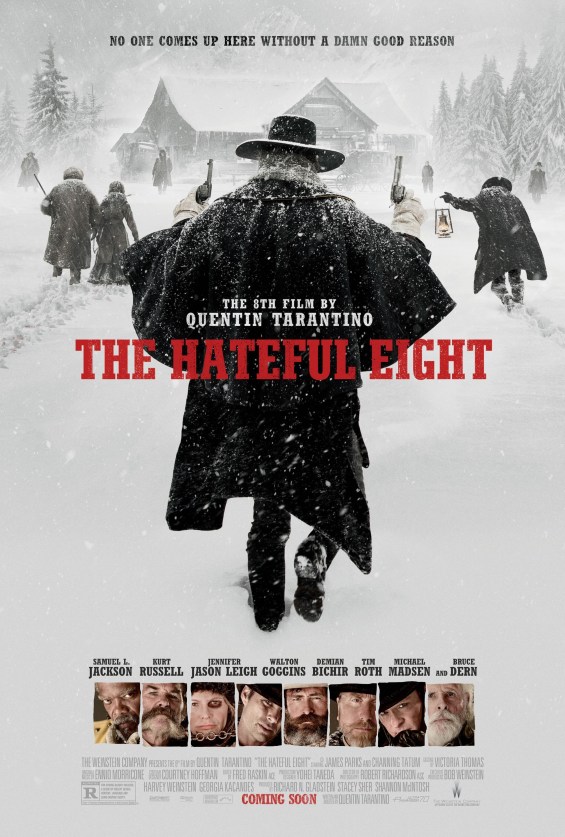
Written and directed by legendary filmmaker Quentin Tarantino (Reservoir Dogs, Pulp Fiction, Inglourious Basterds), 2015’s The Hateful Eight is appropriately Tarantino’s eighth cinematic masterwork and his second western following Django: Unchained in 2012. Loaded with astounding performances, captivating dialogue and a story that seems to fly by even with a runtime of almost three hours, The Hateful Eight is a suspenseful and darkly comedic flick where every character is shrouded in mystery and distrust. And, whilst not quite as iconic or as influential as some of Tarantino’s other work, I feel the film is rather underrated when it comes to his esteemed catalogue of entertainingly violent projects, standing firm as a gripping mystery-thriller with a wintry western backdrop.

Plot Summary: While heading toward the town of Red Rock in post-Civil War Wyoming, bounty hunter John ‘The Hangman’ Ruth and his fugitive prisoner, Daisy Domergue, come upon another bounty hunter and a drifter claiming to be Red Rock’s newest sheriff. Despite their distrust for one another, the group travels to a nearby stagecoach stopover, seeking shelter from an approaching blizzard. Greeted there by four other nomads, their shared scepticism reaches its peak as the weary travellers realise they may not reach their destination

From beginning to end, The Hateful Eight is oozing with tension and Tarantino’s signature style of filmmaking, quickly proving itself to be just as enjoyable as his many other critically acclaimed projects. The story itself bears many similarities to the sci-fi-horror; The Thing (1982), as both stories take place in an isolated location, concentrating on a collection of rugged characters who doubt each others’ intentions. Additionally, both films retain an atmosphere of dread and mistrust that builds almost imperceptibly, concluding with a thrilling climax. Of course, dissimilar to the 1980s classic, The Hateful Eight doesn’t feature an extraterrestrial creature mimicking its victims. Instead, much of the characters’ distrust comes from their varying beliefs and sinful histories, especially since Tarantino doesn’t play it safe in regard to the many racist sentiments that populated America during the post-Civil War era.

With two bounty hunters, a fugitive prisoner, a drifter who claims to be the newest sheriff of the small town of Red Rock, Bob “The Mexican,” enthusiastic hangman Oswaldo Mobray, lonesome cowpoke Joe Gage and the elderly war general Sandy Smithers, all expertly portrayed by Samuel L. Jackson, Kurt Russell, Jennifer Jason Leigh, Walton Goggins, Demián Bichir, Tim Roth, Michael Madsen and Bruce Dern, The Hateful Eight has no shortage of compelling characters and equally compelling performances. As a result of the characters’ myriad of slow-burning conversations, the film consistently retains a solid level of tension via the characters’ interactions, with Jackson being at his best, whilst Roth warrants merit for his performance as his character Oswaldo delivers a number of comedic moments due to his eccentric British accent and joyful outlook on the justice system.

Aside from the film’s occasional use of slow-motion, which appears corny and needless, nearly all of the visuals throughout The Hateful Eight are spectacular, as the cinematography by Robert Richardson effortlessly captures the seclusion of the setting of a stagecoach stopover caught in a blizzard. Providing a pleasant aesthetic change, not only from Tarantino’s prior western, but the western genre in general, visually differentiating itself as a result of the vast whiteness of the creeping cold just outside the stopover’s wooden doorway. Across many scenes, The Hateful Eight also possesses an almost theatre-like quality, which is an intriguing concept that is taken one step too far, in my opinion, when the story is interrupted by a short ‘interval,’ where Tarantino himself narrates what transpired in the past fifteen minutes after a jump cut, instantly yanking the audience out of the immersion of the narrative.

Known for his many western scores, as well as his arrangements for the previously mentioned sci-fi-horror; The Thing, composer Ennio Morricone similarly backs up many of the film’s suspenseful moments flawlessly through tracks like Overture and Neve. In fact, according to Tarantino, some of Morricone’s compositions for the film are actually unused pieces from the gruesome ’80s masterpiece. As brilliant as the original score is, however, The Hateful Eight conversely makes effective use of audible restraint during many scenes, with the blistering wind of the approaching blizzard pounding the stopover’s walls only escalating the build-up of tension.

On another note, cinephiles familiar with the director’s illustrious filmography will have a field day checking off the countless Tarantino tropes, from the chapter headings to the Red Apple tobacco reference and a final act full of glorious blood and guts. However, one lesser-known tidbit is Tarantino’s continuous collaboration with practical effects artist Greg Nicotero, the effects guru behind the post-apocalyptic television series; The Walking Dead, along with an array of Quentin Tarantino’s other projects, including Kill Bill: Vol. 1 (2003), Inglourious Basterds (2009) and Django: Unchained (2012). Comparable to those flicks, the practical effects throughout The Hateful Eight are brutal and virtually cartoonish in design, lending themselves to some of the film’s most memorable moments.

In summary, The Hateful Eight unsurprisingly offers another well-crafted jewel from Quentin Tarantino, integrating his signature blend of suspense, humour, snappy dialogue and over-the-top ultra-violence, all whilst demonstrating his grip on the filmmaking craft has in no way diminished amidst his many years of operating in the ever-evolving film industry. As such, The Hateful Eight is certainly not one to be missed. Rating: 8/10.

hateful_eight_ver10_xxlg

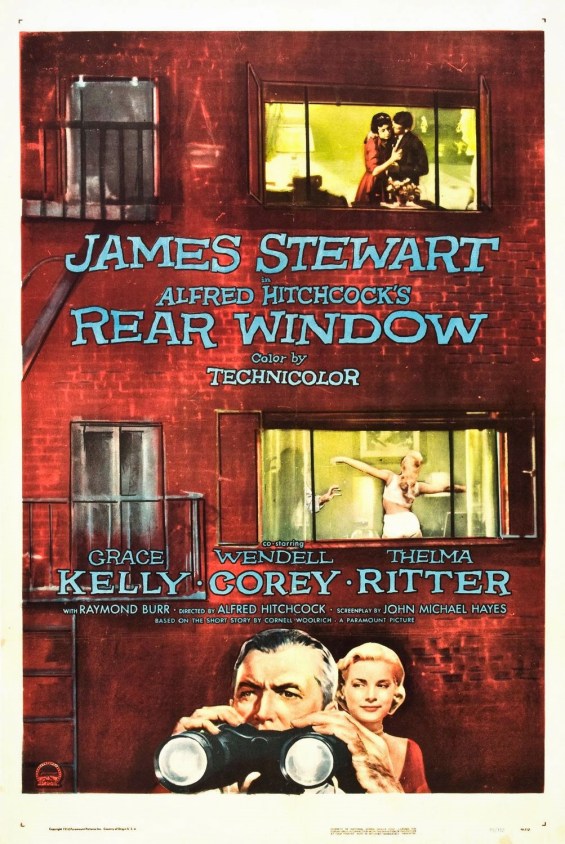
Rear Window (1954) – Film Review

“We’ve Become a Race of Peeping Toms. What People Ought to Do Is Get Outside Their Own House and Look in for a Change.” – Stella

A refined combination of acting, cinematography, editing, blocking and set design, Rear Window, released in 1954, is a mystery-thriller with a terrific premise that brims with suspense and intrigue. Supposedly based (very loosely so) on the short story of the same name by Cornell Woolrich, as well as the details of two grisly real-world murder cases, Rear Window provides a compelling narrative with an extensive amount of visual storytelling, exuding tension throughout its runtime alongside a handful of well-written, amusing characters who are easy to understand and get behind.

Plot Summary: When professional photographer, L.B. ‘Jeff‘ Jefferies, breaks his leg while obtaining a shot at an auto race, he finds himself confined to his New York apartment during a discomfiting heatwave, spending his time peering out of his rear window observing his neighbours. But, when Jefferies begins to suspect that a man across the courtyard may have murdered his wife, he enlists the help of his fashion model girlfriend, Lisa Fremont, to investigate

Helmed by one of cinema’s greatest and most recognisable filmmakers, the late Sir Alfred Hitchcock (VertigoPsychoThe Birds), Rear Window stands as one of Hitchcock’s lesser-known films, despite its still overly positive reception from critics and audiences alike, which I feel is unfair, as the film contains much of the same cultivated and innovative directing Hitchcock was known for. For example, every cast member in the apartments facing Jefferies’ window wore an earpiece through which they could receive directions, allowing for lengthy extracts where Jefferies observes others as their gestures and body language reveal what is occurring in their lives behind closed doors. Furthermore, Hitchcock cleverly uses cuts to imply things about Jefferies’ neighbours and himself. For instance, when Jefferies is discussing his potential future with Lisa, specifically if he should propose to her, we follow his perspective as he observes a newlywed couple before his eyes turn to another apartment where another couple’s marriage has become distant and lifeless. Equivalent to much of Hitchcock’s filmography, Rear Window also possesses underlying themes of voyeurism, repeatedly questioning Jefferies’ actions as he snoops on the private affairs of those around him, valiant intentions or not.

The late central cast of James Stewart, Grace Kelly, Thelma Ritter, Wendell Corey and Raymond Burr are all fantastic. The protagonist, L.B. ‘Jeff‘ Jefferies, is portrayed with such snark and conviction by Stewart, relishing his life of risk, reward and travel with no plans to settle down anytime soon. Equally, Kelly as Lisa Fremont perfectly embodies beauty and elegance in contrast to Jefferies’ ruggedness, yet is still capable in her own right, eager to disprove Jefferies’ assumption that she could never fit into his world, hoping he will someday propose to her. After taking notice of Jefferies’ obsessive behaviour with his neighbour across the courtyard, however, Lisa agrees to put aside their relationship issues to assist in his investigation, along with Jefferies’ transient nurse, Stella, whom Ritter lends an excellent sense of intellect and dry wit via her performance.

Shot entirely on one set, which required months of planning and construction, the apartment courtyard set measured ninety-eight feet wide, one hundred eighty-five feet long and forty feet high, consisting of thirty-one apartments, eight of which were completely furnished. As a result, the cinematography by the late Robert Burks permits an array of creative and distance-spanning shots that move from apartment to apartment with ease, noticeably in the film’s rightly celebrated opening shot, a prolonged and sinuous tracking shot that sweeps across the whole courtyard, spending a moment in each of the six featured apartments before pulling back into Jefferies’ apartment to find him dozing in his wheelchair. Additionally, the lighting throughout Rear Window is remarkable for a film shot in a soundstage, with around one thousand arc lights being used to simulate sunlight. And, thanks to the extensive pre-lighting of the set, the crew could impressively change the lighting from day to night in under forty-five minutes.

Moving from the visuals to the audio, all of the sound in Rear Window is diegetic, meaning that all of the music, speech and other noises come from within the world of the film, excluding the non-diegetic original score heard in the opening scene by the late Franz Waxman, the most prominent piece of which is the orchestral track; Prelude, a jazzy, relatively lively track with a subtle aura of mystery.

On a more cynical note, whilst the foremost characters are well-defined and even have clear character arcs, not all of Jefferies’ neighbours are written equal, with some members of the apartment courtyard, such as the “Hearing Aid Lady” (a nickname given by Jefferies as he doesn’t know her real name), residing in one of the ground-floor apartments, receiving little to no development and only a single prominent action.

In summary, Rear Window is a captivating flick that, while perhaps not as iconic as some of Hitchcock’s other work, is just as delightful. Meticulous, gripping and surprisingly humorous, Rear Window is just one of the many films that hit that mark with Hitchcock at the wheel, employing elements that couldn’t be carried out in any art form other than film. And, true to his eclectic form, Hitchcock switched gears drastically for his next release, the 1955 romantic mystery; To Catch a Thief, proving he could lend his hand to almost any genre in cinema. Rating: 8/10.

rear_window_ver2_xlg

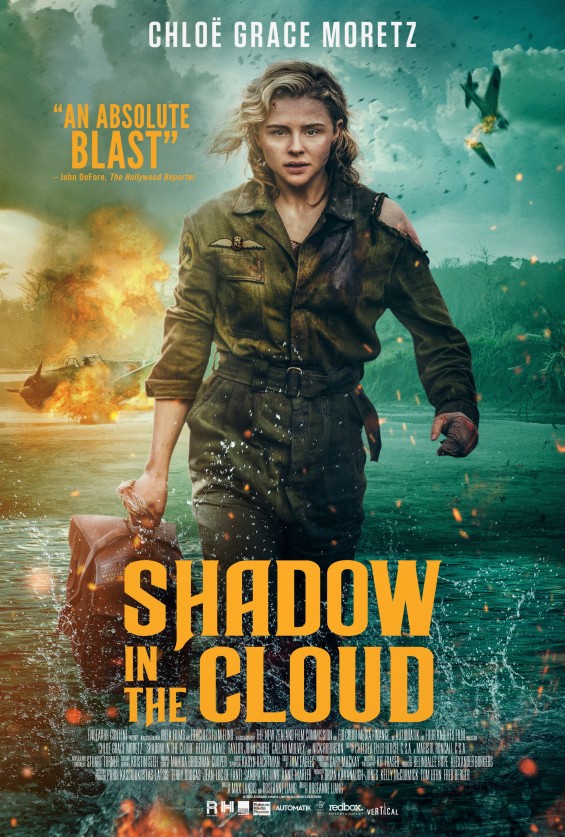
Shadow in the Cloud (2020) – Film Review

“I Saw… I Saw Something Move on the Right Wing…” – Maude Garrett

Shadow in the Cloud, released in 2020, is an action-thriller with a remarkably intriguing premise, playing into the fables of the mischievously dangerous creature known as the “Gremlin,’ a folkloric rodent that originated in the 20th century to explain malfunctions with aircraft operations, primarily during World War II. Depictions of these creatures have varied widely over the years, with their most well-known incarnation being in the 1984 horror-comedy classic; Gremlins. Before that film’s release, however, stories regarding the creatures often referenced them as the cause of the inexplicable technical and psychological tribulations many pilots faced during the Second World War, Shadow in the Cloud being one of those stories. Yet, despite this potential, aside from some impressive set design and the earnest attempt by its leading actress, Chloë Grace Moretz, to schlep the film as a ‘one-woman show,’ it’s largely a chore to make it through the entire runtime of Shadow in the Cloud, fleeting though it may be.

Plot Summary: In the throes of World War II, pilot officer, Maude Garrett, joins the all-male crew of the B-17 bomber, the Fool’s Errand, with a top-secret package. Caught off-guard by the presence of a woman on their military flight, the crew tests Maude’s every move. But, before they can enquire further about her assignment, Maude notices something sinister clinging onto the underside of their aircraft…

Co-written and directed by Roseanne Liang (Banana in a NutshellMy Wedding and Other Secrets), the somewhat clunky screenplay for Shadow in the Cloud was originally penned by Max Landis, but was later heavily rewritten during pre-production by Liang due to sexual harassment allegations made against Landis at the time. Liang and Moretz claim that Landis was distanced from the production, with his screenplay being rewritten several times before filming began. But, after watching the film, Landis argued that about 90-95% of the screenplay is still his.

Chloë Grace Moretz undertakes the role of the film’s protagonist, adept pilot, Maude Garrett, or at least, that’s how she introduces herself, as Maude’s true identity and the nature of her assignment is actually a mystery for much of the runtime. Nevertheless, Moretz does a great job carrying the acting load, while Maude receives a serviceable amount of characterisation. The rest of the crew, portrayed by Taylor John Smith, Callan Mulvey, Nick Robinson, Beulah Koale, Byron Coll, Joe Witkowski and Benedict Wall, are well-acted yet lack any real depth or distinct character traits, only serving to hammer home the film’s underlying feminist themes as masculine caricatures. So much so, that as soon as Maude steps aboard the aircraft, she’s immediately met with sexist wisecracks and condescending nicknames.

Given that the majority of the film takes place aboard an aircraft amidst the clouds, it’s understandable that much of Shadow in the Cloud‘s visuals are confined to Maude and the camera crammed into the ball turret on the underside of the aircraft after the crew shove her down there to keep her out of their way during take off. From that point on, almost every shot maintains a steady level of motion to match the constant turbulence of the aircraft in the thick of the vicious storms and enemy fighters that surround it. Simply put, whilst the cinematography by Kit Fraser isn’t anything unprecedented, it is exceptionally accurate to the film’s wavering setting.

However, the same cannot be said for the original score by Mahuia Bridgman Cooper, which is bewilderingly inappropriate for both the narrative and its time period, beginning as a melodious yet out-of-place synthetic score before transitioning into something far more chaotic and tumultuous by the third act, draining away much of the suspense through tracks, like True Stories and Dangerous Feelings. Similarly, the film’s stylistic choice of occasionally cutting away from Maude in the ball turret to see the other crew mates in a blackened space with kaleidoscopic lighting feels at odds with the remainder of the visuals, especially since it obscures much of the aircraft’s detailed set design.

On a more positive note, the film’s opening does feature a nifty animated sequence based on the cartoon shorts of Private Snafu, a series of 1940s adult-oriented instructional videos meant to educate enlisted personnel on army discretion, hygiene, combat readiness and daily life. While the designs of the gremlins in these shorts might appear playful, the design of the actual creature in Shadow in the Cloud leans into a more lifelike approach, admirably constructing a creature that possesses a grey-haired, monkey-like body structure with minor traits of bats and rats. Unfortunately, the visual effects for the creature often do the film more harm than good, as although certain shots of the gremlin are passable, almost all of the shots of Maude on the exterior of the aircraft via green screen look dreadful, likely suffering as a result of a stretched-thin effects budget.

In summary, whilst Shadow in the Cloud bears a fantastic premise, it’s continuously so poorly executed that it becomes difficult to appreciate it, forcing its audience to significantly suspend their disbelief even more than you’d expect for an action-centric creature-feature, frequently coming across as pulpy and overly dramatic. Thus, by the time Shadow in the Cloud trots out historical footage of real servicewomen alongside an inspiring pop song during the end credits, the film has essentially veered into self-parody in spite of the tremendous conviction Moretz conveys in her performance. Rating: 4/10.

shadow_in_the_cloud_ver2_xxlg

Escape From Tomorrow (2013) – Film Review

“I’m Afraid if I Come With You, Something Bad Is Going to Happen…” – Jim

Written and directed by relatively unknown filmmaker Randy Moore, Escape From Tomorrow, released in 2013, serves as a genre-defying, experimental arthouse flick, which, whilst flawed, has to be admired for both its ambition and ingenuity. Produced on a budget of around £502,000 and illicitly shot at the Walt Disney World Resort in Orlando, Florida, and Disneyland in Anaheim, California, without permission or permits from the Walt Disney Company, Escape From Tomorrow attempts to criticise today’s fascination with “Disney Culture” by mocking the company’s rose-tinted reputation (particularly its string of immersive theme parks) to deliver a conceptually audacious, darkly surreal roller-coaster of a film that morphs a miserable father’s seemingly straightforward excursion to Walt Disney World into an other-worldly tale of paranoia, conspiracy, sex and violence, interspersed between visits to iconic attractions, like Space Mountain, Dumbo the Flying Elephant and It’s a Small World.

Plot Summary: While his family frolics, taking in the sights and sounds of the Walt Disney World Resort, discontented and recently discharged father, Jim, finds himself curiously obsessed with a pair of beautiful teenage girls, subsequently leading him to unveil fiendish forces behind the Happiest Place on Earth…

As a result of Disney’s reputation for being immensely protective of its intellectual property, the cast and crew behind Escape From Tomorrow employed a variety of guerrilla filmmaking techniques to avoid attracting attention within the theme parks, such as saving their screenplays on their smartphones and filming on hand-held cameras similar to those used by visitors. After production wrapped, Randy Moore was so determined to keep the film a secret from Disney (and their lawyers) that he decided to edit the project in South Korea. Rather than suppressing the film, however, the Walt Disney Company merely chose to ignore it, with the 2013 Sundance Film Festival likewise declining to discuss Escape From Tomorrow in detail before it premiered. Those who saw the film expressed strong doubts it would ever be widely released, due to the legal issues involved and its negative depiction of Disney’s theme parks, dubbing it; “The Ultimate Guerrilla Film.” This unfavourable portrayal is most evident during the first act, as the film takes a less ‘magical’ glimpse at the Magic Kingdom, focusing on the strain and exertion of the parents taking their children to the consistently clangorous, overcrowded theme park.

As far as characters go, the film’s protagonist, Jim, portrayed by Roy Abramsohn, is rather unpleasant, heading to the Walt Disney World Resort with his family for a sunlit getaway, only to have his trip tarnished by a call informing him he has lost his job, leading him to drink, neglect his children and even make public advances on his wife, whilst there. These traits are later enhanced when Jim begins to undergo increasingly peculiar hallucinations and perverted sexual daydreams following his spotting of two French teenagers. Still, while the character is unquestionably unlikeable, credit must be given to Abramsohn, whose charismatic performance makes Jim an oddly amiable protagonist (one that you even feel some sympathy for), despite his repeatedly deplorable actions. The supporting cast of Elena Schuber, Katelynn Rodriguez and Jack Dalton aren’t quite as stirring as Jim’s sheepish wife and energetic children, though this could be forgiven, given their limited screen-time and experience.

Utilising a greyscale colour palette to disguise cinematographer Lucas Lee Graham’s occasionally amateurish camerawork and provide the film with an aura of visual cynicism and dream-like surrealism, Escape From Tomorrow, though primarily set in the Magic Kingdom, was partially shot at Disneyland on account of production issues, with the resultant theme park seen on-screen being an amalgamation of the two. These production tribulations are sometimes very noticeable, as it’s especially apparent during the second act that the filmmakers had to use shoddy visual effects, green screen composition and digital stabilisation to rescue some of the sloppier (and potentially improvised) monochrome shots.

Fortunately, the fantastical original score by Abel Korzeniowski flawlessly matches the film’s pessimistic outlook, as tracks like Gates of Tomorrow and Fantasy Girl mimic the cheerful, wonderous tone of the actual melodies employed at the Walt Disney World Resort before the score becomes more unearthly and ominous with somewhat futuristic, 1960s-inspired tracks, like Mystery Man and Lost in Caves.

Playing into many of the urban legends surrounding Disney’s illustrious theme parks, Escape From Tomorrow features many references to online conspiracy theories related to the House of Mouse, one being the mention of a location known as “Base 21,” which refers to a real, little-known V.I.P. lounge located inside the Spaceship Earth attraction at Epcot. This fixation on urban legends again ties into the film’s underlying themes, twisting Disney’s adorable, family-friendly brand into a disturbing, perverse satire that finds macabre in the ordinary, comparable to David Lynch’s uncanny style of filmmaking.

In summary, while Escape From Tomorrow retains an undeniably bold vision, the film is only intermittently successful in execution, lacking well-developed characters or consistently striking visuals in spite of its many thoughtful or freakish moments. Nevertheless, I’d be lying if I said I detest Escape From Tomorrow, as I certainly hold a soft spot for the film. And whilst I know it will not be to all tastes, if you’re willing to look beyond the gimmick of its production, Escape From Tomorrow is a fascinating yet largely forgotten cinematic scrutiny of the Walt Disney Company that ultimately became another urban legend encircling their theme parks. Rating: low 5/10.

escape_from_tomorrow_ver2_xlg-transformed

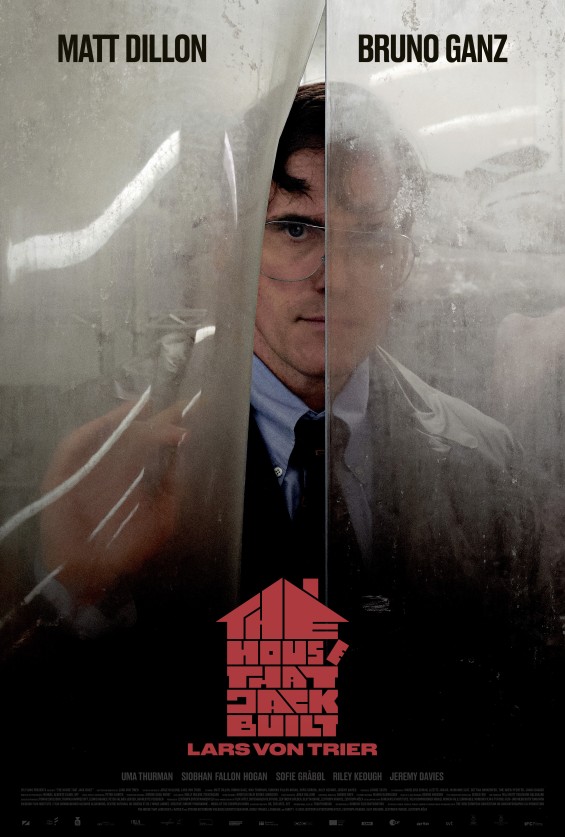
The House That Jack Built (2018) – Film Review

“The Old Cathedrals Often Have Sublime Artworks Hidden Away in the Darkest Corners for Only God to See. The Same Goes for Murder.” – Jack

Whether writing screenplays that contain scenes of self-administered clitorectomies or expressing Nazi sympathy at press conferences, the controversial yet distinguished writer-director Lars von Trier (DogvilleAntichristMelancholia) loves to cause headlines, with shock value frequently being employed as one of his greatest tools, often accentuating the underlying themes of his filmography. The House That Jack Built, released in 2018, is perhaps von Trier’s most distressing film to date, however, presenting the filmmaker at his most unfiltered and uncompromising. As such, for some, the film will serve as a captivating arthouse piece that delves into the layers of a serial killer’s mind, while for others, The House That Jack Built will seem like nothing more than an insensitive, tasteless horror flick brimming with disturbing moments, all in service of a lumpen statement that has been better cinematically expressed elsewhere.

Plot Summary: Reflecting on his existence, Jack, a failed architect and sadistic serial killer, describes his twelve-year reign of terror to Verge, his unseen, enigmatic companion, illuminating the significance of his systematic atrocities by recounting five randomly chosen incidents from his blood-spattered past…

Premiering at the Cannes International Film Festival on May 14th, 2018, The House That Jack Built was reported to have more than a hundred audience members (including some critics) walk out during its premiere, despite a six-minute standing ovation following the screening. Furthermore, some of the resentful audience members condemned the film afterwards on social media for its relentless violence and nihilistic tone. Although I’m usually not one to get offended by media, The House That Jack Built is a film where I can, at least, understand why some take issue with the flick, as the film effectively promotes the idea that life is cruel and soulless, whilst simultaneously playing upon many ‘hot topic’ political assertions, primarily around the American politician, media personality and 45th president of the United States, Donald Trump. This persistent fatalistic outlook, along with its excessive runtime and unsettling violence, ensures that The House That Jack Built harbours minimal appeal for general audiences, even if much of the potentially contentious commentary gets buried beneath the film’s many other aspects.

Boasting about his achievements to an unseen, accented man known as Verge, the titular, obsessive-compulsive engineer, Jack, portrayed by Matt Dillion, appears unhinged yet astute straight from the opening scene, as he circumstantially describes five haphazardly chosen events from his life, all of which involve gruesome murders. From there, the film spends little time on Jack’s upbringing or the circumstances that led him to such a depraved place, but instead concentrates purely on the unconnected series of incidents where Jack slaughters his victims. Through these scenes, you can see Dillon slowly losing himself in the role as he spectacularly portrays Jack as an authentic, twisted psychopath who possesses no redeeming qualities or childhood trauma in an attempt to connect with the audience. Additionally, the supporting cast of Bruno Ganz, Uma Thurman, Siobhan Fallon Hogan and Sofie Gråbøl are all adequate in their various roles, usually as screaming, hapless victims.

A hefty portion of the cinematography by Manuel Alberto Claro, unfortunately, leaves much to be desired as the film is shot in an almost documentary-like fashion, predominantly relying on hand-held close-ups and mid-shots, where characters repeatedly pass in front of the frame, obscuring the audience’s view. As a result, The House That Jack Built has a noticeable deficiency of attractive shots and is continuously dimly lit, causing many scenes to blend together. That being said, the film does include a handful of brief animated sequences that are invariably visually interesting, in addition to an intriguing assemblage of archival footage/images for whenever Jack refers to fortes like architecture or winemaking.

Exceedingly unremarkable, the original score by Víctor Reyes is barely discernable for most of the scenes it’s featured within. Thankfully, the song choices throughout the runtime manage to audibly enhance the film somewhat, as songs like Fame by David Bowie support the story’s implied 1970s time period while classic French overture pieces, such as Partita No. 2 in C Minor, BWV 826 and The Four Seasons – Concerto No. 3 in F Minor, RV 293, heavily contrast with the ghastly violence on-screen, making a few of Jack’s killings seem darkly comedic.

Regarding the film’s graphic violence, I would argue that it could be excused in this case, given the narrative revolves around an unfeeling mass murder, an inherently frightening yet compelling subject matter that has been covered many times before in cinema with a comparable level of violence, most notably in the horror/black comedy classic; American Psycho (2000).

In summary, unlike a few other horror flicks that attempt to dive into the headspace of a serial killer, The House That Jack Built truly pulls no punches, depicting a self-examining, metaphor-heavy story of a man disguising his shortage of worthwhile contribution with violent self-interest. Throughout the film, Lars von Trier essentially grabs the audience’s head and shoves it into a vortex of anguish, unconcerned about whether it will appeal to the masses. For that reason, the film is not one I would recommend lightly, as if not swept up in the interpretative storytelling of The House That Jack Built, this sickening arthouse flick will likely carry the allure of a lengthy therapy session as it lacks the magnetism of some of von Trier’s other work. Rating: 6/10.

the_house_that_jack_built-p1046485

Winnie-the-Pooh: Blood and Honey (2023) – Film Review

“Pooh, You’ve Got to Help Me! Something’s Wrong With Piglet, He Killed My Wife!” – Christopher Robin

Shot in a mere ten days, Winnie-the-Pooh: Blood and Honey, released in 2023, is a British-American-produced micro-budget slasher that takes a more despicable approach to the beloved characters of Winnie-the-Pooh, Piglet and the other inhabitants of the Hundred Acre Wood, morphing the convivial critters into bloodthirsty, savage killers. Unsurprisingly, due to its laughable concept, terrible screenplay, amateurish filmmaking and general lack of any genuine horror or satire, Winnie-the-Pooh: Blood and Honey serves as nothing more than a bargain-basement slasher that fails to exhibit even a passing interest in the source material it’s adapting. As such, the film is only really notable for its title, simply existing as a bizarre, mismatched amalgamation of the horror genre and classic children’s literature.

Plot Summary: When Christopher Robin, now a young man, departs the Hundred Acre Wood to attend university, leaving Winnie-the-Pooh and his furred friends to fend for themselves, their days of merriment and adventure quickly come to an end as they become feral and enraged, soon acquiring a taste for flesh that steers them on a bloody rampage…

The creation of Winnie-the-Pooh: Blood and Honey became feasible at the start of 2022 after the 1926 children’s book; Winnie-the-Pooh by A. A. Milne, entered the public domain in the United States, voiding its copyright, and therefore Disney’s media exclusivity over the titular character. This meant that the filmmakers behind Winnie-the-Pooh: Blood and Honey were free to use characters like Pooh, Piglet and Eeyore, as long as they did not resemble their animated, Disney-owned counterparts, which were still actively protected by copyright. Nevertheless, I feel that most would agree that a malicious interpretation of Milne’s cuddly animal characters is undoubtedly a poorly-conceived concept from the get-go, with the film doing little to prove its critics wrong in this respect throughout the exceptionally brief runtime, even if it is commendable that this is the first live-action adaptation of Winnie-the-Pooh not produced by the Walt Disney Company, as well as the first adaptation geared towards mature audiences.

Regarding the film’s surplus of shortcomings, Winnie-the-Pooh: Blood and Honey‘s most significant issues lie within its screenplay, as the film crams several unwarranted scenes and overly dramatic subplots into a formulaic slasher framework, like having the underwritten protagonist Maria, portrayed by Maria Taylor, be suffering from serve PTSD, following a night where an anonymous sexual deviant broke into her home. These details add little to the narrative and generally come across as screen-time wasters. The rest of the characters, including Christopher Robin, Jessica, Alice, Zoe and Lara, portrayed by Nikolai Leon, Natasha Rose Mills, Amber Doig-Thorne, Danielle Ronald and Natasha Tosini, respectively, are all tremendously underdeveloped, delivering tedious exposition dumps that lead nowhere through performances that frequently present the cast as if they are uncomfortable in their various roles, underselling or overselling their reactions at every turn.

With the exception of the creative opening sequence, which sets the stage for this darker rendition of the honey-hungry yellow bear via pencil-doodled animation, Winnie-the-Pooh: Blood and Honey is a rather shoddy horror flick that lazily relies on its handful of admirable practical effects to avoid attempting anything visually or audibly impressive, as the cinematography by Vince Knight is relatively dull when it isn’t chaotically unstable during chase sequences, whilst the editing haphazardly slaps scenes together without any consideration for continuity or pacing. Furthermore, the film utilises plenty of editing trickery to get around its poor direction, namely, a ludicrous quantity of fade-to-black transitions and an assortment of abysmal CG blood effects.

One of the more mildly charming aspects of Winnie-the-Pooh: Blood and Honey, however, is its original score by Andrew Scott Bell, as tracks like In Which We Are Introduced to Winnie-the-PoohTogether Forever and Silly Old Bear, while generic, are, at least, of a relatively high-quality thanks to Bell’s innovative approach to the whimsical yet eerie score, employing a variety of instruments in the composition of the soundtrack, such as a “Beehiveolin,” a combination of a beehive and a violin.

Interestingly, writer-director Rhys Frake-Waterfield (The Area 51 IncidentThe Killing TreeFirenado) originally wanted Tigger to appear in the film, but the character ultimately didn’t on account of copyright. Some may say this was a favourable outcome, as Winnie-the-Pooh: Blood and Honey evidently doesn’t strive for faithful recreations of the cherished characters of the Hundred Acre Wood. Instead, the film opportunistically coasts on the novelty of placing the loveable critters in a macabre context, bringing the characters to live-action through rubbery, full-face masks that display no hair or visible mouths, allowing for minimal expressions, meaning Pooh and Piglet may as well be murderous individuals sporting animal-themed masks.

In summary, Winnie-the-Pooh: Blood and Honey is exactly what many anticipated it to be following the release of its viral trailer in mid-2022; an atrocious slasher, an appalling adaptation, and an all-around execrable piece of cinema. Still, that’s not to say that Winnie-the-Pooh: Blood and Honey was a commercial failure, as the film actually grossed over £4 million on a budget of around £79,000, despite its near-universally negative reviews. Consequently, this suggests that with many other children’s literary works soon making their way into the public domain, we will regrettably be receiving far more lousy, horror-centric renditions of long-established characters in the near future, with Winnie-the-Pooh: Blood and Honey 2Bambi: The Reckoning and Peter Pan’s Neverland Nightmare, being just some of the projects already announced. Rating: 2/10.

winniethepooh_blood_and_honey_xxlg

The Place Beyond the Pines (2012) – Film Review

“If You Ride Like Lightning, You’re Going to Crash Like Thunder.” – Robin

Successively suspenseful and dramatic, The Place Beyond the Pines, released in 2012, is a thrilling crime-drama recounting a tale of fatherly sins visited by their descendants. Efficiently co-written and directed by Derek Cianfrance (Blue ValentineThe Light Between OceansSound of Metal), The Place Beyond the Pines utilises its decade-spanning story and outstanding performances from its extensive cast to construct a film that succeeds both as a high-stakes crime-thriller, and a far quieter, more empathetic character study of enraged, solitary men, ascertaining Cianfrance’s penchant for bold storytelling and eye for sighting the cast members to carry his stories through to their climax.

Plot Summary: When Luke, a high-wire motorcycle stuntman, passes through Schenectady, New York, as part of a travelling carnival, he reconnects with his former lover, Romina, discovering that, in his absence, she has given birth to their son, Jason. Determined to give his son the upbringing he never had, Luke renounces his life on the road to provide for his new family, taking an underpaid job as a car mechanic before committing a series of bank robberies aided by his exceptional motorcycle skills, eventually placing him on a collision course with the ambitious police officer, Avery Cross…

Unfolding over fifteen years, the actual narrative of The Place Beyond the Pines is undoubtedly one of the film’s finest aspects, disclosing an engaging and dreary tale, all within the confines of Schenectady and its surrounding woodland. The first two acts of the story, which almost feel like distinct ‘chapters,’ are consistently compelling and narratively unpredictable. Unfortunately, however, the strengths of the first two acts are diluted in the somewhat meandering third act, which is admittedly weaker than those that precede it, concluding the story with something of an anticlimax. Nevertheless, it is a uniquely structured plot, conforming to the notion of generational sins.

In the first act, the story revolves around the travails of Luke, portrayed by Ryan Gosling, a heavily-tattooed motorcycle stuntman living a freeing life on the road before he learns his former lover, Romina, portrayed by Eva Mendes, has given birth to their son. Given something to care about in his life, Luke decides to abandon his trivial lifestyle to become a suitable father figure, plunging into a dead-end job before taking a friend’s suggestion to rob banks. From here, Luke rides the line between logical and immoral, performing vile acts in the hope of earning money to fuel better ones, making for an instantly compelling character as Gosling suitably delivers a nuanced, moody performance riddled with pathos. Likewise, Avery Cross, excellently portrayed by Bradley Cooper, is a captivating protagonist in the second act. Serving as one of the police officers tasked with finding Luke, Avery is a well-educated officer keen to prove himself and move up the ranks of law enforcement. But, as his time in the force grows, Avery begins to see the deep level of corruption within his department, conveying underlying social commentary that is even more relevant today. Lastly, in the third act, the narrative switches focus to the sons of Luke and Avery, Jason and AJ, portrayed by Dane DeHaan and Emory Cohen, respectively, fifteen years after the previous acts. And despite DeHaan and Cohen delivering admirable performances as both characters inherit some of their father’s traits, this act and its protagonists are less gripping than the previous two, as previously mentioned.

When it comes to the visuals, the cinematography of The Place Beyond the Pines is largely dominated by hand-held shots. Fortunately, these shots are considerably less distracting (and motion sickness-inducing) than many other flicks where this style of camerawork is employed. However, Sean Bobbitt’s cinematography is undoubtedly at its most effective in one particularly exhilarating chase sequence, seemingly accomplished in one unbroken take as it’s shot entirely through the window screen of a police car pursuing Luke on his motorcycle.

In spite of the many moments of violence and tension, the original score by Mike Patton is unexpectedly soothing. Patton, who is most known as the lead singer of the alternative metal band, Faith No More, made his debut composing for film with the action sequel; Crank: High Voltage, in 2009, The Place Beyond the Pines being his third score, and easily his most impressive to date. A combination of electronic tones, electric and acoustic guitar accents and a sampled choir, the soundtrack retains many beautiful tracks, the most notable being; The Snow Angel, a lonesome piano-led motif that is only heard once during the runtime yet is exceptionally memorable, even appearing in one of the film’s trailers.

Intriguingly, Derek Cianfrance claims that his financier would only provide him with the budget he desired if he reduced the one hundred-and-fifty-eight-page screenplay to one hundred and ninety pages. Without removing anything, Cianfrance sneakily used a smaller font and extended the margins, which I’m thankful for as, in my opinion, virtually every scene throughout The Place Beyond the Pines is important.

In summary, in trying to convey such a monumental amount of story, The Place Beyond the Pines does sometimes spread itself too thin and leave some strands incomplete, but when the film is at its best, it is an enthralling and well-written piece of storytelling. And while its underlying themes are weighty, Derek Cianfrance’s strong direction and surprisingly effective use of hand-held camerawork result in a disquieting style that snappily underplays the drama and uncertainty. Rating: low 8/10.

place_beyond_the_pines_xxlg (1)

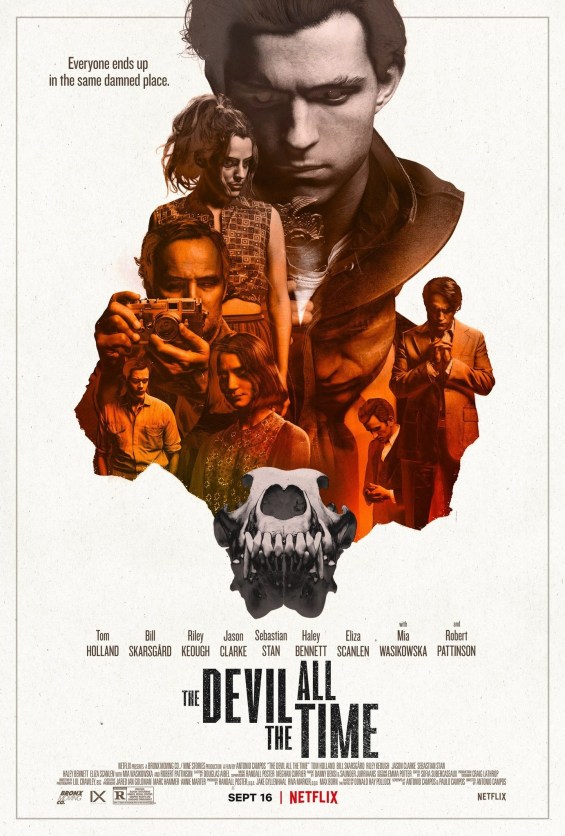
The Devil All the Time (2020) – Film Review

“Blessed Are Those That Hunger and Thirst for Righteousness.” – Reverend Preston Teagardin

A gripping yet troubling exposé of a period in history that frequently appears overly sanitised, 2020’s The Devil All the Time is a superb Netflix Original that utilises its relentlessly grim narrative, stellar all-star cast and period-accurate song choices to explore an underused setting in cinema; Southern Ohio in the 1950s. And, as a result, the film crafts an engaging and thought-provoking tale of backwoods preachers, religious zealots and broken, weathered souls witnessing the atrocities of a post-war world, replenished with sins that even faith is unable to wash away.

Plot Summary: In 1950s-era rural Southern Ohio, an assortment of crooked and sinister individuals intersect paths in the Midwestern town of Knockemstiff, a rustic, sparsely-populated cesspool teeming with corruption and brutality…

Co-written and directed by Antonio Campos (Buy It NowSimon KillerChristine), the screenplay for The Devil All the Time was adapted from the novel of the same name by Donald Ray Pollock, who, interestingly, actually performed the narration for the film, making the role his first-ever narrating position as he avoided performing the voiceover work for his own audiobooks. Similar to the original novel, a large majority of the story revolves around the real-life town of Knockemstiff, Ohio. Here, the non-linear narrative, which examines the violent vestiges of religious iconography, thrusts an array of devilish characters to encounter one another through differing scenarios, often resulting in horrific outcomes. In particular, the opening three arcs produce a distressing first act where death is seemingly always lurking around the corner. However, while most of the characters and their individual storylines are captivating, certain characters (and their continually fiendish actions) can appear somewhat underdeveloped due to a lack of screen-time, along with a few narrative details, namely, the subplot of Deputy Lee Bodecker accepting payments as a corrupt officer, not falling into place.

Regarding one of the finest aspects of the film, the central cast of Tom Holland, Robert Pattinson, Harry Melling, Bill Skarsgård and Sebastian Stan (among many others) are all exceptional in their various roles, with most of the cast’s accents seeming flawless, barring Holland and Pattinson’s accents, which come across as inconsistent and wildly over-the-top, respectively. The cast’s performances are only enriched by their usually well-written characters, however, as their unanswered prayers seem to eventually lead each of them to turmoil as they exist at a bleak point in history where treatments for diseases were scarce and a devastating World War had just wiped out millions, rendering religion to serve as the only recourse for most. What makes the characters more intriguing is that The Devil All the Time is also a multigenerational tale, beginning with the semi-protagonist, Arvin Russell, as a youngster before concluding the story with Arvin as an adult in his early twenties, all the while propelling Arvin and his step-sister, Lenora, to reckon with the ghosts of their parents’ past. That is not to say that any character is represented as exemplary, though, as during the final act, the primarily benevolent Arvin exercises his father’s vengeful tactics for a satisfyingly violent payoff.

In a rather bothersome decision, The Devil All the Time repeatedly feels compelled to remind the audience of earlier sequences in the story that mirror later moments. Yet, most of the time, these flickers of earlier scenes in the film are thoroughly unnecessary and quickly begin to grate on the audience. Aside from this annoyance, the editing and cinematography by Lol Crawley are serviceable, continually being enhanced by the terrific set design and set dressing, which makes every inch of the rundown town of Knockemstiff appear worn and ripe with religious imagery.

Alongside the original score by Danny Bensi and Saunder Jurriaans, which remains nuanced and unpretentious whilst still adding to the cruelty and suspense on-screen at many points, The Devil All the Time employs an extensive selection of traditional gospel tunes and ’50s-era songs, such as Washed in the BloodThe Three Bells and Honeycomb, all beneficially playing into the setting and underlying religious themes of the story with some of the more upbeat songs even prompting certain scenes to develop a moderately satirical tone.

Returning to the visuals, momentarily, crucifixion is a recurring image throughout the runtime, relating to the film’s central underlying theme of the conflict between belief and the horrors of the real world. For example, in the first act, Willard Russell discovers a bloodied, fly-infested serviceman crucified during his deployment on the Solomon Islands during World War II. This image changes the once godly soldier to a religiously apathetic, but more importantly, makes it apparent how closely savagery and sacrifice are exemplified through the image of Jesus Christ tortured on the cross. Later in the film, there is also a painting of Jesus Christ on the cross hanging on the wall in Arvin’s room, reminding the audience of this subtext.

In summary, whilst The Devil All the Time‘s ruthlessly pessimistic narrative can occasionally be harrowing to the point of punishment, much of the dour storytelling is offset by the strong work from the outstanding cast, whose performances are often so compelling they even redeem the rather conventional style of filmmaking the film adopts, which is unlikely to leave any audience member in awe. Still, The Devil All the Time is an effective, religion-centred thriller. Rating: 7/10.

devil_all_the_time_ver2_xxlg

Deepwater Horizon (2016) – Film Review

“I’d Think You Money-Hungry Sons of Bitches Would at Least Be Good at Math…” – Mike Williams

The Deepwater Horizon Oil Spill, commonly referred to as the BP Oil Spill, is, to this day, regarded as one of the widest-reaching environmental disasters in human history. An industrial catastrophe that began on April 20th, 2010, off the coast of the United States in the Gulf of Mexico, the event caused the deaths of eleven oilfield workers and was estimated to have spilt over two hundred and ten million gallons of oil into the ocean, forcing industry giant BP to pay more than $60 billion in criminal and civil penalties, natural resource damages, economic claims and cleanup costs for their reckless corporate culture of cost-cutting and excessive risk-taking. The 2016 cinematic interpretation of this true-to-life tale; Deepwater Horizon, makes effective use of its titular location and subsequent tragedy to deliver a lamentable yet nevertheless gripping thriller, admiring the bravery of those who escaped with their lives whilst never losing sight of the affliction and distress they endured on that faithful day.

Plot Summary: Manned by one hundred and twenty-six workers, the semi-submersible, offshore oil-drilling rig, Deepwater Horizon, operates as usual over the Gulf of Mexico, forty-one miles southeast of the Louisiana Coast. But, before long, chief electronics technician, Mike Williams, and seasoned rig supervisor, Jimmy Harrell, discover that the critical examination of Deepwater Horizon’s cement foundation was bypassed by BP’s frugal executives, consequently inducing a devastating explosion that kills several oilfield workers and traps Mike and his remaining colleagues on the cadaverous rig amidst the flames…

Upon its announcement, many oilfield workers from the Gulf of Mexico were against the production of Deepwater Horizon, declaring that they believed the film would dishonour the men who sadly perished during the event. However, Mike Williams (one of the survivors) thoroughly supported the film, assisting the crew throughout production alongside another survivor, as they felt it was a suitable method of depicting the terrifying circumstances they and the other oilfield workers endured, with the leading intent of director Peter Berg (HancockLone SurvivorPatriots Day) being to make the disaster feel as real as possible for the audience, encapsulating the sensation of workers’ shared dread in 2010.

In keeping with this sense of realism, the dialogue throughout Deepwater Horizon remains authentic to the vocabulary of oilfield workers, repeatedly tossing around the shorthand terminology of the position. Similarly, the screenplay is precise in defining the various components of the oil rig without becoming overwhelmed, making the eventual catastrophe that unfolds appear merited and tangible. Regrettably, however, even with most of the central cast, including Mark Wahlberg, Kurt Russell and Gina Rodriguez, being introduced before they set foot on the rig through an assortment of brief, home-set sequences, the majority of these preliminary scenes only provide insight into their industrial roles along with some clumsy exposition concerning the Deepwater Horizon, conveying that each of the oilfield workers has loved ones, but not much else.

For the production of Deepwater Horizon, an extensive oil rig set was constructed in Chalmette, Louisiana (where filming predominantly took place). One of the largest-scale sets ever built at the time, the rig-inspired set was assembled using over three million pounds of steel in a two-million-gallon water tank. And while this commitment to building an expansive set is indeed impressive, appearing immensely accurate to the actual Deepwater Horizon, the set design is partially hindered by the cinematography by Enrique Chediak, which remains relatively uninspired throughout the runtime, primarily consisting of hand-held mid-shots and the occasional sweeping wide shot of the rig and surrounding ocean.

The third instance composer Steve Jablonsky has collaborated with Peter Berg following 2012’s Battleship and 2013’s Lone Survivor. Berg and Jablonsky’s staple as a director-composer duo seems to be taking sampled mechanical sounds and using them as the cornerstones of each original score. On Battleship, this sound was the whining, clanging cacophony of a medical MRI machine whereas, on Deepwater Horizon, it’s the incessant ping of an active SONAR alongside a combination of electronic tones and instruments. As such, the score lacks melody and harmony, yet successfully creates suspense through tracks like The RigNegative Pressure Test and Cut the Pipe, up to when the rig explodes.

Once the rig does eventually burst into flames, it’s suitably nightmarish as Peter Berg doesn’t attempt to ‘wow’ the audience with impressive visual effects or exhilarating set pieces, but rather never lets the audience forget that this is a man-made disaster, pointing the finger squarely at BP for their monumental mistake and proving that while there may have been some temptation to provide the story with a glossy finish, Berg found a way to present blockbuster-level effects without sacrificing any of the realism or torment of the actual event.

In summary, whilst most disaster flicks are usually guilt-free confections, given that they often centralise on an act of nature and feature destruction so grandiose in appearance that it lessens the impact of the on-screen devastation to the point that the audience can relish in the utter mayhem. Deepwater Horizon takes a drastically different approach to the disaster genre, with its story being based on true events. By embracing this realism, the cataclysm that occurs within the film becomes more immediate and horrifying. And while there are feats of courage here and there, Deepwater Horizon is predominantly presented as a real-world calamity, not a comforting tale of heroism and optimism. Rating: 7/10.

deepwater_horizon_ver7_xxlg