The Quiet Ones (2014) – Film Review

“What if You Could Prove That the Supernatural Was Merely a Manifestation of What Alreadly Exists in the Mind; the Subconscious?” – Professor Joepsh Coupland

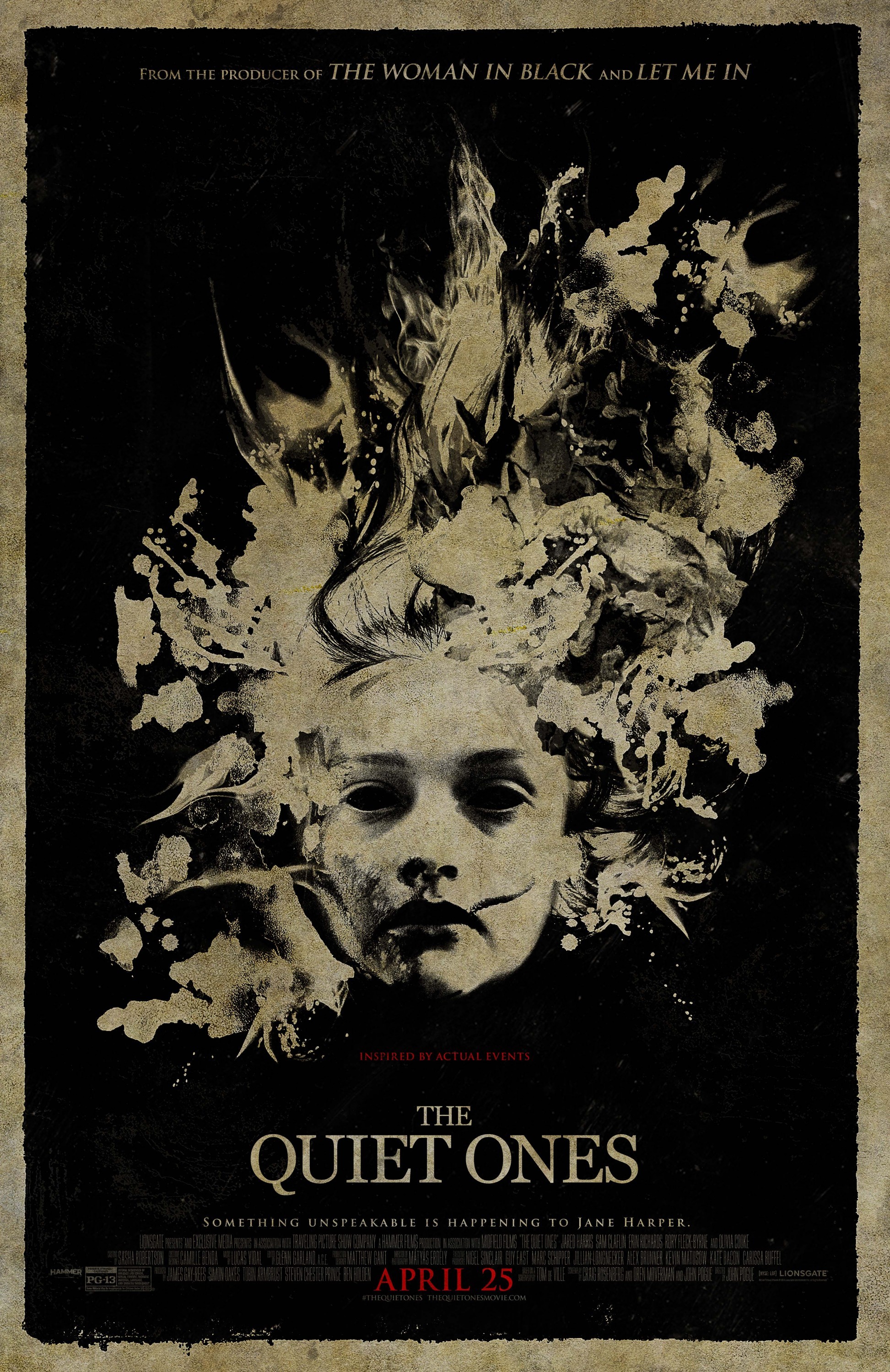
Shot in 2012 yet not released until 2014, The Quiet Ones is a 1970s-set, melancholic horror loosely based on the Philip Experiment, a 1972 parapsychology experiment conducted in Toronto, Ontario, made to determine whether living subjects can communicate with fictionalised ghosts through expectations of human will. Led by mathematical geneticist Dr. A.R. George Owen and overseen by psychologist Dr. Joel Whitton, their goal was to create a fictional character through a purposeful methodology and then ‘attempt’ to communicate with it through a séance. The created character was anointed; “Philip Aylesford,” referred to as “Philip” during the test. Although participants did report feeling a ghostly presence, table vibrations, breezes, unexplained echoes and eerie noises, matching responses to questions about Philip’s life, an apparition ultimately never appeared. Nevertheless, director John Pogue (Quarantine 2: The Terminal, Blood Brother, Deep Blue Sea 3) set out to take this real-world trial and twist it into an unnerving horror flick to, regrettably, minimal success.

Plot Summary: Summoning his top students to a secluded estate on the outskirts of Oxford in 1974, the unorthodox Professor Joseph Coupland proposes to the deeply troubled orphan Jane Harper that they perform a risky experiment to manifest the darkness within her. Operating under the theory that paranormal activity is triggered by negative human energy, Joseph and his team employ a series of tests to push the young woman to the brink of sanity. But, as the morally questionable experiment continues, the professor and his ambitious students soon realise they may have unwillingly released an unrelenting horror…

Heavily rewritten during production for budgetary reasons, The Quiet Ones does have a captivating piece of inspiration at its core, with the Philip Experiment being historically regarded as one of the most promiscuous and unsettling experiments of the 1970s, often playing into the configuration of conventional séances as Dr. A.R. George Owen sat his participants around a table, dimming the lights and requesting no communication between the group, even if the experiment has been criticised in recent years for lacking systematic management and clear results due to the unreliability of séances. Similar tests were conducted in the years following creating further make-believe characters, known as “Lilith” and “Humphrey,” producing near-identical results that were eventually deemed inconclusive. Regardless, it’s a bewitching real-world event for a horror flick, mashing up elements of science and the supernatural as frightening occurrences get underway, leading the researchers to admit their understanding of life and death isn’t as accurate as they once thought.

Portraying the zealous research team, Jared Harris, Sam Claflin, Olivia Cooke, Erin Richards and Rory Fleck Byrne are on all their A-game, with Harris being a particular highlight as the intelligent and self-assured Professor Joseph Coupland, portraying the character as equal parts unpredictable and oddly calming, it’s just a shame the character’s emotional backstory isn’t utilised to its full effect. In one of her first major roles, the then-upcoming actress, Olivia Cooke, is also a stand out, portraying Jane as an immensely tragic woman who has suffered from mental illness and uncanny events almost all of her life, being sent in and out of foster homes as a result of the malevolence enveloping her like a storm.

Continuously made to appear as if portions of the film were shot on ’70s-era cameras, The Quiet Ones is one of those horror flicks that feels as if it could have very easily been conceived as an entirely found-footage endeavour, but instead, the film uses the found-footage format sparingly, only employing the visual aesthetic at pivotal moments in the narrative. Most notably, during the scene with the Kirlian photography experiment (as seen through the lens of Brian’s 16mm camera), which was actually filmed by Sam Claflin himself, although not with an authentic 1970s camera, but with the contemporary camera of cinematographer Mátyás Erdély.

Comparable to how many of the film’s frights are your typical, lethargic jump-scares, such as windows slamming, doors knocking, beds breaking and chandeliers falling (each time, the deafening scare being preceded by an elongated silence), the orginal score by Lucas Vidal features the usual assortment of rackety, blaring tracks, like Not Scientific Proof and Bathtub Attack. Perhaps some of this audible bombardment was meant to conceal that there isn’t much depth to the story beyond the underlying theme of science and its relation to the supernatural.

In addition to The Quiet Ones, the infamous Philip Experiment also inspired the horror flick; The Apparition, released a few years prior in 2012, but that isn’t too surprising, given that a 2019 poll concluded that nearly half of the American populace believes that spirits and/or demons exist, despite overwhelming evidence that belief that life persists after death is declining.

In summary, The Quiet Ones is a horror flick that, in my opinion, is deserving of its largely overlooked status in the horror genre, as most of the film relies on cheap frights and visual trickery more than genuine dread to unnerve its audience. Though the film possesses an honourable cast, an appealing setting and an intriguing real-world influence, its rather lifeless execution holds it back. In essence, The Quiet Ones is much like the experiment in its narrative, throwing ideas into a beaker and praying it works as intended, yet it doesn’t achieve the desired outcome. Rating: low 5/10.
quiet_ones_xxlg

The Festival (2018) – Film Review

“There Are a Hundred Thousand People There. The Chances of Bumping into Her Are a Million to One…” – Shane Stubbs

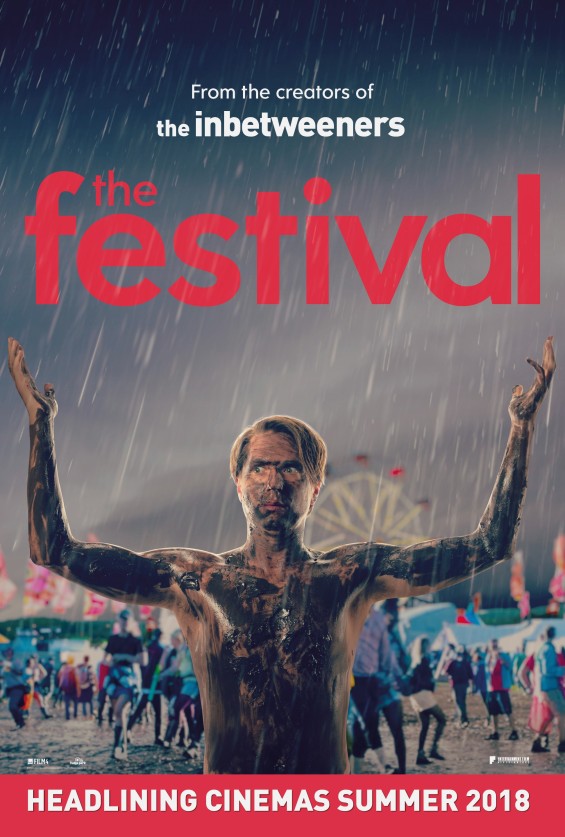
Having conquered British television with three series of the quintessential adult sitcom; The Inbetweeners, the comic duo of Damon Beesley and Iain Morris turned their attention to producing cinematic comedies in a similar vain, following that series’ two follow-up films with The Inbetweeners Movie (2011) and The Inbetweeners 2 (2014). Their next attempt at a humorous hit was 2018’s The Festival, a British comedy centring around the re-formative experience of attending a music festival for the first time, complete with the return of The Inbetweeners‘ starJoe Thomas, and director Iain Morris (The Inbetweeners 2). However, while the film does have its share of absurd misadventures and self-abasing nudity, The Festival doesn’t quite manage to capture the three-day lunacy of an actual festival experience, failing to live up to the comedic reputation of the iconic sitcom that preceded it.

Plot Summary: When Nick’s girlfriend, Caitlin, breaks up with him on the day of their university graduation, Nick’s best friend, Shane, persuades him to attend a monumental music festival to get over her, eager to meet his favourite masked DJ, Hammerhead. But, after running into Caitlin and her friends at the festival, the pair’s weekend quickly begins to descend into one of misery and madness…

Written by Keith Akushie and Joe Parham, The Festival is a comedy about friendship, maturing and enjoying the brief time we get in life. Of course, being a comedy, these underlying themes are largely pushed back to focus on its humour rather than its narrative or more intimate character moments, leading to scenes like Nick getting his nipple pierced, spending a drug-fuelled night with a girl outfitted as a Smurf and being chased through the festival grounds by security, sporting only his boxers. And, although some of these comedic set pieces are amusing, other gags feel as if they needed a bit more screen-time to wring out all of their comedic potential. That is, excluding the many gross-out moments, which consistently come across as lazy and unwarranted.  

Following this routine ‘getting-over-the-girl’ storyline, protagonist Nick Taylor, portrayed by Joe Thomas, is remarkably similar to Thomas’ character in The Inbetweeners series, Simon Cooper, a selfish, uptight teenager whose sorrows narrowly outweigh his unlikeable traits as he tries anything and everything to win back his ex-girlfriend, Caitlin, portrayed by Hannah Tointon. Meanwhile, Nick’s best friend, Shane, and festival aficionado/certified oddball, Amy, admirably portrayed by Hammed Animashaun and Claudia O’Doherty, respectively, attempt to get Nick to embrace the music and the mud, getting into a few bizarre situations themselves. Additionally, The Festival lends some pizzazz to the often overused ’embarrassing stepdad’ archetype character via the casting of New Zealand actor and comedian, Jemaine Clement, lending the well-meaning father figure a genuine sense of care for his stepson as well as delightful line delivery. Interestingly, the previously mentioned Joe Thomas and Hannah Tointon are, in actuality, engaged and have been in a relationship since 2010.

Partially shot at Bestival and Leeds Festival, with actual festival goers being used as extras for the scenes requiring enormous crowds, the film’s cinematography, handled by Simon Tindall, allows for a number of visually pleasing and colourful shots. The film, however, does little to visually differentiate itself from other modern comedies, aside from its opening titles, which creatively appear on an array of vibrant, crinkled title cards inspired by stylistic festival line-up posters, fittingly backed by a surplus of authentic footage of festival goers dancing, socialising, drinking and face painting.

Hardly ever present for the bulk of the runtime, the original score by Rael Jones is an element of the film that I cannot even review, in its entirety, as the score simply isn’t utilised enough. Instead, the film suitably employs a variety of songs that wouldn’t seem out of place at an actual music festival, ranging from swinging indie classics to contemporary dance anthems, such as Do You Know Me? and Blaze Up the Fire.

In the tradition of comedy franchises like the American Pie series, The Festival also serves as somewhat of a modern satire of adolescent angst and foolishness, appearing actually rather saccharine beneath its scatological surface, gently mocking yet ultimately painting a buoyant portrait of its target audience, teenagers, with much of the humour deriving from awkward juvenile situations, like peer group shaming, discomfiting parental over-sharing and clashes with adult authority figures. Still, there is a good quantity of jokes aimed towards a slightly older audience, including a sly homage to The Elephant Man (1980) and a running gag regarding Jemaine Clement’s fellow cultural icons, Crowded House, a New Zealand/Australian rock band.

In summary, upon watching, its apparent that The Festival is trying to capture the immature charm of The Inbetweeners series, but the writing just isn’t strong enough to grasp its crude essence, particularly in relation to its characters, none of which are anywhere near as memorable as Will, Simon, Jay or Neil. And, if truth be told, with the film sharing many tonal similarities and Joe Thomas’ performance feeling so reminiscent of his portrayal of Simon Cooper, I honestly don’t see why The Festival couldn’t have simply been a spin-off of The Inbetweeners series, functioning as a stand-alone story set after the events of the previous instalments. Nevertheless, if you occasionally desire a lower-budget British comedy with constant witticisms regarding sex, drugs and overflowing toilets, then The Festival might suffice, despite its faults. Rating: 5/10.

MV5BOTczZjJhMzktYmEwYi00YWE0LWI4ZDEtODVjYjZiOTQ5MTJmXkEyXkFqcGdeQXVyNjI0NjE1MjM@._V1_

Escape From Tomorrow (2013) – Film Review

“I’m Afraid if I Come With You, Something Bad Is Going to Happen…” – Jim

Written and directed by relatively unknown filmmaker Randy Moore, Escape From Tomorrow, released in 2013, serves as a genre-defying, experimental arthouse flick, which, whilst flawed, has to be admired for both its ambition and ingenuity. Produced on a budget of around £502,000 and illicitly shot at the Walt Disney World Resort in Orlando, Florida, and Disneyland in Anaheim, California, without permission or permits from the Walt Disney Company, Escape From Tomorrow attempts to criticise today’s fascination with “Disney Culture” by mocking the company’s rose-tinted reputation (particularly its string of immersive theme parks) to deliver a conceptually audacious, darkly surreal roller-coaster of a film that morphs a miserable father’s seemingly straightforward excursion to Walt Disney World into an other-worldly tale of paranoia, conspiracy, sex and violence, interspersed between visits to iconic attractions, like Space Mountain, Dumbo the Flying Elephant and It’s a Small World.

Plot Summary: While his family frolics, taking in the sights and sounds of the Walt Disney World Resort, discontented and recently discharged father, Jim, finds himself curiously obsessed with a pair of beautiful teenage girls, subsequently leading him to unveil fiendish forces behind the Happiest Place on Earth…

As a result of Disney’s reputation for being immensely protective of its intellectual property, the cast and crew behind Escape From Tomorrow employed a variety of guerrilla filmmaking techniques to avoid attracting attention within the theme parks, such as saving their screenplays on their smartphones and filming on hand-held cameras similar to those used by visitors. After production wrapped, Randy Moore was so determined to keep the film a secret from Disney (and their lawyers) that he decided to edit the project in South Korea. Rather than suppressing the film, however, the Walt Disney Company merely chose to ignore it, with the 2013 Sundance Film Festival likewise declining to discuss Escape From Tomorrow in detail before it premiered. Those who saw the film expressed strong doubts it would ever be widely released, due to the legal issues involved and its negative depiction of Disney’s theme parks, dubbing it; “The Ultimate Guerrilla Film.” This unfavourable portrayal is most evident during the first act, as the film takes a less ‘magical’ glimpse at the Magic Kingdom, focusing on the strain and exertion of the parents taking their children to the consistently clangorous, overcrowded theme park.

As far as characters go, the film’s protagonist, Jim, portrayed by Roy Abramsohn, is rather unpleasant, heading to the Walt Disney World Resort with his family for a sunlit getaway, only to have his trip tarnished by a call informing him he has lost his job, leading him to drink, neglect his children and even make public advances on his wife, whilst there. These traits are later enhanced when Jim begins to undergo increasingly peculiar hallucinations and perverted sexual daydreams following his spotting of two French teenagers. Still, while the character is unquestionably unlikeable, credit must be given to Abramsohn, whose charismatic performance makes Jim an oddly amiable protagonist (one that you even feel some sympathy for), despite his repeatedly deplorable actions. The supporting cast of Elena Schuber, Katelynn Rodriguez and Jack Dalton aren’t quite as stirring as Jim’s sheepish wife and energetic children, though this could be forgiven, given their limited screen-time and experience.

Utilising a greyscale colour palette to disguise cinematographer Lucas Lee Graham’s occasionally amateurish camerawork and provide the film with an aura of visual cynicism and dream-like surrealism, Escape From Tomorrow, though primarily set in the Magic Kingdom, was partially shot at Disneyland on account of production issues, with the resultant theme park seen on-screen being an amalgamation of the two. These production tribulations are sometimes very noticeable, as it’s especially apparent during the second act that the filmmakers had to use shoddy visual effects, green screen composition and digital stabilisation to rescue some of the sloppier (and potentially improvised) monochrome shots.

Fortunately, the fantastical original score by Abel Korzeniowski flawlessly matches the film’s pessimistic outlook, as tracks like Gates of Tomorrow and Fantasy Girl mimic the cheerful, wonderous tone of the actual melodies employed at the Walt Disney World Resort before the score becomes more unearthly and ominous with somewhat futuristic, 1960s-inspired tracks, like Mystery Man and Lost in Caves.

Playing into many of the urban legends surrounding Disney’s illustrious theme parks, Escape From Tomorrow features many references to online conspiracy theories related to the House of Mouse, one being the mention of a location known as “Base 21,” which refers to a real, little-known V.I.P. lounge located inside the Spaceship Earth attraction at Epcot. This fixation on urban legends again ties into the film’s underlying themes, twisting Disney’s adorable, family-friendly brand into a disturbing, perverse satire that finds macabre in the ordinary, comparable to David Lynch’s uncanny style of filmmaking.

In summary, while Escape From Tomorrow retains an undeniably bold vision, the film is only intermittently successful in execution, lacking well-developed characters or consistently striking visuals in spite of its many thoughtful or freakish moments. Nevertheless, I’d be lying if I said I detest Escape From Tomorrow, as I certainly hold a soft spot for the film. And whilst I know it will not be to all tastes, if you’re willing to look beyond the gimmick of its production, Escape From Tomorrow is a fascinating yet largely forgotten cinematic scrutiny of the Walt Disney Company that ultimately became another urban legend encircling their theme parks. Rating: low 5/10.

escape_from_tomorrow_ver2_xlg-transformed

Welcome to Marwen (2018) – Film Review

“I Was a Hell of a Good Artist, an Illustrator. I Loved to Draw, and Now, I Can Barely Write My Name…” – Mark Hogancamp

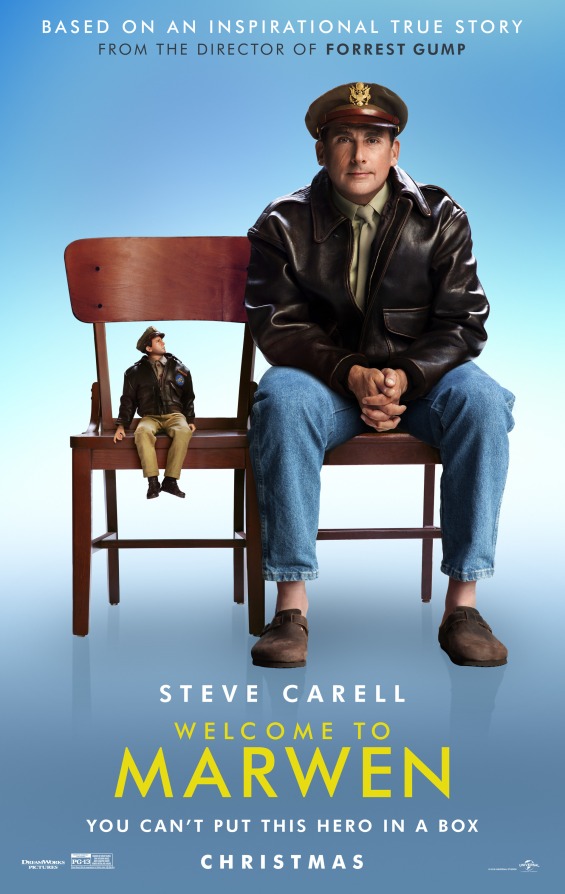
Co-written and directed by Robert Zemeckis (Back to the FutureForrest GumpCast Away), Welcome to Marwen, released in 2018, is a dramatisation of the 2010 documentary; Marwencol, which recounted the true story of Mark Hogancamp, who, on April 8th, 2000, was brutally assaulted by five men who beat him almost to death, thrusting Mark into a nine-day coma and a forty-day hospitalisation period before he was discharged, woefully bearing severe brain damage that left him with little memory of his past life. Welcome to Marwen takes the tragic story of Mark Hogancamp and aims to provide it with a tint of optimism, romance and fantasy through its unique storytelling approach and dazzling visual effects. Yet, the film ultimately falls flat due to its confused tone and graceless screenplay, making Zemeckis’ invitation to enter the village of Marwen a leisurely one to decline.

Plot Summary: After being ruthlessly assaulted by five men who left him for dead outside a bar in Kingston, New York State, yielding severe memory loss and trauma. Aspiring artist, Mark Hogancamp, constructs a remarkable therapeutic outlet on his property known as Marwen, a miniature World War II-era Belgium village compromised of period-dressed dolls. But, when Mark is requested to attend the court hearing of the men who mutilated him, his anguish returns to torment him…

Mark Hogancamp, the real individual upon whom the film is based, suffered injuries on every part of his body following the assault, subsequently placing him into a coma for nine straight days. As a result, most of the memories of his life before the assault were virtually extinguished, and the limitations of his health insurance prevented his continued rehabilitation. Sadly, only three of his assailants ever went to prison, with all three getting released within two years. Welcome to Marwen ignores many of these bleak details and outcomes, however, instead attempting to lace the story with more sanguinity and merriment as the film plays out over two planes; Mark’s plane of existence (our own) and that of the dolls, who, are enlivened via CGI in a fashion that could be described, as a more photo-realistic version of Toy Story (1995). It’s an admirable method of trying to infuse Mark’s despairing reflection of his assault with a dash of imagination and humour, but it’s predominantly an unsuccessful one, as this approach renders the film immensely inconsistent in terms of its pacing, tone and authenticity to the actual account of Mark’s horrific assault.

In a somewhat bizarre casting choice, Mark Hogancamp is portrayed by Steve Carell, who, whilst not awful, by any means, feels as if he lacks the acting aptitude required to depict Mark’s agonising trauma and isolation. But, Carrell does (of course) prevail with the more comedic moments, even if the gags themselves generally flop as Capt. Hogie (Mark’s gallant, plastic alter-ego) has a plethora of oddly placed witticisms. The supporting cast of Merritt Wever, Diane Kruger, Janelle Monáe, Eiza González and Gwendoline Christie all deliver passable performances (barring Christie’s overbearing Russian accent) yet possess little characterisation as the so-called; Women of Marwen, dolls that populate the tiny, make-believe village of Marwen, inspired by the powerful women Mark knows in his real life. Leslie Mann also makes an appearance in the film as Mark’s friendly, inexplicably curious neighbour, Nicol, who eventually becomes an object of affection for Mark in both his worlds, which occasionally comes across as rather uncomfortable as Mark lives out some of his romantic fantasies with Nicol through his dolls.

Despite spending almost half of the runtime in the imaginary village of Marwen, Mark’s fantasies of himself and his female companions as heroes of the Second World War are often short on memorable shots. Lacking stimulating action sequences or grand set pieces to truly justify how much screen-time is spent in the village of Marwen, the rarely inventive cinematography by C. Kim Miles makes the scenes of the dolls socialising or firing at Nazis relatively visually flat, that is, barring the well-rendered visual effects.

On the more positive side of things, the original score by Alan Silvestri is equally adventurous and diverse, with tracks such as MagicYou Got ThisBeautiful Moon and Marwencol, all harmoniously balancing sorrow, yearning and genuine tension while featuring a snare drum to further play into the World War II setting of Marwen. The score also includes some auditory references to Zemeckis’ earlier filmography, including a callback to the signature motif of the Back to the Future trilogy.

Nevertheless, the finest aspect of Welcome to Marwen is, by far, its CG effects, which brilliantly utilise motion capture to employ the faces and body movements of its cast onto plastic figurines clothed in World War II-era outfits/uniforms. As such, every scene within Mark’s fantasy world oozes with detail and toy-related visual gags, even if the animation of the dolls periodically appears overly fluid compared to the somewhat rigid reality of poseable figurines.

In summary, the current stage of Zemeckis’ career has long been repressed by his obsession with visual effects, repeatedly concentrating on style over substance. Welcome to Marwen is no exception to this rule, with the numerous sequences set within Mark’s fictitious world being the film’s most enjoyable moments. Thus, Welcome to Marwen fails to flourish as a wonderous, period-set adventure or a rumination of violent hate crimes and personal trauma, merely existing as a creatively ambitious misfire. Rating: low 5/10.

welcome_to_marwen_ver10_xxlg

RED (2010) – Film Review

“You Just Had Your Ass Handed to You by a Goddamned Retiree.” – Cynthia Wilkes

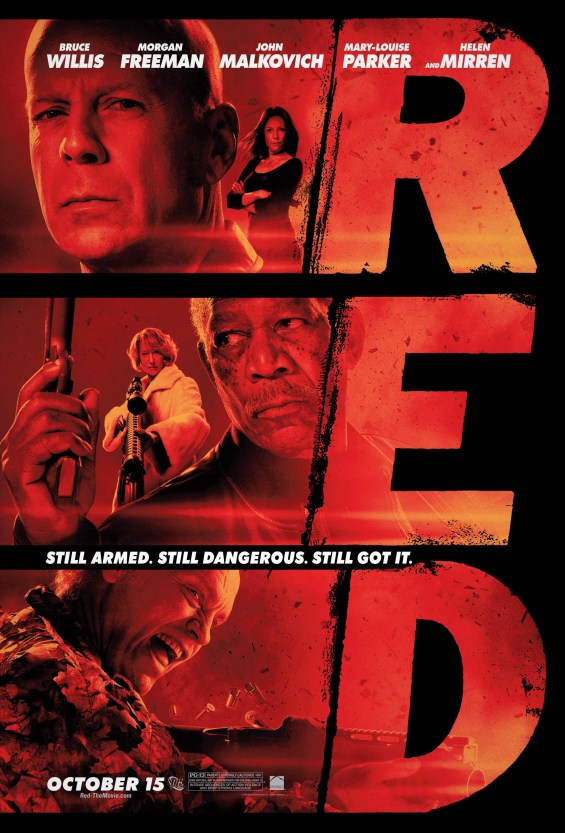
Loosely based on the comic book mini-series of the same name by Warren Ellis, RED, released in 2010, is a fast-paced and humourous action-comedy with an all-star cast of ageing actors and actresses. Yet, despite everything the film has going for it, RED never quite reaches the soaring heights of exhilaration most would expect to see from an action flick with a cast of this calibre. Still, at the very least, RED doesn’t just rely on its renowned performers to impress, as director Robert Schwentke (The Family JewelsR.I.P.D.The Captain) integrates a sufficient amount of both style and wit into the adaptation.

Plot Summary: When his peaceful life becomes threatened by persistent attacks from squads of heavily armed, masked assailants. Former black ops agent, Frank Moses, reassembles his old team of highly-trained assassins in a last-ditch effort to uncover who his assailants work for and why they are hunting him…

One of the few DC Comics properties not based around superheroes and/or supervillains. RED was surprisingly the first widely-released adaptation of a DC Comics series not produced by Warner Bros. Pictures, as Batman, released in 1966 by Twentieth Century Fox, was a spin-off from the television series. Whereas Superman, released in 1948 by Columbia Pictures, was technically a serial. These comic book roots factor into the film in a number of ways, some visual, some not. For instance, when it comes to the narrative, the pacing often seems unnecessarily quick, making the constant location-jumping of the characters feel overwhelming at points. On top of this, there is an abundance of scenes throughout RED that seem to serve little-to-no purpose, such as a moment in the opening montage of Frank’s day-to-day life where he positions Christmas decorations, implying the festive season will somehow play a part in the story. Yet, from that scene onward, Christmas isn’t even mentioned, so why is it there?

The leading component to the enjoyability of RED is undoubtedly its formerly mentioned cast and their respective characters. From Bruce Willis as the hard-boiled protagonist; Frank Moses, to Morgan Freeman as the capable yet cancer-ridden; Joe Matheson, along with John Malkovich and Helen Mirren as Marvin Boggs and Victoria, a paranoid nut-job and sophisticated assassin, respectfully. All of the characters that are part of the central team known as R.E.D. (an acronym for “Retired and Extremely Dangerous”) are well-defined and sufficiently likeable. Outside of this primary team, however, some of the characters suffer from a lack of development. Most notably, William Cooper, portrayed by Karl Urban, a misguided CIA agent assigned the task of capturing Frank and his team. Frank’s love interest, Sarah Ross, portrayed by Mary-Louise Parker, is, unfortunately, just as bland, with her character arc of maturing from a fearful, reluctant companion to an adrenaline junkie relishing in her time beside Frank, being corny and unbelievable.

Evidently inspired by the comic book mini-series it’s based upon, RED is generally rather creative with its visuals, implementing a considerable number of innovative shots that rotate around the characters as they perform various tasks. Nevertheless, the cinematography by Florian Ballhaus isn’t impeccable, as the film is frequently impaired by the jerky, hand-held style of camerawork that plagued many action sequences in the early 2010s. Furthermore, while I appreciate the attempt to add some flair to the visuals by integrating a string of imaginative location transitions, a few of these transitions come across as somewhat cheesy, particularly whenever they revolve around a screen-spreading postcard.

In a quirky little detail, all of the tracks throughout RED‘s original score are titled to fit the acronym of R.E.D. Some of these titles include; Rotating Enforcement DeviceRegular Easygoing Dudes and Rehash Every Detail. However, even when ignoring this minor detail, the original score by Christophe Beck is rather impressive, adding to the film’s appeal as a lively and stimulating guitar-led soundtrack that more than fits the quick pacing and sharp wit seen throughout the rest of the runtime.

When it comes to the action sequences, it may surprise many to learn that RED largely spreads out its rousing set pieces. If truth be told, the film’s most interesting narrative decision is that every act feels different in its approach. The first act, for example, predominantly focuses on humour, whilst the second act takes on a more serious tone, and the third act bursts into an exhilarating display of discharged firearms and downed adversaries. That’s not to say that the first two acts don’t retain any of their own exciting moments, however, as they certainly do. Interestingly, actress Helen Mirren had to learn how to fire a gun without blinking to appear more like an experienced assassin in her action sequences. This is actually an issue that has troubled cast members of the action genre for years. In fact, blinking was one of the main reasons why the cast of The Matrix trilogy wore sunglasses, concealing their involuntary reactions.

In summary, whilst RED is an action-comedy endowed with prominent names, most will come away imbued with the reassuring thought that all of the cast left their egos at home to assemble something amusing and easily digestible. Although the film isn’t anything extraordinary and definitely has its fair share of flaws, RED does have some of the makings of an entertaining action-comedy, pleasing fanatics of the veteran actors/actresses whose names litter the film’s promotional material, especially. Rating: high 5/10.

Red Teaser 1sht.Rev.1:Red Teaser 1sht.Rev.1

Hell Fest (2018) – Film Review

“That Same Guy Has Been Following Us the Entire Night!” – Natalie

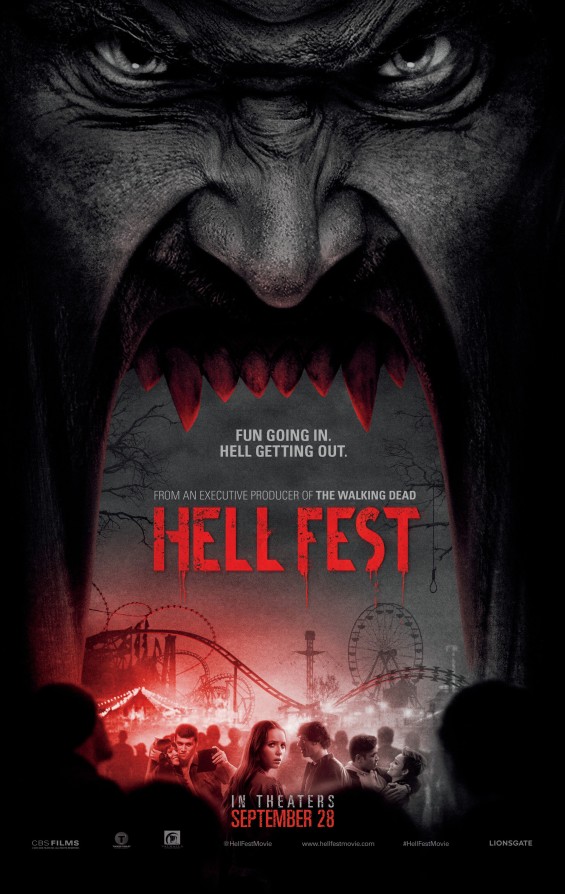
Initially conceived as a yearly horror franchise similar to Saw and Paranormal Activity, with a sequel released each following October. Hell Fest, released in 2018, is a gruesome throwback to 1980s slasher flicks. Equally violent and bombastic, the film includes many amusing moments for lovers of both scare mazes and ’80s horror. As a result of its formulaic and often uninspired screenplay, however, Hell Fest suffers from a number of issues that diminish its quality as a nostalgic slasher, even when taking into account its distinct horror-festival setting.

Plot Summary: On Halloween night, a group of friends make their way to Hell Fest, a ghoulish travelling festival loaded with attractions, games and scare mazes, hoping for an exciting night of thrills and chills. But, as the night continues, the scares soon become all too real as a masked serial killer turns the horror-themed festival into his personal playground…

Before director Gregory Plotkin (Paranormal Activity: The Ghost DimensionCrimson) was chosen to helm the project, a handful of other filmmakers were considered, including Jennifer Lynch and Neil Marshall. Needless to say, whilst Hell Fest is competently directed, the premise of the film is really where most of its appeal resides, as the idea of a pursuing killer blending in with an enormous crowd dressed as various ghouls, maniacs and monsters is a rather alarming concept, of which the film takes full advantage. For instance, when the group first encounter the killer chasing another girl through a blacklight-lit scare maze, they assume it’s all part of an act, so they merely watch as he butchers her. As opposed to sporting a single mask throughout the runtime, the killer, only referred to as “The Other,” also swaps out his disguise at many points. Distinguishing the character from horror icons like Michael Myers, despite Stephen Conroy’s physical performance appearing reminiscent of Michael’s movements in the original Halloween from 1978.

The rest of the cast, including Amy Forsyth, Reign Edwards, Roby Attal, Bex Taylor-Klaus, Christian James and Matt Mercurio, portray their characters sufficiently. The actual characterisation of the group is where most of the screenplay’s problems lie, as the teens come across as rather cliché archetypes. This issue is only worsened by the screenplay placing more emphasis on the characters’ relationships than their personalities during their first few scenes together, which is also where a large amount of the film’s corniest dialogue can be heard. On a more positive note, Hell Fest is the second horror flick to feature the voice of horror legend; Tony Todd, in a theme park, the first being Final Destination 3 in 2006. Todd later appears in person, too, portraying an enthusiastic stage announcer and providing the murderous proceedings with a brief jolt of energy.

In terms of the visuals, the cinematography by José David Montero is quite visually interesting, making fantastic use of the daunting yet colourfully lit location of Hell Fest, mainly whenever the camerawork employs wide shots to display the true scale of the bustling festival of frights. Moreover, when it comes to the killings, Hell Fest does a fine job of slaughtering the teens in creative ways through an array of superb practical effects. However, many of these kills are unfortunately spoilt by the film’s overreliance on shiny CG blood, which somewhat takes away from the charm of the 1980s-inspired artificial heads and rubber eyeballs.

Similar to the film itself, the original score by Bear McCreary feels contemporary yet simultaneously like a nod to the past, as the score combines two musical styles with synth and orchestral, along with some violin harmonics later in the soundtrack. The signature track of the score; Trophies, effectively serves as the killer’s motif and lurks in the background for most of the runtime (similarly comparable to an abundance of classic slashers). Many of the other tracks, such as Technical DifficultiesGuillotine and Welcome to Hell, do an admirable job of building suspense when required, but aren’t that memorable by themselves.

Of course, the most noteworthy aspect of Hell Fest has to be its exceptional production design, which utilises an eye-catching assortment of scare mazes segments, costumes and props from numerous Halloween events all across the United States. A fair amount of the decorations were borrowed from Six Flags Over Georgia’s annual Fright Fest, while many of the costumes were leased from the Netherworld Haunted House in Georgia, one of the highest-rated scare attractions in the country. Furthermore, many members of Hell Fest‘s production crew had formerly worked as scare maze decorators, designers and staffers, so they were more than familiar with the setup of a scare attraction.

In summary, Hell Fest certainly isn’t anything new. The film isn’t reinventing the slasher subgenre, nor is it trying to. Hell Fest is merely attempting to be an entertaining, modern-day slasher that pays homage to horror classics of the 1980s, and in that sense, I suppose it succeeds. It’s just a shame that Hell Fest doesn’t go further with its violence or horror-festival setting, as the production design is undoubtedly one of the most impressive elements of Hell Fest. And, I’m sure that if any scare maze enthusiasts were to watch this slasher flick, they would be blown away by what the production crew accomplished with the detailed costumes, props and sets on display. Rating: high 5/10.

hell_fest_xxlg

Red Riding Hood (2011) – Film Review

“Full Moon. Lock up Tonight. Better the Wolf Takes the Pig Than You…” – The Reeve

A reinterpretation/modernisation of the centuries-old fairy tale; Little Red Riding Hood; a children’s story centering on a young girl as she encounters the Big Bad Wolf on a journey to visit her grandma. Red Riding Hood, released in 2011, retains the framework of the original story, but not much else, as this reinterpretation aims to be a dark fantasy with elements of romance and gothic horror thrown in. Yet, in almost all of these genres, the film falls flat as a result of its subpar screenplay and direction. That’s not to say that Red Riding Hood doesn’t have any positives, however, as this fantasy flick undoubtedly deserves praise for its outstanding production design and dreary fantasy aesthetic.

Plot Summary: For years, the residents of a remote mountain village have maintained an uneasy truce with a fearsome werewolf by offering the bloodthirsty beast a monthly animal sacrifice. But, when the wolf violates their trust by taking a human life, the village falls into hysteria, prompting the arrival of the famed werewolf hunter, Father Solomon, to assist in their hunt. Meanwhile, Valerie, a beautiful young woman torn between two viable fiancés, begins to suspect that the beast may be someone she knows…

Similar to most European fairy tales, the origins of Little Red Riding Hood lie within the folk tradition of oral storytelling. So, no singular author can be credited for the story’s creation. However, the two most prominent renditions of the fairy tale are proclaimed to have been written by Charles Perrault and the Brothers Grimm in the 17th century. Despite this history, Red Riding Hood seems to largely disregard the various iterations of the fairy tale, to instead take influence from the first instalment of the infamous Twilight series, as the two films share a number of similarities. For example, the opening title sequence where the camera majestically glides over vast snowy landscapes closely resembles the opening title sequence of Twilight. Furthermore, Taylor Lautner, who previously appeared in Twilight, was considered for the role of Peter early in pre-production. Still, these similarities shouldn’t be that surprising, considering that director Catherine Hardwicke (ThirteenLords of DogtownMiss You Already) helmed the first entry in the series in 2008.

In regard to the cast, Amanda Seyfried portrays the titular character of Valerie/Red Riding Hood sufficiently, but her performance is somewhat hindered on account of her placement between Shiloh Fernandez and Max Irons as her love interests, Peter and Henry, whose performances leave a lot to be desired coming across as drab and rather wooden for the majority of their screen-time. As per usual, the highlight of the cast is undoubtedly Gary Oldman as the morally-grey werewolf hunter, Father Solomon. Though Oldman doesn’t get to exhibit immense amounts of emotion (despite his character having a tragic backstory), the veteran actor does stay committed to his detestable character.

Aside from some outlandish CGI and a handful of moments where cast members/props that should seemingly be in focus are not, the cinematography by Mandy Walker is one of the finest components of Red Riding Hood. From the glowing red of Valerie’s hood contrasting against the white snow to the blood-red moon gradually emerging over the village rooftops, Red Riding Hood is a visually stunning fantasy at points. What’s more is that the set, costume and prop design are all exceptional, as every location feels rustic yet fantastical, whilst every costume/prop appears worn and functional. From a design standpoint, even the trees that appear throughout the runtime are visually unique as they harbour cadaverous spikey branches, giving the impression that merely wandering through any of the dense forests surrounding the village could result in a wound and subsequently a trail of blood.

Unsuitable yet well-crafted, the original score by Alex Heffes and Brian Reitzell begins rather promisingly with the track; Towers of the Void, which Reitzell co-wrote with musician, Anthony Gonzalez, of the electronic band; M83. As such, the ominous track contains waves of strings and industrial-sounding electronics, these instruments then persist onto the second track; Kids, where they are accompanied by ghostly vocals and moody synth. Essentially, while not a bad soundtrack, by any means, the score for Red Riding Hood is simply so unfit for a story set in this time period and genre, that it’s difficult to overlook when reviewing the score.

For a significant portion of the runtime, the story of Red Riding Hood unfolds like a mystery, with the human identity of the werewolf being kept a secret to keep the audience guessing. And whilst many suspects are immediately dismissed, the screenplay does a serviceable job of introducing red herrings without seeming overly conspicuous. When the truth is finally revealed, however, the answer as to who is behind the beastly slayings is rather disappointing, especially since the reveal is quickly followed up by an equally disappointing climax and epilogue.

In summary, as far as gloomy retellings of classic fairy tales go, Red Riding Hood is certainly one of them. While Amanda Seyfried and Gary Oldman are magnetic in their respective roles, the unremarkable leading men along with the painfully formulaic screenplay, continuously devalue the beautiful production design and often spectacular visuals. So, whilst it’s possible that the Twilight crowd will find a specific appeal in Red Riding Hood, outside of that devoted fanbase, I doubt many others will. Rating: low 5/10.

red_riding_hood-p509441

Enola Holmes (2020) – Film Review

“The Choice Is Always Yours. Whatever Society May Claim, It Can’t Control You.” – Sherlock Holmes

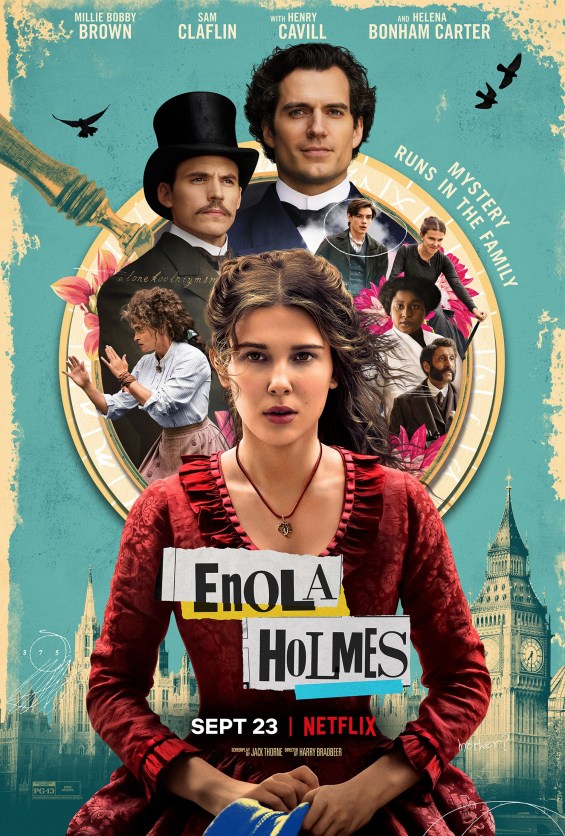
Based on the book series; The Enola Holmes Mysteries by Nancy Springer, a string of books centralising on Sherlock and Mycroft Holmes’ younger sister, Enola. 2020’s Enola Holmes serves as an alternate take on the Sherlock Holmes mythology, aiming itself towards preteens (specifically preteen girls) and injecting the world of the renowned detective with both colour and humour. Unfortunately, however, on account of the film’s poor pacing, overly long runtime and comedic sequences that frequently fall flat, Enola Holmes struggles to attain much appeal outside its preteen demographic, even with a terrific performance from Millie Bobby Brown as the titular character.

Plot Summary: When Enola Holmes, Sherlock Holmes’ teenage sister, discovers that her mother has gone missing, she embarks on a daring mission to the city of London to find her. Swiftly becoming a proficient detective in her own right as she outwits her older brothers and unravels a treacherous conspiracy surrounding a young, runaway Lord…

Adapting the first entry of the book series into an origin story, of sorts. The plot of Enola Holmes revolves around a mystery, similar to many adaptations of Sherlock Holmes literature. However, unlike many other adaptations of the world’s greatest detective, Enola Holmes repeatedly breaks the fourth wall throughout its narrative, having Enola turns towards the camera and speaks directly to the audience, delivering exposition and sharing her thoughts on her current situation. Yet, this isn’t too surprising as director Harry Bradbeer (As the Beast Sleeps, The Brides in the Bath, Perfect Day: The Millennium) is predominantly a television director, directing episodes on several well-known series, including Fleabag, which also features a number of fourth-wall-breaking moments. Furthermore, with a female protagonist at the centre of the story, Enola Holmes attempts to weave themes of feminism and the sexist nature of the 1800s into its narrative, which is an admirable goal, yet often comes across as preachy in its delivery as the female characters continuously outperform and belittle the male characters, including Sherlock Holmes himself.

Best known for her role as Eleven in the smash-hit sci-fi television series; Stranger Things, Millie Bobby Brown portrays the youthful detective, Enola Holmes, with plenty of wit and confidence. And, although the screenplay doesn’t give Enola much complexity beyond occasionally being too headstrong for her own good, she is a fine protagonist, especially for impressionable young girls. The supporting cast also does well in their respective roles, with Henry Cavill, in particular, portraying a remarkable iteration of Sherlock Holmes in a more traditional portrayal of the character following the rather wild and scattered portrayals from Robert Downey Jr. and Benedict Cumberbatch. Cavill is calm and collected as the stark image of his older brother, Mycroft Holmes, portrayed by Sam Claflin, who is far more rigid. Mycroft also makes an excellent foil to Enola as he demands she conform to the standards of 18th-century women. Then there is Helena Bonham Carter, who doesn’t have much to do as the Holmes matriarch, Eudoria Holmes, but makes the most of her screen-time through her monologues, bouncing from various tones with her eccentric behaviour and sage advice.

For added freedom and flexibility when it comes to camera movement, Enola Holmes was shot almost exclusively using a Steadicam system. This allowed cinematographer Giles Nuttgens to obtain many of the energetic shots seen throughout the film. Yet, despite this persistent sense of movement, many of the shots in Enola Holmes aren’t anything overly inventive, and instead, a large portion of the camerawork simply presents the detailed costumes and sets with pride. All of which feel period-accurate, if a little excessively vibrant.

Whilst not as memorable or as distinct as many of his other scores, composer Daniel Pemberton does a passable job with the soundtrack for Enola Homes. Crafting an orchestra-led score brimming with bouncy rhythms and sassy melodies, all united by guitar. Effectively, it’s a modern score that makes no real attempt to convey the time period of the story. Instead, the original score concentrates on Enola as a protagonist, accentuating her personality through tracks like Gifts from MotherCracking the Chrysanthemums Cypher and The Game is Afoot.

According to the novel; A Study in Scarlet, by Sir Arthur Conan Doyle. Sherlock Holmes first met his assistant, Dr. Watson, in 1881. But, in Enola Holmes, which is set in 1884, Lestrade states that Sherlock always works alone, indicating that the pair have not yet met. As such, it’s a safe assumption that Enola Holmes is set outside of the series’ usual continuity, further playing into the idea that Enola Holmes is an entirely new interpretation of the series. This assumption is inadvertently also a pleasant distraction from the film’s countless cringe-worthy quips and one-liners.

In summary, Enola Holmes is the type of film that preteens will delight in; a charming, family-friendly adventure with an intriguing mystery at its core. For others, however, this family flick is unlikely to impress as a result of its notable flaws and restrictive appeal, not to mention its constant attempts to plant seeds for the inevitable sequels that will be coming to Netflix later down the line. Having said that, I feel Millie Bobby Brown will certainly advance her career with this project as she was actually one of the primary reasons Enola Holmes was greenlit, approaching author, Nancy Springer, with the intention of starring in and producing an adaptation of her work. Rating: 5/10.

Enola Holmes • Poster

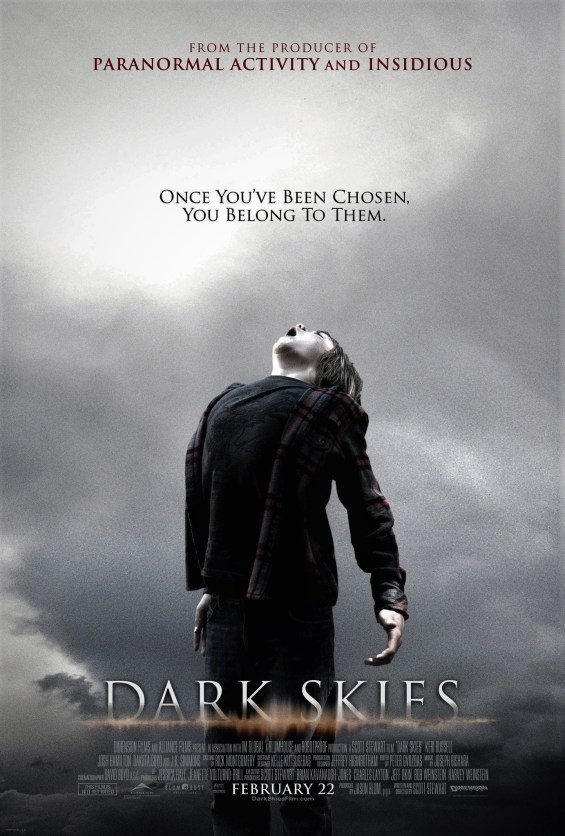
Dark Skies (2013) – Film Review

“People Think of Aliens as These Beings Invading Our Planet in Some Great Cataclysm, Destroying Monuments, Stealing Our Natural Resources. But, It’s Not Like That at All. The Invasion Already Happened.” – Edwin Pollard

As much a science fiction flick as it is a horror, Dark Skies, released in 2013, has a solid cast, a fascinating premise and some admirable ambitions, attempting to break away from the familiar tropes of alien abduction stories in favour of delivering its own take on the common phobia of extraterrestrials discreetly arriving on Earth. Unfortunately, however, writer and director Scott Stewart (Legion, Priest, Holidays – Segment: Christmas) doesn’t seem to know how to utilise any of these elements, and as such, Dark Skies ends up being an extremely underwhelming film in more ways than one, even if it is a slight improvement over Blumhouse Productions’ usual jump-scare-filled endeavours.

Plot Summary: Suffering from financial troubles and the slow decline of their marriage, middle-aged couple, Lacy and Daniel Barrett, soon find their suburban life even further disrupted when an escalating series of unexplainable events leads them to discover that a terrifying force is monitoring them, a force which may have arrived from beyond the stars…

Originally pitched as a found-footage film with a screenplay written in only six weeks. Dark Skies curiously borrows more from supernatural horrors than it does from other extraterrestrial stories like Signs (2002), Skinwalker Ranch (2013) and Close Encounters of the Third Kind (1977) as the film somewhat follows the structure of a conventional haunted house/possessed child storyline. And, as a result, suffers from many of the same issues that those films do. Appearing overly formulaic and frequently missing the opportunity to shift into full-on genre mode by the time its final act arrives. Furthermore, this structure results in many of the daytime sequences feeling quite tiresome as almost all of the extraterrestrial-related events don’t transpire until nightfall, leaving the daytime scenes to solely be used for kindred drama than foreboding moments of sci-fi dread.

The central cast of Keri Russell, Josh Hamilton, Dakota Goyo, Kadan Rockett and J.K. Simmons all do a serviceable job throughout the film, portraying members of a family that is slowly growing apart as time goes on. A situation that is only made more difficult by the family’s mounting bills and Daniel’s numerous attempts to find a replacement job falling flat at every turn. And whilst all of this is interesting for a family-centred plot, the problem here is that outside of the family’s general struggles, all of the characters are given very little development, an issue that is only exacerbated by the film’s many altering subplots, which cover everything from Lacy and Daniel’s declining sex life to their teenage son’s developing hormones and subsequent teenage crush.

Moving onto the visuals, with the exception of a couple of bewitching shots, the film’s cinematography by David Boyd is rather bland, primarily relying on hand-held mid-shots and close-ups. Dark Skies also continuously employs dim lighting for the majority of its runtime, meaning that nearly every shot at night is almost pitch-black with only a few small beams of moonlight to illuminate each room in the family’s house. Additionally, the film’s setting is, again, rather bland, as even though the location of a pleasant, everyday American suburb was chosen by Scott Stewart to help ground the story in reality, the setting itself is exceedingly dull, particularly for the horror genre.

Luckily, the original score fares a little better as composer Joseph Bishara, best known for his fear-invoking score on 2010’s Insidious, once again uses his musical skills to craft a chilling soundtrack stocked with eerie futuristic noises and unsettling sound cues most present in the tracks; Two PosibitliesNight RideNot in Control and The Disturbances. Showcasing the true terror that these extraterrestrials are capable of purely through a distorted soundscape.

When it comes to the concept of creatures from another world studying our planet, it isn’t often that this idea drifts into the realm of horror, especially with the cliché image of a small, grey-skinned alien with an oversized head and black eyes, commonly referred to as a Gray, being any but frightening. However, in Dark Skies, the Grays are genuinely unnerving beings, appearing as lanky, shadow-like figures that tower over the Barrett family. In addition to the Grays, the film establishes two other extraterrestrial races known as the Reptilians and the Insectoids. Interestingly, all three of these races are actually based on real-life abduction reports where abductees described their encounters, with Reptilians being described as green-skinned humanoids with attributes of reptiles, such as hairless scaled-skin, concave-vertical pupils and the ability to shapeshift, changing from reptilian to human at will, while Insectoids are described as large beings with a close resemblance to grasshoppers/praying mantises. Playing into the various conspiracies that surround life on other planets.

In summary, whilst Dark Skies doesn’t earn many points for originality. When the film manages to tap into more low-level, relatable anxieties with its family-focused story, it does come far closer to getting under its audience’s skin than your typical horror film ghost or ghoul. That being said, Dark Skies also repeatedly devalues the effectiveness of the alien abduction subgenre with its uninspired visuals and fairly predictable plot. And while I do consider Scott Stewart to be a talented writer and director with the right project, his films occasionally do leave something to be desired, Dark Skies simply being another example. Rating: low 5/10.

dark_skies_xxlg

Peter Rabbit (2018) – Film Review

“This Is Our Ancestor’s Land, It’s Time to Get Our Garden Back…” – Peter Rabbit

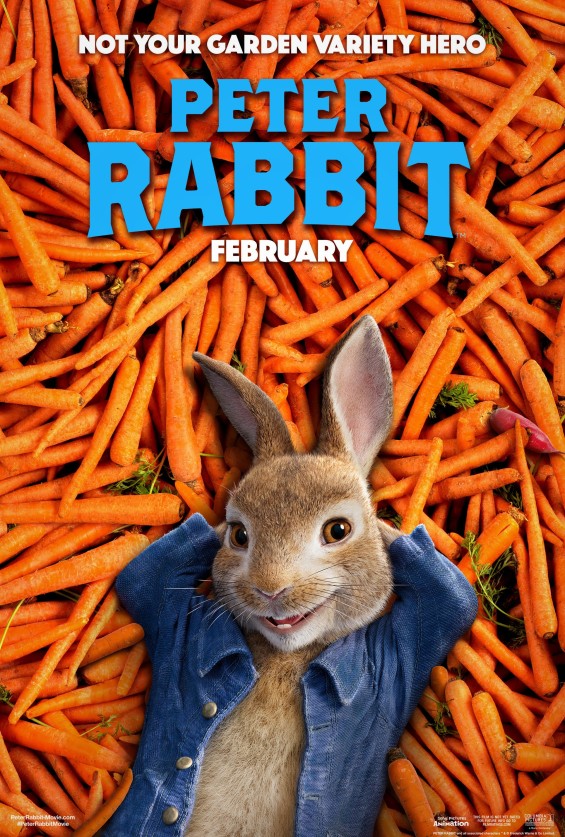
Based on the children’s book; The Tales of Peter Rabbit, written and illustrated by Beatrix Potter, 2018’s Peter Rabbit is the first live-action adaptation of the mischievous, jacket-wearing bunny. And although Potter herself would’ve more than likely not enjoyed the film as the condemnatory author was well-known for her continuous criticisms of how her characters were utilised (to the extent that she even oversaw much of the characters’ merchandise). Over a century on, it’s understandable that Peter’s garden high-jinx would pale in comparison to many modern family flicks. Thus, Peter Rabbit unsurprisingly attempts to update the character, resulting in a mixed bag of a film brimming with over-the-top antics and wild animal house parties.

Plot Summary: After spending years in the countryside toying and tormenting the old, crotchety gardener, Mr. McGregor, as they steal from his luscious vegetable patch. Peter Rabbit and his twin sisters find themselves up against a real challenge when Mr. McGregor dies of a heart attack, prompting his young, compulsive great-nephew, Thomas McGregor, to inherit his property and all that comes with it…

While screenwriters Rob Lieber and Will Gluck (who also directs) do a serviceable job at crafting a family adventure, one of Peter Rabbit‘s biggest issues is that its story is often told from an American perspective, in which the picturesque British countryside is exclusively filled with cosy cottages and well-meaning residents. This frequently results in quite the disconnect whenever the story becomes more chaotic as garden rakes begin to fly, explosives go off and electric fences impart a never-ending stream of injuries to both humans and animals, all played with flippant humour that’s somewhat at odds with the emotional fallout of Peter’s parents’ death many years earlier.

The voices of James Cordon, Colin Moody, Daisy Ridley, Margot Robbie, Elizabeth Debicki and Sia lead the cast, lending their star-studded vocals to the various animals ripped straight from the source material in terms of both their designs and personalities. On the human side of things, however, many of the characters have been significantly reworked from their original appearances, primarily in an attempt to modernise them, which is pretty clear from Mr. McGregor being swapped out for his younger nephew in an admittedly bleak fashion. And even though Donald Gleeson is incredibly exaggerated in his performance as Thomas McGregor, the character does serve his purpose well as not only a foil for Peter, but also a reasonably likeable man thrown into an understandably aggravating conflict with a troublesome rabbit. Rose Byrne equally elevates her role as the friendly next-door neighbour who is fond of both Thomas and Peter, often leaving the two boys to fight over her affection.

On a technical level, Peter Rabbit is a fairly polished film as the blend of actors and CG characters is well-done and feels natural, while the cinematography by Peter Menzies Jr. ensures the film stays visually appealing even during the story’s more outlandish moments, often having the camera head-level with Peter and his relatives to give the animals more intimate scenes. Moreover, the film frequently integrates animated sequences which are remarkably reminiscent of the source material, having many flashbacks appear as water-coloured paintings similar to the book’s endearing artwork.

With the exception of the uplifting track; Rascal Rebel Rabbit, the original score by Dominic Lewis isn’t overly memorable. But, thankfully, Lewis still manages to compose a score that has a youthful bounce to it as the soundtrack’s melodies all have great energy to them. Furthermore, the way the score is structured means the audience gets to experience the slapstick fun of the film’s first and second acts, but as the third act arrives, some real emotional weight creeps in. Also worth noting is the brilliant use of garden tools in the fabric of the score, the most notable of which is the use of the garden shears as percussion throughout several tracks.

Curiously, many of the live-action scenes for Peter Rabbit were actually filmed in Australia, not the United Kingdom as Sydney was chosen as the primary filming location as the city is home to Animal Logic, the company that produced much of the film’s advanced animation. However, this did cause a problem for the filmmakers as rabbits have been regarded as pests in the country since the 1800s as the country was once overrun with them. And, at its illegal to bring living rabbits into the country, the actors had to work opposite CG characters for the entirety of the production, with even their closet of interactions being achieved through the use of CGI, which luckily does hold up.

In summary, Peter Rabbit is bitterly average as it’s a film you can sit through, but not much else beyond that. In many ways, it almost feels as if Will Gluck was bored with the source material and was concerned that audiences would be too, leading him to implement as many disorderly action sequences and childish, fourth-wall-breaking gags as he possibly can. Unfortunately, making the film more frenetic only adds to its sense of desperation. Still, with Peter Rabbit racking in over £229 million at the global box office, I’m convinced we’ll be seeing many, many sequels (and potentially spin-offs) to this family adventure in the near future. Rating: 5/10.

peter_rabbit_ver2_xxlg