The Thing (1982) – Film Review

One of John Carpenter’s many horror classics, and one of my all-time favourites, ‘The Thing’ is a violent, eerie and creative sci-fi/body horror icon, as I personally adore this film and believe it’s one of Carpenter’s best, as the film always uses isolation and paranoia to its best extent, never failing to keep you on edge and invested throughout the entirety of its narrative and runtime.

Plot Summary: Members of an American research outpost in Antarctica find themselves battling a parasitic alien organism capable of perfectly imitating its victims. As time passes, they realise that killing the creature will be harder than they initially thought, as paranoia begins to sink in as to who has already been assimilated by the shape-shifting entity…

Although ‘The Thing’ is actually a remake of the classic; ‘The Thing from Another World,’ from 1957, I would say this is one of the rare times that a remake is better than the original as it’s constant tension building alongside the outstanding practical creature effects, make the film an incredible experience. Similar to films, such as ‘Alien’ or ‘The Fly,’ ‘The Thing’ also has a very slow opening, using its introduction to build tension and give the audience a great view of the location before the film descends into the gory, suspenseful chaos.

Kurt Russell, Keith David, Wilford Brimley, David Clennon and the rest of the cast are all decent, while Kurt Russell’s character, ‘MacReady,’ is easily my favourite simply due to his charisma, but none of the cast are terrible, by any means. However, I do feel there are too many characters within the story, as it can get confusing at many points as to which character is wrapped up within their large fluffy coats. And while I understand the need for a high body count for a film like this (which is the reason for the lack of development for many of the characters), I simply find it a little too easy to get lost at points.

Dean Cundey handles the cinematography within the film, which is decent throughout but nothing amazing, placing more of an emphasis on the practical effects within the shots, rather than the shots themselves. The cinematography, however, does still help to build tension effectivity through its many still shots and dark colour palette. Furthermore, all of the creature effects throughout the film are completely practical, giving the amazing creature designs true life by many of them being puppets or costumes rather than CGI, like most modern-day horror or sci-fi flicks. These effects truly create some very memorable scenes, as make-up effects artist, Rob Bottin, known for his work on ‘RoboCop’ and ‘Total Recall,’ truly did some of his best work on ‘The Thing.’

The original score (surprisingly not composed by John Carpenter himself) is by Ennio Morricone, but suitably does feel like a traditional Carpenter soundtrack and helps towards the eerie atmosphere as soon as the opening begins, as while maybe not as iconic as some of Carpenter’s other scores, such as ‘Halloween’ or ‘The Fog,’ etc. The original score is still brilliant in its own right and truly sets the tone for the film.

As the film takes place in an extremely isolated location and features a creature that can morph into any character, the film also never fails to keep the viewer on constant edge, as one of the best elements of the film is the paranoia the runtime continues, as any of the characters could be infected with the extraterrestrial creature. So, we never know who is going to be the next unfortunate victim, and who is their killer. Interestingly, during filming, John Carpenter didn’t even tell the actors who was the creature on set, only adding to the mystery.

In summary, ‘The Thing’ is a phenomenal entry into the genres of science fiction and horror, truly being an iconic staple of what to expect from an extraterrestrial film from then on. From its building of tension to the outstanding phenomenal practical effects as well as the constant threat, we feel whilst watching, almost placing us into the shoes of the characters themselves. Soon going on to be a true sci-fi/horror classic and becoming one of the best remakes to ever grace the silver screen. Final Rating: 9/10.
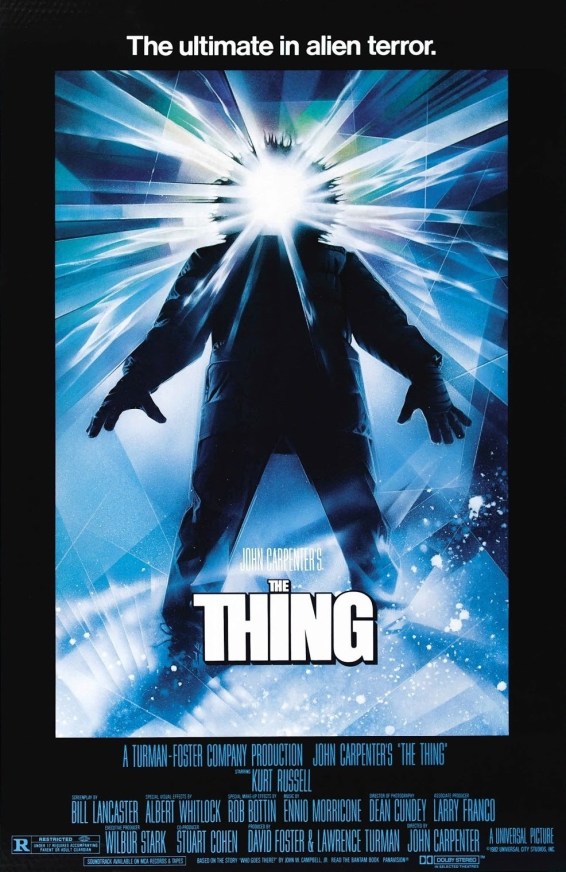
The Thing (1982) Original

Spider-Man: Into the Spider-Verse (2018) – Film Review

A superhero film like no other, ‘Spider-Man: Into the Spider-Verse’ is an extremely entertaining animated adventure, filled with plenty of humour, heart and exciting action scenes throughout its runtime. All displayed through some stunning illustration-like animation which looks as if the audience was thrown straight into the colourful pages of a ‘Spider-Man’ comic book, giving every location, character and even movement/action it’s own unique visual flair.

Plot Summary: When Brooklyn teen ‘Miles Morales’ obtains strange new abilities, he soon finds himself in an unusual situation. Encountering the beloved superhero, ‘Spider-Man,’ alongside many other spider-people from multiple different dimensions, as New York City begins to collapse in on itself when a super-collider attempts to merge the other dimensions into its own…

From the opening scene of the film through to its closing credits, it’s very clear that the filmmakers behind ‘Spider-Man: Into the Spider-Verse’ have a great love for this character, as the attention to detail throughout the film as well as the sheer amount of references to ‘Spider-Man’s long history and his enormous list of villains. The film feels like it was made for the fans, by the fans, and does a great job at expressing it.

When it comes to the cast, Shameik Moore, Jake Johnson, Hailee Steinfeld and Mahershala Ali are all fantastic as their respective characters. Whether they are the villainous antagonists, or the iconic heroes we all know and love, they all give very charismatic and ranged performances, with Liev Schreiber personally being true stand out for me, portraying the villain; ‘Kingpin,’ almost as brilliantly as Vincent D’Onofrio did before him in the acclaimed ‘Daredevil’ series. Soon becoming one of the most intimidating antagonists ‘Spider-Man’ has ever faced on film. I also have to give the hilarious ‘Spider-Ham,’ portrayed by John Mulaney, an honourable mention, purely for the cartoonish and over-the-top nature of his character, which always had me laughing many times.

The animated cinematography within the film also helps back-up the incredible animation, as the film is brimming with beautiful shots throughout, many of which contain large amounts of movement as characters soar across New York City. The original score by Daniel Pemberton is also fantastic, as the soundtrack (similar to the film itself) is very unique and filled with style, blending tracks that sound as if they should be from different films entirely into one modern-day superhero flick, which is surprisingly very effective.

Even though the animation style is without a doubt one of the best elements of the film purely through its striking visuals, the action scenes throughout the film are also very impressive. Matching many of the actions scenes you’d see in your standard live-action blockbuster perfectly combined with the film’s varied colour palette and comic book style, creating many memorable and exciting moments. My personal favourite being the action scene in ‘Aunt May’s house, containing a variety of characters all in one singular small room. This is also when it becomes very clear that each version of ‘Spider-Man’ has their own completely distinct design, movements and personality, with the clear example of this being ‘Spider-Man Noir,’ portrayed by Nicolas Cage, as the character is always seen in black and white and delivers all his dialogue intensely, almost like a parody of ‘Batman.’

My only issue with the film is the lack of time some scenes are given within the narrative, as for example, some characters not from ‘Miles’ reality discover that certain people are alive/dead in the universe they have now arrived in, as this could’ve been a really interesting piece of characterisation if done well, as well as adding another emotional scene to the film’s story. Unfortunately, however, most of these moments are skimmed over, mostly due to the film’s very fast pacing.

In summary, ‘Spider-Man: Into the Spider-Verse’ is some of the most fun I’ve had in a cinema, an absolute visual treat for the eyes alongside its original story, phenomenal animation and fantastic original score. The film truly becomes an amazing experience for any comic book or film fan. I highly recommend this one, especially if you’re a ‘Spider-Man’ fan like myself, as this is without a doubt the web-head’s best film to date. Final Rating: 9/10.

spider-man-into-the-spider-verse-poster-miles-morales

The Shape of Water (2017) – Film Review

Without question one of my favourite films from director Guillermo del Toro (Hellboy, Pacific Rim, Crimson Peak), ‘The Shape of Water’ is for sure not a film that everyone will enjoy, but for those who do, this strange story of a woman falling in love with an otherworldly fish creature inspired by the horror classic; ‘Creature from the Black Lagoon,’ will truly push visuals and storytelling to their limits. Combining some outstanding cinematography with stunning make-up effects and plenty of absorbing performances from Sally Hawkins, Doug Jones and Michael Shannon, all equalling to one truly incredible cinematic experience.

Plot Summary: In the midst of the 1960s, inside a high-security government facility, lonely cleaner, ‘Elisa,’ is trapped in a life of silence and isolation, stuck in a familiar and mundane routine. But, when the facility she works within captures a mysterious fish creature in order to study its unique physiology, ‘Elisa’s life changes forever as she becomes more and more attached to the creature…

‘The Shape of Water’ is undoubtedly a Guillermo del Toro film through and through, as with another director at the helm, I could definitely see this film not working, as the completely bazaar plot is no doubt an instant turn-off for some viewers. But, del Toro truly brings his ‘A’ game here, bringing every inch of his creativity and passion to the film. And, as such, the film is an absolute pleasure to watch from beginning-to-end, which is even more impressive considering both of the film’s protagonists, a.k.a. ‘Elisa’ and ‘The Amphibian Man,’ are completely mute for the entirety of the runtime. In fact, one of Octavia Spencer’s favourite things about the film was that by the main couple being mute, most of the dialogue comes from a black woman and a closeted gay man, who would’ve both experienced real oppression during the 1960s setting of the film.

Despite actor Doug Jones being in heavy make-up prosthetics to portray ‘The Amphibian Man’ for all his screen-time, he actually is able to invoke a variety of emotions, and shares plenty of chemistry with his co-star Sally Hawkins as ‘Elisa,’ with the supporting cast of Michael Shannon, Richard Jenkins, Octavia Spencer and Lauren Lee Smith also being surprisingly excellent given their character’s limited time on-screen. As well as the marvellous cast, the writing throughout the film is also fantastic, as del Toro writes the screenplay almost like poetry. Forming a romantic bond between the two main protagonists as the film progresses, all the while integrating plenty of social commentary on the time-period, backing-up the film’s main theme of what makes us different, whether that be because we are deaf, blind or possibly, not even human, which I personally found very compelling.

The phenomenal cinematography by Dan Laustsen elevates ‘The Shape of Water’ drastically, which contains an unbelievable amount of beautiful shots throughout the narrative, with the film’s dark blue/green colour palette only helping to add to the film’s visuals. Furthermore, many shots within the film play into aspects of various characters, most notably, ‘Elisa’s isolated life, displaying the facility where she works as a cold, dirty and segregating place.

Additionally, ‘The Shape of Water’ adds another remarkable score to composer Alexandre Desplat’s already-overflowing catalogue of work, as this unusually-beautiful romantic score with an almost French-esque feel, is very impactful in many moments throughout the film. Particularly with the opening scene however, as the opening shot glides slowly through a flooded room set to the my personal favourite track of the film; ‘The Shape of Water,’ preparing the viewer for the strange story that lies ahead. Desplat also provided recordings of his own whistling to be featured in the soundtrack, as del Toro wanted the score to feature whistling so it could contrast with the film’s many scenes that feature water.

One of my personal favourite elements of the film is definitely the make-up and prosthetics, as every second of screen-time we get with ‘The Amphibian Man’ the make-up effects look completely flawless, with many aspects of the strange and original design being inspired by real animals. Which is nothing new to this director however, as del Toro has always been known for creating incredible creatures of dark fantasy, such as in ‘Pan’s Labyrinth’ and the ‘Hellboy’ series. Although used less than what many may initially think, the CGI throughout the film is also very effective, amplifying many of the small effects around the creature rather than distracting from (or overpowering) them.

In summary, I honestly believe ‘The Shape of Water’ may be one of my all-time favourite films, and certainly one of favourite films of 2017, as the relationship between the two protagonists and the journey their relationship represents is truly memorising from start-to-finish. Backed-up by some amazing cinematography, a great original score as well as the make-up and CG effects, whilst perhaps not a film for every cinephile, it is an extremely well-made film regardless, and one that I would surely recommend. Final Rating: 9/10.

shape_of_water_ver3_xxlg