Jurassic Park IV (2005) – Lost Projects

Before 2015’s Jurassic World brought dinosaurs back to the silver screen in the form of a glossy soft reboot, an earlier, radically different concept was drawn up for the fourth instalment of the franchise, with the aptly titled; Jurassic Park IV, set for release in mid-2005. This scrapped, now-long-forgotten sequel would’ve taken the series in a bold and contentious direction, concentrating its narrative on a crazed storyline revolving around genetically engineered dinosaur-human hybrids being deployed worldwide as weaponised combatants by a sinister organisation. While this ludicrous idea did reach the concept art and early scripting stages, the project was ultimately discarded, with executives fearing it would undermine the cinematic legacy and relatively grounded tone of the franchise’s earlier instalments, relegating the unproduced film to become an obscure yet fascinating piece of the franchise’s history, following the success of the 1993 classic that began its journey.

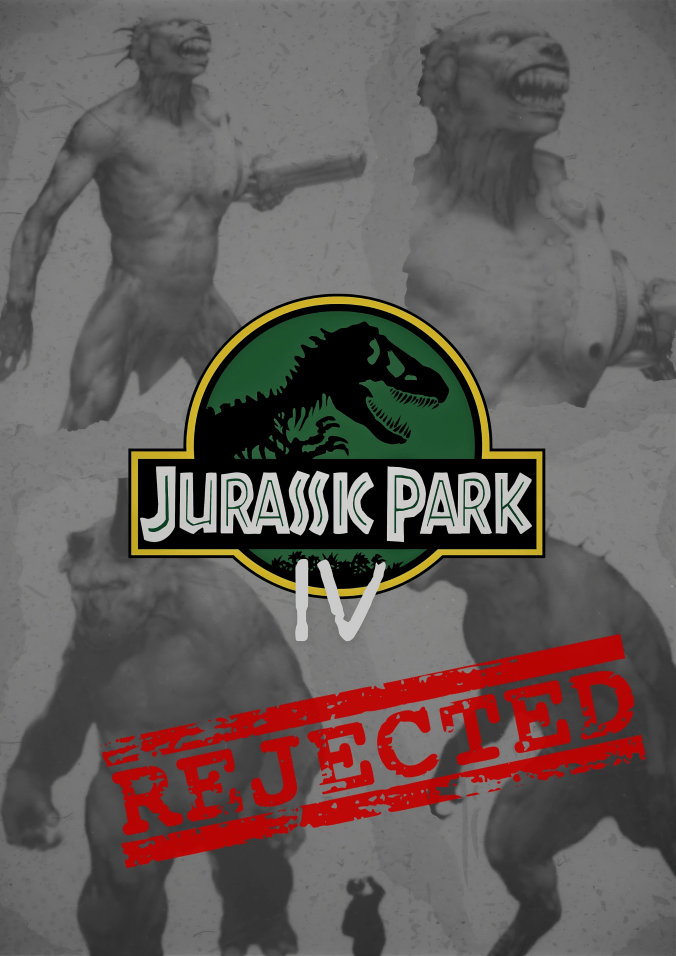
From the information currently available, this hybrid storyline seemingly first came about as a result of esteemed director and the series’ executive producer Steven Spielberg’s supposed dissatisfaction with the prior entry in the franchise; Jurassic Park III (2001), wanting the subsequent sequel to be more daring and worthy of being part of the renowned franchise, hence the jump towards more outrageous concepts. The previously mentioned hybrids were to be intelligent, humanoid, combat-capable creatures that blended human and dinosaur physiology. Among the early illustrations was a Triceratops hybrid, a fully upright, green-skinned creature with humanoid proportions, three toes on each foot and one prominent horn atop its head, the other broken. A Tyrannosaurus Rex hybrid, which stood upright like a human and bore reddish-brown and charcoal-black skin, retaining the creature’s stubby, two-fingered hands, now with more muscular, human-like arms. And, lastly, a Velociraptor hybrid, which went through numerous iterations, with concept artist Carlos Huante, who developed many of the designs, once referring to the creature as the “Raptor-Man” in a since-deleted post on Instagram. Depicting the creature as agile and lean with a humanoid frame augmented by raptor-like features, the Velociraptor hybrid was perhaps the most unsettling of the early designs, blurring the line between futuristic horror and evolutionary fantasy, with one design even bearing a high-tech weapon on its left arm.

Carlos Huante later claimed that the concept of the dinosaur-human hybrids was shut down almost immediately after Steven Spielberg and executives at Amblin Entertainment reviewed the artwork, as they believed the idea strayed too far from the franchise’s core identity, shifting its focus from scientific plausibility and natural wonder to over-the-top, militarised science fiction. Nevertheless, whether intentional or not, the first public hint of this odd creative decision came in October 2003, when palaeontologist and longtime franchise dinosaur consultant Jack Horner appeared on Minnesota Public Radio. In response to a caller’s question regarding the speculative “Dinosauroid,” a hypothetical, intelligent descendant of the omnivore Troodon, a relatively small, bird-like theropod, Horner cryptically answered that the caller should; “Keep Thinking About That for a Couple of Years,” adding; “Go See Jurassic Park IV,” suggesting the franchise would explore the notion of dinosaur evolution.

Interestingly, despite this concept of dinosaur-human hybrids eventually being axed along with this iteration of the series’ fourth instalment, a similar idea had actually appeared during Universal Studios’ Halloween Horror Nights in 2002, an annual scare event often featuring well-known franchises from the horror and sci-fi genres, within the attraction; Project Evilution. In the story of the tropical jungle-themed scare maze, Dr. Burton, a deranged InGen scientist, had conducted twisted experiments, mixing human and dinosaur DNA to create dinosaur-human hybrids that would terrorise visitors, which may have influenced or prefigured many of the illustrations that emerged during the development of Jurassic Park IV.

Outside of the central dinosaur-human hybrid concept, the story of Jurassic Park IV would have focused on ex-Navy Seal Nick Harris, as he is covertly enlisted by John Hammond to travel to the now-restricted island of Isla Nublar to locate Dennis Nedry’s missing canister of dinosaur embryos, lost during the events of Jurassic Park (1993). After landing on the island, avoiding threats and recovering the canister, however, Nick would be captured and taken to an archaic castle in the Swiss Alps. There, Baron Herman Von Drax, the CEO of the corrupt organisation, the Grendel Corporation, would reveal they had created dinosaur hybrids that partially shared DNA with both humans and domestic dogs, which Von Drax had supposedly found a way to control utilising radio signals. From there, the rest of the story follows Nick as he is forced to train the dinosaur-human hybrids to obey Von Drax further, concluding with Nick obtaining complete control of the hybrids, leading to a gigantic action sequence where the carnivorous creatures chase down Von Drax, some even sporting bulletproof armour.

In summary, though shelved, this sequel and, by extension, the notion of dinosaur-human hybrids, remain one of the most absurd yet intriguing ‘what-if’ chapters in the franchise’s history. And, whilst this rendition of Jurassic Park IV never came to fruition, many of its concepts actually did via the eventual, aforementioned soft-reboot; Jurassic World, converting the idea of dinosaur-human hybrids to Jurassic World scientists combining various strands of dinosaur/animal DNA in an attempt to manufacture a formidable, marketable beast, inadvertently resulting in blood-thirsty creatures like the Indominus Rex and the Indoraptor, the latter of which even maintaining the idea of being used as a weapon, but in a manner that felt more grounded in the world established by earlier franchise installments. Additionally, protagonist Nick Harris shares several similarities with Chris Pratt’s ensuing character, Owen Grady, with the two not only sharing the same military background, but also serving as trainers to a squad of carnivorous dinosaurs. Still, in my opinion, discarding this original storyline for the franchise’s fourth instalment was definitely a wise move, narrowly avoiding a creative decision that could have morphed the series into something laughably ludicrous and utterly unrecognisable from what it once was. 
Corpse Bride (2005) – Film Review

Tim Burton’s twisted story of a man accidentally marrying a deceased bride could certainly be seen as too dark for an animated family adventure by some, but the film actually blends many of its dark scenes with plenty of gothic charm, heart and humour throughout. Making this stop-motion flick not quite one of the director’s best, but definitely a must-watch for fans of the unique director.

Plot Summary: When shy groom, Victor Van Dort, practices his wedding vows in the inadvertent presence of a deceased young woman, she rises from her grave assuming he has married her. Before he knows it, ‘Victor’ soon finds himself in the land of the dead, and now must find a way to return to the land of the living before he loses his still-living wife forever…

Alongside the entertaining narrative, throughout the film there are various different musical sequences, which were surprisingly entertaining considering I’m usually not a huge fan of musical numbers in film. But, I actually found many of the songs throughout the film actually added to the plot and gave the film another creative element which worked really well when combined with the brilliant original score by Danny Elfman.

Johnny Depp and Helena Bonham Carter portray ‘Victor’ and his accidental ‘Corpse Bride,’ alongside the supporting cast of Emily Watson and Paul Whitehouse. Who, are all terrific, with the two leads in particular having pretty some great chemistry with each other, which really added to some of the romantic scenes throughout runtime (especially when it comes to an animated film). The cast also features Richard E. Grant, who portrays the villainous, ‘Barkis Bittern,’ perfectly, coming across as very sly, rude and intelligent from start-to-finish.

The cinematography by Pete Kozachik is pretty effective considering his previous work is usually far from the realm of stop-motion animation, as although there is definitely room for improvement, the cinematography is interesting enough to keep the viewer engaged throughout the film’s story.

Without a doubt, the original score by Danny Elfman is definitely one of the best elements of the film, as well as being one of my favourites for a Tim Burton flick, as while not quite on the level of the original ‘Batman’ or ‘Edward Scissorhands,’ for example, the entire soundtrack still perfectly captures the creepy tone of the film, as well as many of it’s more emotional moments, all adding to both an extremely memorable and beautiful score. Especially the tracks; ‘Main Titles’ and ‘End Credits Pt. 1,’ which are my two personal favourites from the film.

The stop-motion animation throughout the film is simply outstanding, as each character’s unique design influences their movements, with many of the characters having very interesting and over-the-top designs which perfectly fit within the world of a Tim Burton story. The film also has an unexpectedly ranged colour palette, as in addition to the usual dark Burton-esque colours. The film surprisingly also uses a large range of bright greens, purples and reds in a few scenes, which all really help the film stand out, and give a little more light to many of the miniature sets and various characters.

In summary, while I didn’t expect to enjoy ‘Corpse Bride’ as much as I did, the film’s fantastic stop-motion animation, great humour and emotional scenes all topped with the unique Tim Burton style, I’d say the film is a pretty solid watch aside from the occasional cheesy joke or scene. Final Rating: 8/10.

corpse_bride_xlg

What’s Wrong With Modern Horror? – Film Discussion

What’s wrong with the majority of modern horror films?

In my opinion, there are many different issues that modern horrors/thrillers suffer from nowadays, although there are a few films that manage to avoid these problems, such as ‘It Follows,’ ‘The Descent,’ ‘A Quiet Place,’ ‘Don’t Breathe’ and ‘The Void,’ to name a few. The majority of modern horrors follow a very similar formula, a group of stereotypical teenagers do something they shouldn’t, e.g. find a certain object (an Ouija board, a cursed book or a dead friend/relative’s photo), or a loving family moves into their new home only for it to be haunted by ghosts/demons. These two plot lines are the go-to for most of the new horror releases, despite being unbelievably drawn out by this point.

Similar to how nearly every horror plot of the 1980s involved a group of teenagers visiting a cabin deep in the woods only to get slaughtered one by one at the hands of a psychotic serial killer. Sticking to stories that we have become so familiar with means that there is little surprise left for the audience, and the narrative soon becomes very predictable. Another issue with the majority of the stories that are told is the weak characters, nearly every modern horror has such bland characters it’s difficult to get invested in the story at all. Just because these characters may be killed off doesn’t mean you don’t have to write for them, having some likeable or interesting characters actually makes the audience care whether they live or die, therefore increasing the film’s tension. Of course, hiring unknown actors who aren’t the most amazing at their craft also doesn’t help this issue.

Another thing that’s always bothered me in regards to the characters in most modern horrors, is the character’s extreme stupidity. The film actually falls less out of reality due to the characters being so unbelievably oblivious to everything around them. It’s understandable the characters would have some doubts the first time one of their friends dies. But, after two or three, it’s ridiculous the characters still haven’t figured out what the audience has half an hour ago, even if they’re curious but not concerned, it’s nothing but frustrating and less believable. This unbelievability also applies to the attractiveness of the cast, as although I think a film featuring a few attractive cast members is perfectly fine, casting nothing but models pulls the audience out of the narrative. A film particularly guilty of both of these things is the Blumhouse supernatural flick; ‘Truth or Dare.’ As this film is a perfect example of the problems I have with most modern horrors, both in regard to their characters, actors and screenplays.

It isn’t just the screenplay or actors that are an issue when it comes to modern horror, however, as the overall filmmaking of the picture is usually extremely bland. Again, due to the genre, some people may believe that filmmaking isn’t important. This isn’t true. The filmmaking can still be impressive while building tension and fear. ‘It Follows’ is a great example of this, the beautiful lighting, cinematography and original score all give the film style without taking anything away from the eerie atmosphere. Horror soundtracks are a huge issue for me when it comes to most films, as it is possible to create a great memorable score without making it just sound eerie, e.g. ‘Halloween’ or ‘The Shining.’

Finally, we get to the biggest problem with modern horror, the classic; jump-scare. Jump-scares only really came around in the early 2000s, but since then they have completely invaded the film industry. Not only appearing in horror but everything from action to sci-fi to even superhero films, they’ve now become almost a staple of modern filmmaking. I don’t believe they are an entirely awful idea, they can be used correctly every so often to shock the audience and give them a quick rush before the next scene. However, most modern horrors now essentially rely on jump-scares (most James Wan films are particularly guilty of this, in my opinion) and I believe this is incredibly lazy. Horror should be about creating an eerie atmosphere, having creepy visuals and giving the audience some likeable characters to fear for, essentially placing the audience in that situation themselves. ‘Pyewacket’ from 2016 is a terrific example of this, drawing out shots and using dim lighting/shadows and silhouettes, can all help build fear in the audience, rather than just throwing ‘frightening’ faces at the screen alongside loud noises to see what sticks.

The primary reason all these bad decisions are made when it comes to the horror/thriller genre is mostly due to money, no matter how awful the majority of these horrors are, the reality is that they make money as these films can be made on modest budgets as they utilise mostly unknown actors and very little CGI or make-up effects, with a target audience consisting of teenagers or horror fanatics who will pay to see the film, no matter how terrible the trailers may look. For example, the first ‘Paranormal Activity’ had a budget of only £11,800 and grossed over £151 million. The film only has an hour and twenty-minute runtime, along with very few ‘ghosts’ even being displayed on-screen. ‘The Bye Bye Man’ also being another example, harbouring a tiny budget of £6 million, with a total gross of £21 million, despite awful reviews from both critics and audiences.

In summary, modern horror films are suffering due to both a lack of creativity and a heavy focus on profit. I’m, of course, aware that film is a business, but, in my opinion, creativity is the most important aspect, as without creativity film doesn’t exist. Horror is a fantastic genre that isn’t reaching its full potential a majority of the time due to production companies/directors not caring. There’s a reason a lot of indie horrors are praised, as they don’t set out to only make money, many of them are extremely creative and make amazing use of their micro-budgets. Although horror also wasn’t perfect in the past, I definitely preferred it. At least back in the ’80s/’90s we still had some creative concepts, from killers invading their victim’s dreams to murderous children’s dolls to even a hand-held documentary on teenagers finding an ancient evil witch in a forest. The possibilities were (and still are) truly endless. Hopefully soon, filmmakers and producers alike will look past the profit and truly see this.

insidious_xxlg