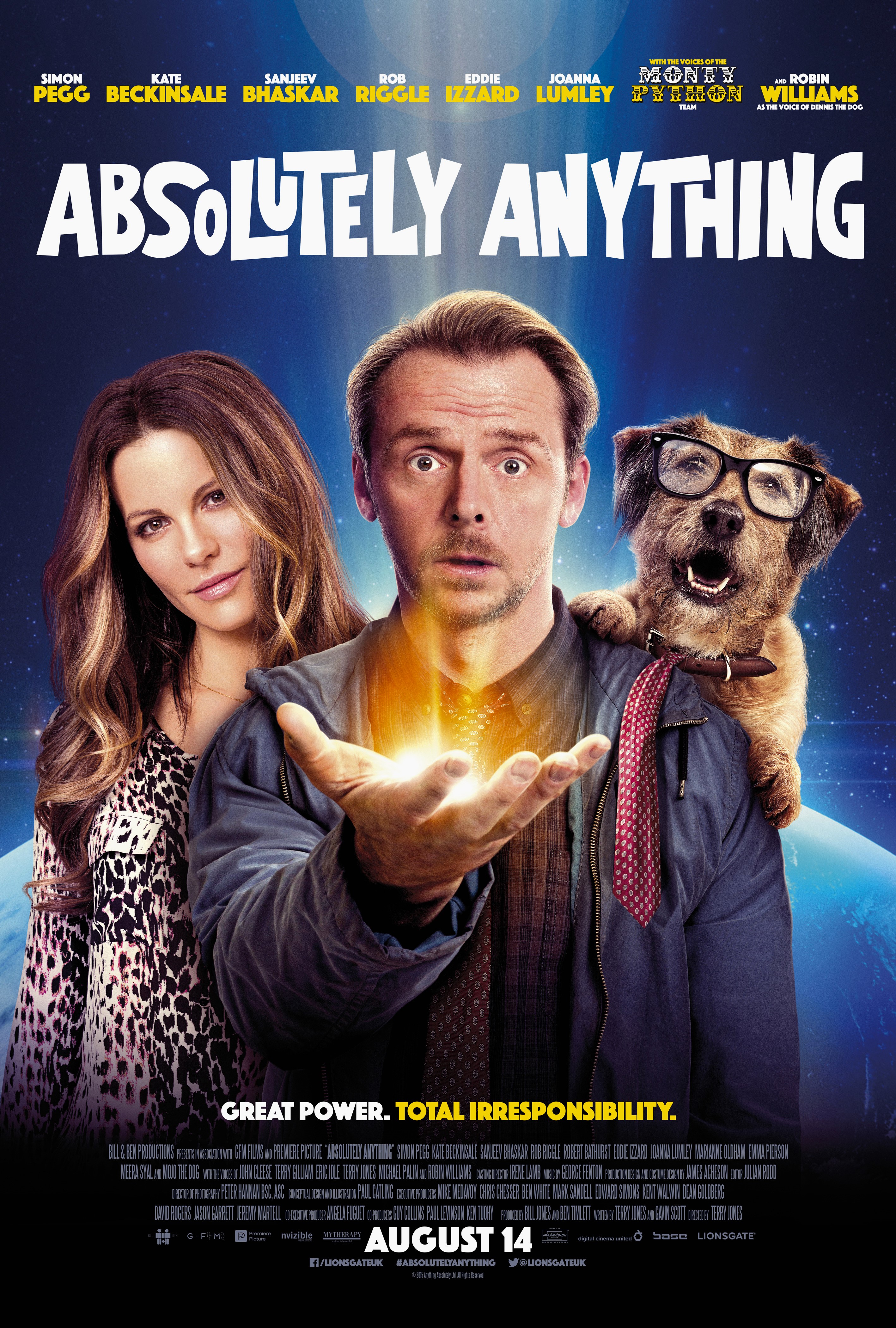
Absolutely Anything (2015) – Film Review

“Absolute Power Doesn’t Corrupt, It Just Drives You Bloody Mad!” – Neil Clarke

Released in 2015, Absolutely Anything is a zany sci-fi-comedy that explores the age-old fantasy of unlimited wish fulfillment, a concept historically associated with gods, genies and mythical beings. In this instance, however, the power rests in the hands of omnipotent extraterrestrials, who, believing in their superiority, bestow their boundless ability upon a single unsuspecting human. Alas, aside from this inventive alternative, Absolutely Anything misuses its limitless premise and affable lead, Simon Pegg, for a typical rom-com setup, offering mild, light-hearted entertainment over consistent gags, creative visuals or lasting impact.

Plot Summary: As part of an interplanetary experiment, an extraterrestrial council traverse the universe in search of intelligent life. Upon reaching Earth, they initiate their usual test of granting one randomly selected inhabitant the ability to do anything to determine whether humanity is worthy of joining their intergalactic community or should be annihilated. A test that likely spells doom for humanity as the council haphazardly selects Neil Clarke, a washout British school teacher, as their subject…

Co-written and directed by the late Terry Jones (Monty Python and the Holy Grail, Personal Services, The Wind in the Willows), Absolutely Anything draws inspiration from the 1898 short story; The Man Who Could Work Miracles, by H.G. Wells, as both stories centre on an ordinary man suddenly granted reality-altering abilities. However, the leading discrepancy between the two is how Absolutely Anything leans heavily into comedy, delivering a string of farcical scenarios that allow Pegg’s energetic performance to shine. As such, the tone throughout the film remains consistently blithe as the screenplay shies away from any deep philosophical exploration of its central concept or even any long-term consequences to Neil’s actions, as when a situation veers into chaos, Neil merely waves his hand to undo the damage, undercutting any disorder his newfound power might trigger.

As the leading man, Simon Pegg infuses Neil Clarke with an endearing blend of immaturity and dopey charm, rendering the character’s misguided desires and naïve missteps more forgivable. Still, the film undoubtedly misses the opportunity to examine how absolute power might affect the average person, for better or worse. Instead, Neil uses his ability almost entirely for petty or farcical purposes, with one of his more amusing decisions granting his loyal dog, Dennis, the capacity to speak, leading the canine to be energetically voiced by the late Robin Williams. The result is a delightfully giddy sidekick, whose witticisms often relate to the amusing traits of his species. Less enjoyable is the romantic subplot between Neil and his downstairs neighbour Catherine, portrayed by Kate Beckinsale, as despite Neil’s fascination with Catherine being at the core of the story, her character is underwritten and uninteresting, making their relationship (and her inclusion) feel obligatory rather than organic, a criticism that applies to many of the side characters.

Visually, Absolutely Anything is an odd mix of British realism and low-budget science fiction, with the majority of the film shot in and around an abandoned building that was formerly a school, cleverly repurposed to serve as Neil’s flat and the secondary school where he teaches. While these Earthbound settings help ground the otherwise outlandish story in a familiar, everyday backdrop, many of the sets throughout the runtime appear cheap and flavourless, especially when combined with the American sitcom-esque lighting and cinematography by Peter Hannan. The most jarring disparity in the film’s visuals, however, comes with the subpar CG effects, from the splicing of Simon Pegg’s head onto different bodies to the space-bound sequences of the extraterrestrial council debating; the CGI is noticeably lacking, even if the aliens’ designs exhibit visual variety.

Contrarily, the original score by George Fenton brings a whimsical energy to the film, as his compositions underscore the comedic beats with light piano melodies, lively orchestration and plucky strings that reflect Neil’s bemused reactions to his newfangled ability. For example, during the scene where Neil begins experimenting with his powers, commanding a bottle of whiskey to exchange itself only to witness it bouncing down the stairs towards the front door, the accompanying track is fittingly bouncy and eccentric.

Upon its initial release, Absolutely Anything was frequently compared to Bruce Almighty (2003), another male-led comedy about divine empowerment. But, their distinctions are actually quite significant, as Bruce Nolan, the titular character, cannot override free will, whereas Neil can. Moreover, Bruce Almighty centres on a theological framework with God as an active character, whereas Neil’s powers come from extraterrestrials he never encounters, exuberantly voiced by the surviving members of the Monty Python series. In fact, Absolutely Anything notably marks the first on-screen reunion of the Monty Python cast since The Meaning of Life (1983), and, according to Terry Jones, might be their last collaborative outing. There’s also a nod to their comedic legacy during the opening sequence, as the camera pans across space to an orbital scrapyard of discarded spaceships, one of which is from 1979’s Life of Brian.

In summary, Absolutely Anything is a comedy buoyed by its bewitching premise and the charisma of its lead. Yet, it is frustratingly superficial, opting for a low-stakes story, cartoonish gags and rom-com tropes rather than exploring the satirical or existential dimensions its narrative invites. Whilst the film does contain some moments of wit, Absolutely Anything never lives up to the potential promised by its title or the strong comedic talent it harbours. Rating: 4/10.

Jurassic Park IV (2005) – Lost Projects

Before 2015’s Jurassic World brought dinosaurs back to the silver screen in the form of a glossy soft reboot, an earlier, radically different concept was drawn up for the fourth instalment of the franchise, with the aptly titled; Jurassic Park IV, set for release in mid-2005. This scrapped, now-long-forgotten sequel would’ve taken the series in a bold and contentious direction, concentrating its narrative on a crazed storyline revolving around genetically engineered dinosaur-human hybrids being deployed worldwide as weaponised combatants by a sinister organisation. While this ludicrous idea did reach the concept art and early scripting stages, the project was ultimately discarded, with executives fearing it would undermine the cinematic legacy and relatively grounded tone of the franchise’s earlier instalments, relegating the unproduced film to become an obscure yet fascinating piece of the franchise’s history, following the success of the 1993 classic that began its journey.

From the information currently available, this hybrid storyline seemingly first came about as a result of esteemed director and the series’ executive producer Steven Spielberg’s supposed dissatisfaction with the prior entry in the franchise; Jurassic Park III (2001), wanting the subsequent sequel to be more daring and worthy of being part of the renowned franchise, hence the jump towards more outrageous concepts. The previously mentioned hybrids were to be intelligent, humanoid, combat-capable creatures that blended human and dinosaur physiology. Among the early illustrations was a Triceratops hybrid, a fully upright, green-skinned creature with humanoid proportions, three toes on each foot and one prominent horn atop its head, the other broken. A Tyrannosaurus Rex hybrid, which stood upright like a human and bore reddish-brown and charcoal-black skin, retaining the creature’s stubby, two-fingered hands, now with more muscular, human-like arms. And, lastly, a Velociraptor hybrid, which went through numerous iterations, with concept artist Carlos Huante, who developed many of the designs, once referring to the creature as the “Raptor-Man” in a since-deleted post on Instagram. Depicting the creature as agile and lean with a humanoid frame augmented by raptor-like features, the Velociraptor hybrid was perhaps the most unsettling of the early designs, blurring the line between futuristic horror and evolutionary fantasy, with one design even bearing a high-tech weapon on its left arm.

Carlos Huante later claimed that the concept of the dinosaur-human hybrids was shut down almost immediately after Steven Spielberg and executives at Amblin Entertainment reviewed the artwork, as they believed the idea strayed too far from the franchise’s core identity, shifting its focus from scientific plausibility and natural wonder to over-the-top, militarised science fiction. Nevertheless, whether intentional or not, the first public hint of this odd creative decision came in October 2003, when palaeontologist and longtime franchise dinosaur consultant Jack Horner appeared on Minnesota Public Radio. In response to a caller’s question regarding the speculative “Dinosauroid,” a hypothetical, intelligent descendant of the omnivore Troodon, a relatively small, bird-like theropod, Horner cryptically answered that the caller should; “Keep Thinking About That for a Couple of Years,” adding; “Go See Jurassic Park IV,” suggesting the franchise would explore the notion of dinosaur evolution.

Interestingly, despite this concept of dinosaur-human hybrids eventually being axed along with this iteration of the series’ fourth instalment, a similar idea had actually appeared during Universal Studios’ Halloween Horror Nights in 2002, an annual scare event often featuring well-known franchises from the horror and sci-fi genres, within the attraction; Project Evilution. In the story of the tropical jungle-themed scare maze, Dr. Burton, a deranged InGen scientist, had conducted twisted experiments, mixing human and dinosaur DNA to create dinosaur-human hybrids that would terrorise visitors, which may have influenced or prefigured many of the illustrations that emerged during the development of Jurassic Park IV.

Outside of the central dinosaur-human hybrid concept, the story of Jurassic Park IV would have focused on ex-Navy Seal Nick Harris, as he is covertly enlisted by John Hammond to travel to the now-restricted island of Isla Nublar to locate Dennis Nedry’s missing canister of dinosaur embryos, lost during the events of Jurassic Park (1993). After landing on the island, avoiding threats and recovering the canister, however, Nick would be captured and taken to an archaic castle in the Swiss Alps. There, Baron Herman Von Drax, the CEO of the corrupt organisation, the Grendel Corporation, would reveal they had created dinosaur hybrids that partially shared DNA with both humans and domestic dogs, which Von Drax had supposedly found a way to control utilising radio signals. From there, the rest of the story follows Nick as he is forced to train the dinosaur-human hybrids to obey Von Drax further, concluding with Nick obtaining complete control of the hybrids, leading to a gigantic action sequence where the carnivorous creatures chase down Von Drax, some even sporting bulletproof armour.

In summary, though shelved, this sequel and, by extension, the notion of dinosaur-human hybrids, remain one of the most absurd yet intriguing ‘what-if’ chapters in the franchise’s history. And, whilst this rendition of Jurassic Park IV never came to fruition, many of its concepts actually did via the eventual, aforementioned soft-reboot; Jurassic World, converting the idea of dinosaur-human hybrids to Jurassic World scientists combining various strands of dinosaur/animal DNA in an attempt to manufacture a formidable, marketable beast, inadvertently resulting in blood-thirsty creatures like the Indominus Rex and the Indoraptor, the latter of which even maintaining the idea of being used as a weapon, but in a manner that felt more grounded in the world established by earlier franchise installments. Additionally, protagonist Nick Harris shares several similarities with Chris Pratt’s ensuing character, Owen Grady, with the two not only sharing the same military background, but also serving as trainers to a squad of carnivorous dinosaurs. Still, in my opinion, discarding this original storyline for the franchise’s fourth instalment was definitely a wise move, narrowly avoiding a creative decision that could have morphed the series into something laughably ludicrous and utterly unrecognisable from what it once was. 

Anomalisa (2015) – Film Review

“Sometimes There’s No Lesson. That’s a Lesson in Itself.” – Michael Stone

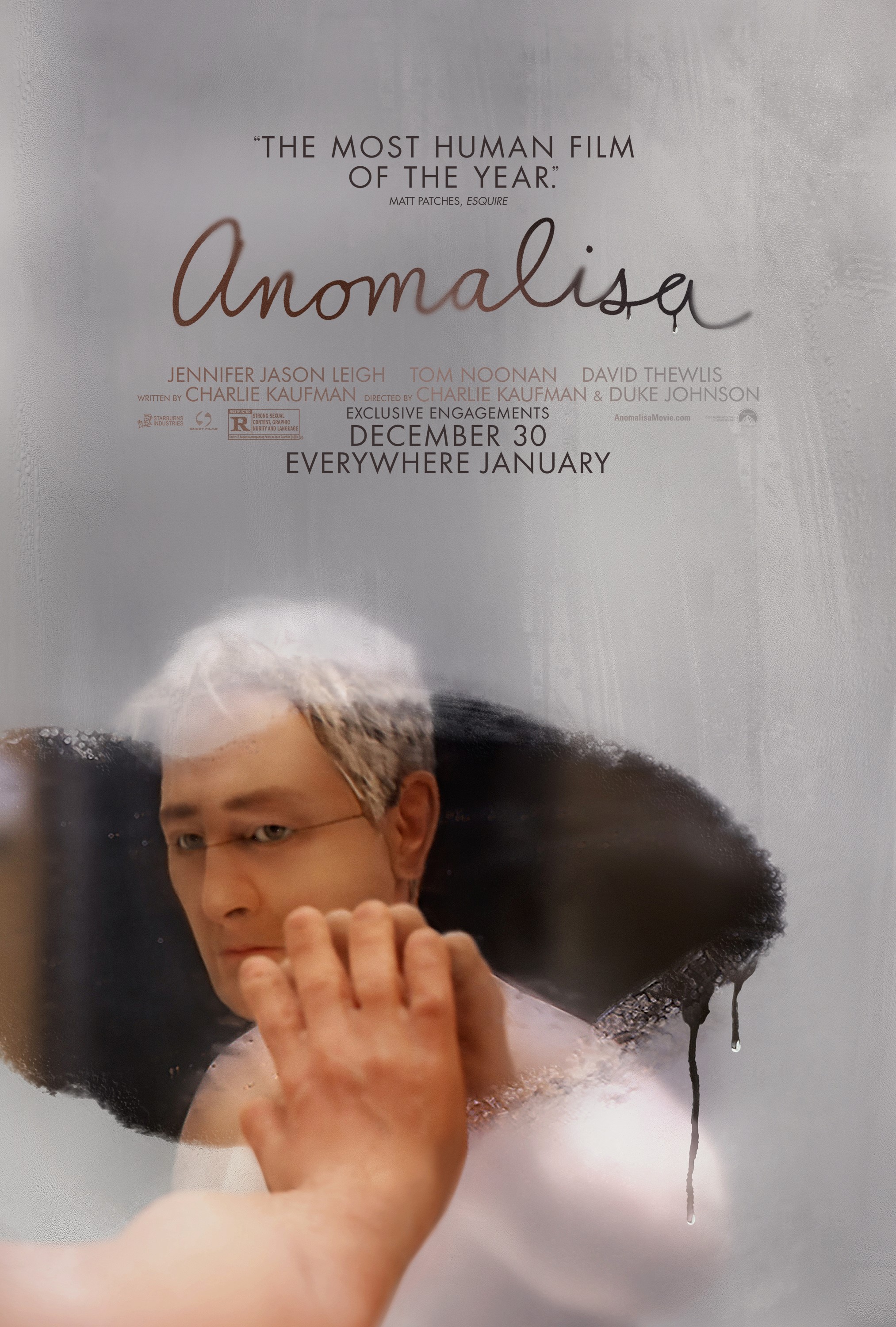
Originally planned to be a short film, roughly forty minutes in length, with the large sum of funds later gathered from a crowd-funder on Kickstarter pivoting the project to become feature-length, 2015’s Anomalisa is a technically impressive and exceptionally humane stop-motion drama that marks another distinctive highlight in writer and co-director Charlie Kaufman’s filmography. Serving as a thought-provoking treat for fans of introspective cinema, Anomalisa is a quirky and mesmerising exploration of mental illness seen through the eyes of a middle-aged author trapped beneath the weight of his mundane life, integrating memorable characters and dry wisecracks wherever possible to craft a story that is just as captivating as it is interpretive.

Plot Summary: After travelling to Cincinnati, Ohio, to deliver a speech at the Fregoli Hotel, motivational writer and customer service expert Michael Stone encounters Lisa, a seemingly unremarkable woman who immediately enchants him, shaking up his mundane existence after many years of feeling disconnected from his family and those around him…

Directed by Duke Johnson and Charlie Kaufman, the latter also being the screenwriter, Anomalisa is one of those films that will click with some audience members sometime after the credits roll, dwelling on many of the concepts the film focuses on through its relatively simple, yet accessible and melancholic story, a narrative made more interesting by how it’s told. Blending Kaufman’s caustic sense of humour with genuine moments of human connection, Anomalisa is stuffed with true-to-life, awkward interactions, naturalistic dialogue and numerous subtle touches, similar to many of his previous written works, such as Being John Malkovich (1999) and Eternal Sunshine of the Spotless Mind (2004). Moreover, Anomalisa acts as a direct challenge to the notion that many still seem to hold; that animated films are solely for children, combating this belief by conveying a mature story via charming stop-motion, never shying away from harsh language, nudity or even a graphic scene in which two of the lifelike, puppeteered characters engage in lovemaking.

On the topic of characters, the robust central duo of David Thewlis and Jennifer Jason Leigh are terrific, delivering superb vocal performances that (along with the dialogue) deliver characterisation to the audience, quickly making it apparent that Michael has mental baggage related to Cincinnati, bearing the scars of a love life he left behind. Right from the opening scene, it also becomes apparent that Michael is one of the only uniquely designed puppets, as every other character he encounters seems to have an identical facial structure and a similar voice with a comically flat tone, continually voiced by Tom Noonan. All of these analogous characters (male or female, adult or child) illustrate how Michael, despite his career, struggles to interact with those around him, desiring to do anything but talk to others, including his wife and son, with certain details regarding his behaviour suggesting the character is going through a mid-life crisis and/or implying he may have serious mental issues. Yet, both are merely theories, as nothing is ever confirmed.

Visually, the film’s stop-motion animation is stunning, with the felt-faced puppets lending personality to every scene. Each character lives and breathes on-screen in a way that I feel visual effects couldn’t achieve, making the fact that every character was brought to life via thousands of tiny adjustments all the more extraordinary. The animation is utilised to spectacular effect during one nightmarish dream sequence, where Michael is confronted by his seemingly deteriorating mental state, even drawing attention to his puppet’s prominent facial slit in a bizarrely humorous fourth-wall-breaking moment. On top of the animation, the cinematography by Joe Passarelli is visually striking, frequently appearing as if it has been carried over from a live-action drama.

Often coming across as a forty-minute audible representation of the film itself, the original score by Carter Burwell is a slow-paced and downcast soundtrack that occasionally features snippets of dialogue from the film’s various characters, an eccentricity that is sometimes effective and sometimes irritating, with the score’s finest track; Overture, thankfully being dialogue-free, allowing its nuanced sweetness to flourish.

Further playing into the previously mentioned theories surrounding the film, it’s interesting to note that the hotel Michael stays at, the Fregoli Hotel, is actually named after “The Fregoli Delusion,” also known as “The Delusion of Doubles,” a rare disorder in which a person holds the misconception that those around them are a single person who changes appearance or is in disguise. While Kaufman has confirmed in the past that Michael doesn’t suffer from this exact disorder, the Fregoli Delusion did serve as an inspiration for the film and functions as a reasonable explanation for some of Michael’s peculiar visions, but still doesn’t answer every inquiry an audience member may have about his mental state.

In summary, although the exquisite sop-motion animation automatically makes the film worth a viewing for anyone with even the slightest interest in stop-motion storytelling, Anomalisa will likely have its naysayers, given the film is a rather cyclical drama featuring a cynical protagonist, with perhaps too few gags mixed-in to oppose the constant cynicism. Nevertheless, the film is a well-conceived character study exploring loneliness and mental illness, impressively interpreted through a painstaking style of animation, painting a different shade of drama, a drama that I personally believe wouldn’t work as well should it have been produced with CGI or in live-action. Rating: 8/10.

The Hateful Eight (2015) – Film Review

“One of Them Fellas Is Not What He Says He Is…” – John ‘The Hangman’ Ruth

Written and directed by legendary filmmaker Quentin Tarantino (Reservoir Dogs, Pulp Fiction, Inglourious Basterds), 2015’s The Hateful Eight is appropriately Tarantino’s eighth cinematic masterwork and his second western following Django: Unchained in 2012. Loaded with astounding performances, captivating dialogue and a story that seems to fly by even with a runtime of almost three hours, The Hateful Eight is a suspenseful and darkly comedic flick where every character is shrouded in mystery and distrust. And, whilst not quite as iconic or as influential as some of Tarantino’s other work, I feel the film is rather underrated when it comes to his esteemed catalogue of entertainingly violent projects, standing firm as a gripping mystery-thriller with a wintry western backdrop.

Plot Summary: While heading toward the town of Red Rock in post-Civil War Wyoming, bounty hunter John ‘The Hangman’ Ruth and his fugitive prisoner, Daisy Domergue, come upon another bounty hunter and a drifter claiming to be Red Rock’s newest sheriff. Despite their distrust for one another, the group travels to a nearby stagecoach stopover, seeking shelter from an approaching blizzard. Greeted there by four other nomads, their shared scepticism reaches its peak as the weary travellers realise they may not reach their destination

From beginning to end, The Hateful Eight is oozing with tension and Tarantino’s signature style of filmmaking, quickly proving itself to be just as enjoyable as his many other critically acclaimed projects. The story itself bears many similarities to the sci-fi-horror; The Thing (1982), as both stories take place in an isolated location, concentrating on a collection of rugged characters who doubt each others’ intentions. Additionally, both films retain an atmosphere of dread and mistrust that builds almost imperceptibly, concluding with a thrilling climax. Of course, dissimilar to the 1980s classic, The Hateful Eight doesn’t feature an extraterrestrial creature mimicking its victims. Instead, much of the characters’ distrust comes from their varying beliefs and sinful histories, especially since Tarantino doesn’t play it safe in regard to the many racist sentiments that populated America during the post-Civil War era.

With two bounty hunters, a fugitive prisoner, a drifter who claims to be the newest sheriff of the small town of Red Rock, Bob “The Mexican,” enthusiastic hangman Oswaldo Mobray, lonesome cowpoke Joe Gage and the elderly war general Sandy Smithers, all expertly portrayed by Samuel L. Jackson, Kurt Russell, Jennifer Jason Leigh, Walton Goggins, Demián Bichir, Tim Roth, Michael Madsen and Bruce Dern, The Hateful Eight has no shortage of compelling characters and equally compelling performances. As a result of the characters’ myriad of slow-burning conversations, the film consistently retains a solid level of tension via the characters’ interactions, with Jackson being at his best, whilst Roth warrants merit for his performance as his character Oswaldo delivers a number of comedic moments due to his eccentric British accent and joyful outlook on the justice system.

Aside from the film’s occasional use of slow-motion, which appears corny and needless, nearly all of the visuals throughout The Hateful Eight are spectacular, as the cinematography by Robert Richardson effortlessly captures the seclusion of the setting of a stagecoach stopover caught in a blizzard. Providing a pleasant aesthetic change, not only from Tarantino’s prior western, but the western genre in general, visually differentiating itself as a result of the vast whiteness of the creeping cold just outside the stopover’s wooden doorway. Across many scenes, The Hateful Eight also possesses an almost theatre-like quality, which is an intriguing concept that is taken one step too far, in my opinion, when the story is interrupted by a short ‘interval,’ where Tarantino himself narrates what transpired in the past fifteen minutes after a jump cut, instantly yanking the audience out of the immersion of the narrative.

Known for his many western scores, as well as his arrangements for the previously mentioned sci-fi-horror; The Thing, composer Ennio Morricone similarly backs up many of the film’s suspenseful moments flawlessly through tracks like Overture and Neve. In fact, according to Tarantino, some of Morricone’s compositions for the film are actually unused pieces from the gruesome ’80s masterpiece. As brilliant as the original score is, however, The Hateful Eight conversely makes effective use of audible restraint during many scenes, with the blistering wind of the approaching blizzard pounding the stopover’s walls only escalating the build-up of tension.

On another note, cinephiles familiar with the director’s illustrious filmography will have a field day checking off the countless Tarantino tropes, from the chapter headings to the Red Apple tobacco reference and a final act full of glorious blood and guts. However, one lesser-known tidbit is Tarantino’s continuous collaboration with practical effects artist Greg Nicotero, the effects guru behind the post-apocalyptic television series; The Walking Dead, along with an array of Quentin Tarantino’s other projects, including Kill Bill: Vol. 1 (2003), Inglourious Basterds (2009) and Django: Unchained (2012). Comparable to those flicks, the practical effects throughout The Hateful Eight are brutal and virtually cartoonish in design, lending themselves to some of the film’s most memorable moments.

In summary, The Hateful Eight unsurprisingly offers another well-crafted jewel from Quentin Tarantino, integrating his signature blend of suspense, humour, snappy dialogue and over-the-top ultra-violence, all whilst demonstrating his grip on the filmmaking craft has in no way diminished amidst his many years of operating in the ever-evolving film industry. As such, The Hateful Eight is certainly not one to be missed. Rating: 8/10.

hateful_eight_ver10_xxlg

Jupiter Ascending (2015) – Film Review

“I Will Harvest That Planet Tomorrow Before I Let Her Take It From Me.” – Balem Abrasax

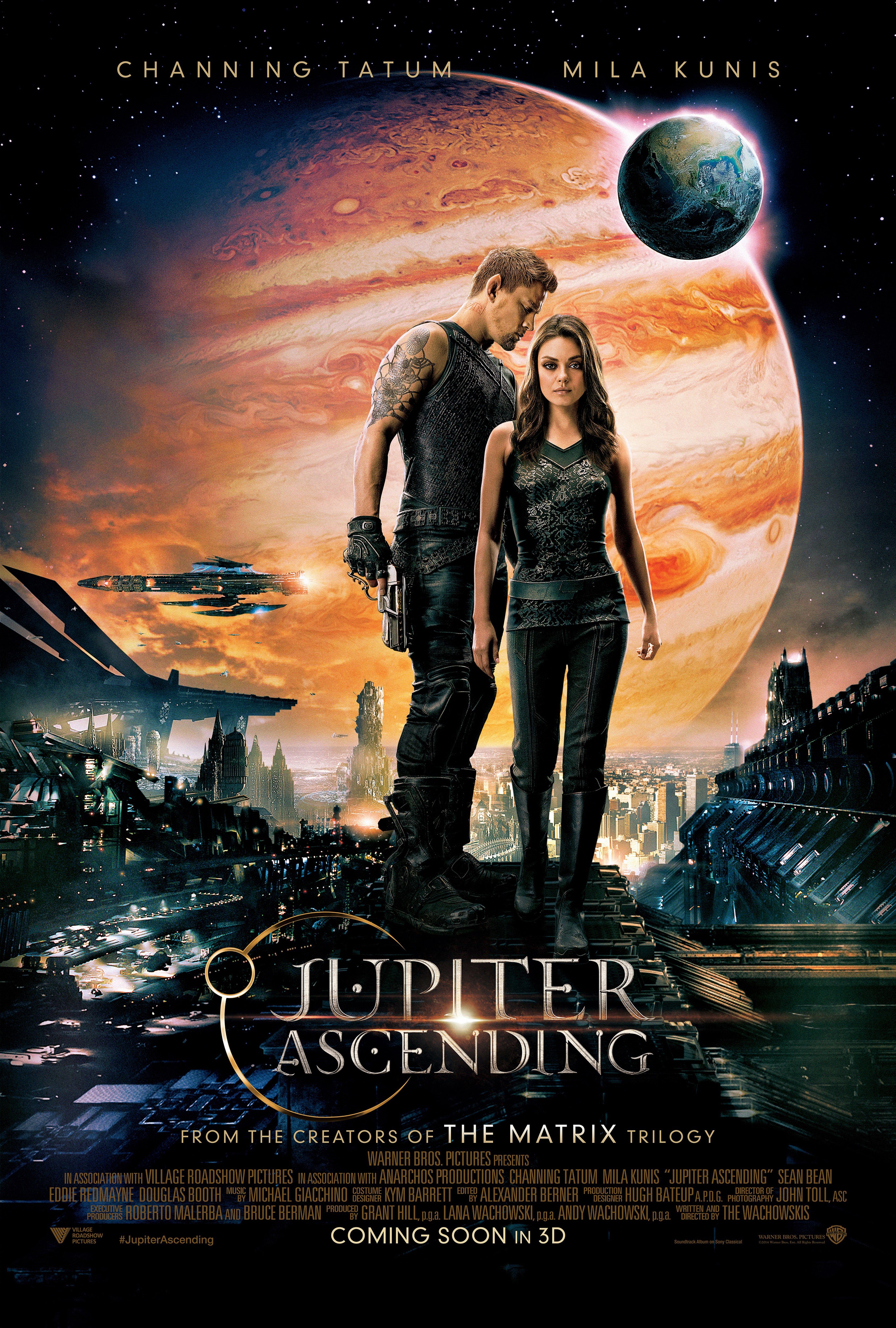
A sci-fi blockbuster from the writer-directors behind; Cloud AtlasV for Vendetta and The Matrix trilogy, Lana Wachowski and Lilly Wachowski, a.k.a. the Wachowskis. 2015’s Jupiter Ascending is a rarely exciting, often laughable science fiction flick that attempts to explore a number of interesting concepts yet frequently fails on almost every other front. Unquestionably the singular work of the Wachowskis, Jupiter Ascending exhibits many of the filmmakers’ worst tendencies, recounting a campy, overblown spectacle of a story that retains barely any of the visionary leadership that drove some of their earlier filmographies to be held in such high regard.

Plot Summary: Born under a night sky, with signs predicting she was destined for great things, Jupiter Jones dreams of the stars but awakens to the cold reality of a dead-end cleaning job in Chicago. But, when Caine Wise, a genetically engineered ex-military bounty hunter, arrives on Earth to track her down, Jupiter begins to realise what the universe has in store for her as she is marked next in line for a royal inheritance that could alter the balance of the cosmos…

Originally slated to release on July 25th, 2014, before the production slipped over six months to provide more time for the visual effect team to complete the elaborate effects. Jupiter Ascending possesses many attributes that commonly make for an entertaining sci-fi epic, with large-scale set pieces, thrilling action sequences and moments of world-building all appearing throughout its runtime. However, similar to The Matrix sequels, where the sheer scale of the storytelling seemed to overwhelm the Wachowskis, Jupiter Ascending frequently appears unfocused and carries little dramatic weight as it places all of its attention on exploring its vast universe, with the plot itself resembling planet-hopping stories like Dune and the Star Wars prequel trilogy, revolving around various factions grasping for power. It’s a serviceable story, to be sure, but it usually feels secondary to the world-building which, as previously mentioned, comes across as cluttered and forces countless characters to serve as exposition dumps for Jupiter, even if there are some interesting ideas at play, such as humans not originating from Earth and being sighted as cattle to species that consider themselves superior.

On a screenplay level, Jupiter Ascending is hardly revolutionary, depicting the protagonist, Jupiter Jones, as a young, seemingly insignificant woman who discovers she actually holds the key to extraordinary power. Yet, the screenplay rarely treats Jupiter as anything more than a damsel in distress, constantly needing to be protected by the fearless soldier turned bounty hunter, Caine Wise. As a result, the central duo of Mila Kunis and Channing Tatum deliver rather bland performances, occasionally wisecracking as they travel from location to location, continually in danger and continually underdeveloped, especially when they develop feelings for one another. In keeping with their surroundings, the supporting cast of Sean Bean, Eddie Redmayne, Douglas Booth and Tuppence Middleton turn in similarly lacklustre performances, with Redmayne’s performance as the antagonist, Balem Abrasax, being the true standout (unintentionally so), whispering some lines and shrieking others.

The visuals of Jupiter Ascending are one of the film’s best aspects, as the cinematography by John Toll captures the majesty of outer space in several creative ways, presenting the universe with much more colour and lavishness than many other sci-fi blockbusters. Speaking of other science fiction franchises, unlike Stark Trek or Battlestar Galactica, all of the spaceship designs throughout the film are pristine and elegant, almost comparable to floating cathedrals, as they maintain a golden colour scheme to play into the idea of the proprietors of said ships (and accompanying opulent costumes) belonging to a royal bloodline. Many of the interiors of the spaceships even appear inspired by European architecture, specifically Renaissance architecture, massively deviating from the grey, metallic interiors seen in most of the sci-fi genre. Sadly, however, it’s difficult to fully concentrate on the myriad of beautiful visuals due to the abysmal dialogue, which ranges from dull and overly expositional to unconsciously hilarious.

On another cynical note, the original score by Michael Giacchino is regrettably one of the composer’s weakest scores to date. Moving from thunderous, brassy statements to a deeply menacing voice choir that evokes memories of The Emperor’s Theme from Star Wars: Episode VI – Return of the Jedi, released in 1983, the soundtrack for Jupiter Ascending certainly fits within the science fiction genre, yet never feels distinguishable or greatly adds to the emotion/excitement playing out on-screen.

In terms of action, Jupiter Ascending makes the most of its few action sequences by having Caine Wise and the assorted adversaries he goes against cleverly utilise a selection of futuristic weapons and gadgets. In particular, one early sequence of Jupiter and Caine escaping an extraterrestrial attack squad in a chase above the twilight streets of Chicago is both eye-catching and exhilarating.

In summary, at its heart, Jupiter Ascending is a jumbled wish-fulfilment narrative whereby a despondent cleaner turns out to be the secret proprietor of Earth. And with so many heroes’ journey-type franchises existing nowadays, it is a bold stroke to make the ‘chosen one’ a respected monarch. But, on account of the sheer magnitude of the story and world-building, Jupiter Ascending quickly crumbles under its only weight, only being saved from total collapse by its impressive visual effects and stimulating action set pieces, subsequently failing to start what would have been yet another big-budget science fiction franchise. Rating: low 4/10.

jupiter_ascending-p914589

Carol (2015) – Film Review

“You Seek Resolutions Because You Are Young. But, You Will Understand This One Day.” – Carol Aird

A period-set romantic drama with a pleasant festive aesthetic in the former half of its runtime, 2015’s Carol is based on the novel; The Price of Salt by Patricia Highsmith. Powered by the fantastic performances of Cate Blanchett and Rooney Mara in the lead roles, Carol is a well-told and engrossing tale of forbidden love between two women that lives up to its cherished source material. Thanks in part to its elegant production design and magnificent original score by Carter Burwell.

Plot Summary: During the Christmas season of 1952, aspiring photographer, Therese Belivet, meets Carol Aird whilst working at a boutique store in Manhattan. Semi-divorced and entrapped in a loveless relationship with her former husband, Carol quickly sparks a connection with Therese over their shared romantic hardships. Yet, amidst the strict social norms of their time, their undisguised interest in one another soon turns into profound affection…

The original novel the film is based upon was actually inspired by a blonde woman in a mink coat who ordered a doll from Patricia Highsmith when she was working as a temporary salesgirl at Bloomingdale’s in New York City during the 1948 Christmas season. Highsmith recalled feeling; “Odd and Swimmy in the Head, Near to Fainting. Yet, at the Same Time, Uplifted.” Highsmith completed the outline for the story in about two hours that same night. Moreover, the character of Carol Aird was inspired by Virginia Kent Catherwood, a Philadelphia socialite six years older than Patricia Highsmith, with whom the author had a love affair in the 1940s. Catherwood subsequently lost custody of her daughter after her homosexuality was used against her with a taped recording of a lesbian liaison she had in a hotel room. Director Todd Haynes (Velvet GoldmineFar from HeavenI’m Not There) sufficiently employs all these ideas into a grander narrative in his adaptation, primarily concentrating on the senseless consequences of a lesbian relationship in a time when they were strongly frowned upon.

When it comes to the cast, the pairing of Cate Blanchett and Rooney Mara is superb, with Blanchett portraying the thirty-two-year-old, Carol Aird, as a woman chafing against the constraints of her role as an upper-class wife and mother, continually expressing her sexual desires for women as a method of rebelling against her husband and her conformist world. While Mara’s performance as nineteen-year-old, Therese Belivet, is more suppressed, depicting the quiet young woman as a self-deprecating, novice photographer who prefers to hide behind her camera than engage with others. Softly spoken and sweet-natured, Therese is as single-minded in her relationship with her boyfriend as she is in her pursued career. As such, it’s easy to see why the pair bond, given that they provide a sense of escapism for each other, and upon their first meeting, the sexual tension between them is palpable.

Although the cinematography by Edward Lachman is doubtful to blow any audience member away with its framing or use of colour, Carol still features a number of visually interesting shots that occasionally even illustrate what the characters are feeling. For instance, in the opening shot, we see an iron floor grille from which the camera slowly pulls out, visually representing the entrapment that Carol and Therese feel at the beginning of the narrative. Another intriguing attribute in regard to the visuals is that Carol was shot on Super-16 millimetre film to better resemble the look of photographic film from the late 1940s/early 1950s. Many of the shots are also directly influenced by the photojournalism of Vivian Maier, Ruth Orkin, Helen Levitt and Esther Bubley, respectively.

Moving onto the original score, through orchestral tracks like OpeningDatebookChristmas Trees and Waterloo, the score by Carter Burwell consistently sounds wrapped in a gauze of wistful minimalism, with the leading duo being audibly identified by two instrumental markers; Carol by piano and Therese by woodwinds. In addition to the wonderful original score, Carol makes terrific use of songs from the time period. In fact, prior to the start of production, Todd Haynes compiled a playlist of seventy-nine songs that were popular during the era the story is set within to further understand the period. A few of the songs that were ultimately chosen for the film include; One Mint JulepEasy Living and Smoke Rings.

From start to finish, the production design of Carol is also outstanding, capturing the polished and aristocratic essence of the ’50s without seeming excessive. This praise can be applied to all parts of the production, but, most notably, the costume design. What makes the costume design even more spectacular is that excluding the suit Therese wears in her first and last scene(s), all of Rooney Mara’s costumes were actually well-worn, vintage clothing pieces.

In summary, whilst Carol isn’t one of the finest romantic dramas ever made, it is still a tremendous flick in more ways than one. While the pacing is sometimes too slow for its own good, and the original score occasionally does a lot of the heavy lifting during the more emotionally impactful moments, Carol is an indelible and captivating story, all the same. On top of that, even though many may see Carol as a rather strange choice for a Christmas viewing, I feel the joyous, snowy aesthetic that the film presents during its first half is enough to make the flick a reliable, less whimsical pick for the festive season. Rating: low 7/10.

carol-p1023477

Room (2015) – Film Review

“There Are So Many Things Out Here. And Sometimes It’s Scary. But, That’s Ok. Because It’s Still Just You and Me…” – Jack

Based on the best-selling novel of the same name by Emma Donoghue, 2015’s Room is a captivating and immensely well-crafted drama, guided by a pair of astonishing performances from Brie Larson and the young Jacob Tremblay. Simultaneously showcasing the best and worst of humanity, Room undoubtedly begins in a very dark place narrative-wise, but that doesn’t necessarily make it a bleak film, as Room is filled with just as many uplifting moments as it has sombre ones. Ultimately making for a harrowing yet equally rewarding piece of both filmmaking and storytelling.

Plot Summary: Held captive for seven years by a rapist, eventually giving birth to a baby boy. Joy Newsome, and her now five-year-old son, Jack, spend their days trapped inside a small room, this enclosed space being the only world Jack has ever known. Knowing that Jack’s growth has made their situation precarious, however, Joy, with the help of her son, orchestrates an escape plan in the hope that they can finally gain their freedom…

Maintaining the same narrative stance as the novel the film is based upon, much of Room‘s story is told from the perspective of Jack, with many of the plot points being childishly interpreted as the sheltered youngster can barely comprehend much of what he sees. By telling its story from the point of view of a child, the film is able to easily differentiate Jack’s distorted understanding of the world from the real world that lies just outside his view, all the while leaving the more unsettling aspects of the story, such as Joy’s abduction and subsequent sexual abuse, to be tastefully implied as opposed to occurring on-screen, as those events transpire out of Jack’s presence/eyesight.

Predominantly shot in chronological order to make it easier for the then-eight-year-old Jacob Tremblay to perform as his character matures. The pairing of Brie Larson and Tremblay as mother and son is no doubt one of the best elements of Room, as the pairs’ performances are astoundingly believable, with the development of their characters only furthering this sense of realism. To Jack, the ten-foot square room he and his mum live within is the entire world, where objects such as a table, a rug and a wardrobe are the only ones of their kind. Whereas for Joy (repeatedly referred to as “Ma” by her son), this room is her prison. A cell in which she has been kept for over seven years since she was kidnapped at seventeen by a man who has raped her countless times, ultimately fathering Jack. Yet, through sheer willpower and the love she harbours for her son, Joy keeps all these harsh truths to herself. And throughout the runtime, Larson turns in a tragically punishing performance to match this broken yet incredibly resilient character, finding courage from the need to protect her child from the enormity of their tormentor, only ever referred to as “Old Nick.” With that in mind, it’s not too much of a surprise that Larson later went on to win an Oscar for her performance in 2016.

Shot over a period of ten weeks, the first month of Room‘s production primarily took place inside a tiny set with immovable walls. As such, director Lenny Abrahamson (Adam & PaulFrankThe Little Stranger) and his crew had to work entirely within the confines of the limited space. Nevertheless, the cinematography by Danny Cohen still manages to remarkably capture the innocent outlook of childhood, employing a number of low-angled close-ups in just the right shaft of light to illustrate how Jack finds enjoyment in his everyday life. Many of these shots also display the grubby surfaces and worn objects in the claustrophobic space Jack and his mother reside, reminding the audience that this sealed room is closer to a dungeon than an inviting family quarter.

Similar to the narrative itself, the original score by Stephen Rennicks is the perfect combination of beauty and trepidation, with some tracks, most notably; OpeningMouseIn the World and New End, standing as beautiful piano-led pieces that bring a level of warm comfort. Whilst other tracks, like I’m Scared and Roll Up, are much more atmospheric and even somewhat unnerving. In many ways, these two types of tracks could be seen as representations of Jack and Joy, respectively, as the piano melodies are direct and naïve with very little room for movement, a.k.a. Jack. While the violin arrangements could be personified as Joy, being mature, tense and somewhat damaged.

In terms of its structure, Room is a film that is largely divided into two halves. And whilst I don’t want to reveal too much regarding how the plot develops, I will note that the film does lose some of the dramatic steam it builds up in the first half of its story due to a substantial change in the direction and tone of its latter half.

In summary, Room is undeniably a depressing and challenging viewing at points, but it’s also more sanguine in its storytelling than many may expect from a film with such a horrific setup. Through its tremendous performances, thoughtful use of visuals and detailed sets, Room is a terrific drama (and an effective thriller) that explores the uncomfortable topic of abduction from a unique perspective. Formulating a tear-jerking adaptation that occasionally makes too much room for melodrama, but is an expertly told tale, nonetheless. Rating: high 8/10.

room-p1011837

The Martian (2015) – Film Review

“They Say Once You Grow Crops Somewhere, You Have Officially Colonised It. So, Technically, I Colonised Mars. In Your Face, Neil Armstrong!” – Mark Watney

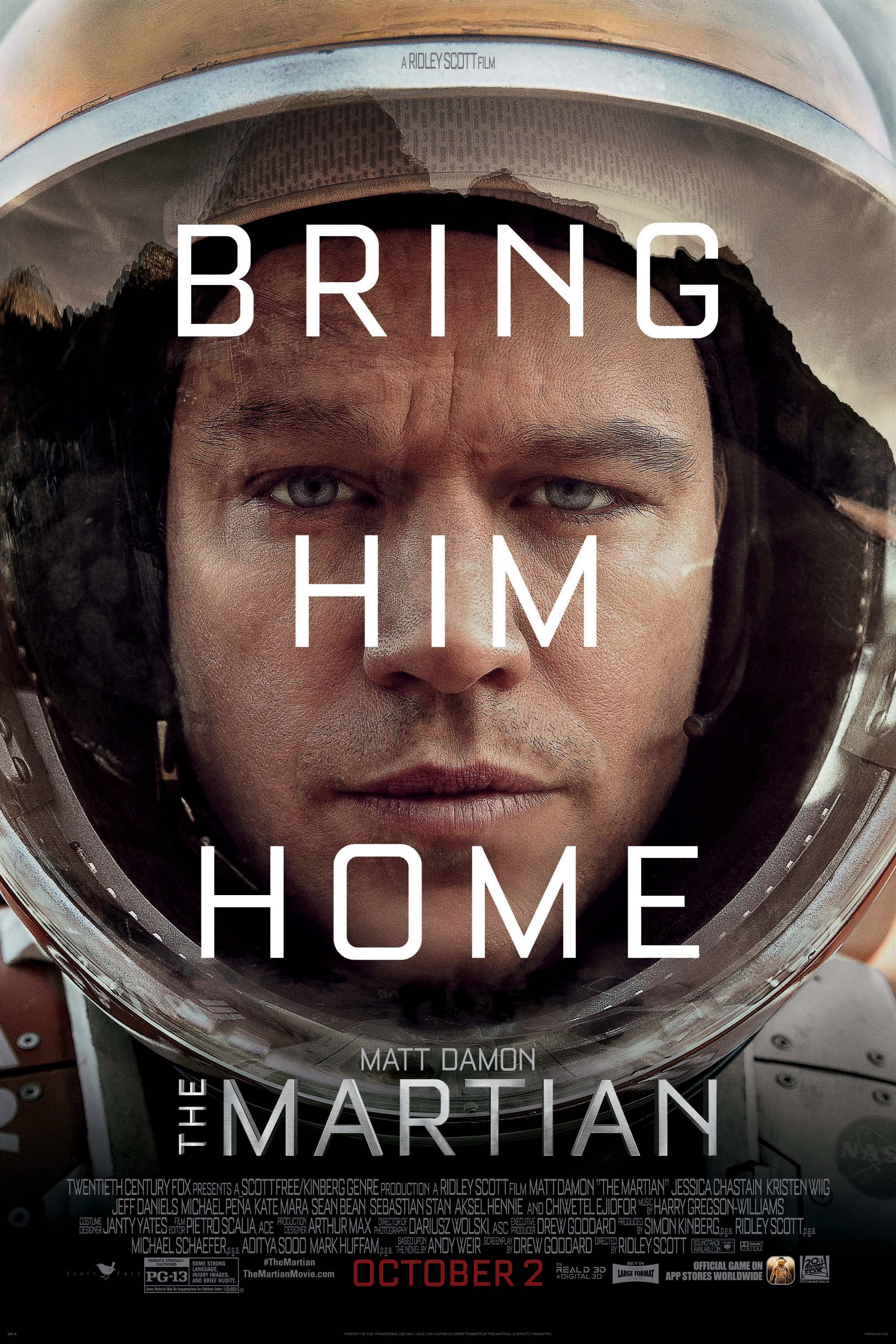
Based on the best-selling novel of the same name by Andy Weir, which was originally self-published on Weir’s personal blog in a serialised format, The Martian, released in 2015, is a sci-fi-drama that combines witty dialogue, stunning cosmic visuals and real-world science to craft a captivating story of survival and innovation. Anchored by a tremendous performance from Matt Damon, The Martian is a cinematic triumph of the science fiction genre, ticking every box that needs to be ticked in this modern era of sci-fi flicks.

Plot Summary: When a fierce storm causes an exploratory mission on Mars to be aborted, astronaut and botanist, Mark Watney, is presumed dead and left behind by his crew. Awakening hours later, injured and alone, Mark is forced to draw upon his wit and scientific ingenuity to endure the hostile surface of the Red Planet. Meanwhile, back on Earth, employees of NASA, alongside a team of international scientists, work around the clock to develop a plan to bring their missing astronaut home…

Just as much a survival thriller as it is a grandiose sci-fi-drama, The Martian is directed by Ridley Scott (Blade RunnerThelma & LouiseGladiator), who, of course, is no stranger to the science fiction genre, with two of the most notable releases of his filmography being Alien in 1979, and Blade Runner in 1982, both renowned as some of the most iconic sci-fi films of all time. And although The Martian likely won’t reach the same level of recognition in ten years, I would say the film has about the same level of directional skill as those well-known flicks. The unsung hero of the film, however, is the screenwriter and executive producer, Drew Goddard, who laces the story with humour and energy, in addition to approaching much of the scientific exposition in a comprehensible yet never overly simplistic fashion.

The incredible all-star cast of Matt Damon, Jessica Chastain, Jeff Daniels, Chiwetel Ejiofor, Kristen Wiig, Sean Bean, Michael Peña, Kate Mara, Sebastian Stan, Aksel Hennie, Benedict Wong and Donald Glover (among others) are all phenomenal in their various roles. And whilst there are a lot of characters, the story juggles them rather efficiently, never taking too much attention away from Mark Watney’s fight for survival, and subsequently, Damon’s terrific performance, which manages to be both humorous and heartfelt. As far as adaptions go, The Martian also solves one of the novel’s biggest issues, that being Mark’s constant internal monologues to provide the reader with commentary on his situation. The film gets around this by having Mark record video logs, in which he explains the science behind what he needs to do to survive, which again, is never dull thanks to Damon’s ceaseless charisma and dry wit.

Primarily filmed in the Middle Eastern desert of Wadi Rum, Jordan. The gorgeous cinematography by Dariusz Wolski emphasises the solitariness of Mars throughout the film, illustrating just how alone Mark truly is and making his line; “I Am the First Man to Be Alone on an Entire Planet,” seem all the more impactful. Furthermore, the colour palette of The Martian is surprisingly diverse considering the story takes place on the Red Planet. While most of the film retains a burnt orange look, many of the shots on Earth or in outer space form a remarkable contrast to the Mars sequences through their use of whites, greys, greens and blues. Much of the set design is also beautifully crafted, riding a careful line between sci-fi futurism and modern comfort. Interestingly, one of the panoramic shots on Mars displays Olympus Mons, the largest volcano discovered in our solar system. Olympus Mons is almost three times larger than Mount Everest and covers an area roughly the size of the U.S. state of Missouri.

Stylistically, the original score for The Martian is an assortment of soothing synth and the orchestral arrangements composer, Harry Gregson-Williams, is best known for. The most notable tracks are Mars, a stark, oppressive track comprised of synth chords and impressionistic processed effects, depicting the planet as a cold, inhospitable place. Making Water, which feels slightly more playful through its use of harps and optimistic strings. And Crossing Mars, the most triumphant-sounding track of the entire score, ultimately comes across as a little generic as it ditches much of the atmospheric synth in exchange for an orchestral motif.

Amidst its many other qualities, The Martian is also a testament to science being employed rather accurately in a science fiction flick, as despite not every line of the screenplay being scientifically exact due to the story taking place in the near future of 2035, The Martian comes pretty close. In fact, NASA was actually consulted on many aspects of the story, specifically regarding Mars, with the film even being supported in its science by the famed author and astrophysicist, Neil deGrasse Tyson.

In summary, The Martian isn’t quite a flawless film as the supporting cast sometimes feels under-served, and at one-hundred and forty-one minutes, the runtime is admittedly rather excessive. But, with the exception of these few (and frankly, minor) flaws, The Martian is a rousing story and an expertly crafted film in which the protagonist recognises he is going to die, and then willfully refuses to accept it. It’s an ennobling and uplifting story delivered with sass, allure and intelligence, essentially being everything a story from the science fiction genre should be. Rating: high 8/10.

martian_xxlg

The Lobster (2015) – Film Review

“If You Encounter Any Problems You Cannot Resolve Yourselves, You Will Be Assigned Children. That Usually Helps.” – The Hotel Manager

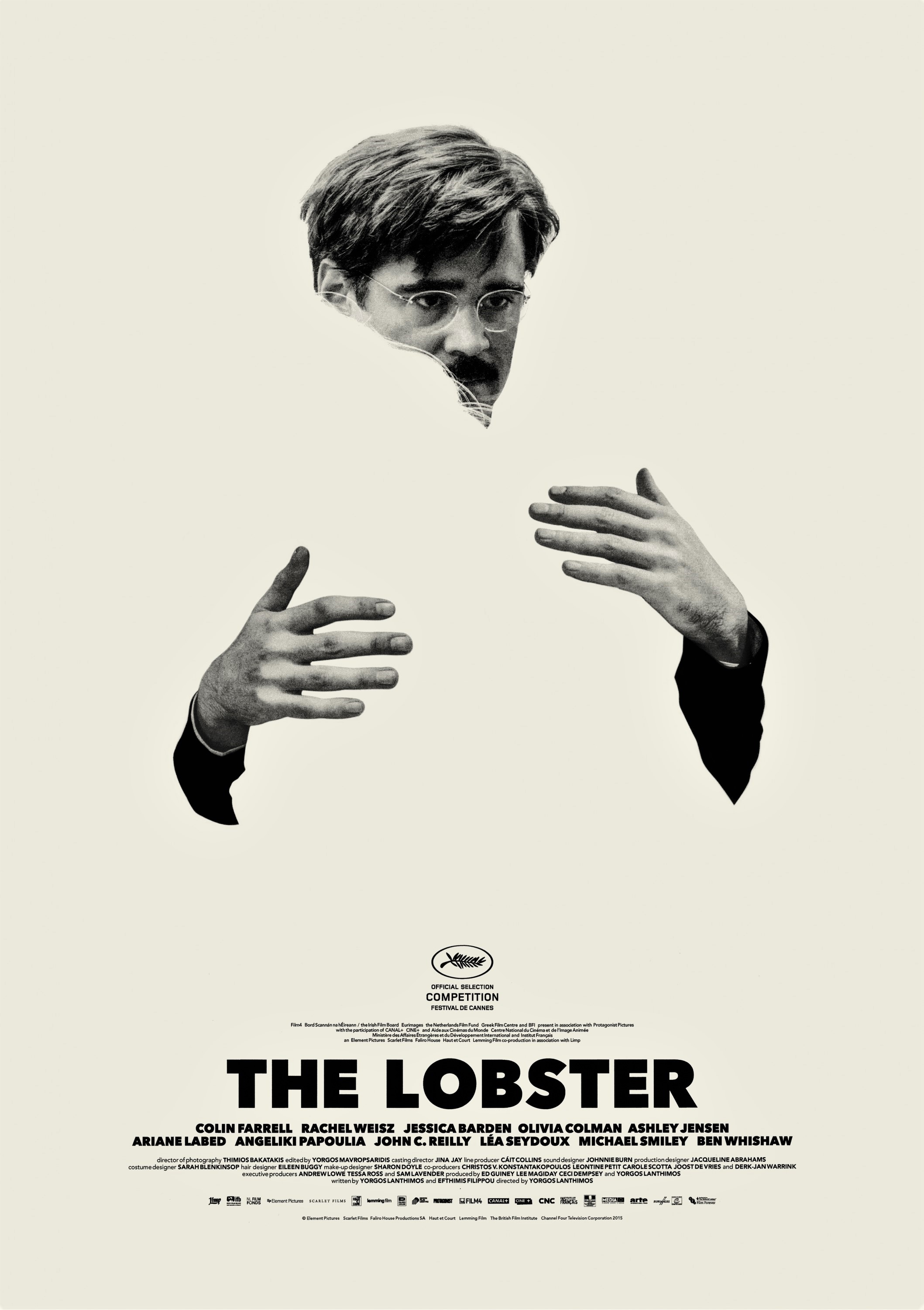
Bleak, eccentric and ambitious, The Lobster, released in 2015, is undoubtedly an acquired taste, but for those with the fortitude to crack through the film’s offbeat sensibilities, it should prove a cinematic treat as co-writer and director Yorgos Lanthimos (DogtoothThe Killing of a Sacred DeerThe Favourite) continuously demonstrates his peculiar style throughout this anomalous black comedy. And, although the film does admittedly fall short in its final act as the story loses interest in its animal-transformation premise and abandons its fascinating hotel setting in favour of a less interesting location with equally less interesting characters, this does little to diminish the intrigue of The Lobster‘s unique outlook on human relationships.

Plot Summary: In a dystopian future where, by law, all citizens must have a life companion, single people are taken to the Hotel, where they are obliged to find a romantic partner within forty-five days. Should they fail, they will be transformed into an animal of their choosing and released into the wild where they will hopefully find love with a different species. Inevitably, as the newly divorced architect David enters the luxurious rehabilitation facility, he too must find a suitable partner, or an uncertain future in the wilderness awaits…

Since its initial release, The Lobster has become an intense hub of speculation regarding its true meaning, but the most common theory is that the film is an absurdist look at modern-day coupling, which, if truthful, is similar to the rest of Lanthimos’ filmography which frequently picks apart damaged characters, attempting to expose the raw and volatile relationship between humans and their fragile sensibilities. Immediately from its opening scene, The Lobster also presents an extraordinarily unusual world, a dystopian future that is simultaneously striking, disquieting and darkly comedic without ever appearing overly futuristic. Needless to say, with a world as irregular as this one is, there are still a few lines of dialogue that feel fairly on-the-nose concerning its world-building.

The film’s large cast of Colin Farrel, Rachel Weisz, Léa Seydoux, Ben Whishaw, Jessica Barden, Angeliki Papoulia, Ariane Labed, Olivia Colman and John C. Reilly are all superb throughout the film, intentionally delivering their lines with a complete lack of emotion. Instead, many of the characters present much of what they are feeling on their faces whilst seemingly concealing everything else. This approach works flawlessly when it comes to the film’s comedy, with the numerous quirky characters David interacts with giving matter-of-fact line readings that are extremely difficult not to find amusing. Yet, these constant stabs at dry humour never feel at odds with the story’s more dramatic/romantic moments either as The Lobster tries to gain emotional investment from its audience by making the characters feel distinctly human through the recognisable neuroses that label them despite their emotionless tones.

Visually, The Lobster is rather impressive as the cinematography by Thimios Bakatakis allows nearly every shot to have something poignant to it, with the symmetrical staircases and hallways of the Hotel presenting a world of order in a simplistic yet elegant manner. One hunting scene, in particular, stands out as gorgeous composition, slow-motion and lighting are all used to great effect. This is made even more impressive when considering that the production crew worked without make-up and exclusively utilised natural light. With large-scale lighting setups only being employed for a handful of evening scenes.

When it comes to the film’s music, even though The Lobster lacks a traditional original score, the film does feature a tremendous assortment of brittle classical compositions, such as String Quartet No. 1 in F Major, Op. 18 and Strauss, R: Don Quixote, Op. 35: Variation: II, both of which give the film a feeling of serenity yet also push much of the story’s tension to the forefront. Quietly damping down the comedic tone that gradually bubbles up through the carefully placed laugh-out-loud one-liners.

Returning to the visuals briefly, The Lobster was primarily filmed in and around the Parknasilla Hotel in Ireland, an ostentatious hotel that is decorated almost entirely with Dutch flower still life from the 1600s. This ageing pattern along with the film’s exceptional use of colour; primarily blues, greens and a few alternate shades of red, including beige-pink, give The Lobster a distinct visual appeal even more so than its cinematography as these colours can even be seen in many of the costumes or mentioned in lines of dialogue, like the scene in which the Short-Sighted Woman says she should wear blue and green clothes or when David mentions that lobsters are “Blue Blooded.” Lobster shells also being red, of course.

In summary, while The Lobster is a droll piece of storytelling lashed with grim humour, it also offers a rich, surreal take on modern relationships that you’d be hard-pressed to find anywhere else. As, for every moment that makes you laugh, there may be another that leaves you with your mouth wide open. In many ways, The Lobster is as much a black comedy as it is a slice of existential horror, glimpsing into an outrageous yet disturbing future, one that is truly a testament to Lanthimos’ brand of filmmaking and storytelling as he’s able to trump even the most outlandish premise and turn it into an accessible and engrossing narrative. Rating: low 8/10.

lobster_xxlg

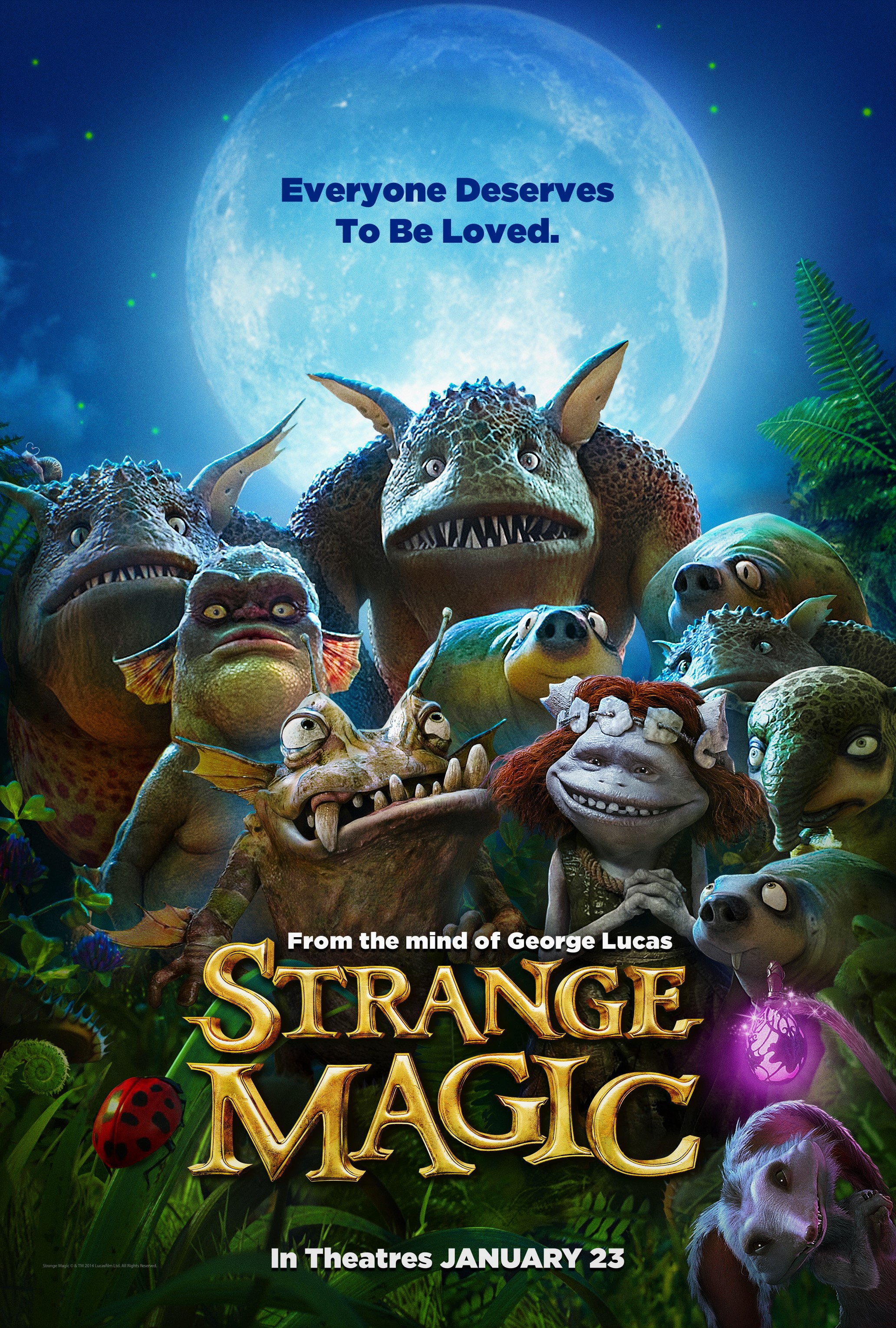
Strange Magic (2015) – Film Review

“Send More Goblins to Cut Down Every Primrose! No Primroses, No Potion. No Potion, No Love. Because Love Is Dangerous. It Weakens… It Rots.” – The Bog King

After selling Lucasfilm to the Walt Disney Company in late 2012, well-established writer-director George Lucas (THX 1138American GraffitiStar Wars: Episode IV – A New Hope) turned his attention away from the mega franchises of Star Wars and Indiana Jones to produce many of his long-gestating passion projects. This ambitious new turn began with the war epic; Red Tails in 2012 and shortly after Strange Magic in 2015, an animated fantasy musical that Lucas had long wanted to produce for his three daughters, having written an early draft of the story fifteen years earlier. Upon its eventual release, however, Strange Magic was deemed a colossal failure, earning only £9 million at the box office on a budget of approximately £74 million, along with receiving largely negative reviews from critics and audiences alike due to its predictable story, dreadful humour and bizarre song choices. All of which, I feel, are valid criticisms.

Plot Summary: In a mystical woodland realm where primrose flowers mark the border between two regions; the Fairy Kingdom and the Dark Forest. The undesirable, Bog King, rules over his gloomy domain without love, going so far as to imprison the Sugar Plum Fairy, who is capable of mixing love potions through the use of primroses, in a bid to permanently cease adoration across his domain…

Technically the first Lucasfilm production to be distributed by the Walt Disney Company following its acquisition. The story of Strange Magic is predominantly based on William Shakespeare’s A Midsummer Night’s Dream, as both narratives are romantic-comedies that involve misunderstandings and cross-purposes between different races or, in this case, species. The film also takes inspiration from many well-known fairy tales, including The Ugly Duckling and Beauty and the Beast for its central underlying theme, which concentrates on the belief that beauty is only skin deep and internal beauty is far more meaningful. An important message for children, to be sure. But, as a result of this subtext being delivered with zero charm or subtlety, the message itself comes across as incredibly forced and even somewhat contradictory, thanks to some of the screenplay’s ill-timed gags.

The central voice cast of Alan Cumming, Evan Rachel Wood, Elijah Kelley, Sam Palladio and Meredith Anne Bull all do a sufficient job of lending some personality to their respective characters. Especially since Strange Magic supplies very little in the way of characterisation, with a majority of the animated characters only being set apart from one another by what species they are, e.g. a fairy, elf or goblin, etc. Quite unfortunate, as for many characters, there is a solid foundation alluding to what they could’ve been should they have been further developed. For example, Marianne (the closet thing the story has to a protagonist) becomes distrustful of men once she witnesses her fiancée, Roland, cheating on her on the day of their wedding, quickly vowing to never love again and instead dedicate her life to protecting her family, specifically her sister, Dawn, who supposedly falls in love with every man she meets.

Aside from the flavourless designs of the fairies, which appear as if they’ve been yanked from any generic fantasy flick of the early 2000s, the visuals of Strange Magic are by far the film’s finest component, with nearly every shot retaining plenty of colour and ingenuity on account of the animated cinematography and the animation itself, which exhibits even the smallest of details right down to the threads on a characters’ clothing or patches of watery moss on tree branches. Yet, this isn’t too surprising, considering that Strange Magic was animated by famed visual effects company, Industrial Light & Magic, standing as their first fully animated feature since Rango in 2011.

Moving from the visuals to the music, Strange Magic is what’s known as a jukebox musical. This means that rather than creating original songs for the film, all of the songs heard throughout Strange Magic are popular songs from past decades. From Can’t Help Falling in Love to Love is Strange and I Can’t Help Myself (Sugar Pie Honey Bunch), the film’s continuous use of on-the-nose songs is undoubtedly what will make or break Strange Magic for most, as older audiences will feel as if they are being pandered to whilst younger audiences will simply be confused as to why none of the songs directly relate to any of the characters/locations within the film. Furthermore, the original score by Marius De Vries is barely distinguishable from any other fantasy score.

On a separate note, although the first entry in the Star Wars saga rarely lacked in world-building when it first introduced audiences to a galaxy far, far away. Strange Magic seems to actively avoid developing its world beyond one or two throwaway lines, establishing the two unimaginatively named regions that reside side-by-side and not much else as to how this fantastical world functions.

In summary, Strange Magic is a film that feels far too familiar to sing its own tune, with its derivative story coming across as a hodgepodge of well-worn elements from other animated and fantasy films. Most evidently, 2013’s Epic and the everlasting series of animated Tinker Bell flicks. As such, there’s virtually nothing about this fractured fairy tale that feels remotely fresh aside from some of its attractive visuals. There are enjoyable moments, of course, but, for the most part, Strange Magic is simply half-hearted and creatively lazy. Rating: high 3/10.

strange_magic-p940629