Malcolm & Marie (2021) – Film Review

“Cinema Doesn’t Need to Have a Message. It Needs to Have a Heart!” – Malcolm Elliott

A contained and regaling monochrome drama, 2021’s Malcolm & Marie was one of the first feature-length films produced amidst the COVID-19 global pandemic. Written and directed by Sam Levinson (Another Happy Day, Assassination Nation), best known as the creator and lead writer of the hit teen-drama series; Euphoria, Malcolm & Marie was shot during the U.S. COVID-19 lockdown between June and July of 2020, with the approval of the Writers’ Guild of America, Directors’ Guild of America, Screen Actors’ Guild of America, and the American Federation of Television and Radio Artists, as the production followed strict safety protocols to ensure the cast and crew could work safely. With this in mind, Malcolm & Marie makes the best of challenging circumstances, utilising a singular location, minimal cast and sleek visuals to craft a captivating flick that examines how volatile personalities can clash, especially when tangled in a long-standing relationship.

Plot Summary: After returning home from the premiere of his debut project, filmmaker Malcolm Elliott and his girlfriend, Marie Jones, await what is sure to be an imminent critical and financial success. But, as the evening transpires, their celebratory night takes a turn for the worse as revelations begin to surface, testing the strength of their devotion to one another…

Between Marcel Rév’s scrumptious black-and-white cinematography and the no-holds-barred verbal brawl delivered by the central duo of Washington and Zendaya, it’s impossible to discuss Malcolm & Marie without drawing comparisons to the cinematic adaptation of Who’s Afraid of Virginia Woolf? (1966). Like the stage play the film is based upon, first staged in 1962, Who’s Afraid of Virginia Woolf? explores the complexities of the marriage of middle-aged couple Martha and George, where, late one evening, after a university faculty party, they receive an unwitting younger couple, Nick and Honey, as guests and are drawn into their bitter and frustrated relationship. Although Malcolm & Marie only focus on the two titular characters, both stories have more than a few similarities. One element of Malcolm & Marie that is unique to the film, however, is its underlying theme of the essence of cinema, examining this concept through the eyes of Malcolm as a passionate Black filmmaker who loathes the politics surrounding Black filmmakers. In fact, Malcolm’s intense dislike of an anonymous female critic from the L.A. Times is believed to be a reference to L.A. Times writer Katie Walsh, who once wrote an unfavourable review of one of Levinson’s prior directorial outings.

As the sole cast members, John David Washington and Zendaya hold the entire weight of the film on their shoulders. Thankfully, both share amazing chemistry and receive countless chances to let their talent shine as they each deliver lengthy monologues exploding with emotion. Through these monologues and the sharp dialogue, it quickly becomes apparent that the titular, well-defined couple exist in different rhythms, with Malcolm exuberantly (and obnoxiously) extolling the delights of premiering his first film as a writer and director, which pushes him to the cusp of newfound power and prestige, while Marie appears sullen, bored and utterly over Malcolm and his prickly, delicate ego that repeatedly puts strain on the pair’s relationship, often failing to acknowledge Marie’s support. However, this constant back-and-forth does come at a cost, as both characters can come across as somewhat unlikable through their many imperfections being blatantly illustrated on-screen at all times.

One of the few Netflix Originals shot to be on 35mm, the cinematography by Marcell Rév is elegant and sheeny. Yet, what makes these visuals even more impressive is that for the entirety of the runtime, the titular couple never once leave the house, as previously mentioned, merely strolling to different rooms or into the garden with a cigarette in hand as their bickering continues. Some may think this sounds dull, but I feel this approach ensnares much of the tension between the two characters and the heavy air that flows through their temporary, luxurious home. Furthermore, with both characters being chic and sophisticated, as well as returning from the premiere in their formal evening wear, there is a suave feel to the visuals of Malcolm & Marie, making the film seem like a romance from the 1930s, with tight camerawork to intensify the drama.

Likewise, the film’s original score, helmed by British musician Labrinth, reunited with Sam Levinson after composing much of the score for Euphoria, retains a similar tone to that of a 1930s drama, with the delicate, jazzy score meshing flawlessly with cleverly selected needle drops. Famed songs, like I Forgot to Be Your Lover and Get Rid of Him, are also baked into the runtime, doing much of the talking when the characters aren’t.

Interestingly, because Malcolm & Marie was produced during the COVID-19 pandemic, none of the cast or crew associated with the film received any kind of payment or entered into any agreement with the depiction of tobacco products, which is certainly admirable given the current state of cinema, where many films are greenlit purely for the sake of profit.

In summary, due to its entire runtime taking place in one location with a heavy reliance on dialogue, Malcolm & Marie will likely be a divisive flick that won’t please everyone. But, for those it will, I feel it’s more than entertaining, even if the film isn’t as layered or as tightly-knit as it thinks it is. Rating: 7/10.

Leave the World Behind (2023) – Film Review

“A Conspiracy Theory About a Shadowy Group of People Running the World Is Far Too Lazy of an Explanation… Especially When the Truth Is Much Scarier.” – G. H. Scott

Suspenseful, intriguing and enigmatic, 2023’s Leave the World Behind is an adaptation of the novel of the same name by Rumaan Alam. Steadily drawing its audience in through its engaging premise and stunning camerawork, this stylish Netflix Original is an apocalyptic thriller centred around the idea of humanity’s destruction being brought about by our distrust of others, our overreliance on modern technology and our lack of control over the planet. And, although not perfect, the film is a predominantly engrossing and intricate original flick for the streaming service in more ways than one.

Plot Summary: Exchanging New York City for a much-needed family getaway at a luxurious, remote rental home, couple Amanda and Clay Sanford are shaken by the late-night arrival of the sharply-dressed stranger, G. H. Scott, and his daughter, Ruth, bearing troubling news of a regional blackout and communication issues. But, as the pair are invited inside and speculate on why this rapid technological breakdown is occurring, all signs begin to point to more than a temporary malfunction…

Written and directed by Sam Esmail (Comet), creator of the incredibly gripping and considerably underrated crime-thriller television series; Mr. Robot, through which Esmail proves his extraordinary talent as a screenwriter and director. Leave the World Behind proves, once again, that Esmail is an absurdly talented filmmaker, governing the film’s pacing, upsurge in tension and consistently dour tone to an astonishing degree, all whilst enveloping the story in an unpredictable and surprisingly close to reality ‘end of the world’ scenario, even if the narrative unnecessarily harbours a lengthy runtime of almost two and a half hours. I can, however, see some taking issue with the film as a result of its conclusion, which is rather inconclusive and underwhelming after all the film’s build-up, even though the climax does answer many of the questions the audience likely possesses at that time.

The central cast of Julia Roberts, Mahershala Ali, Ethan Hawke, Myha’la, Farrah Mackenzie, Charlie Evans and Kevin Bacon all hold their own throughout the runtime, authentically portraying a concerned family, a pair of fairly unwelcomed guests and a distrustful neighbour with the appropriate dose of awkwardness and apprehension. Yet, the characters themselves aren’t given enough to make them appear memorable or complex, merely functioning as viewpoints for the audience as they piece together the sprinklings of clues and information they uncover in relation to the circumstances that are transpiring around them.

Utilising its colour palette to represent specific characters, like the colour blue, for example, being employed around the Sanford family, with their bedroom, car, clothes and other minor details all sharing this colour. The visuals, specifically the sleek cinematography by Tod Campbell, are inventive and attractive, visually conveying much of the paranoia the characters are feeling while implementing Esmail’s signature style of filmmaking via uncomfortable close-ups on the characters, positioning them in the corner of the frame to further put the audience on edge, with even the wall art in the master bedroom altering over time as Amanda and Clay’s temperament intensifies. Additionally, Leave the World Behind houses a few moments of fairly impressive CGI whenever the characters encounter a CG flamboyance of flamingos or a herd of deer near their rental home, which is certainly abnormal and visually interesting, yet the animals’ significance in the grander narrative is largely lost on me.

Crafting an outstanding score for all four series of Mr. Robot, Mac Quayle is a superb composer and continues to prove his worth with his nail-biting, horror-esque score for Leave the World Behind, continuously adding to the suspense of each and every scene, whether there is any physical peril at that time or not. During tracks such as; Beach Day and Cyberattack, Quayle’s orginal score is led by an isolated, eerie piano piece, placing the audience (for a brief moment) amid the film’s impending apocalypse and the human drama unfurling within. However, as much as the score attempts to immerse the audience in the narrative, some of the licensed songs chosen for the film have the counter effect, seeming unsuitable and irrelevant to both the tone and the story, despite the stylish opening animated sequence where one of these songs is featured, serving as an electrifying curtain-raiser.

On another note, Leave the World Behind interestingly contains several references to Esmail’s previously mentioned television series, including Amanda’s laptop and the yellow emergency kits the character, Danny, purchases both being produced by E-Corp, a fictional corporation featured in the series, as well as a book written by the Mr. Robot character, Irving, also appearing, suggesting that the stories may take place in the same universe, which would make sense, given the stories’ shared notions of hackers, cyberattacks and theories regarding online terrorist groups.

In summary, Leave the World Behind is a Netflix Original that will undoubtedly divide its audience, taking an unconventional approach to the well-known formula of the apocalyptic scenario, leaning more into the isolated paranoia and scepticism of an ordinary American family rather than the grand destruction of famed cities and their associated landmarks across the globe. Even so, whilst not quite as polished or as compelling as Esmail’s masterwork of a television series, Leave the World Behind definitely has its notable elements, in my opinion, grounding itself in reality as much as possible. Rating: 7/10.

leave_the_world_behind_xxlg

Love and Monsters (2020) – Film Review

“I Didn’t Really Have Your Typical Upbringing. I Mean, I Did at First… but Then the World Ended.” – Joel Dawson

Originally titled; Monster Problems, the Netflix Original, Love and Monsters, released in 2020, is a comedic, post-apocalyptic romance filled with plenty of heart, humour, clever world-building and, as its title suggests, gigantic monsters. Despite housing a few blemishes here and there, Love and Monsters covers an abundance of emotional ground throughout its story, standing as an entertaining, monster-filled adventure, the sort of film that delivers wit, excitement and creativity all in generous portions, making for an amusing time during ‘the end of times,’ as it were.

Plot Summary: Seven years after the world-ending event known as the “Monsterpocalypse,” twenty-three-year-old Joel Dawson, along with the rest of humanity, is wearily living underground in a hidden bunker since colossal mutated monsters took control of the surface. But, after reconnecting over the radio with his high school girlfriend, Aimee, who is now eighty miles away at a coastal colony, Joel courageously decides to venture out into the monstrous open-air to find her…

Demonstrating his storytelling capability almost immediately, director Michael Matthews (Five Fingers for Marseilles) artfully lays out the film’s premise during the opening sequence, employing a voiceover from Joel and a variety of animated illustrations made to appear as if they were pencil-sketched by Joel in his notebook. Through this opening, we learn that several years ago, the human race fired a series of rockets into space to destroy an impending asteroid nicknamed; “Agatha 616,” which successfully blew the rock to smithereens. However, this action had consequences, as the chemical compounds used to launch the missiles rained back down to Earth and transformed the cold-blooded wodge of the animal kingdom into mutated monstrosities, forcing the human race to flee underground. From this point on, Love and Monsters continually explores its unique world, building upon the notion of the “Monsterpocalypse” in several ways whilst also taking cues from 2009’s Zombieland by not taking itself too seriously, avoiding the common concern of its post-apocalyptic setting feeling ‘played out.’ Of course, this does mean that Love and Monsters includes a number of tonal shifts, some of which occur rather suddenly, similar to how many of the film’s gags vary in quality.

In terms of characters, the timid, self-deprecating protagonist of Joel Dawson is perfectly cast with Dylan O’Brien, as the screenplay allows the young actor to flex every acting muscle he possesses, toeing the line between weighty and light-hearted scenes through his myriad of interactions with the other survivors of his monster-infested world. For Joel, the world-ending cataclysm was particularly bad timing as he was on a date with his girlfriend Aimee when the pair were separated and shipped to different colonies. While terrified of almost everything at first, Joel eventually pushes himself out of love, serving as a likeable yet dimwitted guide through a world of horrors and devastation, discovering more about himself along the way. In addition to O’Brien, the cast is studded with some great talent, from Jessica Henwick, who manages to make Aimee seem capable and sympathetic in spite of her limited screen-time, to the unlikely pairing of Michael Rooker and Ariana Greenblatt as Clyde and Minnow, two world-weary survivors travelling together after their respective families were killed by undisclosed creatures. Moreover, whilst on his journey, Joel encounters the grieving, intelligent canine, Boy, who is remarkably well-portrayed on-screen by the two Australian kelpies, Hero and Dodge.

Given that much of the film is a voyage across post-apocalyptic America, Love and Monsters is almost episodic in its visual presentation, following Joel as he treks past devastated, overgrown suburbs, corroded fairgrounds and expansive meadows, all of which are wrapped in impressive details like spider-like webbing enfolding the rooftops and trickling egg sacks sprouting on trees. Lachlan Milne’s cinematography and the film’s wonderful production design (considering its modest budget for a premise of this scale) lend themselves brilliantly to this concept with an ample amount of wide shots, thoroughly embracing the strange beauty and vibrant colours of the “Monsterpocalypse.”

Drawing inspiration from the scores of larger-than-life science fiction classics from the 1950s and 1960s, composers Marco Beltrami and Marcus Trumpp provide Love and Monsters with a grand, stimulating and highly vigorous orchestral score. Through tracks such as; Bunker Breach, Wisdom of the Wild, Amiee’s Colony and End Credits, the original score works in tandem with practically all the scenes it can be heard, whether they are stirring or unsettling.

As you’d hope for a monster-centric flick, the titular creatures of Love and Monsters are widely imaginative, with oversized centipedes, frogs, snails and crabs all featured throughout the runtime, all outlandish and intimidating in design, yet still recognisable to their real-world counterparts, brought to life via exquisite practical and CG effects, ultimately leading the film to become an Oscar nominee in 2021’s Best Visual Effects category, alongside Tenet (2021) and The Midnight Sky (2021).

In summary, Love and Monsters is an enjoyable, earnest and comforting flick, packed with splendid creature designs, charming characters and a delightful cast. In many ways, the film is a high school rom-com that just so happens to be set in a post-apocalyptic world, serving as a terrific template for crafting a leaner, less bloated summer flick that virtually all can enjoy. And, for once, with the film leaving things open-ended enough for a sequel, this is the rare scenario where, I’d say, another instalment would actually be welcome. Rating: low 8/10.

love_and_monsters_xlg

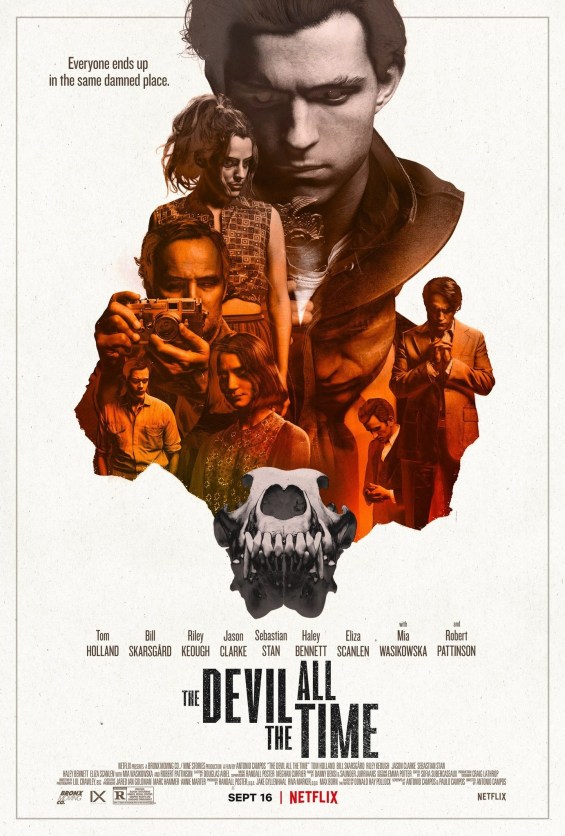
The Devil All the Time (2020) – Film Review

“Blessed Are Those That Hunger and Thirst for Righteousness.” – Reverend Preston Teagardin

A gripping yet troubling exposé of a period in history that frequently appears overly sanitised, 2020’s The Devil All the Time is a superb Netflix Original that utilises its relentlessly grim narrative, stellar all-star cast and period-accurate song choices to explore an underused setting in cinema; Southern Ohio in the 1950s. And, as a result, the film crafts an engaging and thought-provoking tale of backwoods preachers, religious zealots and broken, weathered souls witnessing the atrocities of a post-war world, replenished with sins that even faith is unable to wash away.

Plot Summary: In 1950s-era rural Southern Ohio, an assortment of crooked and sinister individuals intersect paths in the Midwestern town of Knockemstiff, a rustic, sparsely-populated cesspool teeming with corruption and brutality…

Co-written and directed by Antonio Campos (Buy It NowSimon KillerChristine), the screenplay for The Devil All the Time was adapted from the novel of the same name by Donald Ray Pollock, who, interestingly, actually performed the narration for the film, making the role his first-ever narrating position as he avoided performing the voiceover work for his own audiobooks. Similar to the original novel, a large majority of the story revolves around the real-life town of Knockemstiff, Ohio. Here, the non-linear narrative, which examines the violent vestiges of religious iconography, thrusts an array of devilish characters to encounter one another through differing scenarios, often resulting in horrific outcomes. In particular, the opening three arcs produce a distressing first act where death is seemingly always lurking around the corner. However, while most of the characters and their individual storylines are captivating, certain characters (and their continually fiendish actions) can appear somewhat underdeveloped due to a lack of screen-time, along with a few narrative details, namely, the subplot of Deputy Lee Bodecker accepting payments as a corrupt officer, not falling into place.

Regarding one of the finest aspects of the film, the central cast of Tom Holland, Robert Pattinson, Harry Melling, Bill Skarsgård and Sebastian Stan (among many others) are all exceptional in their various roles, with most of the cast’s accents seeming flawless, barring Holland and Pattinson’s accents, which come across as inconsistent and wildly over-the-top, respectively. The cast’s performances are only enriched by their usually well-written characters, however, as their unanswered prayers seem to eventually lead each of them to turmoil as they exist at a bleak point in history where treatments for diseases were scarce and a devastating World War had just wiped out millions, rendering religion to serve as the only recourse for most. What makes the characters more intriguing is that The Devil All the Time is also a multigenerational tale, beginning with the semi-protagonist, Arvin Russell, as a youngster before concluding the story with Arvin as an adult in his early twenties, all the while propelling Arvin and his step-sister, Lenora, to reckon with the ghosts of their parents’ past. That is not to say that any character is represented as exemplary, though, as during the final act, the primarily benevolent Arvin exercises his father’s vengeful tactics for a satisfyingly violent payoff.

In a rather bothersome decision, The Devil All the Time repeatedly feels compelled to remind the audience of earlier sequences in the story that mirror later moments. Yet, most of the time, these flickers of earlier scenes in the film are thoroughly unnecessary and quickly begin to grate on the audience. Aside from this annoyance, the editing and cinematography by Lol Crawley are serviceable, continually being enhanced by the terrific set design and set dressing, which makes every inch of the rundown town of Knockemstiff appear worn and ripe with religious imagery.

Alongside the original score by Danny Bensi and Saunder Jurriaans, which remains nuanced and unpretentious whilst still adding to the cruelty and suspense on-screen at many points, The Devil All the Time employs an extensive selection of traditional gospel tunes and ’50s-era songs, such as Washed in the BloodThe Three Bells and Honeycomb, all beneficially playing into the setting and underlying religious themes of the story with some of the more upbeat songs even prompting certain scenes to develop a moderately satirical tone.

Returning to the visuals, momentarily, crucifixion is a recurring image throughout the runtime, relating to the film’s central underlying theme of the conflict between belief and the horrors of the real world. For example, in the first act, Willard Russell discovers a bloodied, fly-infested serviceman crucified during his deployment on the Solomon Islands during World War II. This image changes the once godly soldier to a religiously apathetic, but more importantly, makes it apparent how closely savagery and sacrifice are exemplified through the image of Jesus Christ tortured on the cross. Later in the film, there is also a painting of Jesus Christ on the cross hanging on the wall in Arvin’s room, reminding the audience of this subtext.

In summary, whilst The Devil All the Time‘s ruthlessly pessimistic narrative can occasionally be harrowing to the point of punishment, much of the dour storytelling is offset by the strong work from the outstanding cast, whose performances are often so compelling they even redeem the rather conventional style of filmmaking the film adopts, which is unlikely to leave any audience member in awe. Still, The Devil All the Time is an effective, religion-centred thriller. Rating: 7/10.

devil_all_the_time_ver2_xxlg

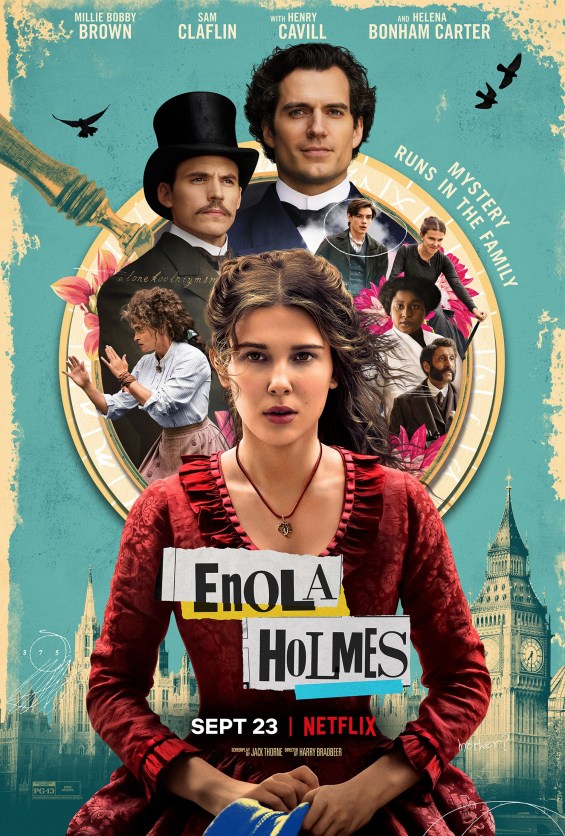
Enola Holmes (2020) – Film Review

“The Choice Is Always Yours. Whatever Society May Claim, It Can’t Control You.” – Sherlock Holmes

Based on the book series; The Enola Holmes Mysteries by Nancy Springer, a string of books centralising on Sherlock and Mycroft Holmes’ younger sister, Enola. 2020’s Enola Holmes serves as an alternate take on the Sherlock Holmes mythology, aiming itself towards preteens (specifically preteen girls) and injecting the world of the renowned detective with both colour and humour. Unfortunately, however, on account of the film’s poor pacing, overly long runtime and comedic sequences that frequently fall flat, Enola Holmes struggles to attain much appeal outside its preteen demographic, even with a terrific performance from Millie Bobby Brown as the titular character.

Plot Summary: When Enola Holmes, Sherlock Holmes’ teenage sister, discovers that her mother has gone missing, she embarks on a daring mission to the city of London to find her. Swiftly becoming a proficient detective in her own right as she outwits her older brothers and unravels a treacherous conspiracy surrounding a young, runaway Lord…

Adapting the first entry of the book series into an origin story, of sorts. The plot of Enola Holmes revolves around a mystery, similar to many adaptations of Sherlock Holmes literature. However, unlike many other adaptations of the world’s greatest detective, Enola Holmes repeatedly breaks the fourth wall throughout its narrative, having Enola turns towards the camera and speaks directly to the audience, delivering exposition and sharing her thoughts on her current situation. Yet, this isn’t too surprising as director Harry Bradbeer (As the Beast Sleeps, The Brides in the Bath, Perfect Day: The Millennium) is predominantly a television director, directing episodes on several well-known series, including Fleabag, which also features a number of fourth-wall-breaking moments. Furthermore, with a female protagonist at the centre of the story, Enola Holmes attempts to weave themes of feminism and the sexist nature of the 1800s into its narrative, which is an admirable goal, yet often comes across as preachy in its delivery as the female characters continuously outperform and belittle the male characters, including Sherlock Holmes himself.

Best known for her role as Eleven in the smash-hit sci-fi television series; Stranger Things, Millie Bobby Brown portrays the youthful detective, Enola Holmes, with plenty of wit and confidence. And, although the screenplay doesn’t give Enola much complexity beyond occasionally being too headstrong for her own good, she is a fine protagonist, especially for impressionable young girls. The supporting cast also does well in their respective roles, with Henry Cavill, in particular, portraying a remarkable iteration of Sherlock Holmes in a more traditional portrayal of the character following the rather wild and scattered portrayals from Robert Downey Jr. and Benedict Cumberbatch. Cavill is calm and collected as the stark image of his older brother, Mycroft Holmes, portrayed by Sam Claflin, who is far more rigid. Mycroft also makes an excellent foil to Enola as he demands she conform to the standards of 18th-century women. Then there is Helena Bonham Carter, who doesn’t have much to do as the Holmes matriarch, Eudoria Holmes, but makes the most of her screen-time through her monologues, bouncing from various tones with her eccentric behaviour and sage advice.

For added freedom and flexibility when it comes to camera movement, Enola Holmes was shot almost exclusively using a Steadicam system. This allowed cinematographer Giles Nuttgens to obtain many of the energetic shots seen throughout the film. Yet, despite this persistent sense of movement, many of the shots in Enola Holmes aren’t anything overly inventive, and instead, a large portion of the camerawork simply presents the detailed costumes and sets with pride. All of which feel period-accurate, if a little excessively vibrant.

Whilst not as memorable or as distinct as many of his other scores, composer Daniel Pemberton does a passable job with the soundtrack for Enola Homes. Crafting an orchestra-led score brimming with bouncy rhythms and sassy melodies, all united by guitar. Effectively, it’s a modern score that makes no real attempt to convey the time period of the story. Instead, the original score concentrates on Enola as a protagonist, accentuating her personality through tracks like Gifts from MotherCracking the Chrysanthemums Cypher and The Game is Afoot.

According to the novel; A Study in Scarlet, by Sir Arthur Conan Doyle. Sherlock Holmes first met his assistant, Dr. Watson, in 1881. But, in Enola Holmes, which is set in 1884, Lestrade states that Sherlock always works alone, indicating that the pair have not yet met. As such, it’s a safe assumption that Enola Holmes is set outside of the series’ usual continuity, further playing into the idea that Enola Holmes is an entirely new interpretation of the series. This assumption is inadvertently also a pleasant distraction from the film’s countless cringe-worthy quips and one-liners.

In summary, Enola Holmes is the type of film that preteens will delight in; a charming, family-friendly adventure with an intriguing mystery at its core. For others, however, this family flick is unlikely to impress as a result of its notable flaws and restrictive appeal, not to mention its constant attempts to plant seeds for the inevitable sequels that will be coming to Netflix later down the line. Having said that, I feel Millie Bobby Brown will certainly advance her career with this project as she was actually one of the primary reasons Enola Holmes was greenlit, approaching author, Nancy Springer, with the intention of starring in and producing an adaptation of her work. Rating: 5/10.

Enola Holmes • Poster

Extraction (2020) – Film Review

“If You Want to Survive, You Will Do Exactly as I Say…” – Tyler Rake

Based on the graphic novel; Ciudad by Ande Parks, which in itself was based on an unproduced screenplay written by Joe Russo in 2014. 2020’s Extraction transfers the story it’s adapting from the Paraguayan city of Ciudad Del Este to Dhaka in Bangladesh whilst still indulging in all of the same barbaric violence and exciting action set pieces. Yet, despite its spectacular stunt work, impressive long takes and electric performance from Chris Hemsworth, Extraction isn’t entirely saved from its generic complexion, as the film frequently falls back on many of the usual tropes we tend to see in modern action flicks.

Plot Summary: In an underworld of weapons dealers and traffickers, Ovi Mahajan, the son of a notorious drug lord, becomes the pawn in a war between two criminal syndicates. Now, held hostage by a group of kidnappers in one of the world’s most impenetrable cities, his rescue beckons the unparalleled skill of black-market mercenary, Tyler Rake, a broken man with nothing to lose, harbouring a death wish that makes an already dangerous mission near impossible…

Extraction marks the feature-length directorial debut of the stunt coordinator/second unit director for 2019’s Avengers: Endgame, Sam Hargrave, who, producers Joe and Anthony Russo, hand-picked to helm the project following their collaboration on the superhero blockbuster. Meaning, of course, that Hargrave’s profession as a stunt coordinator (and stunt double) repeatedly comes into focus as each of the film’s action sequences are relentlessly thrilling and well-orchestrated. If truth be told, however, most of Extraction‘s faults come not from its directing, but rather its screenplay. As, in many ways, Extraction‘s screenplay is structured much like a video game, continuously introducing new ‘boss levels’ that Tyler must complete before advancing, such as a corrupt general who also happens to be the country’s best sniper. Quickly equalling to tiring formula, especially when the film introduces the odd interesting idea, like a subplot focusing on a troubled teenager taking his first, uneasy steps into the world of organised crime.

Although Chris Hemsworth gives an admirable performance as the film’s protagonist, Tyler Rake, a fearless mercenary and former SASR operator, discreetly mourning the loss of his son who died from lymphoma. The character’s promising (if a little cliché) setup is soon spoilt by the complete lack of development from that point onwards, as Tyler essentially goes nowhere after the groundwork for his character is laid, cementing him as a by-the-book action hero and nothing more. Surprising, considering that Extraction was effectively conceived as a ‘star vehicle’ for Hemsworth, a remarkable actor who has struggled to obtain a signature role outside of the God of Thunder, Thor Odinson. On the flip of this, there is the school-age son of a Mumbai drug lord, Ovi Mahajan, portrayed by Rudhraksh Jaiswal, who, serves his purpose as an innocent child caught in the crossfire between two gangs. It’s just unfortunate that the film tries to build a parental relationship between the two, merely reminding the audience how paper-thin its characters are.

When overlooking the murky, displeasing colour palette, a majority of the visuals throughout Extraction are spellbinding as the film uses its dynamic, hand-held cinematography by Newton Thomas Sigel to place the audience alongside the characters in the busy streets of Dhaka, having Tyler grapple with corrupt police officers while tuk-tuks and scooters disorderly rush past, a feeling that is only amplified by the film’s multiple one-takes. One of these takes, which clocks in at around eleven minutes and twenty-nine seconds, is, in actuality, comprised of thirty-six stitched sequences, some of which took over twenty-five takes to line up correctly, according to Sam Hargrave.

Regrettably, the original score by Henry Jackman and Alex Belcher isn’t as innovative as the soundtrack almost solely consists of indistinguishable ostinato-driven action tracks, such as Police Search and Checkpoint, all of which have a heavy emphasis on percussion, with only the occasional pause for breath. And, whilst there isn’t a standout theme as such, Extraction does have an effective little motif that runs through some of the tracks to give the score a bit of personality.

Naturally, the action sequences of Extraction are what the majority of the film hinders. And, luckily, they deliver, being brutal, bloody and fast-paced as, dissimilar to highly-skilled characters, like John Wick, whose fighting style is inherently tactical and calculated, Tyler Rake engages in combat far more spontaneously, improvising weapons and thinking on his feet whenever he is thrown into a dangerous scenario. As previously mentioned, the film’s camerawork also amplifies many of these exhilarating moments, particularly one car chase sequence, during which, Hargrave actually manned the camera himself whilst he was strapped to the hood of the vehicle pursuing Tyler and Ovi.

In summary, Extraction is slightly contrived and sporadically over-the-top, and there’s no question that the film’s characters are essentially just cardboard cutouts delivering line after line of uninspired dialogue. In fact, for most of its runtime, Extraction almost feels as if you’re watching someone play a video game, which as I’m sure any video game enthusiast will tell you, is only amusing for a short time. But, purely in terms of action, Hargrave and the Russo Brothers bring the noise with a film fueled by the charisma and physicality of its leading actor, suggesting that Hemsworth has found his go-to genre once he retires his iconic superhero. Rating: 6/10.

extraction_netflix_xxlg

Cargo (2017) – Film Review

“You Can’t Lose Hope.” – Etta

Based on the short film of the same name, which went on to be an online sensation following its release in 2013, garnering over thirteen million views on YouTube alone. Cargo takes a refreshingly character-driven approach to the post-apocalyptic genre differentiating itself from other films featuring flesh-devouring monstrosities through its secluded setting and Martin Freeman’s terrific lead performance. A combination that will surely satisfy most zombie fanatics, even if the genre’s more mainstream crowd could potentially be disappointed at the exclusion of decaying hordes of the undead, a true sense of dread and a lack of extravagant gore.

Plot Summary: After an epidemic spreads across Australia morphing humanity into flesh-eating monsters, Andy, along with his wife, Kay, and their infant daughter, Rosie, attempt to escape the Outback via the river, making their way to a presumably secure military base. But, when the trio stumble upon an abandoned yacht, Kay is bitten while searching the vessel for supplies, soon passing the virus onto her husband. Now, with his time running short, Andy has one mission; find a new home for his daughter…

Directed by Ben Howling and Yolanda Ramke, Cargo is not only Howling and Ramke’s first feature-length film, but is also Australia’s first-ever production spotlighted as a Netflix Original, released globally on the streaming service in 2017. And although Netflix has ventured into the post-apocalyptic genre before, with films like Ravenous (2017) and the television series; Z Nation, both Howling and Ramke wanted Cargo to be more than just a straightforward story of survival. Subsequently, this led the pair to intertwine an abundance of social commentary into their zombie-centric story, covering a range of topics from environmental fracking to the exploitation of Australia’s aboriginal peoples. However, in my opinion, the best element of Cargo is its central concept, as the idea of a father having only forty-eight hours to find a new life for his child is a plot enriched with dramatic potential. Moreover, the nocuous outbreak Andy finds himself within serves as the perfect backdrop to juxtapose the qualities one would look for in a capable (and devoted) guardian.

Speaking of the protagonist, Martin Freeman leads the cast brilliantly as Andy, portraying an affectionate father and husband who is determined to protect his family at all costs, an intention which, whilst honourable, often lands him and his loved ones in an even more treacherous spot as Andy refuses to accept when he is out of time. Freeman’s youthful co-star, Simone Landers, unfortunately, doesn’t fare quite as well, as her frail performance frequently results in poignant scenes feeling less sincere. Nevertheless, Thoomi is still an intriguing character, with her subplot concentrating on the demise of her father and the survival of a nearby native tribe, providing a vastly different perspective on the epidemic compared to Andy’s point of view.

Utilising the vegetation-splotched, sun-parched rural land of the Australian Outback flawlessly, the cinematography by Geoffrey Simpson is both varied and visually interesting, even if, in reality, the Australian wilderness where Cargo was shot threw everything it had at the production crew, with South Australia experiencing what was supposedly its worst weather in a century, with floods, power blackouts, torrential downpours and even a miniature cyclone all occurring during the five weeks of production. Yet, miraculously, the crew didn’t lose even a single day of filming, which was extremely fortunate for the filmmakers, given how the remote setting of the narrative is a crucial player in the film’s identity, its harsh and unforgiving nature hurling countless obstacles at our characters whilst, at the same time, offering them the means to survive.

Managed by four distinct composers, including Michael Hohnen, Daniel Rankine, Geoffrey Gurrumul Yunupingu and Johnathon Mangarri Yunupingu, the original score for Cargo substantially strengthens each scene’s emotional significance, almost as if the score is applying a proverbial highlighter to certain moments with sombre, tenuous tracks, such as The Grave and Goodbye, flourishingly pulling at the audience’s heartstrings more times than one.

Taking an alternate route to avoid comparisons to zombie designs of the 1960s and 1970s, most notably in classic horror flicks like Rabid (1977) and Night of the Living Dead (1968). Cargo strays away from many of the usual clichés associated with the undead, centring its zombie design around an orange pus-like substance that oozes from the infected’s facial orifices rather than the bleeding open wounds the living dead are commonly known for. This distinction is further emphasised through what we see of their behaviour, as the infected are presented as mindless animals more than they are man-eating monsters, requiring dark and damp areas to incubate during the daytime before feasting on whatever wildlife they can find once night falls. Quickly reminding the audience that what they are witnessing is a viral infection, hence why the infected are nicknamed; “Virals.”

In summary, even if Cargo‘s story could have been executed better with a motley of improvements, I feel Cargo is still a creditable entry into the realm of post-apocalyptic storytelling. Standing as a zombie flick with soul and pathos, which, in turn, makes the living dead formidable once again, not because of jump-scares or excessive bloodshed, but because of the film’s biggest drawcard; its sheer humanity. Recounting a story that largely revolves around the notion of human determination, witnessing just how far an individual will go to protect another in the bleakest of circumstances. Rating: 7/10.

cargo-poster-1

The Ritual (2017) – Film Review

Based on the bestselling novel of the same name by Adam Nevill, 2017’s ‘The Ritual’ is possibly one of my favourite horrors from Netflix’s extensive list of original films, as although its story revolves around a scenario that many horror enthusiasts will likely be familiar with, ‘The Ritual’ effectively uses its sound design and adept visual obfuscation to create an immensely unsettling atmosphere. All the while, developing its characters and exploring themes of grief and manhood in equal measure, turning what could’ve been a wearisome adaptation into an efficient and discomfiting low-budget British horror.

Plot Summary: Haunted by the death of his best friend who was killed during a liquor store robbery six months prior, ‘Luke’ and a group of his former university housemates reunite to mark his passing, hiking across the Scandinavian mountains as a tribute to their lamented friend. But, when one of them sprains their ankle, the group are forced to take a shortcut through a nearby forest in order to arrive at their lodge before nightfall, a forest which unbenounced to them, is actually the domain of an ancient evil…

Directed by David Bruckner (The Signal, Southbound – Segment: The Accident, The Night House) and executively produced by well-known motion capture performer, Andy Serkis, ‘The Ritual’ takes a large amount of inspiration for its story from classic 1970s horror films in addition to the obvious influences forest-set horrors, like ‘The Blair Witch Project’ and ‘Deliverance.’ Yet, ‘The Ritual’ helps itself stand out amongst these other ‘lost in the woods’ films predominantly due to its implementation of Norse mythology, as the film continuously integrates many of the darker, more disturbing elements of Norse folklore into its plot, linking back to the film’s Scandinavian setting.

In a refreshing turn for a modern horror, the four central characters of ‘The Ritual’ frequently act as if they have actually seen a horror film before, but the film doesn’t use this self-awareness to simply indulge in cheeky one-liners and pop culture references. Instead, the characters use this perspective to make insightful decisions, almost immediately realising there is something trailing them. The group of friends, led by Rafe Spall as ‘Luke,’ are all in fine form when it comes to their performances, even if the other three members of the group, portrayed by Robert James-Collier, Sam Troughton and Arsher Ali, all receive less characterisation when compared to ‘Luke,’ which in a way also makes sense, as ‘Luke’ is the cause of the lingering tension among the quartet, with group seemingly believing if ‘Luke’ would’ve intervened as opposed to being frozen in fear, their friend would still be alive. And, this resentment comes boiling to the surface over time, giving Spall the perfect opportunity to convey a real sense of frustration and guilt as the group begins to splinter.

The film’s forest setting is utilised incredibly well throughout the film, as the cinematography by Andrew Shulkind treats the vast wilderness as a formidable presence, crafting a sense of pervasive doom with each step the characters take. From extreme wide shots to uncomfortable P.O.V.s, the camerawork remains both inventive and visually appealing until the end of the runtime, almost luring the audience in with its breathtaking locations before putting them on edge through the abnormal emptiness. Additionally, more observant viewers may be able to spot many minor details hidden within the background of certain shots, some being far more frightening than others.

The original score by Ben Lovett expertly and artfully taps into the film’s arboreal vibe of Norse mythology, as aside from a handful of tracks which more on synthwave to add to the story’s various dream sequences, most of the soundtrack makes marvellous use of strings, horns and a small choir, giving the film an old-world feel in the same spirit of modern horrors, like ‘The Witch.’ With tracks such as ‘Four Tents,’ ‘The Ritual,’ ‘Through the Trees’ and ‘Fear God,’ all reflecting the horror elements of the story as well as the fractured relationship between the characters.

As mentioned previously, ‘The Ritual’ heavily leans into many of the dourer aspects of Norse folklore when it comes to its story, as the film explores ritual sacrifices and everlasting life, following the reveal of the film’s antagonist, who is a towering elk-like creature known as ‘Jōtunn,’ one of the children of ‘Loki,’ the God of mischief and mayhem. And, whilst ‘Loki’ is famously known to have fathered a multitude of strange beings, including a giant wolf, named; ‘Fenrir’ and the colossal sea serpent; ‘Jörmungandr,’ ‘Jōtunn’ is an ideal pick for the film. Being brought to life through some above-average CG effects and an exceptional design by renowned concept artist Keith Thompson, ‘Jōtunn’ is a fascinating and distinctive creature, even having many of its attributes further relate back to other stories within Norse mythology.

In summary, ‘The Ritual’ is a solid entry into the horror genre for more reasons than one, as despite its story not being anything revolutionary and occasionally falling back into skilfully delivered horror tropes. ‘The Ritual’ still manages to construct a mature and slow-burning narrative, only elevated by its fantastic filmmaking, mythological influences and strong direction from David Bruckner, playing upon the Scandinavian tales of old to deliver something truly alluring. Final Rating: low 8/10.

the_ritual-p1100318

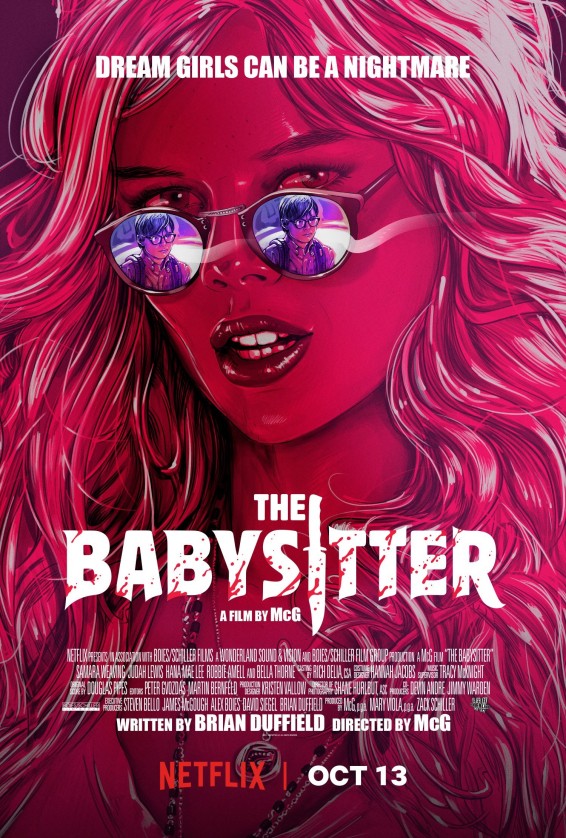
The Babysitter (2017) – Film Review

Originally filmed in 2015 with the intention of playing in cinemas, the horror-comedy; ‘The Babysitter,’ wasn’t seen by any horror fanatics until it released late 2017 after Netflix acquired the rights to the film for streaming. And, although ‘The Babysitter’ doesn’t exactly break any of the rules we’ve come to expect within the horror genre, this horror-comedy with splatterings of style must’ve been entertaining enough for those who decided to watch it, as the film would eventually spawn a Netflix-exclusive franchise with a later sequel.

Plot Summary: Riddled with anxiety, twelve-year-old; ‘Cole,’ has always been bullied and picked on due to his constant panicking, only finding comfort around the one person who understands him, his attractive babysitter, ‘Bee.’ That is, until one night, after ‘Cole’ secretly stays up past his bedtime to discover she’s actually part of a satanic cult, forcing ‘Cole’ to spend the rest of his evening evading ‘Bee’s band of killers who will stop at nothing to prevent him from spilling their dark secret…

Directed by Joseph McGinty Nichol (Charlie’s Angels, Terminator: Salvation, This Means War) or ‘McG’ as he more commonly goes by, ‘The Babysitter’ is a film that has received a number of alterations (both big and small) since even the early stages of its pre-production. For example, in the original screenplay for the film, ‘Sonya’ was actually a cheerleader, ‘Allison’ was a journalist for her high school newspaper, and ‘Max’ had dreadlocks, but eventually it was decided that ‘Bee’s cult followers should be reimagined to more closely reflect the stereotypical characters seen in classic slasher flicks, only in this film, they’re the antagonists. And, this idea is one of the film’s best aspects in terms of its writing, as it gives the film a real sense of self-awareness in addition paying respect to what came before it. Most notably, the ‘Friday the 13th’ series, which ‘Max’ references directly at one point when he chants; “Ch-Ch-Ch-Ah-Ah-Ah,” whilst chasing ‘Cole.’

Judah Lewis does manage to leave an impression in his first film role, portraying protagonist ‘Cole’ as an innocent twelve-year-old with few friends aside from ‘Bee,’ even if a large portion of his anxious characterisation feels far too over-the-top. Then there is also Samara Weaving as the titular babysitter; ‘Bee,’ and her cult followers; ‘Max,’ ‘Allison,’ ‘Sonya’ and ‘John,’ portrayed by Robbie Amell, Bella Thorne, Hana Mae Lee, and Andrew Bachelor, respectively. Who, are all wonderfully devilish throughout the film, having plenty of dark comedic moments between them making their deaths quite unfortunate, as while I’m sure most could’ve guessed their characters do die at some point within the narrative, we don’t get to spend enough time with any of them to get a strong grasp on their exaggerated personalities or any understanding of their malevolent cult.

In spite of the usually dull cinematography by Shane Hurlbut, ‘The Babysitter’ still manages to be one of the more visually interesting Netflix Originals through its unique style, as the film continuously implements different text, graphics and colours to give it a distinct stylistic appeal, not too dissimilar from (although nowhere near impressive as) ‘Scott Pilgrim vs. The World’ from 2010. Many of these editing decisions also help to redeem the film’s humour, which is extremely inconsistent, bouncing from hilarious cutaways and meta horror jokes to embarrassing lines of dialogue which try far too hard.

Whilst composer Douglas Pipes has crafted some great scores in the past, like ‘Monster House’ and ‘Trick ‘r Treat,’ ‘The Babysitter’ is certainly not one of them, as even with the film having many serviceable tracks. The soundtrack in general just lacks anything distinctive, and I believe that if it was ever compared to any other score from Pipes, or even just a handful of random horror scores, I doubt most would be able to tell it apart. The film also throws in the iconic Queen song; ‘We Are the Champions,’ nearing the runtime’s end, which feels immensely out-of-place and comes out of nowhere.

For a large duration of its tight runtime (which the film breezes through as a result of its unrelentingly fast pacing), ‘The Babysitter’s story is predominantly just one long chase sequence, and whilst occasionally tense, I couldn’t help but feel that the film’s screenplay could’ve taken better advantage of its evil babysitter concept or its few supernatural elements, despite the series second entry; ‘The Babysitter: Killer Queen,’ delving much further into the latter. Yet, the film doesn’t disappoint when it comes to its violence, having plenty of fantastically gruesome gore effects which are all successfully played for comedy.

In summary, I could see ‘The Babysitter’ being an enjoyable experience for some and possibly just a boring viewing for others, as when ignoring the film’s graphic gore and fun stylistic choices, the story leaves a lot to be desired, and can often feel derivative of horror classics even if this was the film’s intention to an extent with its focus on horror tropes/clichés. For me, although I do admire the film’s ridiculous tone and dark humour, the disappointing story can often feel sluggish, diminishing the film’s memorability and rewatchability. Final Rating: 5/10.

babysitter_xxlg

Secret Obsession (2019) – Film Review

Other than providing the viewer with plenty of unintentionally comedic moments to laugh at, ‘Secret Obsession’ fails to do much of anything as a thriller, a mystery, or even a drama, being incredibly predictable and formulaic from start-to-finish, in addition to lacking in both interesting characters and a real sense of dread throughout. ‘Secret Obsession’ remains to this day Netflix’s attempt at an ominous thriller that was quickly swept under-the-rug shortly after its release, only being known now as a poorly thought out thriller that would seem more at home on the Lifetime Channel.

Plot Summary: After being brutally attacked by a mysterious stranger at a rest-stop one night, newlywed; ‘Jennifer Williams,’ awakens in hospital healing from her injuries. Now unable to recall her past, her husband; ‘Russell Williams,’ is simply thankful she’s alive and is eager to get her home. But, as he reintroduces her to their secluded mountain estate, ‘Jennifer’ begins to realise she may not be as safe as she initially believed…

Even though ‘Secret Obsession’ received nearly universally negative reviews upon its initial release, in just twenty-eight days, over forty million viewers watched the thriller, placing it in the top ten most viewed Netflix Original films in the history of the streaming service (despite the film’s absence of anything truly unique). This is even more surprising considering the film wasn’t the only psychological thriller released on Netflix in 2019, as another entry in the genre titled; ‘Fractured,’ appeared on viewer’s accounts months later, sharing many similarities in story and setup to ‘Secret Obsession.’

Brenda Song and Mike Vogel are both fine within the film, delivering serviceable performances with the exception of the occasional corny line which can feel quite over-acted. Neither one of these performances improve the film much, however, as ‘Secret Obsession’ is anything but subtle in terms of both its dialogue and its characterisation. A perfect example of this is the character; ‘Detective Frank Page,’ portrayed by Dennis Haysbert, as not only is this character very cliché and only in the film to serve as a plot device later down the line. ‘Detective Frank’ also has a character arc which receives almost no development and makes little sense, in spite of Haysbert possibly giving the best performance of the film without being anything extraordinary.

The film’s cinematography by Eitan Almagor does manage to be at least somewhat visually interesting for majority of the runtime. With that said, much of the film’s visual style doesn’t fit with the actual narrative, as the film’s main setting of the Colorado Mountains feels like a far too beautiful and scenic location for a dark thriller, such as this. This also goes for the film’s colour palette and lighting, which are both overly bright, resulting in the film sharing a similar visual appeal to a modern comedy rather than a suspenseful thriller/mystery.

Just as bland as it is cheesy, the original score by Jim Dooley doesn’t fare much better either, usually landing on either side of the scale: immensely generic or overly loud and extravagant. Almost giving the impression it’s taken from the soundtrack of a live-action ‘Scooby-Doo’ flick at points with how aggressively its orchestral score alludes to danger. But, considering this composer hasn’t worked on many well-known films throughout his career, I feel Dooly is still yet to create a beloved (or even memorable) original score for a film.

Nevertheless, the film’s main hook is, of course, it’s signature plot twist, as even hinted at by the ‘Secret’ part of its title. Yet, in my opinion, the story’s ‘twist’ is revealed far too early on within the runtime as a result of the screenplay’s extremely blunt hints and clues, which leave little to the imagination. While you could argue the film intends for the audience to know what’s going on so early in the narrative in order to build tension, the lack of any likeable or engrossing characters makes this a mostly fruitless effort, and with the film never delving much into the details of its twist, it soon leaves the viewer pondering the believability of its story. Alongside the obvious fact that a continuous and overarching mystery always helps to make a story more compelling, with iconic thrillers, such as ‘Seven’ and ‘Shutter Island,’ knowing this full well.

In summary, ‘Secret Obsession’ is a film no one is likely to obsess over, with its unfitting location and colour palette, dull characters and constant illogical moments throughout its story, the film has little to offer for fans of psychological thrillers. Whilst some may see the film as a ‘so bad it’s good’ flick, similar to other comically awful films, like ‘The Room,’ ‘Battlefield Earth’ and ‘Batman and Robin,’ I personally find the film a very forgettable and occasionally irritating experience. So, unless you’re on the hunt for a thriller that soon evolves into an unintended comedy, definitely give this dreadful Netflix Original a miss. Final Rating: 2/10.

secret_obsession_xxlg