In January 2004, then-Pixar CEO Steve Jobs announced that the Walt Disney Company would not renew its distribution deal with Pixar Animation. At the time, Pixar was quickly earning its status as one of the world’s leading animation studios, responsible for a string of box-office hits, including Toy Story (1995), Monsters, Inc. (2001) and Finding Nemo (2003). Anticipating the split, then-Disney CEO Michael Eisner downplayed the fallout and Pixar’s discontent with the terms of their deal, arguing Disney could continue producing sequels to Pixar’s films without their involvement, since Disney retained the rights to Pixar’s characters and franchises under their original contract. To that end, Eisner launched a new animation studio in Glendale, California, dubbed Circle 7 Animation, named after Circle 7 Drive, where the studio was located, solely established to develop sequels to Pixar’s films without any input from their creative team, most of which were intended to be budget-friendly, direct-to-DVD releases.
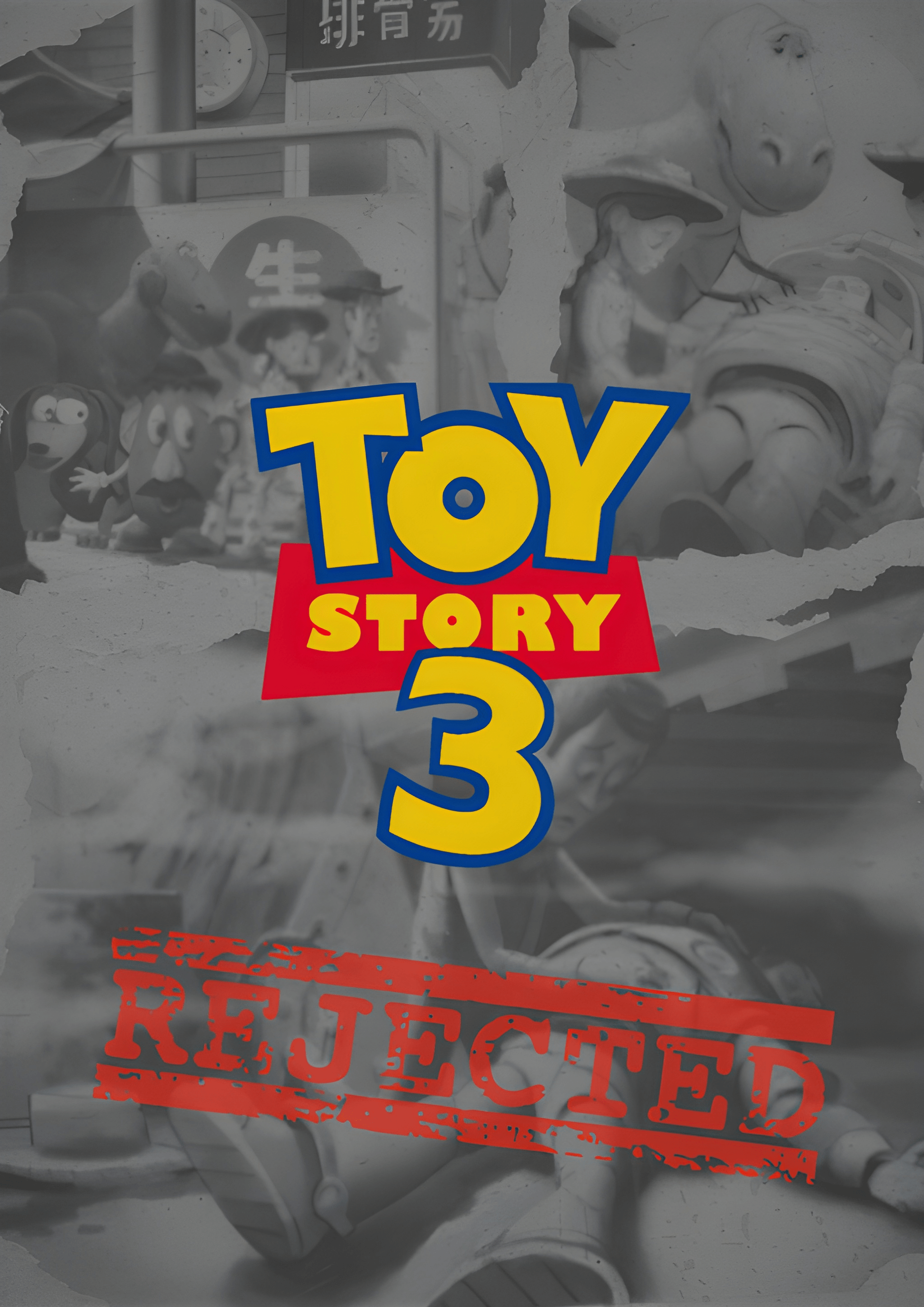
Among Circle 7’s first projects were early drafts for Monsters, Inc. 2, Finding Nemo 2 and, of course, Toy Story 3. During this time, several ideas for a third Toy Story instalment were considered, including a whodunnit-style mystery in which Woody and the gang investigate a string of missing toys in Andy’s grandmother’s attic, and another where Andy’s mother remarries, leading to the toys becoming lost in Mexico, encountering knock-off versions of themselves, such as El Buzz and Mr. Papaya Head. Eventually, however, a screenplay by Jim Herzfeld was selected, with screenwriters Bob Hilgenberg and Rob Muir revising both the dialogue and the narrative as many concept artists, including Ric Sluiter, Jim Martin and Shane Zalvin, began developing the project’s visuals through a variety of sketches and art pieces.
In this rendition of Toy Story 3, Buzz Lightyear begins to malfunction, prompting Andy’s mother to send him back to the factory in Taipei, Taiwan, where he was manufactured, unaware that a global recall has been issued to destroy, rather than repair, all defective Buzz Lightyear units. Upon learning this, Woody, Jessie, Rex, and the rest of the gang embark on an international rescue mission, facing a series of chaotic and comedic set pieces, such as a tense encounter at a daycare centre inside the towering Taipei 101 skyscraper. Meanwhile, at the factory, Buzz narrowly escapes destruction by a machine known as “The Smasher” and teams up with a duo of faulty, recalled toys known as Cindy Scissors, a superheroine with bladed legs, and Rosey, a defective bed warmer doll, to deliver a letter to the company’s elusive founder, Mr. Kagoy. However, their journey is complicated by the arrival of Daxx Blastar, a flashy new Star Command toy intended to replace Buzz, who narcissistically confronts them. As all hope seems lost, Woody and the gang arrive to help expose the corrupt board members’ scheme to destroy all the Buzz Lightyear units, as Mr. Kagoy, who is secretly aware that all toys are alive, rescinds the recall order and promises to repair all the defective units and return them to their owners. As the gang prepare to head home, Daxx makes one last attempt to stop them, but is humorously thwarted and subsequently shipped off to Sid’s house, thanks to Jessie and the gang. The story concludes with a cheerful montage of Woody, Buzz and the rest of the toys returning home to Andy, whilst the previously recalled toys, Cindy and Rosey, find new owners.
This proposed continuation of the Toy Story franchise would have been a mixed bag to say the least, expanding on the beloved world of sentient toys in bold and imaginative ways while regressing in others. For example, taking the characters out of the American suburbs to explore another country would have allowed Woody and the gang to venture through a rich tapestry of tropical forests and vibrant cities across Taiwan, setting itself apart from any locations we have seen in the franchise previously. Moreover, Buzz’s underlying character arc, from inevitable destruction to rediscovery, mirrors the existential themes of earlier instalments, while new characters, such as Cindy and Rosey, offer fresh perspectives on value, identity and rejection. Conversely, the narrative frequently exhibits signs of overreach, juggling multiple subplots, a sprawling cast of characters and locations, and a corporate conspiracy angle that risks overshadowing the story’s emotional core. Additionally, Daxx Blastar, the central antagonist of the film, is largely underdeveloped and almost cartoonishly evil when compared to the antagonists of previous entries, making the factory’s climactic showdown feel rather lacklustre. What’s more, some narrative turns, like Mr. Kagoy’s sudden awareness of the toys’ sentience, feel overly convenient and lack sufficient setup for what is supposed to be a grand reveal.
In my opinion, however, the biggest problem with this iteration of Toy Story 3 is that it shares far too many similarities with the franchise’s prior entry, Toy Story 2 (1999), with the gang setting off on a journey to recover one of their members (who has been taken by humans for one reason or another and is unlikely to return), while having a toy antagonist to contend with. As a result, this rendition of Toy Story 3 also lacks the emotional and satisfying conclusion of the actual third instalment, revisiting familiar territory and suggesting a new cycle of conflict, leaving the door open for further sequels and coming adventures for Woody, Buzz, Jessie and the rest of the gang, which simply isn’t fitting for a third instalment of an iconic series.
In summary, Circle 7 Animation was ultimately a strategic backup plan, an animation studio created by Disney to protect and extend its ownership of Pixar properties during a time of uncertainty. But, in January 2006, after Bob Iger succeeded Michael Eisner as CEO, Disney changed course. Iger opted to purchase Pixar outright for approximately £6.07 billion ($7.4 billion), bringing the studio’s creative and commercial power fully under Disney’s corporate umbrella. As part of the acquisition, Circle 7 Animation was shut down, with all of its in-development projects cancelled. Pixar’s own version of Toy Story 3, released in 2010, took a different creative direction and became a critically acclaimed and award-winning triumph. Today, the Circle 7 rendition of the film only exists in remnants, each a glimpse into a parallel timeline that never came to be, a fascinating ‘what if’ in animation history. With tighter writing and deeper character development, it might have stood as a worthy continuation of one of Disney and Pixar’s most beloved franchises. Personally, though, I feel the rendition of Toy Story 3 we eventually received is a near-perfect series finale (before the unnecessary sequels materialised), so I’m not too disheartened we never saw this iteration of the toys’ third outing.