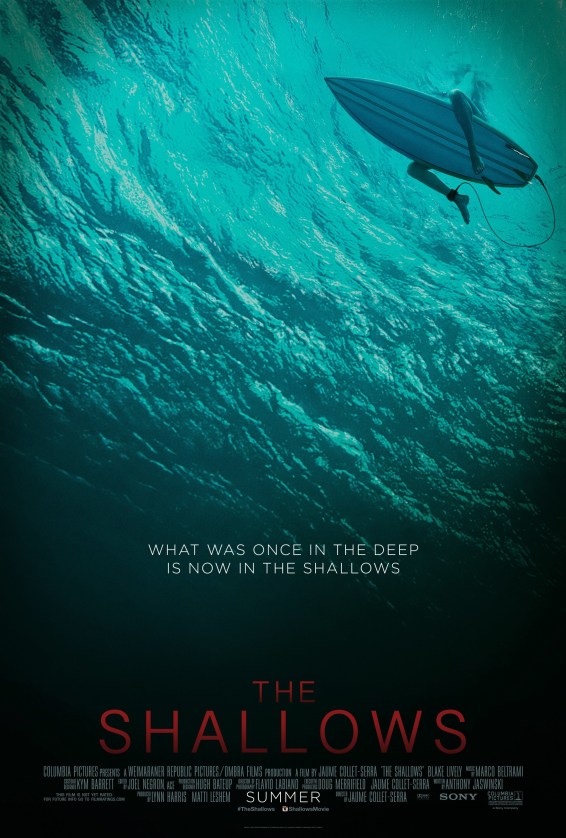
The Shallows (2016) – Film Review

Ever since the release of the original blockbuster; ‘Jaws,’ in the summer of 1975, shark films have never quite managed to reach the same heights, with flops such as ‘Deep Blue Sea,’ ‘Bait,’ ’47 Meters Down,’ and ‘Shark Night’ feeling quite distant from reality, as they present the animals as nothing but bloodthirsty monsters that devour brain dead characters. And, while ‘The Shallows’ does feel like a slight improvement over many of these other flicks (mostly in regards to its protagonist), the film still falters at many turns.

Plot Summary: After losing her mother in an accident, medical student; ‘Nancy,’ dumps her responsibilities in Galveston and travels to Mexico, hitchhiking a ride to a hidden beach that her mother loved when she was young. But, following her discovery of a whale carcass whilst surfing, ‘Nancy’ is attacked by a great white shark, leaving her tired, bleeding and stranded on a small rock, with no sign of rescue…

Releasing in 2016 to great success, ‘The Shallows’ was one of the first major shark films released into cinemas in quite some-time, but as well as being a creature-feature, ‘The Shallows’ also serves as a modern-day survival-thriller along the same lines of ‘127 Hours Later,’ as ‘Nancy’ has to face not only the great white shark stalking her, but also hunger, thirst, weather, and, of course, the severe leg injury she receives when she first encounters the apex-predator. Yet, despite this focus making for a far more engaging experience, the narrative simultaneously tries its hand at character development, with ‘Nancy’ receiving plenty of characterisation in the film’s first act, which is sadly made less interesting as its delivered through some immensely corny dialogue.

Blake Lively, who is by no means a renowned actress, with only two films throughout her career featuring her in the top-billed cast, carries the film solo, and her commitment to this role is certainly admirable, as Lively gives a very intense performance as a result of ‘Nancy’ being in agonising pain for most of the runtime. Furthermore, Lively did most of her own stunts for the film aside from her character’s surfing. In fact, in one particular scene where ‘Nancy’ crushes a crab and then proceeds to eat it raw, Lively is actually eating a real crab that the production crew found dead on a nearby beach that morning, so her reactions of disgust are genuine, even though the crab initially being crushed was achieved through CGI. This is all made even more impressive by the fact that Lively was pregnant with her second child at the time of filming. 

Flavio Martínez Labiano’s cinematography does provide a handful of attractive and memorable shots when not focusing on the characters, these usually being when the shots revolve more around the shark lurking beneath the water, or when the camerawork effectively uses framing to display how far ‘Nancy’ is from safety. And, of course, with the film being shot off the Gold Coast of Australia (excluding a few scenes which were shot in a large water-tank), the film’s signature beach and crystal clear waves are always an alluring sight, which is a superb visual clash with the horror that lies within.

The original score by Marco Beltrami serves the story well enough, as the film’s soundtrack drifts from beautiful calming tracks, like ‘Paddle In’ and ‘Nancy and Dad Facetime,’ to much more tense tracks, such as ‘Main Title’ and ‘Towards the Dead Whale.’ However, its when the story shifts into full on threat that the score begins to feel extremely generic, most notably, the track; ‘Underwater Attack,’ which is barely distinguishable from any other thriller soundtrack as it doesn’t encapsulate either the beauty or isolation of the ocean as many of the other tracks do.

Unlike ‘Jaws’ or even ‘Deep Blue Sea’ during a few moments, ‘The Shallows’ exclusively uses CGI to bring its shark to life, which is unfortunate, as while there is clearly a huge level of detail put into the shark as director Jaume Collet Serra (Orphan, Unknown, Non-Stop) worked closely with the film’s visual effects artists to ensure a sense of realism in the shark’s design, having the team do thousands of hours of research. This all sadly goes to waste though due to the demands of the film’s screenplay, as the shark in ‘The Shallows’ rarely acts like a real animal, often feeling like just a hulking murderous monster whose CG effects drastically vary depending on the shot.

In summary, ‘The Shallows’ is a step-up from a number of other shark flicks, but even with its above-average filmmaking and solid performance from Blake Lively. The film still falls into many of the common issues shark films do, as the story favours the idea of using its shark as a monster of the ocean and that alone, and this on top of the film’s occasionally strange stylistic choices, shoddy CG effects and cheesy dialogue, result in the film becoming just another poor attempt at revitalising the great white shark as a cinematically enthralling antagonist. Final Rating: 4/10.
shallows_xxlg

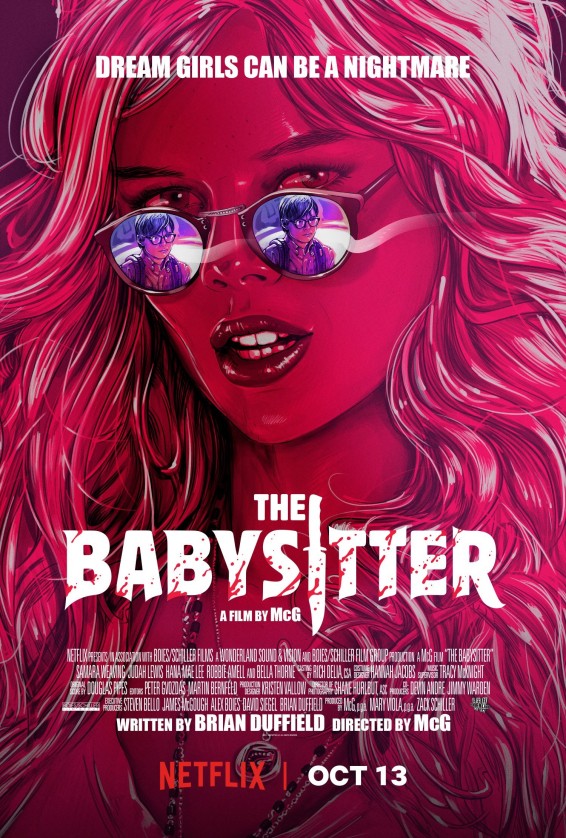
The Babysitter (2017) – Film Review

Originally filmed in 2015 with the intention of playing in cinemas, the horror-comedy; ‘The Babysitter,’ wasn’t seen by any horror fanatics until it released late 2017 after Netflix acquired the rights to the film for streaming. And, although ‘The Babysitter’ doesn’t exactly break any of the rules we’ve come to expect within the horror genre, this horror-comedy with splatterings of style must’ve been entertaining enough for those who decided to watch it, as the film would eventually spawn a Netflix-exclusive franchise with a later sequel.

Plot Summary: Riddled with anxiety, twelve-year-old; ‘Cole,’ has always been bullied and picked on due to his constant panicking, only finding comfort around the one person who understands him, his attractive babysitter, ‘Bee.’ That is, until one night, after ‘Cole’ secretly stays up past his bedtime to discover she’s actually part of a satanic cult, forcing ‘Cole’ to spend the rest of his evening evading ‘Bee’s band of killers who will stop at nothing to prevent him from spilling their dark secret…

Directed by Joseph McGinty Nichol (Charlie’s Angels, Terminator: Salvation, This Means War) or ‘McG’ as he more commonly goes by, ‘The Babysitter’ is a film that has received a number of alterations (both big and small) since even the early stages of its pre-production. For example, in the original screenplay for the film, ‘Sonya’ was actually a cheerleader, ‘Allison’ was a journalist for her high school newspaper, and ‘Max’ had dreadlocks, but eventually it was decided that ‘Bee’s cult followers should be reimagined to more closely reflect the stereotypical characters seen in classic slasher flicks, only in this film, they’re the antagonists. And, this idea is one of the film’s best aspects in terms of its writing, as it gives the film a real sense of self-awareness in addition paying respect to what came before it. Most notably, the ‘Friday the 13th’ series, which ‘Max’ references directly at one point when he chants; “Ch-Ch-Ch-Ah-Ah-Ah,” whilst chasing ‘Cole.’

Judah Lewis does manage to leave an impression in his first film role, portraying protagonist ‘Cole’ as an innocent twelve-year-old with few friends aside from ‘Bee,’ even if a large portion of his anxious characterisation feels far too over-the-top. Then there is also Samara Weaving as the titular babysitter; ‘Bee,’ and her cult followers; ‘Max,’ ‘Allison,’ ‘Sonya’ and ‘John,’ portrayed by Robbie Amell, Bella Thorne, Hana Mae Lee, and Andrew Bachelor, respectively. Who, are all wonderfully devilish throughout the film, having plenty of dark comedic moments between them making their deaths quite unfortunate, as while I’m sure most could’ve guessed their characters do die at some point within the narrative, we don’t get to spend enough time with any of them to get a strong grasp on their exaggerated personalities or any understanding of their malevolent cult.

In spite of the usually dull cinematography by Shane Hurlbut, ‘The Babysitter’ still manages to be one of the more visually interesting Netflix Originals through its unique style, as the film continuously implements different text, graphics and colours to give it a distinct stylistic appeal, not too dissimilar from (although nowhere near impressive as) ‘Scott Pilgrim vs. The World’ from 2010. Many of these editing decisions also help to redeem the film’s humour, which is extremely inconsistent, bouncing from hilarious cutaways and meta horror jokes to embarrassing lines of dialogue which try far too hard.

Whilst composer Douglas Pipes has crafted some great scores in the past, like ‘Monster House’ and ‘Trick ‘r Treat,’ ‘The Babysitter’ is certainly not one of them, as even with the film having many serviceable tracks. The soundtrack in general just lacks anything distinctive, and I believe that if it was ever compared to any other score from Pipes, or even just a handful of random horror scores, I doubt most would be able to tell it apart. The film also throws in the iconic Queen song; ‘We Are the Champions,’ nearing the runtime’s end, which feels immensely out-of-place and comes out of nowhere.

For a large duration of its tight runtime (which the film breezes through as a result of its unrelentingly fast pacing), ‘The Babysitter’s story is predominantly just one long chase sequence, and whilst occasionally tense, I couldn’t help but feel that the film’s screenplay could’ve taken better advantage of its evil babysitter concept or its few supernatural elements, despite the series second entry; ‘The Babysitter: Killer Queen,’ delving much further into the latter. Yet, the film doesn’t disappoint when it comes to its violence, having plenty of fantastically gruesome gore effects which are all successfully played for comedy.

In summary, I could see ‘The Babysitter’ being an enjoyable experience for some and possibly just a boring viewing for others, as when ignoring the film’s graphic gore and fun stylistic choices, the story leaves a lot to be desired, and can often feel derivative of horror classics even if this was the film’s intention to an extent with its focus on horror tropes/clichés. For me, although I do admire the film’s ridiculous tone and dark humour, the disappointing story can often feel sluggish, diminishing the film’s memorability and rewatchability. Final Rating: 5/10.

babysitter_xxlg

Now You See Me (2013) – Film Review

Quite a unique film within the crime genre, ‘Now You See Me’ is seemingly a magician’s rendition of ‘Ocean’s Eleven,’ as director Louis Leterrier crafts an entertaining film following the story of a group of four illusionists, all with different skill sets, robbing establishments across the globe before then vanishing without a trace. And although some viewers may have to suspend their disbelief for a few elements regarding the film’s plot, the film still manages to remain a mostly enjoyable affair throughout its two-hour runtime.

Plot Summary: After four small-time magicians are anonymously invited to attend a meeting in a run-down apartment. They reappear one year later as ‘The Four Horsemen,’ performing a live-show in Las Vegas in which they claim they are going to rob a bank in Paris from the stage and distribute the money to the audience. But after the French bank is found empty following the show, F.B.I. Agent, ‘Dylan Rhodes,’ is assigned to the case with his partner, ‘Alma Day,’ where the two begin to suspect that the heist was just a distraction for a bigger scheme…

Even though ‘Now You See Me’ prioritises its story over anything else, the film does still feature a couple of exciting action sequences including a car chase and a fistfight, respectively. Both of which stick with the idea of the magicians performing magic tricks, utilising many of the age-old illusions we know in creative ways, yet this shouldn’t be too surprising, considering director Louis Leterrier has worked on action flicks, like ‘The Transporter,’ in the past. However, ‘Now You See Me’ does miss a big opportunity to say anything interesting about the actual profession of magic, as with very few films focusing on characters with this skill set, it would make sense to delve further into figures with this expertise.

‘The Four Horseman,’ portrayed by Jesse Eisenberg, Woody Harrelson, Isla Fisher and Dave Franco are all splendid in their roles as the signature group of magicians. As despite Dave Franco’s ‘Jack Wilder’ feeling a little neglected at points as the fourth member of the group, all of the cast give very charismatic performances to where you could believe they perform live-shows most evenings. The group also spends most of the film being hunted by a F.B.I. detective duo portrayed by Mark Ruffalo and Mélanie Laurent, and although both actors are great within their roles, the film does attempt to build-up a romantic relationship between the two, which honestly comes across as forced and underdeveloped.

Mitchell Amundsen and Larry Fong’s cinematography is competent even if the film does have quite the overreliance on mid-shots to focus on the actors’ performances, first and foremost. But, when taking into account the film’s constant emphasis on eye-contact and slight of hand, I did feel the camerawork wasn’t used very effectively to display that trickery, which would’ve surely placed the film’s audience in the same position as ‘The Four Horsemen’s live-audience. The cinematography does still allow for plenty of stunning wide-shots during each live-show, however, as the camera glides over the huge crowd giving an impressive view of the massive audiences that attend each night.

The original score by Brian Tyler is a jazz-style soundtrack in the same vein as other crime/heist films such as the previously mentioned ‘Ocean’s Eleven.’ In particular, the tracks; ‘Now You See Me,’ ‘The Four Horseman’ and ‘Welcome to the Eye,’ are all deeply rooted in jazz, fitting a familiar tone to many real illusionist shows. So much so, that it soon becomes quite evident that Tyler has done his research as his score fully embraces its funky percussion and snappy brass motifs.

Throughout the film, there are also a number of magnificent effects, CG and practical alike. In fact, near the beginning of the film when ‘Daniel Atlas’ is performing an extraordinary card trick, we see the hands of Dan or Dave Buck digitally composited with Jesse Eisenberg’s face. These twin brothers are actually acclaimed sleight of hand artists, as well as pioneers in the art of cardistry, their skills have also been seen in the action flick; ‘Smokin’ Aces,’ from 2006, performing tricks for Jeremy Piven. Cardistry is an open display of skill with cards, similar to juggling, and the sequence of moves performed in ‘Now You See Me’ is called a ‘Pandora,’ which at the time of filming, was considered one of the hardest moves to perform in cardistry.

In summary, I feel ‘Now You See Me’ serves its purpose as a crime/mystery, telling an engaging and mostly well-written story that doesn’t take itself all too seriously. While the film does disguise many of its obvious flaws through smoke and mirrors, I believe the vast majority of viewers will enjoy this film for what it is. And, if you have already seen this flick and relished it, then I’d strongly recommend you watch ‘The Prestige,’ another magician-related film which I personally think surpasses ‘Now You See Me’ (and its uninspired sequel) in many ways. Final Rating: low 7/10.

NowYouSeeMePoster2

As Above, So Below (2014) – Film Review

Co-written and directed by John Erick Dowdle (The Poughkeepsie Tapes, Quarantine, Devil), ‘As Above, So Below’ is certainly an interesting found-footage flick, as while at a first mention the film may just sound like another a stereotypical horror, this claustrophobic delve into the caliginous Paris catacombs does actually have some depth hidden beneath its generic exterior. But, unfortunately, even with the story’s intriguing religious imagery/influences, the film soon plummets into clichéd mediocrity, mostly as a result of its bland characters and weak scares.

Plot Summary: When a team of explorers venture into the miles of twisting catacombs that lie beneath the streets of Paris, all in search of the historical ‘Philosopher’s Stone,’ they encounter far more than they bargained for when they realise they have entered into the first of the nine rings of Hell, where visions of their past sins begin to relentlessly torment them…

From a quick glance at the film’s visuals, its understandable why many would see ‘As Above, So Below’ as just another found-footage horror, only this time capitalising on the daunting real-world location of the Paris catacombs, which hold the remains of more than six million people in the small part of a tunnel network built to consolidate Paris’ ancient stone quarries. But, the film’s setting does heavily relate to the story of ‘Inferno,’ a short poem written by Italian poet Dante Alighieri in the fourteenth century, focusing on the tale of man who journeys through Hell guided by the Roman poet Virgil. Even the film’s title plays into this central idea, as the words; “As Above, So Below,” are derived from “On Earth as it is in Heaven,” which is a line from the ‘Christian Lord’s Prayer,’ which begins with “Our Father, Who Art in Heaven…”

Even though their characters are immensely mundane, Ben Feldman, Edwin Hodge, François Civil, Marion Lambert, and Ali Marhyar are all serviceable in their respective roles, delivering the usual screaming, ventilating and panicking performances that occur in most found-footage films. However, while the film’s protagonist; ‘Scarlett,’ is portrayed well by Perdita Weeks, the character herself is noticeably very unlikeable, mostly due to her constant obsession with the ‘Philosopher’s Stone,’ which she places all of her friend’s lives at risk for without question, and its never made clear whether we should actually be rooting for her to survive or not.

The cinematography by Léo Hinstin is more of the usual for this subgenre, providing the viewer with plenty of shaky and out of focus shots as the characters make their way through the almost pitch-black burial ground. This doesn’t distract from what is easily the film’s most impressive (and most ambitious) filming tip-bit, however, which is that the film was actually shot in the Paris catacombs themselves, not in a soundstage. In fact, this was the first production ever to secure permission from the French government to film within the catacombs, which would have been quite a challenge as the series of narrow, winding tunnels with centuries-old skeletons arranged on the walls would’ve had little room for equipment and crew. Yet, this does payoff as the film utilises its location extremely well, always placing its characters in tight areas to insight a feeling of claustrophobia in the audience.

While the film doesn’t feature a complete original score for obvious reasons, one of the strongest aspects of found-footage flicks, sound design, is actually an area where ‘As Above, So Below’ is lacking, as despite the film’s many attempts to feel impactful when the characters dive into water or are nearly crushed by a collapsing ceiling, a vast majority of the sound effects don’t sound as if they are coming from within the catacombs, usually sounding quite evident they have been added in post-production on account of the absence of echo or density.

With a large portion of the film’s narrative being based on Dante’s ‘Inferno,’ the film’s basic structure revolves around the characters heading further and further into Hell, with each character facing a vision of a personal sin from their past. These rings (or levels) in order are ‘Limbo,’ ‘Lust,’ ‘Gluttony,’ ‘Greed,’ ‘Anger,’ ‘Heresy,’ ‘Violence,’ ‘Fraud,’ and ‘Treachery.’ But, outside of the film’s previously mentioned religious symbolism, after the characters leave the initial catacombs, each ring is represented purely through dark empty caverns, which become quite repetitive after a point.

In summary, despite the Paris catacombs being a very compelling setting for a modern horror film, in addition to much of the film’s religious influences making for quite a unique story. I’d still suggest other claustrophobic horrors, like ‘The Descent’ or ‘The Thing’ before ‘As Above, So Below,’ as not only does the film eventually devolve into the standard horror formula without much experimentation, but if you’re unaware of any of the religious context, then I could definitely see the film being fairly forgettable. In all honesty, I feel this film may have been better off as non-found-footage, as I think this would’ve allowed the film to better explore its story and religious subtext. Final Rating: 5/10.

as_above_so_below-p874968

The Man From U.N.C.L.E. (2015) – Film Review

Both a stylish Guy Ritchie comedy as well as a reimagining of the classic 1960s espionage show of the same name, ‘The Man From U.N.C.L.E.’ is a mostly successful modern take on the classic spy-caper. Capturing a familiar tone in spite of its unremarkable story, which the film tries to distract from through its charismatic cast and many exciting set pieces, equalling to a decently entertaining ’60s action/comedy even if it may be on the lower side of Ritchie’s filmography, with ‘Snatch’ and ‘The Gentlemen’ still being far superior films, in my opinion.

Plot Summary: In the early 1960s, CIA agent; ‘Napoleon Solo,’ successfully helps ‘Gaby Teller’ escape East Berlin despite the intimidating opposition of KGB agent, ‘Illya Kuryakin.’ Later, all three unexpectedly find themselves working together on a globe-trotting mission to stop a private criminal organisation that is working to proliferate nuclear weapons…

Being co-written and directed by Guy Ritchie (Snatch, Sherlock Holmes, The Gentlemen), ‘The Man From U.N.C.L.E.’ takes in much of the director’s usual style/humour, having an abundance of witty and amusing dialogue (much of which is brimming with innuendos), in addition to plenty of editing flair. But, ‘The Man From U.N.C.L.E.’ also serves as the first film interpretation of the ’60s espionage show, which Warner Bros. Pictures had actually been trying to adapt for over a decade, director Steven Soderbergh was once even attached to the project with George Clooney, Channing Tatum and Emily Blunt all set to play the three leading characters. The film’s story isn’t just a recreation of a specific episode from the show, however, as Ritchie and his story team actually decided to create an original narrative based around the origin of ‘U.N.C.L.E.’ A backstory that was only hinted at in the show.

Henry Cavill and Armie Hammer portray the film’s protagonist duo, and while neither of their characters are exactly memorable, they do both give great performances, sharing many comedic moments together and bouncing off each other very well, the film even gives its characters a sufficient amount of development early on in the story, though it is delivered through mission briefings and expositional dialogue. Yet, it’s the third member of the cast where some issues begin to arise, as Alicia Vikander as ‘Gaby’ is supposed to be the emotional centre of the story, as her father is being forced to make nuclear weapons, but the film makes it quite hard to resonate with her due to her lack of characterisation and inconsistent German accent, which seemingly disappears at random. Elizabeth Debicki also appears in the film as antagonist, ‘Victoria,’ but similar to Hugh Grant’s character, ‘Waverly,’ she has little impact on the viewer as a result of her very limited screen-time.

Aside from the occasional CGI-enhanced shot, the cinematography by John Mathieson is pretty creative throughout the film, having many unique shots alongside plenty of shots which feel like throwbacks to classic espionage flicks. The film also makes excellent use of Ritchie’s signature editing style, cutting between scenes in a variety of visually interesting ways as well as colourfully implementing the film’s Russian/German subtitles, all of which are displayed in a bright yellow text almost as if they are taken from a 1960s spy poster, not too dissimilar to the film’s opening and ending credits, which are reminiscent of the original show’s intro whilst also feeling fresh.

Daniel Pemberton’s original score is in keeping with the film’s tonal integrity, as Pemberton sought to capture a sound that combined the crispness and sophistication of today with a distinctly 1960s flavour. The first step of which was the venue, as ‘The Man From U.N.C.L.E.’s score was actually recorded in Studio 2 at Abbey Road, where even the most casual music fan likely knows that this is where ‘The Beatles’ recorded many of their iconic albums. Yet, apart from the tracks; ‘His Name is Napoleon Solo’ and ‘Escape from East Berlin,’ the soundtrack feels well-crafted but still falls short, being fairly forgettable in the long run.

However, the world of ‘The Man From U.N.C.L.E.’ isn’t as forgettable, as the film’s 1960s time period mixes together the elegant class of the era with more futuristic spy technology/gadgets. One of the reasons the film stayed in the ’60s time period was to allow the film to have its own reality, setting it apart from films like ‘The Bourne’ franchise and other recent spy thrillers, according to director Guy Ritchie. Obviously, this means that the film constantly revels in its period-accurate vehicles, set design and costumes, a few pieces of which were actually vintage.

In summary, ‘The Man From U.N.C.L.E.’ isn’t a film that will surpass expectations as the film delivers on what it sets out to, for the most part, displaying some fantastic action scenes and enjoyable gags. It’s hard to ignore the film’s uninteresting story, which simultaneously feels drawn out and dull, even branching into convoluted at points with the sheer amount of characters and locations mentioned. But, for myself, and any other classic espionage enthusiasts, ‘The Man From U.N.C.L.E.’ will suffice, even though it could’ve done with some refinement in certain areas. Final Rating: 6/10.

the-man-from-uncle-poster

How to Train Your Dragon (2010) – Film Review

One of the highest-regarded films from DreamWorks Animation, 2010’s ‘How to Train Your Dragon’ is successful in nearly every regard as an animated feature, making many changes to its original source material (all of which for the better), to excel as a brilliant piece of family-focused storytelling. With plenty of memorable characters, exhilarating action sequences and an outstanding original score by John Powell, ‘How to Train Your Dragon’ would soon go on to become one of DreamWorks’ most recognisable and profitable franchises for good reason.

Plot Summary: On the island of ‘Berk,’ ‘Hiccup,’ the frail son of the Viking Chief, aspires to hunt dragons and keep his home safe like the rest of his clan, earning the respect of his fellow Vikings. But, after injuring a ‘Night Fury,’ one of the rarest and most powerful dragons known to exist, ‘Hiccup’ forms an unlikely friendship with the creature, soon realising that dragons aren’t at all what Vikings believe them to be…

The first film to be directed by duo Chris Sanders and Dean DeBlois since the Disney animated classic; ‘Lilo and Stitch,’ in 2002. The film adaptation of ‘How to Train Your Dragon’ makes many alterations to the story seen in the original children’s book. As, firstly, ‘Hiccup’ does not have a love interest, and the now-iconic DreamWorks character; ‘Toothless,’ is about the size of the ‘Terrible Terror’ dragon breed, his skin is also green and red, not black. Furthermore, ‘Toothless’ gets his name when ‘Hiccup’ first finds him with no teeth. But, the film’s producers decided, with the approval of author Cressida Cowell, that it would be more cinematic to make ‘Toothless’ large enough to be ridden as a flying mount. As such, ‘Toothless’ was completely redesigned as a rare ‘Night Fury,’ a highly intelligent breed of dragon evolved for speed and stealth with teeth that retract into their jaw when shooting a fiery pulse.

Protagonist; ‘Hiccup,’ is portrayed by Jay Baruchel, a fairly under-the-radar actor. But, similar to his character in ‘The Sorcerer’s Apprentice’ from 2011, Baruchel suits a nervous character, like ‘Hiccup,’ extremely well due to his naturally anxious voice, making for a likeable yet never vexatious protagonist. Gerard Butler as ‘Hiccup’s father; ‘Stoick,’ is another member of the cast who naturally fits his character, as Butler’s rough Scottish accent melds with the hefty Viking’s design perfectly. The film also features a great ensemble cast for the other young dragon recruits through America Ferrera, Jonah Hill, Christopher Mintz-Plasse, T.J. Miller and Kristen Wiig, who together provide many of the film’s comedic moments.

The animated cinematography throughout ‘How to Train Your Dragon’ is superior to a number of other animated flicks when put in comparison, as the film continuously features beautiful visuals. The most obvious being within the scene; ‘First Flight,’ in which, ‘Hiccup’ hops aboard ‘Toothless’ for the first-time as they soar across the stunning land of ‘Berk,’ breezing over acres of forest and past/through cliffs, all while being tracked by the camera. Interestingly, many of these dragon-flying moments are also inspired by combat and aerobatic aircrafts, as ‘Toothless’ performs many aerobatic maneuvers and combinations, such as a ‘Loop and Snap.’

Nominated for an Oscar at one point-in-time, the original score by John Powell is truly sensational, a majestic score that occasionally even utilises bagpipes in order to further fit with the film’s Scottish setting (which is alluded to by the many Scottish accents). And, while Powell has always been known for creating phenomenal scores for animated flicks, with ‘Ice Age,’ ‘Kung Fu Panda’ and ‘Horton Hears a Who!,’ being just some of his sublime work, the soundtrack for:’How to Train Your Dragon’ is by far some of his best, with the tracks; ‘This is Berk’ and ‘Forbidden Friendship,’ becoming some of the most notable tracks in all animation.

The animation itself has begun to show its age in a handful of shots since the film’s initial release, but as a result of the film’s many wonderful designs, usually in relation to its dragons, which display different abilities, colours, horns and skin-tones for each breed, the film manages to redeem any shot that feels at all dated. These pleasant designs also help distract from the film’s overly fast pacing, as whilst I understand that younger viewers may have shorter attention spans, the film can sometimes feel as if its rushing through one scene to quickly get to the next.

In summary, although I possess the quite controversial opinion of disliking the sequels to ‘How to Train Your Dragon,’ as I personally find them much more generic and by-the-numbers in terms of their storylines, especially when compared to the original, the first of the series is still one of DreamWorks’ best efforts, and I’d even argue is on the level of beating out their previous fantasy franchise; ‘Shrek,’ in regard to its characters, creatures and world-building. So, even if you don’t enjoy animated/family films, perhaps ‘How to Train Your Dragon’ will sway you into the genre just as it does with its wondrous story. Final Rating: 8/10.

how-to-train-dragon-poster1

The Perks of Being a Wallflower (2012) – Film Review

Dealing with heavy themes of loneliness, mental health and suicide, ‘The Perks of Being a Wallflower’ may not astonish when it comes to its visuals. Yet, through its strong performances, heartfelt story and well-written screenplay (aside from one or two cliché lines), the film soon becomes a very sincere and captivating adaptation of the acclaimed coming-of-age novel many grew up with when it released in 1999, now being seen as one of the best teenage dramas in recent years.

Plot Summary: Fifteen-year-old; ‘Charlie,’ a socially awkward teenager heading into his first year of high school, used to watching life from the sidelines, ‘Charlie’ soon discovers the joys of friendship, love and music as the free-spirited; ‘Sam,’ and her stepbrother; ‘Patrick,’ open his eyes to the real world. But, when his friends prepare to leave for college after graduating high school, ‘Charlie’s inner sadness threatens to shatter his newly-found confidence…

In a rare scenario, the film adaptation of ‘The Perks of Being a Wallflower’ is not only based on the novel of the same name by Stephen Chbosky, but is actually written and directed by Chbosky himself. As, originally, beloved writer-director John Hughes, the comic genius behind; ‘The Breakfast Club’ and ‘Sixteen Candles,’ amongst many other ’80s teen flicks, was intended to direct the adaptation, initially wanting to make the film into more of a dark comedy with Shia LaBeouf set to play ‘Charlie,’ Kirsten Dunst as ‘Sam,’ and Patrick Fugit as ‘Patrick.’ But, with Hughes sudden death in 2009 stalling the project, his screenplay was eventually scrapped as he’d not completed it before his passing, leaving Chbosky to take the reins.

Throughout the entirety of the film, the central trio of friends are portrayed wonderfully by Logan Lerman, Ezra Miller and Emma Watson, in one of her first roles following the end of the ‘Harry Potter’ series, as each member of the young cast display plenty of range with their respective characters receiving an almost absurd amount of characterisation alongside, resulting in all three of the central protagonists soon forming a real bond with the audience through their lovable yet realistic portrayals of high school teenagers. Well-known comedy actor Paul Rudd also appears within the film as ‘Mr. Anderson,’ using his natural charisma to portray a genuinely kind-hearted teacher, guiding ‘Charlie’ to what he believes is his future career as a writer.

The film’s cinematography by Andrew Dunn is noticeably where the filmmaking dips in quality, as despite the camerawork occasionally allowing for some interesting framing, such as when ‘Charlie’ is framed alone with only bare walls surrounding him, visually presenting him as an outcast due to his anxiety when interacting with others. Most of the film’s cinematography feels fairly mundane, with the colour palette, in particular, seeming very confined, always utilising quite warm/calming colours regardless of what’s happening within the narrative. With that said, near the end of the runtime, the film does manage to impress with its editing as ‘Charlie’ begins to suffer from a panic-attack, represented through the film cutting rapidly between an array of previous scenes, ensuring a feeling of being overwhelmed within any viewer whilst watching. 

From iconic songs, such as: ‘Heroes’ and ‘Come on Eileen,’ to the beautifully somber original score by Michael Brook. The entire soundtrack for ‘The Perks of Being a Wallflower’ is both graceful and immensely underappreciated, capturing the film’s many alternating tones, whether that’s its unrelenting isolation, or its upbeat bliss. But, my personal two favourite tracks have to be ‘Charlie’s First Kiss’ and ‘Shard,’ a pair of tracks that are both truly touching pieces of music, evoking emotion in any listener in spite of their simplicity.

Another aspect of the film I adore is how it represents high school, as while many coming-of-age flicks usually lean into the idea of high school being an often chaotic, but satisfying experience, ‘The Perks of Being a Wallflower’ never glorifies school, refusing to represent it as either a positive or negative place. This all backed up, of course, by the story’s interesting themes which the film handles with care, never overemphasising it’s concepts in a similar fashion to the source material. Also, in line with the original novel is the film’s nostalgic 1990s setting. Yet, with the exception of the numerous mix-tapes the characters listen to, you’d be forgiven for being unaware that the film even takes place within this time-period, as it’s never mentioned nor plays into the film’s style.

In summary, ‘The Perks of Being a Wallflower’ is deserving of the praise it receives, as while the film’s uninspired cinematography does leave some room for improvement, for a directorial debut, Stephen Chbosky really knocks it out of the park here, with some brilliant performances and very underrated original score, the film is truly an adaptation to be admired. And, regardless of whatever time-period its story is set within, many of its themes/messages are timeless, and I personally believe this is what any other films focusing on troubled teenage characters should strive to be. Final Rating: 8/10.

perks_of_being_a_wallflower_xxlg

Scary Stories to Tell in the Dark (2019) – Film Review

Based on the controversial 1980s children’s book series of the same name, written by Alvin Schwartz and nightmarishly illustrated by Stephen Gammell. The film adaptation of ‘Scary Stories to Tell in the Dark’ directed by André Øvredal and co-written/produced by Guillermo del Toro, takes a very different approach than what many may expect when considering its source material, as the film ditches the book’s original anthology structure in favour of a more interconnected story to mixed results.

Plot Summary: On Halloween night, 1968, a group of childhood friends daringly enter the abandoned home of ‘The Bellows’ family, whose shadow has loomed over the small town of Mill Valley for generations as a result of the notorious murder of ‘Sarah Bellows,’ who turned her tortured life into a book of scary stories many years ago. But, these terrifying tales soon have a way of becoming all too real when the reclusive ‘Stella’ decides to take ‘Sarah’s story-filled journal home…

Clearly inspired by Stephen King’s classic novel; ‘It,’ ‘Scary Stories to Tell in the Dark’ takes the now-popular route of focusing on a younger cast, capturing that classic spirit of childhood adventure mixed with plenty of light-horror, but rather than setting the film in the hackneyed time-period of the 1980s, the film actually chooses to set it’s story near the end of the 1960s, which I feel helped the film stand out amongst the ‘It’ remake and it’s many similar incarnations. However, since its release, ‘Scary Stories’ has received plenty of criticism for its underwhelming horror, despite this being a completely intentional decision on behalf of the filmmakers, ensuring the film as a first step into the horror genre for younger audiences, never displaying too much violence or overly intense scares, not too dissimilar to the book series itself.

Zoe Margaret Colletti, Michael Garza, Austin Zajur, Natalie Ganzhorn, Gabriel Rush, and Austin Abrams portray the main group of friends and all do a decent job, as while their individual characters don’t exactly break new ground, they are likeable enough and have their inklings of both personality and humour. Contortionist Troy James, who once appeared on ‘America’s Got Talent,’ also appears in the film as one of the monsters, known as ‘The Jangly Man.’ Who, aside from having some CGI-enhanced facial expressions, actually performed all of his impressively unnatural body movements himself, including walking backwards, twisting his torso and crawling upside-down.

Roman Osin’s cinematography does remain visually interesting for the majority of the runtime, having plenty of creative shots with an effective implementation of colour alongside. But, it’s the film’s monsters that are unquestionably the best aspect of this adaptation, as the film takes the horrifying and abstract illustrations of Stephen Gammell and melds them into live-action flawlessly. So much so, that even in spite of each creature’s very limited screen-time, every monster manages to be quite memorable in its own right, from ‘The Pale Lady’ to ‘The Big Toe’ to the dilapidated poster-child scarecrow; ‘Harold,’ all of which were brought to life through prosthetic make-up and convincing practical costumes, rather than just CGI.

The original score by Marco Beltrami and Anna Drubich is a fairly average horror score, yet does still serve the story well for what it has too, even if most of the tracks aren’t worth looking-up afterwards. But, it’s also within the main score that there a small nod towards the original book series, as one of the tracks that plays throughout the film is titled; ‘The Hearse Song,’ which is actually a short song from the book series’ first entry.

As previously mentioned, the main creative decision that seems very peculiar to me is that the film adaptation of ‘Scary Stories to Tell in the Dark’ is not an anthology film, despite the books the film is based on focusing entirely on different characters/monsters with each new story. Instead, the writers chose to create an original story based-around the depraved spirit of ‘Sarah Bellows’ bringing the stories within her book to life, which was apparently done in order to stop one of the stories from overshadowing the rest, according to Guillermo del Toro. Yet, I personally feel that this makes the film less entertaining, as many of the story’s concepts and creatures feel underutilised, due to this overarching (and occasionally corny) narrative, even if the main story does borrow some of its ideas from other unused tales within the books series.

In summary, ‘Scary Stories to Tell in the Dark’ does triumph in its goal of crafting a horror more accessible for younger audiences, as I could see this film appealing to many young audience members in search of a gateway into the horror genre. If you are already a veteran within the genre, however, then I feel ‘Scary Stories’ will more than likely disappoint, as the film’s many cliché story-beats and lack of any gore or truly tense moments does result in this adaptation becoming a mostly forgettable horror flick with the exception of its many unique creature designs. Final Rating: 5/10.

scary_stories_to_tell_in_the_dark_xxlg

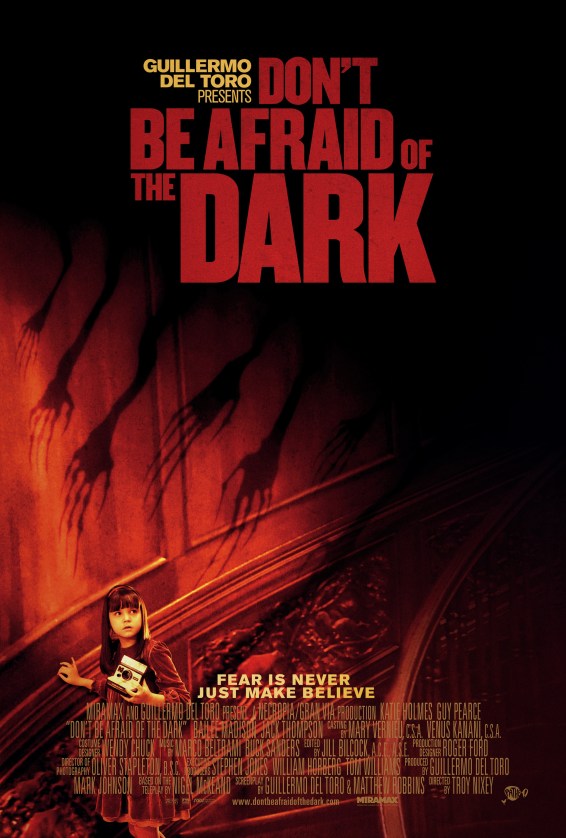
Don’t Be Afraid of the Dark (2010) – Film Review

Co-written/produced by Guillermo del Toro and directed by Troy Nixey, ‘Don’t Be Afraid of the Dark’ embraces many of the same elements as del Toro’s other films, crafting a narrative which combines both traditional gothic horror and childlike fantasy. But sadly, unlike a usual del Toro project, there is a noticeable absence in everything from captivating characters to memorising practical effects/creatures, resulting in a film that feels like a mostly copy-and-paste effort beyond one or two interesting ideas.

Plot Summary: After being sent to live with her father and his new girlfriend at their recently renovated manor, the previous home of the long-missing painter: ‘Emerson Blackwood’. Young ‘Sally’ begins to hear ominous voices emanating from the basement’s ash-pit, soon leading her to discover the cause of the painter’s disappearance…

Taking heavy inspiration from the classic H.P. Lovecraft short story: ‘The Rats in the Walls.’ ‘Don’t Be Afraid of the Dark’ is actually a remake of a low-budget 1973 TV film, as the now-iconic director Guillermo del Toro has stated in the past that he was terrified of the film when he first watched it as a child, later inspiring him to reimagine the mostly-unknown horror flick. Yet even with a much larger-budget and a more well-known cast, the film is still quite underwhelming when it comes to both its scares and story, as the film’s narrative follows a formula almost identical to many other modern horrors.

All of the performances throughout the film aren’t anything overly impressive, as whilst Katie Holmes does try her best to portray a young girl witnessing sights that no one else believes. Her character: ‘Sally’ (similar to the rest of the film’s characters) receives very limited characterisation, which does make many of the scenes revolving around the family-dynamic far less entertaining. Then there is also ‘Sally’s father and his girlfriend: ‘Kim’ portrayed by Guy Pearce and Bailee Madison respectively, and although Madison gives a serviceable performance, Pearce may give one of the weakest performances of his career here. As ‘Sally’s father: ‘Alex,’ always shows little concern or remorse when it comes to his daughter, making the character immensely difficult to resonate with.

The cinematography by Oliver Stapleton is very grand in its execution, allowing for a large number of wide-shots, some of which even flow smootly-around the various rooms of the manor. But it’s the film’s colour palette which is most worth noting, as the film utilises much more red and yellow than many other modern horrors, which is a pleasant change in terms of visuals as the more vibrant colours reflect the manor’s elegant design, which is probably one of the most visually striking ‘haunted houses’ in recent memory, with even the manor’s front entrance having a beautiful carving of an old oak tree merged into the multi-coloured glass.

Marco Beltrami and Buck Sanders provide the original score for the film, which similar to the film’s cinematography, gives the story a much more epic feel. As the heavy orchestral score could’ve easily been taken from any classic gothic horror, lending itself effectively to many scenes aside from a couple of generic tracks. The film often also features some fantastically creepy sound design, as the film’s creatures continuously speak to ‘Sally’ using their ghostly whispering voices, which seemingly echo throughout the usually empty corridors of the manor.

Although many of del Toro’s other outings do provide plenty of wonderful practical effects to gaze at, usually creating an array of unsettling and memorable creatures, ‘Don’t Be Afraid of the Dark’ takes another (less appealing) route to its monsters. As the film’s creatures are brought to life almost entirely though CG effects, which not only makes some shots appear slightly dated, but also manages to take away from nearly all of the film’s tense moments. Additionally, the film’s creature designs aren’t all that menacing, as despite the idea of evil fairytale monsters being quite unique (as the creatures are later revealed to be a sinister incarnation of tooth-fairies). The creature’s extremely small-size does make them feel very unthreatening even if it is a nice change-of-pace over having one large entity, as the film never does enough with its miniature antagonists regardless of what knives/tools they arm themselves with.

All in all, ‘Don’t Be Afraid of the Dark’ is a film that is regrettably just not worth its short runtime. As while I admire the effort to combine famed fairytale stories with a chilling atmosphere, the predominantly poor performances and numerous unexplored concepts leave the film simply another bland horror flick with a surprisingly weak screenplay by del Toro to-boot, especially when compared to much of his other work. Still, with all that said, I feel that Troy Nixey does deserve another shot in the director’s chair someday, as since this film’s initial release, he actually hasn’t worked on any other projects, which is unfortunate, as I do believe he does have some talent as a filmmaker when looking at this film’s merits. Final Rating: high 3/10.

Layout 1

The Blair Witch Project (1999) – Film Review

Upon its initial release, the original ‘Blair Witch Project’ blew many audiences away with its realistic depiction of found-footage horror, subsequently leading many audience members to believe that the events they were watching on-screen actually took place, making for a truly terrifying experience. However, now, many years after its first appearance, the film’s reputation has significantly altered with both critics and audiences alike, as ‘The Blair Witch Project’ is definitely a film that lies outside of the usual horror clichés.

Plot Summary: When three student filmmakers travel to Burkittsville, Maryland, in attempt to produce a documentary based around the local urban legend of ‘The Blair Witch,’ they mysteriously disappear after traveling into the nearby Black Hills Forest, leaving only their footage behind to be discovered one year later…

Whilst ‘The Blair Witch Project’ wasn’t the original found-footage horror film, with the infamous exploitation flick; ‘Cannibal Holocaust,’ first introducing the horror subgenre in 1980. ‘The Blair Witch Project’ was the first film to popularise the found-footage concept, as this film was at one point in time in the ‘Guinness Book of World Records’ for the largest box-office ratio, as the low-budget film only had a budget of around £45,000 and made back over £189 million, quickly spawning an inconsistent horror franchise despite the film’s only partially complete backstory for its creature and setting.

The three main cast members of Heather Donahue, Joshua Leonard, and Michael C. Williams (who all share their real names with their characters), are all tremendous throughout the film, as while their character’s don’t receive nowhere near as much development as they should considering how much screen-time we spend with them, each one of the actors do give the impression they are becoming more tormented and frustrated the longer they remain in the Black Hills Forest. The main reason the film’s protagonists don’t receive much characterisation, however, is actually due to the film’s production itself, as with the film not focusing very heavily on story, the actors were given no more than a thirty-five page outline of plot points rather than a full screenplay. So, as filming continued, the cast just played out various scenes, only having little knowledge of the mythology behind ‘The Blair Witch’ and improvising the vast majority of their lines.

Practically the entirety of the cinematography by Neal L. Fredericks is exactly what you’d expect from a found-footage horror, featuring an abundance of both shaky and out-of-focus shots, further adding to the idea that just behind the lens is a group of amateur student filmmakers (with some scenes even being shot by the cast themselves). In addition to the hand-held camerawork, the film’s visuals are also quite distinctive when it comes to its visual quality, as throughout the duration of the film, many shots remain incredibly grainy and occasionally even switch to a completely greyscale colour palette, which again, whilst adding to the realism of the film being a no-budget student documentary, does ensure the absence of any genuinely attractive shots.

Although it’s only heard during the film’s atmospheric end credits, ‘The Blair Witch Project’ does actually have an original score composed by Antonio Cora, but obviously being a found-footage horror, the film mostly aims to please with its sound design, as the sounds of crackling leaves and chirping birds are heard continuously. Interestingly, many of the eerie branch-cracking sounds heard at night even being made by the director and his friends simply walking up to the cast’s camp-perimeter and then tossing around twigs, rocks, and branches in various directions.

The main aspect that many will either admire or despise about ‘The Blair Witch Project,’ is its previously mentioned focus on realism and minimalist storytelling, as while the film does utilise its forest setting very effectively throughout the runtime, many who may be expecting a thrilling final act or possibly even a glimpse at ‘The Blair Witch’ herself will be greatly disappointed, as due to the story’s constant emphasis on realism, the film never actually provides any genuine evidence of the supernatural, with many of the film’s tense moments mostly relying on the darkness of the woods or the belligerent quarreling between the characters.

In summary, ‘The Blair Witch Project’ is certainly a fascinating horror film even if it isn’t always a successful one. As, to this day, this found-footage indie flick is a very divisive film for horror fans, with a 86% score on Rotten Tomatoes, the film has the highest-rating of any film that was also nominated for a Razzie Award for Worst Picture. So, even with the cast’s impactful performances and ‘The Blair Witch’ herself being an intriguing urban legend, this is one horror that really depends on your personal taste. For myself, while I find the film far from perfect and considerably less compelling than many other iconic horrors, I can appreciate what this experimental piece of filmmaking (and its marketing) was trying to accomplish, and for that, I feel it’s worth at least one viewing for any fan of the genre. Final Rating: 6/10.

blair_witch_project_ver3_xxlg