Arthur Christmas (2011) – Film Review

From Sony Pictures Animation and Aardman Animations, the latter being the iconic British company behind many beloved handcrafted films, such as ‘Wallace & Gromit,’ ‘Chicken Run,’ ‘Morph’ and ‘Early Man,’ comes a festive family adventure focusing on ‘Santa’s son; ‘Arthur,’ as he races across the globe to deliver a present to an overlooked child. And, although the film doesn’t feature the impeccable stop-motion animation the company is best known for, it does make up for its mostly generic CG visuals through its amusing moments, charming characters and inventive story.

Plot Summary: On the night of Christmas Eve, after ‘Santa’ and his enormous team of elves believe themselves to have succeeded in another year of present delivery for the children of the world. ‘Santa’s clumsy son; ‘Arthur,’ and a skilled gift wrapping elf, named; ‘Bryony,’ discover a young girl’s present has been misplaced, leaving her the only child in the world without a gift from ‘Santa.’ Fearing what the young girl will think when she awakens to find nothing under the tree Christmas morning, ‘Arthur’ sets out on a desperate mission with ‘Santa’s elderly father to deliver the forgotten gift…

Directed by Sarah Smith and Barry Cook, ‘Arthur Christmas’ is actually the first directorial effort from Cook since the iconic Disney flick; ‘Mulan,’ in 1998, with Smith having never directed a feature before in her career. Yet, even with these fairly inexperienced directors, ‘Arthur Christmas’ never gets muddled within its own story, managing to balance its many characters, exciting sequences and themes of family and symbolism/icons immensely well, whilst the film also cleverly answers the question that has perplexed children around the world for years, that being “How Does Santa Deliver Every Child’s Present in a Single Night?” The only major issue ‘Arthur Christmas’ suffers from as a film is its fast-pacing, which does remain very quick throughout the runtime and results in some scenes feeling very rushed.

James McAvoy portrays the film’s humble protagonist; ‘Arthur,’ who is likeable enough and easy to root for as a character in wanting to deliver the misplaced present, though I could see McAvoy’s performance irritating some viewers, as ‘Arthur’ is always very energetic, jumping from fearful to cheerful incredibly fast, even if it is a nice change-of-pace for a protagonist to have nothing but love for the Christmas season. The rest of the cast of Bill Nighy, Hugh Laurie, Ashley Jensen, Jim Broadbent and Imelda Staunton, are all exceptional in their roles as the ‘Claus’ family, adding up to a splendid family-dynamic which the story actually explores a fair amount of.

Just as lively as the film’s fast pacing, the animated cinematography for ‘Arthur Christmas’ is very innovative, constantly displaying a number of visually interesting and fairly unique shots, many of which capture the massive scale of the ‘S-1,’ the high-tech sleigh-replacement ‘Santa’ now utilises, as it soars across the sky. Additionally, with ‘Arthur’ and ‘Grandsanta’ being unfamiliar with the modern world due to them being confined to the North Pole for much of their lives, much of their journey revolves around them accidentally arriving at various locations as they attempt to find the young girl’s home in Trelew, England. And, each location manages to feel diverse and allows for many exhilarating set pieces, from the sleigh being chased by the Spanish police force through Trelew, Argentina, to ‘Arthur’ and ‘Grandsanta’ almost being eaten alive by lions after finding themselves on the Savannah plains.

However, the original score by Harry Gregson-Williams is the complete opposite, as the film’s soundtrack is your standard animated score with little memorable or interesting about it. From tracks, like ‘Trelew, Cornwall, England,’ ‘Operation Christmas’ and ‘Goodbye Evie,’ the original score is fairly disappointing when considering many of the film’s creative ideas in regards to its story. With that said, the track; ‘One Missed Child,’ does capture ‘Arthur’s true awe at the sight of the original sleigh perfectly, as short as the scene itself may be.

The animation itself isn’t extremely well detailed but does remain attractive throughout the story, despite my distaste of a few of the character’s designs that is, as I personally found many of the characters to appear far too cartoonish and even slightly unappealing, particularly, when it comes to many of the elves’ designs. These design choices are actually intentional, however, as the animators decided to approach the character designs with the goal of making them feel authentically British and quirky, rather than air-brushed and immensely appealing.

In summary, ‘Arthur Christmas’ has far more merits than it does faults, as the film serves as a refreshing take on the typical ‘Santa’ saves Christmas story. Interjecting a family dynamic and a large array of adult-centred humour into what is already an entertaining and surprisingly smart narrative for a family flick. So, even in spite of its average-looking animation and overly fast pacing, ‘Arthur Christmas’ is truly a joyful film to watch with a heartfelt message at its core, and I feel is likely to become a modern Christmas classic in time. Final Rating: 7/10.

0c1f74f2f315a3b102cde84ba1b6000e

The Grinch (2018) – Film Review

Theodor Seuss Geisel, better known as his pen-name; ‘Dr. Seuss,’ is recognised today as one of the best authors in children’s literature. Through his whimsical writing, memorable characters and surreal illustrations, many of Geisel’s stories have become truly timeless as a result of how original they were compared to other children’s books released around the same period. So, of course, it would only be a matter of time till Geisel’s various characters began making their way to the silver screen, with one of his most villainous characters; ‘The Grinch,’ receiving many adaptations, the most recent of which possibly being the worst to date.

Plot Summary: In the town of ‘Whoville,’ the residents, known as the ‘Whos,’ excitedly await the arrival of Christmas Day. But, just north of ‘Whoville,’ on the top of ‘Mount Crumpit,’ the cantankerous and green-furred; ‘Grinch,’ begins to hatch a plan with his loyal dog; ‘Max,’ crafting a scheme to steal Christmas from the ‘Whos’ in an attempt to silence their irritating holiday cheer once and for all…

This 2018 readaptation of ‘How the Grinch Stole Christmas!’ is animated by Illumination Animation, the animation company behind modern family flicks, like ‘Despicable Me,’ ‘Sing’ and ‘The Secret Life of Pets,’ in addition to a previous ‘Dr. Seuss’ adaptation; ‘The Lorax,’ in 2012. This isn’t surprising of course, as Illumination Animation have truly exploded in popularity since 2010, mostly due to their creation of ‘The Minions.’ And, whilst I personally don’t despise the company as a whole, as I feel many of their films are entertaining enough for younger viewers, it’s fair to say their film catalogue is spotty at best, with many of their films boasting extremely predictable humour and generic animation/character designs, and ‘The Grinch’ is, unfortunately, no exception.

Benedict Cumberbatch portrays the title character, and although Cumberbatch is usually an actor I adore, having given an array of brilliant performances throughout his career. ‘The Grinch’ is without a doubt one of his weakest, as his performance somehow manages to feel both minimum effort and also far too cartoonish. Resulting in this version of the nefarious characters becoming instantly forgettable, especially when put in comparison with Jim Carrey’s beloved performance. Then there is also Cameron Seely and Rashida Jones, who portray ‘Cindy-Lou Who’ and her mother; ‘Donna,’ who this time around have their own subplot mostly unrelated to ‘The Grinch’s scheme, which serves little purpose aside from one particular scene. And, finally, there is Pharrell Williams as the story’s narrator, which is some of the most bizarre casting I’ve ever seen, as his Southern American dialect doesn’t at all fit the role of a traditional Christmas storyteller.

Similar to the rest of Illumination Animation’s releases, ‘The Grinch’ is visually impressive at a first glance, as the film’s animated cinematography and extremely vibrant colour palette is likely to catch any viewer’s eye. Yet, also in line with their other films, Illumination Animation’s style does feel very repetitive after so long, as each character/location does little to make itself stand out. A perfect example of this is ‘The Grinch’ himself, as while ‘The Grinch’ is implied to have very poor hygiene similar to other adaptations of the story, neither ‘The Grinch’ nor his home within ‘Mount Crumpit’ are ever displayed as unpleasant, even though ‘The Grinch’s home being dark and filthy serves as an extension of his vile personality.

Aside from ‘Tyler the Creator’s abysmal new rendition of ‘You’re a Mean One, Mr. Grinch,’ the original score by Danny Elfman is completely unremarkable. From ‘A Wonderful Awful Idea’ to ‘Stealing Christmas,’ all of the film’s tracks lack both memorability and charm, barley embracing the fantastical nature of ‘Dr. Seuss’ stories or the festive season itself, with the rest of the film’s soundtrack just relying on other modern renditions of classic Christmas songs.

Undoubtedly, the most disappointing aspect of this readaptation, however, is the actual animation style as one obvious benefit that this new adaptation has over the live-action adaptation of ‘How the Grinch Stole Christmas!’ is simply being animated, as this allows the film’s designs to greatly lean into the wonderful illustrations of ‘Dr. Seuss,’ as his sketches are incredibly difficult to recreate in real life as result of their harsh curves and gravity-defying architecture. But, strangely, the film doesn’t take advantage of this, with many designs only having a slight ‘Seuss’ influence in spite of the clearly inspired rhyming dialogue.

In summary, ‘The Grinch’ is a worst-case scenario for a readaptation, as I feel this animated film falls flat in most areas, never reaching the emotional or comedic heights of ‘How the Grinch Stole Christmas’ from 2000, or even matching up to the delightful hand-drawn animation seen in the original 1966 short. So, whilst its visuals may appear pleasant at first, it quickly becomes apparent something is missing, as this new adaptation gives the impression it was made by a team of producers rather than just one director, and as a result, fails to breathe new life into this age-old Christmas tale. Final Rating: 3/10.

grinch_ver5_xxlg

Krampus (2015) – Film Review

Whilst most Christmas films get across their message about how family is the true meaning of the holiday in a wholesome and light-hearted fashion, ‘Krampus’ takes quite a different approach as director Michael Dougherty (Trick ‘r Treat, Godzilla: King of the Monsters) crafts a cynical and amusing horror-comedy based around ‘Krampus,’ a creature from European folklore with origins stretching back to the days before Christianity, serving as essentially the sinister twin of jolly ‘Saint Nicholas,’ punishing those who misbehave in various odious ways. And, while the film is far from perfect, ‘Krampus’ creative ideas and impressive practical effects make the film worth its runtime.

Plot Summary: When his dysfunctional family clash over the holidays, young ‘Max’ finally decides to turn his back on Christmas, tearing up his letter to ‘Santa Claus’ in a fit of rage. Little does he know, his lack of Christmas spirit has unleashed the wrath of ‘Krampus,’ an ancient demon who punishes those who don’t celebrate the festive season. Forcing ‘Max’ and the rest of his family to fight for one another if they hope to survive…

Although there are plenty of enjoyable films out there to watch over the festive season, I usually always find myself craving something new around the Christmas period, as the cliché narrative of children helping ‘Santa Claus’ save Christmas gets very old quick. ‘Krampus’, however, does certainly attempt something new, even if it isn’t always successful. While the original outline for the film was closer to a straightforward horror, focusing mostly on ‘Krampus’ picking people off throughout ‘Max’s town, it was eventually decided to make it more of a dark retelling of a traditional Christmas film. This is why the plot is kicked off with a letter to ‘Santa,’ and why the film’s first act begins much like a family film would before then having a drastic turn towards horror and dark fantasy.

The film’s large cast of Adam Scott, Toni Collette, Emjay Anthony, David Koechner, Allison Tolman, Stefania LaVie Owen, Conchata Ferrell and Krista Stadler are all serviceable in their roles, even though many of their characters aren’t developed nowhere near enough. Additionally, ‘Tom Engel,’ a.k.a. ‘Max’s father, also has many moments where he doesn’t seem to take their life-threatening situation that seriously, almost as if he is acknowledging how bizarre the story is, which diminishes the film’s tension at points. But, with ‘Krampus’ featuring moments of humour and fright alike, the film obviously has many shifts in tone between scenes.

Jules O’Loughlin’s cinematography is nothing amazing altogether, as in spite of the film having quite a few memorable and attractive shots, there are also a large number of bland shots whenever the camera is focusing on the actors themselves. What is far more admirable though is how the camerawork enhances the film’s set design, making the audience believe that the film was shot inside a real house and outside on a real wintry street. When, in reality, over 95% of the film was shot on a soundstage, with the snow covering the ground being made from a material that’s commonly used for making nappies.

Composer Douglas Pipes handles the film’s original score, and he described his soundtrack as “A Collection of Twisted Christmas Carols With Pagan Thrown in,” as the score incorporates everything from the sounds of chains, bells, bones and animal-skin drums in addition to having choirs chant and whisper in different tongues, making for a foreboding but suitably Christmassy score. The track; ‘A Cold Wind,’ also does a phenomenal job of reiterating ‘Krampus’ as the ominous shadow of ‘Santa Claus’ through its use of sleigh bells. However, the film’s actual sound design features some incredibly strange choices for horror, as many cartoonish sound effects can be heard within the film, feeling immensely out of place every time they are.

One of the finest aspects of ‘Krampus’ as a film has to be its effects, as rather than having an overreliance on CG visuals, ‘Krampus’ brings all of its uniquely creepy creatures to life through detailed costumes and animatronics, harkening back to classic ’80s horror-comedies, like ‘Gremlins’ and ‘Fright Night.’ Many of the film’s terrifying monsters also share wonderfully horrific designs, with the final design for ‘Krampus’ and his elves being distilled from various postcards and illustrations seen over time. Or, in the case of the malevolent toys, taking inspiration from the 1992 low-budget horror, ‘Demonic Toys,’ with the angel ornament, teddy bear, robot and Jack-in-a-box that attack the family sharing many similarities to the toys seen in that obscure horror flick.

In summary, ‘Krampus’ is a rollicking ride of a Christmas film even if it isn’t quite as polished as Dougherty’s Halloween flick; ‘Trick ‘r Treat,’ as the film’s excellent practical effects, menacing creature designs and great original score all lend themselves very well to the distinctive story, despite the narrative itself often feeling like wasted potential considering ‘Krampus’ doesn’t full appear until near the end of the runtime. Regardless, this horror-comedy is still, in my opinion, the best on-screen interpretation of ‘Krampus’ and his devilish minions as of yet. Final Rating: 7/10.

krampus_ver3_xxlg

Chronicle (2012) – Film Review

In spite of its short runtime and novice director, ‘Chronicle’ is both a unique and refreshing take on the found-footage subgenre. Diverting from the usual teen horror stories that have completely overtaken the found-footage style for a more sci-fi-esque narrative, which overcomes its gimmicky camerawork and occasionally dated CG effects through riveting moments of action, fast-paced direction and charismatic performances from its young cast.

Plot Summary: After three high school friends venture into a mysterious hole which travels deep beneath the Earth, they reemerge with incredible telekinetic abilities, with introverted; ‘Andrew.’ becoming the most powerful of the three. But, as ‘Andrew’ struggles to cope with his mother’s terminal illness and his father’s alcoholic abuse towards him, his friends ‘Matt’ and ‘Steve’ soon realise ‘Andrew’s abilities are beginning to consume him…

Directed by the infamous Josh Trank (Fantastic Four, Capone) and written by Max Landis, best known for his work on Netflix’s ‘Bright’ and ‘Dirk Gently’s Holistic Detective Agency.’ ‘Chronicle’ takes a lot of inspiration from modern superhero blockbusters, which in a way is ironic, as cast members Dane DeHaan and Michael B. Jordan would later go on to star in big-budget superhero films, with DeHaan portraying ‘Harry Osborn/The Green Goblin’ in ‘The Amazing Spider-Man 2’ and Jordan going on to portray ‘Johnny Storm’ in the ‘Fantastic Four’ remake as well as the threatening antagonist; ‘Killmonger,’ in 2018’s ‘Black Panther.’ So, for DeHaan and Jordan, ‘Chronicle’ essentially served as the jumping off point for their future careers.

Before filming actually began on ‘Chronicle,’ director Josh Trank had actors Dane DeHaan, Alex Russell and Michael B. Jordan live in a house together for fifteen days, and it’s due to this (in addition to Landis’ teenage-accurate writing) that you do feel a genuine bond between the three, as the group of friends act like real teenagers, reckless and immature yet not totally unlikeable, which was an important area to succeed in as a large majority of the story early on leans on their antics as they share banter and test how far their abilities can truly go. However, even with all three characters having quite diverse personalities, it’s ‘Andrew’ who really steals the film as a character. As, his descent into hysteria serves as a compelling character arc within the story, and is well-executed aside from one or two lines nearing the end of the runtime, which are reminiscent of a cheesy supervillain quote from an early 2000s blockbuster.

While the film’s cinematography by Matthew Jensen does begin as your standard affair for a found-footage flick, when it comes to the film’s final act it can be quite difficult to tell where (or what) the camera is actually supposed to be, as its during the final act the characters fully embrace their abilities, allowing them to fly, tear through buildings, make objects float with ease and even throw vehicles, with many of their impowered actions being seen through various CCTV footage or onlookers’ floating phones and tablets, resulting in a fairly chaotic conclusion in spite of its creativity.

Also, as a result of its found-footage style, ‘Chronicle’ lacks an original score, yet the film still features many songs through sources within the world of the film itself like radios and phones. And, while the film does have a more realistic feel because of this, the film’s constant overreliance on glitchy transitions have the complete opposite effect, as the overuse of glitches soon becomes just as irritating as it is distracting considering ‘Andrew’ is often filming through a contemporary camera.

Sadly, in the years since it’s release, much of the CGI throughout ‘Chronicle’ hasn’t aged well, as while some of the CG effects still hold up, there is such a huge number of effects seen within the film that it would’ve been difficult for all of them to remain unblemished. These dated CG visuals might also relate to the film’s budget of £8.9 million, which may seem like a large amount, but is actually quite thin when taking into account what is required of it. The film’s budget also played a part in where it was filmed, as ‘Chronicle’ was primarily shot in Cape Town, South Africa, with American designed vehicles needing to be shipped over for the production, even though the story takes place in Seattle.

In summary, whilst the film has its issues like many other found-footage flicks, ‘Chronicle’ is certainly an underappreciated entry in the subgenre, excelling in many different ways. And, since the film’s initial release, there have been plenty of rumours regarding a sequel, with Max Landis constantly being attached and then unattached as its writer. But, I think it’s pretty evident now that we’ll probably never see a sequel to this underrated science fiction story, which I believe is a good thing, as although the film does have some concepts which could be further explored, I feel the story of ‘Andrew’s psychotic downfall will always be the main focus of ‘Chronicle,’ and without his character, it would seem incomplete. Final Rating: 7/10.

chronicle-teaser-poster

Non-Stop (2014) – Film Review

Although ‘Non-Stop’ has been heavily overshadowed by a number of other films within the thriller genre, being mostly forgotten amongst the strew of critically acclaimed films that released in 2014. I personally feel this high-altitude thriller is one of the better stories set within the confines of an aircraft, utilising Liam Neeson’s action expertise to craft a compelling mystery with occasional moments of excitement, even if the film is noticeably lacking in both realism and memorability.

Plot Summary: While on a flight from New York to London, ‘Bill Marks,’ a worn and alcoholic air marshal, receives an anonymous text message, informing him that unless one hundred and fifty million dollars are transferred into an offshore account within the next twenty minutes, someone aboard the plane will die. Now, finding himself in the middle of a deadly cat-and-mouse game, ‘Bill’ desperately searches for the suspect, unintentionally implicating himself into a hostage crisis unfolding at thirty-thousand feet…

‘Non-Stop’ is actually the second of four films directed by Jaume Collet-Serra that feature Liam Neeson, beginning with ‘Unknown’ in 2011, then ‘Run All Night’ in 2015, and lastly ‘The Commuter’ in 2018. And, whilst Collet-Serra’s other films also contain a central mystery, ‘Non-Stop’ certainly has the most interesting location of the bunch, using its tight and claustrophobic setting of an aircraft to great effect as the film never cuts away from the plane itself, even when ‘Bill’s contacts his superiors we the audience remain inside the aircraft with the characters, adding to the suspense. The film also attempts to integrate themes of airline safety and security into its story, which are intriguing though they are never fully explored, nor is the terrorist’s motivation when it’s finally revealed.

Liam Neeson leads the cast as ‘Bill Marks,’ giving his standard action film performance as a mostly straight-faced action hero. But, just as he is in the ‘Taken’ franchise and every other explosive blockbuster, Neeson is an easy protagonist to root for, and ‘Bill’ is given a fair amount of development for what is required. Julianne Moore also makes an appearance in the film as ‘Jen Summers,’ who similar to the rest of the supporting cast of Michelle Dockery, Scoot McNairy, Corey Stoll, Jason Butler Harner, Nate Parker, Omar Metwally, and Lupita Nyong’o, is given limited characterisation and is mostly in the film to serve as a potential suspect, but I suppose considering this is the basis for the story, it would’ve been an enormous challenge to development the huge array of passengers and crew aboard the flight.

The cinematography by Flavio Martínez Labiano is serviceable for the most part, as whilst the film features a few attractive shots and focus pulls throughout its runtime, the majority of the film’s camerawork focuses on hand-held shots, which aside from lending themselves effectively to action sequences and scenes where the plane experiences turbulence, do become a little monotonous. ‘Non-Stop’ also features a couple of scenes that were filmed entirely within a single take, most notably, from the moment ‘Bill’ begins his announcement to the passengers about his phone inspection, through to the moment he duct-tapes a suspect’s hands together, there isn’t a single cut.

John Ottman’s original score does suit the film well, with tracks, like ‘Non-Stop,’ ‘Welcome to Aqualantic,’ and ‘Reluctant Passenger/Blue Ribbon,’ having a nice fusion of synth sounds, percussion, strings, and brass, adding up to simplistic yet competent soundtrack. Constantly pushing or creating the tension in a simple and confined environment while simultaneously fitting with the modern set design of the plane and ‘Bill’ as a reluctant hero forced into action.

With 95% of the film taking place within an aircraft, the set for the plane itself was certainly a crucial detail to get right. Luckily, ‘Non-Stop’ does succeed here, as despite the set having to be built slightly larger than a standard commercial airliner to accommodate for equipment and Liam Neeson’s 6’4′ height. The set does feel like a real plane, having both sleek business class and first class areas as well as lavatories and a crew rest compartment, all of which are very cramped and dimly lit, as the story takes place over the course of one night. This realism is even more impressive considering that the aircraft and airline are clearly fictional, as the aircraft type is never referred to yet its cabin interior and flight deck layout doesn’t match any real aircraft design.

In summary, even though films, like ‘Red Eye’ and ‘Flightplan,’ have taken the enclosed setting of an airplane and made it work before, I believe ‘Non-Stop’ has slightly more entertainment value, as whilst some viewers may find the story’s absence of realism quite frustrating at points, the film distracts from its over-the-top ideas and bland side characters through its tense and fast-paced narrative, making for a thrilling mystery for those that can suspend their disbelief for a few elements. And, with Liam Neeson and the rest of the cast helping ‘Non-Stop’ to collect plenty of air-miles for enjoyability, I’d say the film is worth a watch. Final Rating: low 7/10.

nonstop_xxlg

Moonlight (2016) – Film Review

Directed by Barry Jenkins (Medicine for Melancholy, If Beale Street Could Talk) and based on the unproduced stage play; ‘In Moonlight Black Boys Look Blue’ by Tarell Alvin McCraney. ‘Moonlight’ has been heavily praised since its initial release in 2016, being just one of the films from adored production company A24, who also brought us modern indie classics, like ‘Hereditary,’ ‘Waves,’ ‘Eighth Grade,’ ‘The Witch’ and ‘A Ghost Story,’ just to name a few. And, although ‘Moonlight’ may not be the company’s greatest film to date, it is certainly one of the finest examples of visual storytelling and subtle characterisation in recent memory.

Plot Summary: Through three different time periods, young adolescence, mid-teen and young adult, African-American; Chiron, grapples with his identity and sexuality as he grows up in Miami, his journey to manhood being guided by the kindness, support and love of the community that helped raise him…

In addition to receiving almost universally positive reviews, ‘Moonlight’ also won three Oscars for Best Picture, Best Screenplay and Best Supporting Actor in 2017. And, with the film only having a budget of around £1.1 million, ‘Moonlight’ has the lowest budget of any Best Picture winner since ‘Rocky’ in 1976, which cost only £820,000. However, even with this smaller budget, director Barry Jenkins and writer Tarell Alvin McCraney always had a clear vision as to what the film would be, as both men had similar childhood experiences living in Miami, with mothers who had both struggled with drug addiction. So, it was decided early on to replicate those experiences, with roughly 80% of the film being shot in the same neighbourhood the pair originally grew up.

Alex R. Hibbert, Ashton Sanders and Trevante Rhodes portray ‘Chiron’ across the three different time periods of his life, and all do a great job in spite of them not sharing many of the same mannerisms outside of ‘Chiron’s manner of speaking, yet this doesn’t stop the trio from still making ‘Chiron’s quiet and sheepish personality shine. The supporting cast of Mahershala Ali, Naomie Harris, Janelle Monáe and André Holland, are all also fantastic, but with all four being such skilled actors who have given few bad performances throughout their careers, it was unlikely this indie drama would ever be an exception, it’s just a shame their characters aren’t featured more within the narrative.

Despite a large amount of James Laxton’s cinematography consisting of shaky hand-held shots, the film’s camerawork does allow for plenty of movement, as the camera rarely remains still during conversations between characters, making many of the story’s dramatic moments far more visually interesting and giving each scene a consistent flow through the many revolving shots. Additionally, the film also utilises its cinematography to reflect ‘Chiron’s emotional state at many points, combining with the film’s original score for some very impactful story beats. All of this working in synch with the film’s bright colour palette and smooth editing, which both make superb use of the beautiful setting of Miami.

Another masterful and memorable aspect of ‘Moonlight’ is its original score by Nicholas Britell, as the film has a very diverse yet gentle score with tracks ranging from orchestral to more piano-focused, as Britell decided to ‘Chop and Screw’ the orchestra to create a new kind of sound, this technique can be seen throughout the tracks; ‘The Middle of the World,’ ‘Chiron’s Theme’ and ‘Chef’s Special,’ with director Barry Jenkins stating that he always wanted the film’s score to be distinctive, as he actively tried to avoid the cliché of Black-lead films featuring exclusively hip-hop soundtracks.

Much of ‘Moonlight’s story was also inspired by Barry Jenkins’ own childhood in Miami, where he was surrounded by lush green grass and stunning golden sunsets, yet also lived in a neighbourhood where some tragic events took place, declaring his childhood; “A Beautiful Struggle.” And, whilst the film’s slow pacing allows this story to be fully explored, this shouldn’t put viewers off, as the narrative doesn’t move along at a brutally slow pace, only slow enough to fully immerse its events/characters in realism. Then, of course, there is the film’s visual/minimalist storytelling, which is some of the best executed I’ve seen in a long-time, as the film hides many small visual/audio details for those paying close attention, presenting its themes of embracing yourself, addiction and masculinity in such a fashion that I feel different audience members will interpret the story in their own way.

In summary, ‘Moonlight’ is a prepossessing coming-of-age story, even if it isn’t one of the best films A24 has to offer, as while the film is still an incredibly entertaining and well-written drama with an equally well-crafted original score and some creative cinematography to boot. A24 simply has such a vast and exceptional range of indie films to choose from, as the production company is never hindered by genre, style or tone for projects they green-light. But, if you enjoy dramas or are a lover of Barry Jenkins’ other work, then ‘Moonlight’ will surely be a captivating watch followed by a fascinating discussion, just be sure to give the film your full attention. Rating: 8/10.

moonlight_ver2_xxlg

Southpaw (2015) – Film Review

Raw, dramatic, and gripping, ‘Southpaw,’ released in 2015, may suffer from feeling a little too familiar at points, following an almost identical structure to many other boxing flicks, like ‘Rocky,’ ‘Warrior,’ and ‘The Fighter,’ in addition to featuring some fairly bland filmmaking. But, through Jake Gyllenhaal’s powerhouse performance alongside the story’s strong grasp on realism, ‘Southpaw’ rolls with the punches to become a mostly enthralling watch throughout its typical rags-to-riches narrative.

Plot Summary: Professional boxer; ‘Billy Hope,’ lives a life of luxury with his supportive wife; ‘Maureen,’ and their daughter; ‘Leila,’ after winning forty-three consecutive fights in a row, becoming a world-famous champion in light-heavyweight boxing. But, after the zealous contender; ‘Miguel Escobar,’ publicly challenges ‘Billy,’ a violent confrontation breaks out between the two, during which, ‘Maureen’ is fatally shot, sending ‘Billy’ down a rampant path of self-destruction. Months later, ‘Billy’ is forced back into the ring, now fighting to revive his career and reclaim his daughter from child protective services…

Directed by Antoine Fuqua (Training Day,  The Equalizer, The Magnificent Seven), ‘Southpaw’ is quite a diversion from Fuqua’s usual trend of directing action-heavy blockbusters. However, strangely, ‘Southpaw’ was originally conceived as an unofficial follow-up to the drama; ‘8 Mile,’ which was based on the real-life story of renowned rapper; ‘Eminem,’ with the rapper himself also set to return as the film’s protagonist. But, as a result of the evolution of the film’s screenplay and ‘Eminem’s music career conflicting with ‘Southpaw’s production schedule, the idea was eventually scrapped. Yet, ‘Eminem’ still has an appearance within the film having worked on the soundtrack, performing the songs; ‘Phenomenal’ and ‘Kings Never Die,’ alongside being an executive producer for the rest of the film’s music.

Jake Gyllenhaal’s performance is for most, the best element of ‘Southpaw’ as a whole, and it’s clear to see why, as Gyllenhaal makes the film far more engaging through his portrayal of ‘Billy Hope,’ displaying a huge range of emotions for the boxer from intense rage to devastating loneliness. Gyllenhaal’s performance even hints to the idea his character may be suffering from a traumatic brain injury, as early on in the film, after ‘Billy’ is brutally beaten during a fight, he struggles to have a simple conversation with his wife or answer questions from the press. Gyllenhaal has stated that he was inspired by real-world boxer Miguel Cotto, which might explain why his portrayal is so accurate. Forrest Whitaker, Rachel McAdams, and Oona Laurence are all also excellent within the film, with each character undertaking an important role within the story.

When it comes to ‘Southpaw’s editing or it’s cinematography by Mauro Fiore, the film doesn’t really allow for anything overly creative or surprising, as while many close-ups are effectively utilised for when ‘Billy’ fights his opponents within the ring, with the camera paying close attention to the sheer amount of sweat, spit and blood that protrudes from the pugilists. Most of the film’s camerawork consists of standard close-ups of character’s reactions or mid-shots of dimly-lit environments. That is, before the story travels to the Las Vegas and Madison Square Garden stadiums, which are both much larger in scale and therefore, also spectacle.

Sadly, the second-to-last film to have a score composed by James Horner. ‘Southpaw’s original score doesn’t receive too much focus during the runtime, despite being a decently emotional and impactful score even if it isn’t all that memorable. Interestingly, director Antoine Fuqua actually had no money to pay James Horner to compose the film as a result of ‘Southpaw’s budget running short. However, Horner didn’t care as he adored the film’s screenplay, and eventually (and generously) decided he’d compose the film for free.

In spite of the film pummelling it’s audience with genre clichés, I admittedly did find a few of ‘Southpaw’s story-beats engrossing. Most notably, the notion of ‘Billy’ dealing with his emotions, as the boxer faces everything from severe grief to bitter rage throughout the film, ultimately leading him to drug abuse and the eventual loss of his daughter, as I felt these personality flaws made ‘Billy’ a more realistic and in some ways relatable character, appearing as a struggling father rather than just a boxing champion who fails to beat an opponent due to his pride. The screenplay also gives the impression that writer Kurt Sutter did his research into the world of professional boxing, as the film continuously displays how unforgiving the sport can be, with ‘Billy’ receiving serious bruises/wounds after each fight, and when training, has to perform an abundance of techniques beyond just repeatedly hitting a punching bag.

In summary, although ‘Southpaw’ does have its issues and isn’t likely to become a drama recognised for generations to come, Jake Gyllenhaal’s spectacular performance certainly raises the film higher, and makes for an enjoyable time whether you’re a fanatic of sport-orientated dramas or not, with the film’s grimy realism and commentary on the harsh world of boxing (as underdeveloped as it may be) simply being extra additions to the mixture. Final Rating: low 7/10.

southpaw_ver2_xxlg

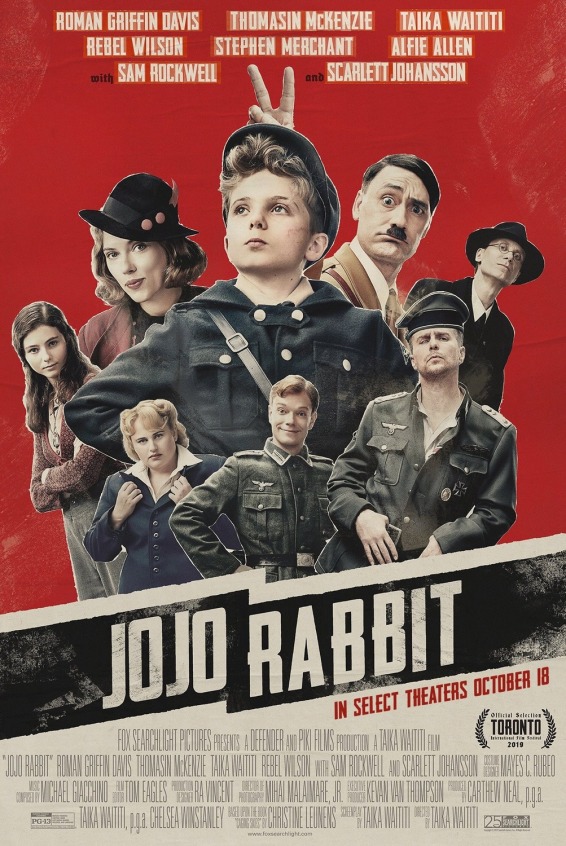
Jojo Rabbit (2019) – Film Review

From Taika Waititi, the now-esteemed comedy director behind modern comedy classics, like ‘What We Do in the Shadows,’ ‘Hunt for the Wilderpeople,’ and ‘Thor: Ragnarok,’ comes a beautifully crafted war film with a strangely pleasant sense of humour, as ‘Jojo Rabbit’ really stands out within the war genre for being one of the first films set during World War II to be an anti-hate satire, telling it’s heartwarming and optimistic story in an amusing yet respectful fashion. Soon cementing itself as one of the most noteworthy releases of 2019.

Plot Summary: Nearing the end of the Second World War, a lonely German boy named: ‘Jojo’ aspires to be a Nazi, hoping to one day fight on the frontline. But, ‘Jojo’ soon finds his worldview turned upside-down when he discovers his mother is hiding a young Jewish girl in their attic. Aided only by his idiotic imaginary friend, who takes the form of ‘Adolf Hitler,’ ‘Jojo’ must confront the unexpected guest in his home, and in doing so, confront his blind nationalism…

Partly based on the novel; ‘Caging Skies’ by Christine Leunens, the screenplay for ‘Jojo Rabbit’ was actually written back in 2011, putting it in-between ‘Boy,’ released in 2010, and ‘What We Do in the Shadows,’ released in 2014, in the chronology of Taika Waititi-penned films. And, while ‘Jojo Rabbit’ is certainly one of Waititi’s finest films to-date, it is also one of his most controversial, as whilst I personally feel the film goes about its comedy in a tasteful manner, never undercutting the story’s message and mostly just poking-fun at ridiculous Nazi protocols and beliefs. ‘Jojo Rabbit’ did receive plenty of flack from critics as soon as it was even announced the film would contain any kind of humour, which I find quite unfair on behalf of the film, as it’s clear to me that the humour is crucial in what the story is trying to accomplish.

The young and impressive Roman Griffin Davis leads the cast excellently as ‘Jojo,’ portraying the young boy as simply a regular kid who has a fascination with this ideology the Nazis are fighting for, even though he has little understanding of it nor its horrific consequences. Then there is Thomasin McKenzie, who portrays the opposite side of this, as her character; ‘Elsa,’ is a resourceful and intelligent Jewish girl who attempts to open ‘Jojo’s eyes to the real-world, rather than the warped-reality his fellow Nazis have burned into him. Scarlett Johansson is also fantastic in the film as ‘Jojo’s mother, ‘Rosie,’ having the most consistent German accent of the cast by far. But, it’s the director himself, Taika Waititi, who takes the short straw portraying the infamous Adolf Hitler, or at least ‘Jojo’s imaginary interpretation of him, as ‘Hitler’ is always presented in a very discriminating way, with Waititi portraying the dictator like a complete tool, only ever having as much information and maturity as ‘Jojo’ does, and occasionally, even less so.

Oppose to many other war films, ‘Jojo Rabbit’ features a very vibrant colour palette, as Waititi actually discovered through much of his research that Germany during World War II was both colourful and fashionable, and was interested in shying away from war films only ever displaying World War II as dark and dreary. So, through this, as well as the fairly creative cinematography by Mihai Malaimare, ‘Jojo’s small town is presented as a seemingly celebratory place with stylishly dressed citizens. Almost as if the town is trying to ignore the impending threat, only semi-aware that the Third Reich is crumbling beneath them.

The film’s original score by Michael Giacchino is another wonderful effort from the composer, as the score features a number of memorable tracks, from ‘Jojo’s Theme’ to ‘A Butterfly’s Wings,’ and ‘Rosie’s Nocturne.’ In many ways, the score for ‘Jojo Rabbit’ almost sounds as if it’s a military march composed by a group of children, which works perfectly considering the film’s story is told through a child’s perspective. Furthermore, the original score also utilises German vocals to more accurately fit with the story’s setting.

Although the supporting cast of Archie Yates, Rebel Wilson, Stephen Merchant, and Alfie Allen are all brilliant within the film, I really do wish their characters were featured more throughout the narrative. As, aside from Sam Rockwell’s ‘Captain Klenzendorf,’ who receives a respectable amount of screen-time, many of the story’s side characters are seemingly only in the film for the sake of a couple of humorous scenes, which is unfortunate, as every member of the cast portrays their Nazi characters as hilariously over-the-top as possible.

In summary, ‘Jojo Rabbit’ isn’t only another extraordinary entry into Taika Waititi’s catalogue of comedy flicks. But, I’d argue it’s his best project thus far, a daring and charming film that simultaneously explores the horrors of war, yet also the compassion in people. And, while the film may not be for everyone, with many reviews clearly indicating how divisive the film is with its implementation of comedy, I feel the film juggles its humour and emotional moments immensely well, with its remarkable original score and bright colour palette only helping the film stand further out from the crowd. Final Rating: 8/10.

jojo_rabbit_ver2_xlg

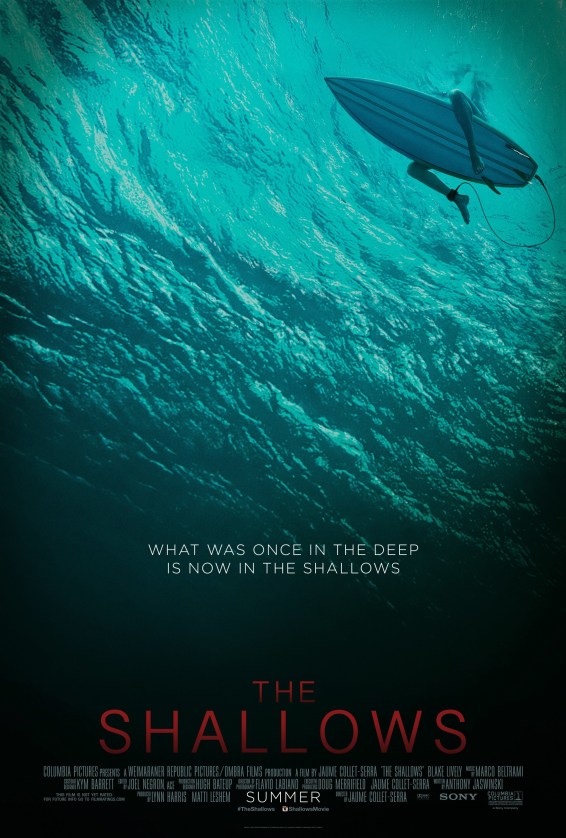
The Shallows (2016) – Film Review

Ever since the release of the original blockbuster; ‘Jaws,’ in the summer of 1975, shark films have never quite managed to reach the same heights, with flops such as ‘Deep Blue Sea,’ ‘Bait,’ ’47 Meters Down,’ and ‘Shark Night’ feeling quite distant from reality, as they present the animals as nothing but bloodthirsty monsters that devour brain dead characters. And, while ‘The Shallows’ does feel like a slight improvement over many of these other flicks (mostly in regards to its protagonist), the film still falters at many turns.

Plot Summary: After losing her mother in an accident, medical student; ‘Nancy,’ dumps her responsibilities in Galveston and travels to Mexico, hitchhiking a ride to a hidden beach that her mother loved when she was young. But, following her discovery of a whale carcass whilst surfing, ‘Nancy’ is attacked by a great white shark, leaving her tired, bleeding and stranded on a small rock, with no sign of rescue…

Releasing in 2016 to great success, ‘The Shallows’ was one of the first major shark films released into cinemas in quite some-time, but as well as being a creature-feature, ‘The Shallows’ also serves as a modern-day survival-thriller along the same lines of ‘127 Hours Later,’ as ‘Nancy’ has to face not only the great white shark stalking her, but also hunger, thirst, weather, and, of course, the severe leg injury she receives when she first encounters the apex-predator. Yet, despite this focus making for a far more engaging experience, the narrative simultaneously tries its hand at character development, with ‘Nancy’ receiving plenty of characterisation in the film’s first act, which is sadly made less interesting as its delivered through some immensely corny dialogue.

Blake Lively, who is by no means a renowned actress, with only two films throughout her career featuring her in the top-billed cast, carries the film solo, and her commitment to this role is certainly admirable, as Lively gives a very intense performance as a result of ‘Nancy’ being in agonising pain for most of the runtime. Furthermore, Lively did most of her own stunts for the film aside from her character’s surfing. In fact, in one particular scene where ‘Nancy’ crushes a crab and then proceeds to eat it raw, Lively is actually eating a real crab that the production crew found dead on a nearby beach that morning, so her reactions of disgust are genuine, even though the crab initially being crushed was achieved through CGI. This is all made even more impressive by the fact that Lively was pregnant with her second child at the time of filming. 

Flavio Martínez Labiano’s cinematography does provide a handful of attractive and memorable shots when not focusing on the characters, these usually being when the shots revolve more around the shark lurking beneath the water, or when the camerawork effectively uses framing to display how far ‘Nancy’ is from safety. And, of course, with the film being shot off the Gold Coast of Australia (excluding a few scenes which were shot in a large water-tank), the film’s signature beach and crystal clear waves are always an alluring sight, which is a superb visual clash with the horror that lies within.

The original score by Marco Beltrami serves the story well enough, as the film’s soundtrack drifts from beautiful calming tracks, like ‘Paddle In’ and ‘Nancy and Dad Facetime,’ to much more tense tracks, such as ‘Main Title’ and ‘Towards the Dead Whale.’ However, its when the story shifts into full on threat that the score begins to feel extremely generic, most notably, the track; ‘Underwater Attack,’ which is barely distinguishable from any other thriller soundtrack as it doesn’t encapsulate either the beauty or isolation of the ocean as many of the other tracks do.

Unlike ‘Jaws’ or even ‘Deep Blue Sea’ during a few moments, ‘The Shallows’ exclusively uses CGI to bring its shark to life, which is unfortunate, as while there is clearly a huge level of detail put into the shark as director Jaume Collet Serra (Orphan, Unknown, Non-Stop) worked closely with the film’s visual effects artists to ensure a sense of realism in the shark’s design, having the team do thousands of hours of research. This all sadly goes to waste though due to the demands of the film’s screenplay, as the shark in ‘The Shallows’ rarely acts like a real animal, often feeling like just a hulking murderous monster whose CG effects drastically vary depending on the shot.

In summary, ‘The Shallows’ is a step-up from a number of other shark flicks, but even with its above-average filmmaking and solid performance from Blake Lively. The film still falls into many of the common issues shark films do, as the story favours the idea of using its shark as a monster of the ocean and that alone, and this on top of the film’s occasionally strange stylistic choices, shoddy CG effects and cheesy dialogue, result in the film becoming just another poor attempt at revitalising the great white shark as a cinematically enthralling antagonist. Final Rating: 4/10.

shallows_xxlg

The Babysitter (2017) – Film Review

Originally filmed in 2015 with the intention of playing in cinemas, the horror-comedy; ‘The Babysitter,’ wasn’t seen by any horror fanatics until it released late 2017 after Netflix acquired the rights to the film for streaming. And, although ‘The Babysitter’ doesn’t exactly break any of the rules we’ve come to expect within the horror genre, this horror-comedy with splatterings of style must’ve been entertaining enough for those who decided to watch it, as the film would eventually spawn a Netflix-exclusive franchise with a later sequel.

Plot Summary: Riddled with anxiety, twelve-year-old; ‘Cole,’ has always been bullied and picked on due to his constant panicking, only finding comfort around the one person who understands him, his attractive babysitter, ‘Bee.’ That is, until one night, after ‘Cole’ secretly stays up past his bedtime to discover she’s actually part of a satanic cult, forcing ‘Cole’ to spend the rest of his evening evading ‘Bee’s band of killers who will stop at nothing to prevent him from spilling their dark secret…

Directed by Joseph McGinty Nichol (Charlie’s Angels, Terminator: Salvation, This Means War) or ‘McG’ as he more commonly goes by, ‘The Babysitter’ is a film that has received a number of alterations (both big and small) since even the early stages of its pre-production. For example, in the original screenplay for the film, ‘Sonya’ was actually a cheerleader, ‘Allison’ was a journalist for her high school newspaper, and ‘Max’ had dreadlocks, but eventually it was decided that ‘Bee’s cult followers should be reimagined to more closely reflect the stereotypical characters seen in classic slasher flicks, only in this film, they’re the antagonists. And, this idea is one of the film’s best aspects in terms of its writing, as it gives the film a real sense of self-awareness in addition paying respect to what came before it. Most notably, the ‘Friday the 13th’ series, which ‘Max’ references directly at one point when he chants; “Ch-Ch-Ch-Ah-Ah-Ah,” whilst chasing ‘Cole.’

Judah Lewis does manage to leave an impression in his first film role, portraying protagonist ‘Cole’ as an innocent twelve-year-old with few friends aside from ‘Bee,’ even if a large portion of his anxious characterisation feels far too over-the-top. Then there is also Samara Weaving as the titular babysitter; ‘Bee,’ and her cult followers; ‘Max,’ ‘Allison,’ ‘Sonya’ and ‘John,’ portrayed by Robbie Amell, Bella Thorne, Hana Mae Lee, and Andrew Bachelor, respectively. Who, are all wonderfully devilish throughout the film, having plenty of dark comedic moments between them making their deaths quite unfortunate, as while I’m sure most could’ve guessed their characters do die at some point within the narrative, we don’t get to spend enough time with any of them to get a strong grasp on their exaggerated personalities or any understanding of their malevolent cult.

In spite of the usually dull cinematography by Shane Hurlbut, ‘The Babysitter’ still manages to be one of the more visually interesting Netflix Originals through its unique style, as the film continuously implements different text, graphics and colours to give it a distinct stylistic appeal, not too dissimilar from (although nowhere near impressive as) ‘Scott Pilgrim vs. The World’ from 2010. Many of these editing decisions also help to redeem the film’s humour, which is extremely inconsistent, bouncing from hilarious cutaways and meta horror jokes to embarrassing lines of dialogue which try far too hard.

Whilst composer Douglas Pipes has crafted some great scores in the past, like ‘Monster House’ and ‘Trick ‘r Treat,’ ‘The Babysitter’ is certainly not one of them, as even with the film having many serviceable tracks. The soundtrack in general just lacks anything distinctive, and I believe that if it was ever compared to any other score from Pipes, or even just a handful of random horror scores, I doubt most would be able to tell it apart. The film also throws in the iconic Queen song; ‘We Are the Champions,’ nearing the runtime’s end, which feels immensely out-of-place and comes out of nowhere.

For a large duration of its tight runtime (which the film breezes through as a result of its unrelentingly fast pacing), ‘The Babysitter’s story is predominantly just one long chase sequence, and whilst occasionally tense, I couldn’t help but feel that the film’s screenplay could’ve taken better advantage of its evil babysitter concept or its few supernatural elements, despite the series second entry; ‘The Babysitter: Killer Queen,’ delving much further into the latter. Yet, the film doesn’t disappoint when it comes to its violence, having plenty of fantastically gruesome gore effects which are all successfully played for comedy.

In summary, I could see ‘The Babysitter’ being an enjoyable experience for some and possibly just a boring viewing for others, as when ignoring the film’s graphic gore and fun stylistic choices, the story leaves a lot to be desired, and can often feel derivative of horror classics even if this was the film’s intention to an extent with its focus on horror tropes/clichés. For me, although I do admire the film’s ridiculous tone and dark humour, the disappointing story can often feel sluggish, diminishing the film’s memorability and rewatchability. Final Rating: 5/10.

babysitter_xxlg