RED (2010) – Film Review

“You Just Had Your Ass Handed to You by a Goddamned Retiree.” – Cynthia Wilkes

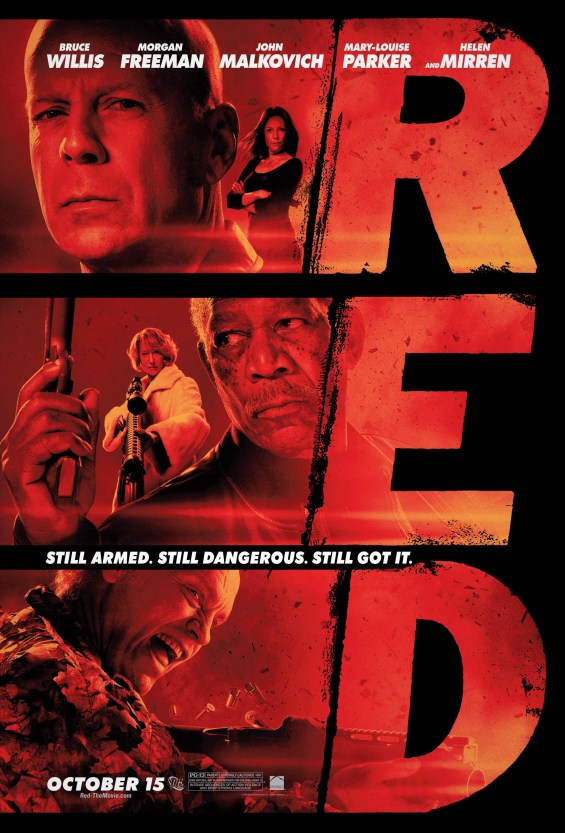
Loosely based on the comic book mini-series of the same name by Warren Ellis, RED, released in 2010, is a fast-paced and humourous action-comedy with an all-star cast of ageing actors and actresses. Yet, despite everything the film has going for it, RED never quite reaches the soaring heights of exhilaration most would expect to see from an action flick with a cast of this calibre. Still, at the very least, RED doesn’t just rely on its renowned performers to impress, as director Robert Schwentke (The Family JewelsR.I.P.D.The Captain) integrates a sufficient amount of both style and wit into the adaptation.

Plot Summary: When his peaceful life becomes threatened by persistent attacks from squads of heavily armed, masked assailants. Former black ops agent, Frank Moses, reassembles his old team of highly-trained assassins in a last-ditch effort to uncover who his assailants work for and why they are hunting him…

One of the few DC Comics properties not based around superheroes and/or supervillains. RED was surprisingly the first widely-released adaptation of a DC Comics series not produced by Warner Bros. Pictures, as Batman, released in 1966 by Twentieth Century Fox, was a spin-off from the television series. Whereas Superman, released in 1948 by Columbia Pictures, was technically a serial. These comic book roots factor into the film in a number of ways, some visual, some not. For instance, when it comes to the narrative, the pacing often seems unnecessarily quick, making the constant location-jumping of the characters feel overwhelming at points. On top of this, there is an abundance of scenes throughout RED that seem to serve little-to-no purpose, such as a moment in the opening montage of Frank’s day-to-day life where he positions Christmas decorations, implying the festive season will somehow play a part in the story. Yet, from that scene onward, Christmas isn’t even mentioned, so why is it there?

The leading component to the enjoyability of RED is undoubtedly its formerly mentioned cast and their respective characters. From Bruce Willis as the hard-boiled protagonist; Frank Moses, to Morgan Freeman as the capable yet cancer-ridden; Joe Matheson, along with John Malkovich and Helen Mirren as Marvin Boggs and Victoria, a paranoid nut-job and sophisticated assassin, respectfully. All of the characters that are part of the central team known as R.E.D. (an acronym for “Retired and Extremely Dangerous”) are well-defined and sufficiently likeable. Outside of this primary team, however, some of the characters suffer from a lack of development. Most notably, William Cooper, portrayed by Karl Urban, a misguided CIA agent assigned the task of capturing Frank and his team. Frank’s love interest, Sarah Ross, portrayed by Mary-Louise Parker, is, unfortunately, just as bland, with her character arc of maturing from a fearful, reluctant companion to an adrenaline junkie relishing in her time beside Frank, being corny and unbelievable.

Evidently inspired by the comic book mini-series it’s based upon, RED is generally rather creative with its visuals, implementing a considerable number of innovative shots that rotate around the characters as they perform various tasks. Nevertheless, the cinematography by Florian Ballhaus isn’t impeccable, as the film is frequently impaired by the jerky, hand-held style of camerawork that plagued many action sequences in the early 2010s. Furthermore, while I appreciate the attempt to add some flair to the visuals by integrating a string of imaginative location transitions, a few of these transitions come across as somewhat cheesy, particularly whenever they revolve around a screen-spreading postcard.

In a quirky little detail, all of the tracks throughout RED‘s original score are titled to fit the acronym of R.E.D. Some of these titles include; Rotating Enforcement DeviceRegular Easygoing Dudes and Rehash Every Detail. However, even when ignoring this minor detail, the original score by Christophe Beck is rather impressive, adding to the film’s appeal as a lively and stimulating guitar-led soundtrack that more than fits the quick pacing and sharp wit seen throughout the rest of the runtime.

When it comes to the action sequences, it may surprise many to learn that RED largely spreads out its rousing set pieces. If truth be told, the film’s most interesting narrative decision is that every act feels different in its approach. The first act, for example, predominantly focuses on humour, whilst the second act takes on a more serious tone, and the third act bursts into an exhilarating display of discharged firearms and downed adversaries. That’s not to say that the first two acts don’t retain any of their own exciting moments, however, as they certainly do. Interestingly, actress Helen Mirren had to learn how to fire a gun without blinking to appear more like an experienced assassin in her action sequences. This is actually an issue that has troubled cast members of the action genre for years. In fact, blinking was one of the main reasons why the cast of The Matrix trilogy wore sunglasses, concealing their involuntary reactions.

In summary, whilst RED is an action-comedy endowed with prominent names, most will come away imbued with the reassuring thought that all of the cast left their egos at home to assemble something amusing and easily digestible. Although the film isn’t anything extraordinary and definitely has its fair share of flaws, RED does have some of the makings of an entertaining action-comedy, pleasing fanatics of the veteran actors/actresses whose names litter the film’s promotional material, especially. Rating: high 5/10.

Red Teaser 1sht.Rev.1:Red Teaser 1sht.Rev.1

Room (2015) – Film Review

“There Are So Many Things Out Here. And Sometimes It’s Scary. But, That’s Ok. Because It’s Still Just You and Me…” – Jack

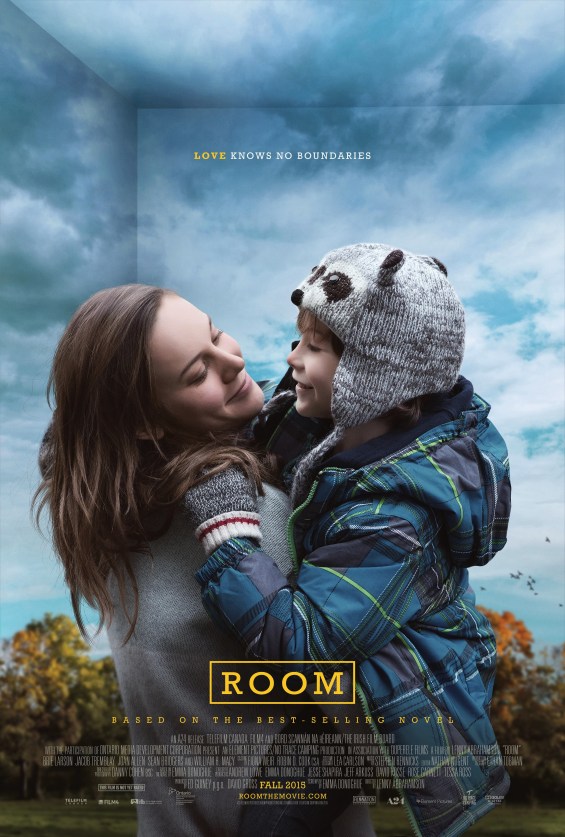
Based on the best-selling novel of the same name by Emma Donoghue, 2015’s Room is a captivating and immensely well-crafted drama, guided by a pair of astonishing performances from Brie Larson and the young Jacob Tremblay. Simultaneously showcasing the best and worst of humanity, Room undoubtedly begins in a very dark place narrative-wise, but that doesn’t necessarily make it a bleak film, as Room is filled with just as many uplifting moments as it has sombre ones. Ultimately making for a harrowing yet equally rewarding piece of both filmmaking and storytelling.

Plot Summary: Held captive for seven years by a rapist, eventually giving birth to a baby boy. Joy Newsome, and her now five-year-old son, Jack, spend their days trapped inside a small room, this enclosed space being the only world Jack has ever known. Knowing that Jack’s growth has made their situation precarious, however, Joy, with the help of her son, orchestrates an escape plan in the hope that they can finally gain their freedom…

Maintaining the same narrative stance as the novel the film is based upon, much of Room‘s story is told from the perspective of Jack, with many of the plot points being childishly interpreted as the sheltered youngster can barely comprehend much of what he sees. By telling its story from the point of view of a child, the film is able to easily differentiate Jack’s distorted understanding of the world from the real world that lies just outside his view, all the while leaving the more unsettling aspects of the story, such as Joy’s abduction and subsequent sexual abuse, to be tastefully implied as opposed to occurring on-screen, as those events transpire out of Jack’s presence/eyesight.

Predominantly shot in chronological order to make it easier for the then-eight-year-old Jacob Tremblay to perform as his character matures. The pairing of Brie Larson and Tremblay as mother and son is no doubt one of the best elements of Room, as the pairs’ performances are astoundingly believable, with the development of their characters only furthering this sense of realism. To Jack, the ten-foot square room he and his mum live within is the entire world, where objects such as a table, a rug and a wardrobe are the only ones of their kind. Whereas for Joy (repeatedly referred to as “Ma” by her son), this room is her prison. A cell in which she has been kept for over seven years since she was kidnapped at seventeen by a man who has raped her countless times, ultimately fathering Jack. Yet, through sheer willpower and the love she harbours for her son, Joy keeps all these harsh truths to herself. And throughout the runtime, Larson turns in a tragically punishing performance to match this broken yet incredibly resilient character, finding courage from the need to protect her child from the enormity of their tormentor, only ever referred to as “Old Nick.” With that in mind, it’s not too much of a surprise that Larson later went on to win an Oscar for her performance in 2016.

Shot over a period of ten weeks, the first month of Room‘s production primarily took place inside a tiny set with immovable walls. As such, director Lenny Abrahamson (Adam & PaulFrankThe Little Stranger) and his crew had to work entirely within the confines of the limited space. Nevertheless, the cinematography by Danny Cohen still manages to remarkably capture the innocent outlook of childhood, employing a number of low-angled close-ups in just the right shaft of light to illustrate how Jack finds enjoyment in his everyday life. Many of these shots also display the grubby surfaces and worn objects in the claustrophobic space Jack and his mother reside, reminding the audience that this sealed room is closer to a dungeon than an inviting family quarter.

Similar to the narrative itself, the original score by Stephen Rennicks is the perfect combination of beauty and trepidation, with some tracks, most notably; OpeningMouseIn the World and New End, standing as beautiful piano-led pieces that bring a level of warm comfort. Whilst other tracks, like I’m Scared and Roll Up, are much more atmospheric and even somewhat unnerving. In many ways, these two types of tracks could be seen as representations of Jack and Joy, respectively, as the piano melodies are direct and naïve with very little room for movement, a.k.a. Jack. While the violin arrangements could be personified as Joy, being mature, tense and somewhat damaged.

In terms of its structure, Room is a film that is largely divided into two halves. And whilst I don’t want to reveal too much regarding how the plot develops, I will note that the film does lose some of the dramatic steam it builds up in the first half of its story due to a substantial change in the direction and tone of its latter half.

In summary, Room is undeniably a depressing and challenging viewing at points, but it’s also more sanguine in its storytelling than many may expect from a film with such a horrific setup. Through its tremendous performances, thoughtful use of visuals and detailed sets, Room is a terrific drama (and an effective thriller) that explores the uncomfortable topic of abduction from a unique perspective. Formulating a tear-jerking adaptation that occasionally makes too much room for melodrama, but is an expertly told tale, nonetheless. Rating: high 8/10.

room-p1011837

Villains (2019) – Film Review

“Son, I’d Blow Your Brains Out if I Thought You Had Any.” – George

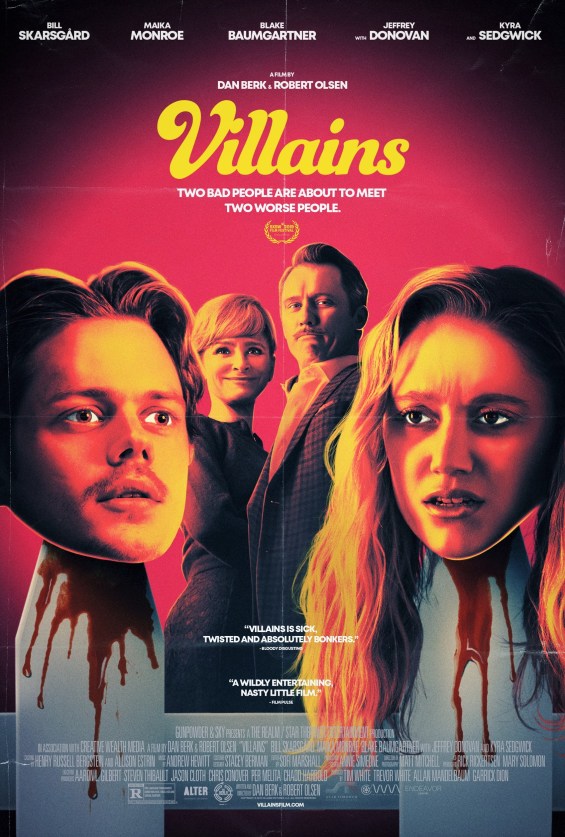
Engrossing, suspenseful and darkly humorous, Villains, released in 2019, is a fast-paced crime-thriller with a sharp comedic edge. Led by a quartet of strong performances, including the likes of Bill Skarsgård and Maika Monroe as the leading pair of romantically-entangled criminals, Villains has more than a few noteworthy elements. Alongside its many qualities, however, Villains also suffers from several shortcomings, mainly in regard to the lack of style in its visuals, despite what the film’s flamboyant promotional posters would lead you to believe.

Plot Summary: On the run after robbing a local gas station, amateur lovebird criminals, Mickey and Jules, find themselves breaking into a secluded house in search of a new set of wheels. But, upon entering the quaint abode, the pair discover that the home they have stumbled into is actually the residency of a sadistic couple with more than a few dark secrets…

While never outright frightening, Villains does have a surplus of tense sequences and bloody violence to quench one’s thirst for excitement. However, these stirring moments don’t persist into the third act, as Villains‘ story actually reaches its peak absurdity during the second act, and then opts for a quieter, more emotionally resonant third act to conclude its narrative. Admittedly, this is a rather jarring decision, and the film’s pacing does suffer as a result, but it undeniably works in the characters’ favour. Furthermore, whilst not filled to the brim with plot twists and narrative subversions, the first act of Villains features enough twists and turns that I would advise those going in to go in blind as possible to get the full impact of the reveals.

Headed southbound for a fresh start in the sunshine state of Florida, the central couple of Mickey and Jules, portrayed by Bill Skarsgård and Maika Monroe, are surprisingly likeable characters in spite of being wanted criminals. Monroe is the most charismatic she’s ever been in her role as Jules, whilst Skarsgård portrays Mickey as a goofy yet considerate partner, delivering some of the film’s most amusing lines of dialogue. The pair could have easily been depicted as despicable, but Monroe and Skarsgård imbue them with such warmth and earnestness that you can’t help but root for them. As for the demented homeowners, George and Gloria, portrayed by Jeffrey Donovan and Kyra Minturn, are charismatic yet equally intimidating, portraying their characters with a subdued sense of lunacy as opposed to being overly insane to an almost comical degree. On top of the terrific performances, all of the characters receive an adequate amount of development. I’d even go so far as to say it’s unfortunate that the runtime isn’t a little longer to further flesh out the characters, as the hints of backstory we receive for some of them (particularly Gloria) are both tragic and fascinating.

Visually, Villains is somewhat flat, as the cinematography by Matt Mitchell largely relies on unremarkable close-up and mid-shots without much innovation or implementation of style. Excluding the end credits, that is, which are vibrant and chaotic, emulating a skater-like art style through its animation and font choices. Luckily, the production design fares better than the camerawork, as George and Gloria’s house is uniquely coated in 1960s decor, complete with radiant colours and a vintage television. All of the outfits that the psychotic couple sport also play into this ’60s aesthetic. Moreover, writers-directors Dan Berk and Robert Olsen (BodyThe Stakelander) effectively utilise the setting of George and Gloria’s home, establishing the geography of their house scene by scene so the audience has a clear understanding of where each character is in relation to one another during the many cat-and-mouse chase sequences.

The original score by Andrew Hewitt is regrettably rather generic, boasting several tracks that sound as if they were lifted from various scores from a selection of genres, from mysteries to horrors. But, on a more positive note, Villains does make sufficient use of a number of soothing instrumental pieces, such as The Free LifeTime for Romance and Looking Back on Love, which all serve as excellent contrasts to the on-screen violence and grim setup of the narrative.

Upon first viewing, it quickly becomes apparent that Villains takes a lot of influence from other crime flicks. Most notably for its protagonists, Mickey and Jules, as the pair share many similarities to the couple; Pumpkin and Honey Bunny from the opening and closing scenes of the quintessential crime flick; Pulp Fiction, released in 1994. The film even pays tribute to this specific influence through a small Easter egg, as if you look closely, you can see that Mickey has a tattoo on his wrist of Stuntman Mike’s car from 2007’s Death Proof, another flick directed by Quentin Tarantino.

In summary, Villains is an entertaining crime-thriller, but it’s also a film that continuously feels as if it’s on the cusp of something extraordinary, yet it never quite reaches whatever that may be. While the performances are solid and the plot is engaging, the almost total absence of style and flair is exceedingly difficult to ignore. Still, Villains has enough of its own offbeat energy to avoid merely coming across as an assemblage of two young filmmakers’ cinematic influences, which is more than can be said for many modern releases. Rating: 6/10.

villains-movie-poster

What If (2013) – Film Review

“In Fairy Tales, Love Inspires You to Be Noble and Courageous, but in Real Life, Love Is Just an All-Purpose Excuse for Selfish Behavior. You Can Lie and Cheat and Hurt People and It’s All Okay Because You’re in Love.” – Wallace

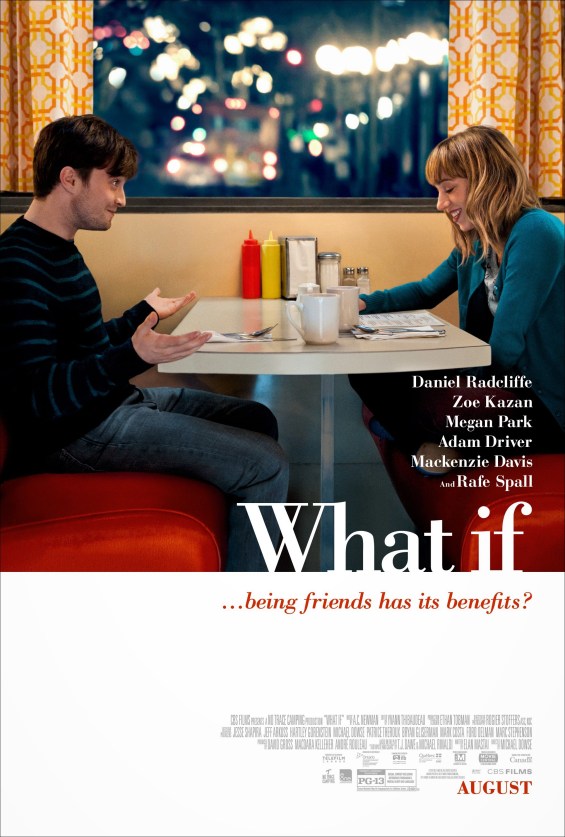
Based on the novel and later stage play; Toothpaste & Cigars by T.J. Dawe and Michael Rinaldi, 2013’s What If (alternatively titled; The F Word), is a light-hearted romantic-comedy that largely overcomes its familiar framework and few derivative elements. Continuously mindful of the many clichés associated with rom-coms, What If employs an abundance of witty dialogue, subversive story decisions and the effervescent chemistry of its leads: Daniel Radcliffe and Zoe Kazan, to deliver a charming, self-aware romantic-comedy that will appeal to those well-acquainted with the genre (and its typical shortcomings), as well as those who prefer the ‘com’ to the ‘rom’ portions of a rom-com.

Plot Summary: After being repeatedly burned by bad relationships, medical school dropout, Wallace, decides to put his love life on hold while everyone around him seems to be finding the perfect partner. But, when Wallace meets Chantry at a house party, an endearing animator who lives with her long-time boyfriend, Ben. The pair form an instant connection, striking up a close friendship and leaving Wallace to contemplate whether his newly-found friend could also be the love of his life…

Directed by Michael Dowse (It’s All Gone Pete TongGoonStuber) and written by Elan Mastai. In many ways, the screenplay for What If feels as if it was conceived as an unabashed tribute to the exemplary romantic-comedy; When Harry Met Sally from 1989. Primarily due to its underlying theme/question of whether a man and a woman can truly just be friends. However, unlike that renowned rom-com, What If places a heavy emphasis on its characters and their relationships, alongside its hilarious gags. As a result, many of the cringe-inducing comedic moments feel very natural and in-character, as opposed to feeling like embarrassing scenarios the screenwriter conjured up on the spot. As previously mentioned, What If is also continually conscious of the numerous painful clichés that plague the rom-com genre, attempting to avoid them at every turn. As such, the film crafts many of its amusing yet romantically uncomfortable situations in unpredictable ways, rather than what the audience would typically expect, which works remarkably well.

Portrayed by Daniel Radcliffe, the story’s polite and self-effacing protagonist, Wallace, is close enough to Radcliffe’s actual personality that the actor rarely feels as if he is portraying a fictional character, yet he is immensely entertaining to watch, nonetheless. And when paired with the charismatic and equally likeable Zoe Kazan, whose character, Chantry, is luminously quirky, the pair’s excellent chemistry quickly bubbles to the surface. In addition to the leading duo, Wallace’s outlandish best friend, Allan, portrayed by Adam Driver, provides a considerable amount of the film’s most amusing moments, as his wild personality is a fantastic foil to Wallace’s often pessimistic view of the world. Then there is Rafe Spall as Chantry’s long-lasting boyfriend, Rob, who, thankfully isn’t written as a simplistic, cheating miscreant designed to simply push his girlfriend into the arms of the protagonist. If truth be told, the only character the film squanders is Wallace’s sister, Ellie, portrayed by Jemima Rooper, as she is incredibly underutilised, only appearing in two (inconsequential) scenes.

When it comes to visuals, the cinematography by Rogier Stoffers maintains a light touch throughout the runtime, allowing the photogenic city of Toronto to function as a vibrant setting without ever seeming overly romanticised, which is a satisfying contrast to many other city-set romantic-comedies. Additionally, to correspond with Chantry working at an animation studio, What If seizes the opportunity to add some flair to its visuals by having many of its characters sporadically daydream. These mental fabrications are represented by Chantry’s cartoonish sketches coming to life and appearing alongside the characters, usually in a projection-like form via their surroundings.

Despite What If presenting its song choices as the focal point of its audio instead of its acoustic-led original score, many of the tracks by composer A.C. Newman, including Beach Bummer and Packing with Dalia, are cordial and possess a delightful little motif. Still, the licensed songs are naturally the most memorable part of the soundtrack, with upbeat tunes like Best of FriendsBig Bird in a Small Cage and Let’s Get High, sufficiently supporting the story and its central underlying theme.

Sticking with the notion of avoiding romantic-comedy tropes, the ending of What If is a rather restrained piece of storytelling that merely gets across what details it needs to before cutting to black. The ending is a terrific throwback to a line of dialogue from earlier in the film, bringing the story to completion. That is essentially why I prefer that original ending to the extended ending that was shot eighteen months later, as where the original climax is drawn-back and concise, the extended ending feels unnecessarily long and even falls into a couple of the stale plot points What If was trying to sidestep throughout its narrative.

In summary, What If is a feel-good flick that frequently flirts with rom-com clichés yet skillfully evades the worst of them, all while traversing into unexpected territory, both comedically and dramatically. Whilst I’d argue the film has widespread appeal, those who enjoyed Michael Dowse’s previous outings are especially likely to appreciate What If, as it similarly blends a warm, earnest attitude with shocking, irreverent jokes. Repeatedly pointing out how much better romantic-comedies can be when you have fully-formed characters and exceptional performances, in addition to side-splitting wisecracks. Rating: low 8/10.

what_if_xxlg

Hell Fest (2018) – Film Review

“That Same Guy Has Been Following Us the Entire Night!” – Natalie

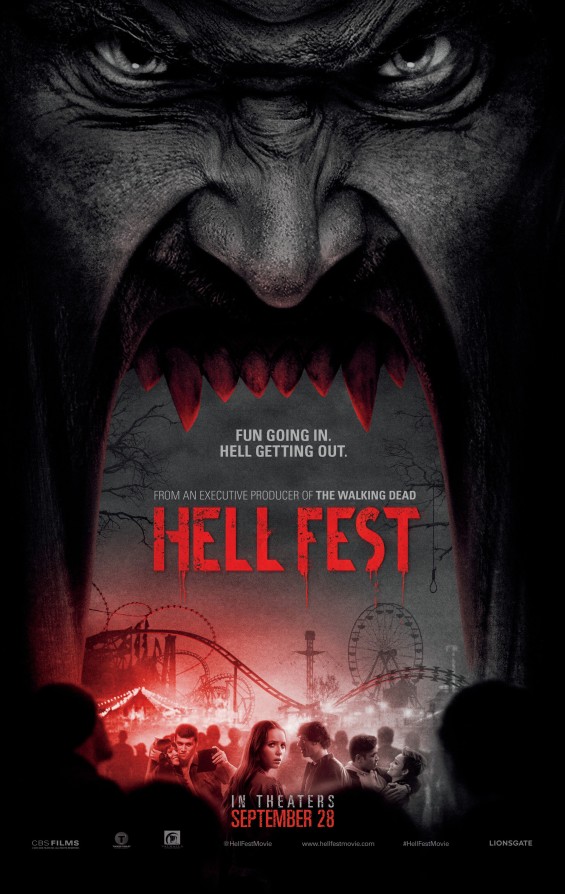
Initially conceived as a yearly horror franchise similar to Saw and Paranormal Activity, with a sequel released each following October. Hell Fest, released in 2018, is a gruesome throwback to 1980s slasher flicks. Equally violent and bombastic, the film includes many amusing moments for lovers of both scare mazes and ’80s horror. As a result of its formulaic and often uninspired screenplay, however, Hell Fest suffers from a number of issues that diminish its quality as a nostalgic slasher, even when taking into account its distinct horror-festival setting.

Plot Summary: On Halloween night, a group of friends make their way to Hell Fest, a ghoulish travelling festival loaded with attractions, games and scare mazes, hoping for an exciting night of thrills and chills. But, as the night continues, the scares soon become all too real as a masked serial killer turns the horror-themed festival into his personal playground…

Before director Gregory Plotkin (Paranormal Activity: The Ghost DimensionCrimson) was chosen to helm the project, a handful of other filmmakers were considered, including Jennifer Lynch and Neil Marshall. Needless to say, whilst Hell Fest is competently directed, the premise of the film is really where most of its appeal resides, as the idea of a pursuing killer blending in with an enormous crowd dressed as various ghouls, maniacs and monsters is a rather alarming concept, of which the film takes full advantage. For instance, when the group first encounter the killer chasing another girl through a blacklight-lit scare maze, they assume it’s all part of an act, so they merely watch as he butchers her. As opposed to sporting a single mask throughout the runtime, the killer, only referred to as “The Other,” also swaps out his disguise at many points. Distinguishing the character from horror icons like Michael Myers, despite Stephen Conroy’s physical performance appearing reminiscent of Michael’s movements in the original Halloween from 1978.

The rest of the cast, including Amy Forsyth, Reign Edwards, Roby Attal, Bex Taylor-Klaus, Christian James and Matt Mercurio, portray their characters sufficiently. The actual characterisation of the group is where most of the screenplay’s problems lie, as the teens come across as rather cliché archetypes. This issue is only worsened by the screenplay placing more emphasis on the characters’ relationships than their personalities during their first few scenes together, which is also where a large amount of the film’s corniest dialogue can be heard. On a more positive note, Hell Fest is the second horror flick to feature the voice of horror legend; Tony Todd, in a theme park, the first being Final Destination 3 in 2006. Todd later appears in person, too, portraying an enthusiastic stage announcer and providing the murderous proceedings with a brief jolt of energy.

In terms of the visuals, the cinematography by José David Montero is quite visually interesting, making fantastic use of the daunting yet colourfully lit location of Hell Fest, mainly whenever the camerawork employs wide shots to display the true scale of the bustling festival of frights. Moreover, when it comes to the killings, Hell Fest does a fine job of slaughtering the teens in creative ways through an array of superb practical effects. However, many of these kills are unfortunately spoilt by the film’s overreliance on shiny CG blood, which somewhat takes away from the charm of the 1980s-inspired artificial heads and rubber eyeballs.

Similar to the film itself, the original score by Bear McCreary feels contemporary yet simultaneously like a nod to the past, as the score combines two musical styles with synth and orchestral, along with some violin harmonics later in the soundtrack. The signature track of the score; Trophies, effectively serves as the killer’s motif and lurks in the background for most of the runtime (similarly comparable to an abundance of classic slashers). Many of the other tracks, such as Technical DifficultiesGuillotine and Welcome to Hell, do an admirable job of building suspense when required, but aren’t that memorable by themselves.

Of course, the most noteworthy aspect of Hell Fest has to be its exceptional production design, which utilises an eye-catching assortment of scare mazes segments, costumes and props from numerous Halloween events all across the United States. A fair amount of the decorations were borrowed from Six Flags Over Georgia’s annual Fright Fest, while many of the costumes were leased from the Netherworld Haunted House in Georgia, one of the highest-rated scare attractions in the country. Furthermore, many members of Hell Fest‘s production crew had formerly worked as scare maze decorators, designers and staffers, so they were more than familiar with the setup of a scare attraction.

In summary, Hell Fest certainly isn’t anything new. The film isn’t reinventing the slasher subgenre, nor is it trying to. Hell Fest is merely attempting to be an entertaining, modern-day slasher that pays homage to horror classics of the 1980s, and in that sense, I suppose it succeeds. It’s just a shame that Hell Fest doesn’t go further with its violence or horror-festival setting, as the production design is undoubtedly one of the most impressive elements of Hell Fest. And, I’m sure that if any scare maze enthusiasts were to watch this slasher flick, they would be blown away by what the production crew accomplished with the detailed costumes, props and sets on display. Rating: high 5/10.

hell_fest_xxlg

Apollo 18 (2011) – Film Review

“You Knew Something Was Down There… and You Sent Them Anyway.” – John Grey

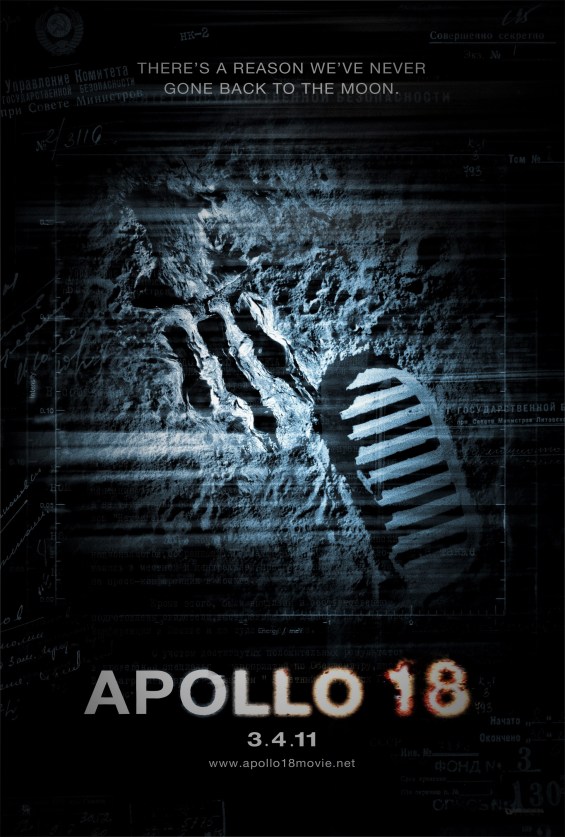
Directed by Gonzalo López-Gallego (King of the HillThe Open GraveThe Hollow Point), Apollo 18 is an intriguing (if infrequently enthralling) found-footage fusion of period-accurate space-flight procedures, U.S. government conspiracy theories and 1970s creature features. Presenting itself as authentic NASA footage through granular shots from astronauts’ suit cams and Lunar Module cameras alike, Apollo 18 is an interesting filmmaking experiment, to be sure. But, as far as its storytelling is concerned, the film is unlikely to leave an impact on general audiences, though it may appeal to a few sci-fi-horror fanatics.

Plot Summary: When decades-old footage from NASA’s abandoned Apollo 18 mission is uncovered, documenting astronauts, Benjamin Anderson, Nathan Walker and John Grey, as they embark on a classified mission to collect geological samples. The ageing footage reveals a disturbing explanation as to why the U.S. has never attempted another mission to the moon…

A mere six months after the triumph of Apollo 11, NASA renounced its plans for Apollo 20 in January, 1970. Soon after, Apollo 18 and 19 were cancelled in the wake of NASA’s planned budgetary cuts for 1971. By this point, public interest in space exploration had declined since Neil Armstrong and Buzz Aldrin’s trip to the moon, with minimal attention paid to Apollo 12. As a result, many newspaper editorials and public figures began calling for the upcoming missions to be cancelled and for the money to be spent on eliminating poverty across America instead. Consequently, many conspiracy theories regarding why NASA never attempted another trip to the moon arose, which is where the filmmakers found their inspiration for the story. And whilst much of this inspiration is rather apparent, it’s even more apparent that the screenwriters lifted a lot from the original Alien (1979), with a later plot twist feeling as if it was ripped straight from the sci-fi-horror classic. To its credit, though, Apollo 18 has no shortage of technically-accurate dialogue throughout its screenplay.

In regard to the cast, Warren Christie, Lloyd Owen and Ryan Robbins are all understated in their performances. Even when their situation escalates, and it becomes increasingly obvious that there is little chance any of them will make it off the moon, the cast reign in their performances so as to not fall into the trap of screaming and wailing for the entire runtime, a common issue many entries into the found-footage subgenre suffer from. Having said that, Apollo 18 does suffer from another well-known shortcoming of found-footage flicks; one-note characters. As, despite the film only containing three characters (excluding the transmissions), the screenplay never takes the time to develop any of them beyond some brief interviews during the first act, introducing each of the astronauts by name.

In addition to utilising a large amount of NASA stock footage to depict the period-accurate space-flight technology and procedures, Apollo 18 was shot using camera lenses from the ’70s, enhancing the visual authenticity of its grainy aesthetic. Furthermore, through a combination of visual effects and sets, Apollo 18 manages to create a convincing imitation of the moon’s barren surface, harkening back to the hours of mission coverage that kept television spectators entertained during the heyday of the Apollo program. Due to this, José David Montero’s cinematography is able to perfectly capture the essence of the cratered lunar landscape, along with the cramped, claustrophobic interiors of the Apollo Lunar Module, making for an ever-present discomfiting atmosphere.

While the original score by Harry Cohen consists of merely a single sombre track for the end credits, the sound design throughout Apollo 18 is quite effective with the continuous breathing from the astronauts’ helmets, as well as the constant static and technical malfunctions of the cameras sounding eerie yet not absurdly frightening as to take away from the sense of realism and isolation that the visuals induce.

A likely divisive aspect of Apollo 18 will be its preference for showing very little for most of its runtime, with a large majority of the story acting out like any routine NASA mission. When Apollo 18 finally reveals what the malevolent threat lurking on the surface of the moon is, however, the film takes a sharp turn into body horror as its malicious, spider-like creatures infiltrate the lunar module and later the astronauts’ suits. And whilst this approach to the horror elements could have worked should the film have stuck with it, Apollo 18 is more of a slow-paced thriller up to that point. So, these sequences of body horror end up seeming somewhat out of place. Additionally, while this complaint undoubtedly comes down to preference, I feel that the designs of the creatures aren’t all that frightening. So much so, I imagine the only audience members that will be terrified of the extraterrestrial entities will be those with severe arachnophobia or petraphobia, both exceedingly rare phobias.

In summary, Apollo 18 certainly had potential, but as a result of its lack of polish, the film is rarely able to provoke intrigue or an underlining sense of dread to the degree it wants to. Nevertheless, Apollo 18 is a unique film, a largely entertaining found-footage sci-fi-horror with an unnerving atmosphere, capitalising on the claustrophobia of 1970s space travel. And while the film isn’t for everyone, I enjoyed Apollo 18 on account of its period-accurate visuals and surprisingly true-to-life sets and technical details. Rating: 6/10.

apollo_18-p480664

The Forest (2016) – Film Review

“Do Not Stay After Dark.” – Michi

The Aokigahara forest, more commonly known as the “Suicide Forest” or the “Sea of Trees,” is a thirty-five-square-kilometre grove lying at the northwest base of Mount Fuji in Japan. The forest is often cited as the most widespread site for suicide in the country, given that in 2003, over a hundred bodies were discovered in the forest, exceeding the previous record of seventy-eight in 2002. The site became so heavily associated with suicide that a sign at the start of the main trail was later installed to urge suicidal visitors to contact a suicide prevention helpline. So, with all of this notoriety, it was merely a matter of time until a film would utilise the infamous location. Enter, 2016’s The Forest, a supernatural horror flick that sacrifices all of its compelling ideas and despairing real-world setting for cheap, predictable scares and an immensely uninteresting story.

Plot Summary: When orphan, Sara Price, receives a phone call from the Japanese authorities informing her that her twin sister, Jess Price, has disappeared and was last seen heading into the Aokigahara forest, Sara decides to travel to Japan to investigate her sister’s disappearance. But, after entering the notorious forest, accompanied by her Japanese guide, Michi, and American reporter, Aiden, Sara’s investigation begins to send her down a dark path of tormented souls and supernatural occurrences…

Whilst two other films were released before The Forest inspired by Aokigahara, those being; Shawn4Ever in 2012 and The Sea of Trees in 2015, neither film could be considered a horror. And this is what ultimately attracted director Jason Zada (Project Dead Zone) to the project, as Zada was surprised to learn that there had never been a horror film based on the ill-famed site. After discovering that the Aokigahara forest also has a strong association with demons in Japanese mythology, Zada’s interest in the project grew as this information opened the door for a more supernatural narrative. However, the story eventually selected for The Forest is hardly what I’d call engrossing, as while the first act sufficiently sets the story in motion, the narrative quickly devolves into Sara simply meandering through the forest getting sporadically interrupted by blaring jump-scares, many of which are easily foreseen.

Portraying twin sisters; Sara and Jess Price, Natalie Dormer delivers a compelling performance throughout The Forest by lending her acting talents to dual characters. Yet, she is frequently burdened by the screenplay’s lack of characterisation and stale dialogue, which is often as wooden as the trees in the forest. Moreover, the supporting cast of Taylor Kinney, Yukiyoshi Ozawa and Eoin Macken give understandably bland performances as their characters are given next-to-no development and little urgency when it comes to their decisions within the plot.

Since the Japanese government would not allow the filmmakers access to the Aokigahara forest for filming, the Tara National Forest in Serbia served as a suitable stand-in for the location. Aside from the forest itself, however, all of the scenes in Japan were shot on location, and this authenticity does come across on camera. Speaking of the camerawork, the cinematography by Mattias Troelstrup is serviceable, for the most part, as the film makes adequate use of the eerie forest backdrop by implementing a large number of environmental shots, lingering on the calming beauty of the forest in contrast to the tragedies that repeatedly occur within it.

Ominous yet forgettable, the original score by Bear McCreary fits the dreary tone of The Forest appropriately yet lacks anything to make itself distinguishable from other horror scores. Furthermore, whilst there are multiple fast-paced tracks, there is a surprising shortage of slow and moody pieces for a film set in a location like the Aokigahara forest. Nevertheless, I will give McCreary credit for integrating a children’s choir into the score, effectively blending the ghostly juvenile vocals with the rest of the instruments (most notably in the track; Into the Forest), almost as if the choir represents the siren call of the forest.

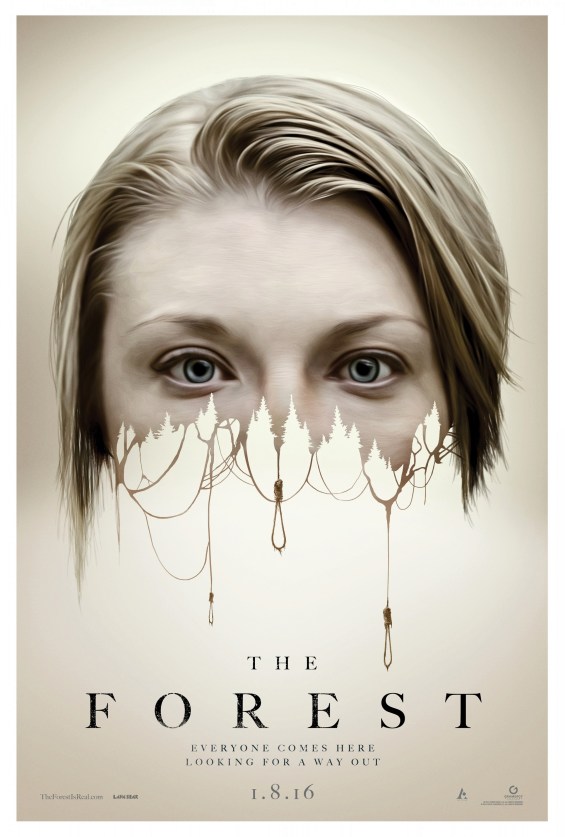
Interestingly, one of the promotional posters for The Forest features the top half of Natalie Dormer’s face with the bottom half removed, the dividing line between them forming a silhouette of treetops and dangling nooses. This imagery carries a clear resemblance to a photograph of an actual suicide victim once found within the Aokigahara forest; a bald man in such a decomposed state that his jaw had fallen off and strips of flesh were hanging from where it had once been. This photograph is also recreated in the film, albeit in a less grotesque form. Fortunately, outside of this scene, The Forest doesn’t contain much blood/gore, which I’d argue was a good decision on behalf of the filmmakers to remain respectful of the families who have lost loved ones to Aokigahara.

In summary, while The Forest offers Natalie Dormer a few chances to showcase her range through a dual role, it isn’t enough to offset the fact that The Forest is just not all that startling or interesting. Of course, these shortcomings could be attributed to Jason Zada being a music video director by trade, harbouring only one other horror flick in his filmography. But, regardless of the cause, it’s unfortunate, as I feel that given the right attention, the Aokigahara forest could make for a phenomenal setting for a minimalist horror, especially if it’s combined with a tasteful narrative that plays upon the site’s infamy. Rating: low 4/10.

forest_xxlg

The Pyramid (2014) – Film Review

“This Pyramid, Unlike Any Structure Other I’ve Ever Encountered, Seems to Have Been Built With the Express Purpose of Keeping Whatever Is Inside From Escaping…” – Holden

Poorly lit, inconsistently shot and lazily written, The Pyramid, released in 2014, is a horror flick that perfectly demonstrates the notion that giving a large budget to a project doesn’t necessarily make it a success. In the case of The Pyramid, this claustrophobic (predominantly) found-footage horror was given a budget of almost £6 million, a rather substantial amount of funding for a modern horror. Yet, even with a budget of this size, the film squanders almost every penny as its potentially captivating delve into Egyptian history/mythology is tainted by repeatedly clunky dialogue and countless lacklustre jump-scares.

Plot Summary: When a team of U.S. archaeologists unearth an ancient pyramid buried beneath the desert just outside Cario, they yearn to explore the interior of the structure despite extensive pushback from locals. Ignoring the residents’ objections, the group decide to head into the depths of the pyramid, soon becoming hopelessly lost in its endless passageways, eventually coming to realise that they aren’t just trapped, they are being hunted…

Directed by Grégory Levasseur, a frequent collaborator of producer Alexandre Aja. The Pyramid was Levasseur’s first and only directorial credit to date, and upon a first watch, it quickly becomes apparent as to why that is as The Pyramid is a horror ripe with imperfections that nearly any critic or casual audience member could spot. However, many of these issues are a result of Levasseur continuously brawling with the constraints of the found-footage subgenre, which might explain why the film makes so many baffling choices when it comes to its cinematography. Moreover, many of the scares throughout are telegraphed well in advance, so if you watch plenty of horror flicks, you’ve likely already seen everything the film has to offer.

When it comes to the story, the first act rushes through a string of contrivances, such as threats of air poisoning following the opening of the pyramid’s entrance, a military-ordered evacuation, and a NASA rover being mysteriously destroyed inside the pyramid, all of which were plainly written into the screenplay in order to get the central group of characters into the foreboding burial site as swiftly as possible. Yet, through this entire act, the screenplay rarely tries to develop any of the characters beyond a few traits, whether that be Dr. Nora Holden; a prodigious prehistorian and graduate of the Christmas Jones Academy of Scientist Couture, portrayed by Ashley Hinshaw, or the dim-witted British cameraman, Fitzie, portrayed by James Buckley. Every one of the characters are remarkably unoriginal and uninteresting. And even though certain supporting cast members, such as Denis O’Hare and Christa Nicola, deliver respectable performances, they ultimately add up to very little as most of the dialogue consists of excessive exposition or generic lines like “This Is the Find of a Century.”

As mentioned previously, The Pyramid bizarrely utilises both a first-person and a third-person perspective. So, despite many of the characters wearing or carrying cameras to present the film as recovered footage, the cinematography by Laurent Tangy frequently reverts to well-presented shots that none of the characters could have realistically obtained. This illogical decision pretty much ensures that the audience will be taken out of the spine-chilling, claustrophobic scenarios the screenplay is trying to craft, in addition to breaking the illusion that what the audience is watching is recovered footage. That being said, The Pyramid does harbour some impressive set design, as from the moment the group enter the pyramid, they are ensnared in narrow chambers and passageways, each retaining sand-littered bases and detailed Egyptian wall hieroglyphics.

Similar to the cinematography, the original score by Nima Fakhrara is rather inconsistent. Although the score clearly takes admirable influences from Egyptian culture and includes a commendable array of effective tracks. In actuality, The Pyramid shouldn’t have an original score, given the film is supposedly a found-footage flick. The end credits sequence is also accompanied by the rock song; 5173 by Kevin Hastings, which only adds to the utter strangeness of the soundtrack.

Perhaps The Pyramid‘s greatest flaw, however, is that even those with a strong interest in Egyptian history/mythology are unlikely to enjoy the story, as many of its ideas are barely explored and there are numerous instances where the Egyptian mythology that the story does integrate is incorrect. For example, near the end of the runtime (spoilers ahead in this section for those who wish to go in blind), the evil entity behind the pyramid’s existence is revealed to be Anubis, an ancient Egyptian deity. In the film, Anubis is composed of terrible CGI and presented as a ferocious beast. Yet, in Egyptian mythology, Anubis was quite benevolent towards humans, treating them with respect as they embarked on their voyage into the afterlife. Hence, his characterisation in The Pyramid is a far cry from how Ancient Egyptians actually viewed him.

In summary, very little of The Pyramid is especially engaging or particularly frightening as many of the characters are portrayed as cardboard cutouts, simply meandering their way through an exceedingly tiresome plot. So, aside from some convincing set design and supporting performances, I feel The Pyramid is undoubtedly a horror worth skipping. Considering that the production company behind the project, 20th Century Fox, decided not to release The Pyramid on physical formats in many territories due to its dismal box office performance, it seems that most have already forgotten this found-footage catastrophe. Rating: low 3/10.

the_pyramid-p905947 (1)

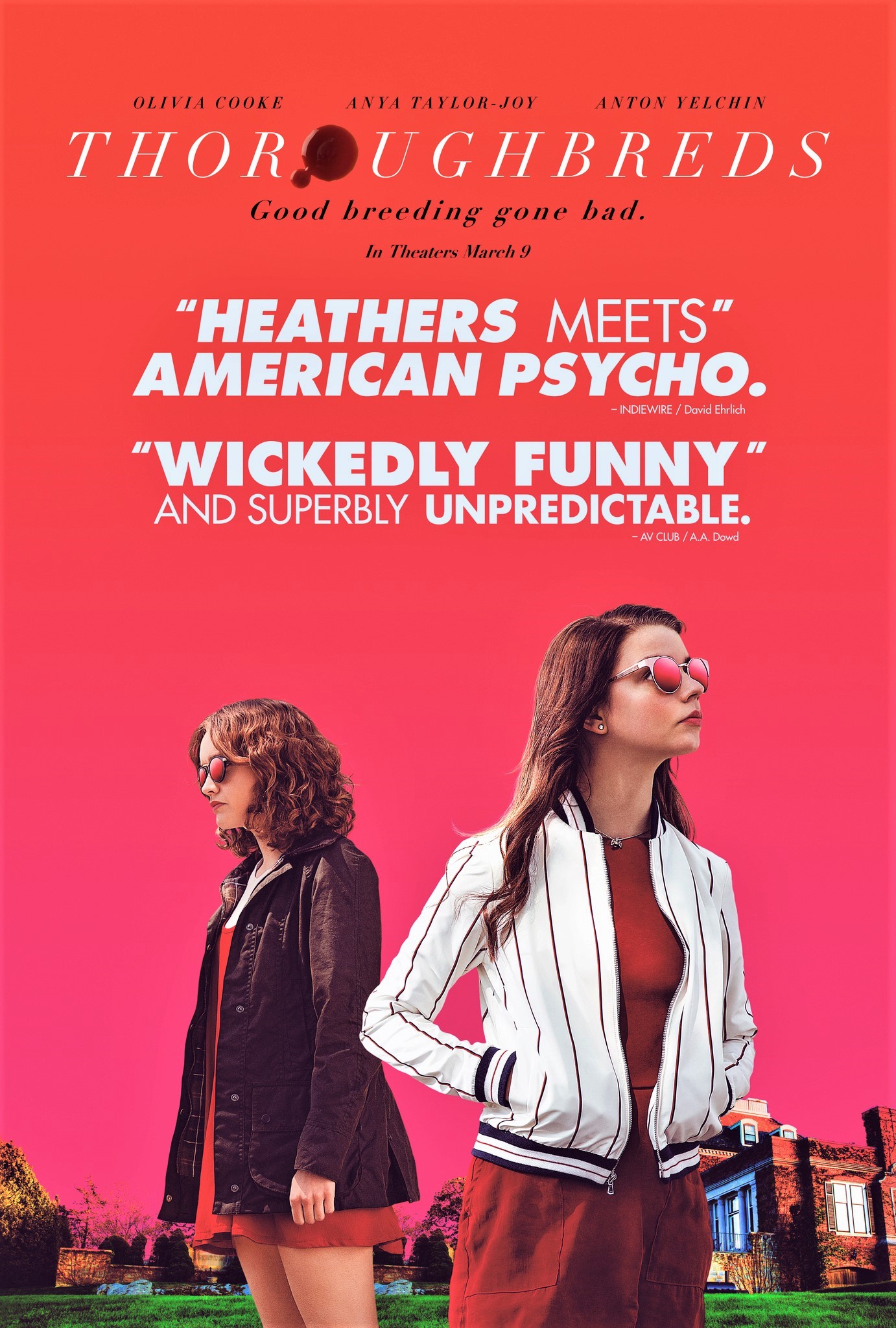
Thoroughbreds (2017) – Film Review

“The Only Thing Worse Than Being Incompetent, or Being Unkind, or Being Evil… Is Being Indecisive.” – Amanda

Originally written for the stage, 2017’s Thoroughbreds juggles many conflicting tones, but does so with such panache and charm that it’s rare to find deficiencies within its tonal shifts. With a straightforward yet deeply engrossing plot, elegant visuals and a pair of top-notch performances from Olivia Cooke and Anya Taylor-Joy, Thoroughbreds delivers a sharply written and refreshingly unpredictable entry into the black comedy genre. Placing far more emphasis on its characters and their internal issues than anything other black comedy in recent memory.

Plot Summary: In suburban Connecticut, a pair of childhood friends reconnect after many years when the sharply-witted sociopath, Amanda, arrives at the residence of the wealthy and academically inclined, Lily, for a private tutoring session. After rekindling their friendship, however, Lily soon learns of Amanda’s peculiar philosophy, prompting the pair to hatch a plan to solve both their problems, a plan that begins with the murder of Lily’s detestable stepfather…

Stuck in limbo for almost two years, the production of Thoroughbreds technically ceased in mid-2016, yet the film wasn’t released into cinemas until March 9th, 2018. This was due to several factors, but most notably, this was a result of the film’s lengthy and extensive festival circuit in 2017. During this festival run, Thoroughbreds received many positive reactions, which in a way, surprises me, as even though the plot of Thoroughbreds may sound like a setup for a compelling thriller, the plot twists and suspenseful moments are never the main attributes of the film. Instead, Thoroughbreds is far more focused on having its characters use their words to eke the darkness out of one another, which ultimately, leads to an outcome that, in its theatricality, may feel anticlimactic to some. But, for others, will feel like a unique take on what could’ve been a poorly executed sequence for a lower-budget crime-thriller.

The two central characters of Amanda and Lily, expertly portrayed by Olivia Cooke and Anya Taylor-Joy, are unquestionably the primary focus of Thoroughbreds, with much of the runtime being spent developing the pair and depicting many of the similarities and differences between their respective personalities. For instance, since their early days of horseback riding, Lily has turned into a polished, upper-class teenager with outstanding grades and a coveted internship on her resume. Meanwhile, Amanda has developed a strong sense of perception and a stern attitude, all in the process of becoming a social outcast and unregistered sociopath, which is flawlessly depicted through Cooke’s impassive performance. Sadly, Thoroughbreds was also the final project to feature a terrific performance from actor, Anton Yelchin, as the small-time drug dealer, Tim, before his tragic death on June 19th, 2016, at the age of twenty-seven. As such, the film is dedicated to him.

Despite writer-director Cory Finley (Bad Education) bearing a more extensive background in theatre than filmmaking, Finley displays a natural cinematic instinct right from the opening scene. Depicting the baroque, marble-lined mansion where Lily, her mother and her stepfather reside as more of a prison than a utopia, as the cinematography by Lyle Vincent stalks through the location in lengthy, restless takes. Lingering on specific elements, such as an SUV driving up the gravel driveway or two characters staring at each other from adjacent rooms. Furthermore, the visuals retain a surprisingly vibrant colour palette when considering the grim nature of the story, utilising luminous whites, greens and greys for the majority of the runtime.

For the original score, composer, Erik Friedlander, manipulated various instruments to achieve a number of atonal sounds, like boinks and sproings, which all serve as disconcerting counterpoints to the refined visuals. And, while there are many excellent tracks throughout the seemingly unstructured score as a result of these unusual sounds, the final track; Win Win, is undoubtedly the best track of the original score, concluding the black comedy on a bittersweet note thanks in part to the optimistic piece.

Bleak yet direct in its underlying commentary on the turmoil of being a teenager in the modern world, Thoroughbreds takes the problems of the young and privileged and explores them through the narrative. With many teenagers (particularly teenage girls) often being told to act or react in specific ways, this story of two girls who are both removed yet acutely aware of their emotions is something to be appreciated in modern character studies. Still, as a consequence of this gradual exploration of the two central characters, I believe many audience members will be turned off by the film on account of its slow pacing and total lack of on-screen violence. However, that’s not to say that I agree with these conceivable criticisms, as even with Thoroughbreds‘ slow pacing, I actually feel that the runtime could’ve been slightly extended, providing more time for characterisation in the first act before the girls reunite.

In summary, Thoroughbreds is a quirky, darkly comedic and entertaining crime-thriller anchored by some exceptional performances and praiseworthy filmmaking. Although the film may not be for everyone given its harsh perspective on teenage life, shortage of blood/gore and frequently slow pacing, Thoroughbreds lavish presentation and snappy dialogue are immensely effective. To the point that the screenplay even manages to make the audience empathise with a character that is completely incapable of empathy, which is a rather impressive feat. Rating: 8/10.

thoroughbreds-p1037063

Red Riding Hood (2011) – Film Review

“Full Moon. Lock up Tonight. Better the Wolf Takes the Pig Than You…” – The Reeve

A reinterpretation/modernisation of the centuries-old fairy tale; Little Red Riding Hood; a children’s story centering on a young girl as she encounters the Big Bad Wolf on a journey to visit her grandma. Red Riding Hood, released in 2011, retains the framework of the original story, but not much else, as this reinterpretation aims to be a dark fantasy with elements of romance and gothic horror thrown in. Yet, in almost all of these genres, the film falls flat as a result of its subpar screenplay and direction. That’s not to say that Red Riding Hood doesn’t have any positives, however, as this fantasy flick undoubtedly deserves praise for its outstanding production design and dreary fantasy aesthetic.

Plot Summary: For years, the residents of a remote mountain village have maintained an uneasy truce with a fearsome werewolf by offering the bloodthirsty beast a monthly animal sacrifice. But, when the wolf violates their trust by taking a human life, the village falls into hysteria, prompting the arrival of the famed werewolf hunter, Father Solomon, to assist in their hunt. Meanwhile, Valerie, a beautiful young woman torn between two viable fiancés, begins to suspect that the beast may be someone she knows…

Similar to most European fairy tales, the origins of Little Red Riding Hood lie within the folk tradition of oral storytelling. So, no singular author can be credited for the story’s creation. However, the two most prominent renditions of the fairy tale are proclaimed to have been written by Charles Perrault and the Brothers Grimm in the 17th century. Despite this history, Red Riding Hood seems to largely disregard the various iterations of the fairy tale, to instead take influence from the first instalment of the infamous Twilight series, as the two films share a number of similarities. For example, the opening title sequence where the camera majestically glides over vast snowy landscapes closely resembles the opening title sequence of Twilight. Furthermore, Taylor Lautner, who previously appeared in Twilight, was considered for the role of Peter early in pre-production. Still, these similarities shouldn’t be that surprising, considering that director Catherine Hardwicke (ThirteenLords of DogtownMiss You Already) helmed the first entry in the series in 2008.

In regard to the cast, Amanda Seyfried portrays the titular character of Valerie/Red Riding Hood sufficiently, but her performance is somewhat hindered on account of her placement between Shiloh Fernandez and Max Irons as her love interests, Peter and Henry, whose performances leave a lot to be desired coming across as drab and rather wooden for the majority of their screen-time. As per usual, the highlight of the cast is undoubtedly Gary Oldman as the morally-grey werewolf hunter, Father Solomon. Though Oldman doesn’t get to exhibit immense amounts of emotion (despite his character having a tragic backstory), the veteran actor does stay committed to his detestable character.

Aside from some outlandish CGI and a handful of moments where cast members/props that should seemingly be in focus are not, the cinematography by Mandy Walker is one of the finest components of Red Riding Hood. From the glowing red of Valerie’s hood contrasting against the white snow to the blood-red moon gradually emerging over the village rooftops, Red Riding Hood is a visually stunning fantasy at points. What’s more is that the set, costume and prop design are all exceptional, as every location feels rustic yet fantastical, whilst every costume/prop appears worn and functional. From a design standpoint, even the trees that appear throughout the runtime are visually unique as they harbour cadaverous spikey branches, giving the impression that merely wandering through any of the dense forests surrounding the village could result in a wound and subsequently a trail of blood.

Unsuitable yet well-crafted, the original score by Alex Heffes and Brian Reitzell begins rather promisingly with the track; Towers of the Void, which Reitzell co-wrote with musician, Anthony Gonzalez, of the electronic band; M83. As such, the ominous track contains waves of strings and industrial-sounding electronics, these instruments then persist onto the second track; Kids, where they are accompanied by ghostly vocals and moody synth. Essentially, while not a bad soundtrack, by any means, the score for Red Riding Hood is simply so unfit for a story set in this time period and genre, that it’s difficult to overlook when reviewing the score.

For a significant portion of the runtime, the story of Red Riding Hood unfolds like a mystery, with the human identity of the werewolf being kept a secret to keep the audience guessing. And whilst many suspects are immediately dismissed, the screenplay does a serviceable job of introducing red herrings without seeming overly conspicuous. When the truth is finally revealed, however, the answer as to who is behind the beastly slayings is rather disappointing, especially since the reveal is quickly followed up by an equally disappointing climax and epilogue.

In summary, as far as gloomy retellings of classic fairy tales go, Red Riding Hood is certainly one of them. While Amanda Seyfried and Gary Oldman are magnetic in their respective roles, the unremarkable leading men along with the painfully formulaic screenplay, continuously devalue the beautiful production design and often spectacular visuals. So, whilst it’s possible that the Twilight crowd will find a specific appeal in Red Riding Hood, outside of that devoted fanbase, I doubt many others will. Rating: low 5/10.

red_riding_hood-p509441