The Iron Giant (1999) – Film Review

“It’s Bad to Kill. Guns Kill. And You Don’t Have to Be a Gun. You Are What You Choose to Be…” – Hogarth Hughes

Partially based on the novel; The Iron Man by Ted Hughes, 1999’s The Iron Giant is an incredible achievement in both storytelling and animation. Tackling ambitious themes and complex animation techniques for the time through its near-seamless blend of hand-drawn and CG animation, The Iron Giant is a captivating and uplifting animated sci-fi adventure with plenty of humour and heart entrenched in its story. And while perhaps not the peak of director Brad Bird’s filmography, with The IncrediblesRatatouille and Mission: Impossible – Ghost Protocol all serving as stiff competition. As far as directorial debuts go, The Iron Giant was undoubtedly a curtain-raiser for Bird and his team.

Plot Summary: When a massive metal automaton, sent from somewhere in the black void of outer space, crash-lands on Earth just outside the small town of Rockwell, Maine. Eleven-year-old, Hogarth Hughes, stumbles across the android and quickly strikes up a friendship with the giant. But, unbeknownst to Hogarth, U.S. government agent, Kent Mansley, has his sights set on finding the extraterrestrial visitor and will stop at nothing to ensure its destruction…

Whilst The Iron Giant bears little resemblance to the novel it’s based upon, the stories behind both the novel and the film’s creation are tragic yet fascinating. As originally, the author of the novel, Ted Hughes, wrote the story as a way of comforting his children after the suicide of their mother, Sylvia Plath. Similarly, Brad Bird was in part inspired to adapt the novel as a memorial to his sister, Susan Bird, emphasising the anti-gun message of the story as she was shot by her estranged husband in a murder-suicide in 1989. His initial pitch was this; “What if a Gun Had a Soul and Didn’t Want to be a Gun?” And even if the title of the adaptation (and subsequently the titular character’s name), was later changed to The Iron Giant to avoid confusion with the renowned comic book character, Iron Man. This underlying theme has always been associated with the character and is weaved into the narrative exceptionally.

The main voice cast of Eli Marienthal, Jennifer Aniston, Harry Connick Jr., and Christopher McDonald all do a fantastic job as the central clump of well-defined characters, portraying them as surprisingly grounded personalities for an animated flick. However, the most significant member of the cast has to be Vin Diesel as the Iron Giant himself. Sharing similarities with his later role as Groot/Baby Groot in the Marvel Cinematic Universe, Diesel only speaks a total of fifty-three words throughout the entire runtime, excluding yells and groans. Yet, even with these limited lines, Diesel provides the enormous android with a suitably weighty voice and plenty of amusing/endearing moments.

On account of The Iron Giant being the first traditionally animated film to feature a principal character that is entirely computer-generated, there are a few scenes where cracks have begun to form in the animation and the animated cinematography. However, for the most part, the visuals on display throughout The Iron Giant are magnificent as the film contains an extensive amount of vibrant and alluring shots that meld both animation techniques. Many of these shots also make superb use of the remote, coastal setting of Rockwell, as well as the 1950s time period.

The original score by the late Michael Kamen is largely superior to a number of other orchestral scores for animated family flicks, with the acclaimed track; No Following, standing as a beautiful yet heart-rending composition that considerably enriches the final act. Further tracks, such as The Eye of the Storm and Souls Don’t Die, are pleasant to listen to and serve their purpose within the story, despite not being particularly memorable.

Another noteworthy aspect of The Iron Giant is how the film takes inspiration from classic sci-fi films of the 1950s. Intentionally playing into many of the staples of the science fiction genre around that time, including the widespread fears of nuclear war and Earth being invaded by creatures from another world. This ’50s inspiration even extends to the character designs with the appearance of the Iron Giant himself, who is instantly recognisable as a result of his atomic-age headpiece. Furthermore, the tentacles that emerge from the Iron Giant’s back during the final act are an unmistakable visual homage to one of the most well-known extraterrestrial films in cinematic history; The War of the Worlds, released in 1953.

In summary, whilst it still saddens me that The Iron Giant was such a box office failure upon its initial release, only grossing around £19 million on an estimated budget of £58 million. I am delighted that the film has gone on to become such a cult classic, predominately through positive word-of-mouth, no less. Releasing on August 6th, 1999, the same day as The Sixth SenseThe Iron Giant was commercially overshadowed immediately out of the gate. Moreover, following the success of Toy Story in 1995, The Iron Giant was released at a time when hand-drawn animation was being superseded by CGI. So much so, that Warner Bros. Pictures was in the process of shutting down its traditional animation division during the film’s production. And yet, The Iron Giant still flourished in spite of all these obstacles, which, in my opinion, is a testament to the efforts of Brad Bird and his masterful team of animators and creatives. Rating: low 8/10.

iron_giant_ver4_xxlg

Casino Royale (2006) – Film Review

“I’m Sorry, That Last Hand… Nearly Killed Me.” – James Bond

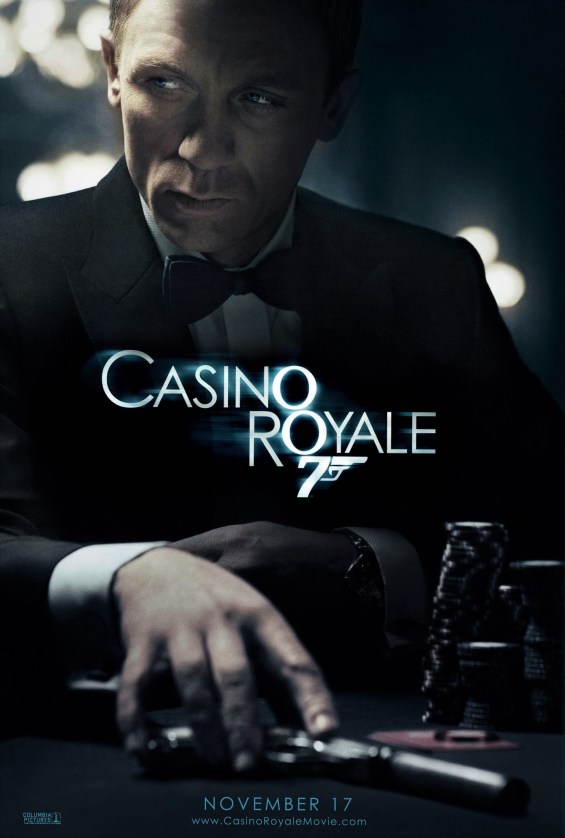
Much like the sci-fi television series; Doctor Who, or any franchise that reboots itself after a certain amount of time. The biggest hurdle the 007 franchise has to overcome with every incarnation is getting die-hard fans of the long-established espionage franchise on board. Luckily, the 2006 reboot of the series; Casino Royale, succeeded in this regard, with Daniel Craig taking on the iconic role of James Bond in a slick and thrilling mission. Doing away with much of the absurdity present in previous instalments, in exchange for pulse-pounding action sequences and an unexpectedly engaging romantic subplot.

Plot Summary: After receiving his license to kill, British Secret Service agent, James Bond, sets out on his first mission as 007, travelling to Madagascar, where he uncovers a link to Le Chiffre, a private banker financing terrorist organisations. Learning that Le Chiffre plans to raise funds through a high-stakes poker game at Casino Royale, Montenegro, Bond is instructed to play against him and thwart his plans…

Holding familiarity with the franchise after directing the Pierce Brosnan-era instalment; GoldenEye, in 1995. Director Martin Campbell (The Mask of ZorroVertical LimitThe Foreigner), along with the series’ producers, decided to take the franchise in a more grounded direction following the bombastic action sequences of the later Brosnan entries. So, there are no high-tech gadgets or tumultuous helicopter chases in Casino Royale. Instead, the poker game at the centre of the story is what holds most of the film’s suspense, occupying the majority of the second act and harbouring some of Bond’s best lines. Moreover, Casino Royale is one of the most faithful adaptations of the 007 source material, adapted from the novel of the same name by Ian Fleming, the first piece of media to feature the character of James Bond.

Despite the casting of Daniel Craig initially sparking outrage amongst the 007 fanbase due to Craig’s blue eyes and blonde hair, the online annoyance didn’t last long as once Casino Royale was released, critics and fans alike instantly fell for Craig’s rendition of the character. This was partially because, unlike the other cinematic portrayals of James Bond, whose kills held no more weight than the cheeky one-liners that accompanied them, Craig’s tussles tend to be intimate, bloody and devoid of glamour. Craig’s brooding persona, dry humour and excellent line delivery also find a close match in Eva Green’s take on the “Bond Girl,” Vesper Lynd, whose intelligence and assertive attitude puts aside any negative traits associated with the supporting role. And while Mads Mikkelsen is merely serviceable as the antagonist, Le Chiffre, with his menacing performance leaving little impact, Judi Dench makes the most of her brief screen-time as M, the head of MI6, exuding both confidence and power.

In terms of visuals, Casino Royale makes one subtle change that results in the instalment looking quite different from the ones that precede it. For most of the 007 entries before Casino Royale, the visuals almost seem to have been an afterthought as the lighting is flat, the composition is dull, and the cinematography never does anything to advance the characters or the story. Yet, with Casino Royale, it’s evident that the main principle that guides the camerawork is to always keep the camera moving. Thus, the cinematography by Phil Meheux repeatedly makes effective use of hand-held close-ups and mid-shots. Furthermore, when it comes to filmmaking, the first ten minutes of screen-time are crucial in establishing the tone, mood and style of a project. Casino Royale clearly understands this, as the opening scene employs canted camera angles and intercuts between past and present, all dosed in a fierce, greyscale colour palette for a striking introduction.

Surprisingly, the classic 007 theme, composed by Monty Norman, appears very rarely in the film’s original score. Supposedly, this is because the filmmakers wanted to emphasise Bond’s inexperience, essentially having 007 earn the theme by the time the end credits roll. However, that’s not to say that the rest of the score is terrible, as composer David Arnold steers the soundtrack away from over-the-top action cues and towards more nuanced tracks like Vesper and Blunt Instrument. And, of course, no 007 entry would be complete without a memorable song to pair with the stylish opening title sequence. In this case, it’s You Know My Name, by Chris Cornell, an alternative rock piece that fits the tone of Casino Royale flawlessly.

The action sequences are where Casino Royale delivers some of its most jaw-dropping moments. Almost every set piece could easily be the climactic action sequence of any typical action flick, which truly demonstrates the impressive stunt work and remarkable fight choreography on display throughout Casino Royale. The action-heavy first act, in particular, boasts one of the finest parkour sequences seen in this franchise to date as Bond chases a terrorist through the streets of a Madagascan village, culminating in an exhilarating hand-to-hand scuffle atop a towering construction crane.

In summary, Casino Royale disposes of the goofiness and gadgetry that plagued older James Bond outings as Daniel Craig delivers what critics and fans have been waiting for; a brutal, haunted and intense reinvention of 007. With rousing action sequences, a compelling narrative and a conclusion filled with plenty of potential. Casino Royale functions as a terrific example of how to reboot a well-known franchise, even if it isn’t particularly distinct when placed alongside other espionage flicks. Rating: high 7/10.

casino_royale-p379801

Enola Holmes (2020) – Film Review

“The Choice Is Always Yours. Whatever Society May Claim, It Can’t Control You.” – Sherlock Holmes

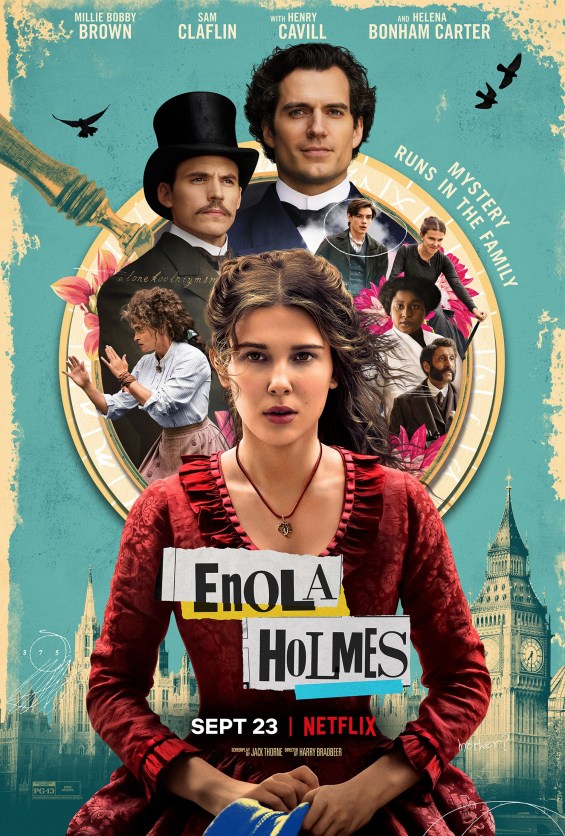
Based on the book series; The Enola Holmes Mysteries by Nancy Springer, a string of books centralising on Sherlock and Mycroft Holmes’ younger sister, Enola. 2020’s Enola Holmes serves as an alternate take on the Sherlock Holmes mythology, aiming itself towards preteens (specifically preteen girls) and injecting the world of the renowned detective with both colour and humour. Unfortunately, however, on account of the film’s poor pacing, overly long runtime and comedic sequences that frequently fall flat, Enola Holmes struggles to attain much appeal outside its preteen demographic, even with a terrific performance from Millie Bobby Brown as the titular character.

Plot Summary: When Enola Holmes, Sherlock Holmes’ teenage sister, discovers that her mother has gone missing, she embarks on a daring mission to the city of London to find her. Swiftly becoming a proficient detective in her own right as she outwits her older brothers and unravels a treacherous conspiracy surrounding a young, runaway Lord…

Adapting the first entry of the book series into an origin story, of sorts. The plot of Enola Holmes revolves around a mystery, similar to many adaptations of Sherlock Holmes literature. However, unlike many other adaptations of the world’s greatest detective, Enola Holmes repeatedly breaks the fourth wall throughout its narrative, having Enola turns towards the camera and speaks directly to the audience, delivering exposition and sharing her thoughts on her current situation. Yet, this isn’t too surprising as director Harry Bradbeer (As the Beast Sleeps, The Brides in the Bath, Perfect Day: The Millennium) is predominantly a television director, directing episodes on several well-known series, including Fleabag, which also features a number of fourth-wall-breaking moments. Furthermore, with a female protagonist at the centre of the story, Enola Holmes attempts to weave themes of feminism and the sexist nature of the 1800s into its narrative, which is an admirable goal, yet often comes across as preachy in its delivery as the female characters continuously outperform and belittle the male characters, including Sherlock Holmes himself.

Best known for her role as Eleven in the smash-hit sci-fi television series; Stranger Things, Millie Bobby Brown portrays the youthful detective, Enola Holmes, with plenty of wit and confidence. And, although the screenplay doesn’t give Enola much complexity beyond occasionally being too headstrong for her own good, she is a fine protagonist, especially for impressionable young girls. The supporting cast also does well in their respective roles, with Henry Cavill, in particular, portraying a remarkable iteration of Sherlock Holmes in a more traditional portrayal of the character following the rather wild and scattered portrayals from Robert Downey Jr. and Benedict Cumberbatch. Cavill is calm and collected as the stark image of his older brother, Mycroft Holmes, portrayed by Sam Claflin, who is far more rigid. Mycroft also makes an excellent foil to Enola as he demands she conform to the standards of 18th-century women. Then there is Helena Bonham Carter, who doesn’t have much to do as the Holmes matriarch, Eudoria Holmes, but makes the most of her screen-time through her monologues, bouncing from various tones with her eccentric behaviour and sage advice.

For added freedom and flexibility when it comes to camera movement, Enola Holmes was shot almost exclusively using a Steadicam system. This allowed cinematographer Giles Nuttgens to obtain many of the energetic shots seen throughout the film. Yet, despite this persistent sense of movement, many of the shots in Enola Holmes aren’t anything overly inventive, and instead, a large portion of the camerawork simply presents the detailed costumes and sets with pride. All of which feel period-accurate, if a little excessively vibrant.

Whilst not as memorable or as distinct as many of his other scores, composer Daniel Pemberton does a passable job with the soundtrack for Enola Homes. Crafting an orchestra-led score brimming with bouncy rhythms and sassy melodies, all united by guitar. Effectively, it’s a modern score that makes no real attempt to convey the time period of the story. Instead, the original score concentrates on Enola as a protagonist, accentuating her personality through tracks like Gifts from MotherCracking the Chrysanthemums Cypher and The Game is Afoot.

According to the novel; A Study in Scarlet, by Sir Arthur Conan Doyle. Sherlock Holmes first met his assistant, Dr. Watson, in 1881. But, in Enola Holmes, which is set in 1884, Lestrade states that Sherlock always works alone, indicating that the pair have not yet met. As such, it’s a safe assumption that Enola Holmes is set outside of the series’ usual continuity, further playing into the idea that Enola Holmes is an entirely new interpretation of the series. This assumption is inadvertently also a pleasant distraction from the film’s countless cringe-worthy quips and one-liners.

In summary, Enola Holmes is the type of film that preteens will delight in; a charming, family-friendly adventure with an intriguing mystery at its core. For others, however, this family flick is unlikely to impress as a result of its notable flaws and restrictive appeal, not to mention its constant attempts to plant seeds for the inevitable sequels that will be coming to Netflix later down the line. Having said that, I feel Millie Bobby Brown will certainly advance her career with this project as she was actually one of the primary reasons Enola Holmes was greenlit, approaching author, Nancy Springer, with the intention of starring in and producing an adaptation of her work. Rating: 5/10.

Enola Holmes • Poster

The Martian (2015) – Film Review

“They Say Once You Grow Crops Somewhere, You Have Officially Colonised It. So, Technically, I Colonised Mars. In Your Face, Neil Armstrong!” – Mark Watney

Based on the best-selling novel of the same name by Andy Weir, which was originally self-published on Weir’s personal blog in a serialised format, The Martian, released in 2015, is a sci-fi-drama that combines witty dialogue, stunning cosmic visuals and real-world science to craft a captivating story of survival and innovation. Anchored by a tremendous performance from Matt Damon, The Martian is a cinematic triumph of the science fiction genre, ticking every box that needs to be ticked in this modern era of sci-fi flicks.

Plot Summary: When a fierce storm causes an exploratory mission on Mars to be aborted, astronaut and botanist, Mark Watney, is presumed dead and left behind by his crew. Awakening hours later, injured and alone, Mark is forced to draw upon his wit and scientific ingenuity to endure the hostile surface of the Red Planet. Meanwhile, back on Earth, employees of NASA, alongside a team of international scientists, work around the clock to develop a plan to bring their missing astronaut home…

Just as much a survival thriller as it is a grandiose sci-fi-drama, The Martian is directed by Ridley Scott (Blade RunnerThelma & LouiseGladiator), who, of course, is no stranger to the science fiction genre, with two of the most notable releases of his filmography being Alien in 1979, and Blade Runner in 1982, both renowned as some of the most iconic sci-fi films of all time. And although The Martian likely won’t reach the same level of recognition in ten years, I would say the film has about the same level of directional skill as those well-known flicks. The unsung hero of the film, however, is the screenwriter and executive producer, Drew Goddard, who laces the story with humour and energy, in addition to approaching much of the scientific exposition in a comprehensible yet never overly simplistic fashion.

The incredible all-star cast of Matt Damon, Jessica Chastain, Jeff Daniels, Chiwetel Ejiofor, Kristen Wiig, Sean Bean, Michael Peña, Kate Mara, Sebastian Stan, Aksel Hennie, Benedict Wong and Donald Glover (among others) are all phenomenal in their various roles. And whilst there are a lot of characters, the story juggles them rather efficiently, never taking too much attention away from Mark Watney’s fight for survival, and subsequently, Damon’s terrific performance, which manages to be both humorous and heartfelt. As far as adaptions go, The Martian also solves one of the novel’s biggest issues, that being Mark’s constant internal monologues to provide the reader with commentary on his situation. The film gets around this by having Mark record video logs, in which he explains the science behind what he needs to do to survive, which again, is never dull thanks to Damon’s ceaseless charisma and dry wit.

Primarily filmed in the Middle Eastern desert of Wadi Rum, Jordan. The gorgeous cinematography by Dariusz Wolski emphasises the solitariness of Mars throughout the film, illustrating just how alone Mark truly is and making his line; “I Am the First Man to Be Alone on an Entire Planet,” seem all the more impactful. Furthermore, the colour palette of The Martian is surprisingly diverse considering the story takes place on the Red Planet. While most of the film retains a burnt orange look, many of the shots on Earth or in outer space form a remarkable contrast to the Mars sequences through their use of whites, greys, greens and blues. Much of the set design is also beautifully crafted, riding a careful line between sci-fi futurism and modern comfort. Interestingly, one of the panoramic shots on Mars displays Olympus Mons, the largest volcano discovered in our solar system. Olympus Mons is almost three times larger than Mount Everest and covers an area roughly the size of the U.S. state of Missouri.

Stylistically, the original score for The Martian is an assortment of soothing synth and the orchestral arrangements composer, Harry Gregson-Williams, is best known for. The most notable tracks are Mars, a stark, oppressive track comprised of synth chords and impressionistic processed effects, depicting the planet as a cold, inhospitable place. Making Water, which feels slightly more playful through its use of harps and optimistic strings. And Crossing Mars, the most triumphant-sounding track of the entire score, ultimately comes across as a little generic as it ditches much of the atmospheric synth in exchange for an orchestral motif.

Amidst its many other qualities, The Martian is also a testament to science being employed rather accurately in a science fiction flick, as despite not every line of the screenplay being scientifically exact due to the story taking place in the near future of 2035, The Martian comes pretty close. In fact, NASA was actually consulted on many aspects of the story, specifically regarding Mars, with the film even being supported in its science by the famed author and astrophysicist, Neil deGrasse Tyson.

In summary, The Martian isn’t quite a flawless film as the supporting cast sometimes feels under-served, and at one-hundred and forty-one minutes, the runtime is admittedly rather excessive. But, with the exception of these few (and frankly, minor) flaws, The Martian is a rousing story and an expertly crafted film in which the protagonist recognises he is going to die, and then willfully refuses to accept it. It’s an ennobling and uplifting story delivered with sass, allure and intelligence, essentially being everything a story from the science fiction genre should be. Rating: high 8/10.

martian_xxlg

Left Behind (2014) – Film Review

“I Don’t Have All the Answers, but for Now, Faith Is Enough.” – Buck Williams

Awkwardly combining religious proselytising with a number of well-worn tropes from the disaster genre. Left Behind, released in 2014, is an apocalyptic thriller with a fascinating idea at its core, depicting the events that would transpire if millions of people suddenly vanished off the face of the Earth. A brilliant concept that is utterly squandered due to its horrendous execution, with subpar production values, bewildering dialogue and appalling performances, being just some of the many issues this overtly religious thriller suffers from. As such, Left Behind presents one of the most unintentionally hilarious depictions of the apocalypse ever committed to film, which more often than not, devolves into enunciated Christian propaganda.

Plot Summary: When millions of people suddenly disappear without a trace, throwing the world into disarray as unmanned vehicles crash, planes fall from the sky and mass riots break out. Airline pilot, Ray Steele, struggles to keep composure aboard his proceeding flight to London as he and his passengers try to comprehend the inexplicable scenario they find themselves within. Meanwhile, Ray’s daughter, Chloe Steele, braves the chaos of the city streets below in search of her mother and brother…

If the Left Behind title sounds familiar, that’s likely because the film is actually a reboot of a relatively well-known series, with Left Behind: The Movie, Left Behind II: Tribulation and Left Behind III: World at War being released prior in 2000, 2002 and 2005, respectively. All of them are based on the best-selling series of apocalyptic novels by Jerry B. Jenkins and Tim LaHaye; a series that is essentially a modern-day rendition of the biblical rapture, where all Christians are transported to Heaven as divine forces decimate the Earth. 2014’s Left Behind adapts a small portion of the first book in the series, setting the majority of the story aboard an airliner piloted by Ray Steele, which for an apocalyptic thriller, isn’t the most exciting location to view a large-scale catastrophe from.

Speaking of the protagonist, despite the uproarious actor, Nicolas Cage, portraying the central character of Ray Steele. Left Behind never manages to get an entertaining performance out of the actor as for most of the runtime, Cage, who in interviews has stated that he took the role at the urging of his pastor brother, seems practically sedated, even when his character is convinced that the plane is heading towards certain doom. Regrettably, none of the supporting cast is much better, with Chad Michael Murray, Cassi Thomson, Nicky Whelan and Gary Grubbs (among others) all portraying one-dimensional characters continually reciting unnatural dialogue. From the Southern entrepreneur, Dennis Beese, to Cameron ‘Buck’ Williams, a renowned news reporter, who inadvertently becomes Ray’s co-pilot, none of the characters throughout Left Behind are indelible or significantly developed outside of their lack of devotion to Christianity.

In regard to the visuals, Left Behind doesn’t exhibit much improvement over its dialogue and performances as the set pieces appear small and chintzy, the lighting is flat, Jack Green’s cinematography is largely styleless and the editing between the drama on board Ray’s flight and the disorder on the ground below is a monotonous back-and-forth of plot points with no scene being given enough time to sink in. Moreover, the CG effects for the airliner itself are rather poor, particularly during one of the film’s final moments, where Ray is forced to land the plane on a makeshift runway.

Likewise, the original score by Jack Lenz has no identity or anything even remotely unique about it, subsequently causing the soundtrack to dissolve into the background where the majority of audience members will forget it even exists. Quite surprising considering that Lenz has proven himself to be a capable composer in the past, penning many respectable scores, including the theme for the Goosebumps television series.

Yet, even when overlooking all of the flick’s shortcomings in terms of filmmaking, the film continues to stutter as there are plenty of moments within the film that can be mocked. But, by far the easiest scene that illustrates just how uniquely awful Left Behind is would be the moment in which Irene Steele stares adoringly at a terribly photoshopped picture of her family. It is possible, however, that the film’s flawed execution could be a result of a lack of experience on the part of director Vic Armstrong (Joshua TreeA Sunday Horse), as Armstrong is known for his work as a stunt coordinator/stunt performer, not as a director.

In summary, while Left Behind‘s premise is undoubtedly an interesting one that could’ve made for a compelling apocalyptic thriller, if placed in the hands of the right director and/or screenwriter. The version of Left Behind we did receive is far from compelling as its flaws are nearly endless, consequently leading the film to be panned by critics and perform poorly at the box office. Still, this wasn’t the end for Left Behind as not long after, the producers of the film decided to finance the sequel through an Indiegogo campaign, simply titled; “Help Us Make Left Behind 2.” The campaign received £61,558 out of the half a million asked, with the last update on the project being on May 7th 2015. So, more than likely, the project was cancelled, which I’d say is for the best. Rating: 2/10.

left_behind_ver3_xxlg

Peter Rabbit (2018) – Film Review

“This Is Our Ancestor’s Land, It’s Time to Get Our Garden Back…” – Peter Rabbit

Based on the children’s book; The Tales of Peter Rabbit, written and illustrated by Beatrix Potter, 2018’s Peter Rabbit is the first live-action adaptation of the mischievous, jacket-wearing bunny. And although Potter herself would’ve more than likely not enjoyed the film as the condemnatory author was well-known for her continuous criticisms of how her characters were utilised (to the extent that she even oversaw much of the characters’ merchandise). Over a century on, it’s understandable that Peter’s garden high-jinx would pale in comparison to many modern family flicks. Thus, Peter Rabbit unsurprisingly attempts to update the character, resulting in a mixed bag of a film brimming with over-the-top antics and wild animal house parties.

Plot Summary: After spending years in the countryside toying and tormenting the old, crotchety gardener, Mr. McGregor, as they steal from his luscious vegetable patch. Peter Rabbit and his twin sisters find themselves up against a real challenge when Mr. McGregor dies of a heart attack, prompting his young, compulsive great-nephew, Thomas McGregor, to inherit his property and all that comes with it…

While screenwriters Rob Lieber and Will Gluck (who also directs) do a serviceable job at crafting a family adventure, one of Peter Rabbit‘s biggest issues is that its story is often told from an American perspective, in which the picturesque British countryside is exclusively filled with cosy cottages and well-meaning residents. This frequently results in quite the disconnect whenever the story becomes more chaotic as garden rakes begin to fly, explosives go off and electric fences impart a never-ending stream of injuries to both humans and animals, all played with flippant humour that’s somewhat at odds with the emotional fallout of Peter’s parents’ death many years earlier.

The voices of James Cordon, Colin Moody, Daisy Ridley, Margot Robbie, Elizabeth Debicki and Sia lead the cast, lending their star-studded vocals to the various animals ripped straight from the source material in terms of both their designs and personalities. On the human side of things, however, many of the characters have been significantly reworked from their original appearances, primarily in an attempt to modernise them, which is pretty clear from Mr. McGregor being swapped out for his younger nephew in an admittedly bleak fashion. And even though Donald Gleeson is incredibly exaggerated in his performance as Thomas McGregor, the character does serve his purpose well as not only a foil for Peter, but also a reasonably likeable man thrown into an understandably aggravating conflict with a troublesome rabbit. Rose Byrne equally elevates her role as the friendly next-door neighbour who is fond of both Thomas and Peter, often leaving the two boys to fight over her affection.

On a technical level, Peter Rabbit is a fairly polished film as the blend of actors and CG characters is well-done and feels natural, while the cinematography by Peter Menzies Jr. ensures the film stays visually appealing even during the story’s more outlandish moments, often having the camera head-level with Peter and his relatives to give the animals more intimate scenes. Moreover, the film frequently integrates animated sequences which are remarkably reminiscent of the source material, having many flashbacks appear as water-coloured paintings similar to the book’s endearing artwork.

With the exception of the uplifting track; Rascal Rebel Rabbit, the original score by Dominic Lewis isn’t overly memorable. But, thankfully, Lewis still manages to compose a score that has a youthful bounce to it as the soundtrack’s melodies all have great energy to them. Furthermore, the way the score is structured means the audience gets to experience the slapstick fun of the film’s first and second acts, but as the third act arrives, some real emotional weight creeps in. Also worth noting is the brilliant use of garden tools in the fabric of the score, the most notable of which is the use of the garden shears as percussion throughout several tracks.

Curiously, many of the live-action scenes for Peter Rabbit were actually filmed in Australia, not the United Kingdom as Sydney was chosen as the primary filming location as the city is home to Animal Logic, the company that produced much of the film’s advanced animation. However, this did cause a problem for the filmmakers as rabbits have been regarded as pests in the country since the 1800s as the country was once overrun with them. And, at its illegal to bring living rabbits into the country, the actors had to work opposite CG characters for the entirety of the production, with even their closet of interactions being achieved through the use of CGI, which luckily does hold up.

In summary, Peter Rabbit is bitterly average as it’s a film you can sit through, but not much else beyond that. In many ways, it almost feels as if Will Gluck was bored with the source material and was concerned that audiences would be too, leading him to implement as many disorderly action sequences and childish, fourth-wall-breaking gags as he possibly can. Unfortunately, making the film more frenetic only adds to its sense of desperation. Still, with Peter Rabbit racking in over £229 million at the global box office, I’m convinced we’ll be seeing many, many sequels (and potentially spin-offs) to this family adventure in the near future. Rating: 5/10.

peter_rabbit_ver2_xxlg

Molly’s Game (2017) – Film Review

“You Know What Makes You Feel Okay About Losing? Winning.” – Molly Bloom

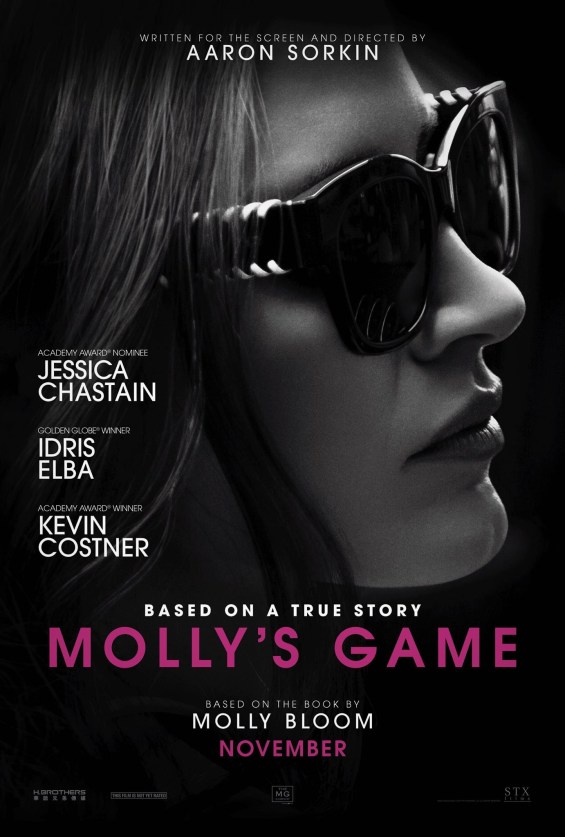
Following his many triumphs as an Oscar-nominated screenwriter, in 2017, Aaron Sorkin took a seat in the director’s chair for the first time in his career. And just like many of his previous writing efforts, his impressive directorial debut; Molly’s Game, was based on the exploits of a real-life figure. Adapting the memoir of the same name by Molly Bloom, the self-proclaimed; “Poker Princess,” who became the subject of tabloid infamy in 2007 when she was outed as the brains behind a prestigious underground poker tournament frequented by celebrities, CEOs and mobsters alike.

Plot Summary: When a catastrophic injury robs her of a promising sports career and a long-coveted Olympic medal, former competitive skier, Molly Bloom, moves to Los Angeles to take a year out and avoid attending law school. But, shortly after arriving, Molly discovers that the quickest way to achieve success is through the world of high-stakes poker, building herself up through the ranks of deep-pocketed celebrities and the corporate elite as she hosts weekly poker nights, soon drawing the attention of the Russian mob and the Federal Bureau of Investigation. Now, facing a variety of federal charges, Molly’s only hope rests in the capable hands of the criminal defence lawyer, Charlie Jaffey, who learns there is more to Molly than meets the eye…

Premiering at the Toronto Film Festival in 2017, Molly’s Game was the first film to be both written and directed by Aaron Sorkin, as previously mentioned. And although the screenplay itself isn’t as unique as some of Sorkin’s other work, with A Few Good Men (1992), The Social Network (2010), Moneyball (2011) and Steve Jobs (2015), being just some of the immensely well-received and Oscar-nominated/winning biopics Sorkin has written in the past. The screenplay for Molly’s Game still crackles and excites at many points as the writing is quick-witted and frequently goes into extreme detail whenever Molly recounts parts of her story, subsequently earning Sorkin another Oscar nomination in 2018 for Best Adapted Screenplay.

Real-world entrepreneur and author, Molly Bloom, actually told Aaron Sorkin that she wanted actress Jessica Chastain to portray her should a film adaptation of her story ever be made. And it seems that this was certainly the right call in retrospect as Chastain perfectly expresses resolve and vulnerability in her role as Molly, portraying a woman who uses her intellect as a weapon. Carving her own path as she leans into her former career as a competitive skier to fuel her drive to succeed, as high achieving doesn’t even come close to the grand ambitions she harbours. Nevertheless, years later, after leaving the world of poker behind, Molly is still far from free as she is arrested by the Federal Bureau of Investigation on tentative crimes, which is where Charlie Jaffey comes into the story, excellently portrayed by Idris Elba. Additionally, Kevin Costner and Michael Cera give superb performances as Molly’s father and Player X, respectively. The latter being a professional actor and adept poker player who, despite having his real name disclosed, is widely believed to be based on Tobey Maguire.

While the cinematography by Charlotte Bruus Christensen does tend to over-rely on mid-shots and close-ups now and then, Molly’s Game still contains some admirable shots whenever the film decides to fully indulge in its visuals. Specifically, whenever the story brings us back to the poker table as there the film utilises many on-screen graphics to visually display the fundamentals of poker in the event that some audience members (such as myself) aren’t familiar with the game’s regulations, sidestepping the need for lengthy scenes of poker-related specification. Furthermore, the editing frequently attempts to keep pace with the dialogue, occasionally even employing archive footage when Molly goes into certain topics, giving the film a terrific sense of style.

On a similar note, the original score by Daniel Pemberton is a fast-paced soundtrack that varies between light synthetic rock and electronic dance, so tracks like Staring Down a Mountain, Molly’s Journey, House of Cards and Therapy Session make for a dazzling mixture of electronic and more classical compositions. However, that isn’t to say there aren’t any slow tracks, as both Molly’s Dream and Scars are far slower and more melodic, with Molly’s Dream, in particular, explicitly featuring a piano, a marked contrast from the bulk of the score.

Interestingly, due to Aaron Sorkin’s constant focus on realism, right down to the way players handled their cards during games, all of the extras seen during the poker games are actually professional poker players. According to Sorkin, the cast could often be seen playing poker between takes with the professional players. This meant that the extras (who are usually paid around £65 for a twelve-hour workday) were usually some of the highest-paid individuals on set during production.

In summary, Molly’s Game is a film that, in the grand scheme of well-acted biopics, won’t demolish the competition, but is a well-crafted and entertaining film, nonetheless. Particularly for fans of Sorkin’s filmography, Molly’s Game‘s one-hundred and forty-minute runtime will fly by, as this delve into a world of glamour, privilege and gambling is just as compelling as Sorkin’s earlier screenplays, perhaps even more so in some aspects. If you’re a little exasperated with Sorkin’s self-satisfied writing, however, then Molly’s Game is unlikely to change your mind. Rating: low 8/10.

mollys_game_xxlg

Paddington (2014) – Film Review

“Mrs. Brown Says That in London Everyone Is Different and That Means Anyone Can Fit in. I Think She Must Be Right Because Although I Don’t Look Like Anyone Else, I Really Do Feel at Home…” – Paddington

Inspired by a lone teddy bear author, Michael Bond, noticed on a store shelf near Paddington Station on Christmas Eve 1956. The literature debut of the loveable little bear known as Paddington came in the children’s book; A Bear Called Paddington, in 1958. And has since been featured in more than twenty books written by Bond and illustrated by Peggy Fortnum, among other artists. In 2014, writer-director Paul King (Under One RoofBunny and the BullPaddington 2) brought the darling bear to the silver screen in a film that affectionately honours its source material while simultaneously delivering a family-friendly fable that is just as heart-warming and amusing as its marmalade-munching protagonist.

Plot Summary: After a devastating earthquake destroys his home in the Peruvian rainforest, a young bear with an affection for all things British travels to London in search of a new home. Finding himself lost and alone at Paddington Station, he begins to realise that city life is not all he had imagined it to be until he encounters the Brown family, who after reading the label around his neck, offer him a temporary haven. But, just as things seem to be looking up for the Peruvian bear, he soon catches the eye of a fiendish museum taxidermist…

As it happens, the story of Paddington actually shares many similarities to the creation of the character; as the idea of a lonely bear sitting in Paddington Station can be linked back to old newsreels depicting child evacuees leaving London during World War II with labels around their necks and their possessions packed in small suitcases. Indicating that King understands the importance of this character in British pop culture, yet the film can’t be criticised for playing things too safe with this narrative as it does update the Peruvian bear where it can to stay relevant within modern times. Additionally, as a family comedy, Paddington hits all the right notes as the film’s gags range from laugh-out-loud observations regarding the transformative effects of fatherhood to slapstick bathroom antics, satisfying any audience member regardless of their age or affiliation with the character.

The voice of Paddington is provided by Ben Whishaw, who it turns out is the perfect voice for the beloved bear as his line delivery is naive yet charming, portraying Paddington as an innocent character who always sees the positive in any given situation. Moreover, the supporting cast of Hugh Bonneville, Sally Hawkins and Nicole Kidman are all delightful and are given an unexpected amount of characterisation, with Henry Brown being an uptight, risk analyst who is reluctant to take Paddington in, whilst his kind, artistic wife, Mary Brown, treats Paddington almost as if he is their own child. But, it’s Kidman who truly steals the show as the film’s antagonist, Millicent, riding the line between sinister and playfully over-the-top in her portrayal of a museum taxidermist who catches and stuffs exotic animals in her spare time.

Continuously imaginative and vibrant, the cinematography by Erik Wilson is ceaselessly innovative, assembling many visually pleasing shots with equally pleasant bursts of colour, especially when snow begins to fall over London during the final act. It also becomes apparent when examining the camerawork that Paddington is just as much a love letter to the city of London as it is an adaptation of a classic child-friendly character. So, of course, there’s the usual display of postcard locations, from the London Eye to Buckingham Palace, along with a stream of light-hearted wisecracks surrounding taxis, the underground and the mundanity of modern life in the British capital.

On a separate note, the original score for the film is by no means a work of art, but composer, Nick Urata, does manage to craft a score that remains both diverse and playful through tracks like Arrival in LondonThis Will Do Nicely, Millicent’s Lab and Theif Chase. While the more tender tracks, such as Journey from Peru and The Letter Home, blend austere piano melodies with subtle strings, making for an altogether cheerful if slightly prosaic score.

When it comes to Paddington himself, the film brings the character to life via the use of CGI. And whilst this information may worry a few fans of the character, the CG effects used throughout the film are almost faultless, as Paddington expresses a range of emotions and seamlessly interacts with the environments/objects around him. Furthermore, Paddington’s outfit is an exact replica of what he wears in the book series, including his iconic blue duffel coat and red Peruvian hat. However, producer David Heyman dismissed his well-known red Wellington boots as they weren’t actually part of the character’s original design, but were added over the years by toy manufacturers to ensure that the real-life Paddington bears were able to stand on their feet.

In summary, even though Paddington follows a formula seen in numerous other family flicks, the film is understandably more concerned with making its audience laugh and cry than it is reinventing the genre (something it achieves with aplomb). And with a heart as big as its protagonist’s appetite for marmalade, I feel Paddington deserved the successful franchise it later received, with its superb humour, pitch-perfect performances and incidental details proudly cementing the film as an adaption that could go hand-to-hand with some of the finest adaptions of children’s literature. Rating: 8/10.

paddington-p901792

Extraction (2020) – Film Review

“If You Want to Survive, You Will Do Exactly as I Say…” – Tyler Rake

Based on the graphic novel; Ciudad by Ande Parks, which in itself was based on an unproduced screenplay written by Joe Russo in 2014. 2020’s Extraction transfers the story it’s adapting from the Paraguayan city of Ciudad Del Este to Dhaka in Bangladesh whilst still indulging in all of the same barbaric violence and exciting action set pieces. Yet, despite its spectacular stunt work, impressive long takes and electric performance from Chris Hemsworth, Extraction isn’t entirely saved from its generic complexion, as the film frequently falls back on many of the usual tropes we tend to see in modern action flicks.

Plot Summary: In an underworld of weapons dealers and traffickers, Ovi Mahajan, the son of a notorious drug lord, becomes the pawn in a war between two criminal syndicates. Now, held hostage by a group of kidnappers in one of the world’s most impenetrable cities, his rescue beckons the unparalleled skill of black-market mercenary, Tyler Rake, a broken man with nothing to lose, harbouring a death wish that makes an already dangerous mission near impossible…

Extraction marks the feature-length directorial debut of the stunt coordinator/second unit director for 2019’s Avengers: Endgame, Sam Hargrave, who, producers Joe and Anthony Russo, hand-picked to helm the project following their collaboration on the superhero blockbuster. Meaning, of course, that Hargrave’s profession as a stunt coordinator (and stunt double) repeatedly comes into focus as each of the film’s action sequences are relentlessly thrilling and well-orchestrated. If truth be told, however, most of Extraction‘s faults come not from its directing, but rather its screenplay. As, in many ways, Extraction‘s screenplay is structured much like a video game, continuously introducing new ‘boss levels’ that Tyler must complete before advancing, such as a corrupt general who also happens to be the country’s best sniper. Quickly equalling to tiring formula, especially when the film introduces the odd interesting idea, like a subplot focusing on a troubled teenager taking his first, uneasy steps into the world of organised crime.

Although Chris Hemsworth gives an admirable performance as the film’s protagonist, Tyler Rake, a fearless mercenary and former SASR operator, discreetly mourning the loss of his son who died from lymphoma. The character’s promising (if a little cliché) setup is soon spoilt by the complete lack of development from that point onwards, as Tyler essentially goes nowhere after the groundwork for his character is laid, cementing him as a by-the-book action hero and nothing more. Surprising, considering that Extraction was effectively conceived as a ‘star vehicle’ for Hemsworth, a remarkable actor who has struggled to obtain a signature role outside of the God of Thunder, Thor Odinson. On the flip of this, there is the school-age son of a Mumbai drug lord, Ovi Mahajan, portrayed by Rudhraksh Jaiswal, who, serves his purpose as an innocent child caught in the crossfire between two gangs. It’s just unfortunate that the film tries to build a parental relationship between the two, merely reminding the audience how paper-thin its characters are.

When overlooking the murky, displeasing colour palette, a majority of the visuals throughout Extraction are spellbinding as the film uses its dynamic, hand-held cinematography by Newton Thomas Sigel to place the audience alongside the characters in the busy streets of Dhaka, having Tyler grapple with corrupt police officers while tuk-tuks and scooters disorderly rush past, a feeling that is only amplified by the film’s multiple one-takes. One of these takes, which clocks in at around eleven minutes and twenty-nine seconds, is, in actuality, comprised of thirty-six stitched sequences, some of which took over twenty-five takes to line up correctly, according to Sam Hargrave.

Regrettably, the original score by Henry Jackman and Alex Belcher isn’t as innovative as the soundtrack almost solely consists of indistinguishable ostinato-driven action tracks, such as Police Search and Checkpoint, all of which have a heavy emphasis on percussion, with only the occasional pause for breath. And, whilst there isn’t a standout theme as such, Extraction does have an effective little motif that runs through some of the tracks to give the score a bit of personality.

Naturally, the action sequences of Extraction are what the majority of the film hinders. And, luckily, they deliver, being brutal, bloody and fast-paced as, dissimilar to highly-skilled characters, like John Wick, whose fighting style is inherently tactical and calculated, Tyler Rake engages in combat far more spontaneously, improvising weapons and thinking on his feet whenever he is thrown into a dangerous scenario. As previously mentioned, the film’s camerawork also amplifies many of these exhilarating moments, particularly one car chase sequence, during which, Hargrave actually manned the camera himself whilst he was strapped to the hood of the vehicle pursuing Tyler and Ovi.

In summary, Extraction is slightly contrived and sporadically over-the-top, and there’s no question that the film’s characters are essentially just cardboard cutouts delivering line after line of uninspired dialogue. In fact, for most of its runtime, Extraction almost feels as if you’re watching someone play a video game, which as I’m sure any video game enthusiast will tell you, is only amusing for a short time. But, purely in terms of action, Hargrave and the Russo Brothers bring the noise with a film fueled by the charisma and physicality of its leading actor, suggesting that Hemsworth has found his go-to genre once he retires his iconic superhero. Rating: 6/10.

extraction_netflix_xxlg

Gone Girl (2014) – Film Review

“Want to Test Your Marriage for Weak Spots? Add One Recession, Subtract Two Jobs. It’s Surprisingly Effective.” – Amy Dunne

An intricate and satisfying adaptation of the novel of the same name by Gillian Flynn, which went on to be a New York Times bestseller following its release in 2012, being hailed by many publications as a “Literary Masterpiece.” Gone Girl, released in 2014, flawlessly combines its maze-like plot with the distinct style of director David Fincher (SevenFight ClubThe Social Network) and a duet of astonishing performances from Ben Affleck and Rosamund Pike. Promptly resulting in an unmissable mystery-thriller that represents an exceptional pairing of filmmaker and source material, fully expressing Fincher’s cynicism regarding the current age of televised media and the darkness lurking just beneath the surface of contemporary life.

Plot Summary: On the occasion of his fifth wedding anniversary, former New York-based writer, Nick Dunne, returns home to find that his wife, Amy, has vanished. After reporting her disappearance to the authorities, the couple’s public portrait of a blissful marriage soon begins to crumble as the cases’ ever-growing media attention places Nick as the prime suspect, ultimately leading everyone to ask the same question; did Nick Dunne murder his wife?

Making her screenwriting debut, Gillian Flynn does an extraordinarily efficient job of streamlining her four-hundred-and-thirty-two-page novel, retaining its bifurcated structure and elaborate twists without significantly altering the story as a whole. Certainly, not an easy task as the very nature of Gone Girl‘s story requires the film to be constantly jumping through time, depicting the entire timeline of Nick and Amy’s marriage from their first encounter through to the total collapse of their love life, giving the audience a clear understanding of their individual personalities and relationship. And, through it all, Amy remains a consistent screen presence, continually popping up in flashbacks to her earlier, happier days living in New York City, where she led a life of luxury as a thriving children’s author. That is, until her relationship with Nick, a working-class Midwesterner, comes into focus, gradually draining Amy of her individuality, which is only worsened by the pair’s eventual layoffs and relocation to Nick’s hometown. Quickly spawning whispers of spousal neglect, infidelity and domestic violence, all of which are condensed for the sake of the film’s runtime yet never feel rushed.

Both Ben Affleck and Rosamund Pike are phenomenal throughout the film with not a single weak moment between them as Affleck, who has never been more ideally cast, delivers a captivating balancing act of a performance, fostering sympathy and the suspicion that his true self lies somewhere between shallow husband and heartless murderer. While Pike, who has actually had very few lead roles despite her extensive filmography, is continuously emphatic and commanding. What’s more, is that Gone Girl is a film that doesn’t aim to paint either of these two characters in a purely positive or negative light. Instead, Flynn frequently leaves it to the audience to decide which character (if any) they should be rooting for as the couple copes with the rapid decline of their marriage in dissimilar ways. The outstanding leads aside, Gone Girl also features a terrific supporting cast of Carrie Coon, Kim Dickens, Tyler Perry and Neil Patrick Harris, all of whom serve crucial roles within the story.

As ever, Fincher’s regular collaborators turn in work of an exceedingly high standard, with Jeff Cronenweth’s cinematography being unerringly well-placed in nearly every scene, bringing a drab, underlit look to Nick and Amy’s home, the police station and other North Carthage locations. And although Gone Girl does admittedly have quite the overreliance on mid-shots, Cronenweth’s intentionally controlled approach does lend itself well to creating many memorable shots, speaking less to visual flair and more to Fincher’s adroit style.

Along these same lines, the original score by Trent Reznor and Atticus Ross is a gloomy composition, invoking feelings of anxiety in the audience with subtle electronic pulses. Allegedly, Fincher’s musical brief to Reznor and Ross was based on a visit he took to a spa in which the accompanying melody was supposed to be relaxing, yet Fincher perceived it as unsettling. And, this undoubtedly comes across in Gone Girl‘s score, with tracks like What Have We Done to Each Other?With Suspicion and Technically, Missing, perfectly encapsulating this idea of a supposedly comforting soundtrack which, in truth, instills a sense of dread.

Similar to the novel it’s based upon, Gone Girl‘s story is also teeming with compelling underlying themes and social commentary covering a range of topics. On a broader level, however, the story is really about public perception and how televised media builds fabulations that quickly get subsumed as truth, as the American populace is willing to swallow whatever narrative is sold to them without question, a thought-provoking theme that the film never forgets to explore and build upon.

In summary, Gone Girl is a shining example of an adaptation that stays faithful to the source material whilst simultaneously injecting the narrative with its own style, not once letting the story drag or the suspense settle in its pursuit of transferring an acclaimed novel to the silver screen. Still, with a plethora of attractive visuals and tremendous performances (along with a handful of darkly comedic moments), I feel Gone Girl would’ve been a memorising film even in the absence of its engrossing central mystery. Rating: low 9/10.

gone_girl-p932779