Double Indemnity (1944) – Film Review

“How Could I Have Known That Murder Could Sometimes Smell Like Honeysuckle?” – Walter Neff

Widely regarded as one of the greatest films released during the Golden Age of Hollywood, Double Indemnity is a 1944 crime-thriller that combines suspense and sharp wit, conveying its captivating story of murder and romance through stylish, achromatic visuals and scintillating dialogue. Despite the technical limitations of its time and the occasional dragging scene, Double Indemnity‘s favourable qualities easily outweigh its shortcomings, setting the standard for almost every noir that followed, to the point that the American Film Institute actually ranked the film as their “29th Greatest Movie of All Time” in 2007.

Plot Summary: Living a life largely devoid of excitement, the smooth-talking insurance salesman Walter Neff finds his thirst for more quenched when he encounters the seductive Phyllis Dietrichson, the weary wife of a callous husband whom she plans to murder and cash out on his ‘accidental’ death claim, eventually convincing Walter to join her devious scheme. But, when his quick-witted supervisor, Barton Keyes, becomes suspicious of the claim, Walter’s paranoia gets the better of him as the pair’s fiendish ploy begins to fall apart

Based on the novella of the same name by James M. Cain, supposedly inspired by a 1927 murder case perpetrated by a married woman and her lover, whose trial he attended whilst working as a journalist in New York. During this, Ruth Snyder persuaded her boyfriend, Judd Gray, to kill her husband, Albert, after having him take out an insurance policy with a double-indemnity clause before the couple were ultimately identified, arrested and convicted. Although the novella was well-adapted to the silver screen by screenwriters Billy Wilder and Raymond Chandler, the pair did not get along while penning the screenplay, a process loaded with arguments and behind-the-scenes drama. Nevertheless, the two writers’ squabbles may have been worthwhile as the dialogue exchanges between characters perfectly exemplify the noir genre, being both snappy and comical. So much so that the scene where Walter and Phyllis meet for the first time could be seen as the template for what virtually all notable noir films sound like.

Despite several cast members initially being apprehensive about signing on to the project, with the late lead Fred MacMurray even on the verge of turning down the role because he feared his career would be ruined by playing such a despicable character, every cast member in Double Indemnity is performing to their highest ability. From MacMurray and the late Barbara Stanwyck as murderous lovers, Walter Neff and Phyllis Dietrichson, flaunting their palpable on-screen chemistry, to the late Edward G. Robinson as Walter’s astute, snarky office manager, Barton Keyes, exhibiting a perfect balance of tenacity and humour, smelling something rotten about Mr. Dietrichson’s untimely demise, all of the performances are worthy of the screenplay’s well-crafted verbal exchanges.

Owing much of its visual brilliance to the late cinematographer John F. Seitz, an influential figure in camerawork with a career spanning several decades, Seitz’s work on Double Indemnity is often deemed a masterclass in stylish visuals. Well-known for his ability to use light and shadows to evoke mood, Seitz was instrumental in establishing the visual language of the noir genre via this film and many others, with the chiaroscuro lighting, tight framing and innovative use of darkness heightening the tension and moral ambiguity that pervade the narrative, his collaboration with the late director Billy Wilder (Sabrina, Some Like It Hot, The Apartment) only elevating Double Indemnity into a film that visually communicates its underlying themes of greed, betrayal and moral corruption as much as the dialogue. Additionally, light filtering in through blinds (a staple of the noir genre) is frequently used to visually depict Walter being ‘behind bars.’

The late Miklos Rózsa’s stagey original score is your traditional orchestral soundtrack, with the opening piece; Prelude, being a standout track, dramatically enriching the opening credit sequence where a mysterious silhouette of a man stepping toward the camera on crutches soon engulfs the screen. Following this, Rózsa adds emotional depth to the film with the track; Murder Theme, a suspenseful piece in which the striking of a timpani forms a grim rhythm, accompanied by violins that deliver a numbing pulse, alluding to the characters’ dark intentions.

Outside of the crime elements, Double Indemnity also harbours a hefty amount of romance within its narrative, largely thanks to the previously mentioned chemistry between MacMurray and Stanwyck, but also as a result of the film’s sensual moments and even moderately suggestive visuals for the time. For example, when Walter first meets Phyllis, the camera is drawn to a bracelet (or anklet) on her right ankle, with an urban legend stating that a married woman wearing a right-sided anklet indicates she is married yet available to other men. One of the many details that not only adds to the characterisation of Phyllis, but also serves as a humorous time capsule of the 1940s, when merely showing a woman’s ankle was considered scandalous.

In summary, if there is one Golden Age Hollywood classic that defines the very essence of the genre it’s a part of, it’s Double Indemnity, standing as a tremendous example of how to craft an engaging crime-thriller, building tension by employing intimate close-ups and honed dialogue. For a film from this era, you can’t do much better than Double Indemnity, a famed noir that stands the test of time after seventy years and will likely stand for seventy more, given its venerable reputation. Rating: 8/10.

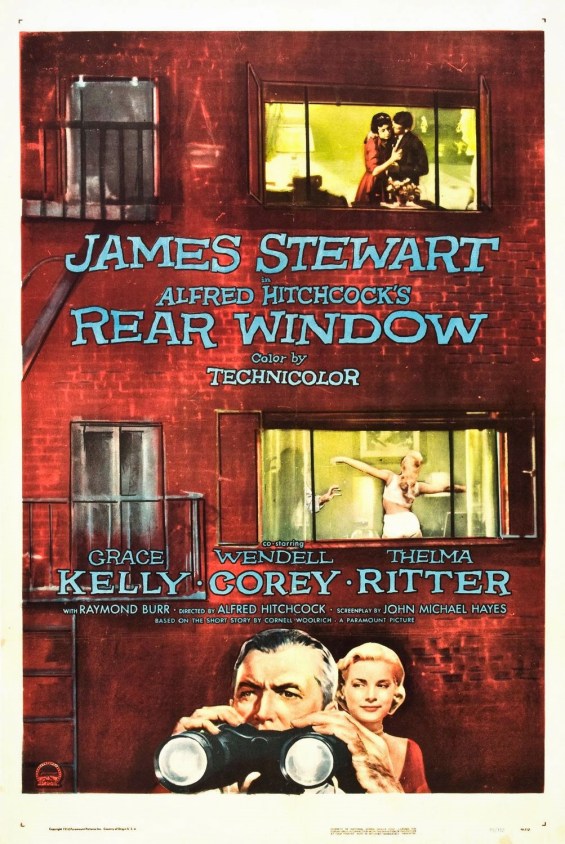
Rear Window (1954) – Film Review

“We’ve Become a Race of Peeping Toms. What People Ought to Do Is Get Outside Their Own House and Look in for a Change.” – Stella

A refined combination of acting, cinematography, editing, blocking and set design, Rear Window, released in 1954, is a mystery-thriller with a terrific premise that brims with suspense and intrigue. Supposedly based (very loosely so) on the short story of the same name by Cornell Woolrich, as well as the details of two grisly real-world murder cases, Rear Window provides a compelling narrative with an extensive amount of visual storytelling, exuding tension throughout its runtime alongside a handful of well-written, amusing characters who are easy to understand and get behind.

Plot Summary: When professional photographer, L.B. ‘Jeff‘ Jefferies, breaks his leg while obtaining a shot at an auto race, he finds himself confined to his New York apartment during a discomfiting heatwave, spending his time peering out of his rear window observing his neighbours. But, when Jefferies begins to suspect that a man across the courtyard may have murdered his wife, he enlists the help of his fashion model girlfriend, Lisa Fremont, to investigate

Helmed by one of cinema’s greatest and most recognisable filmmakers, the late Sir Alfred Hitchcock (VertigoPsychoThe Birds), Rear Window stands as one of Hitchcock’s lesser-known films, despite its still overly positive reception from critics and audiences alike, which I feel is unfair, as the film contains much of the same cultivated and innovative directing Hitchcock was known for. For example, every cast member in the apartments facing Jefferies’ window wore an earpiece through which they could receive directions, allowing for lengthy extracts where Jefferies observes others as their gestures and body language reveal what is occurring in their lives behind closed doors. Furthermore, Hitchcock cleverly uses cuts to imply things about Jefferies’ neighbours and himself. For instance, when Jefferies is discussing his potential future with Lisa, specifically if he should propose to her, we follow his perspective as he observes a newlywed couple before his eyes turn to another apartment where another couple’s marriage has become distant and lifeless. Equivalent to much of Hitchcock’s filmography, Rear Window also possesses underlying themes of voyeurism, repeatedly questioning Jefferies’ actions as he snoops on the private affairs of those around him, valiant intentions or not.

The late central cast of James Stewart, Grace Kelly, Thelma Ritter, Wendell Corey and Raymond Burr are all fantastic. The protagonist, L.B. ‘Jeff‘ Jefferies, is portrayed with such snark and conviction by Stewart, relishing his life of risk, reward and travel with no plans to settle down anytime soon. Equally, Kelly as Lisa Fremont perfectly embodies beauty and elegance in contrast to Jefferies’ ruggedness, yet is still capable in her own right, eager to disprove Jefferies’ assumption that she could never fit into his world, hoping he will someday propose to her. After taking notice of Jefferies’ obsessive behaviour with his neighbour across the courtyard, however, Lisa agrees to put aside their relationship issues to assist in his investigation, along with Jefferies’ transient nurse, Stella, whom Ritter lends an excellent sense of intellect and dry wit via her performance.

Shot entirely on one set, which required months of planning and construction, the apartment courtyard set measured ninety-eight feet wide, one hundred eighty-five feet long and forty feet high, consisting of thirty-one apartments, eight of which were completely furnished. As a result, the cinematography by the late Robert Burks permits an array of creative and distance-spanning shots that move from apartment to apartment with ease, noticeably in the film’s rightly celebrated opening shot, a prolonged and sinuous tracking shot that sweeps across the whole courtyard, spending a moment in each of the six featured apartments before pulling back into Jefferies’ apartment to find him dozing in his wheelchair. Additionally, the lighting throughout Rear Window is remarkable for a film shot in a soundstage, with around one thousand arc lights being used to simulate sunlight. And, thanks to the extensive pre-lighting of the set, the crew could impressively change the lighting from day to night in under forty-five minutes.

Moving from the visuals to the audio, all of the sound in Rear Window is diegetic, meaning that all of the music, speech and other noises come from within the world of the film, excluding the non-diegetic original score heard in the opening scene by the late Franz Waxman, the most prominent piece of which is the orchestral track; Prelude, a jazzy, relatively lively track with a subtle aura of mystery.

On a more cynical note, whilst the foremost characters are well-defined and even have clear character arcs, not all of Jefferies’ neighbours are written equal, with some members of the apartment courtyard, such as the “Hearing Aid Lady” (a nickname given by Jefferies as he doesn’t know her real name), residing in one of the ground-floor apartments, receiving little to no development and only a single prominent action.

In summary, Rear Window is a captivating flick that, while perhaps not as iconic as some of Hitchcock’s other work, is just as delightful. Meticulous, gripping and surprisingly humorous, Rear Window is just one of the many films that hit that mark with Hitchcock at the wheel, employing elements that couldn’t be carried out in any art form other than film. And, true to his eclectic form, Hitchcock switched gears drastically for his next release, the 1955 romantic mystery; To Catch a Thief, proving he could lend his hand to almost any genre in cinema. Rating: 8/10.

rear_window_ver2_xlg

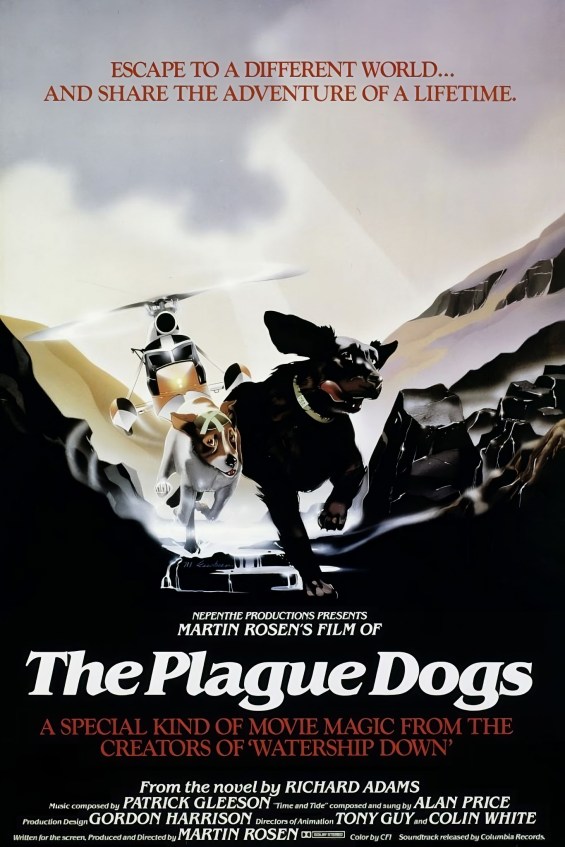
The Plague Dogs (1982) – Film Review

“They’re Not Masters. I Had a Master Once and I Know. Whatever the White Coats Are, They’re Not Masters…” – Snitter

One of the longest British animated films ever released, 1982’s The Plague Dogs is an extraordinarily bleak yet emotionally resonant film that tackles the uncomfortable subject matter of animal testing, particularly in the case of canines. A beautifully melancholy and poignant story about hope, companionship and scientific boundaries, many will undoubtedly find The Plague Dogs a long-winded and generally unpleasant experience. Whereas, for those who can stomach its harrowing storytelling, The Plague Dogs will be as captivating as it is heart-rending, standing as an underappreciated, well-crafted piece of hand-drawn ’80s animation.

Plot Summary: When Snitter and Rowf, a pair of tormented dogs, manage to escape from a remote animal testing facility in Northwestern England, the facility director attempts to keep their escape quiet. But, as an increasing amount of local livestock are found dead, word soon leaks out, along with rumours that the dogs may be potential carriers of the bubonic plague…

The second animated film to be based on a novel by Richard Adam and written/directed by Martin Rosen, following the release of Watership Down in 1978, The Plague Dogs is similarly aimed at an adult audience despite its charming animal protagonists. In fact, alongside The Last Unicorn (1982) and The Secret of Nimh (1982), The Plague Dogs is amongst the darkest and most violent animated films of the late twentieth century. As such, if, like me, you’re a dog lover, many scenes throughout The Plague Dogs will be supremely challenging to watch as the canines suffer at many points, both mentally and physically, to thrust the underlying themes of the film onto the audience. And, as the film’s title would suggest, the protagonists’ daring journey is not as morally straightforward as it first may seem, as via a series of conversations between scientists, journalists and government officials, it’s suggested that Snitter and Rowf may carry a variant of the bubonic plague, thanks to the facility “White Coats,” but this is never entirely confirmed, leaving the rumours (as well as the ambiguous ending) up for interpretation.

The central voice cast of the late Sir John Hurt, Christopher Benjamin and James Bolam are all terrific in their assorted roles, delivering vocal performances that are empathic yet never too intense for the steady pacing. Moreover, the foremost duo of Snitter and Rowf are swiftly established and supplied with plenty of characterisation, as Rowf, a labrador retriever mix breed, begrudgingly follows the lead of Snitter, a determined and optimistic fox terrier, frequently acting as a foil for his mystical sanguinity, combating it with world-weary nihilism. Rowf’s pessimism is hardly irrational, however, as the pair’s horrific experiences in the facility have left them scarred, striving to use their escape as a chance to heal from those hellish experiences, with the survival guidance of a cunning fox known only as the “Tod.” Snitter is seemingly the heart of the film, though, formerly belonging to an affectionate owner who tragically died in an accident. Snitter underwent surgery of some kind during his time in the facility, resulting in a crown of bloodstained bandages around his head, ghostly hallucinations and persistent moments of distress due to a clamouring noise that only he can hear.

To match the relentlessly sombre tone, The Plague Dogs retains a shady colour palette throughout its runtime for both its stunning, watercoloured backgrounds and astonishingly realistic animation for the dogs, continuously prompting frames to resemble aged landscape paintings, complete with expansive fields, derelict farmhouses and cloud-covered peaks, which is even more impressive when considering no rotoscoping was utilised during production. Furthermore, the animated cinematography is dynamic and visually engaging as the camera glides around the dogs and their environment(s), often passing through windows and over stone walls, inadvertently helping to redeem the irksome amount of fade-to-black transitions in between.

Influenced by the techniques of American minimalism as well as the scores of Polish composer, Witold Lutosławski, Patrick Gleeson’s orginal score for The Plague Dogs conforms to the style of Rosen’s uncompromising filmmaking for the most part, as tracks, such as FreedomWondering and In the Pens, are suitably dour and fine-drawn, rarely flaring up to create room for the atmospheric sound design.

Unfortunately, regarding its reception, The Plague Dogs performed incredibly poorly critically and commercially upon its initial release, failing to live up to expectations as a follow-up to Martin Rosen’s last feature. Shortly after its UK premiere, the film’s distributor, Embassy Pictures, decided not to pursue any further theatrical releases, meaning many American animators never saw the result of their hard work, one of whom was actually a young Brad Bird, eventual writer-director of The Incredibles (2004), before he was fired during production.

In summary, the entire duration of The Plague Dogs is undeniably oozing with despair and dread. So much so, it wouldn’t be misleading to say the film is a “Prolonged Howl of Helplessness.” Still, in my opinion, the film and Rosen as a writer/director are unfairly unrecognised in the realm of animation, as while Rosen may have only orchestrated two films throughout his career, finding any animated flicks that can be compared to his filmography is virtually impossible. Rosen was a pioneer in animation, taking bold risks in his narratives and imagery alike to delve into topics the medium of animation is usually afraid to tackle, something The Plague Dogs does favourably and uncompromisingly. Rating: low 8/10.

MV5BNDA1ZDU3M2ItNTdmZC00NjlkLWJhN2UtYjY3YWI3Y2FhMThhXkEyXkFqcGdeQXVyMTQxNzMzNDI_._V1_-transformed

The Lost World: Jurassic Park (1997) – Film Review

“Oh, Yeah. Oooh, Ahhh, That’s How It Always Starts. Then Later There’s Running and Screaming…” – Dr. Ian Malcolm

Strangely dubbed; The Lost World: Jurassic Park, a title that appears to be out of order in its literary arrangement. This adventurous sequel to the timeless classic; Jurassic Park, released in 1993, was once among the most anticipated films of the 1990s. Yet, upon its initial release in 1997, The Lost World: Jurassic Park disappointed many for not living up to the lofty expectations set by the original, including Spielberg himself, who expressed disappointment with the film after becoming increasingly disenchanted with it during production. Nevertheless, I have always considered The Lost World: Jurassic Park somewhat underrated, harbouring an intriguing story and a more foreboding tone/aesthetic, which offsets some of its screenplay-centric faults.

Plot Summary: Four years after the catastrophe of Jurassic Park, the now-humbled John Hammond, strives to redeem himself by studying the well-being of the dinosaurs roaming free on InGen’s secondary site for bio-engineering, the secluded island of Isla Sorna. While assembling his team for this study, Hammond contacts the reluctant Dr. Ian Malcolm to convince him to join the expedition. Meanwhile, Hammond’s ignorant nephew, Peter Ludlow, intends to use his newly-obtained position as the CEO of InGen to capture as many of the island’s prehistoric species as possible for a new attraction opening in central San Diego…

Similar to the original film, The Lost World: Jurassic Park is loosely based on the novel of the same name by Michael Crichton and helmed by celebrated director Steven Spielberg. So, as is to be expected, under this masterful direction, The Lost World: Jurassic Park boasts several edge-of-your-seat moments, the stand outs of which are a scene that features a Tyrannosaurus Rex tandem bashing a mobile trailer over a cliff, as well as a sequence in which a Tyrannosaurus Rex rampages through San Diego destroying everything in its path, morphing the audience’s perception of dinosaurs from captivating, awe-inspiring creatures to truly terrifying prehistoric beasts, following the incident on Isla Nublar. However, as the runtime continues, it becomes increasingly evident that Spielberg desperately wanted to integrate as many of his own ideas into the framework of Crichton’s sequel novel as he could. A desire that ultimately results in the narrative becoming unfocused, eventually losing itself almost entirely near the end of the second act to concentrate on exciting dinosaur sequences.

Returning from the original film is Jeff Goldblum as Dr. Ian Malcolm, the remarkably entertaining pessimistic mathematician with a dry sense of humour. Accompanying Malcolm this time around is his adolescent daughter, Kelly Curtis, portrayed by Vanessa Lee Chester, and his palaeontologist girlfriend, Sarah Harding, portrayed by Julianne Moore, in addition to the other members of Hammond’s research team; wildlife photographer, Nick Van Owen, portrayed by Vince Vaughn, and tech expert, Eddie Carr, portrayed by Richard Schiff. Whilst every cast member turns in a solid performance, however, there is undoubtedly a lack of well-defined characters in The Lost World: Jurassic Park, as every character has a shortage of development beyond the dexterities they bring to their team. Roland Tembo, portrayed by the late Pete Postlethwaite, is perhaps the most compelling character of this particular entry in the series, being depicted as a jaded big-game hunter, determined to capture a male Tyrannosaurus Rex, single-handedly.

Swapping out the tidied facilities and tropical foliage of Jurassic Park for dim lighting, expansive forests and more intense violence, The Lost World: Jurassic Park‘s visuals are substantially darker than its predecessor, corresponding with the more downbeat tone of the narrative. Furthermore, the cinematography by Janusz Kaminski retains a tremendous sense of movement, while the film’s abundant use of marvellous CG effects, detailed miniatures and impressive life-sized animatronics effectively bring the dinosaurs (and a handful of locations) to life, all whilst demonstrating how far CGI had come since the first instalment in the franchise in ’93.

Once again composed by John Williams, the original score for The Lost World: Jurassic Park only contains minor hints towards the iconic theme and secondary motifs of Jurassic Park. Instead, the score houses much of its own appeal (not too dissimilar to how the visuals differ from the original film) as Williams constructs a different thematic and textural landscape for InGen’s Site B, a.k.a. Isla Sorna. As such, the soundtrack sheds much of the amazement and beauty of John Hammond’s prehistoric theme park for a more ominous soundscape. Excluding the film’s unfairly neglected theme; The Lost World, which is more wildlife adventure-inspired.

On a separate note, whilst its amusing to see franchise-staple dinosaurs like the Tyrannosaurus Rex and the Velociraptors return in The Lost World: Jurassic Park, I’ve always felt its a shame the filmmakers didn’t attempt to introduce a selection of lesser-known dinosaurs, especially with how many fantastic choices there are, as the carnivorous Alioramus, Majungasaurus and Spinosaurus (which would later appear in 2001’s Jurassic Park III), all would’ve served as significant threats and upped the ante for this much-anticipated sequel.

In summary, while it truthfully does pale in comparison to the original film, there is plenty to appreciate about The Lost World: Jurassic Park when viewed from a different perspective, as the film retains an overabundance of spectacle and exceptional visual effects, affirmed by the film’s Academy Award nomination for Best Visual Effects in 1998. Essentially, The Lost World: Jurassic Park is a perfect example of just how difficult it can be to craft an engaging sequel to a beloved cinema-altering blockbuster. Rating: 6/10.

the_lost_world_jurassic_park-p196804

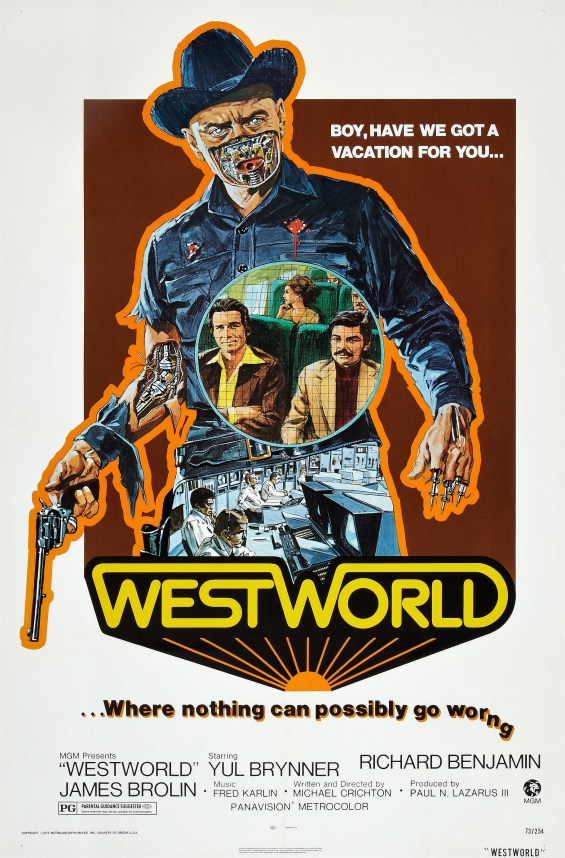
Westworld (1973) – Film Review

“There’s No Way to Get Hurt in Here. Just Enjoy Yourself.” – John Blane

Before the emergence of the hit sci-fi-drama series of the same name, 1973’s Westworld was a pillar of the science fiction genre. With an engaging story, imaginative concepts and a terrific performance from the late Yul Brynner as a lethal, automated gunslinger, the original Westworld is a delightful sci-fi-western hybrid that puts its clever tricks to creative use, rarely getting bogged down by pretentious statements regarding the creation of artificial life (unlike its contemporary television counterpart), to instead concentrate on its visceral style of storytelling and filmmaking.

Plot Summary: In the near future, the Delos Corporation offers the perfect getaway with the entertainment destinations; Medievalworld, Romanworld and Westernworld, where guests can experience life in the time period of their choosing, indulging in their wildest fantasies while interacting with the attendant androids that populate them. But, when Westworld undergoes a system-wide malfunction, causing the androids’ built-in safety features to fail, the safety of the guests is put into question…

Written and directed by Michael Crichton (ComaLookerPhysical Evidence), author of many celebrated novels, including Jurassic Park. Crichton became inspired to write Westworld following his trip to Disneyland, where he rode the water-based attraction, Pirates of the Caribbean, and was impressed by the animatronic pirates. This is also why the iconic attraction is mentioned in the 1993 adaptation of Jurassic Park when Malcolm states; “When the Pirates of the Caribbean Breaks Down, the Pirates Don’t Eat the Tourists.” Crichton effectively utilises this inspiration by playing upon humanity’s fears of artificial intelligence one day overthrowing us. Furthermore, through the characters, Crichton’s screenplay retains a solid amount of satire, with the guests hungry for danger and adventure quickly turning spineless once Westworld becomes truly dangerous, much like the real Wild West that inspired it.

Regarding the characters, the screenplay largely depicts them as if they are the audience themselves, with the protagonist, Peter Martin, portrayed by Richard Benjamin, being a recently-divorced Westworld newcomer, whilst his friend, John Blane, portrayed by James Brolin, is a returning guest eager to jump back into the ways of the Old West. As a result, we get to see how Westworld functions from a guest and staff perspective before the chaos begins. And while neither of the central duo is given a lot of development, both characters serve an important purpose within the narrative as wealthy guests who are visiting Westworld to indulge their desires for pampering and daring escapades, whether that a bank robbery, a bar-room brawl or merely taking sexual advantage of a coy-serving wench. Then, on the android side of things, there’s the Gunslinger, portrayed by the late Yul Brynner, who truly steals the show, becoming fixated on the pair following their confrontation in the first act. The Gunslinger acts as an embodiment of the widespread malfunction, relentlessly hunting his target(s) with a cold, calculating demeanour and a continually menacing presence.

From the vast desert-set Westworld to Medievalworld, a mead and chicken-leg heaven, to the flowery gardens and toga parties of Romanworld, the set design throughout Westworld is excellent, excluding a few barren hallways, here and there. The cinematography by Gene Polito isn’t as remarkable, however, overly depending on close-ups and mid-shots, which becomes rather repetitive, despite appearing reminiscent of the camerawork in classic westerns. In addition to the three entertainment destinations, all of the period-set areas are connected by a web of subterranean passageways and an eerily prescient CCTV system, both of which help provide enticing snippets into the unfolding horror once Westworld collapses, furnishing the film with a healthy amount of edge instead of relying on unwarranted bloody violence for its final act.

An efficacious blend of sci-fi and western, Westworld‘s original score frequently alleviates the atmosphere of scenes that could otherwise appear quite sinister, as the score varies from lively, Wild West-era tracks like The Western Warble and Stagecoach Arrival to scratchy, ominous tones and percussions with tracks like Robot Repair. This switch from passé to futuristic pieces never feels out of place, though, as the distinctive tracks lean into the idea of merging multiple time periods via the entertainment destinations.

Intriguingly, Westworld actually marked the first-ever use of computer-digitised images in a feature film (not merely monitor graphics) with the shots from the Gunslinger’s point-of-view. After the technical process was sufficiently developed to produce satisfactory results, it only took around eight hours to produce every ten seconds of footage for the Gunslinger’s pixelated P.O.V., which is monumental for 1970s filmmaking. However, this praise could be applied to almost all of the film’s effects, which have held up well since the ’70s. That is, aside from the fake blood, which looks closer to bright red paint whenever a guest or android is shot dead.

In summary, in an era of pessimism, it’s refreshing to see a sci-fi flick like Westworld that depicts the future as not dystopian, but an affluent and joyous time with merely detrimental forms of recreation, adding a level of appeal to the world-building that many science fiction releases seem to miss out. As such, Westworld comes across as an innovative sci-fi-western, harbouring an appropriate amount of satire along with an abundance of apprehension regarding the evolution of artificial intelligence, keeping the audience captivated throughout its moderate runtime, even in spite of its occasional time-worn aspects. Rating: high 7/10.

westworld-p692769

The Iron Giant (1999) – Film Review

“It’s Bad to Kill. Guns Kill. And You Don’t Have to Be a Gun. You Are What You Choose to Be…” – Hogarth Hughes

Partially based on the novel; The Iron Man by Ted Hughes, 1999’s The Iron Giant is an incredible achievement in both storytelling and animation. Tackling ambitious themes and complex animation techniques for the time through its near-seamless blend of hand-drawn and CG animation, The Iron Giant is a captivating and uplifting animated sci-fi adventure with plenty of humour and heart entrenched in its story. And while perhaps not the peak of director Brad Bird’s filmography, with The IncrediblesRatatouille and Mission: Impossible – Ghost Protocol all serving as stiff competition. As far as directorial debuts go, The Iron Giant was undoubtedly a curtain-raiser for Bird and his team.

Plot Summary: When a massive metal automaton, sent from somewhere in the black void of outer space, crash-lands on Earth just outside the small town of Rockwell, Maine. Eleven-year-old, Hogarth Hughes, stumbles across the android and quickly strikes up a friendship with the giant. But, unbeknownst to Hogarth, U.S. government agent, Kent Mansley, has his sights set on finding the extraterrestrial visitor and will stop at nothing to ensure its destruction…

Whilst The Iron Giant bears little resemblance to the novel it’s based upon, the stories behind both the novel and the film’s creation are tragic yet fascinating. As originally, the author of the novel, Ted Hughes, wrote the story as a way of comforting his children after the suicide of their mother, Sylvia Plath. Similarly, Brad Bird was in part inspired to adapt the novel as a memorial to his sister, Susan Bird, emphasising the anti-gun message of the story as she was shot by her estranged husband in a murder-suicide in 1989. His initial pitch was this; “What if a Gun Had a Soul and Didn’t Want to be a Gun?” And even if the title of the adaptation (and subsequently the titular character’s name), was later changed to The Iron Giant to avoid confusion with the renowned comic book character, Iron Man. This underlying theme has always been associated with the character and is weaved into the narrative exceptionally.

The main voice cast of Eli Marienthal, Jennifer Aniston, Harry Connick Jr., and Christopher McDonald all do a fantastic job as the central clump of well-defined characters, portraying them as surprisingly grounded personalities for an animated flick. However, the most significant member of the cast has to be Vin Diesel as the Iron Giant himself. Sharing similarities with his later role as Groot/Baby Groot in the Marvel Cinematic Universe, Diesel only speaks a total of fifty-three words throughout the entire runtime, excluding yells and groans. Yet, even with these limited lines, Diesel provides the enormous android with a suitably weighty voice and plenty of amusing/endearing moments.

On account of The Iron Giant being the first traditionally animated film to feature a principal character that is entirely computer-generated, there are a few scenes where cracks have begun to form in the animation and the animated cinematography. However, for the most part, the visuals on display throughout The Iron Giant are magnificent as the film contains an extensive amount of vibrant and alluring shots that meld both animation techniques. Many of these shots also make superb use of the remote, coastal setting of Rockwell, as well as the 1950s time period.

The original score by the late Michael Kamen is largely superior to a number of other orchestral scores for animated family flicks, with the acclaimed track; No Following, standing as a beautiful yet heart-rending composition that considerably enriches the final act. Further tracks, such as The Eye of the Storm and Souls Don’t Die, are pleasant to listen to and serve their purpose within the story, despite not being particularly memorable.

Another noteworthy aspect of The Iron Giant is how the film takes inspiration from classic sci-fi films of the 1950s. Intentionally playing into many of the staples of the science fiction genre around that time, including the widespread fears of nuclear war and Earth being invaded by creatures from another world. This ’50s inspiration even extends to the character designs with the appearance of the Iron Giant himself, who is instantly recognisable as a result of his atomic-age headpiece. Furthermore, the tentacles that emerge from the Iron Giant’s back during the final act are an unmistakable visual homage to one of the most well-known extraterrestrial films in cinematic history; The War of the Worlds, released in 1953.

In summary, whilst it still saddens me that The Iron Giant was such a box office failure upon its initial release, only grossing around £19 million on an estimated budget of £58 million. I am delighted that the film has gone on to become such a cult classic, predominately through positive word-of-mouth, no less. Releasing on August 6th, 1999, the same day as The Sixth SenseThe Iron Giant was commercially overshadowed immediately out of the gate. Moreover, following the success of Toy Story in 1995, The Iron Giant was released at a time when hand-drawn animation was being superseded by CGI. So much so, that Warner Bros. Pictures was in the process of shutting down its traditional animation division during the film’s production. And yet, The Iron Giant still flourished in spite of all these obstacles, which, in my opinion, is a testament to the efforts of Brad Bird and his masterful team of animators and creatives. Rating: low 8/10.

iron_giant_ver4_xxlg

Hellraiser (1987) – Film Review

“Oh, No Tears, Please. It’s a Waste of Good Suffering!” – Pinhead

Written, directed and based on the novella; The Hellbound Heart by Clive Barker (NightbreedLord of Illusions), 1987’s Hellraiser is truly a fiendishly unique vision. Offering a discomfiting and sadistically smart alternative to mindless gore, this classic horror rarely has a tiresome moment, utilising its outstanding practical effects and an onslaught of intriguing ideas to great effect, to the point where the film sequentially became a victim of its own success, becoming so influential that it not only spawned a decades’ worth of poor imitations, but even its own series of continuously disappointing sequels. Nevertheless, it can’t be denied that the original Hellraiser is an unforgettable excursion into a netherworld of monsters, murder and disloyalty.

Plot Summary: When Kirsty’s father, Larry, and stepmother, Julia, move into Larry’s childhood home, Julia discovers the newly resurrected, partially-formed body of her brother-in-law, Frank, a sexual deviant who lost his physical form after solving a supernatural puzzle box which summons a group of multi-dimensional demon sadists known as the Cenobites. Now, to reclaim his body, Frank convinces Julia, his one-time lover, to lure unsuspecting men back to the house so he can use their blood to revitalise himself and escape the clutches of the demonic beings pursuing him…

One of the central concepts of the Hellraiser franchise; a seemingly innocuous puzzle box that is, in reality, a gateway to Hell, has its basis in the urban legend of The Devil’s Toy Box, which concerns a six-sided cube constructed of inward-facing mirrors. According to the legend, individuals who enter the structure will undergo disturbing phenomena that will simultaneously grant them a revelatory experience while permanently warping their minds. This story has heavy ties to the idea of insanity, which is certainly prevalent throughout Hellraiser, as the film, similar to the rest of Clive Barker’s work, is very surreal in nature. However, unlike the rest of Barker’s work, the budget for Hellraiser was astonishingly low at around £730,000. Whilst this was most likely due to Barker’s lack of filmmaking experience (only having directed two short films at the time), Hellraiser quickly earned over £14 million, immediately cementing Barker as a promising writer and director in addition to establishing Hellraiser as a series we’d still see years down the line.

The superb cast of Andrew Robinson, Clare Higgins, Sean Chapman and Ashley Laurence all effectively serve their purpose within the narrative, as Hellraiser admirably values its characters more than many other horror films, developing each of the family members, so they feel both genuine and distinct from one another, ensuring the pivotal plot threads of adultery and Julia’s subsequent guilt remain riveting. Then, of course, there is Doug Bradley as the film’s icon, Pinhead, who, despite being kept in the background for a majority of the runtime, gives a solid performance, especially considering Pinhead, like the rest of the Cenobites, has very limited dialogue and screen-time.

Speaking of iconography, while Hellraiser no doubt has its fair share of recognisable shots, much of this iconic imagery isn’t due to the cinematography by Robin Vidgeon, but more so because of the film’s masterful creature, costume and prop design. As the camerawork itself, although dynamic, often just falls back on conventional close-ups and mid-shots, with the occasional zoom or tilt thrown in to further magnify the effects on-screen.

For the original score, Clive Barker originally wanted the experimental electronic music group, Coil, to compose music for the film. But, when that notion was rejected, the film’s editor Tony Randel, suggested composer Christopher Young as a replacement. And truthfully, I feel this was for the better, as Young’s score perfectly lends itself to the dreamlike, otherworldly tone of the film, with the opening theme; Hellraiser, standing as a grand orchestral piece with a dark, fairytale-like undertone, whilst tracks like Resurrection and The Lament Configuration have an unnerving, almost gothic quality to them.

Yet, it’s undoubtedly the artful designs of Hellraiser that make the film so unique, with the grotesque and somewhat fetishistic designs of Pinhead and the other Cenobites being particularly striking as Barker drew inspiration for their diverse looks from punk fashion, catholicism and visits he took to S&M clubs in New York and Amsterdam. Interestingly, in spite of the character’s reputation, in the novella, Pinhead is present but is not the lead Cenobite. The Female Cenobite, the Chatterer and the Engineer, all have more prominent roles, but as a result of the visually impressive yet extremely restrictive prosthetic make-up for the respective characters, Pinhead took point on account of Doug Bradley’s prosthetics allowing for the most facial movement, promptly resulting in Pinhead becoming the face of the horror franchise.

In summary, Hellraiser is truly one of the most gruesome, captivating and indelible horror films of the 1980s, even though it’ll no longer leave audiences chilled to the bone, just as it did way back when. Despite rarely receiving the attention it deserves, Hellraiser is not only an exceptionally eerie slice of ’80s pop culture, but an important entry in the history of cinema, as not only did the film force ostentatious critics to accept that the horror genre could have artistic weight, but it also pushed the boundaries of practical effects, with many of its costumes, animatronics and prosthetic make-up effects even outshining today’s CG efforts. Rating: 8/10.

hellraiser_xxlg

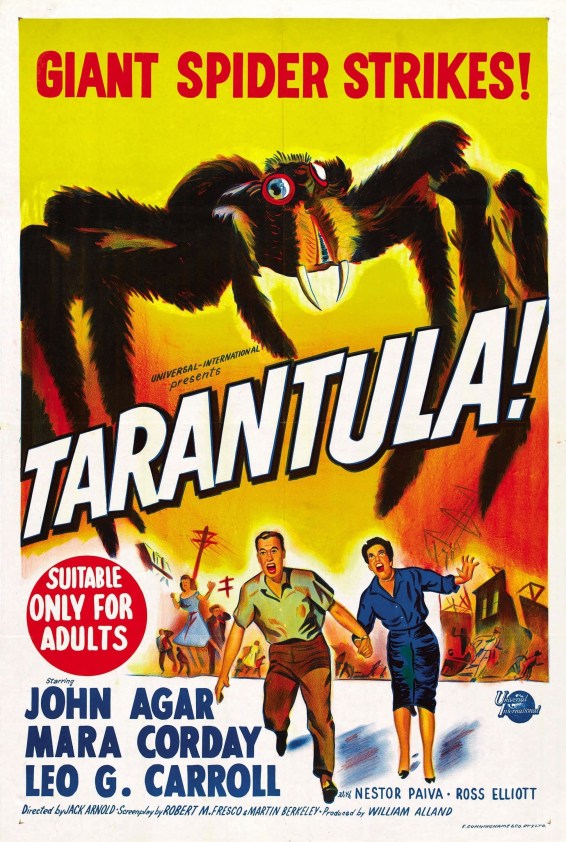
Tarantula (1955) – Film Review

Before the horror genre truly began capitalising on the common phobia of creepy crawlies with films like ‘Arachnophobia,’ ‘Itsy Bitsy,’ ‘Kingdom of the Spiders,’ and ‘Eight Legged Freaks,’ the 1955 sci-fi-horror classic; ‘Tarantula,’ terrified audiences with its marvellous creature effects and continuously unnerving atmosphere. Ensuring the film would go on to be the exemplary for future monster flicks, despite featuring many of the usual problems plaguing creature-features at the time.

Plot Summary: In a remote facility in the Arizona desert, ‘Professor Gerald Deemer’ is conducting a series of experiments in the hopes of finding a way to increase the world’s food supply, injecting growth hormones into various animals to greatly increase their size. But, when a tarantula escapes from the isolated laboratory, still growing at a exponential rate due to the formula, the giant arachnid begins to wreak havoc on a nearby town…

Directed by the late Jack Arnold (With These Hands, Creature from the Black Lagoon, The Incredible Shrinking Man), ‘Tarantula’ was just one of the many science fiction flicks Arnold undertook throughout his career, and in a similar fashion to many of his other stories revolving around horrifying creatures, ‘Tarantula’ was part of the 1950s wave of sci-fi and horror films crafted around the newfound fear of nuclear radiation following World War II. Yet, while we now know ‘Tarantula‘ did greatly help in creating the ‘giant animal’ subgenre, there is an argument to be made that if not for the release of ‘The Beast from 20,000 Fathoms’ just a year prior, ‘Tarantula’ may not even exist, as general audiences only gained interest in creature-features on account of that film’s success.

The late John Agar portrays the film’s square-jawed hero, ‘Dr. Matt Hastings,’ and just like a large majority of male protagonists in ’50s sci-fi, ‘Dr. Hastings’ is charismatic enough to carry the film in spite of the actual character receiving very little development over the course of the runtime. And, as expected, ‘Tarantula’ also includes a romantic subplot between ‘Dr. Hastings’ and secondary protagonist, ‘Stephanie Clayton,’ portrayed by Mara Corday, which although made palatable by Agar and Corday, still feels pretty forced. However, one of the film’s biggest missed opportunities is certainly ‘Professor Gerald Deemer’ portrayed by the late Leo G. Carroll, as whilst Carroll gives a decent performance here, the story sadly pushes his character into the background and nearly entirely ignores the suffering his character later endures after injecting himself with his formula, making his character’s inclusion seem quite superfluous.

Despite the many creature effects throughout ‘Tarantula’ clearly being the film’s main focus, the cinematography by the late George Robinson does have its share of attractive shots even with the film’s lack of colour and camera movement alike due to the technological restrictions of the time-period, as any wide-shots displaying the vast Arizona desert or the fictional town of ‘Desert Rock’ are fairly appealing, and occasionally, even add to the film’s tense atmosphere as the uneven rocky landscape alongside the film’s dim lighting allows the giant arachnid to often lurk unseen.

The original score by the late Herman Stein and the late Henry Mancini is a thunderous and sometimes overly dramatic score, feeling very much like a soundtrack taken from films of the 1950s for better, and for worse. And, while both composers are often uncredited for their work on the film, ‘Tarantula’ is far from the first time Herman Stein has collaborated with director Jack Arnold, providing scores (and having much of his music reused) for a number of his films.

But, of course, ‘Tarantula’ will always be best known for its effects, which are in all fairness the film’s best attribute, as whilst many fondly remembered science fiction and horror films of the 1950s relied on models, costumes and stop-motion to bring their strange creatures to life, many of these filmmaking techniques can feel very dated and tacky by today’s standards for films brimming with CGI. This isn’t the case with ‘Tarantula’s effects, however, as the way the film brings its signature creature to life is quite innovative, as the filmmakers actually used a real tarantula shot separately from the rest of the film, before it was then enlarged and composited/projected onto the desert locations. This clever technique allows the spider to move naturally, and was not only state-of-the-art for the era, but is still quite impressive now, as the matte effect is usually impeccable aside from one or two shots where some of the tarantula’s legs seem to phase through the environment.

In summary, just like many other films released around the time of the 1950s/1960s, ‘Tarantula’ does have its entertainment value, but is also much slower-paced and far more simplistic than many of the sci-fi blockbusters and epic creature-features we’d see released today. Yet, whilst its characters are a little uninspired and the film is more about spectacle than anything else, ‘Tarantula’ definitely has its moments, and, even if just for the effects alone, I think it deserves its place as a ’50s classic, flaws and all. Final Rating: 6/10.

tarantula_poster_05

The Blair Witch Project (1999) – Film Review

Upon its initial release, the original ‘Blair Witch Project’ blew many audiences away with its realistic depiction of found-footage horror, subsequently leading many audience members to believe that the events they were watching on-screen actually took place, making for a truly terrifying experience. However, now, many years after its first appearance, the film’s reputation has significantly altered with both critics and audiences alike, as ‘The Blair Witch Project’ is definitely a film that lies outside of the usual horror clichés.

Plot Summary: When three student filmmakers travel to Burkittsville, Maryland, in attempt to produce a documentary based around the local urban legend of ‘The Blair Witch,’ they mysteriously disappear after traveling into the nearby Black Hills Forest, leaving only their footage behind to be discovered one year later…

Whilst ‘The Blair Witch Project’ wasn’t the original found-footage horror film, with the infamous exploitation flick; ‘Cannibal Holocaust,’ first introducing the horror subgenre in 1980. ‘The Blair Witch Project’ was the first film to popularise the found-footage concept, as this film was at one point in time in the ‘Guinness Book of World Records’ for the largest box-office ratio, as the low-budget film only had a budget of around £45,000 and made back over £189 million, quickly spawning an inconsistent horror franchise despite the film’s only partially complete backstory for its creature and setting.

The three main cast members of Heather Donahue, Joshua Leonard, and Michael C. Williams (who all share their real names with their characters), are all tremendous throughout the film, as while their character’s don’t receive nowhere near as much development as they should considering how much screen-time we spend with them, each one of the actors do give the impression they are becoming more tormented and frustrated the longer they remain in the Black Hills Forest. The main reason the film’s protagonists don’t receive much characterisation, however, is actually due to the film’s production itself, as with the film not focusing very heavily on story, the actors were given no more than a thirty-five page outline of plot points rather than a full screenplay. So, as filming continued, the cast just played out various scenes, only having little knowledge of the mythology behind ‘The Blair Witch’ and improvising the vast majority of their lines.

Practically the entirety of the cinematography by Neal L. Fredericks is exactly what you’d expect from a found-footage horror, featuring an abundance of both shaky and out-of-focus shots, further adding to the idea that just behind the lens is a group of amateur student filmmakers (with some scenes even being shot by the cast themselves). In addition to the hand-held camerawork, the film’s visuals are also quite distinctive when it comes to its visual quality, as throughout the duration of the film, many shots remain incredibly grainy and occasionally even switch to a completely greyscale colour palette, which again, whilst adding to the realism of the film being a no-budget student documentary, does ensure the absence of any genuinely attractive shots.

Although it’s only heard during the film’s atmospheric end credits, ‘The Blair Witch Project’ does actually have an original score composed by Antonio Cora, but obviously being a found-footage horror, the film mostly aims to please with its sound design, as the sounds of crackling leaves and chirping birds are heard continuously. Interestingly, many of the eerie branch-cracking sounds heard at night even being made by the director and his friends simply walking up to the cast’s camp-perimeter and then tossing around twigs, rocks, and branches in various directions.

The main aspect that many will either admire or despise about ‘The Blair Witch Project,’ is its previously mentioned focus on realism and minimalist storytelling, as while the film does utilise its forest setting very effectively throughout the runtime, many who may be expecting a thrilling final act or possibly even a glimpse at ‘The Blair Witch’ herself will be greatly disappointed, as due to the story’s constant emphasis on realism, the film never actually provides any genuine evidence of the supernatural, with many of the film’s tense moments mostly relying on the darkness of the woods or the belligerent quarreling between the characters.

In summary, ‘The Blair Witch Project’ is certainly a fascinating horror film even if it isn’t always a successful one. As, to this day, this found-footage indie flick is a very divisive film for horror fans, with a 86% score on Rotten Tomatoes, the film has the highest-rating of any film that was also nominated for a Razzie Award for Worst Picture. So, even with the cast’s impactful performances and ‘The Blair Witch’ herself being an intriguing urban legend, this is one horror that really depends on your personal taste. For myself, while I find the film far from perfect and considerably less compelling than many other iconic horrors, I can appreciate what this experimental piece of filmmaking (and its marketing) was trying to accomplish, and for that, I feel it’s worth at least one viewing for any fan of the genre. Final Rating: 6/10.

blair_witch_project_ver3_xxlg

The Dark Crystal (1982) – Film Review

Despite the success of the recent prequel series; ‘The Dark Crystal: Age of Resistance,’ on Netflix, most audiences still seem relatively unaware of the original ‘Dark Crystal’s existence, which, unfortunately, received mostly lukewarm reviews and massively underperformed at the box-office upon its initial release. Yet, regardless of its age, ‘The Dark Crystal’ is still, in my opinion, an extraordinary family adventure. Creating an intriguing and developed fantasy world brimming with plenty of memorable characters, spectacular locations, and terrifying creatures, all flawlessly brought to life by the film’s enormous array of brilliant practical effects and detailed puppets.

Plot Summary: Centuries ago on the world of ‘Thra,’ the mysterious ‘Dark Crystal’ was cracked and brought forth two races. One, the villainous bird-like creatures known as the ‘Skeksis,’ who now rule over the planet with an iron-fist, and the other, a peaceful of wizards race known as the ‘Mystics.’ But, after a young ‘Gelfling’s ‘Mystic’ master passes on, ‘Jen’ is sent on a quest to locate the missing shard of ‘The Dark Crystal’ and save his homeworld…

Directed by legendary puppeteers Jim Henson and Frank Oz, most known for their creation of the beloved ‘Muppets’ franchise. ‘The Dark Crystal’ is known by many for being rather frightening for younger viewers, as the film always explores its fantasy world without ever shying away from any of its darker elements. Resulting in many who experienced the film at a young age only recalling it due to being ‘traumatised’ by the film’s menacing antagonists, the ‘Skeksis.’ However, despite ‘The Dark Crystal’ giving this ghastly depth to the world it’s narrative takes place within, the film still suffers from the occasional story cliché, as while I’m sure these ideas were less-familiar in the early 1980s, the concept of ‘Jen’ being the last of his kind and having to undertake an epic journey does feel fairly overdone by today’s standards.

Stephen Garlick and Lisa Maxwell lend their voices well to the two protagonists; ‘Jen’ and ‘Kira,’ alongside the voice of Billie Whitelaw and the late Jim Henson and Frank Oz themselves as puppeteers, and while Jim Henson and Frank Oz both do a fantastic job as usual when it comes to their work with puppeteered characters. It’s the late Barry Dennen as the most devious of the ‘Skeksis,’ ‘The Chamberlain,’ who is truly superb, as ‘The Chamberlain’ soon becomes a very memorable antagonist, heavily in part because of his intentionally obnoxious high-pitched voice and now-iconic whimper.

Whilst the cinematography by the late Oswald Morris does serve the film’s story effectively, many shots throughout ‘The Dark Crystal’ are a little restricted due to the focus primarily being placed on the puppets themselves (especially when there is a large number of characters on-screen). That being said, the cinematography does still manage to provide plenty of beautiful wide shots to establish the story’s various locations, the majority of which are elevated through some incredibly impressive matte paintings and miniature sculptures.

Although I do prefer the original score by Daniel Pemberton for the Netflix prequel series, the score for the original film by Trevor Jones is still terrific, feeling like a mixture between a classic fantasy score along with some sinister undertones to help build tension. From the film’s signature track; ‘The Dark Crystal Overture,’ through the track that plays over one of the film’s final moments; ‘The Great Conjunction,’ the film’s original score is still an enjoyable piece to hear, even if it seems most audiences prefer the soundtrack of Jim Henson’s other ’80s fantasy flick; ‘Labyrinth.’

Of course, the main draw of ‘The Dark Crystal’ is (and will always be) the puppets themselves, as while the idea of not a single human appearing within a live-action film may sound daunting to some, the film’s huge variety of practical effects, from the different creatures that prowl the forests and swamps to each one of the detailed and intricate sets for ‘The Castle of the Crystal,’ every single creative aspect of the film in regards to its designs constantly feels as if great talent and effort has been put into each of them, with much of the film’s visuals actually being inspired by the illustrations of Brian Froud, who would eventually join the production as a conceptual designer.

In summary, ‘The Dark Crystal’ was truly a film ahead of its time, as despite the new prequel series helping the unique fantasy series reach a wider audience, I’m not too surprised this ambitious film has been largely forgotten in modern pop culture, as the film’s fascinating and fleshed-out world alongside its entertaining story and huge number of amazing practical effects sadly weren’t enough to save it from its eventual neglected fate. Still, even if this fantastical family adventure didn’t receive the praise it deserved when it was released in 1982, I feel it certainly can now from modern audiences, if just for its painstaking puppeteering work and great character designs alone. Final Rating: 8/10.

dark_crystal_xlg