Winnie-the-Pooh: Blood and Honey (2023) – Film Review

“Pooh, You’ve Got to Help Me! Something’s Wrong With Piglet, He Killed My Wife!” – Christopher Robin

Shot in a mere ten days, Winnie-the-Pooh: Blood and Honey, released in 2023, is a British-American-produced micro-budget slasher that takes a more despicable approach to the beloved characters of Winnie-the-Pooh, Piglet and the other inhabitants of the Hundred Acre Wood, morphing the convivial critters into bloodthirsty, savage killers. Unsurprisingly, due to its laughable concept, terrible screenplay, amateurish filmmaking and general lack of any genuine horror or satire, Winnie-the-Pooh: Blood and Honey serves as nothing more than a bargain-basement slasher that fails to exhibit even a passing interest in the source material it’s adapting. As such, the film is only really notable for its title, simply existing as a bizarre, mismatched amalgamation of the horror genre and classic children’s literature.

Plot Summary: When Christopher Robin, now a young man, departs the Hundred Acre Wood to attend university, leaving Winnie-the-Pooh and his furred friends to fend for themselves, their days of merriment and adventure quickly come to an end as they become feral and enraged, soon acquiring a taste for flesh that steers them on a bloody rampage…

The creation of Winnie-the-Pooh: Blood and Honey became feasible at the start of 2022 after the 1926 children’s book; Winnie-the-Pooh by A. A. Milne, entered the public domain in the United States, voiding its copyright, and therefore Disney’s media exclusivity over the titular character. This meant that the filmmakers behind Winnie-the-Pooh: Blood and Honey were free to use characters like Pooh, Piglet and Eeyore, as long as they did not resemble their animated, Disney-owned counterparts, which were still actively protected by copyright. Nevertheless, I feel that most would agree that a malicious interpretation of Milne’s cuddly animal characters is undoubtedly a poorly-conceived concept from the get-go, with the film doing little to prove its critics wrong in this respect throughout the exceptionally brief runtime, even if it is commendable that this is the first live-action adaptation of Winnie-the-Pooh not produced by the Walt Disney Company, as well as the first adaptation geared towards mature audiences.

Regarding the film’s surplus of shortcomings, Winnie-the-Pooh: Blood and Honey‘s most significant issues lie within its screenplay, as the film crams several unwarranted scenes and overly dramatic subplots into a formulaic slasher framework, like having the underwritten protagonist Maria, portrayed by Maria Taylor, be suffering from serve PTSD, following a night where an anonymous sexual deviant broke into her home. These details add little to the narrative and generally come across as screen-time wasters. The rest of the characters, including Christopher Robin, Jessica, Alice, Zoe and Lara, portrayed by Nikolai Leon, Natasha Rose Mills, Amber Doig-Thorne, Danielle Ronald and Natasha Tosini, respectively, are all tremendously underdeveloped, delivering tedious exposition dumps that lead nowhere through performances that frequently present the cast as if they are uncomfortable in their various roles, underselling or overselling their reactions at every turn.

With the exception of the creative opening sequence, which sets the stage for this darker rendition of the honey-hungry yellow bear via pencil-doodled animation, Winnie-the-Pooh: Blood and Honey is a rather shoddy horror flick that lazily relies on its handful of admirable practical effects to avoid attempting anything visually or audibly impressive, as the cinematography by Vince Knight is relatively dull when it isn’t chaotically unstable during chase sequences, whilst the editing haphazardly slaps scenes together without any consideration for continuity or pacing. Furthermore, the film utilises plenty of editing trickery to get around its poor direction, namely, a ludicrous quantity of fade-to-black transitions and an assortment of abysmal CG blood effects.

One of the more mildly charming aspects of Winnie-the-Pooh: Blood and Honey, however, is its original score by Andrew Scott Bell, as tracks like In Which We Are Introduced to Winnie-the-Pooh, Together Forever and Silly Old Bear, while generic, are, at least, of a relatively high-quality thanks to Bell’s innovative approach to the whimsical yet eerie score, employing a variety of instruments in the composition of the soundtrack, such as a “Beehiveolin,” a combination of a beehive and a violin.

Interestingly, writer-director Rhys Frake-Waterfield (The Area 51 Incident, The Killing Tree, Firenado) originally wanted Tigger to appear in the film, but the character ultimately didn’t on account of copyright. Some may say this was a favourable outcome, as Winnie-the-Pooh: Blood and Honey evidently doesn’t strive for faithful recreations of the cherished characters of the Hundred Acre Wood. Instead, the film opportunistically coasts on the novelty of placing the loveable critters in a macabre context, bringing the characters to live-action through rubbery, full-face masks that display no hair or visible mouths, allowing for minimal expressions, meaning Pooh and Piglet may as well be murderous individuals sporting animal-themed masks.

In summary, Winnie-the-Pooh: Blood and Honey is exactly what many anticipated it to be following the release of its viral trailer in mid-2022; an atrocious slasher, an appalling adaptation, and an all-around execrable piece of cinema. Still, that’s not to say that Winnie-the-Pooh: Blood and Honey was a commercial failure, as the film actually grossed over £4 million on a budget of around £79,000, despite its near-universally negative reviews. Consequently, this suggests that with many other children’s literary works soon making their way into the public domain, we will regrettably be receiving far more lousy, horror-centric renditions of long-established characters in the near future, with Winnie-the-Pooh: Blood and Honey 2, Bambi: The Reckoning and Peter Pan’s Neverland Nightmare, being just some of the projects already announced. Rating: 2/10.

winniethepooh_blood_and_honey_xxlg

The Lighthouse (2019) – Film Review

“Why’d Ya Spill Yer Beans?” – Thomas Wake

A psychological horror only in the vaguest sense, 2019’s The Lighthouse is a strange yet wondrous cinematic venture, incomparable to many other modern releases due to its distinct visual aesthetic and often genre-defying narrative. Led by an outstanding pair of performances from Robert Pattinson and Willem Dafoe, The Lighthouse is the type of film that relentlessly sears itself into its audience’s memory, employing striking visuals, Lovecraftian influences and ominous, atmospheric sound design to craft an unnerving flick that closely resembles the fever-induced night terrors many actual lighthouse keepers endured during their lonesome, off-shore excursions tending to a beacon.

Plot Summary: Off the coast of late 19th-century New England, two lighthouse keepers, the taciturn former lumberjack, Ephraim Winslow, and the elderly lighthouse caretaker, Thomas Wake, set foot on a remote island to begin their monthly duties. But, as the tight-lipped men spend more and more time in each other’s company, a mutual resentment begins to arise as their collective sanity unravels…

Co-written and directed by Robert Eggers (The Witch, The Northman), the story of The Lighthouse is loosely based on a real-life affair that occurred in 1801 known as the Smalls Lighthouse Tragedy, during which two Welsh lighthouse keepers, sharing the name Thomas, became trapped at their station during a storm. When one of the men died, it is said to have driven the other insane. The story also takes some influence from the seafaring literature of renowned authors, including Herman Melville, Robert Louis Stevenson and H.P. Lovecraft, all of which lends the film a sense of historical accuracy and unseen oceanic horror. According to Eggers, earlier versions of the screenplay were more coherent, however, this was later changed as Eggers’ felt the best way to approach the film was to make the audience feel like they were losing their minds alongside the characters. As a result, The Lighthouse can occasionally be quite difficult to follow, yet this ultimately works in the narrative’s favour as the audience, much like the characters, struggle to tell reality from delusion. Even the very concept of time gets thrown out the window by the end of the second act, as it becomes almost impossible to tell how much time has passed between certain scenes, forcing the characters (and the audience) to question exactly how long they have been on the secluded island.

As the only two cast members, Robert Pattinson and Willem Dafoe are superb throughout the runtime as fellow lighthouse keepers, Ephraim Winslow and Thomas Wake. Simultaneously appearing layered and accurate to the time period, both characters flourish on-screen thanks to Pattinson and Dafoe’s electric performances, which are only enhanced when combined with the continuously compelling dialogue. This period-accurate dialogue bleeds through every scene, with the screenplay’s emphasis on 19th-century terminology and expressions instantly transporting the audience to the time and setting of the story, enriching Ephraim and Thomas’ persistent back-and-forths as they become increasingly infuriated at their situation. What makes the characters even more interesting is that neither one can be sighted as a reliable point-of-view, no matter how much they claim the other to be untrustworthy or deranged under their boozy breath.

Shot on Double-X stock, which requires much more light to get exposure. So much so, that the crew had to use about fifteen to twenty times more lights on set when filming at night or indoors to successfully capture footage. The cinematography by Jarin Blaschke is imposing and hypnotic, exhaustively utilising the isolated location of the treeless, storm-susceptible island along with its adjoining greyscale colour palette to create an array of hauntingly beautiful shots. Many of the visuals almost seem like depictions of a sailor’s nightmare, with the dense black-and-white grain of 35mm capturing every shadow and contour, lending the visuals a sensation of 19th-century expressionist horror, where even the tight aspect ratio proves to be claustrophobic. Furthermore, The Lighthouse employs several exceptional practical effects to depict the story’s more fantastical elements, such as its visual references to Greek mythology and seafarer folklore, like mermaids, sirens and the mighty Kraken.

Moving onto the original score, composer Mark Korven adds to the film’s foreboding atmosphere through doomy tracks, like Arrival, Curse Your Name and Stranded. However, much of the unsettling atmosphere could also be attributed to the immersive sound design, central to which is a bellowing foghorn, which sound designer, Damian Volpe, turned to J.J. Jamieson to create; a craftsman in Shetland, Scotland, who makes YouTube tutorials on operating and maintaining foghorns. Using Jamieson’s samples, Volpe manipulated the sound to create a period-accurate foghorn that was suitably startling and memorable.

Another favourable aspect of The Lighthouse is its authenticity, not merely in relation to its time period, but in regard to its restraint to filming on-location, which allows the film to retain a consistent level of practicality throughout, similar to its sense of dread, both of which are only broken up by the handful of well-timed, darkly comedic moments.

In summary, disorientation is clearly the primary intent of The Lighthouse as Eggers offers hints towards a grander narrative, but never fully commits to a sweeping, readable story, even avoiding an easily discernible conclusion. As such, instead of being a straightforward psychological horror or a disturbing historic folk tale, The Lighthouse is more of a surreal exploration of masculinity, guilt and seclusion, in addition to standing as another impressive showcase of Robert Eggers’ screenwriting and filmmaking abilities. Rating: 9/10.

lighthouse_ver2_xxlg

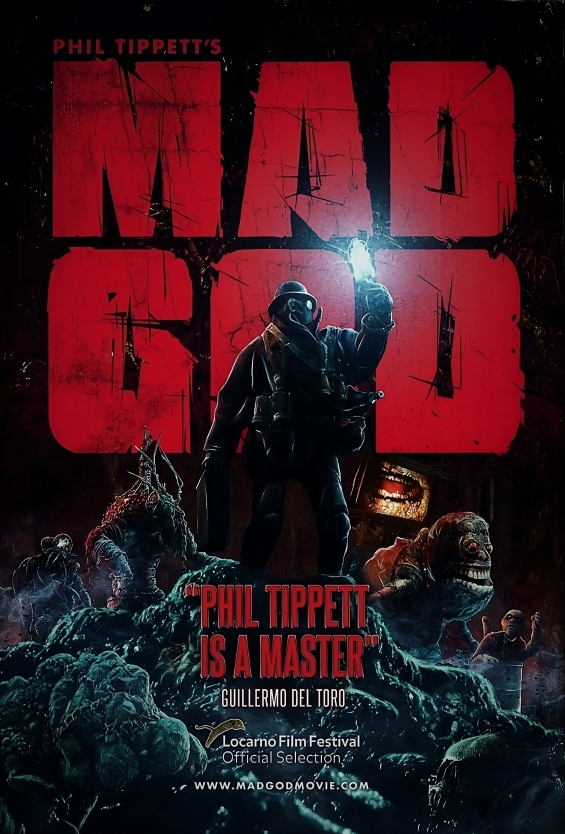
Mad God (2021) – Film Review

“If You Disobey Me and Remain Hostile to Me, I Will Act Against You in Wrathful Hostility. I, for My Part, Will Discipline You Sevenfold for Your Sins…” – Opening Quotation

Written, produced and directed (among many other credits) by Phil Tippett, the founder and namesake of Tippett Studio, whose varied career in visual effects has spanned more than thirty years and includes two Academy Award wins and six nominations. Mad God, released in 2021, is a rich visual treat for enthusiasts of horror and stop-motion animation alike, serving as a harrowing delve into a post-apocalyptic hellscape that is both unique and disturbing. Harbouring a cinematic allure that is equal parts unsettling and mesmerising, Mad God proves that even in the age of CGI, the art form of stop-motion remains strong, even if the story and characters it’s bringing to life are far from well-developed.

Plot Summary: Equipped with a gas mask and an ageing map, the Assassin, a lone iron-clad humanoid, descends into an underworld of tortured souls, ruined cities and wretched monstrosities on a covert mission to reach the heart of this nightmarish realm of suffering…

First starting work on the project in the late 1980s, shortly after creating effects for RoboCop 2, released in 1990. Mad God has been Tippett’s pet project for over thirty years, despite the filmmaker almost considering abandoning the project when Jurassic Park was released in 1993, as CG effects appeared to make stop-motion a thing of the past. After some urging from those around him, however, Tippett decided to create a Kickstarter campaign that allowed him to complete the project. In the following years, three parts of Mad God were released online, which made up around half of the full eighty-two-minute version that was eventually screened at various film festivals. And whilst this story behind the film’s creation is certainly intriguing, Mad God‘s biggest shortcoming is that it lacks a narrative itself, or at least a coherent one. Instead, the film relies on visual storytelling and world-building as the audience follows the Assassin on his lengthy journey, encountering many distinct creatures, locations and civilisations on a mission that is never disclosed. As such, watching Mad God requires a lot of concentration to get the most out of it, much like how the project was crafted, I suppose.

With no dialogue or characterisation to speak of, Mad God‘s characters hinge entirely on their design. Thankfully, every character/creature that appears throughout the runtime is visibly repulsive, unnerving and eccentric. At the core of Mad God‘s story is a character only known as the Assassin, a silent, gas mask-wearing humanoid who also receives no characterisation, instead functioning as an audience surrogate through Tippett’s fever dream of a post-apocalyptic world. As the film features no dialogue, the central cast, including Alex Cox, Niketa Roman and Satish Ratakonda, only appear in a handful of live-action sequences, which similar to the scenes of stop-motion, are grimy and discomforting whilst relying on visuals over direct storytelling. While these sequences are interesting and count towards what little plot there is, many of these moments also pull you out of the experience and are often plagued by the film’s need to implement oral sounds to ensure the human characters don’t appear mute, meaning noises like “Eh?” and “Hmmm” become rather repetitious.

The cinematography by Chris Morley and Phil Tippett allows for spectacular framing within every scene, lending to the atmosphere and intrigue of each setting, whether its an oxidised factory of greasy machinery or a society of helpless slaves ruled over by an electronic screen that speaks in childlike gibberish. Furthermore, each of the surroundings the Assassin treks across is distinguished by the film’s colour palette, which seamlessly jumps from cold blues to vile greens and blood reds, making the stop-motion appear incredibly cinematic. Interestingly, one scene, which features a mountain of dead soldiers, was actually accomplished by melting thousands of plastic army men together on a wire. This scene took six animators around three years to complete, demonstrating the substantial amount of dedication required to animate even a single scene of Mad God.

Through prolonged tracks like Long Way Down and Conveyance, Mad God‘s original score by Dan Wool enhances many of the surreal visuals in a relatively nuanced fashion, making for a soundtrack that isn’t all that memorable, but avoids becoming overbearing as to let the visuals speak for themselves. However, the sound design is where the film’s audio truly shines as the countless animalistic growls of the mutated creatures that roam Mad God‘s mystifying world are ghastly and add audible depth to whichever location the Assassin finds himself.

As most would expect from Tippett Studio, the animation itself is smooth yet appropriately unearthly, providing every creature with its own jittery method of walking/crawling that feels remarkably natural. What’s even more impressive is that, according to Tippett, a considerable amount of the animation on Mad God was actually conducted by novice students who wanted to gain some filmmaking experience.

In summary, Mad God will likely be a very divisive film on account of its largely interpretive narrative and absence of well-defined characters. But, these annoyances ultimately don’t matter that much in the grand scheme, as Mad God thrives in what it’s trying to do. Presenting itself as a love letter to stop-motion that could only be realised by a legendary visual effects artist like Phil Tippett. And with stop-motion animation in such short supply nowadays, an outstanding piece of artsy like Mad God will always be a joy to behold, faults or not. Rating: 7/10.

w1cnVYUNJU3NPYh6FBeq0voXD15-transformed

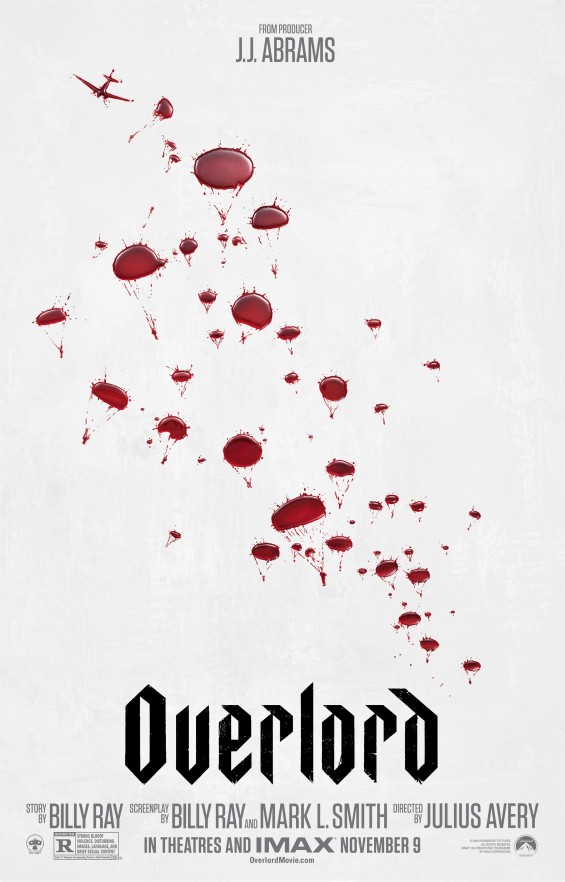
Overlord (2018) – Film Review

“Three Months Ago, I Was Cutting Grass On My Front Yard. The Mailman Shows up With a Letter From the Army. Now, I’m Here, and I Have No Idea Where I’m Going to End Up.” – Private. Edward Boyce

Initially thought to be the fourth instalment in the Cloverfield franchise, an anthology-like series featuring the projects of Cloverfield, 10 Cloverfield Lane and The Cloverfield Paradox. Producer J.J Abrams later confirmed at New York City CinemaCon in 2018 that the war-horror hybrid flick, Overlord, would not be part of the series, despite being produced under the same production company, Bad Robot Productions. In a similar vein to the Cloverfield franchise, however, Overlord frequently appears disjointed and underwhelming in its effort to combine many diverse genres and ideas in a World War II gore-fest.

Plot Summary: On the eve of D-Day, a squad of American paratroopers is dropped behind enemy lines with the mission of penetrating the walls of a fortified local church and destroying the radio-jamming tower inside. But, as the soldiers approach their target, they soon discover that the Nazis are conducting a series of ungodly experiments in a hidden laboratory beneath the church. Experiments that could change the tide of the Second World War…

Evidently inspired by the renowned video game multiplayer mode, Call of Duty: Zombies. Overlord, directed by Julius Avery (Son of a Gun, Samaritan), grounds its absurdist story around a real military operation; “Operation: Overlord,” a code name for the Allied mission for the Battle of Normandy, which launched the successful invasion of Nazi-occupied Europe. This procedure, alongside “Operation: Neptune,” would become known as D-Day. This connection to the factual history of World War II does add some depth to the narrative, in addition to playing into a number of conspiracy theories regarding Nazi experimentation and the classified missions many American soldiers embarked upon during the Second World War. However, a downside to this sort of approach is that Overlord is repeatedly in a tonal conflict with itself, as the first hour of the runtime is a largely straightforward war epic, whilst the final half-hour is a plethora of blood, bullets and superhuman, zombie-like creatures. As such, the film feels as if it’s split into two halves, both at odds with each other. Still, at least Overlord ditches the irritating use of storytelling mystery boxes, a J.J. Abrams staple.

While the performances of Jovan Adepo, Wyatt Russell, Mathilde Ollivier, John Magaro and Pilou Asbæk continually range from serviceable to immensely hammy. The dialogue and characterisation throughout Overlord are somehow much worse, often coming across as cheesy, and in the case of the characterisation, wildly inconsistent. For example, Private. Edward Boyce is initially portrayed as quiet, nervous and hesitant to kill. But, as the runtime continues, Boyce soon changes his disposition almost entirely to become confident and adept on the battlefield, having no issue killing others, all without any semblance of a character arc. Corporal. Lewis Ford suffers from a different issue as the squad’s ruthless leader, wanting to ensure that his unit completes its mission at any cost. Yet, his no-nonsense attitude and bleak outlook are never explained beyond the reasoning of ‘war changes people.’

Primarily relying on hand-held mid-shots and close-ups, many of Overlord‘s finest shots can be seen whenever the squad are outdoors amongst the burning fields and aircraft-filled skies of the small French village where their target resides. Outside of these outdoor shots, the cinematography by Laurie Rose isn’t all that impressive. However, the various sets and locations chosen for the film are rather impressive, appearing period-accurate and extremely unsanitary in regard to the undisclosed Nazi laboratory and connecting subterranean access tunnels.

When it comes to the original score by Jed Kurzel, tracks like Mist Patrol, Devil Dogs, Approaching the Church and Re-Animation, do a respectable job of adding to the tension and brutality of many scenes, yet rarely feel distinguishable or noteworthy by themselves. The film’s end credits song; Bridging the Gap by Naz, is also a peculiar choice given that the well-known jazz-rap song doesn’t fit the time period, tone or even location of Overlord on account of its lyrical references to Mississippi and New York City.

On a more positive note, unlike many modern horror releases, Overlord actually features a reasonable amount of practical effects. One scene in which practical effects were utilised is the opening sequence, which sees soldiers leaping from a burning aircraft as it plummets to the ground. This thrilling moment was accomplished by rigging an aircraft-themed set on a tilting gimbal and then having stuntmen tumble through real flames via its back portion. Sadly, however, many of these effect-filled sequences are somewhat tainted by the film’s need to place CG enchantments on top of its practical effects. Most of which make many of the effects (including a gruesome scene in which a soldier’s neck snaps back so quickly bones pierce out of his chest) appear as if they were achieved purely through CGI.

In summary, when it was first announced many years ago, Overlord seemed practically destined for cult status, appealing to fanatics of war epics, zombie thrillers and gory, low-budget horror flicks alike. But, looking at it now, it’s clear that Overlord doesn’t fully dedicate itself to its bonkers premise, preferring to be a predominately solemn war piece instead of the outrageous, violent homage to the niche horror subgenre of Nazi zombies. As a result, whether it’s your first viewing or your fifth, it’s hard not to wonder how much stronger Overlord would’ve been should it have stuck the landing. Rating: low 4/10.

overlord_ver2_xxlg

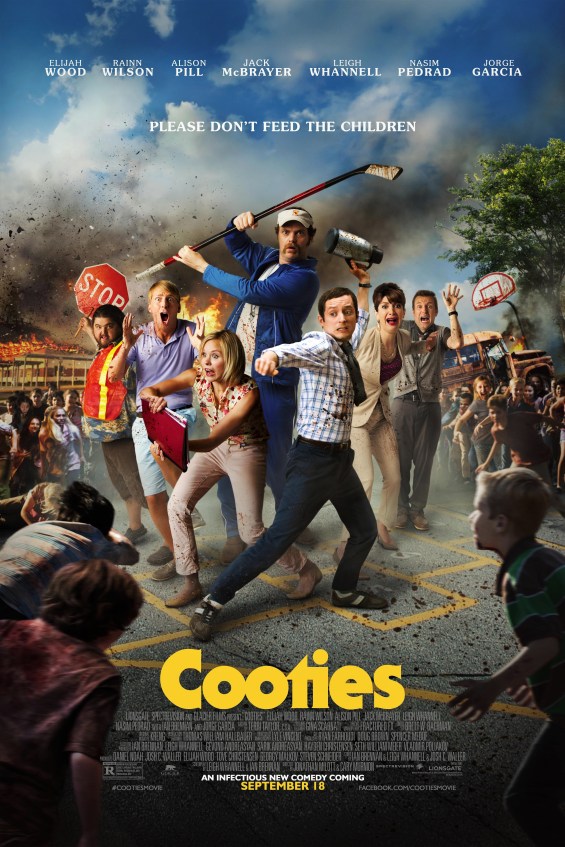
Cooties (2014) – Film Review

“Nap Time, Motherfuckers…” – Wade

For many, children can seem like loud, disease-infested monsters, and it’s not difficult to see why. There’s usually something leaking out their noses, their meals are often encrusted around their mouths, and they care little for social decorum or personal space. As such, it’s not too surprising that a horror-comedy like Cooties would come along in 2014 to take this waggish status to a more terrifying level, altering children into nimble monstrosities hungry for human flesh. Yet, in spite of how much potential a concept like this holds, Cooties ultimately squanders many of its favourable qualities, never fully committing to its absurd premise and the horror/humour it holds.

Plot Summary: When a mysterious virus originating from contaminated chicken nuggets hits an isolated elementary school, transforming the children within into a feral swarm of flesh-eating monsters. A group of misfit teachers are forced to band together as they attempt to flee the bloody, juvenile carnage…

Directed by Jonathan Milott and Cary Murnion (Bushwick, Becky), Cooties undoubtedly harbours a remarkable premise, and the screenplay effectively sets itself up as a hybrid of both comedy and horror in its first act, balancing conversational witticisms and light moments of characterisation, with violent sequences of teachers and parents being torn apart by the infected children. However, the screenplay quickly turns sour once the second act arrives, as a number of plot conveniences/inconsistencies arise to make the perilous situation of the central group of characters survivable. Moreover, as the virus spreads and the teachers become trapped inside the school, the story begins to feel rather generic as the screenplay moves between uninteresting plot points from the chintzy jokes that preceded them.

While the characters featured throughout Cooties aren’t what I’d describe as particularly memorable or unique, they are, at least, well-defined and have their respective witty moments. A fair portion of this character appeal could also be attributed to the cast, however, as Elijah Wood, Alison Pill, Rainn Wilson, Leigh Whannel, Jack McBrayer and Jorge Garcia all deliver excellent performances as self-centred educators who are evidently displeased with how their lives have turned out. For example, Clint (the protagonist), who formerly moved to New York City in an attempt to become a novelist, reluctantly finds himself back in his hometown of Fort Chicken, Illinois, as a substitute teacher. The only positive outcome of his return home is his reconciliation with his childhood crush, Lucy, who now works at the same school. But, any chance of sparking a connection with her is swiftly stomped out by P.E. teacher, Wade, her loathsome boyfriend. Presumably, leaving many audience members grateful they don’t lead a life as a downtrodden, small-town elementary school teacher.

Aside from the truly nauseating opening title sequence at a chicken farm, which is sure to turn many audience members into vegetarians. Thanks in part to its use of vile close-ups, sludgy green colour palette and singular chicken nugget stuffed with an ominous black gloop. The rest of Lyle Vincent’s cinematography is relativity drab, relying on monotonous mid-shots to depict the puerile chaos. Outside of a handful of moments where close-ups are effectively employed to display the fantastic practical effects, that is, including a darkly comedic sequence in which the infected children pull the hapless school principal apart, using his intestines as a skipping rope, soon thereafter.

Cooties‘ original score, composed by Kreng, a.k.a. Pepijn Caudron, is an interesting musical composition, a quirky mix of electronic horror and childlike innocence, much like the film itself. And whilst the score is occasionally too synth-heavy, which can seem a little odd given the film’s lack of 1980s influences. Cooties‘ soundtrack does make space for haunting vocals and violins where it can, blending comforting and madcap cues to create splendid tracks like Opening Titles and Rick’s Tape.

As previously mentioned, Cooties does appear fairly derivative following its first act, relying on no end of familiar tropes for the zombie subgenre. In addition to caving into an array of plot convinces, such as the sex-ed teacher, Doug, possessing a significant amount of knowledge on viruses and the human brain alike, so he can explain to the others that adults cannot be infected. Still, that isn’t where the writing-related issues cease, as towards the end of the third act (spoilers ahead in this section for those who wish to go in blind), the story becomes virtually aimless, providing no resolution as the characters scurry through the barren, nearby town of Danville until the credits roll. Of course, there is always the possibility that this sudden discontinuation was a result of the film’s limited budget, but it’s a less-than-satisfying way of concluding the narrative, nonetheless.

In summary, Cooties‘ screenplay is largely what drags the rest of the project down, appearing almost confined in its storytelling as if the screenwriters couldn’t reach beyond the typical traits of a zombie flick. Once the teachers hunker down inside a classroom, the story grinds to a tedious halt, merely observing the characters as they crawl through air ducts and suit up with school equipment to escape, scenes you’ve seen a thousand times before in other zombie-centric stories. But, what’s most disappointing, is that Cooties wastes such an inspired idea, as teachers surviving against a horde of infected children is an imaginative and amusing concept that could’ve easily made for an enjoyable, low-budget horror-comedy if it was executed skillfully. Rating: 4/10.

cooties-p1005972

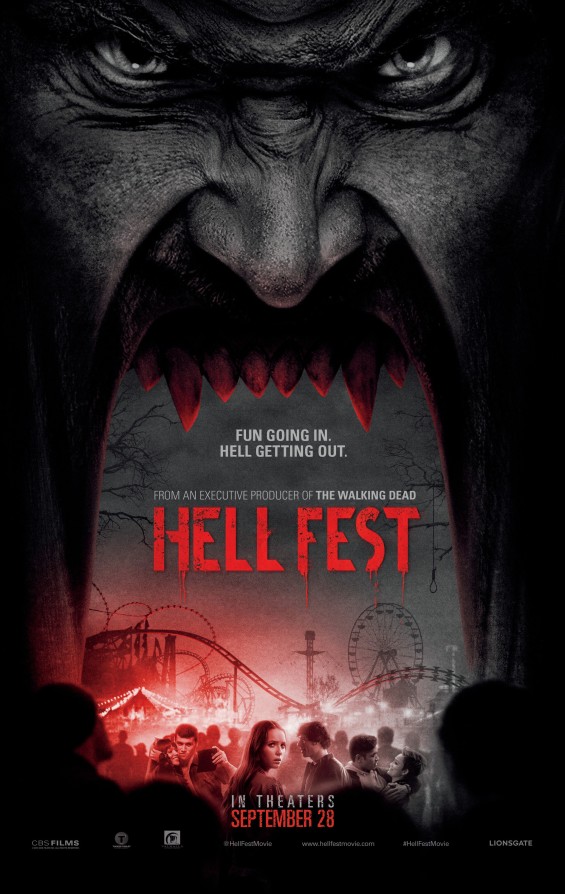
Hell Fest (2018) – Film Review

“That Same Guy Has Been Following Us the Entire Night!” – Natalie

Initially conceived as a yearly horror franchise similar to Saw and Paranormal Activity, with a sequel released each following October. Hell Fest, released in 2018, is a gruesome throwback to 1980s slasher flicks. Equally violent and bombastic, the film includes many amusing moments for lovers of both scare mazes and ’80s horror. As a result of its formulaic and often uninspired screenplay, however, Hell Fest suffers from a number of issues that diminish its quality as a nostalgic slasher, even when taking into account its distinct horror-festival setting.

Plot Summary: On Halloween night, a group of friends make their way to Hell Fest, a ghoulish travelling festival loaded with attractions, games and scare mazes, hoping for an exciting night of thrills and chills. But, as the night continues, the scares soon become all too real as a masked serial killer turns the horror-themed festival into his personal playground…

Before director Gregory Plotkin (Paranormal Activity: The Ghost Dimension, Crimson) was chosen to helm the project, a handful of other filmmakers were considered, including Jennifer Lynch and Neil Marshall. Needless to say, whilst Hell Fest is competently directed, the premise of the film is really where most of its appeal resides, as the idea of a pursuing killer blending in with an enormous crowd dressed as various ghouls, maniacs and monsters is a rather alarming concept, of which the film takes full advantage. For instance, when the group first encounter the killer chasing another girl through a blacklight-lit scare maze, they assume it’s all part of an act, so they merely watch as he butchers her. As opposed to sporting a single mask throughout the runtime, the killer, only referred to as “The Other,” also swaps out his disguise at many points. Distinguishing the character from horror icons like Michael Myers, despite Stephen Conroy’s physical performance appearing reminiscent of Michael’s movements in the original Halloween from 1978.

The rest of the cast, including Amy Forsyth, Reign Edwards, Roby Attal, Bex Taylor-Klaus, Christian James and Matt Mercurio, portray their characters sufficiently. The actual characterisation of the group is where most of the screenplay’s problems lie, as the teens come across as rather cliché archetypes. This issue is only worsened by the screenplay placing more emphasis on the characters’ relationships than their personalities during their first few scenes together, which is also where a large amount of the film’s corniest dialogue can be heard. On a more positive note, Hell Fest is the second horror flick to feature the voice of horror legend; Tony Todd, in a theme park, the first being Final Destination 3 in 2006. Todd later appears in person, too, portraying an enthusiastic stage announcer and providing the murderous proceedings with a brief jolt of energy.

In terms of the visuals, the cinematography by José David Montero is quite visually interesting, making fantastic use of the daunting yet colourfully lit location of Hell Fest, mainly whenever the camerawork employs wide shots to display the true scale of the bustling festival of frights. Moreover, when it comes to the killings, Hell Fest does a fine job of slaughtering the teens in creative ways through an array of superb practical effects. However, many of these kills are unfortunately spoilt by the film’s overreliance on shiny CG blood, which somewhat takes away from the charm of the 1980s-inspired artificial heads and rubber eyeballs.

Similar to the film itself, the original score by Bear McCreary feels contemporary yet simultaneously like a nod to the past, as the score combines two musical styles with synth and orchestral, along with some violin harmonics later in the soundtrack. The signature track of the score; Trophies, effectively serves as the killer’s motif and lurks in the background for most of the runtime (similarly comparable to an abundance of classic slashers). Many of the other tracks, such as Technical Difficulties, Guillotine and Welcome to Hell, do an admirable job of building suspense when required, but aren’t that memorable by themselves.

Of course, the most noteworthy aspect of Hell Fest has to be its exceptional production design, which utilises an eye-catching assortment of scare mazes segments, costumes and props from numerous Halloween events all across the United States. A fair amount of the decorations were borrowed from Six Flags Over Georgia’s annual Fright Fest, while many of the costumes were leased from the Netherworld Haunted House in Georgia, one of the highest-rated scare attractions in the country. Furthermore, many members of Hell Fest‘s production crew had formerly worked as scare maze decorators, designers and staffers, so they were more than familiar with the setup of a scare attraction.

In summary, Hell Fest certainly isn’t anything new. The film isn’t reinventing the slasher subgenre, nor is it trying to. Hell Fest is merely attempting to be an entertaining, modern-day slasher that pays homage to horror classics of the 1980s, and in that sense, I suppose it succeeds. It’s just a shame that Hell Fest doesn’t go further with its violence or horror-festival setting, as the production design is undoubtedly one of the most impressive elements of Hell Fest. And, I’m sure that if any scare maze enthusiasts were to watch this slasher flick, they would be blown away by what the production crew accomplished with the detailed costumes, props and sets on display. Rating: high 5/10.

hell_fest_xxlg

Apollo 18 (2011) – Film Review

“You Knew Something Was Down There… and You Sent Them Anyway.” – John Grey

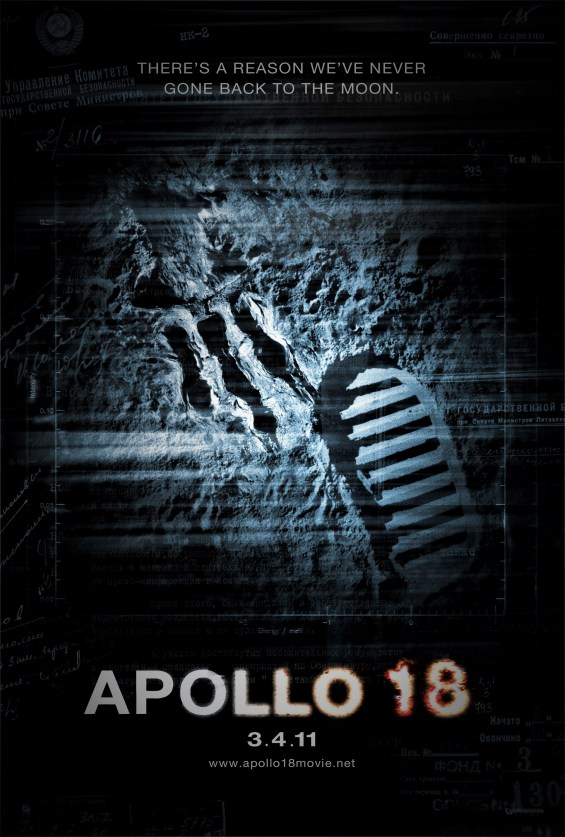
Directed by Gonzalo López-Gallego (King of the Hill, The Open Grave, The Hollow Point), Apollo 18 is an intriguing (if infrequently enthralling) found-footage fusion of period-accurate space-flight procedures, U.S. government conspiracy theories and 1970s creature features. Presenting itself as authentic NASA footage through granular shots from astronauts’ suit cams and Lunar Module cameras alike, Apollo 18 is an interesting filmmaking experiment, to be sure. But, as far as its storytelling is concerned, the film is unlikely to leave an impact on general audiences, though it may appeal to a few sci-fi-horror fanatics.

Plot Summary: When decades-old footage from NASA’s abandoned Apollo 18 mission is uncovered, documenting astronauts, Benjamin Anderson, Nathan Walker and John Grey, as they embark on a classified mission to collect geological samples. The ageing footage reveals a disturbing explanation as to why the U.S. has never attempted another mission to the moon…

A mere six months after the triumph of Apollo 11, NASA renounced its plans for Apollo 20 in January, 1970. Soon after, Apollo 18 and 19 were cancelled in the wake of NASA’s planned budgetary cuts for 1971. By this point, public interest in space exploration had declined since Neil Armstrong and Buzz Aldrin’s trip to the moon, with minimal attention paid to Apollo 12. As a result, many newspaper editorials and public figures began calling for the upcoming missions to be cancelled and for the money to be spent on eliminating poverty across America instead. Consequently, many conspiracy theories regarding why NASA never attempted another trip to the moon arose, which is where the filmmakers found their inspiration for the story. And whilst much of this inspiration is rather apparent, it’s even more apparent that the screenwriters lifted a lot from the original Alien (1979), with a later plot twist feeling as if it was ripped straight from the sci-fi-horror classic. To its credit, though, Apollo 18 has no shortage of technically-accurate dialogue throughout its screenplay.

In regard to the cast, Warren Christie, Lloyd Owen and Ryan Robbins are all understated in their performances. Even when their situation escalates, and it becomes increasingly obvious that there is little chance any of them will make it off the moon, the cast reign in their performances so as to not fall into the trap of screaming and wailing for the entire runtime, a common issue many entries into the found-footage subgenre suffer from. Having said that, Apollo 18 does suffer from another well-known shortcoming of found-footage flicks; one-note characters. As, despite the film only containing three characters (excluding the transmissions), the screenplay never takes the time to develop any of them beyond some brief interviews during the first act, introducing each of the astronauts by name.

In addition to utilising a large amount of NASA stock footage to depict the period-accurate space-flight technology and procedures, Apollo 18 was shot using camera lenses from the ’70s, enhancing the visual authenticity of its grainy aesthetic. Furthermore, through a combination of visual effects and sets, Apollo 18 manages to create a convincing imitation of the moon’s barren surface, harkening back to the hours of mission coverage that kept television spectators entertained during the heyday of the Apollo program. Due to this, José David Montero’s cinematography is able to perfectly capture the essence of the cratered lunar landscape, along with the cramped, claustrophobic interiors of the Apollo Lunar Module, making for an ever-present discomfiting atmosphere.

While the original score by Harry Cohen consists of merely a single sombre track for the end credits, the sound design throughout Apollo 18 is quite effective with the continuous breathing from the astronauts’ helmets, as well as the constant static and technical malfunctions of the cameras sounding eerie yet not absurdly frightening as to take away from the sense of realism and isolation that the visuals induce.

A likely divisive aspect of Apollo 18 will be its preference for showing very little for most of its runtime, with a large majority of the story acting out like any routine NASA mission. When Apollo 18 finally reveals what the malevolent threat lurking on the surface of the moon is, however, the film takes a sharp turn into body horror as its malicious, spider-like creatures infiltrate the lunar module and later the astronauts’ suits. And whilst this approach to the horror elements could have worked should the film have stuck with it, Apollo 18 is more of a slow-paced thriller up to that point. So, these sequences of body horror end up seeming somewhat out of place. Additionally, while this complaint undoubtedly comes down to preference, I feel that the designs of the creatures aren’t all that frightening. So much so, I imagine the only audience members that will be terrified of the extraterrestrial entities will be those with severe arachnophobia or petraphobia, both exceedingly rare phobias.

In summary, Apollo 18 certainly had potential, but as a result of its lack of polish, the film is rarely able to provoke intrigue or an underlining sense of dread to the degree it wants to. Nevertheless, Apollo 18 is a unique film, a largely entertaining found-footage sci-fi-horror with an unnerving atmosphere, capitalising on the claustrophobia of 1970s space travel. And while the film isn’t for everyone, I enjoyed Apollo 18 on account of its period-accurate visuals and surprisingly true-to-life sets and technical details. Rating: 6/10.

apollo_18-p480664

The Forest (2016) – Film Review

“Do Not Stay After Dark.” – Michi

The Aokigahara forest, more commonly known as the “Suicide Forest” or the “Sea of Trees,” is a thirty-five-square-kilometre grove lying at the northwest base of Mount Fuji in Japan. The forest is often cited as the most widespread site for suicide in the country, given that in 2003, over a hundred bodies were discovered in the forest, exceeding the previous record of seventy-eight in 2002. The site became so heavily associated with suicide that a sign at the start of the main trail was later installed to urge suicidal visitors to contact a suicide prevention helpline. So, with all of this notoriety, it was merely a matter of time until a film would utilise the infamous location. Enter, 2016’s The Forest, a supernatural horror flick that sacrifices all of its compelling ideas and despairing real-world setting for cheap, predictable scares and an immensely uninteresting story.

Plot Summary: When orphan, Sara Price, receives a phone call from the Japanese authorities informing her that her twin sister, Jess Price, has disappeared and was last seen heading into the Aokigahara forest, Sara decides to travel to Japan to investigate her sister’s disappearance. But, after entering the notorious forest, accompanied by her Japanese guide, Michi, and American reporter, Aiden, Sara’s investigation begins to send her down a dark path of tormented souls and supernatural occurrences…

Whilst two other films were released before The Forest inspired by Aokigahara, those being; Shawn4Ever in 2012 and The Sea of Trees in 2015, neither film could be considered a horror. And this is what ultimately attracted director Jason Zada (Project Dead Zone) to the project, as Zada was surprised to learn that there had never been a horror film based on the ill-famed site. After discovering that the Aokigahara forest also has a strong association with demons in Japanese mythology, Zada’s interest in the project grew as this information opened the door for a more supernatural narrative. However, the story eventually selected for The Forest is hardly what I’d call engrossing, as while the first act sufficiently sets the story in motion, the narrative quickly devolves into Sara simply meandering through the forest getting sporadically interrupted by blaring jump-scares, many of which are easily foreseen.

Portraying twin sisters; Sara and Jess Price, Natalie Dormer delivers a compelling performance throughout The Forest by lending her acting talents to dual characters. Yet, she is frequently burdened by the screenplay’s lack of characterisation and stale dialogue, which is often as wooden as the trees in the forest. Moreover, the supporting cast of Taylor Kinney, Yukiyoshi Ozawa and Eoin Macken give understandably bland performances as their characters are given next-to-no development and little urgency when it comes to their decisions within the plot.

Since the Japanese government would not allow the filmmakers access to the Aokigahara forest for filming, the Tara National Forest in Serbia served as a suitable stand-in for the location. Aside from the forest itself, however, all of the scenes in Japan were shot on location, and this authenticity does come across on camera. Speaking of the camerawork, the cinematography by Mattias Troelstrup is serviceable, for the most part, as the film makes adequate use of the eerie forest backdrop by implementing a large number of environmental shots, lingering on the calming beauty of the forest in contrast to the tragedies that repeatedly occur within it.

Ominous yet forgettable, the original score by Bear McCreary fits the dreary tone of The Forest appropriately yet lacks anything to make itself distinguishable from other horror scores. Furthermore, whilst there are multiple fast-paced tracks, there is a surprising shortage of slow and moody pieces for a film set in a location like the Aokigahara forest. Nevertheless, I will give McCreary credit for integrating a children’s choir into the score, effectively blending the ghostly juvenile vocals with the rest of the instruments (most notably in the track; Into the Forest), almost as if the choir represents the siren call of the forest.

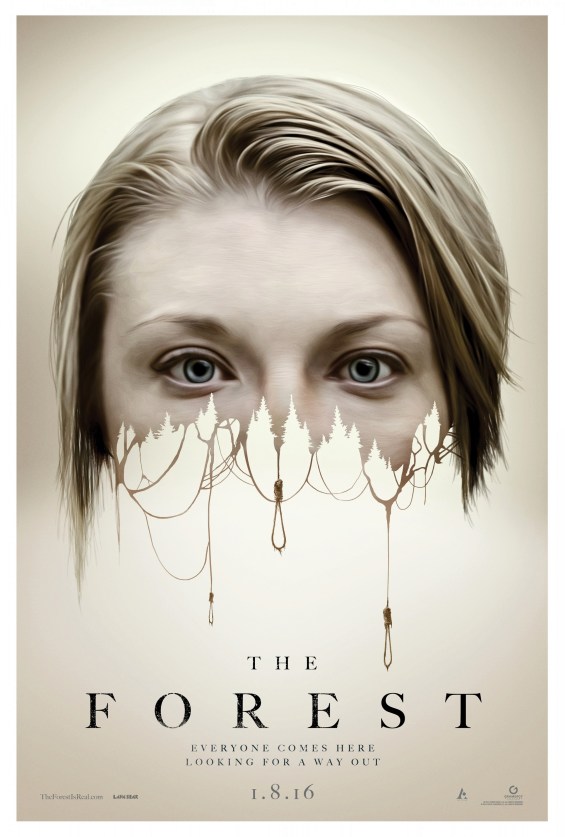
Interestingly, one of the promotional posters for The Forest features the top half of Natalie Dormer’s face with the bottom half removed, the dividing line between them forming a silhouette of treetops and dangling nooses. This imagery carries a clear resemblance to a photograph of an actual suicide victim once found within the Aokigahara forest; a bald man in such a decomposed state that his jaw had fallen off and strips of flesh were hanging from where it had once been. This photograph is also recreated in the film, albeit in a less grotesque form. Fortunately, outside of this scene, The Forest doesn’t contain much blood/gore, which I’d argue was a good decision on behalf of the filmmakers to remain respectful of the families who have lost loved ones to Aokigahara.

In summary, while The Forest offers Natalie Dormer a few chances to showcase her range through a dual role, it isn’t enough to offset the fact that The Forest is just not all that startling or interesting. Of course, these shortcomings could be attributed to Jason Zada being a music video director by trade, harbouring only one other horror flick in his filmography. But, regardless of the cause, it’s unfortunate, as I feel that given the right attention, the Aokigahara forest could make for a phenomenal setting for a minimalist horror, especially if it’s combined with a tasteful narrative that plays upon the site’s infamy. Rating: low 4/10.

forest_xxlg

The Pyramid (2014) – Film Review

“This Pyramid, Unlike Any Structure Other I’ve Ever Encountered, Seems to Have Been Built With the Express Purpose of Keeping Whatever Is Inside From Escaping…” – Holden

Poorly lit, inconsistently shot and lazily written, The Pyramid, released in 2014, is a horror flick that perfectly demonstrates the notion that giving a large budget to a project doesn’t necessarily make it a success. In the case of The Pyramid, this claustrophobic (predominantly) found-footage horror was given a budget of almost £6 million, a rather substantial amount of funding for a modern horror. Yet, even with a budget of this size, the film squanders almost every penny as its potentially captivating delve into Egyptian history/mythology is tainted by repeatedly clunky dialogue and countless lacklustre jump-scares.

Plot Summary: When a team of U.S. archaeologists unearth an ancient pyramid buried beneath the desert just outside Cario, they yearn to explore the interior of the structure despite extensive pushback from locals. Ignoring the residents’ objections, the group decide to head into the depths of the pyramid, soon becoming hopelessly lost in its endless passageways, eventually coming to realise that they aren’t just trapped, they are being hunted…

Directed by Grégory Levasseur, a frequent collaborator of producer Alexandre Aja. The Pyramid was Levasseur’s first and only directorial credit to date, and upon a first watch, it quickly becomes apparent as to why that is as The Pyramid is a horror ripe with imperfections that nearly any critic or casual audience member could spot. However, many of these issues are a result of Levasseur continuously brawling with the constraints of the found-footage subgenre, which might explain why the film makes so many baffling choices when it comes to its cinematography. Moreover, many of the scares throughout are telegraphed well in advance, so if you watch plenty of horror flicks, you’ve likely already seen everything the film has to offer.

When it comes to the story, the first act rushes through a string of contrivances, such as threats of air poisoning following the opening of the pyramid’s entrance, a military-ordered evacuation, and a NASA rover being mysteriously destroyed inside the pyramid, all of which were plainly written into the screenplay in order to get the central group of characters into the foreboding burial site as swiftly as possible. Yet, through this entire act, the screenplay rarely tries to develop any of the characters beyond a few traits, whether that be Dr. Nora Holden; a prodigious prehistorian and graduate of the Christmas Jones Academy of Scientist Couture, portrayed by Ashley Hinshaw, or the dim-witted British cameraman, Fitzie, portrayed by James Buckley. Every one of the characters are remarkably unoriginal and uninteresting. And even though certain supporting cast members, such as Denis O’Hare and Christa Nicola, deliver respectable performances, they ultimately add up to very little as most of the dialogue consists of excessive exposition or generic lines like “This Is the Find of a Century.”

As mentioned previously, The Pyramid bizarrely utilises both a first-person and a third-person perspective. So, despite many of the characters wearing or carrying cameras to present the film as recovered footage, the cinematography by Laurent Tangy frequently reverts to well-presented shots that none of the characters could have realistically obtained. This illogical decision pretty much ensures that the audience will be taken out of the spine-chilling, claustrophobic scenarios the screenplay is trying to craft, in addition to breaking the illusion that what the audience is watching is recovered footage. That being said, The Pyramid does harbour some impressive set design, as from the moment the group enter the pyramid, they are ensnared in narrow chambers and passageways, each retaining sand-littered bases and detailed Egyptian wall hieroglyphics.

Similar to the cinematography, the original score by Nima Fakhrara is rather inconsistent. Although the score clearly takes admirable influences from Egyptian culture and includes a commendable array of effective tracks. In actuality, The Pyramid shouldn’t have an original score, given the film is supposedly a found-footage flick. The end credits sequence is also accompanied by the rock song; 5173 by Kevin Hastings, which only adds to the utter strangeness of the soundtrack.

Perhaps The Pyramid‘s greatest flaw, however, is that even those with a strong interest in Egyptian history/mythology are unlikely to enjoy the story, as many of its ideas are barely explored and there are numerous instances where the Egyptian mythology that the story does integrate is incorrect. For example, near the end of the runtime (spoilers ahead in this section for those who wish to go in blind), the evil entity behind the pyramid’s existence is revealed to be Anubis, an ancient Egyptian deity. In the film, Anubis is composed of terrible CGI and presented as a ferocious beast. Yet, in Egyptian mythology, Anubis was quite benevolent towards humans, treating them with respect as they embarked on their voyage into the afterlife. Hence, his characterisation in The Pyramid is a far cry from how Ancient Egyptians actually viewed him.

In summary, very little of The Pyramid is especially engaging or particularly frightening as many of the characters are portrayed as cardboard cutouts, simply meandering their way through an exceedingly tiresome plot. So, aside from some convincing set design and supporting performances, I feel The Pyramid is undoubtedly a horror worth skipping. Considering that the production company behind the project, 20th Century Fox, decided not to release The Pyramid on physical formats in many territories due to its dismal box office performance, it seems that most have already forgotten this found-footage catastrophe. Rating: low 3/10.

the_pyramid-p905947 (1)

Red Riding Hood (2011) – Film Review

“Full Moon. Lock up Tonight. Better the Wolf Takes the Pig Than You…” – The Reeve

A reinterpretation/modernisation of the centuries-old fairy tale; Little Red Riding Hood; a children’s story centering on a young girl as she encounters the Big Bad Wolf on a journey to visit her grandma. Red Riding Hood, released in 2011, retains the framework of the original story, but not much else, as this reinterpretation aims to be a dark fantasy with elements of romance and gothic horror thrown in. Yet, in almost all of these genres, the film falls flat as a result of its subpar screenplay and direction. That’s not to say that Red Riding Hood doesn’t have any positives, however, as this fantasy flick undoubtedly deserves praise for its outstanding production design and dreary fantasy aesthetic.

Plot Summary: For years, the residents of a remote mountain village have maintained an uneasy truce with a fearsome werewolf by offering the bloodthirsty beast a monthly animal sacrifice. But, when the wolf violates their trust by taking a human life, the village falls into hysteria, prompting the arrival of the famed werewolf hunter, Father Solomon, to assist in their hunt. Meanwhile, Valerie, a beautiful young woman torn between two viable fiancés, begins to suspect that the beast may be someone she knows…

Similar to most European fairy tales, the origins of Little Red Riding Hood lie within the folk tradition of oral storytelling. So, no singular author can be credited for the story’s creation. However, the two most prominent renditions of the fairy tale are proclaimed to have been written by Charles Perrault and the Brothers Grimm in the 17th century. Despite this history, Red Riding Hood seems to largely disregard the various iterations of the fairy tale, to instead take influence from the first instalment of the infamous Twilight series, as the two films share a number of similarities. For example, the opening title sequence where the camera majestically glides over vast snowy landscapes closely resembles the opening title sequence of Twilight. Furthermore, Taylor Lautner, who previously appeared in Twilight, was considered for the role of Peter early in pre-production. Still, these similarities shouldn’t be that surprising, considering that director Catherine Hardwicke (Thirteen, Lords of Dogtown, Miss You Already) helmed the first entry in the series in 2008.

In regard to the cast, Amanda Seyfried portrays the titular character of Valerie/Red Riding Hood sufficiently, but her performance is somewhat hindered on account of her placement between Shiloh Fernandez and Max Irons as her love interests, Peter and Henry, whose performances leave a lot to be desired coming across as drab and rather wooden for the majority of their screen-time. As per usual, the highlight of the cast is undoubtedly Gary Oldman as the morally-grey werewolf hunter, Father Solomon. Though Oldman doesn’t get to exhibit immense amounts of emotion (despite his character having a tragic backstory), the veteran actor does stay committed to his detestable character.

Aside from some outlandish CGI and a handful of moments where cast members/props that should seemingly be in focus are not, the cinematography by Mandy Walker is one of the finest components of Red Riding Hood. From the glowing red of Valerie’s hood contrasting against the white snow to the blood-red moon gradually emerging over the village rooftops, Red Riding Hood is a visually stunning fantasy at points. What’s more is that the set, costume and prop design are all exceptional, as every location feels rustic yet fantastical, whilst every costume/prop appears worn and functional. From a design standpoint, even the trees that appear throughout the runtime are visually unique as they harbour cadaverous spikey branches, giving the impression that merely wandering through any of the dense forests surrounding the village could result in a wound and subsequently a trail of blood.

Unsuitable yet well-crafted, the original score by Alex Heffes and Brian Reitzell begins rather promisingly with the track; Towers of the Void, which Reitzell co-wrote with musician, Anthony Gonzalez, of the electronic band; M83. As such, the ominous track contains waves of strings and industrial-sounding electronics, these instruments then persist onto the second track; Kids, where they are accompanied by ghostly vocals and moody synth. Essentially, while not a bad soundtrack, by any means, the score for Red Riding Hood is simply so unfit for a story set in this time period and genre, that it’s difficult to overlook when reviewing the score.

For a significant portion of the runtime, the story of Red Riding Hood unfolds like a mystery, with the human identity of the werewolf being kept a secret to keep the audience guessing. And whilst many suspects are immediately dismissed, the screenplay does a serviceable job of introducing red herrings without seeming overly conspicuous. When the truth is finally revealed, however, the answer as to who is behind the beastly slayings is rather disappointing, especially since the reveal is quickly followed up by an equally disappointing climax and epilogue.

In summary, as far as gloomy retellings of classic fairy tales go, Red Riding Hood is certainly one of them. While Amanda Seyfried and Gary Oldman are magnetic in their respective roles, the unremarkable leading men along with the painfully formulaic screenplay, continuously devalue the beautiful production design and often spectacular visuals. So, whilst it’s possible that the Twilight crowd will find a specific appeal in Red Riding Hood, outside of that devoted fanbase, I doubt many others will. Rating: low 5/10.

red_riding_hood-p509441