Silent Night (2012) – Film Review

“I’m on His Tail Now. There’s Nowhere Safe…” – Sheriff Cooper

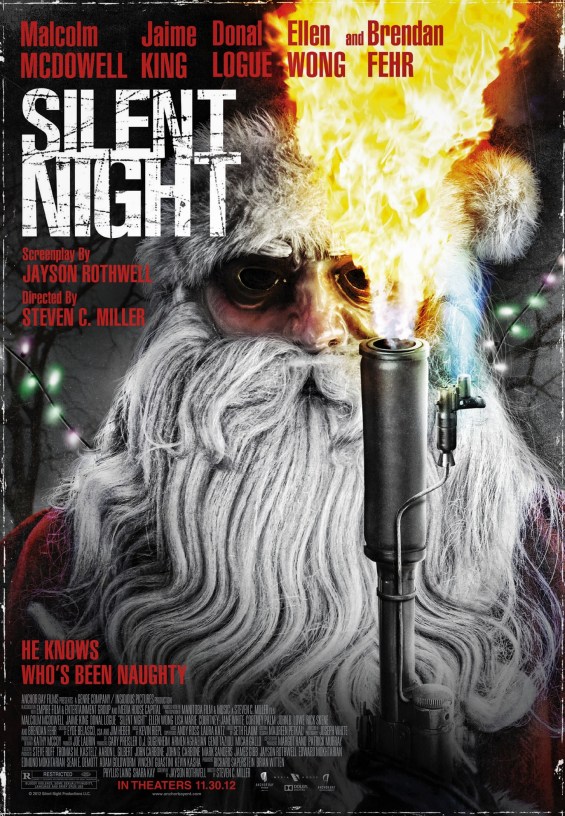
One of the most controversial films of the 1980s, primarily due to its promotional material, which featured a killer Santa Claus brandishing an axe as he emerged from a chimney. Silent Night, Deadly Night, released in 1984, is well-known amongst horror fans for its bizarre legacy, spawning a franchise consisting of four extremely low-budget sequels that had barely any relation to each other, yet still gained a cult following, thanks to their bewildering stories and unintentionally hilarious moments. Years later, in 2012, we received Silent Night, a remake of the original film that reimagines the concept of a murderous Father Christmas for modern audiences, utilising its attractive visuals and creative kills to provide slasher fanatics with their fill of ho-ho-horror, even if Silent Night is filled with many of its own unique issues.

Plot Summary: When a sadistic serial killer dressed as Santa Claus embarks on a Christmas Eve rampage through a remote Midwestern town, the local police force must follow the killer’s trail of victims in the hope of uncovering his identity and averting the rest of his festive bloodbath…

Partially inspired by the 2008 Covina Holiday Massacre, during which forty-five-year-old, Bruce Jeffrey Pardo, killed nine people at a Christmas party whilst wearing a Santa Claus suit. Silent Night isn’t the first voyage director Steven C. Miller (The Aggression ScaleMaraudersThe Line of Duty) has taken into the horror genre, though, it may be his goriest as Miller, along with screenwriter Jayson Rothwell, up the ante from the original film by jumping straight into the violence, having the kills drive the story forward as they occur one after another. However, the screenplay certainly falls short when it comes to some other aspects, like developing the characters or building intrigue regarding the true identity of the masked killer, as the characters are insipid and the mystery uninteresting, making the film’s climactic plot twist feel less than galvanising, which is only made worse by the overcompensating dialogue.

The central cast of Jaime King, Malcolm McDowell, Donal Logue and Ellen Wong all try their hardest at providing their fairly lifeless characters with a personality and a reason for the audience to empathise with them, but it’s a largely wasted effort as King and Logue merely go through the motions as small-town police officers with a few glimmers of characterisation. While McDowell truly steals the spotlight as a dimwitted and pompous sheriff, frequently coming across as if his performance was taken from another film entirely. Then there is veteran stuntman, Rick Skene, who fulfils the demanding physical requirements of the killer Santa without saying a word, using his immense stature and threatening demeanour to great effect.

Contrasting the horrific bloodshed of the story with a candy-coated aesthetic of stereotypical Christmas traditions, the cinematography by Joseph White allows for a number of visually interesting shots throughout the runtime, nearly all of which are enhanced by the festive colour palette, which employs an abundance of bright red, green and blue lights to make potentially bland locations, such as the police station or a motel, more visually appealing. And despite the moments of barbaric murder frequently falling back on hand-held shakiness in a feeble attempt to increase the brutality of said murders, Silent Night does redeem itself during its flashback sequences as these scenes are entirely coated in black and white, aside from the killer Santa’s suit, which remains a glowing red.

Contrarily, the original score by Kevin Riepl is a blaring and often tedious horror soundtrack, as outside of the track; Sheriff Cooper, which strangely contains a guitar riff that sounds as if it’s been taken from a ’70s crime-thriller. The majority of the score, including the tracks; The Chipper and Rack Mounted, are simply loud and unexceptional. Of course, being a film set at Christmas, the film also features a handful of renowned Christmas songs, such as Up on the Housetop and Deck the Halls, which thankfully aren’t overused.

Although Silent Night, Deadly Night had its fair share of gore, Silent Night takes its gruesome violence to another level, as the bloodthirsty Santa make use of a range of tools, including an axe, a cattle prod, a scythe and even a flamethrower, in addition to constantly exploiting the environment around him, such as a scene where he impales a teenager onto a mounted set of deer antlers in a clear reference to the original film. What’s more, all of the practical effects used throughout these moments are magnificent, rarely relying on CG enhancements for further shock factor.

In summary, Silent Night is a modern slasher with its heart firmly in the ’80s, and I say that as a positive thing, as rather than being dull and quickly forgettable, it maintains the same level of cheese, dark humour and seduction as Silent Night, Deadly Night, but as a result of its modern techniques, looks far better than most horror remakes/reimaginings. So, it’s truly a shame that the screenplay and original score continuously let the film down, as with a few improvements, Silent Night could’ve gone down as a certified Christmas horror classic. But, as it stands, while the film is far from a masterpiece, Silent Night will please fans of the series as well as those seeking a festive slasher. Rating: high 5/10.
silent_night_xxlg

Beneath (2013) – Film Review

 “There’s Something Out There!” – Deb

Directed by Larry Fessenden (HabitWendigoDepraved) and distributed by the horror-centric production company, Chiller Films, a now-defunct television network responsible for many low-budget supernatural horrors, including Siren (2016), Animal (2014) and Dead Souls (2012). Beneath, released in 2013, may have sounded like an estimable idea during its conception, being pitched as a minimalist creature feature that explores the direful outcomes of human behaviour under the influence of extreme isolation and fear. As a result of its overemphatic performances, mindless screenplay and frequently mishandled visuals, however, whatever little tension and intrigue Beneath manages to build up is completely capsized by the time the end credits roll.

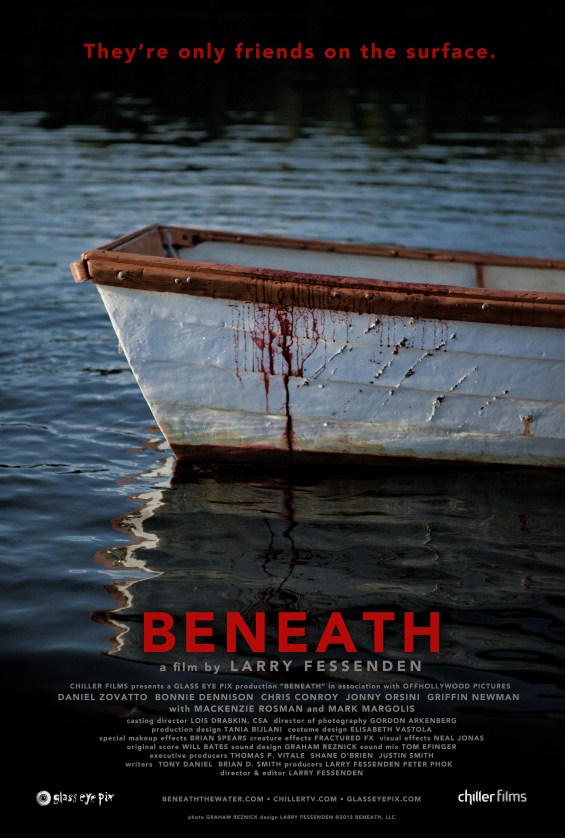
Plot Summary: Following their high school graduation, a group of friends decide to spend one last summer outing together at Black Lake before going their separate ways. But, when their rowboat is struck by an amphibious creature, subsequently killing a member of the group and destroying their oars, the five remaining friends find themselves trapped in the middle of the reservoir, contemplating whether one of them should be thrown overboard as a distraction…

While the original screenplay for the film had flashbacks that further developed the characters and explored their individual journeys throughout high school, Fessenden ultimately decided to remove them. This allowed the entire project to be shot in a mere eighteen days, which certainly shows, as Beneath is a largely dull affair, following the usual formula for a creature feature outside of one or two subversive moments. Given Fessenden’s past work, it would also make sense that the film could go so far as to suggest that the creature in the lake doesn’t actually exist and is, in reality, just a physical manifestation of the characters’ ulterior motives. Yet, regrettably, this is not the case, and Beneath opts to play things relatively straight, with the characters being devoured one by one in equally idiotic ways.

On a similar note, the title of the film doesn’t just refer to what lurks in the tranquil water, but is also a guide to where Beneath‘s substance lies with the film’s unbearable roster of characters, compromising of Johnny, a brooding, long-haired loner, Kitty, the rotating object of desire for practically every male character in the film, Matt, the golden-boy jock whose prospects seem to be going downhill since graduating, his younger, less athletic but more intelligent brother, Simon, along with Kitty’s best friend, Deb, and the hyperactive filmmaker, Zeke, each having a respective outburst as simmering high school grudges, rivalries and romantic betrayals factor into the survival stakes. But, on account of the exceptionally awful dialogue, the prospect of any tension within the story soon becomes virtually non-existent, even with the cast of Daniel Zovatto, Bonnie Dennison, Chris Conroy, Jon Orsini, Mackenzie Rosman and Griffin Newman sharing their fleeting moments of promise in a film brimming with atrocious performances. Moreover, the friendship between the characters feels so unnatural from the outset, considering their vastly different backgrounds and personalities.

Cinematographer Gordon Arkenberg tries his best at keeping the solitary setting of a stranded rowboat visually interesting, which beyond some oddly framed shots and sequences that can only be described as ‘visual disarray,’ is a goal he somewhat succeeds in, particularly whenever the camera is pointed towards the beautiful scenery, where the stillness of the lake accentuates the ominous threat of the creature prowling just beneath its surface. Nevertheless, these shots are soon defaced by harsh shadows and a bleached colour palette due to the whole film being shot with natural light. Judging by the editing, you would also be forgiven for thinking that Black Lake is the largest lake in America as the characters spend hours upon hours rowing with their broken oars (and eventually hands) only to make zero progress in a poor attempt of elongating the runtime.

Even though there is next to no emphasis placed on the original score by Will Bates, the score for Beneath is competent, if very forgettable, making a fair effort to enhance the supposed tension on-screen. Except for the semi-final track; Last Stand, that is, which sounds as if it’s from another soundtrack entirely, mimicking the score from a light-hearted romantic-comedy more than any horror flick.

As for the film’s main feature, the creature itself closely resembles the appearance of a giant anglerfish. And whilst I can respect this decision given the anglerfish is one of the most naturally frighting animals on the planet, this choice also displays a great deal of laziness on behalf of the filmmakers as taking what is already an intimidating-looking animal and simply enlarging it is a rather indolent approach to designing your marketable monstrosity. Having said that, the combination of animatronics and puppetry that brings the creature to life is impressive, despite its limited range of movements.

In summary, while some may get an ironic laugh out of this ninety-minute trainwreck, I feel most will agree that Beneath is above all else just a frustrating experience, with one of the film’s only positives being its commendable reliance on practical effects over CGI. But, truthfully, the effects alone don’t even come close to rectifying what are the film’s many, many other shortcomings, distinguishing Beneath from other films within the genre solely on how moronic and tiresome of a horror/thriller it is, paling in comparison to Fessenden’s other low-budget efforts. Rating: low 2/10.

beneath-p823208

Cargo (2017) – Film Review

“You Can’t Lose Hope.” – Etta

Based on the short film of the same name, which went on to be an online sensation following its release in 2013, garnering over thirteen million views on YouTube alone. Cargo takes a refreshingly character-driven approach to the post-apocalyptic genre differentiating itself from other films featuring flesh-devouring monstrosities through its secluded setting and Martin Freeman’s terrific lead performance. A combination that will surely satisfy most zombie fanatics, even if the genre’s more mainstream crowd could potentially be disappointed at the exclusion of decaying hordes of the undead, a true sense of dread and a lack of extravagant gore.

Plot Summary: After an epidemic spreads across Australia morphing humanity into flesh-eating monsters, Andy, along with his wife, Kay, and their infant daughter, Rosie, attempt to escape the Outback via the river, making their way to a presumably secure military base. But, when the trio stumble upon an abandoned yacht, Kay is bitten while searching the vessel for supplies, soon passing the virus onto her husband. Now, with his time running short, Andy has one mission; find a new home for his daughter…

Directed by Ben Howling and Yolanda Ramke, Cargo is not only Howling and Ramke’s first feature-length film, but is also Australia’s first-ever production spotlighted as a Netflix Original, released globally on the streaming service in 2017. And although Netflix has ventured into the post-apocalyptic genre before, with films like Ravenous (2017) and the television series; Z Nation, both Howling and Ramke wanted Cargo to be more than just a straightforward story of survival. Subsequently, this led the pair to intertwine an abundance of social commentary into their zombie-centric story, covering a range of topics from environmental fracking to the exploitation of Australia’s aboriginal peoples. However, in my opinion, the best element of Cargo is its central concept, as the idea of a father having only forty-eight hours to find a new life for his child is a plot enriched with dramatic potential. Moreover, the nocuous outbreak Andy finds himself within serves as the perfect backdrop to juxtapose the qualities one would look for in a capable (and devoted) guardian.

Speaking of the protagonist, Martin Freeman leads the cast brilliantly as Andy, portraying an affectionate father and husband who is determined to protect his family at all costs, an intention which, whilst honourable, often lands him and his loved ones in an even more treacherous spot as Andy refuses to accept when he is out of time. Freeman’s youthful co-star, Simone Landers, unfortunately, doesn’t fare quite as well, as her frail performance frequently results in poignant scenes feeling less sincere. Nevertheless, Thoomi is still an intriguing character, with her subplot concentrating on the demise of her father and the survival of a nearby native tribe, providing a vastly different perspective on the epidemic compared to Andy’s point of view.

Utilising the vegetation-splotched, sun-parched rural land of the Australian Outback flawlessly, the cinematography by Geoffrey Simpson is both varied and visually interesting, even if, in reality, the Australian wilderness where Cargo was shot threw everything it had at the production crew, with South Australia experiencing what was supposedly its worst weather in a century, with floods, power blackouts, torrential downpours and even a miniature cyclone all occurring during the five weeks of production. Yet, miraculously, the crew didn’t lose even a single day of filming, which was extremely fortunate for the filmmakers, given how the remote setting of the narrative is a crucial player in the film’s identity, its harsh and unforgiving nature hurling countless obstacles at our characters whilst, at the same time, offering them the means to survive.

Managed by four distinct composers, including Michael Hohnen, Daniel Rankine, Geoffrey Gurrumul Yunupingu and Johnathon Mangarri Yunupingu, the original score for Cargo substantially strengthens each scene’s emotional significance, almost as if the score is applying a proverbial highlighter to certain moments with sombre, tenuous tracks, such as The Grave and Goodbye, flourishingly pulling at the audience’s heartstrings more times than one.

Taking an alternate route to avoid comparisons to zombie designs of the 1960s and 1970s, most notably in classic horror flicks like Rabid (1977) and Night of the Living Dead (1968). Cargo strays away from many of the usual clichés associated with the undead, centring its zombie design around an orange pus-like substance that oozes from the infected’s facial orifices rather than the bleeding open wounds the living dead are commonly known for. This distinction is further emphasised through what we see of their behaviour, as the infected are presented as mindless animals more than they are man-eating monsters, requiring dark and damp areas to incubate during the daytime before feasting on whatever wildlife they can find once night falls. Quickly reminding the audience that what they are witnessing is a viral infection, hence why the infected are nicknamed; “Virals.”

In summary, even if Cargo‘s story could have been executed better with a motley of improvements, I feel Cargo is still a creditable entry into the realm of post-apocalyptic storytelling. Standing as a zombie flick with soul and pathos, which, in turn, makes the living dead formidable once again, not because of jump-scares or excessive bloodshed, but because of the film’s biggest drawcard; its sheer humanity. Recounting a story that largely revolves around the notion of human determination, witnessing just how far an individual will go to protect another in the bleakest of circumstances. Rating: 7/10.

cargo-poster-1

Hush (2016) – Film Review

“I Can Come in Any Time I Want, and I Can Get You Anytime I Want. But, I’m Not Going To. Not Until It’s Time.” – The Masked Man

Exceptionally gripping in the face of its simplicity, Hush, released in 2016, navigates the bloody waters of the home invasion subgenre to tremendous results. With only five characters and a single location to speak of, the performances and sound design of Hush are both key components in the film’s goal of establishing a disquieting tone, captivating its audience while simultaneously making them dread that the story they are witnessing on-screen could realistically transpire in the most peaceful of surroundings. Certifying Hush as a concise and well-executed horror/thriller, despite the film’s continuous cat-and-mouse pursuits growing a little tiresome by the third act.

Plot Summary: When Maddie, a deaf and mute author, moves to a secluded woodland house in the hope of living a peaceful, solitary life as she writes her second novel, she soon finds her isolated home the target of a deranged, masked killer…

Co-written, directed and edited by Mike Flanagan, this talented director has been the face of modern horror for many years, crafting chilling and original genre pieces, such as Oculus (2013), Before I Wake (2016) and the horror/drama mini-series; The Haunting of Hill House in 2018, in addition to adapting much of Stephen King’s iconic catalogue of horror literature, with 2017’s Gerald’s Game and 2019’s Doctor SleepHush, however, was one of the director’s earlier projects, with Flanagan conceiving the storyline whilst on a dinner date with his co-writer/leading actress Kate Siegel in 2014, not long before the pair married in 2016. To get a better understanding of the film, Siegel and Flanagan even role-played each scene in their house before writing them into the screenplay, enabling them to envision how the characters would react in the face of danger, a method that I feel ultimately paid off.

Although the lead role of Hush seems tailor-made for a hearing-impaired actress, Kate Siegel portrays Maddie divinely as a quick-witted heroine who keeps the audience on her side at all times. Continuously thinking on her feet, overcoming some of the obstacles associated with her disability, and using her hearing impairment to her advantage whenever possible, it’s easy to root for Maddie to triumph over her assailant. John Gallagher Jr. is also stellar as the mysteriously motivated antagonist, a character only ever referred to as the “Masked Man,” who, throughout the runtime, enjoys playing mind games with his victims, receiving some kind of fetishistic pleasure from toying with those he’s about to slaughter. In many ways, the Masked Man shares similarities to the horror icon, Michael Myers, with his motivation for killing never being stated and his costume consisting primarily of an unadorned white mask, which only adds to the character’s intrigue.

Whilst a substantial portion of the cinematography by James Kniest is hand-held, removing the possibility of Hush standing as one of Mike Flanagan’s most visually impressive films. The fluidity of Hush‘s camerawork does allow the audience to follow Maddie as she wanders through her contemporary home, the camera tracking her every movement as she enters and exits various rooms on impulse. However, a major shortcoming of the film’s visuals is certainly it’s lighting, as due to all of the narrative taking place at night, it makes sense that Hush would be quite gloomy lighting-wise. Yet, most shots are seemingly over-lit, considering the characters are supposed to be in a dense woodland area in the dead of night.

At times peaceful, at times aggressive, the original score for Hush, composed by The Newton Brothers, greatly enhances the story at many points as tracks, like MaddieIntruderAgainst the Glass and Crossbow, are all incredibly atmospheric. And, even if the score lacks a predominant track that could be regarded as the film’s theme in years to come, Hush‘s soundtrack still more than serves its purpose, especially when taking into account the film’s reliance on sound as opposed to a non-diegetic score.

Since the protagonist of Hush is both deaf and mute, the film contains less than fifteen minutes of dialogue. Therefore, with a runtime of around eighty-two minutes, Hush harbours more than seventy minutes of screen-time without a single word spoken. This setup provides Mike Flanagan with a perfect opportunity to play with sound in creative ways, removing the audio entirely (except for an ultrasound machine) in some scenes to put the audience into Maddie’s position and deliver a sudden jolt when appropriate, thus, avoiding the common horror cliché of having nonsensical, ear-piercing jump-scares for no apparent reason. Through the sound design, we also learn more regarding Maddie’s character, as she hears the echoing voice of her deceased mother whispering to her. Her voice usually aids Maddie in conjuring up endings for her novels, but, in this case, her mother’s ghostly voice lays out her options on how to approach her current, precarious situation.

In summary, Hush is a sharp, violent and finely-tuned horror/thriller that goes down familiar paths yet with flair and skill, never reinventing the wheel, but proving that the genres it’s drawing from still have firm legs. From the Masked Man toying with Maddie, as he steals her phone and sends pictures to her laptop to Maddie rapidly locking all of her windows and doors before the killer can enter, Hush is undoubtedly a compelling story with an excess of suspenseful moments, its superb sound design only adding to its appeal as the film regularly comes close to being a sensory-deprivation experience. Rating: 7/10.

hush_xxlg

Terrifier (2016) – Film Review

“What? Did You Think He Was Gonna Hack Me up Into Little Pieces or Something?” – Dawn

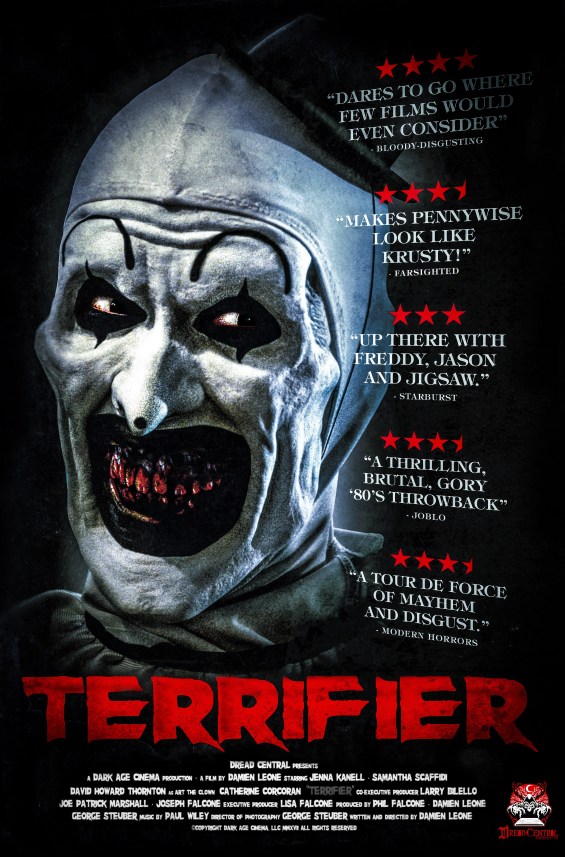
Grisly, taut and seasonally atmospheric, Terrifier, released in 2016, aims to pay homage to the inexpensive slasher flicks of the 1980s, relishing in the same simplistic approach and over-the-top gore that classic horrors like Friday the 13th and Blood Harvest specialised in. And while the film does admittedly fall prey to many of the usual limitations low-budget horrors tend to have, Terrifier is preserved through a genuinely terrifying performance from David Howard Thornton as Art the Clown, in addition to plenty of fantastically gruesome effects and a willingness from writer-director Damien Leone (All Hallows’ EveFrankenstein vs. The Mummy) to push on-screen violence to its limit.

Plot Summary: On Halloween night, Tara Heyes and her best friend, Dawn, find themselves in the wrong place at the wrong time as they become the unfortunate marks of Art the Clown, a demented serial killer with a morbid sense of humour…

With coulrophobia (the name allocated to the fear of clowns) being one of the most common phobias in the world, it makes sense that the horror genre would try to capitalise on this widespread fear of individuals with white face paint, comical horns and oversized shoes. And if there’s one area Terrifier more than thrives in, it’s fully realising this common phobia as Art the Clown is consistently frightening. The film jumps from moments of complete silence as Art stares down his victims to Art violently murdering the poor souls, showering the sadistic clown’s black and white costume with blood. Terrifier isn’t actually Art the Clown’s first appearance, however, as Damien Leone first introduced the character in his second short film, which not only shared the Terrifier title, but is practically the same storyline just condensed into a brief twenty-minute runtime.

Regarding the characters, the conceited Dawn, somewhat sensible Tara Heyes, and loyal sister, Victoria Heyes, portrayed by Catherine Corcoran, Jenna Kanell and Samantha Scaffidi, respectively, all serve an important purpose within the narrative. Yet, the characters themselves never attain a status beyond generic slasher victim, and although each of the actress’ screams of terror sound as suitably realistic as a director could hope for, the delivery of some lines (specifically from the supporting cast) feels rather clunky. But, the true star of the film is undoubtedly David Howard Thornton as Art the Clown, as Thornton ceaselessly stays in character as the psychotic, clown-dressed murderer, portraying Art as a fun-loving mime whose killings involve a combination of predatory sadism and joyful glee. So much so, that Art will make many audience members nervous purely due to his unpredictability, as the character’s manic actions make it almost impossible to predict what he’ll do next.

On a technical level, Terrifier is top-notch considering its thin budget, as whilst the cinematography by George Steuber is far from groundbreaking, the film has a reasonable amount of creative shots, the majority of which are enhanced by the film’s highly saturated colour palette, thin layer of granularity and scenes primarily lit by natural light, providing the film with an authentic low-budget ’80s appeal. And, as previously mentioned, Terrifier does not hold back when it comes to brutality and depravity, certifying the film as one not for the faint of heart as the gore effects are gut-churning and grotesque, with the amount of labour and detail that has gone into each effect being more than deserving of applause, especially when once again acknowledging the film’s budget, which is estimated to have been around £73,000.

The original score by Paul Wiley is a triumphant blend of 2010 and 1980s horror scores, with tracks such as In Pieces and Clown Car standing as daunting and metallic-sounding pieces similar to many modern horror scores, whereas tracks like Kill Horn and the film’s central theme, simply titled; Terrifier Theme, are reminiscent of the original Halloween score in more ways than one, which by no means a poor comparison when it comes to unnerving horror soundtracks.

These connections to past genre films continue further into the film’s visuals as Damien Leone inserts many explicit nods and visual tributes to everything from Psycho (1960) to Hostel (2005) to everything in-between. And, whilst some may not like when a film relies so heavily on pastiche, it never feels overdone in Terrifier, as the film strikes a satisfying balance between throwbacks and unique ideas, occasionally playing with the conventions of slashers by adding some twists to the killer and final girl dynamic, which will most definitely catch some audience members off-guard.

In summary, Terrifier has plenty of entertainment value should you fit into the film’s principal audience as this modern slasher is an unabashed reminder of the bloodthirsty horror films that populated the 1980s, a.k.a. the kind of nasty flicks that were banned during the video-nasty era. The film has its issue, undeniably, most notably with its shortage of interesting characters and often oversimplified story. But, Terrifier does make the most of its foreboding atmosphere and unsettling killer. While watching, it also quickly becomes clear that Damien Leone wants Art the Clown to join the ranks of Jason Voorhees and Michael Myers as a horror icon in the future, which I think is more than feasible given his appearance in Terrifier, so I’d say it really depends on how the horror community feel about the film years down the line. Rating: high 6/10.

terrifier-p1080489

Hellraiser (1987) – Film Review

“Oh, No Tears, Please. It’s a Waste of Good Suffering!” – Pinhead

Written, directed and based on the novella; The Hellbound Heart by Clive Barker (NightbreedLord of Illusions), 1987’s Hellraiser is truly a fiendishly unique vision. Offering a discomfiting and sadistically smart alternative to mindless gore, this classic horror rarely has a tiresome moment, utilising its outstanding practical effects and an onslaught of intriguing ideas to great effect, to the point where the film sequentially became a victim of its own success, becoming so influential that it not only spawned a decades’ worth of poor imitations, but even its own series of continuously disappointing sequels. Nevertheless, it can’t be denied that the original Hellraiser is an unforgettable excursion into a netherworld of monsters, murder and disloyalty.

Plot Summary: When Kirsty’s father, Larry, and stepmother, Julia, move into Larry’s childhood home, Julia discovers the newly resurrected, partially-formed body of her brother-in-law, Frank, a sexual deviant who lost his physical form after solving a supernatural puzzle box which summons a group of multi-dimensional demon sadists known as the Cenobites. Now, to reclaim his body, Frank convinces Julia, his one-time lover, to lure unsuspecting men back to the house so he can use their blood to revitalise himself and escape the clutches of the demonic beings pursuing him…

One of the central concepts of the Hellraiser franchise; a seemingly innocuous puzzle box that is, in reality, a gateway to Hell, has its basis in the urban legend of The Devil’s Toy Box, which concerns a six-sided cube constructed of inward-facing mirrors. According to the legend, individuals who enter the structure will undergo disturbing phenomena that will simultaneously grant them a revelatory experience while permanently warping their minds. This story has heavy ties to the idea of insanity, which is certainly prevalent throughout Hellraiser, as the film, similar to the rest of Clive Barker’s work, is very surreal in nature. However, unlike the rest of Barker’s work, the budget for Hellraiser was astonishingly low at around £730,000. Whilst this was most likely due to Barker’s lack of filmmaking experience (only having directed two short films at the time), Hellraiser quickly earned over £14 million, immediately cementing Barker as a promising writer and director in addition to establishing Hellraiser as a series we’d still see years down the line.

The superb cast of Andrew Robinson, Clare Higgins, Sean Chapman and Ashley Laurence all effectively serve their purpose within the narrative, as Hellraiser admirably values its characters more than many other horror films, developing each of the family members, so they feel both genuine and distinct from one another, ensuring the pivotal plot threads of adultery and Julia’s subsequent guilt remain riveting. Then, of course, there is Doug Bradley as the film’s icon, Pinhead, who, despite being kept in the background for a majority of the runtime, gives a solid performance, especially considering Pinhead, like the rest of the Cenobites, has very limited dialogue and screen-time.

Speaking of iconography, while Hellraiser no doubt has its fair share of recognisable shots, much of this iconic imagery isn’t due to the cinematography by Robin Vidgeon, but more so because of the film’s masterful creature, costume and prop design. As the camerawork itself, although dynamic, often just falls back on conventional close-ups and mid-shots, with the occasional zoom or tilt thrown in to further magnify the effects on-screen.

For the original score, Clive Barker originally wanted the experimental electronic music group, Coil, to compose music for the film. But, when that notion was rejected, the film’s editor Tony Randel, suggested composer Christopher Young as a replacement. And truthfully, I feel this was for the better, as Young’s score perfectly lends itself to the dreamlike, otherworldly tone of the film, with the opening theme; Hellraiser, standing as a grand orchestral piece with a dark, fairytale-like undertone, whilst tracks like Resurrection and The Lament Configuration have an unnerving, almost gothic quality to them.

Yet, it’s undoubtedly the artful designs of Hellraiser that make the film so unique, with the grotesque and somewhat fetishistic designs of Pinhead and the other Cenobites being particularly striking as Barker drew inspiration for their diverse looks from punk fashion, catholicism and visits he took to S&M clubs in New York and Amsterdam. Interestingly, in spite of the character’s reputation, in the novella, Pinhead is present but is not the lead Cenobite. The Female Cenobite, the Chatterer and the Engineer, all have more prominent roles, but as a result of the visually impressive yet extremely restrictive prosthetic make-up for the respective characters, Pinhead took point on account of Doug Bradley’s prosthetics allowing for the most facial movement, promptly resulting in Pinhead becoming the face of the horror franchise.

In summary, Hellraiser is truly one of the most gruesome, captivating and indelible horror films of the 1980s, even though it’ll no longer leave audiences chilled to the bone, just as it did way back when. Despite rarely receiving the attention it deserves, Hellraiser is not only an exceptionally eerie slice of ’80s pop culture, but an important entry in the history of cinema, as not only did the film force ostentatious critics to accept that the horror genre could have artistic weight, but it also pushed the boundaries of practical effects, with many of its costumes, animatronics and prosthetic make-up effects even outshining today’s CG efforts. Rating: 8/10.

hellraiser_xxlg

Brightburn (2019) – Film Review

“Maybe There Is Something Wrong With Brandon. He May Look Like Us, but He’s Not Like Us!” – Kyle Breyer

An inversion of the illustrious Superman origin story, Brightburn, released in 2019, is a film with an aggressively simple pitch, essentially boiling down to; “What if the Man of Steel was Humanity’s Oppressor Rather Than its Saviour?” And, even though the film doesn’t fully follow through on that enthralling premise, predominantly due to its sketchy screenplay and an often botched sense of dread, Brightburn crossbreeds horror tropes with superhero staples in an effective enough fashion to at least offer something unique for enthusiasts of both genres in the face of its many defects.

Plot Summary: After a difficult struggle with fertility, Tori Breyer’s dreams of motherhood become a reality when a child from another world crash-lands on her farm, later naming the boy; Brandon Breyer. But, years later, as Brandon nears puberty, a darkness begins to manifest within him, leading Tori, and her husband, Kyle, to become overwhelmed with terrible doubts concerning their son, doubts that soon put them in grave danger…

Directed by David Yarovesky (The HiveNightbooks) and written by James Gunn’s brother and cousin, Brian Gunn and Mark Gunn, respectively. Brightburn certainly succeeds in its primary goal: setting up an almost identical scenario to Superman’s origin story before taking the narrative in a far darker direction. And the film clearly has no pretences with what it’s drawing from, as Brightburn actually shares many similarities to Superman’s comic book run beyond just its story. From Brandon Breyer’s name following the comic book convention of superheroes with alliterative first and last names, such as Clark Kent, Peter Parker and Bruce Banner, to the story being set in Kansas, the same state where Kal-El first touched down and later grew up to become Superman. The film’s connections to the Caped Wonder are ever-present, even extending to the costume design in certain scenes as Brandon wears combinations of blue, red and yellow, the principal colours of Superman’s iconic outfit. Still, all this association doesn’t fix what is Brightburn‘s most substantial problem; its runtime. With the plot being squeezed into a very brief ninety-one minutes, the film is unable to waste any time, jumping straight into Brandon discovering his abilities and embracing his detrimental side. Thus, the story allows for little emotional investment, with much of the first act being nothing but scene after scene of what seems like trailer-made moments.

When it comes to the cast, Elizabeth Banks and David Denman share most of the film’s character-related scenes as the pair portray concerned parents starting to suspect that their blessing from the stars might, in actuality, be a scourge. However, whilst this is an acceptable start for writing your central characters, Tori and Kyle have little nuance and barely any development outside of the love (and eventual doubt) they share for their son. Then there is Brandon Breyer himself, portrayed by the young actor Jackson A. Dunn, who does a great job not only considering his age but also a similar lack of characterisation, as once Brandon’s twelfth birthday arrives, his sociopathic behaviour suddenly arises, morphing him from an innocent child to a homicidal supervillain so swiftly it appears absurdly forced, even if Dunn’s performance does help to make the transition feel slightly more believable through his complete absence of emotion during the latter half of the film.

Aside from some pleasant visual nods to further associate itself with the character of Superman, including a sweeping rural setting and accompanying farmhouse, interchangeable with that of Clark Kent’s humble abode. The cinematography by Michael Dallatorre is fairly unremarkable, usually just displaying shots without much thought or creativity put into them. With that said, many of the film’s CG effects are solid, especially when taking into account the film’s budget, which was considerably smaller than most modern superhero blockbusters.

Despite being described as a merging of superhero and horror soundtracks, make no mistake that the bulk of the original score for Brightburn, composed by Tim Williams, is firmly entrenched in the horror genre, with tracks usually starting out slow and composed before warping into something far more nightmarish, likely symbolising Brandon’s gradual corruption from the evil that dwells within him. This idea is further illustrated by the unnerving sound design as the more Brandon falls into the abyss of immorality, the more distorted voices he begins to hear, each speaking an uncanny extraterrestrial language.

Unfortunately, between the two previously mentioned genres that Brightburn attempts to represent, the film undoubtedly appears underbaked on the horror side of things as Brightburn lazily relies on clichéd horror concepts like flickering lights and jolting curtains. Meaning that it’s a rarity the film actually tries to build tension or have any frightening occurrences outside of loud jump-scares or the admittedly gruesome ways Brandon disposes of his victims.

In summary, between the red cape and blazing heat-vision, Brightburn is a film that knows exactly what it is; an immoral retelling of an established superhero’s beginnings, complete with plenty of violence and an abundance of horror trickery. Yet, all of the film’s spectacle ultimately feels meaningless when compared to its deficiency of strong characterisation and emotional depth. As such, a majority of the film’s most entertaining moments come at the expense of understanding any of the characters on a deeper level, consequently leaving Brightburn a film that never manages to strive past the subversive elevator pitch it was originally conceived as. Rating: high 5/10.

brightburn-p1056052

Slender Man (2018) – Film Review

“He Gets in Your Head Like a Virus…” – Wren

Releasing years after the internet icon had long since passed his prime popularity, the first mainstream film for the supernatural entity, Slender Man, was released to little praise from critics and audiences alike in 2018, not only due to the film’s abysmal quality, but also as a result of the negative publicity surrounding the Creepypasta creation following the attempted murder of a twelve-year-old Wisconsin girl in 2014, which was supposedly catalysed by the urban legend. The hostile reception to the character got so severe that production companies, Sony and Screen Gems, were reportedly nervous about releasing the film, subsequently leading the companies to release the occult horror with hardly any promotion and no early critic screenings. And yet, in spite of all those difficulties, the actual film is nothing but forgettable as Slender Man sands away virtually all of the mystery, dread and subtlety that made the character so intriguing, to begin with.

Plot Summary: In a small town in Massachusetts, a group of teenage friends fascinated by the internet lore of the Slender Man attempt to disprove his existence by summoning him with an online ritual. But, one week later, after a member of their group mysteriously disappears, the teens begin to realise that the urban legend of the Slender Man is all too real…

Directed by Sylvain White (Stomp the YardThe LosersThe Mark of the Angels – Miserere). The character of Slender Man first appeared on the Something Awful forums in 2009, emerging in a series of photographs edited to depict a tall, humanoid entity unnoticed by others but almost always surrounded by, or near, children. Since then, many have speculated regarding the origins of the internet icon, the earliest reference to a similar creature being in Der Großmann, a German folk tale written in 1702. But, of course, none of this was used for the film. Instead, Slender Man simply ignores all of the character’s rich history and origin, founded through the Marble Hornets web series, the fan-made video games and the bottomless trove of fan fiction, in favour of telling a formulaic and derivative story surrounding a group of teens watching an ‘ominous’ video online before then vanishing into the nearby forest one-by-one.

Naturally, this issue could’ve been concealed with a strong cast and well-written characters, but while Julia Goldani Telles, Joey King, Jaz Sinclair and Annalise Basso try to make their presence felt, especially King as Wren, a soulful waif sporting a punk choker, and Sinclair as Chloe, who beams with energy until she watches in unflinching horror as Slender Man records himself entering her house. The teens are so poorly defined that they are practically interchangeable, so when Slender Man starts abducting the teens, who eventually begin to form a plan and intend to protect each other, it essentially means nothing to the audience as they are entirely disposable protagonists.

The film’s cinematography by Luca Del Puppo, fortunately, fairs a little better, as the camerawork allows for a reasonable amount of attractive shots, particularly in the first act. Nevertheless, this is soon spoilt by the film’s atrocious colour palette, as there isn’t a single shot throughout the runtime not drenched in aggressively drab blues and greys. By that same token, even though I strongly subscribe to the belief that darkness effectively lends itself to building suspense within the horror genre, shots in Slender Man are often layered with so many coats of black that it becomes almost impossible to tell what’s occurring in some scenes, an annoyance that is only made worse by the film’s pitiful CG effects, repeatedly uninteresting set pieces and collection of deafening jump-scares.

Surprisingly composed by Brandon Campbell and the acclaimed Ramin Djawadi, the original score for Slender Man manages to be slightly eerier than the visuals through its heavy use of string instruments, creating as daunting of an atmosphere as it possibly can through tracks like Him and Library. The sound design also adds to the film’s soundscape through the use of thundering cicada buzzing and menacing woodland ambience, both of which are efficacious, even if repetitive.

Considering that the Slender Man character is infamous for tragically invoking an attempted murder in real life (in addition to being blamed for many underaged suicides). It’s almost inconceivable that a high-risk film such as this could also be so inaccurate when it comes to the character it’s based upon, as the mythology for this incarnation of the mysterious, otherworldly entity almost seems to be fabricated on the fly as Slender Man possesses multiple abilities he was never known to have had previously, including mind control, reality/technology manipulation and more.

In summary, the inherent creepiness of Slender Man never comes across in this cinematic interpretation, which despite having a runtime of only ninety-one minutes, feels as if it lingers on for over three hours. That being said, it’s not as if more resources would’ve improved the film, as the main fault of Slender Man lies within its depiction of the titular character, with the filmmakers completely losing sight of what made the internet icon so unnerving in the first place; the trepidation in what you don’t see him do. And, as a result, the film gives you plenty of reasons to put your hands over your eyes, but almost no incentive to peek through your fingers. Rating: 2/10.

slender_man-p1102523

The Wretched (2019) – Film Review

“I Like This House…” – Sara

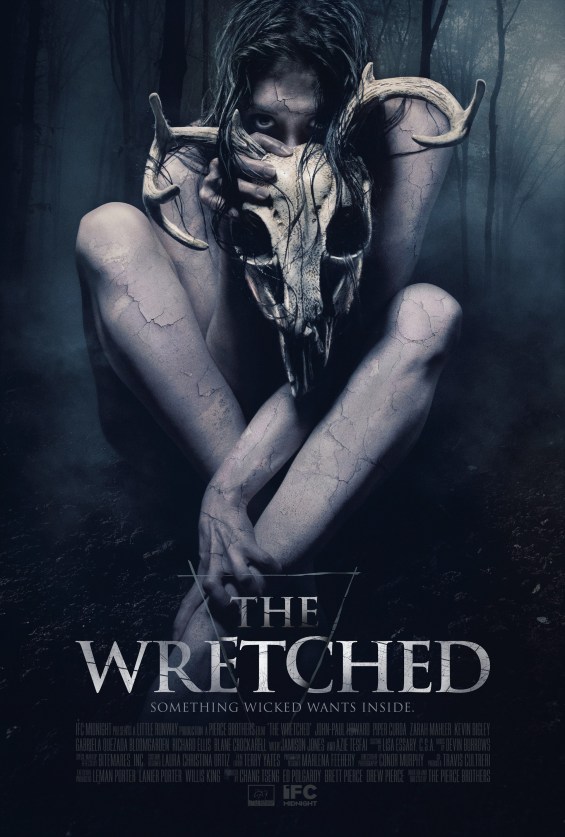
When it comes to the horror genre, sometimes you don’t desire a film that sets out to rewrite the rules of spine-tingling storytelling. Instead, you occasionally find yourself simply wanting to dim the lights and ensconce with a low-budget popcorn flick, and 2019’s The Wretched is firmly one of those films. With appealingly modest ambitions, The Wretched utilises its cast of unknowns, unique creature design and admirable emphasis on body horror as effectively as its thin budget will allow. And, even though the film is far from a game-changer for the realm of supernatural horror, The Wretched still manages to overcome most of its flaws to serve as an engaging, if fairly foreseeable, tale of witchcraft and body-snatching.

Plot Summary: After being sent to live with his father for the summer on account of his parents’ imminent divorce, defiant teenager Ben begins to suspect there is something wrong with his father’s next-door neighbour, eventually discovering that there is an execrable entity lurking beneath her skin…

Originally titled; Hag, before being changed following negative feedback from test audiences. The Wretched was certainly a departure for writer-director duo Brett Pierce and Drew T. Pierce, as the pair’s prior film, Deadheads, released in 2011, was a zombie road-trip comedy. Even so, this leap in tone and genre rarely seems to impair The Wretched from a directorial standpoint, as the film leaps headfirst into its grim tone and horrifying visuals right from the opening scene. And, whilst the film struggles to balance its plot threads from time to time, it quickly becomes clear that the central source of inspiration for the story was the low-budget creature-features of the 1980s, tied together with a desire to create a newfangled interpretation of witchcraft and revitalise hags into terrifying antagonists.

Acting out since his parents’ separation, seventeen-year-old Ben, competently portrayed by John-Paul Howard, is the protagonist. And, while it’s always challenging to portray an angsty teenager, due to the concern of said character becoming incredibly abrasive, Howard pulls it off successfully, portraying Ben as a frustrated and confused adolescent struggling to come to terms with his altered life. Furthermore, The Wretched even aims to justify the common horror trope of parents not believing their children once the supernatural occurrences begin, as when Ben attempts to explain the situation to his father, Ben’s past transgressions of trespassing and stealing medicine come to light, prompting his father to dismiss his claims as either lies or delusions. The supporting cast, including Piper Curda, Jamison Jones, Azie Tesfai and Zarah Mahler, is also serviceable in their minor roles as members of the lakeside community where his father resides.

Shot near Omena and Northport, Michigan, close to the Pierce brothers’ hometown, the cinematography for The Wretched by Conor Murphy often ranges in quality as some scenes are beautifully shot, with a strong emphasis on close-ups, whereas others (usually during conversations between characters) merely rely on dull, hand-held shots. With that said, when working in synch with each other, the camerawork and lighting do a remarkable job of masking the creature early on in the story, only giving the audience brief glimpses of the witch in her contorted, feral state before later displaying the film’s full range of prosthetic make-up and practical effects.

Excluding the ominous theme for the titular witch heard in the tracks; Woods and The Wretched Appears, both of which feature avant-garde strings led by a manipulated sarangi, the original score by Devin Burrows admittedly has some room for improvement as tracks, like Don’t Let Her In, Honey… Beer? and Broken Window repeatedly overuse strings and brass horns to the point where the tracks become too disruptive to the narrative, often mismatching with whatever shot is on-screen.

Of course, the witch herself is unquestionably the film’s primary draw, and The Wretched presents its titular creature with pride, making sure to include all of the most off-putting aspects of the creature’s devilish design and malicious nature. And, whilst the witch isn’t grounded in any specific mythology, with the screenplay only providing minor hints towards its origins, the witch’s carved symbols, salt fragility and quasi-religious shrines all give the creature an element of personality when outside of its human disguise. Speaking of which, the way the creature is presented when inside a body is just as disturbing as we, the audience, along with Ben, observe how the witch practically lives the life of the person whose skin she now inhabits, caring for her decaying body the best she can as the Wretched attempts to act human, each day climbing closer to feasting on the unfortunate children of the mother she is impersonating.

In summary, although The Wretched isn’t as polished as it could be in certain areas, I feel this well-paced horror flick will please most genre fanatics, even in spite of its occasional visual continuity errors, corny dialogue and lack of focus regarding the dual plot lines. The Wretched still delivers on its promise of a skin-crawling creature-feature reminiscent of ’80s cult classics. The film is also one of the few horror films I’d personally like to see a sequel or prequel to someday, as I feel the concept of a witch that feeds on the forgotten is an intriguing idea that doesn’t reach its full potential here, but undoubtedly could in a more refined film. Rating: 6/10.

wretched_ver2_xxlg

The Final Girls (2015) – Film Review

“I Can’t Believe We’re Just Gonna Casually Watch Someone Get Murdered. What Is This, Detroit?” – Vicki Summers

An affectionate nod and occasional parody of 1980s slashers and their associated tropes, The Final Girls, released in 2015, may not be as inspired or as tonally consistent as the similarly self-mocking likes of The Cabin in the Woods (2011), Behind the Mask: The Rise of Leslie Vernon (2006) or the iconic 1996 slasher; Scream. But, with plenty of humorous moments, some stellar visuals, and a surprisingly strong layer of emotion tying together all of the film’s meta amusement, The Final Girls is sure to delight any admirer of the gruesome subgenre, even if the film focuses far more effort towards being a comedy than a nostalgic horror.

Plot Summary: When Max Cartwright and her friends reluctantly attend a tribute screening of the notorious 1980s slasher Camp Bloodbath, a film that starred Max’s late mother, the group are transported into the cult horror flick. Now reunited with an on-screen version of her mother, Max and her friends must join forces with the ill-fated camp counsellors to confront the film’s machete-wielding killer and survive the ninety-two-minute runtime…

Directed by Todd Strauss-Schulson (Drunks vs. Highs, Zombies and Cheerleaders, Isn’t It Romantic) and co-written by M.A. Fortin and Joshua John Miller, The Final Girls does a fantastic job of capturing all the aspects of ’80s slashers in a way that highlights the hilarity of their predictability, whilst still respecting the subgenre, from one character losing her virginity and thus, instantly condemning herself to a violent death, to each of the camp counsellors fitting into one of several slasher stereotypes, e.g. the Jock and the Harlot, etc. The screenplay gets plenty of mileage out of playing with the clichés we all know from the slasher flicks of old. Still, it’s undeniable that the influence for The Final Girls is the Friday the 13th series, as the films share many, many similarities in everything from structure to sound design.

The cast for The Final Girls is extensive, as the screenplay balances the characters from the real world and the over-the-top personalities from Camp Bloodbath, who are intentionally written as walking clichés, with the film placing most of its attention toward developing Max and her mother, Amanda, portrayed by Taissa Farmiga and Malin Akerman, respectively. And, their relationship is where the majority of the story’s poignant scenes come from, as after losing her mother in a tragic car crash three years earlier, Max finally sees her chance to save her, or at least, the on-screen version of her, through saving the fictional character of Nancy from her grim fate, a sweet-souled, unaware shadow of actress Amanda Cartwright. However, while the pairs’ performances are superb, along with the rest of the cast of Alexander Ludwig, Alia Shawkat, Nina Dobrev, Thomas Middleditch, Angela Trimbur (and more), Adam Devine is horribly miscast as Kurt, the sportsman-type character, as, instead of being an athletic, perverted jock, Devine comes across as far more pathetic and obnoxious than he should, almost as if he isn’t fully aware of what slasher archetype he is supposed to be portraying.

Other than some briefly utilised CGI, which has noticeably aged very poorly. A large portion of the visuals throughout The Final Girls are impressive yet not always authentic to the ’80s time-period, as the cinematography by Elie Smolkin allows the camera to swerve, zoom and spin around the characters, all the while, the film’s colour palette is either immensely vibrant or exclusively black and white for whenever a flashback to the killer’s origin story is called for. Moreover, the film features several creative sequences, including a tooling-up montage and a slow-motion chase, both of which not only add to the film’s style but are also terrifically edited.

Though lacking a central theme like many iconic slashers from the 1980s, the original score by Gregory James Jenkins and Eddy Zak is like a musical time-capsule of sounds that are no longer used within the horror genre, as tracks like The Diaphragm Van and Puttin’ It Together are easy-on-the-ears synth tracks that whilst competent and reminiscent of ’80s horror scores, never quite manage to surpass any of their inspirations.

Unfortunately, despite all these positives, The Final Girls isn’t an impeccable horror-comedy, as even with its brief runtime, the film does lose a bit of steam during its last third or so, as the story begins to fall into less inventive territory as the body count rises. Still, the screenwriters find ways to integrate a clever surprise or two, such as the cliffhanger ending, which alludes to the prospect of a money-grubbing sequel, titled; Camp Bloodbath 2: Cruel Summer. The second primary issue The Final Girls suffers from is its almost complete absence of violence/gore, as aside from one or two shots of dripping blood, for a slasher, Camp Bloodbath seems somewhat family-friendly, which, in my opinion, is a huge misstep in light of the slasher subgenre being well-known for its excessive amounts of blood and guts.

In summary, with much of The Final Girls essentially being a film-within-a-film, it’s entirely plausible that this horror-comedy could’ve declined into nothing but constant fourth-wall-breaking jokes and pop culture references. Yet, through its engaging story and facetious writing, The Final Girls successfully deconstructs the slasher subgenre without the cynicism that could render a comedy into an unsurprising, humourless snore. Rating: 7/10.

the_final_girls-p1011432