Possessor (2020) – Film Review

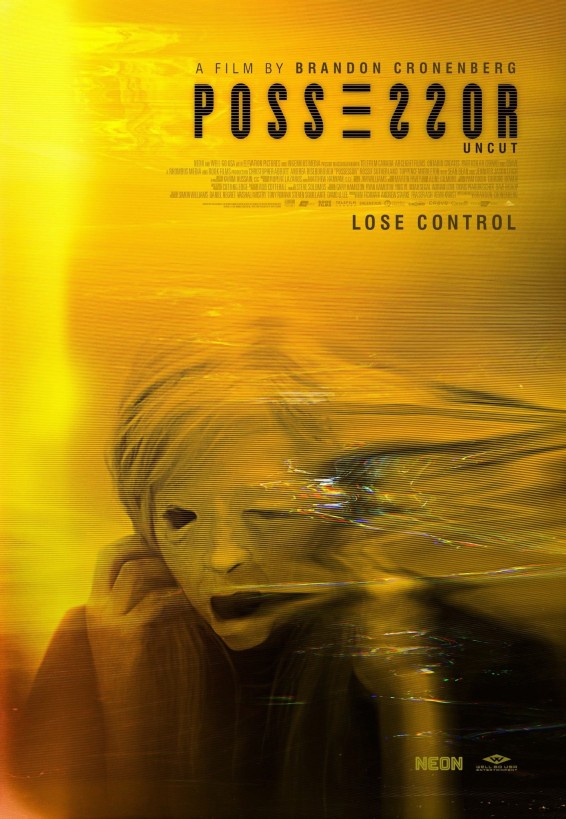
Following his 2012 directorial debut with ‘Antiviral,’ Brandon Cronenberg, son of legendary sci-fi-horror director David Cronenberg, crafts a captivating sci-fi thriller with 2020’s ‘Possessor,’ a film that deals with heavy underlying themes of identity loss and sexual discomfort, all whilst displaying its story through some truly spectacular cinematography and lighting. And, even though Brandon’s second sci-fi/arthouse outing doesn’t quite reach the high bar set by his father’s work, ‘Possessor’ is still more than successful as a surreal and layered science fiction flick with outbursts of strong, bloody violence.

Plot Summary: After many years of working as a corporate agent utilising brain-implanted technology to inhabit other people’s bodies and force them to commit assassinations for the benefit of the company. ‘Tasya Vos’ struggles to suppress her violent memories and urges, soon causing her to completely lose control when taking over the mind of a new subject, whose identity now threatens to destroy her own…

Debuting at Sundance Film Festival in early 2020, ‘Possessor’ has quickly gone down as one of the best low-budget releases of that year. Or, at least, this version of the film has, as according to writer-director Brandon Cronenberg, there was an alternate screenplay for ‘Possessor’ which drastically differed from the version that was released. So much so, that Brandon stated it could possibly become a second film later down the line, encompassing all of the material that didn’t quite make it into the first, which was primarily inspired by two pieces of media, the first being the 1971 novel; ‘Physical Control of the Mind: Toward a Psycho-Civilised Society’ by José Delgado, and the second being the short film; ‘Please Speak Continuously and Describe Your Experiences as They Come to You,’ written and directed by David Cronenberg.

Andrea Riseborough gives a fantastically cold performance throughout the film as ‘Tasya Vos,’ making it clear within only a few minutes that ‘Tasya’ is deeply suffering from the effects of her job, as each time she steps into the life of a new subject, she remerges different, finding it harder and harder to untangle her true identity from the one she just inhabited. And, it probably goes without saying that as a sci-fi focused on entering other people’s bodies, the story does explore sexual desire/sexual discomfort, never shying away from scenes of ‘Tasya’ being entranced with her new body after taking over the mind of ‘Colin Tate,’ portrayed by Christopher Abbott. Who, also gives a superb performance as the unfortunate host chosen to execute the company’s assassination, continuously switching between two personalities before eventually becoming devoid of all emotion as minds conflict.

‘Possessor’s cinematography by Karim Hussain also rarely ceases to impress, as nearly every shot is both attractive and memorable, with many shots leaning into the narrative’s themes in addition to providing a closer look at the heavily detailed gore effects through an array of extreme close-ups. The innovative camerawork is also enhanced by the film’s terrific use of colour, as the lighting and colour palette swiftly alters from bright yellows to dark blues to eye-piercing reds. But, this isn’t where ‘Possessor’s filmmaking peaks, as it can’t be denied that the film is at its best whenever it visualises ‘Tasya’ and ‘Colin’ mentally battling for control of ‘Colin’s body, as the film visually displays this interesting concept of a psychic battle on the astral plane through a range of editing techniques and creative yet strange practical effects. The scene in which ‘Tasya’ first enters ‘Colin’s mind is particularly astounding, as the film displays the fake bodies of the two main cast members, which then melt entirely into liquid flesh.

Many of the film’s bizarre visuals are also elevated to a great extent by Jim Williams’ original score, as ‘Possessor’s synth-esque soundtrack keeps the film’s eerie atmosphere present throughout the runtime, capturing the story’s surreal tone and constantly building tension through its atmospheric feel until we arrive at the story’s thrilling climax. My two personal favourite tracks; ‘Reborn in the Mind of Another’ and ‘A False Reputation,’ aren’t exactly distinctive, but both tracks do help tremendously in this regard.

The leading issue ‘Possessor’ suffers from is its lack of world-building, as supposedly the film takes place in an alternate version of the year 2008, but aside from one short scene where we see ‘Colin’s day-to-day job as a data miner, which does at least serve as a comment on the paranoia of corporate overlords and their nefarious activities, the world of ‘Possessor’ receives very little development and can often feel inconsistent when it comes to its technological advances.

In summary, ‘Possessor’ is the perfect hybrid of sci-fi, character study and body horror, as whilst its lack of world-building and compelling side characters do stop the film from reaching its true potential, ‘Possessor’ (along with Brandon’s previous film), definitely prove that Cronenberg’s son has a talent for telling harrowing and violent stories, all the while never forgetting to integrate intriguing concepts and ideas. And, with Brandon pushing for most of ‘Possessor’s effects to be completed in-camera rather than with CGI, the two directors may be even more alike than I first thought. Final Rating: low 8/10.
possessor_ver3_xxlg

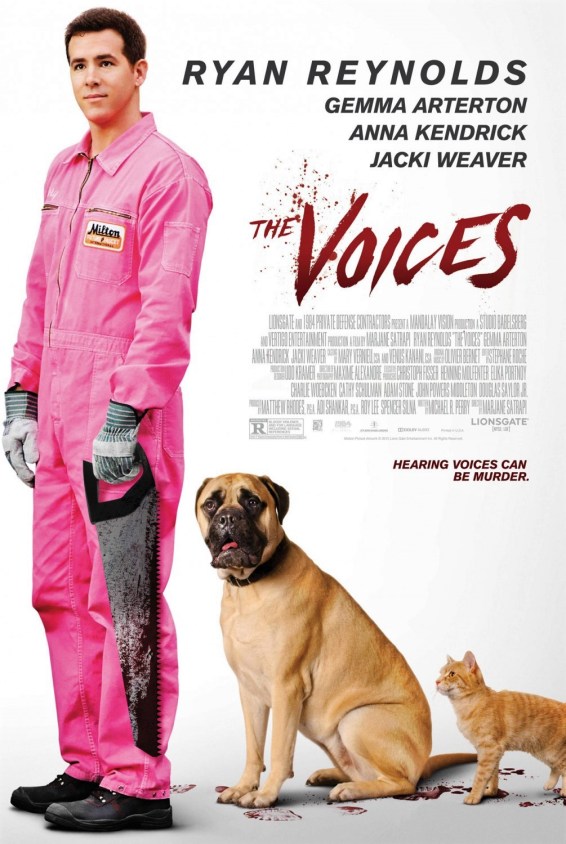
The Voices (2014) – Film Review

This obscure horror-comedy released in late 2014 will certainly make for a divisive viewing, as while ‘The Voices’ does feature an inspired use of colour and set design alongside a stand out performance from Ryan Reynolds, the film is also far more disturbing than much of its marketing would lead you to believe, swerving from absurd moments of humour to visceral moments of gore in a heartbeat. The resulting film essentially becoming a parody/throwback of/to classic horrors, like ‘American Psycho,’ and is a far-cry from a realistic study of psychosis for better, and for worse.

Plot Summary: After working a nine-to-five job at his local bathtub factory, the mentally ill; ‘Jerry,’ finds comfort in returning home to his beloved pets; ‘Bosco’ and ‘Mr. Whiskers.’ Until one day, with the help of his psychiatrist, ‘Jerry’ decides to pursue his office crush; ‘Fiona.’ But, when their relationship takes a sudden, murderous turn leaving ‘Jerry’ with the corpse of his co-worker, he tries desperately to strive for normalcy, only to fall deeper into instability…

Early in the pre-production of ‘The Voices,’ director Mark Romanek, best known for the 2002 drama/thriller; ‘One Hour Photo,’ was attached as the film’s director, before Marjane Satrapi (Persepolis, Chicken With Plums, Radioactive), later took over as the head of the project. And, whilst ‘The Voices’ does feel like quite a large shift from Satrapi’s usual work, it’s hard to know exactly which director would’ve excelled with a screenplay as original as this one is, as while ‘The Voices’ does share some similarities to other serial killer flicks, many of the film’s ideas are just brimming with personality, as everything from ‘Jerry’ showing symptoms of OCD when slicing up the bodies of his victims, to ‘Jerry’ living above an abandoned bowling alley, the film just has such a unique appeal.

Ryan Reynolds really gets a chance to shine portraying the film’s mentally ill protagonist, as whilst ‘Jerry’ does commit many horrible acts over the course of the runtime, Reynolds manages to capture the idea of ‘Jerry’ being a man forced down a road of violence. He is a distinct serial killer in the sense that he desires companionship and happiness, and doesn’t receive any pleasure from killing. So, when it’s eventually revealed what happened to him as a child, you can’t help but sympathise with him, evoking a level of emotion that many murderous characters struggle to achieve. But, unfortunately, the film’s side characters, portrayed by Gemma Arterton, Anna Kendrick, and Jacki Weaver, all feel quite thin as a result of them only being in the story to serve as ‘Jerry’s potential victims.

Maxime Alexandre handles the film’s cinematography well, as the camerawork throughout ‘The Voices’ remains fairly creative. The film’s visuals are most impressive most, however, when it comes to the film’s colour palette, set design, and set dressing, as with nearly the entirety of the story being seen through ‘Jerry’s perspective, the film displays the true extent of ‘Jerry’s delusions through its use of colour/sets. For example, when not on his prescribed medication, ‘Jerry’ views his apartment as very clean and organised, giving the location a much more comfortable feel, whereas when ‘Jerry’ does take his medication, he sees the grim reality of his soiled home.

The original score by Olivier Bernet is similar, never reaching into full on horror, but being a mixture of cartoonish, dream-like tracks, such as ‘In the Woods’ and ‘Jesus Dad,’ before then moving onto more upbeat tracks, like ‘Don’t Mess with Milton.’ A seemingly ironic track focused around the fictional woodland town of ‘Milton,’ where the story takes place, comically claiming the town to be nothing but a friendly and welcoming place.

The main aspect of ‘The Voices’ that I feel could make or break the film for many is likely to be its comedy, as whilst it is revealed fairly early on that many of the film’s bizarre moments, such as ‘Jerry’s pets speaking to him or ‘Jesus’ appearing on a forklift are all taking place within his mind, much of this strange humour is very hit-or-miss. However, an interesting yet small detail regarding the talking pets is that Ryan Reynolds actually voices each one of the animals himself, with each pet having a different accent, furthering ‘Jerry’s delusions. In fact, Reynolds actually modelled the voice of ‘Mr. Whiskers,’ a.k.a. ‘Jerry’s cat, after a Scottish friend he knew for over twenty years.

In summary, while ‘The Voices’ is overflowing with both charm and wit, it also has many issues. From its quickly altering tone and many jokes that fall flat, the film is far from a perfect horror-comedy. But, it does redeem many of its faults through its great performances and eccentric style, all playing into the film’s quirky personality. And, it’s due to all of this that the film feels as if its made for a very niche audience, yet for those ‘The Voices’ does appeal to, there is a fair amount to enjoy here. Final Rating: low 7/10.

voices_ver2_xlg

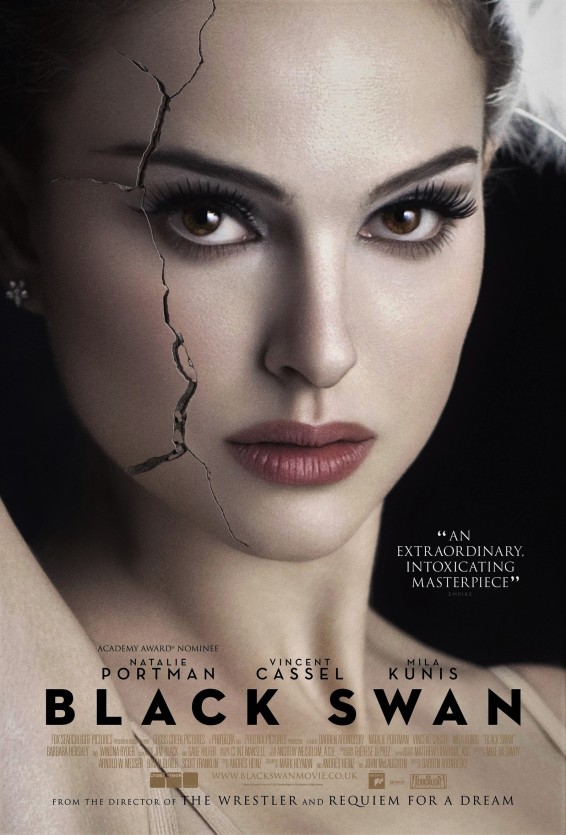
Black Swan (2010) – Film Review

Fantastically deranged at all times, ‘Black Swan,’ directed by Darren Aronofsky (Requiem for a Dream, The Wrestler, Mother!), is for many, the pinnacle of the director’s filmography, as the film’s combination of numerous genres soon evolves into an incredibly unique experience that leaps onto the stage in an effort to impress, with its gorgeous lighting, dreamlike atmosphere and occasionally grotesque visuals all elevating the film’s twisted tale of a dancer obsessed with achieving her dreams. And, whilst the film does trip over itself once or twice, its faults are few and far between.

Plot Summary: When ‘Nina,’ a ballerina for the New York ballet company discovers she has been chosen for the lead role in the company’s production of ‘Swan Lake,’ she struggles to maintain her sanity as her rival dancers, eccentric casting director and obsessive mother twist her perception of reality, forcing ‘Nina’ to prove herself worthy of the duel role and be the example for both the ‘White’ and ‘Black Swan.’

Although the film was never marketed as such, director Darren Aronofsky has always maintained that ‘Black Swan’ is first and foremost a psychological horror film, as the story delves into themes of mental illness and obsession, in addition to displaying many graphic sequences of what is essentially ‘body horror.’ And, yet, the film also somehow manages to never feel restrained to just one genre, which is what keeps it so compelling. This experimental nature might also explain why it took around ten years to be greenlit, as Aronofsky made many changes to the original screenplay in an attempt to get the film funded, with his original hopes for a budget of around £22 million being drastically lowered to roughly £9 million in the end.

The phenomenal lead performance from Natalie Portman nabbed the actress an Oscar back in 2010, and throughout the film, it quickly becomes clear as to why she won, as Portman flawlessly portrays ‘Nina’ as a committed and talented dancer being crushed by the pressure of the role she is undertaking. Portman even went to the extent of altering her voice (which had been continuously criticised by directors in the past for its childish qualities), as Aronofsky requested that for the role of ‘Nina,’ Portman would need to regress backwards and make her voice more childlike. Furthermore, Portman not only lost over twenty pounds for the role, but at least 95% of the dancing seen within the film was performed by Portman herself, with the professional ballerina Sarah Lane acting as her body/dance double for the complex en-pointe work. All of this is without mentioning the excellent supporting cast of Mila Kunis, Vincent Cassel, Barbara Hershey and Winona Ryder, whose performances all add to the film’s surrealist feel.

Matthew Libatique handles the cinematography, which despite relying far too heavily on hand-held shots during some scenes, also makes for some truly astonishing visuals, at points, as the film’s cinematic lighting alongside the grand gothic influence that the film borrows from cult horrors and other arthouse films, most notably, the stylised supernatural horror; ‘Suspiria,’ released in 1977, grant the film a very distinct and striking look. Aronofsky’s trademark of camerawork also creeps its way into the film, as there are a number of moments throughout the runtime where the camera tracks ‘Nina’ from behind as she walks through various locations, giving the cinematography a great sense of movement, not too dissimilar to leaping across a stage.

The original score by Clint Mansell also suitably feels like a score composed for a ballerina recital, as ‘Black Swan’s orchestral soundtrack is mostly a variation on Pyotr Ilyich Tchaikovsky’s ‘Swan Lake’ ballet, the only difference being that the notes are played backwards in a distorted manner. This makes the entire score feel very extravagant and almost overly dramatic, as tracks like ‘Nina’s Dream,’ ‘A Swan is Born’ and ‘Perfection,’ add to both the tragedy and beauty of the story.

As previously mentioned, due to its many scenes of graphic (and frankly disturbing) moments of mutilation, ‘Black Swan’ is far from an easy watch, as while the film doesn’t feature any ‘gore’ per se, all of the scenes of ‘Nina’s harmful acts towards herself feel more grounded in realism as a result of how minimal they are, with all of the skin-picking and dancing injuries she endures being reminiscent of a real disorder, known to medical professions as “Dermatillomania,” a disorder primarily related to skin scratching and/or skin picking.

In summary, even though many believe ‘Black Swan’ to be Aronofsky’s best effort, ‘Requiem for a Dream’ will always be my personal favourite film from the distinctive director as in spite of ‘Black Swan’s beautiful visuals and captivating narrative, the film also feels like it isn’t quite reaching its full potential, mostly due to its overuse of hand-held camerawork and unexplored characters and ideas. Regardless, this arthouse horror sustains its entertainment value, for the most part, and just like many other arthouse films, can be interpreted very differently from person to person. Final Rating: high 7/10.

black_swan_ver7_xxlg

Escape Room (2019) – Film Review

Divertive yet still rather thrilling in parts, ‘Escape Room’ directed by Adam Robitel (The Taking of Deborah Logan, Insidious: The Last Key) fails to unlock much of the potential in its premise, eventually devolving into what is simply scene-after-scene of the film’s characters solving puzzles in a number of themed rooms whilst on a strict time-limit. Yet, depending on what you desire to see from a modern thriller, this may be enough to serve a passing diversion, as the film chooses to just ignore its lack of realism and originality in favour of distracting its audience through creative set design and tense fast-paced sequences.

Plot Summary: When six strangers are each sent a mysterious black puzzle box withholding an invitation to an immersive escape room, they all make their way to the ‘Minos’ facility on the promise of being able to win a fortune should they escape. But, after entering what seems to be the building’s waiting area, innocent fun soon turns into a deadly game as the group discover that each room thy enter is actually an elaborate trap…

From a mere mention of the film’s plot, the ‘Saw’ and ‘Cube’ franchises are understandably the first two things that come to mind. As, in many ways, ‘Escape Room’ is effectively just a far less violent version of those familiar setups, with a character heading into a room only to be greeted with a convoluted trap that will result in their death should they not escape it. And, while ‘Escape Room’ does contain at least a couple of sparks regarding something original, the film is also far from subtle in both its storytelling and dialogue, with plenty of cheesy lines, implausible events and characters’ backstories being shown through literal flashbacks.

Taylor Russell, Logan Miller, Jay Ellis, Tyler Labine, Deborah Ann Woll and Nik Dodani all give passable performances as the main group of characters forced into a twisted game. Their actual characters, however, are possibly the film’s biggest missed opportunity, as whilst a few of the characters do receive development early on in the narrative, its quickly becomes clear as to which characters the film is favouring, making it easy to predict who is going to live, and who is going to die. But, if the film would’ve managed to better balance its characterisation, then not only would the story have been more compelling, but this would’ve kept the viewer constantly guessing as to who could go next.

Aside from one or two wide shots when the group first enter a new room, the cinematography by Marc Spicer is mostly uninspired, never really attempting to integrate any incredibly innovative or unique shots. Still, the cinematography does serve its purpose for the most part, backing up the story without ever relying too heavily on the use of hand-held camerawork or overly choppy editing. Additionally, the film’s CG effects (as sparsely used as they may be), are serviceable but not much else beyond that.

Contrarily, the original score by Brian Tyler and John Carey is fairly inventive, as the pulsing and suspenseful electronic score utilises everything from ticking clocks to power tools, representing the time-pressed characters and the constantly changing environments from which they are trying to escape. This means tracks, such as ‘Coaster’ and ‘Testing Your Limits,’ massively help to build tension, whereas moody tracks, like ‘The King of Trading’ and ‘Let the Games Begin,’ feel more sci-fi and atmospheric in nature. The film’s main theme, simply titled; ‘Escape Room,’ even receives a dubstep-like remix by musicians ‘Madsonik’ and ‘Kill the Noise,’ which plays over the film’s stylised end credits.

The film’s set-design is possibly its best aspect, as rather than going for the bog-standard look of libraries and basements for the basis of each room, the film explores an array of diverse environments for its puzzles. From a snowy log cabin, complete with a grand mountain vista, to an upside-down billiards bar, the film’s ever-changing locations help keep the story’s signature concept feeling fresh. Many of the rooms also relate to the character’s traumatic backstories, the first room, for example, is essentially a giant oven which will burn the group alive should they not escape, this mimics ‘Amanda’s backstory, who was badly burned after she barely survived an IED explosion while serving her country.

In summary, not only is ‘Escape Room’ similar to the ‘Saw’ series in terms of its story and setup, but, unfortunately, also in terms of its franchise potential, as its pretty obvious from the film’s extremely forced ending that Sony Pictures wanted their own low-budget horror/thriller franchise as an easy way to gain profit, and riffing on an already iconic series is a trouble-free way to achieve this. So, although it’s set-design and original score are admirable, in addition to a large majority of the filmmaking ‘Escape Room’ has on display being above-average, if not better, the film definitely has its share of problems, and, in my opinion, isn’t worthy of an entire film series. Final Rating: 5/10.

escape_room_xxlg

Krampus (2015) – Film Review

Whilst most Christmas films get across their message about how family is the true meaning of the holiday in a wholesome and light-hearted fashion, ‘Krampus’ takes quite a different approach as director Michael Dougherty (Trick ‘r Treat, Godzilla: King of the Monsters) crafts a cynical and amusing horror-comedy based around ‘Krampus,’ a creature from European folklore with origins stretching back to the days before Christianity, serving as essentially the sinister twin of jolly ‘Saint Nicholas,’ punishing those who misbehave in various odious ways. And, while the film is far from perfect, ‘Krampus’ creative ideas and impressive practical effects make the film worth its runtime.

Plot Summary: When his dysfunctional family clash over the holidays, young ‘Max’ finally decides to turn his back on Christmas, tearing up his letter to ‘Santa Claus’ in a fit of rage. Little does he know, his lack of Christmas spirit has unleashed the wrath of ‘Krampus,’ an ancient demon who punishes those who don’t celebrate the festive season. Forcing ‘Max’ and the rest of his family to fight for one another if they hope to survive…

Although there are plenty of enjoyable films out there to watch over the festive season, I usually always find myself craving something new around the Christmas period, as the cliché narrative of children helping ‘Santa Claus’ save Christmas gets very old quick. ‘Krampus’, however, does certainly attempt something new, even if it isn’t always successful. While the original outline for the film was closer to a straightforward horror, focusing mostly on ‘Krampus’ picking people off throughout ‘Max’s town, it was eventually decided to make it more of a dark retelling of a traditional Christmas film. This is why the plot is kicked off with a letter to ‘Santa,’ and why the film’s first act begins much like a family film would before then having a drastic turn towards horror and dark fantasy.

The film’s large cast of Adam Scott, Toni Collette, Emjay Anthony, David Koechner, Allison Tolman, Stefania LaVie Owen, Conchata Ferrell and Krista Stadler are all serviceable in their roles, even though many of their characters aren’t developed nowhere near enough. Additionally, ‘Tom Engel,’ a.k.a. ‘Max’s father, also has many moments where he doesn’t seem to take their life-threatening situation that seriously, almost as if he is acknowledging how bizarre the story is, which diminishes the film’s tension at points. But, with ‘Krampus’ featuring moments of humour and fright alike, the film obviously has many shifts in tone between scenes.

Jules O’Loughlin’s cinematography is nothing amazing altogether, as in spite of the film having quite a few memorable and attractive shots, there are also a large number of bland shots whenever the camera is focusing on the actors themselves. What is far more admirable though is how the camerawork enhances the film’s set design, making the audience believe that the film was shot inside a real house and outside on a real wintry street. When, in reality, over 95% of the film was shot on a soundstage, with the snow covering the ground being made from a material that’s commonly used for making nappies.

Composer Douglas Pipes handles the film’s original score, and he described his soundtrack as “A Collection of Twisted Christmas Carols With Pagan Thrown in,” as the score incorporates everything from the sounds of chains, bells, bones and animal-skin drums in addition to having choirs chant and whisper in different tongues, making for a foreboding but suitably Christmassy score. The track; ‘A Cold Wind,’ also does a phenomenal job of reiterating ‘Krampus’ as the ominous shadow of ‘Santa Claus’ through its use of sleigh bells. However, the film’s actual sound design features some incredibly strange choices for horror, as many cartoonish sound effects can be heard within the film, feeling immensely out of place every time they are.

One of the finest aspects of ‘Krampus’ as a film has to be its effects, as rather than having an overreliance on CG visuals, ‘Krampus’ brings all of its uniquely creepy creatures to life through detailed costumes and animatronics, harkening back to classic ’80s horror-comedies, like ‘Gremlins’ and ‘Fright Night.’ Many of the film’s terrifying monsters also share wonderfully horrific designs, with the final design for ‘Krampus’ and his elves being distilled from various postcards and illustrations seen over time. Or, in the case of the malevolent toys, taking inspiration from the 1992 low-budget horror, ‘Demonic Toys,’ with the angel ornament, teddy bear, robot and Jack-in-a-box that attack the family sharing many similarities to the toys seen in that obscure horror flick.

In summary, ‘Krampus’ is a rollicking ride of a Christmas film even if it isn’t quite as polished as Dougherty’s Halloween flick; ‘Trick ‘r Treat,’ as the film’s excellent practical effects, menacing creature designs and great original score all lend themselves very well to the distinctive story, despite the narrative itself often feeling like wasted potential considering ‘Krampus’ doesn’t full appear until near the end of the runtime. Regardless, this horror-comedy is still, in my opinion, the best on-screen interpretation of ‘Krampus’ and his devilish minions as of yet. Final Rating: 7/10.

krampus_ver3_xxlg

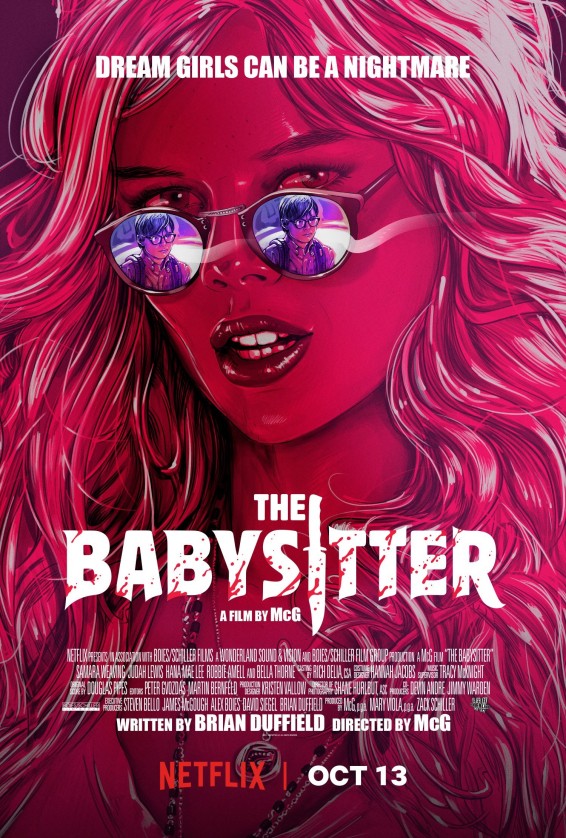
The Babysitter (2017) – Film Review

Originally filmed in 2015 with the intention of playing in cinemas, the horror-comedy; ‘The Babysitter,’ wasn’t seen by any horror fanatics until it released late 2017 after Netflix acquired the rights to the film for streaming. And, although ‘The Babysitter’ doesn’t exactly break any of the rules we’ve come to expect within the horror genre, this horror-comedy with splatterings of style must’ve been entertaining enough for those who decided to watch it, as the film would eventually spawn a Netflix-exclusive franchise with a later sequel.

Plot Summary: Riddled with anxiety, twelve-year-old; ‘Cole,’ has always been bullied and picked on due to his constant panicking, only finding comfort around the one person who understands him, his attractive babysitter, ‘Bee.’ That is, until one night, after ‘Cole’ secretly stays up past his bedtime to discover she’s actually part of a satanic cult, forcing ‘Cole’ to spend the rest of his evening evading ‘Bee’s band of killers who will stop at nothing to prevent him from spilling their dark secret…

Directed by Joseph McGinty Nichol (Charlie’s Angels, Terminator: Salvation, This Means War) or ‘McG’ as he more commonly goes by, ‘The Babysitter’ is a film that has received a number of alterations (both big and small) since even the early stages of its pre-production. For example, in the original screenplay for the film, ‘Sonya’ was actually a cheerleader, ‘Allison’ was a journalist for her high school newspaper, and ‘Max’ had dreadlocks, but eventually it was decided that ‘Bee’s cult followers should be reimagined to more closely reflect the stereotypical characters seen in classic slasher flicks, only in this film, they’re the antagonists. And, this idea is one of the film’s best aspects in terms of its writing, as it gives the film a real sense of self-awareness in addition paying respect to what came before it. Most notably, the ‘Friday the 13th’ series, which ‘Max’ references directly at one point when he chants; “Ch-Ch-Ch-Ah-Ah-Ah,” whilst chasing ‘Cole.’

Judah Lewis does manage to leave an impression in his first film role, portraying protagonist ‘Cole’ as an innocent twelve-year-old with few friends aside from ‘Bee,’ even if a large portion of his anxious characterisation feels far too over-the-top. Then there is also Samara Weaving as the titular babysitter; ‘Bee,’ and her cult followers; ‘Max,’ ‘Allison,’ ‘Sonya’ and ‘John,’ portrayed by Robbie Amell, Bella Thorne, Hana Mae Lee, and Andrew Bachelor, respectively. Who, are all wonderfully devilish throughout the film, having plenty of dark comedic moments between them making their deaths quite unfortunate, as while I’m sure most could’ve guessed their characters do die at some point within the narrative, we don’t get to spend enough time with any of them to get a strong grasp on their exaggerated personalities or any understanding of their malevolent cult.

In spite of the usually dull cinematography by Shane Hurlbut, ‘The Babysitter’ still manages to be one of the more visually interesting Netflix Originals through its unique style, as the film continuously implements different text, graphics and colours to give it a distinct stylistic appeal, not too dissimilar from (although nowhere near impressive as) ‘Scott Pilgrim vs. The World’ from 2010. Many of these editing decisions also help to redeem the film’s humour, which is extremely inconsistent, bouncing from hilarious cutaways and meta horror jokes to embarrassing lines of dialogue which try far too hard.

Whilst composer Douglas Pipes has crafted some great scores in the past, like ‘Monster House’ and ‘Trick ‘r Treat,’ ‘The Babysitter’ is certainly not one of them, as even with the film having many serviceable tracks. The soundtrack in general just lacks anything distinctive, and I believe that if it was ever compared to any other score from Pipes, or even just a handful of random horror scores, I doubt most would be able to tell it apart. The film also throws in the iconic Queen song; ‘We Are the Champions,’ nearing the runtime’s end, which feels immensely out-of-place and comes out of nowhere.

For a large duration of its tight runtime (which the film breezes through as a result of its unrelentingly fast pacing), ‘The Babysitter’s story is predominantly just one long chase sequence, and whilst occasionally tense, I couldn’t help but feel that the film’s screenplay could’ve taken better advantage of its evil babysitter concept or its few supernatural elements, despite the series second entry; ‘The Babysitter: Killer Queen,’ delving much further into the latter. Yet, the film doesn’t disappoint when it comes to its violence, having plenty of fantastically gruesome gore effects which are all successfully played for comedy.

In summary, I could see ‘The Babysitter’ being an enjoyable experience for some and possibly just a boring viewing for others, as when ignoring the film’s graphic gore and fun stylistic choices, the story leaves a lot to be desired, and can often feel derivative of horror classics even if this was the film’s intention to an extent with its focus on horror tropes/clichés. For me, although I do admire the film’s ridiculous tone and dark humour, the disappointing story can often feel sluggish, diminishing the film’s memorability and rewatchability. Final Rating: 5/10.

babysitter_xxlg

As Above, So Below (2014) – Film Review

Co-written and directed by John Erick Dowdle (The Poughkeepsie Tapes, Quarantine, Devil), ‘As Above, So Below’ is certainly an interesting found-footage flick, as while at a first mention the film may just sound like another a stereotypical horror, this claustrophobic delve into the caliginous Paris catacombs does actually have some depth hidden beneath its generic exterior. But, unfortunately, even with the story’s intriguing religious imagery/influences, the film soon plummets into clichéd mediocrity, mostly as a result of its bland characters and weak scares.

Plot Summary: When a team of explorers venture into the miles of twisting catacombs that lie beneath the streets of Paris, all in search of the historical ‘Philosopher’s Stone,’ they encounter far more than they bargained for when they realise they have entered into the first of the nine rings of Hell, where visions of their past sins begin to relentlessly torment them…

From a quick glance at the film’s visuals, its understandable why many would see ‘As Above, So Below’ as just another found-footage horror, only this time capitalising on the daunting real-world location of the Paris catacombs, which hold the remains of more than six million people in the small part of a tunnel network built to consolidate Paris’ ancient stone quarries. But, the film’s setting does heavily relate to the story of ‘Inferno,’ a short poem written by Italian poet Dante Alighieri in the fourteenth century, focusing on the tale of man who journeys through Hell guided by the Roman poet Virgil. Even the film’s title plays into this central idea, as the words; “As Above, So Below,” are derived from “On Earth as it is in Heaven,” which is a line from the ‘Christian Lord’s Prayer,’ which begins with “Our Father, Who Art in Heaven…”

Even though their characters are immensely mundane, Ben Feldman, Edwin Hodge, François Civil, Marion Lambert, and Ali Marhyar are all serviceable in their respective roles, delivering the usual screaming, ventilating and panicking performances that occur in most found-footage films. However, while the film’s protagonist; ‘Scarlett,’ is portrayed well by Perdita Weeks, the character herself is noticeably very unlikeable, mostly due to her constant obsession with the ‘Philosopher’s Stone,’ which she places all of her friend’s lives at risk for without question, and its never made clear whether we should actually be rooting for her to survive or not.

The cinematography by Léo Hinstin is more of the usual for this subgenre, providing the viewer with plenty of shaky and out of focus shots as the characters make their way through the almost pitch-black burial ground. This doesn’t distract from what is easily the film’s most impressive (and most ambitious) filming tip-bit, however, which is that the film was actually shot in the Paris catacombs themselves, not in a soundstage. In fact, this was the first production ever to secure permission from the French government to film within the catacombs, which would have been quite a challenge as the series of narrow, winding tunnels with centuries-old skeletons arranged on the walls would’ve had little room for equipment and crew. Yet, this does payoff as the film utilises its location extremely well, always placing its characters in tight areas to insight a feeling of claustrophobia in the audience.

While the film doesn’t feature a complete original score for obvious reasons, one of the strongest aspects of found-footage flicks, sound design, is actually an area where ‘As Above, So Below’ is lacking, as despite the film’s many attempts to feel impactful when the characters dive into water or are nearly crushed by a collapsing ceiling, a vast majority of the sound effects don’t sound as if they are coming from within the catacombs, usually sounding quite evident they have been added in post-production on account of the absence of echo or density.

With a large portion of the film’s narrative being based on Dante’s ‘Inferno,’ the film’s basic structure revolves around the characters heading further and further into Hell, with each character facing a vision of a personal sin from their past. These rings (or levels) in order are ‘Limbo,’ ‘Lust,’ ‘Gluttony,’ ‘Greed,’ ‘Anger,’ ‘Heresy,’ ‘Violence,’ ‘Fraud,’ and ‘Treachery.’ But, outside of the film’s previously mentioned religious symbolism, after the characters leave the initial catacombs, each ring is represented purely through dark empty caverns, which become quite repetitive after a point.

In summary, despite the Paris catacombs being a very compelling setting for a modern horror film, in addition to much of the film’s religious influences making for quite a unique story. I’d still suggest other claustrophobic horrors, like ‘The Descent’ or ‘The Thing’ before ‘As Above, So Below,’ as not only does the film eventually devolve into the standard horror formula without much experimentation, but if you’re unaware of any of the religious context, then I could definitely see the film being fairly forgettable. In all honesty, I feel this film may have been better off as non-found-footage, as I think this would’ve allowed the film to better explore its story and religious subtext. Final Rating: 5/10.

as_above_so_below-p874968

Scary Stories to Tell in the Dark (2019) – Film Review

Based on the controversial 1980s children’s book series of the same name, written by Alvin Schwartz and nightmarishly illustrated by Stephen Gammell. The film adaptation of ‘Scary Stories to Tell in the Dark’ directed by André Øvredal and co-written/produced by Guillermo del Toro, takes a very different approach than what many may expect when considering its source material, as the film ditches the book’s original anthology structure in favour of a more interconnected story to mixed results.

Plot Summary: On Halloween night, 1968, a group of childhood friends daringly enter the abandoned home of ‘The Bellows’ family, whose shadow has loomed over the small town of Mill Valley for generations as a result of the notorious murder of ‘Sarah Bellows,’ who turned her tortured life into a book of scary stories many years ago. But, these terrifying tales soon have a way of becoming all too real when the reclusive ‘Stella’ decides to take ‘Sarah’s story-filled journal home…

Clearly inspired by Stephen King’s classic novel; ‘It,’ ‘Scary Stories to Tell in the Dark’ takes the now-popular route of focusing on a younger cast, capturing that classic spirit of childhood adventure mixed with plenty of light-horror, but rather than setting the film in the hackneyed time-period of the 1980s, the film actually chooses to set it’s story near the end of the 1960s, which I feel helped the film stand out amongst the ‘It’ remake and it’s many similar incarnations. However, since its release, ‘Scary Stories’ has received plenty of criticism for its underwhelming horror, despite this being a completely intentional decision on behalf of the filmmakers, ensuring the film as a first step into the horror genre for younger audiences, never displaying too much violence or overly intense scares, not too dissimilar to the book series itself.

Zoe Margaret Colletti, Michael Garza, Austin Zajur, Natalie Ganzhorn, Gabriel Rush, and Austin Abrams portray the main group of friends and all do a decent job, as while their individual characters don’t exactly break new ground, they are likeable enough and have their inklings of both personality and humour. Contortionist Troy James, who once appeared on ‘America’s Got Talent,’ also appears in the film as one of the monsters, known as ‘The Jangly Man.’ Who, aside from having some CGI-enhanced facial expressions, actually performed all of his impressively unnatural body movements himself, including walking backwards, twisting his torso and crawling upside-down.

Roman Osin’s cinematography does remain visually interesting for the majority of the runtime, having plenty of creative shots with an effective implementation of colour alongside. But, it’s the film’s monsters that are unquestionably the best aspect of this adaptation, as the film takes the horrifying and abstract illustrations of Stephen Gammell and melds them into live-action flawlessly. So much so, that even in spite of each creature’s very limited screen-time, every monster manages to be quite memorable in its own right, from ‘The Pale Lady’ to ‘The Big Toe’ to the dilapidated poster-child scarecrow; ‘Harold,’ all of which were brought to life through prosthetic make-up and convincing practical costumes, rather than just CGI.

The original score by Marco Beltrami and Anna Drubich is a fairly average horror score, yet does still serve the story well for what it has too, even if most of the tracks aren’t worth looking-up afterwards. But, it’s also within the main score that there a small nod towards the original book series, as one of the tracks that plays throughout the film is titled; ‘The Hearse Song,’ which is actually a short song from the book series’ first entry.

As previously mentioned, the main creative decision that seems very peculiar to me is that the film adaptation of ‘Scary Stories to Tell in the Dark’ is not an anthology film, despite the books the film is based on focusing entirely on different characters/monsters with each new story. Instead, the writers chose to create an original story based-around the depraved spirit of ‘Sarah Bellows’ bringing the stories within her book to life, which was apparently done in order to stop one of the stories from overshadowing the rest, according to Guillermo del Toro. Yet, I personally feel that this makes the film less entertaining, as many of the story’s concepts and creatures feel underutilised, due to this overarching (and occasionally corny) narrative, even if the main story does borrow some of its ideas from other unused tales within the books series.

In summary, ‘Scary Stories to Tell in the Dark’ does triumph in its goal of crafting a horror more accessible for younger audiences, as I could see this film appealing to many young audience members in search of a gateway into the horror genre. If you are already a veteran within the genre, however, then I feel ‘Scary Stories’ will more than likely disappoint, as the film’s many cliché story-beats and lack of any gore or truly tense moments does result in this adaptation becoming a mostly forgettable horror flick with the exception of its many unique creature designs. Final Rating: 5/10.

scary_stories_to_tell_in_the_dark_xxlg

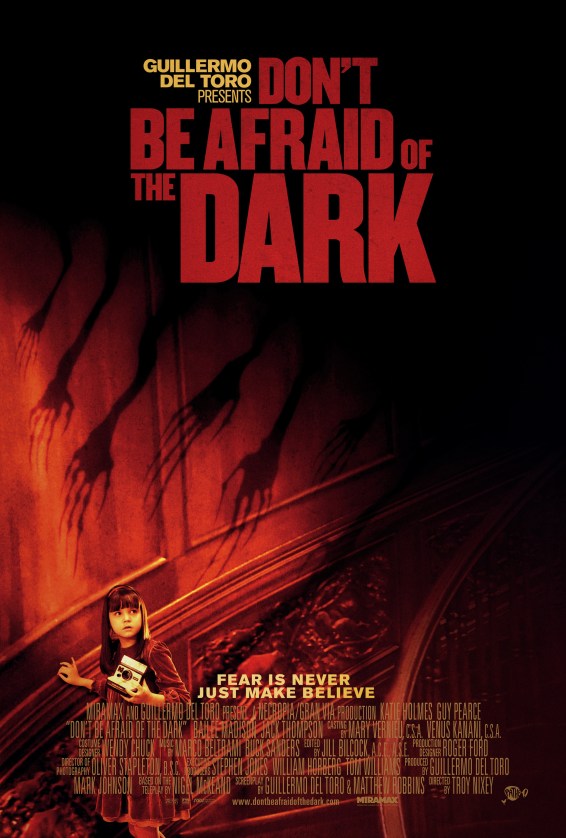
Don’t Be Afraid of the Dark (2010) – Film Review

Co-written/produced by Guillermo del Toro and directed by Troy Nixey, ‘Don’t Be Afraid of the Dark’ embraces many of the same elements as del Toro’s other films, crafting a narrative which combines both traditional gothic horror and childlike fantasy. But sadly, unlike a usual del Toro project, there is a noticeable absence in everything from captivating characters to memorising practical effects/creatures, resulting in a film that feels like a mostly copy-and-paste effort beyond one or two interesting ideas.

Plot Summary: After being sent to live with her father and his new girlfriend at their recently renovated manor, the previous home of the long-missing painter: ‘Emerson Blackwood’. Young ‘Sally’ begins to hear ominous voices emanating from the basement’s ash-pit, soon leading her to discover the cause of the painter’s disappearance…

Taking heavy inspiration from the classic H.P. Lovecraft short story: ‘The Rats in the Walls.’ ‘Don’t Be Afraid of the Dark’ is actually a remake of a low-budget 1973 TV film, as the now-iconic director Guillermo del Toro has stated in the past that he was terrified of the film when he first watched it as a child, later inspiring him to reimagine the mostly-unknown horror flick. Yet even with a much larger-budget and a more well-known cast, the film is still quite underwhelming when it comes to both its scares and story, as the film’s narrative follows a formula almost identical to many other modern horrors.

All of the performances throughout the film aren’t anything overly impressive, as whilst Katie Holmes does try her best to portray a young girl witnessing sights that no one else believes. Her character: ‘Sally’ (similar to the rest of the film’s characters) receives very limited characterisation, which does make many of the scenes revolving around the family-dynamic far less entertaining. Then there is also ‘Sally’s father and his girlfriend: ‘Kim’ portrayed by Guy Pearce and Bailee Madison respectively, and although Madison gives a serviceable performance, Pearce may give one of the weakest performances of his career here. As ‘Sally’s father: ‘Alex,’ always shows little concern or remorse when it comes to his daughter, making the character immensely difficult to resonate with.

The cinematography by Oliver Stapleton is very grand in its execution, allowing for a large number of wide-shots, some of which even flow smootly-around the various rooms of the manor. But it’s the film’s colour palette which is most worth noting, as the film utilises much more red and yellow than many other modern horrors, which is a pleasant change in terms of visuals as the more vibrant colours reflect the manor’s elegant design, which is probably one of the most visually striking ‘haunted houses’ in recent memory, with even the manor’s front entrance having a beautiful carving of an old oak tree merged into the multi-coloured glass.

Marco Beltrami and Buck Sanders provide the original score for the film, which similar to the film’s cinematography, gives the story a much more epic feel. As the heavy orchestral score could’ve easily been taken from any classic gothic horror, lending itself effectively to many scenes aside from a couple of generic tracks. The film often also features some fantastically creepy sound design, as the film’s creatures continuously speak to ‘Sally’ using their ghostly whispering voices, which seemingly echo throughout the usually empty corridors of the manor.

Although many of del Toro’s other outings do provide plenty of wonderful practical effects to gaze at, usually creating an array of unsettling and memorable creatures, ‘Don’t Be Afraid of the Dark’ takes another (less appealing) route to its monsters. As the film’s creatures are brought to life almost entirely though CG effects, which not only makes some shots appear slightly dated, but also manages to take away from nearly all of the film’s tense moments. Additionally, the film’s creature designs aren’t all that menacing, as despite the idea of evil fairytale monsters being quite unique (as the creatures are later revealed to be a sinister incarnation of tooth-fairies). The creature’s extremely small-size does make them feel very unthreatening even if it is a nice change-of-pace over having one large entity, as the film never does enough with its miniature antagonists regardless of what knives/tools they arm themselves with.

All in all, ‘Don’t Be Afraid of the Dark’ is a film that is regrettably just not worth its short runtime. As while I admire the effort to combine famed fairytale stories with a chilling atmosphere, the predominantly poor performances and numerous unexplored concepts leave the film simply another bland horror flick with a surprisingly weak screenplay by del Toro to-boot, especially when compared to much of his other work. Still, with all that said, I feel that Troy Nixey does deserve another shot in the director’s chair someday, as since this film’s initial release, he actually hasn’t worked on any other projects, which is unfortunate, as I do believe he does have some talent as a filmmaker when looking at this film’s merits. Final Rating: high 3/10.

Layout 1

The Blair Witch Project (1999) – Film Review

Upon its initial release, the original ‘Blair Witch Project’ blew many audiences away with its realistic depiction of found-footage horror, subsequently leading many audience members to believe that the events they were watching on-screen actually took place, making for a truly terrifying experience. However, now, many years after its first appearance, the film’s reputation has significantly altered with both critics and audiences alike, as ‘The Blair Witch Project’ is definitely a film that lies outside of the usual horror clichés.

Plot Summary: When three student filmmakers travel to Burkittsville, Maryland, in attempt to produce a documentary based around the local urban legend of ‘The Blair Witch,’ they mysteriously disappear after traveling into the nearby Black Hills Forest, leaving only their footage behind to be discovered one year later…

Whilst ‘The Blair Witch Project’ wasn’t the original found-footage horror film, with the infamous exploitation flick; ‘Cannibal Holocaust,’ first introducing the horror subgenre in 1980. ‘The Blair Witch Project’ was the first film to popularise the found-footage concept, as this film was at one point in time in the ‘Guinness Book of World Records’ for the largest box-office ratio, as the low-budget film only had a budget of around £45,000 and made back over £189 million, quickly spawning an inconsistent horror franchise despite the film’s only partially complete backstory for its creature and setting.

The three main cast members of Heather Donahue, Joshua Leonard, and Michael C. Williams (who all share their real names with their characters), are all tremendous throughout the film, as while their character’s don’t receive nowhere near as much development as they should considering how much screen-time we spend with them, each one of the actors do give the impression they are becoming more tormented and frustrated the longer they remain in the Black Hills Forest. The main reason the film’s protagonists don’t receive much characterisation, however, is actually due to the film’s production itself, as with the film not focusing very heavily on story, the actors were given no more than a thirty-five page outline of plot points rather than a full screenplay. So, as filming continued, the cast just played out various scenes, only having little knowledge of the mythology behind ‘The Blair Witch’ and improvising the vast majority of their lines.

Practically the entirety of the cinematography by Neal L. Fredericks is exactly what you’d expect from a found-footage horror, featuring an abundance of both shaky and out-of-focus shots, further adding to the idea that just behind the lens is a group of amateur student filmmakers (with some scenes even being shot by the cast themselves). In addition to the hand-held camerawork, the film’s visuals are also quite distinctive when it comes to its visual quality, as throughout the duration of the film, many shots remain incredibly grainy and occasionally even switch to a completely greyscale colour palette, which again, whilst adding to the realism of the film being a no-budget student documentary, does ensure the absence of any genuinely attractive shots.

Although it’s only heard during the film’s atmospheric end credits, ‘The Blair Witch Project’ does actually have an original score composed by Antonio Cora, but obviously being a found-footage horror, the film mostly aims to please with its sound design, as the sounds of crackling leaves and chirping birds are heard continuously. Interestingly, many of the eerie branch-cracking sounds heard at night even being made by the director and his friends simply walking up to the cast’s camp-perimeter and then tossing around twigs, rocks, and branches in various directions.

The main aspect that many will either admire or despise about ‘The Blair Witch Project,’ is its previously mentioned focus on realism and minimalist storytelling, as while the film does utilise its forest setting very effectively throughout the runtime, many who may be expecting a thrilling final act or possibly even a glimpse at ‘The Blair Witch’ herself will be greatly disappointed, as due to the story’s constant emphasis on realism, the film never actually provides any genuine evidence of the supernatural, with many of the film’s tense moments mostly relying on the darkness of the woods or the belligerent quarreling between the characters.

In summary, ‘The Blair Witch Project’ is certainly a fascinating horror film even if it isn’t always a successful one. As, to this day, this found-footage indie flick is a very divisive film for horror fans, with a 86% score on Rotten Tomatoes, the film has the highest-rating of any film that was also nominated for a Razzie Award for Worst Picture. So, even with the cast’s impactful performances and ‘The Blair Witch’ herself being an intriguing urban legend, this is one horror that really depends on your personal taste. For myself, while I find the film far from perfect and considerably less compelling than many other iconic horrors, I can appreciate what this experimental piece of filmmaking (and its marketing) was trying to accomplish, and for that, I feel it’s worth at least one viewing for any fan of the genre. Final Rating: 6/10.

blair_witch_project_ver3_xxlg