The Mouse Trap (2024) – Film Review

“I Can See You… Do You Wanna See Me?” – Mickey Mouse

Announced on January 1st, 2024, the same day Steamboat Willie (1928) entered the public domain, the animated short directed by Walt Disney and Ub Iwerks, considered by many to be Mickey and Minnie Mouse’s public debut, despite both characters actually premiering a few months prior in a test screening of Plane Crazy (1928) and the then-unreleased; The Gallopin’ Gaucho (1928). Mickey’s Mouse Trap, later renamed; The Mouse Trap, due to the Walt Disney Company still retaining the commercial rights to the character’s name, is a tedious and derivative low-budget slasher that merely takes the iconic rodent and distorts him into a thundering serial killer without any semblance of wit, dread or depth, to agonisingly painful results.

Plot Summary: On the evening of her 21st birthday, teenager Alex is surprised with a birthday party by her friends at the arcade where she works. But, not long into their night of celebration, a deranged killer dressed as Mickey Mouse interrupts their get-together, forcing Alex and her friends to use their quick thinking to survive the night…

Writer and actor, Simon Phillips, the man behind the mouse mask, is a self-described; “1980s Baby,” who loved the bloody slasher flicks of the time, explaining in an interview; “So, Mouse Trap, to Me, Was Like the Cheesy, Clichéd 1980s and 1990s Horror Movies. I Was Like, Let’s Do This. Let’s Make Mickey Mouse a Slasher Killer. Let’s Trap These Kids in an Amusement Park or an Arcade. And, Like a 1990s Movie, Don’t Think About It Too Much. Just Have Fun!” While this ambition is admirable, The Mouse Trap undoubtedly fails in the aspect of ‘fun,’ harbouring flat, irritating characters, a needlessly complicated setup and a series of vapid kills, with the obligatory, uninteresting drama of assorted jocks, nerds, goths and popular girls scattered in between. And, with quotes like “How Did I Get Stuck With You?! I’m Too Pretty for This!” the dialogue swiftly announces itself for all the wrong reasons.

The central cast of Sophie McIntosh, Alex Fen, Madeline Kelman, Ben Harris, Callum Sywyk and Mireille Gagné do their best with the weak material they are given, with McIntosh retaining at least some semblance of screen-presence in the leading role as Alex, but that’s about it, as their characters are simply cardboard cutouts, neither entertaining nor likeable, with the shoddy dialogue and scarcity of character development rarely helping in this regard. While Simon Phillips’ physical performance as the titular killer is somewhat eerie, his vocal performance is certainly not, as he utters hokey, intended-to-be-intimidating lines via a ghastly Mickey Mouse impression. Perhaps the worst part of The Mouse Trap, however, is the arbitrary cutaways to a police station where one of the survivors cryptically recounts the night’s events (including moments they weren’t even present for) merely as an excuse to pad out the runtime.

If you enjoy watching monotonous, drawn-out shots of teenagers playing air hockey or drinking seemingly nothing out of plastic party cups, then The Mouse Trap is for you. As, despite being branded as a throwback to 1980s/1990s slashers, the first on-screen kill doesn’t actually occur until almost an hour into the runtime, with each victim getting dispatched in ways that lack both memorability and solid blood/gore effects, in addition to being presented in a visually flat manner as a result of the cinematography by multitasking director Jamie Bailey (Deinfluencer, What Lurks Beneath, The Omor Heist).

On another pessimistic note, the original score by Darren Morze is a rather forgettable horror soundtrack that doesn’t justify its numerous tracks, in spite of their tongue-in-cheek titles, such as The Miracle Survivor, Cat and Mouse, Birthday Wish and Total Serial Killer Vibes. The film also implements an aggravating jump-scare-like audio cue every time Mickey appears on-screen, in what I assume is a lacklustre attempt to startle its audience.

Regarding the titular killer, The Mouse Trap does little to differentiate Mickey from any other slasher, solely depicting him as a large man in a mask with murderous intent. That said, the film does at least attempt to explain the origin of Mickey Mouse as a killer in utterly bizzare fashion, as Tim Collins, the manager of the arcade Alex works at, is soon revealed to be ‘possessed’ by a malvolent entity after watching a film reel of Steamboat Willie while sipping a glass of vodka beside film memorabilia, in a moment that is just as nonsensical as it is ridiculous. Outside of this moment, though, The Mouse Trap could just as well be a slasher headlined by Deadmau5 or any number of other mouse-related characters, as none of the traits associated with the anthropomorphic mouse are here, whether accurate or parodied, with Mickey even harbouring an unexplained ability to teleport, which has an equally unexplained weakness to strobing lights.

In summary, in typical ‘horror parody’ fashion, The Mouse Trap is neither amusing nor high-brow, nor does it make effective use of the character/franchise it is mimicking. Instead, the film struggles to justify its existence as a man in a cheap-looking mouse mask slaughters annoying teens with little personality or charm. Perhaps a trenchant satire of Disney and its squeaky-clean image as a family-friendly entertainment giant is too much to ask for, or too legally treacherous. Either way, the only merriment on offer in The Mouse Trap is the occasional piece of unintentional humour that comes from the killer’s bi-sphere silhouette. Rating: 1/10.

Winnie-the-Pooh: Blood and Honey (2023) – Film Review

“Pooh, You’ve Got to Help Me! Something’s Wrong With Piglet, He Killed My Wife!” – Christopher Robin

Shot in a mere ten days, Winnie-the-Pooh: Blood and Honey, released in 2023, is a British-American-produced micro-budget slasher that takes a more despicable approach to the beloved characters of Winnie-the-Pooh, Piglet and the other inhabitants of the Hundred Acre Wood, morphing the convivial critters into bloodthirsty, savage killers. Unsurprisingly, due to its laughable concept, terrible screenplay, amateurish filmmaking and general lack of any genuine horror or satire, Winnie-the-Pooh: Blood and Honey serves as nothing more than a bargain-basement slasher that fails to exhibit even a passing interest in the source material it’s adapting. As such, the film is only really notable for its title, simply existing as a bizarre, mismatched amalgamation of the horror genre and classic children’s literature.

Plot Summary: When Christopher Robin, now a young man, departs the Hundred Acre Wood to attend university, leaving Winnie-the-Pooh and his furred friends to fend for themselves, their days of merriment and adventure quickly come to an end as they become feral and enraged, soon acquiring a taste for flesh that steers them on a bloody rampage…

The creation of Winnie-the-Pooh: Blood and Honey became feasible at the start of 2022 after the 1926 children’s book; Winnie-the-Pooh by A. A. Milne, entered the public domain in the United States, voiding its copyright, and therefore Disney’s media exclusivity over the titular character. This meant that the filmmakers behind Winnie-the-Pooh: Blood and Honey were free to use characters like Pooh, Piglet and Eeyore, as long as they did not resemble their animated, Disney-owned counterparts, which were still actively protected by copyright. Nevertheless, I feel that most would agree that a malicious interpretation of Milne’s cuddly animal characters is undoubtedly a poorly-conceived concept from the get-go, with the film doing little to prove its critics wrong in this respect throughout the exceptionally brief runtime, even if it is commendable that this is the first live-action adaptation of Winnie-the-Pooh not produced by the Walt Disney Company, as well as the first adaptation geared towards mature audiences.

Regarding the film’s surplus of shortcomings, Winnie-the-Pooh: Blood and Honey‘s most significant issues lie within its screenplay, as the film crams several unwarranted scenes and overly dramatic subplots into a formulaic slasher framework, like having the underwritten protagonist Maria, portrayed by Maria Taylor, be suffering from serve PTSD, following a night where an anonymous sexual deviant broke into her home. These details add little to the narrative and generally come across as screen-time wasters. The rest of the characters, including Christopher Robin, Jessica, Alice, Zoe and Lara, portrayed by Nikolai Leon, Natasha Rose Mills, Amber Doig-Thorne, Danielle Ronald and Natasha Tosini, respectively, are all tremendously underdeveloped, delivering tedious exposition dumps that lead nowhere through performances that frequently present the cast as if they are uncomfortable in their various roles, underselling or overselling their reactions at every turn.

With the exception of the creative opening sequence, which sets the stage for this darker rendition of the honey-hungry yellow bear via pencil-doodled animation, Winnie-the-Pooh: Blood and Honey is a rather shoddy horror flick that lazily relies on its handful of admirable practical effects to avoid attempting anything visually or audibly impressive, as the cinematography by Vince Knight is relatively dull when it isn’t chaotically unstable during chase sequences, whilst the editing haphazardly slaps scenes together without any consideration for continuity or pacing. Furthermore, the film utilises plenty of editing trickery to get around its poor direction, namely, a ludicrous quantity of fade-to-black transitions and an assortment of abysmal CG blood effects.

One of the more mildly charming aspects of Winnie-the-Pooh: Blood and Honey, however, is its original score by Andrew Scott Bell, as tracks like In Which We Are Introduced to Winnie-the-PoohTogether Forever and Silly Old Bear, while generic, are, at least, of a relatively high-quality thanks to Bell’s innovative approach to the whimsical yet eerie score, employing a variety of instruments in the composition of the soundtrack, such as a “Beehiveolin,” a combination of a beehive and a violin.

Interestingly, writer-director Rhys Frake-Waterfield (The Area 51 IncidentThe Killing TreeFirenado) originally wanted Tigger to appear in the film, but the character ultimately didn’t on account of copyright. Some may say this was a favourable outcome, as Winnie-the-Pooh: Blood and Honey evidently doesn’t strive for faithful recreations of the cherished characters of the Hundred Acre Wood. Instead, the film opportunistically coasts on the novelty of placing the loveable critters in a macabre context, bringing the characters to live-action through rubbery, full-face masks that display no hair or visible mouths, allowing for minimal expressions, meaning Pooh and Piglet may as well be murderous individuals sporting animal-themed masks.

In summary, Winnie-the-Pooh: Blood and Honey is exactly what many anticipated it to be following the release of its viral trailer in mid-2022; an atrocious slasher, an appalling adaptation, and an all-around execrable piece of cinema. Still, that’s not to say that Winnie-the-Pooh: Blood and Honey was a commercial failure, as the film actually grossed over £4 million on a budget of around £79,000, despite its near-universally negative reviews. Consequently, this suggests that with many other children’s literary works soon making their way into the public domain, we will regrettably be receiving far more lousy, horror-centric renditions of long-established characters in the near future, with Winnie-the-Pooh: Blood and Honey 2Bambi: The Reckoning and Peter Pan’s Neverland Nightmare, being just some of the projects already announced. Rating: 2/10.

winniethepooh_blood_and_honey_xxlg

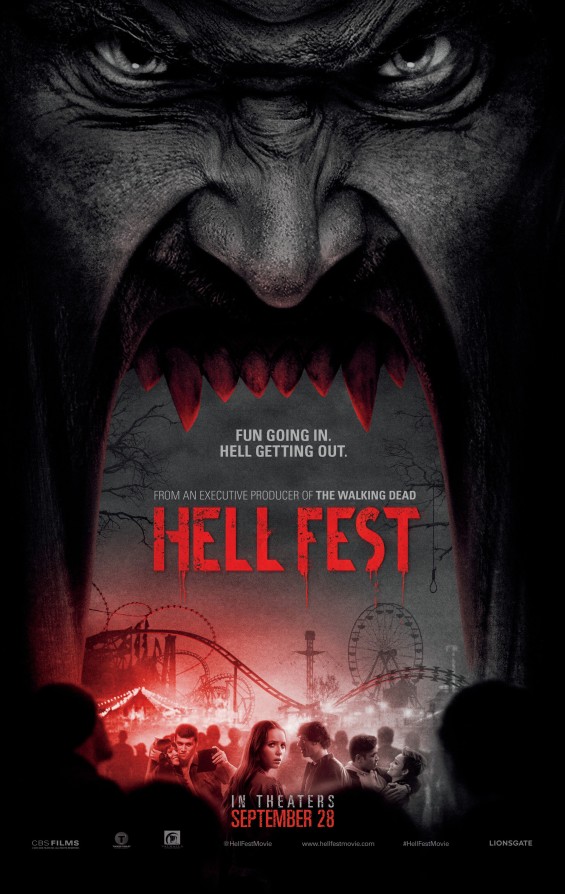
Hell Fest (2018) – Film Review

“That Same Guy Has Been Following Us the Entire Night!” – Natalie

Initially conceived as a yearly horror franchise similar to Saw and Paranormal Activity, with a sequel released each following October. Hell Fest, released in 2018, is a gruesome throwback to 1980s slasher flicks. Equally violent and bombastic, the film includes many amusing moments for lovers of both scare mazes and ’80s horror. As a result of its formulaic and often uninspired screenplay, however, Hell Fest suffers from a number of issues that diminish its quality as a nostalgic slasher, even when taking into account its distinct horror-festival setting.

Plot Summary: On Halloween night, a group of friends make their way to Hell Fest, a ghoulish travelling festival loaded with attractions, games and scare mazes, hoping for an exciting night of thrills and chills. But, as the night continues, the scares soon become all too real as a masked serial killer turns the horror-themed festival into his personal playground…

Before director Gregory Plotkin (Paranormal Activity: The Ghost DimensionCrimson) was chosen to helm the project, a handful of other filmmakers were considered, including Jennifer Lynch and Neil Marshall. Needless to say, whilst Hell Fest is competently directed, the premise of the film is really where most of its appeal resides, as the idea of a pursuing killer blending in with an enormous crowd dressed as various ghouls, maniacs and monsters is a rather alarming concept, of which the film takes full advantage. For instance, when the group first encounter the killer chasing another girl through a blacklight-lit scare maze, they assume it’s all part of an act, so they merely watch as he butchers her. As opposed to sporting a single mask throughout the runtime, the killer, only referred to as “The Other,” also swaps out his disguise at many points. Distinguishing the character from horror icons like Michael Myers, despite Stephen Conroy’s physical performance appearing reminiscent of Michael’s movements in the original Halloween from 1978.

The rest of the cast, including Amy Forsyth, Reign Edwards, Roby Attal, Bex Taylor-Klaus, Christian James and Matt Mercurio, portray their characters sufficiently. The actual characterisation of the group is where most of the screenplay’s problems lie, as the teens come across as rather cliché archetypes. This issue is only worsened by the screenplay placing more emphasis on the characters’ relationships than their personalities during their first few scenes together, which is also where a large amount of the film’s corniest dialogue can be heard. On a more positive note, Hell Fest is the second horror flick to feature the voice of horror legend; Tony Todd, in a theme park, the first being Final Destination 3 in 2006. Todd later appears in person, too, portraying an enthusiastic stage announcer and providing the murderous proceedings with a brief jolt of energy.

In terms of the visuals, the cinematography by José David Montero is quite visually interesting, making fantastic use of the daunting yet colourfully lit location of Hell Fest, mainly whenever the camerawork employs wide shots to display the true scale of the bustling festival of frights. Moreover, when it comes to the killings, Hell Fest does a fine job of slaughtering the teens in creative ways through an array of superb practical effects. However, many of these kills are unfortunately spoilt by the film’s overreliance on shiny CG blood, which somewhat takes away from the charm of the 1980s-inspired artificial heads and rubber eyeballs.

Similar to the film itself, the original score by Bear McCreary feels contemporary yet simultaneously like a nod to the past, as the score combines two musical styles with synth and orchestral, along with some violin harmonics later in the soundtrack. The signature track of the score; Trophies, effectively serves as the killer’s motif and lurks in the background for most of the runtime (similarly comparable to an abundance of classic slashers). Many of the other tracks, such as Technical DifficultiesGuillotine and Welcome to Hell, do an admirable job of building suspense when required, but aren’t that memorable by themselves.

Of course, the most noteworthy aspect of Hell Fest has to be its exceptional production design, which utilises an eye-catching assortment of scare mazes segments, costumes and props from numerous Halloween events all across the United States. A fair amount of the decorations were borrowed from Six Flags Over Georgia’s annual Fright Fest, while many of the costumes were leased from the Netherworld Haunted House in Georgia, one of the highest-rated scare attractions in the country. Furthermore, many members of Hell Fest‘s production crew had formerly worked as scare maze decorators, designers and staffers, so they were more than familiar with the setup of a scare attraction.

In summary, Hell Fest certainly isn’t anything new. The film isn’t reinventing the slasher subgenre, nor is it trying to. Hell Fest is merely attempting to be an entertaining, modern-day slasher that pays homage to horror classics of the 1980s, and in that sense, I suppose it succeeds. It’s just a shame that Hell Fest doesn’t go further with its violence or horror-festival setting, as the production design is undoubtedly one of the most impressive elements of Hell Fest. And, I’m sure that if any scare maze enthusiasts were to watch this slasher flick, they would be blown away by what the production crew accomplished with the detailed costumes, props and sets on display. Rating: high 5/10.

hell_fest_xxlg

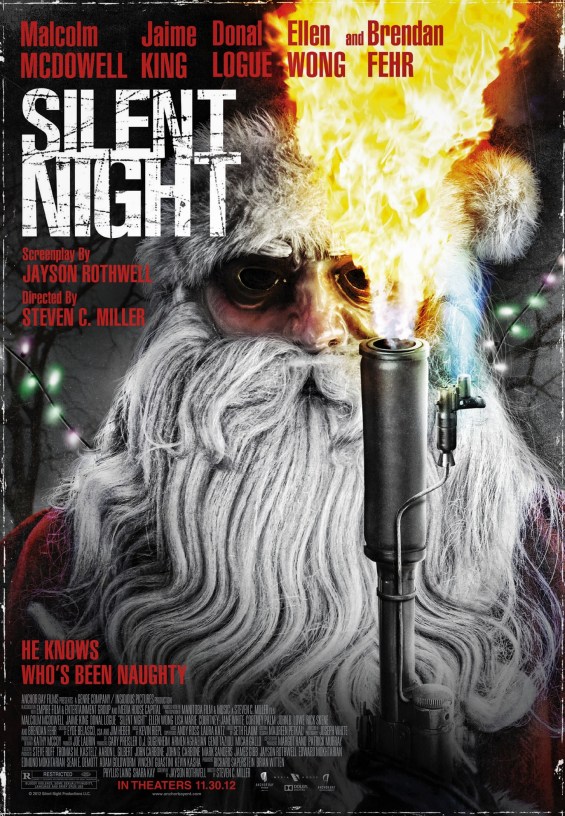
Silent Night (2012) – Film Review

“I’m on His Tail Now. There’s Nowhere Safe…” – Sheriff Cooper

One of the most controversial films of the 1980s, primarily due to its promotional material, which featured a killer Santa Claus brandishing an axe as he emerged from a chimney. Silent Night, Deadly Night, released in 1984, is well-known amongst horror fans for its bizarre legacy, spawning a franchise consisting of four extremely low-budget sequels that had barely any relation to each other, yet still gained a cult following, thanks to their bewildering stories and unintentionally hilarious moments. Years later, in 2012, we received Silent Night, a remake of the original film that reimagines the concept of a murderous Father Christmas for modern audiences, utilising its attractive visuals and creative kills to provide slasher fanatics with their fill of ho-ho-horror, even if Silent Night is filled with many of its own unique issues.

Plot Summary: When a sadistic serial killer dressed as Santa Claus embarks on a Christmas Eve rampage through a remote Midwestern town, the local police force must follow the killer’s trail of victims in the hope of uncovering his identity and averting the rest of his festive bloodbath…

Partially inspired by the 2008 Covina Holiday Massacre, during which forty-five-year-old, Bruce Jeffrey Pardo, killed nine people at a Christmas party whilst wearing a Santa Claus suit. Silent Night isn’t the first voyage director Steven C. Miller (The Aggression ScaleMaraudersThe Line of Duty) has taken into the horror genre, though, it may be his goriest as Miller, along with screenwriter Jayson Rothwell, up the ante from the original film by jumping straight into the violence, having the kills drive the story forward as they occur one after another. However, the screenplay certainly falls short when it comes to some other aspects, like developing the characters or building intrigue regarding the true identity of the masked killer, as the characters are insipid and the mystery uninteresting, making the film’s climactic plot twist feel less than galvanising, which is only made worse by the overcompensating dialogue.

The central cast of Jaime King, Malcolm McDowell, Donal Logue and Ellen Wong all try their hardest at providing their fairly lifeless characters with a personality and a reason for the audience to empathise with them, but it’s a largely wasted effort as King and Logue merely go through the motions as small-town police officers with a few glimmers of characterisation. While McDowell truly steals the spotlight as a dimwitted and pompous sheriff, frequently coming across as if his performance was taken from another film entirely. Then there is veteran stuntman, Rick Skene, who fulfils the demanding physical requirements of the killer Santa without saying a word, using his immense stature and threatening demeanour to great effect.

Contrasting the horrific bloodshed of the story with a candy-coated aesthetic of stereotypical Christmas traditions, the cinematography by Joseph White allows for a number of visually interesting shots throughout the runtime, nearly all of which are enhanced by the festive colour palette, which employs an abundance of bright red, green and blue lights to make potentially bland locations, such as the police station or a motel, more visually appealing. And despite the moments of barbaric murder frequently falling back on hand-held shakiness in a feeble attempt to increase the brutality of said murders, Silent Night does redeem itself during its flashback sequences as these scenes are entirely coated in black and white, aside from the killer Santa’s suit, which remains a glowing red.

Contrarily, the original score by Kevin Riepl is a blaring and often tedious horror soundtrack, as outside of the track; Sheriff Cooper, which strangely contains a guitar riff that sounds as if it’s been taken from a ’70s crime-thriller. The majority of the score, including the tracks; The Chipper and Rack Mounted, are simply loud and unexceptional. Of course, being a film set at Christmas, the film also features a handful of renowned Christmas songs, such as Up on the Housetop and Deck the Halls, which thankfully aren’t overused.

Although Silent Night, Deadly Night had its fair share of gore, Silent Night takes its gruesome violence to another level, as the bloodthirsty Santa make use of a range of tools, including an axe, a cattle prod, a scythe and even a flamethrower, in addition to constantly exploiting the environment around him, such as a scene where he impales a teenager onto a mounted set of deer antlers in a clear reference to the original film. What’s more, all of the practical effects used throughout these moments are magnificent, rarely relying on CG enhancements for further shock factor.

In summary, Silent Night is a modern slasher with its heart firmly in the ’80s, and I say that as a positive thing, as rather than being dull and quickly forgettable, it maintains the same level of cheese, dark humour and seduction as Silent Night, Deadly Night, but as a result of its modern techniques, looks far better than most horror remakes/reimaginings. So, it’s truly a shame that the screenplay and original score continuously let the film down, as with a few improvements, Silent Night could’ve gone down as a certified Christmas horror classic. But, as it stands, while the film is far from a masterpiece, Silent Night will please fans of the series as well as those seeking a festive slasher. Rating: high 5/10.

silent_night_xxlg

Hush (2016) – Film Review

“I Can Come in Any Time I Want, and I Can Get You Anytime I Want. But, I’m Not Going To. Not Until It’s Time.” – The Masked Man

Exceptionally gripping in the face of its simplicity, Hush, released in 2016, navigates the bloody waters of the home invasion subgenre to tremendous results. With only five characters and a single location to speak of, the performances and sound design of Hush are both key components in the film’s goal of establishing a disquieting tone, captivating its audience while simultaneously making them dread that the story they are witnessing on-screen could realistically transpire in the most peaceful of surroundings. Certifying Hush as a concise and well-executed horror/thriller, despite the film’s continuous cat-and-mouse pursuits growing a little tiresome by the third act.

Plot Summary: When Maddie, a deaf and mute author, moves to a secluded woodland house in the hope of living a peaceful, solitary life as she writes her second novel, she soon finds her isolated home the target of a deranged, masked killer…

Co-written, directed and edited by Mike Flanagan, this talented director has been the face of modern horror for many years, crafting chilling and original genre pieces, such as Oculus (2013), Before I Wake (2016) and the horror/drama mini-series; The Haunting of Hill House in 2018, in addition to adapting much of Stephen King’s iconic catalogue of horror literature, with 2017’s Gerald’s Game and 2019’s Doctor SleepHush, however, was one of the director’s earlier projects, with Flanagan conceiving the storyline whilst on a dinner date with his co-writer/leading actress Kate Siegel in 2014, not long before the pair married in 2016. To get a better understanding of the film, Siegel and Flanagan even role-played each scene in their house before writing them into the screenplay, enabling them to envision how the characters would react in the face of danger, a method that I feel ultimately paid off.

Although the lead role of Hush seems tailor-made for a hearing-impaired actress, Kate Siegel portrays Maddie divinely as a quick-witted heroine who keeps the audience on her side at all times. Continuously thinking on her feet, overcoming some of the obstacles associated with her disability, and using her hearing impairment to her advantage whenever possible, it’s easy to root for Maddie to triumph over her assailant. John Gallagher Jr. is also stellar as the mysteriously motivated antagonist, a character only ever referred to as the “Masked Man,” who, throughout the runtime, enjoys playing mind games with his victims, receiving some kind of fetishistic pleasure from toying with those he’s about to slaughter. In many ways, the Masked Man shares similarities to the horror icon, Michael Myers, with his motivation for killing never being stated and his costume consisting primarily of an unadorned white mask, which only adds to the character’s intrigue.

Whilst a substantial portion of the cinematography by James Kniest is hand-held, removing the possibility of Hush standing as one of Mike Flanagan’s most visually impressive films. The fluidity of Hush‘s camerawork does allow the audience to follow Maddie as she wanders through her contemporary home, the camera tracking her every movement as she enters and exits various rooms on impulse. However, a major shortcoming of the film’s visuals is certainly it’s lighting, as due to all of the narrative taking place at night, it makes sense that Hush would be quite gloomy lighting-wise. Yet, most shots are seemingly over-lit, considering the characters are supposed to be in a dense woodland area in the dead of night.

At times peaceful, at times aggressive, the original score for Hush, composed by The Newton Brothers, greatly enhances the story at many points as tracks, like MaddieIntruderAgainst the Glass and Crossbow, are all incredibly atmospheric. And, even if the score lacks a predominant track that could be regarded as the film’s theme in years to come, Hush‘s soundtrack still more than serves its purpose, especially when taking into account the film’s reliance on sound as opposed to a non-diegetic score.

Since the protagonist of Hush is both deaf and mute, the film contains less than fifteen minutes of dialogue. Therefore, with a runtime of around eighty-two minutes, Hush harbours more than seventy minutes of screen-time without a single word spoken. This setup provides Mike Flanagan with a perfect opportunity to play with sound in creative ways, removing the audio entirely (except for an ultrasound machine) in some scenes to put the audience into Maddie’s position and deliver a sudden jolt when appropriate, thus, avoiding the common horror cliché of having nonsensical, ear-piercing jump-scares for no apparent reason. Through the sound design, we also learn more regarding Maddie’s character, as she hears the echoing voice of her deceased mother whispering to her. Her voice usually aids Maddie in conjuring up endings for her novels, but, in this case, her mother’s ghostly voice lays out her options on how to approach her current, precarious situation.

In summary, Hush is a sharp, violent and finely-tuned horror/thriller that goes down familiar paths yet with flair and skill, never reinventing the wheel, but proving that the genres it’s drawing from still have firm legs. From the Masked Man toying with Maddie, as he steals her phone and sends pictures to her laptop to Maddie rapidly locking all of her windows and doors before the killer can enter, Hush is undoubtedly a compelling story with an excess of suspenseful moments, its superb sound design only adding to its appeal as the film regularly comes close to being a sensory-deprivation experience. Rating: 7/10.

hush_xxlg

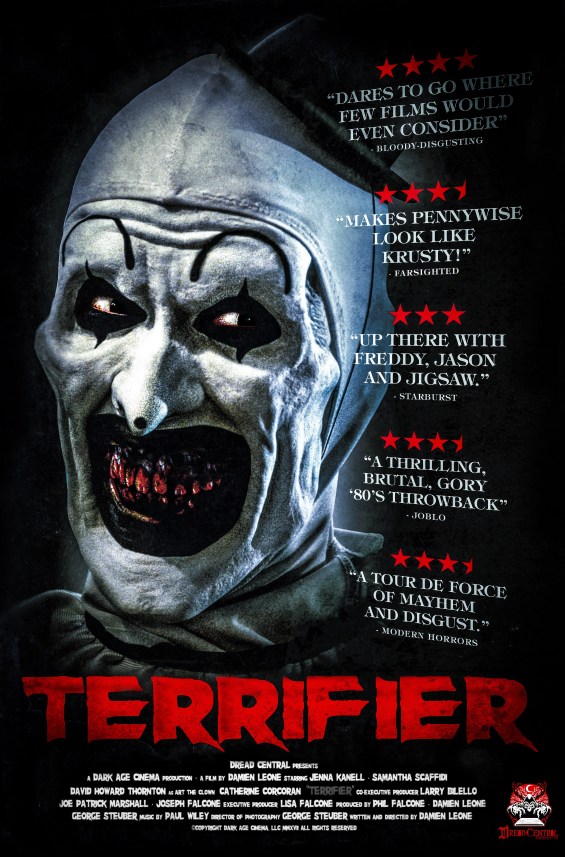
Terrifier (2016) – Film Review

“What? Did You Think He Was Gonna Hack Me up Into Little Pieces or Something?” – Dawn

Grisly, taut and seasonally atmospheric, Terrifier, released in 2016, aims to pay homage to the inexpensive slasher flicks of the 1980s, relishing in the same simplistic approach and over-the-top gore that classic horrors like Friday the 13th and Blood Harvest specialised in. And while the film does admittedly fall prey to many of the usual limitations low-budget horrors tend to have, Terrifier is preserved through a genuinely terrifying performance from David Howard Thornton as Art the Clown, in addition to plenty of fantastically gruesome effects and a willingness from writer-director Damien Leone (All Hallows’ EveFrankenstein vs. The Mummy) to push on-screen violence to its limit.

Plot Summary: On Halloween night, Tara Heyes and her best friend, Dawn, find themselves in the wrong place at the wrong time as they become the unfortunate marks of Art the Clown, a demented serial killer with a morbid sense of humour…

With coulrophobia (the name allocated to the fear of clowns) being one of the most common phobias in the world, it makes sense that the horror genre would try to capitalise on this widespread fear of individuals with white face paint, comical horns and oversized shoes. And if there’s one area Terrifier more than thrives in, it’s fully realising this common phobia as Art the Clown is consistently frightening. The film jumps from moments of complete silence as Art stares down his victims to Art violently murdering the poor souls, showering the sadistic clown’s black and white costume with blood. Terrifier isn’t actually Art the Clown’s first appearance, however, as Damien Leone first introduced the character in his second short film, which not only shared the Terrifier title, but is practically the same storyline just condensed into a brief twenty-minute runtime.

Regarding the characters, the conceited Dawn, somewhat sensible Tara Heyes, and loyal sister, Victoria Heyes, portrayed by Catherine Corcoran, Jenna Kanell and Samantha Scaffidi, respectively, all serve an important purpose within the narrative. Yet, the characters themselves never attain a status beyond generic slasher victim, and although each of the actress’ screams of terror sound as suitably realistic as a director could hope for, the delivery of some lines (specifically from the supporting cast) feels rather clunky. But, the true star of the film is undoubtedly David Howard Thornton as Art the Clown, as Thornton ceaselessly stays in character as the psychotic, clown-dressed murderer, portraying Art as a fun-loving mime whose killings involve a combination of predatory sadism and joyful glee. So much so, that Art will make many audience members nervous purely due to his unpredictability, as the character’s manic actions make it almost impossible to predict what he’ll do next.

On a technical level, Terrifier is top-notch considering its thin budget, as whilst the cinematography by George Steuber is far from groundbreaking, the film has a reasonable amount of creative shots, the majority of which are enhanced by the film’s highly saturated colour palette, thin layer of granularity and scenes primarily lit by natural light, providing the film with an authentic low-budget ’80s appeal. And, as previously mentioned, Terrifier does not hold back when it comes to brutality and depravity, certifying the film as one not for the faint of heart as the gore effects are gut-churning and grotesque, with the amount of labour and detail that has gone into each effect being more than deserving of applause, especially when once again acknowledging the film’s budget, which is estimated to have been around £73,000.

The original score by Paul Wiley is a triumphant blend of 2010 and 1980s horror scores, with tracks such as In Pieces and Clown Car standing as daunting and metallic-sounding pieces similar to many modern horror scores, whereas tracks like Kill Horn and the film’s central theme, simply titled; Terrifier Theme, are reminiscent of the original Halloween score in more ways than one, which by no means a poor comparison when it comes to unnerving horror soundtracks.

These connections to past genre films continue further into the film’s visuals as Damien Leone inserts many explicit nods and visual tributes to everything from Psycho (1960) to Hostel (2005) to everything in-between. And, whilst some may not like when a film relies so heavily on pastiche, it never feels overdone in Terrifier, as the film strikes a satisfying balance between throwbacks and unique ideas, occasionally playing with the conventions of slashers by adding some twists to the killer and final girl dynamic, which will most definitely catch some audience members off-guard.

In summary, Terrifier has plenty of entertainment value should you fit into the film’s principal audience as this modern slasher is an unabashed reminder of the bloodthirsty horror films that populated the 1980s, a.k.a. the kind of nasty flicks that were banned during the video-nasty era. The film has its issue, undeniably, most notably with its shortage of interesting characters and often oversimplified story. But, Terrifier does make the most of its foreboding atmosphere and unsettling killer. While watching, it also quickly becomes clear that Damien Leone wants Art the Clown to join the ranks of Jason Voorhees and Michael Myers as a horror icon in the future, which I think is more than feasible given his appearance in Terrifier, so I’d say it really depends on how the horror community feel about the film years down the line. Rating: high 6/10.

terrifier-p1080489

The Final Girls (2015) – Film Review

“I Can’t Believe We’re Just Gonna Casually Watch Someone Get Murdered. What Is This, Detroit?” – Vicki Summers

An affectionate nod and occasional parody of 1980s slashers and their associated tropes, The Final Girls, released in 2015, may not be as inspired or as tonally consistent as the similarly self-mocking likes of The Cabin in the Woods (2011), Behind the Mask: The Rise of Leslie Vernon (2006) or the iconic 1996 slasher; Scream. But, with plenty of humorous moments, some stellar visuals, and a surprisingly strong layer of emotion tying together all of the film’s meta amusement, The Final Girls is sure to delight any admirer of the gruesome subgenre, even if the film focuses far more effort towards being a comedy than a nostalgic horror.

Plot Summary: When Max Cartwright and her friends reluctantly attend a tribute screening of the notorious 1980s slasher Camp Bloodbath, a film that starred Max’s late mother, the group are transported into the cult horror flick. Now reunited with an on-screen version of her mother, Max and her friends must join forces with the ill-fated camp counsellors to confront the film’s machete-wielding killer and survive the ninety-two-minute runtime…

Directed by Todd Strauss-Schulson (Drunks vs. Highs, Zombies and Cheerleaders, Isn’t It Romantic) and co-written by M.A. Fortin and Joshua John Miller, The Final Girls does a fantastic job of capturing all the aspects of ’80s slashers in a way that highlights the hilarity of their predictability, whilst still respecting the subgenre, from one character losing her virginity and thus, instantly condemning herself to a violent death, to each of the camp counsellors fitting into one of several slasher stereotypes, e.g. the Jock and the Harlot, etc. The screenplay gets plenty of mileage out of playing with the clichés we all know from the slasher flicks of old. Still, it’s undeniable that the influence for The Final Girls is the Friday the 13th series, as the films share many, many similarities in everything from structure to sound design.

The cast for The Final Girls is extensive, as the screenplay balances the characters from the real world and the over-the-top personalities from Camp Bloodbath, who are intentionally written as walking clichés, with the film placing most of its attention toward developing Max and her mother, Amanda, portrayed by Taissa Farmiga and Malin Akerman, respectively. And, their relationship is where the majority of the story’s poignant scenes come from, as after losing her mother in a tragic car crash three years earlier, Max finally sees her chance to save her, or at least, the on-screen version of her, through saving the fictional character of Nancy from her grim fate, a sweet-souled, unaware shadow of actress Amanda Cartwright. However, while the pairs’ performances are superb, along with the rest of the cast of Alexander Ludwig, Alia Shawkat, Nina Dobrev, Thomas Middleditch, Angela Trimbur (and more), Adam Devine is horribly miscast as Kurt, the sportsman-type character, as, instead of being an athletic, perverted jock, Devine comes across as far more pathetic and obnoxious than he should, almost as if he isn’t fully aware of what slasher archetype he is supposed to be portraying.

Other than some briefly utilised CGI, which has noticeably aged very poorly. A large portion of the visuals throughout The Final Girls are impressive yet not always authentic to the ’80s time-period, as the cinematography by Elie Smolkin allows the camera to swerve, zoom and spin around the characters, all the while, the film’s colour palette is either immensely vibrant or exclusively black and white for whenever a flashback to the killer’s origin story is called for. Moreover, the film features several creative sequences, including a tooling-up montage and a slow-motion chase, both of which not only add to the film’s style but are also terrifically edited.

Though lacking a central theme like many iconic slashers from the 1980s, the original score by Gregory James Jenkins and Eddy Zak is like a musical time-capsule of sounds that are no longer used within the horror genre, as tracks like The Diaphragm Van and Puttin’ It Together are easy-on-the-ears synth tracks that whilst competent and reminiscent of ’80s horror scores, never quite manage to surpass any of their inspirations.

Unfortunately, despite all these positives, The Final Girls isn’t an impeccable horror-comedy, as even with its brief runtime, the film does lose a bit of steam during its last third or so, as the story begins to fall into less inventive territory as the body count rises. Still, the screenwriters find ways to integrate a clever surprise or two, such as the cliffhanger ending, which alludes to the prospect of a money-grubbing sequel, titled; Camp Bloodbath 2: Cruel Summer. The second primary issue The Final Girls suffers from is its almost complete absence of violence/gore, as aside from one or two shots of dripping blood, for a slasher, Camp Bloodbath seems somewhat family-friendly, which, in my opinion, is a huge misstep in light of the slasher subgenre being well-known for its excessive amounts of blood and guts.

In summary, with much of The Final Girls essentially being a film-within-a-film, it’s entirely plausible that this horror-comedy could’ve declined into nothing but constant fourth-wall-breaking jokes and pop culture references. Yet, through its engaging story and facetious writing, The Final Girls successfully deconstructs the slasher subgenre without the cynicism that could render a comedy into an unsurprising, humourless snore. Rating: 7/10.

the_final_girls-p1011432

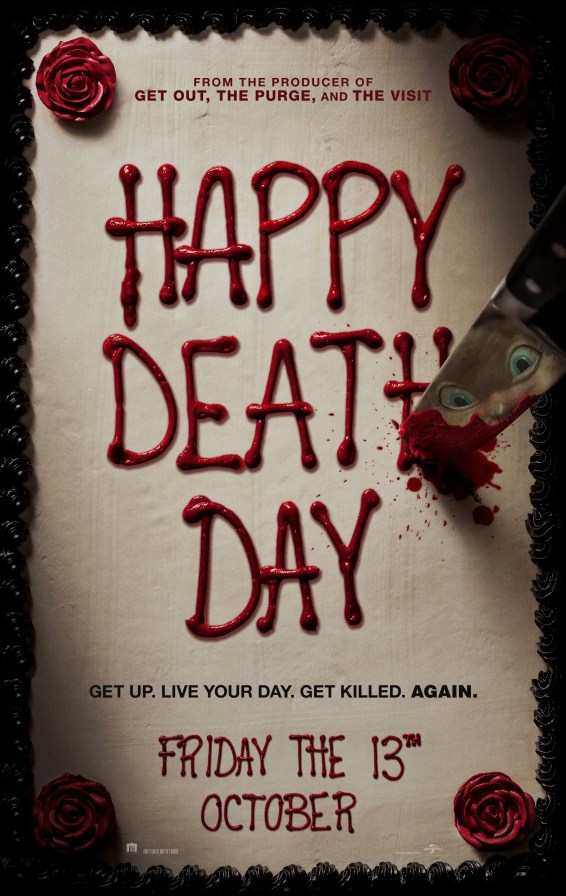
Happy Death Day (2017) – Film Review

Another horror flick from production company Blumhouse Pictures, ‘Happy Death Day,’ released in 2017, does at least extend out of the usual range of Blumhouse horrors to become more of a horror-comedy than just a straightforward teen slasher. But, similar to the rest of their associated franchises, e.g. ‘Insidious,’ ‘The Purge’ and ‘Paranormal Activity,’ both ‘Happy Death Day’ and it’s sequel, have their fair share of issues, with some being far more severe than others.

Plot Summary: Waking up in the dorm room of a boy whose name she can’t remember after a night of heavy drinking, self-centered college student; ‘Tree Gelbman,’ intends to continue her trend of avoiding her birthday, but little does she know that later that night on her way to another party, someone is waiting to murder her. Only after being killed, ‘Tree’ awakens in the same dorm room, soon realising she is being forced to relive her brutal night of murder over-and-over again until she discovers her killer’s identity…

‘Happy Death Day’ similar to many other day-repeating stories in the past, takes most of its inspiration from the comedy classic; ‘Groundhog Day,’ from 1993. Yet, unlike many of the other films that are inspired by this beloved comedy flick, it becomes clear over time that ‘Happy Death Day’ is quite derivative of ‘Groundhog Day,’ as the film’s story not only utilises the comedy’s plot without much innovation (only throwing a killer into the mix). But, the film even steals the main point of the narrative, that being its main character and their correlating character arc, using the time-looping concept to in a way punish the protagonist for their cruel behaviour towards others.

In spite of this, however, the protagonist; ‘Tree,’ portrayed by Jessica Rothe, is by far the best element of the film, as while ‘Tree’ does go through a character arc that is all-too-familiar as previously mentioned, Rothe makes a fantastic first outing as an actress through her very enjoyable performance. Then, of course, there is the killer, whose identity remains a mystery throughout most of the runtime, known as ‘The Babyface Killer,’ the killer’s outfit is actually the mascot of ‘Bayfield University,’ where the film takes place, and although the costume itself is far more goofy then intimidating, the mask/costume was actually designed by Tony Gardner. The costume designer behind the now-iconic; ‘Ghostface,’ costume from the ‘Scream’ series, which does help redeem to the killer’s undoubtedly petty motivation.

The film’s cinematography by Toby Oliver isn’t anything amazing, but does back up the story effectively in a variety of scenes. Whether that’s through its use of wide sweeping shots when the characters are in an intense chase, or when more shaky hand-held camerawork is used to reflect ‘Tree’s breakdown when she first realises she is stuck in her current crisis. Yet, similar to much of its story, the film never leans enough into a more outlandish/experimental nature when considering what the film could accomplish with its cinematography.

Talented composer Bear McCreary handles the film’s original score, which isn’t very distinctive from most of his other work within the horror genre. But, despite the score’s lack of memorability, it still does feel as if there is a decent amount of effort put into it, as the soundtrack actually has quite a lot of range even if some of the tracks don’t always fit with the tone of the film. This also goes for many of the songs used throughout ‘Happy Death Day,’ as nearly all of the film’s song choices massively differ in both genre and general popularity.

Still, the biggest problem ‘Happy Death Day’ suffers from is the inconsistency of its tone, as although the film does attempt to have scenes featuring both scares and humour, alike, many of the film’s jump-scares and jokes range in quality, and occasionally even cancel each other out. Additionally, the film also takes an unusual approach to its violence, as while ‘Tree’ dies countless times throughout the film in a number of different ways. The film never allows for any creative or darkly amusing deaths, due to its lack of any blood or gore. Yet, this wasn’t always the case, as the original screenplay for the film did actually include more violence, so much so, in fact, that it would have gained the film a higher age rating, with plenty of scenes having much grislier deaths that were later altered by director Christopher Landon (Paranormal Activity: The Marked Ones, Scouts Guide to the Zombie Apocalypse) during pre-production.

In summary, whilst the signature performance from Jessica Rothe does help to make ‘Happy Death Day’ a far more enjoyable viewing, in addition to the film’s idea of a protagonist being repeatedly murdered having plenty of potential for a horror-comedy. The film just doesn’t do enough with its story, feeling almost as if its a little restrictive on itself, never delving enough into being either funny or freighting respectively. So, if you desire an amusing horror-comedy to stick on one evening, maybe just go back to your more accustomed choices over this mediocre slasher. Final Rating: 5/10.

happy_death_day_xxlg

Maniac (2012) – Film Review

Directed by Franck Khalfoun (P2, I Lived, Amityville: The Awakening) and shot almost entirely through a first-person perspective, 2012’s ‘Maniac’ is a unique and extremely innovative slasher that has been enormously overlooked by fans of modern horror. While the film does admittedly have its issues, the impressive visuals and timid yet creepy performance from Elijah Wood surely make up for most of them, quickly resulting in a discomforting dive into the sadistic mind of a serial killer.

Plot Summary: After working his day job at a mannequin restoration store, the mentally ill and isolated, ‘Frank’ takes to the dark streets of Los Angeles as a serial killer with a fetish for female scalps. But, when a young artist asks him for help with her new exhibition, ‘Frank’s obsessions begin to consume him…

Although it takes a different approach to its story, ‘Maniac’ is actually a remake of the classic 1980 slasher of the same name. However, this is one of the rare occasions where I believe that the remake is possibly an improvement over the original film, as while the ’80s flick does feature plenty of over-the-top gore, the film never manages to elevate itself from being just a fairly straightforward slasher, and although it’s maybe not always successful, the remake does attempt to further develop ‘Frank’ as a character as well as exploring themes of mental health, parental ignorance and identity loss throughout its runtime.

Elijah Wood, best known for his role as ‘Frodo’ in ‘The Lord of the Rings’ series, portrays the serial killer protagonist, ‘Frank,’ as awkward and almost dry at points, making ‘Frank’ feel incredibly deranged when he interacts with other characters. Most notably, the artist and photographer, ‘Anna,’ portrayed by Nora Arnezeder, who is a clear contrast to ‘Frank’ in the way she portrays her simplistic yet likeable and innocent character, completely unaware of ‘Frank’s dark deeds as she grows closer and closer to him. The performances are slightly dragged down by writing throughout the film, however, as although the dialogue is decent for the most part, the film does still have the odd unusual line.

As previously mentioned, the remake of ‘Maniac’ is also shot nearly entirely through P.O.V. shots and it’s this cinematography by Maxime Alexandre that really makes the film stand out from many other slashers. Whilst watching the film, you can’t help but feel the tension as ‘Frank’ goes on dates or has conversations with women who we know will soon meet a gruesome fate, as the audience is fully aware of his sinister intentions, the film almost makes you feel hostage to ‘Frank’s mind. That being said, the film does sometimes take you out of the experience when it leaves the P.O.V. format for a few seconds. While I understand why the film does this (as it’s usually at crucial points within the narrative), I personally feel keeping the audience restricted to looking through ‘Frank’s eyes would’ve made the film more compelling, especially since we don’t even see ‘Frank’s face until twelve minutes into the film.

Serving as a great throwback to the classic ’80s film it’s based on, in addition to adding too many of the film’s best moments. The original score by Robin Coudert (or merely Rob, as he is usually credited) is a slick synth soundtrack. Utilising electronic waves, this underrated score is certainly a high point of the film, with my two favourite tracks; ‘Doll’ and ‘Haunted,’ both being incredibly memorable in their own right, almost feeling as if they were ripped straight from any of the iconic horrors of the 1980s.

Extremely violent and disturbing throughout, ‘Maniac’ truly pulls no punches when delving into the mind of its serial killer, meaning many viewers may be put off by the film’s highly gory deaths and unnerving murder scenes, as ‘Frank’ disposes of his victims with little remorse, dark memories of his mother during childhood fuel his violent actions. This is also where many of the film’s more bizarre moments come into play, as although it may surprise some viewers, ‘Maniac’ is partly an arthouse film as well as a slasher, as the film’s underlying themes as well as ‘Frank’s broken mind is usually displayed visually throughout the film in a variety of ways. Unfortunately, this leads to the film’s weakest aspect, however, as during many of these anomalous scenes, the film’s editing can become quite erratic, sometimes even placing cuts mid-conversation.

In summary, I deeply enjoy ‘Maniac,’ even though the film is quite problematic in some areas, mostly in regard to its unusual editing choices and occasionally lines of strange dialogue. ‘Maniac’s memorable original score, intense violence and, of course, captivating cinematography through its use of P.O.V. The film stands as definitely one of the better horror remakes in recent memory. And, although I probably wouldn’t recommend ‘Maniac’ to everyone, if you’re preferred realm of the horror genre is gory slashers, then this inventive flick is certainly not one to miss. Final Rating: 7/10.

maniac-p797147

Halloween (2018) – Film Review

Confusingly titled; ‘Halloween,’ despite not being a remake, this direct sequel to John Carpenter’s 1978 classic ignores all the other entries in the franchise in favour of telling a completely new story set forty years later, with Jamie Lee Curtis even returning to her iconic character of ‘Laurie Strode,’ now much older and much wiser. Yet, while definitely a decent attempt at continuing the ‘Halloween’ series, the film is still far from perfect.

Plot Summary: ‘Laurie Strode’ confronts her long-time foe, ‘Michael Myers,’ once again, as the masked figure who has haunted her since she narrowly escaped his killing spree on Halloween night four decades ago, now begins a new massacre after his recent prison escape…

Although the film’s narrative does have some interesting ideas, the film always felt a little too familiar to me, as I usually found myself correctly predicting what was around the next corner, leaving little to be surprised by. Under the direction of David Gordon Green, best known for his 2017 drama; ‘Stronger.’ The film does pay plenty of respect to the original film, as can always tell whilst watching that Green does have a passion for this horror franchise (as he clearly understands what made the original work so well). I still feel a better director could’ve been chosen, as at points, the story does seem to be slightly lacking in direction, and with his previous work in mind, it’s clear that he doesn’t specialise in horror.

It is great, however, to see Jamie Lee Curtis back as her classic character once again, as she really excels in showing how ‘Laurie Strode’ has been affected by those horrific events many years ago. Alongside the rest of the great cast of Judy Greer, Andi Matichak, Will Patton and especially Haluk Bilginer as ‘Dr. Sartain,’ who I was initially concerned would be nothing more than another ‘Dr. Loomis’ type character, but did actually end up going in a very different direction.

The cinematography by Michael Simmonds is nothing outstanding for the majority of the film, yet is still attractive when combined with the dark lighting throughout, particularly anytime ‘Michael’ is on-screen. Another strong element of the film is the wonderful original score by John Carpenter, his son Cody Carpenter and Daniel A. Davies, as although the soundtrack does slightly rely on tracks from the original film, there is plenty of new tracks here as well. Proving John Carpenter is brilliant at his craft once again, with the tracks; ‘The Shape Hunts Allyson’ and ‘The Shape Burns,’ being some of Carpenter’s best work in a long time, in my opinion.

One of the strongest elements of the film for me are definitely the kills, as it’s clear the filmmakers got very creative with the ways ‘Michael Myers’ disposes of his victims, usually creating very memorable scenes with some fantastic practical gore effects included. I also felt the film represented the iconic slasher very well, as ‘Michael Myers’ is always intimidating through his movements, ‘Michael’ even manages to steal the film for me by being the main focus of my personal favourite scene of the film, as ‘The Shape’ stalks his way through Haddonfield’ with murderous intent, all completed within a single take.

Being produced by Blumhouse Pictures, ‘Halloween’ also, unfortunately, features the company’s usual pandering to younger audiences you’d come to expect by now, as the film is littered with jump-scares throughout the runtime, with little attempt to create an eerie atmosphere or build large amounts of tension. In addition to this, the writing throughout the film is decent when it comes to the characters but usually is very lacking when the film attempts comedy, resulting in plenty of cringey lines of dialogue and out-of-place jokes.

In summary, 2018’s ‘Halloween’ is mostly enjoyable, but with a lack of originality, some cheesy lines and forced comedy (not to mention its strong overreliance on jump-scares) the film doesn’t even come close to replicating the classic horror’s best qualities. I do hold the original film in high regard, of course (it being one of my personal favourite horrors), but with plenty of entertaining moments throughout, this latest entry in the ‘Halloween’ series is definitely on the higher end of classic horror sequels. Final Rating: low 7/10.

halloween_xxlg.jpg