World War Z (2013) – Film Review

Very loosely based on the novel of the same name by Max Brooks, ‘World War Z,’ directed by Marc Forster, attempts to tell an enormous globe-trotting story of a spreading virus, and although it does have a few entertaining elements here and there, so much so that it was one of the highest grossing films of 2013. I personally found the film to be extremely messy, and, in general, rather forgettable.

Plot Summary: After narrowly escaping an attack in Philadelphia, former United Nations employee, ‘Gerry Lane,’ traverses the world in a race against time to stop a deadly pandemic that is toppling armies and governments, soon threatening the survival of humanity itself…

Even with a pretty standard plot for a zombie flick, the film is, unfortunately, still brimming with plenty of cliché moments and jump-scares throughout, in addition, of course, to the film’s overall lack of style. Making the entire experience really struggle to stand on its own amongst the many other films within its genre, which I do feel can be mostly put down to director Marc Forster (Finding Neverland, Stranger Than Fiction, Christopher Robin).

Brad Pitt, Mireille Enos both do a decent job as ‘Gerry’ and ‘Karin Lane’ within the film, despite their characters having pretty much no characterisation outside of them being a loving family. Their children, however, portrayed by Sterling Jerins and Abigail Hargrove. I found very irritating, as aside from their constant screaming and crying, their child performances weren’t very convincing to me at all. Strangely, Peter Capaldi also has a small role within the film, despite barley adding anything to the narrative.

Ben Seresin handles the cinematography throughout the film, and aside from a few scenes were hand-held camera techniques are used to reflect the chaos we see during many of the infected’s attacks, many of the visuals are extremely flat, as the cinematography is very bland and uninspired, usually sticking to very standard shots and never really experimenting with anything incredibly interesting. The CG effects throughout the film’s runtime are also very inconsistent, as in some scenes the visual effects work perfectly fine. Whereas in others, they look truly awful, with many of the infected bouncing around as if they were made out of rubber. I do appreciate the various aerial shots which are used during many of these scenes, however, as I feel these shots really incapsulate the enormous scale of the film’s devastating pandemic.

The film’s original score by Marco Beltrami is decent overall, it works within the film to increase what tension and drama there is on-screen. But, outside of the film, it isn’t memorable in the slightest. Coming off as your standard blockbuster soundtrack with the occasional ‘Inception’ noise thrown in for good measure, it is very possible the score was rushed, as for those who may not know, ‘World War Z’ actually went through a very troubled production process, as multiple different directors, writers and producers were brought onboard and then dropped off constantly. This is mostly why the film sometimes feels very unconnected and messy (which also isn’t helped by its quick pacing). Taking this into account, the film definitely could’ve been far worse, but I still found it very noticeable.

Despite all of this, the film does still have some elements I enjoy, as it is simply fun to watch the madness ensue at various points during the film, as the hordes of infected bring chaos to the streets of whatever city the film finds itself in. My favourite scene within the film is definitely near it’s ending, as the film takes a very different direction in choosing to focus on a small tension-filled scenario, which I thought was decently well-executed for the most part. That said, most of the climax is remarkably dull, grinding the film’s pacing to a halt to focus on a small group of infected over an exciting, climatic set-piece.

In summary, ‘World War Z’ isn’t the worst big-budget film you could spend your time watching, it definitely has a variety of problems. From the predictable and generic plot, to the boring characters and the mix of poor CG effects and writing. Which all ensured that I wasn’t such a huge fan, but if you enjoy a mindless zombie blockbuster every so often, then there may be some enjoyment in this for you. But, for me personally, ‘World War Z’ simply felt like a hollow experience, and is nothing more than a generic zombie flick when it’s at it’s best. Final Rating: 3/10.

world_war_z_ver3_xlg

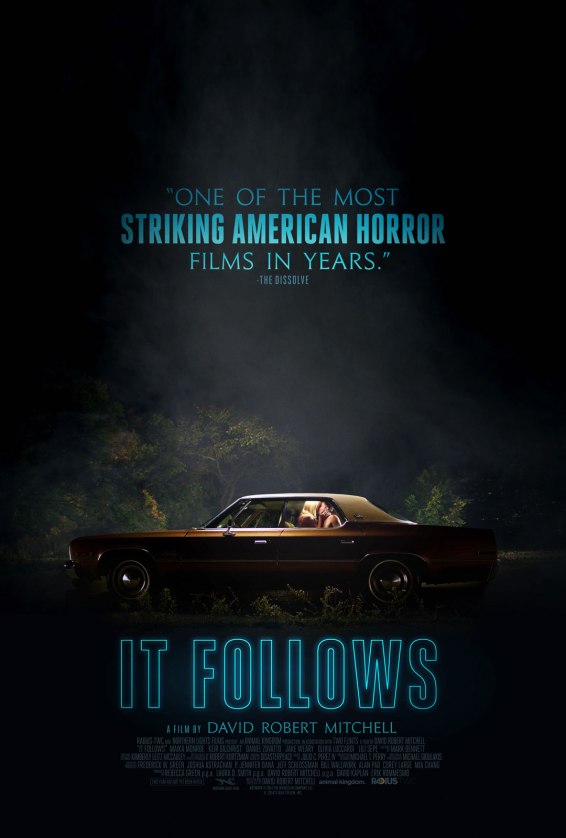
It Follows (2015) – Film Review

‘It Follows’ is easily one of my favourite modern horrors to date, as the film utilises some amazing cinematography by Mike Gioulakis, alongside an extremely eerie atmosphere and some decent performances. All tied in perfectly with an original and engaging story, resulting in a film that’s both very memorable, and very tense throughout.

Plot Summary: After a seemingly innocent sexual encounter, teenager ‘Jay’ finds herself plagued by strange visions and the inescapable sense that someone (or something) is following her. Faced with this burden, ‘Jay’ and her friends must find a way to escape their new nightmare, that seems to always be just a few steps behind…

Mostly due to the direction by David Robert Mitchell (The Myth of the American Sleepover, Under the Silver Lake), ‘It Follows’ feels very polished throughout, as every scene usually plays out very slowly, always using the screen-time to build more tension, which I quite enjoyed, I also found the underlying themes of the film very interesting, as the film’s narrative subtly explores ideas of sexual diseases through its unique plot. However, one element of David’s direction I personally don’t like is the lack of any specific time-period for the film’s setting, as although the majority of the film does feel like a classic 1980s monster flick, the film constantly shows many modern devices and cars, in addition to a variety of old horror films on ‘Jay’s television. Making the film feel very inconsistent, despite this being an intentional decision.

As a cast of mostly unknown actors, Keir Gilchrist, Daniel Zovatto, Lili Sepe, and Olivia Luccardi all give decent performances here, as while nothing truly phenomenal of note, all the characters do feel as if they have chemistry with each other, with Maika Monroe being the obvious stand out, of course, as although her character doesn’t get much development, she portrays ‘Jay’ quite well, coming off as a mostly innocent and likeable teenager.

The cinematography by Mike Gioulakis is nothing short of brilliant, especially in regards to many other horrors. As aside from a few too many hand-held shots, the film constantly uses the camera to build tension and paranoia throughout the entirety of its tight runtime, as in addition to filling the film with a variety of beautiful shots (many of which contain large amounts of movement). The film also uses plenty of P.O.V. shots to see through ‘Jay’s eyes, placing the audience in the terrifying position of the protagonist themselves. ‘It Follows’ is also mainly using wide-angle lenses, which according to David Robert Mitchell, was done in order to give the film a more expansive, intimidating feel.

One of my favourite aspects of the film is definitely the original score by ‘Disasterpeace,’ as this synth score (which was composed in only three weeks) really lends itself well to the film’s eerie atmosphere, creating an original soundtrack which is just as tense and chaotic as it is memorable. This does fall back on the problem of the film not being set within the ’80s again, however, as this original score would fit in perfectly, especially with the tracks; ‘Heels,’ ‘Title,’ ‘Jay’ and ‘Pool.’

As opposed to many other modern horrors, ‘It Follows’ has a noticeable lack of jump-scares, as the film is usually in favour of attempting to use simple yet creepy visuals hidden within the background of shots, which really gives the film a very fresh feel. ‘It Follows’ also separates itself from many other modern horrors by having many of the scenes involving the creature take place during the daytime and/or in locations such as a bright sandy beach or even ‘Jay’s bedroom, locations many would think to be safe for our characters.

In summary, I truly enjoy ‘It Follows’ from beginning-to-end, as the film is a genuine horror experience which takes risks and doesn’t simply feel like more of the same ideas we have seen before, as the fantastic cinematography and original score help create a film that we keep any horror fan engaged in this thrilling story, and while the film may not be entirely flawless, I really do hope more films within this genre can succeed as well as this one does. Final Rating: 8/10.

it-follows-poster

Free Fire (2017) – Film Review

An interesting film for sure, ‘Free Fire’ directed by Ben Wheatley (Kill List, Sightseers, High-Rise), thrusts it’s audience straight into a world of blood, bullets, and amusing quips. Setting the entire story in one single location, which truly helps the film in setting itself apart from other films within its genre, and I really do appreciate the effort that went into this film in order for it to be as entertaining as it is, and whilst not perfect, the film is still mostly entertaining and amusing throughout.

Plot Summary: In an abandoned Boston warehouse in 1978, a small-scale arms deal goes awry, turning the warehouse into a chaotic fight for survival with bullets flying in every direction…

As the film is set in the 1970s, the film is littered with ’70s style. Everything from the costumes, to the original score, to even the colour palette gives fit extremely well with the film’s tone. It’s clear from the style of the film and the witty dialogue that director Ben Wheatley was obviously inspired by early Quentin Tarantino and Martin Scorsese films, which makes complete sense as crime seems to be his go-to genre for the most part.

The entire cast here are all doing a great job of fitting film’s tone, as although there are a few comedically dark moments, the film is mostly light-hearted, as the cast’s performances back up this tone very well, giving the film an over-the-top and comedic outlook on the situation. I also enjoyed the sound design for the weapons in this picture, as I felt like each gunshot actually had an impact, not just that the actors were playing with props. I would say Armie Hammer as ‘Ord’ as well as Cillian Murphy as ‘Chris’ were easily my personal favourites of the cast, as I always found myself enjoying their very charismatic and cocky personas throughout the runtime.

Despite it being nothing amazing, the cinematography by Laurie Rose is decent enough throughout the majority of the film. Although I do believe there is a bit too much of a reliance of a hand-held camera at points, as I feel a still shot would be welcome more than a few times and as already mentioned, the original score by Geoff Barrow backs up that time-period very well. However, the soundtrack itself is pretty forgettable outside the rest of the film.

The best compliment I can give this film is without a doubt the writing, as even though the characters get barely any development throughout the narrative (relying mostly on the actor’s charismatic performances) the writing never fails to implement humour, or extremely tense scenarios nearing the end of the film. This is a shame, however, as I do feel a character arc would have worked very effectively for one of the greedy, egotistical characters on display.

In summary, I would say I enjoyed ‘Free Fire.’ The film definitely isn’t perfect due to its weak characterisation, overreliance on hand-held shots and maybe a few missed jokes here and there. But, still an enjoyable watch, and a nice 1970s throwback, nevertheless, plus the original concept of the narrative always intrigued me, and must be appreciated for its creativity alone. Final Rating: 6/10.

free_fire_ver18_xlg

Bird Box (2018) – Film Review

‘Bird Box’ is based on the novel of the same name by Josh Malerman, which mostly aims to be a dark horror/thriller with an original and twisted story as well as a few other interesting aspects in regards to its filmmaking. Unfortunately, however, the film soon falls into a pit of disappointment which it really struggles to escape from, resulting in ‘Bird Box’ becoming nothing more than another generic Netflix fright-fest.

Plot Summary: In the wake of an unknown global terror, a mother must find the strength to flee with her two children down a treacherous river in search of safety. Yet, due to the unseen deadly forces pursuing them, the perilous journey must be made blind-folded…

As the film jumps back-and-forth between the two different time-periods, the film’s structure can become very frustrating at points, as I personally found the initial chaotic event far more entertaining than the other time-period the film provides, yet this was always cut short as the film continuously cuts between the two at unusual points. The film also chooses to wrap the majority of its story in mystery, never really exploring what the monsters actually are, or how their abilities work. The film even chooses to never actually show the creatures on-screen at all throughout the runtime, and although I agree that not everything has to be explained within a story, the way ‘Bird Box’ presents it makes it nothing but frustrating as the film introduces questions without answers.

Sandra Bullock portrays a struggling mother alongside Danielle Macdonald, Trevante Rhodes and John Malkovich who all portray people attempting to survive in a brutal world, and they do their best considering the weak characters they had to work with. The majority of the supporting cast are also decent, with Sarah Paulson even having a short appearance within the film. However, I actually found she was incredibly wasted in the small (and mostly pointless) role she had within the narrative.

In spite of the film’s many wilderness scenes being shot near the beautiful Smith River in the far north of California. Nearly the entire visual presentation of ‘Bird Box,’ is extremely dull, as the cinematography by Salvatore Totino and editing Ben Lester never really excel beyond ‘okay.’ Usually having scenes consist of many boring shots which never really add much to the tension or atmosphere aside from the occasional moment, this, of course, also alongside the extremely bland grey colour palette.

This is also the case when it comes to the original score by Trent Reznor and Atticus Ross, coming across as nothing more than your standard score for any modern horror/thriller with a slight technological twist, which is very surprising, considering these composers did excellent work on the soundtrack for ‘The Social Network,’ back in 2010.

Although the novel obviously came out before last year’s ‘A Quiet Place,’ I also couldn’t help but notice many similarities between the two films. Such as the lack of a certain sense, the apocalyptic setting, a theme of family and the eerie atmosphere/tone (despite the idea of the monsters making you kill yourself being very original). I also couldn’t help but feel the film never made enough use of its concept of simply witnessing the creatures drives characters to suicide, as this is a terrifying idea, and could’ve provided some very gory and truly shocking moments.

In summary, ‘Bird Box’ is one of those few films that gets a large amount of attention for reasons I’m not entirely sure of, as personally, I thought the film was nothing but bland and forgettable in many aspects. Aside from perhaps the main performance by Sandra Bullock and the original idea of its story. There wasn’t much I enjoyed about this adaptation, perhaps give it a watch if you’re really interested, but, in my opinion, there are many similar films which explore these same ideas just with a much better execution. Final Rating: 3/10.

bird_box_xxlg

Wish Upon (2017) – Film Review

A hilariously awful attempt at horror, ‘Wish Upon’ comes to us from director John R. Leonetti, mostly known for his cinematography on the first two ‘Insidious’ films as well as the first entry in ‘The Conjuring’ series. With him now recently delving his hand into directing, working on films such as ‘Annabelle,’ ‘The Silence’ and obviously ‘Wish Upon.’ However, after watching all of these films, I think I would really rather he just stick to cinematography from now on.

Plot Summary: When teenager Clare Shannon discovers an old music box that carries strange abilities and can grant her any wish she desires, she believes all her dreams have come true. That is until, she realises that there is a deadly price for each one…

Although the film’s plot does take inspiration from W.W. Jacobs’ iconic short story; ‘The Monkey Paw,’ ‘Wish Upon’ itself rarely feels like an actual horror film. Of course, the fact that the film has little-to-no atmosphere as well as an enormous amount of weak jump-scares throughout, it’s very clear that this film was clearly meant to pander towards horror-loving teenagers. ‘Wish Upon’ is truly one of the least tense horrors I’ve watched in a very long time, even being unintentionally hilarious at various points.

This is also one of the few films where I can safely say that every character in the film is not only poorly portrayed, but also incredibly stupid. As the entire cast of Ki Hong Lee, Sydney Park, Shannon Purser and, of course, Joey King as the protagonist, ‘Clare Shannon.’ All make ridiculous decisions throughout the entire runtime, in addition to never really acting very intensely to anything, no matter what it may be. The writing also doesn’t help, however, as none of the characters in the film talk like actual teenagers, and the screenplay is full of incredibly cringey, cliché and cheesy lines.

All of the cinematography throughout the film by Michael Galbraith is very bland and uninspired. Normally using just simple shots without any attempt to integrate any creepy elements into them. The lighting also doesn’t help, however, as most of the film looks like a cheaply made for TV film due to being very bright and clear throughout.

The original score by ‘tomandandy’ is your usual horror affair, with nothing really interesting or particularly memorable of note about it. However, the choice of songs throughout the film is memorable for all the wrong reasons, as the film chooses to use terrible pop music at various points during the film, which comes completely out of nowhere and ruins whatever little tension or atmosphere the film had up to that point, making the film feel almost like more of a teen comedy than a horror. Simply due to how distracting it is, this was easily the worst element of the film for me.

Only a very small detail, but I feel the only aspect of the film I actually enjoyed is the music box itself, having a very creepy and unique ancient Chinese design. It’s clear the filmmakers were trying hard to make the item iconic in its own right. Whilst obviously not truly successful with this, I still like its design, and the eerie tune that it plays as a horrific event unfolds, the film also has a very surreal and entertaining end title sequence, but this obviously adds very little to the film overall.

In summary, ‘Wish Upon’ is a true mess of a horror film, everything from the writing to the cinematography to the original score is either very poorly done or extremely dull and generic. Often coming across as unintentionally hilarious and lacking any truly terrifying scenes, ‘Wish Upon’ is far beyond saving. But, at the very least, the film does have plenty of memorable moments if you decided to watch it with some friends for a laugh. Final Rating: high 1/10.

wish_upon_xxlg

Source Code (2011) – Film Review

Talented science fiction director Duncan Jones (Moon, Warcraft, Mute) brings us an original, engaging and fast-paced sci-fi thriller with ‘Source Code.’ Combining futuristic technology, human drama and a handful of brief action sequences, all equalling to a pretty enjoyable experience, which I personally believe still holds up today, aside from a few small issues here and there.

Plot Summary: When soldier, Colter Stevens, awakens in someone else’s body, he soon discovers he’s part of an experimental government program. Created in order to find the bomber of the commuter train he is aboard. A mission he has only eight minutes to complete…

Despite this time limit, however, the film always manages to deliver its story very effectively as this sci-fi flick builds up a decent layer of mystery and tension as to who is responsible for the bombing throughout giving the film an almost mystery-type structure alongside its science fiction elements, using the story’s original ideas to their best extent as we follow our protagonist; ‘Colter,’ as he searches for his target over the course of the film, encountering many different characters on board the train along the way.

The supporting cast of Vera Farmiga, Michelle Monaghan and Jeffrey Wright all do a pretty great job throughout the film. However, Jake Gyllenhaal as ‘Colter Stevens’ is obviously the stand out, proving that he can hold his own as a leading hero, regardless of whichever genre he finds himself in. But, unfortunately, the characters within the film definitely lack development, as aside from a few short scenes, the film never really seems interested in exploring its characters any further than it needs to. Yet, with the film’s tight runtime, I definitely feel this was a missed opportunity.

The cinematography by Don Burgess is decent for the most part, never really experimenting with anything incredibly creative, but staying at a fairly decent level for the majority of the film. The original score by Chris Bacon is without a doubt the worst element of the film, however, as I simply feel the score doesn’t suit this genre of film at all. Feeling more like a soundtrack from a generic action blockbuster, rather than a slick sci-fi, such as this one. In addition, I feel the train set (where a large majority of the film takes place), could do with some improvement as although this is only a small criticism, and won’t bother most, I personally found the set to look and feel a little too much like a set at points, with the green screen view from the windows not helping towards this. But, with most of the film being shot on a soundstage in Montréal, Canada, I suppose the film we received is the best result.

The film does manage to blend many of its more outlandish sci-fi aspects with the more grounded science fiction elements very well, however, cutting between the past and the present at various points throughout the film, always utilising the lighting as well as the different sets very effectively as a terrific visual indicator for the audience. I was also surprised on my initial viewing to find that the film contains quite a few comedic moments throughout as ‘Colter’ experiences the strange reality he now finds himself in through some of his funny interactions with the various people on board the train. However, this did lead me to wonder if the film could’ve been improved should the story have fully embraced a more absurd tone, perhaps this then would’ve made the film extremely unbelievable, but I personally feel this way the film could have explored some of its interesting ideas further.

In summary, ‘Source Code’ is an enjoyable ride, as while I personally find the film much more interesting for its story and ideas as the cinematography and original score throughout the film can sometimes be a little bland and uninspired (in addition to the film’s lack of characterisation). Regardless, I still find the majority of the filmmaking pretty decent and it results in a mostly entertaining sci-fi thriller, and a pretty easy watch on a Saturday night. Final Rating: 7/10.

Source Code Poster

Ghost Stories (2018) – Film Review

Based on the West End play of the same name written by Jeremy Dyson, ‘Ghost Stories’ is a British horror directed by Jeremy Dyson and Andy Nyman, featuring many tension-filled scenes and plenty of clever story elements throughout, it’s not quite the cliché horror you might expect, as the film definitely takes a unique approach with its storytelling and ideas, and I would say I enjoyed the film quite a bit due to this, although I feel this may not be the same for everyone.

Plot Summary: Sceptical professor; ‘Phillip Goodman,’ embarks on a trip into the terrifying world of the paranormal, after he is given a file with details of three unexplained cases of apparitions to investigate…

Whilst nothing incredibly original for a horror narrative, this story does allow the film to have almost an anthology-like structure in a way, with the three separate case files all being their own contained story. The film also takes a very interesting direction for the majority of its runtime, mostly focusing on the paranoia and imagination of the human mind, and how certain tragic events throughout life can lead the mind to wander. Whilst I personally think this is a very creative way to explore paranormal encounters and the horror genre in general, I can definitely say not every horror fan would enjoy this element, as I can see many hating this film mainly due to its exploration of these ideas. This concept even plays-into title of the film, which was misspelled as ‘Ghost Stories’ in much of the pre-release media. This was done to accord with the film’s tagline; ‘The Brain Sees What it Wants to See.’

Andy Nyman portrays the main protagonist of the film (Phillip Goodman), and I’d say he does a pretty great job with the arrogant character he is given, especially being a mostly unknown actor. Then, of course, we also have Phil Whitehouse, Alex Lawther and Martin Freeman as the various victims of the cases, who I also quite enjoyed watching. All the performances here are also backed-up by the writing in the film, as I feel the writing is pretty on point here. Having many elements of dark comedy along with giving some development to the various characters and having some little pieces of information hidden within dialogue for later in the narrative.

The cinematography by Ole Bratt Birkeland is pretty impressive throughout, only having a few shots throughout the runtime which I thought were a little bland. ‘Ghost Stories’ also utilises many wide shots throughout the film which really lend themselves to the eerie atmosphere, alongside the hauntingly beautiful original score which also lends itself to the film. This time being handled by Haim Frank Ilfman, a composer who I actually hadn’t heard of before this film. But, I do hope to see his name in credits more following on from this, as the soundtrack works perfectly throughout the film, changing from emotional to tense, to chaotic, without ever feeling rushed.

My main criticism of the film is the usual issue I have with modern horrors, as while I do feel this film builds-up a lot more of an eerie atmosphere than many other horrors. The film is still littered with jump-scares, and while I do believe jump-scares can work if used to a minimal extent, here I felt many of them were just thrown in a points without much reason, the film does have plenty of visual horror however which I appreciate. Another small issue I have is the design of one of the creatures we see in the film, as to me it’s design felt very out-of-place when compared to the other paranormal entities we see within the story, but again, this is only a small issue.

In summary, ‘Ghost Stories’ is a very distinct horror film, as while I don’t think the film is perfect, I did find it pretty entertaining for the majority of my watch. Having an original story and great direction as well as many attractive shots along with some great writing and a terrific original score, I’d say the film is a definite watch for someone seeking something a little different from the horror genre. Final Rating: low 8/10.

ghost_stories_ver3_xxlg

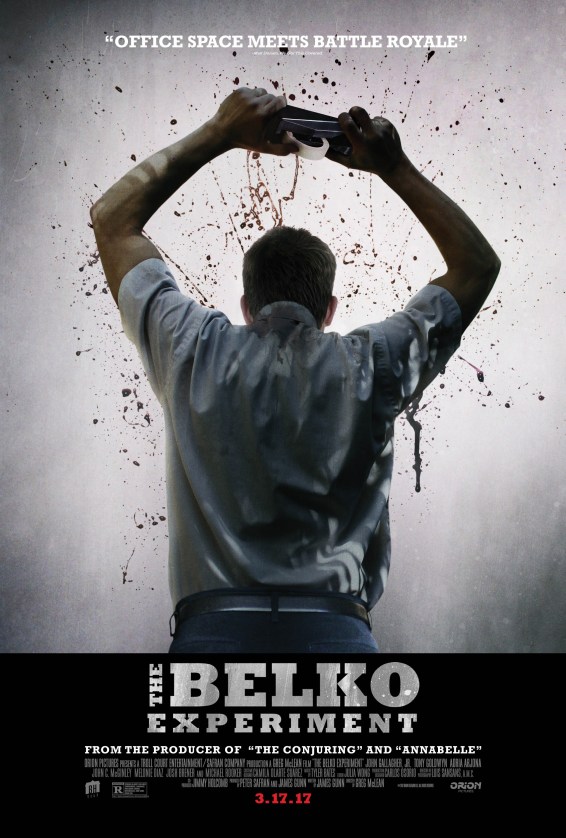
The Belko Experiment (2016) – Film Review

An intense thriller with elements of dark comedy thrown-in for good measure, ‘The Belko Experiment’ is written by ‘Guardians of the Galaxy’ and ‘Slither’ director James Gunn, and directed by Greg McLean (Wolf Creek, Rogue, Jungle). A strange combination which works surprisingly well, in my opinion, as it results in a tense, unique and fast-paced corporate thriller.

Plot Summary: In a twisted social experiment, eighty American employees are locked in their high-rise corporate office building in Bogotá, Colombia, and ordered by an unknown voice coming from the company’s intercom system to participate in a deadly game of kill or be killed. Throwing every employee into a state of panic and a question of morals…

As you can probably guess from a quick pitch of the plot, the film doesn’t hold back from throwing the audience straight into the gory chaos after only about ten to fifteen minutes of screen-time. From here, the film continues to build tension and a dreading atmosphere throughout the remainder of the film. At many points, ‘The Belko Experiment’ also dips its toes into the realm of dark comedy, not too surprising as writer James Gunn was originally set to direct as well. However, when it was time to begin filming, Gunn withdrew, deciding he didn’t want to spend several months working on such a violent film, leaving Greg McLean to bring his screenplay to the big screen.

John Gallagher Jr and Adria Arjona are the main two protagonists of the film, as well as Tony Goldwyn and John C. McGinley as the antagonists, who, are all great in their varied roles, due to there being an entire building worth of employees involved in the story, however, there’s an enormous amount of characters, which, of course, means barley any of characterisation for most of them aside from a couple of lines or the occasional scene.

Whilst the cinematography by Luis David Sansans isn’t any overly impressive, it is decently pleasing throughout the runtime and does manage to show off many of the practical gore effects within the film to their best extent. The same can not be said for the CG effects throughout the film, however, as despite not always being noticeable, there are a few moments where the CGI becomes extremely obvious due to the film’s smaller budget and can take the viewer out of the film for a moment or two. In addition to this, the original score by Tyler Bates is not very memorable or unique despite doing a decent job of building tension throughout the film, as the soundtrack rises and changes over time to fit the more tense and chaotic feel of the narrative. However, the score can also feel a little out-of-place when some of the more comedic scenes come into play, but this issue is also noticeable when it comes to the tone of the film, as despite much of the comedy actually working fairly well, the film sometimes changes from horrific imagery to humour a little too quickly.

One of the main elements of the film is obviously the gory deaths, as the story resolves pretty much completely around the deaths of the various characters, and while the film does have a few memorable moments and kills. I was a little dissatisfied with the variety, as the majority of the characters seem to die simply from gunshots, rather than the film getting creative and making better use of the office location it’s set in, perhaps by having characters use office/everyday equipment and supplies as improvised weapons.

As you may also expect with a violent setup such as this one, ‘The Belko Experiment’ also delivers on plenty of underlying themes and messages. Focusing mostly on how we react as humans to traumatic events and give in to our most primal instincts and selfish desires, and while I do wish these ideas were delved into a little further. They are present throughout the film regardless, and I did find the way the film explored the ideas of human survival pretty interesting. Even my personal favourite scene in the film (which takes place in the main reception of the building) excels at expressing these themes in pretty a brutal way.

In summary, if all you’re searching for on your Saturday night is a bit of gory, comedic excitement with a few underlying themes mixed in good measure. Then, ‘The Belko Experiment’ happily delivers, as the film is an enjoyable thrill-ride with some quick pacing and practical gore effects, regardless of some of its weak characters, CG effects and relatively simplistic story. Although it may not appeal to all, for me, I feel it’s a decent viewing experience. Final Rating: 7/10.

belko_experiment_xxlg

The Woman in Black (2012) – Film Review

Fresh off the success of the final ‘Harry Potter’ instalment, Daniel Radcliffe now takes on a paranormal horror story in this adaptation of the classic British gothic horror novel; ‘The Woman in Black,’ by Susan Hill. Yet, sadly, the film ends up being a pretty lacklustre (and even somewhat boring) experience overall.

Plot Summary: In 1906, a young solicitor travels to a remote village where he discovers the vengeful ghost of a scorned woman is terrorising the locals and stealing their children. But, as he begins to investigate further, he soon uncovers a darker history than he initially thought possible…

Although this type of plot is nothing new for the horror genre, the film does attempt to experiment slightly to engage its audience more through mystery and tension. This is especially clear in the eerie opening stinger, which is probably my favourite scene within the film, but I still personally feel the film doesn’t have quite enough experimentation to stand out that much, as I initially hoped due to its distinct British roots and story based on a successful novel, the film would be somewhat memorable. Unfortunately, the film is mostly quite bland, having a few eerie visuals, but nothing overly exceptional in terms of filmmaking.

Daniel Radcliffe portrays the protagonist of the story, ‘Arthur Kipps,’ very similar to how he has portrayed many of his other characters in the past. Coming across as a mostly likeable character with a little bit of development but nothing extremely major, this is an issue with the majority of the characters, however, which leads me onto the fairly dreadful writing throughout the film, as the film always talks directly to the audience, usually leaving no room for subtlety and coming as mostly cliché and cheesy throughout. Despite the rest of the cast of Ciarán Hinds, Janet McTeer and Liz White, also doing a decent job with what little they are given.

The cinematography by Tim Maurice-Jones is mostly fine throughout the film, having the occasional attractive shot, but never really anything overly interesting. Although I was actually impressed with a variety of the transitions throughout the films, as many of them really utilised the location they were set in very well. Interestingly, many of the music boxes and mechanical toys in the nursery scenes weren’t created for the film, but were genuine antique toys from the time-period, loaned to the production by a collector, which I feel really enhances the film’s set design. However, the film’s original score by Marco Beltrami is sadly also very mediocre, never really becoming very memorable or unique other than the occasional scene where the soundtrack is overly loud and extremely irritating.

Being a modern-day horror film, it’s also probably not much of a surprise that ‘The Women in Black’ is littered with jump-scares, with many of them even being false scares, such as birds appearing out of nowhere, slamming doors and loud screams without a source. All of this adding to the mostly weak atmosphere and many slow scenes, leaving the film with not much to offer beyond its pretty average filmmaking.

One element of the film I did enjoy is the production design, as despite the film definitely not delivering on an eerie atmosphere or well-developed characters, the film does truly feel like it is set in the twentieth century, as every location/set, prop and costume all feel used/lived-in and are very accurate to the story’s time-period. However, I’m personally not an enormous fan of the design of the title character herself, ‘The Woman in Black,’ as even although this may be more of an issue with the novel rather than the film, I find her design simply lacks in many aspects, as every-time she is on-screen she feels very generic and bland for what is attempting to be a tense paranormal horror story.

In summary, ‘The Woman in Black’ didn’t really impress me all that much, as while not completely awful, it felt very similar to 2018’s ‘Winchester,’ to me, as the film does have some great elements, yet gets completely bogged down by its overreliance on jump-scares rather than a creepy atmosphere, alongside a fairly uninteresting story and characters, and is, by the end of its runtime, a lot of wasted potential for a classic British horror. Final Rating: low 4/10.

woman_in_black_ver9_xxlg

Get Out (2017) – Film Review

Actor and comedian Jordan Peele tests his hand at directing for the first time with this intelligent thriller, as ‘Get Out’ utilises its original story and some great performances to become a definite step-up from Blumhouse Productions’ usual standard for films. However, although many viewers think this film is phenomenal throughout it’s most of its runtime, I personally don’t agree, as I actually feel there is more than a few areas in need of some improvement.

Plot Summary: When a young African-American man visits his white girlfriend’s parents for the weekend, his simmering uneasiness about their reception of him eventually reaches an extreme boiling point. Leading ‘Chris’ to believe more sinister forces may be at work…

As already mentioned, the film’s narrative is original, and any regardless of quality, I always appreciate originality when it comes to storytelling. Despite ‘Get Out’ being initially pitched and advertised a horror, however, the film is really anything but, as the film actually has many inclines of comedy mixed-in with some tension-filled moments here and there, and although the film is entertaining, ‘Get Out’ never really manages to build-up an eerie atmosphere or becomes particularly creepy, which is why I believe that the film is now classed as a thriller rather than a horror by most.

The best aspect of the film for me is by far the performances by the cast, as Daniel Kaluuya, Allison Williams, Bradley Whitford, and Catherine Keener are all exceptional throughout, with Daniel Kaluuya as the protagonist; ‘Chris Washington,’ in particular, really keeping me engaged, as he delivers a very ranged performance, managing to portray a very likeable and realistic character within only a short period of time. Unfortunately, not all of the supporting cast quite level-up to this standard.

The cinematography by Toby Oliver is a decent throughout the film, as although there are plenty of attractive shots (most of which make great use of the large open spaces the majority of the story takes place in (especially in the opening scene of the film, which is executed perfectly). There are also a variety of fairly bland shots, this may also be due to the film’s colour palette, however, as throughout the film the use of a very restrictive colour palette results in the film feeling a little visually dull, rather than using its colours to play into its story or genre.

Personally, the weakest element of the film for me is the original score by Michael Abels, as the entire soundtrack itself feels very unusual, and although unique, it usually comes off as incredibly distracting throughout many scenes within the film. Using an orchestra as well as vocals, the score attempts to reflect some of the more surreal scenes nearing the end of the film, and although I appreciate the attempt, I simply don’t think it works, with the track; ‘Sikiliza Kwa Wahenga,’ feeling particularly out-of-place as a result of its bizarre lyrics.

Although the original score may be lacking, the writing throughout the film is brilliant throughout, as writer and director Jordan Peele balances the screenplay’s comedy and horror, in addition to building-up an engaging mystery throughout the story, as every piece of dialogue contains many subtle clues and hidden meanings which come into play later in the narrative. Of course, with a plot such as this one, there is also an enormous amount of themes and social commentary underneath the story itself, and while I did find the majority of the film’s ideas very interesting and thought-provoking, I also found that some of the themes of racism and social issues can often overshadow the film’s main story.

In summary, ‘Get Out’ is a decent thriller, as despite the fact that the performances and writing on display throughout the film is definitely impressive, I still feel the lack of an eerie atmosphere in addition to a suitable original score for the film’s tone really hurt the film. Regardless of this, ‘Get Out’ is still a thriller will plenty of entertainment value, while nothing absolutely amazing, the film definitely has its moments, and I would say the film is a solid watch if you enjoy the occasional thriller. Final Rating: 7/10.

get_out_ver4_xxlg