Absolutely Anything (2015) – Film Review

“Absolute Power Doesn’t Corrupt, It Just Drives You Bloody Mad!” – Neil Clarke

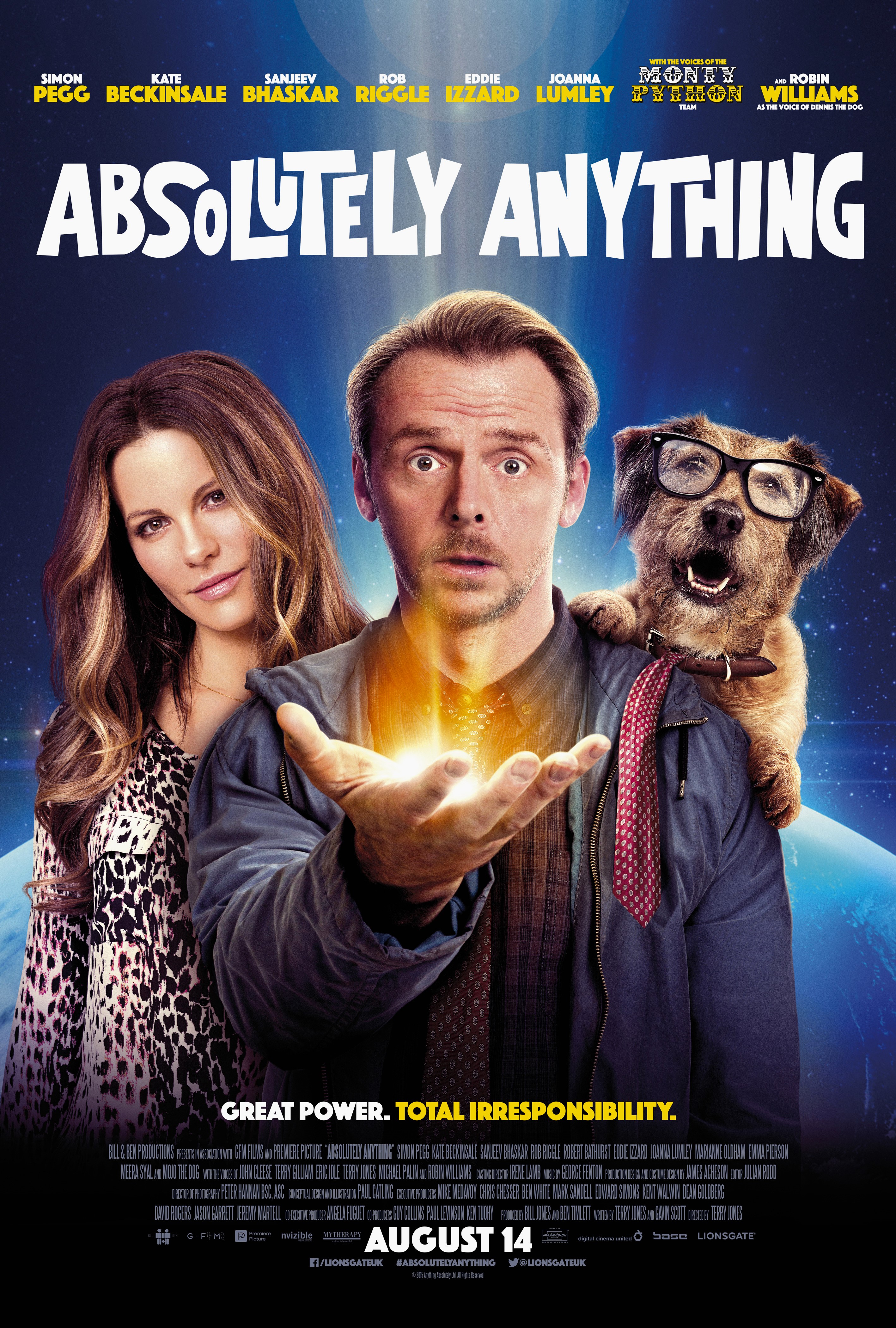
Released in 2015, Absolutely Anything is a zany sci-fi-comedy that explores the age-old fantasy of unlimited wish fulfillment, a concept historically associated with gods, genies and mythical beings. In this instance, however, the power rests in the hands of omnipotent extraterrestrials, who, believing in their superiority, bestow their boundless ability upon a single unsuspecting human. Alas, aside from this inventive alternative, Absolutely Anything misuses its limitless premise and affable lead, Simon Pegg, for a typical rom-com setup, offering mild, light-hearted entertainment over consistent gags, creative visuals or lasting impact.

Plot Summary: As part of an interplanetary experiment, an extraterrestrial council traverse the universe in search of intelligent life. Upon reaching Earth, they initiate their usual test of granting one randomly selected inhabitant the ability to do anything to determine whether humanity is worthy of joining their intergalactic community or should be annihilated. A test that likely spells doom for humanity as the council haphazardly selects Neil Clarke, a washout British school teacher, as their subject…

Co-written and directed by the late Terry Jones (Monty Python and the Holy Grail, Personal Services, The Wind in the Willows), Absolutely Anything draws inspiration from the 1898 short story; The Man Who Could Work Miracles, by H.G. Wells, as both stories centre on an ordinary man suddenly granted reality-altering abilities. However, the leading discrepancy between the two is how Absolutely Anything leans heavily into comedy, delivering a string of farcical scenarios that allow Pegg’s energetic performance to shine. As such, the tone throughout the film remains consistently blithe as the screenplay shies away from any deep philosophical exploration of its central concept or even any long-term consequences to Neil’s actions, as when a situation veers into chaos, Neil merely waves his hand to undo the damage, undercutting any disorder his newfound power might trigger.

As the leading man, Simon Pegg infuses Neil Clarke with an endearing blend of immaturity and dopey charm, rendering the character’s misguided desires and naïve missteps more forgivable. Still, the film undoubtedly misses the opportunity to examine how absolute power might affect the average person, for better or worse. Instead, Neil uses his ability almost entirely for petty or farcical purposes, with one of his more amusing decisions granting his loyal dog, Dennis, the capacity to speak, leading the canine to be energetically voiced by the late Robin Williams. The result is a delightfully giddy sidekick, whose witticisms often relate to the amusing traits of his species. Less enjoyable is the romantic subplot between Neil and his downstairs neighbour Catherine, portrayed by Kate Beckinsale, as despite Neil’s fascination with Catherine being at the core of the story, her character is underwritten and uninteresting, making their relationship (and her inclusion) feel obligatory rather than organic, a criticism that applies to many of the side characters.

Visually, Absolutely Anything is an odd mix of British realism and low-budget science fiction, with the majority of the film shot in and around an abandoned building that was formerly a school, cleverly repurposed to serve as Neil’s flat and the secondary school where he teaches. While these Earthbound settings help ground the otherwise outlandish story in a familiar, everyday backdrop, many of the sets throughout the runtime appear cheap and flavourless, especially when combined with the American sitcom-esque lighting and cinematography by Peter Hannan. The most jarring disparity in the film’s visuals, however, comes with the subpar CG effects, from the splicing of Simon Pegg’s head onto different bodies to the space-bound sequences of the extraterrestrial council debating; the CGI is noticeably lacking, even if the aliens’ designs exhibit visual variety.

Contrarily, the original score by George Fenton brings a whimsical energy to the film, as his compositions underscore the comedic beats with light piano melodies, lively orchestration and plucky strings that reflect Neil’s bemused reactions to his newfangled ability. For example, during the scene where Neil begins experimenting with his powers, commanding a bottle of whiskey to exchange itself only to witness it bouncing down the stairs towards the front door, the accompanying track is fittingly bouncy and eccentric.

Upon its initial release, Absolutely Anything was frequently compared to Bruce Almighty (2003), another male-led comedy about divine empowerment. But, their distinctions are actually quite significant, as Bruce Nolan, the titular character, cannot override free will, whereas Neil can. Moreover, Bruce Almighty centres on a theological framework with God as an active character, whereas Neil’s powers come from extraterrestrials he never encounters, exuberantly voiced by the surviving members of the Monty Python series. In fact, Absolutely Anything notably marks the first on-screen reunion of the Monty Python cast since The Meaning of Life (1983), and, according to Terry Jones, might be their last collaborative outing. There’s also a nod to their comedic legacy during the opening sequence, as the camera pans across space to an orbital scrapyard of discarded spaceships, one of which is from 1979’s Life of Brian.

In summary, Absolutely Anything is a comedy buoyed by its bewitching premise and the charisma of its lead. Yet, it is frustratingly superficial, opting for a low-stakes story, cartoonish gags and rom-com tropes rather than exploring the satirical or existential dimensions its narrative invites. Whilst the film does contain some moments of wit, Absolutely Anything never lives up to the potential promised by its title or the strong comedic talent it harbours. Rating: 4/10.
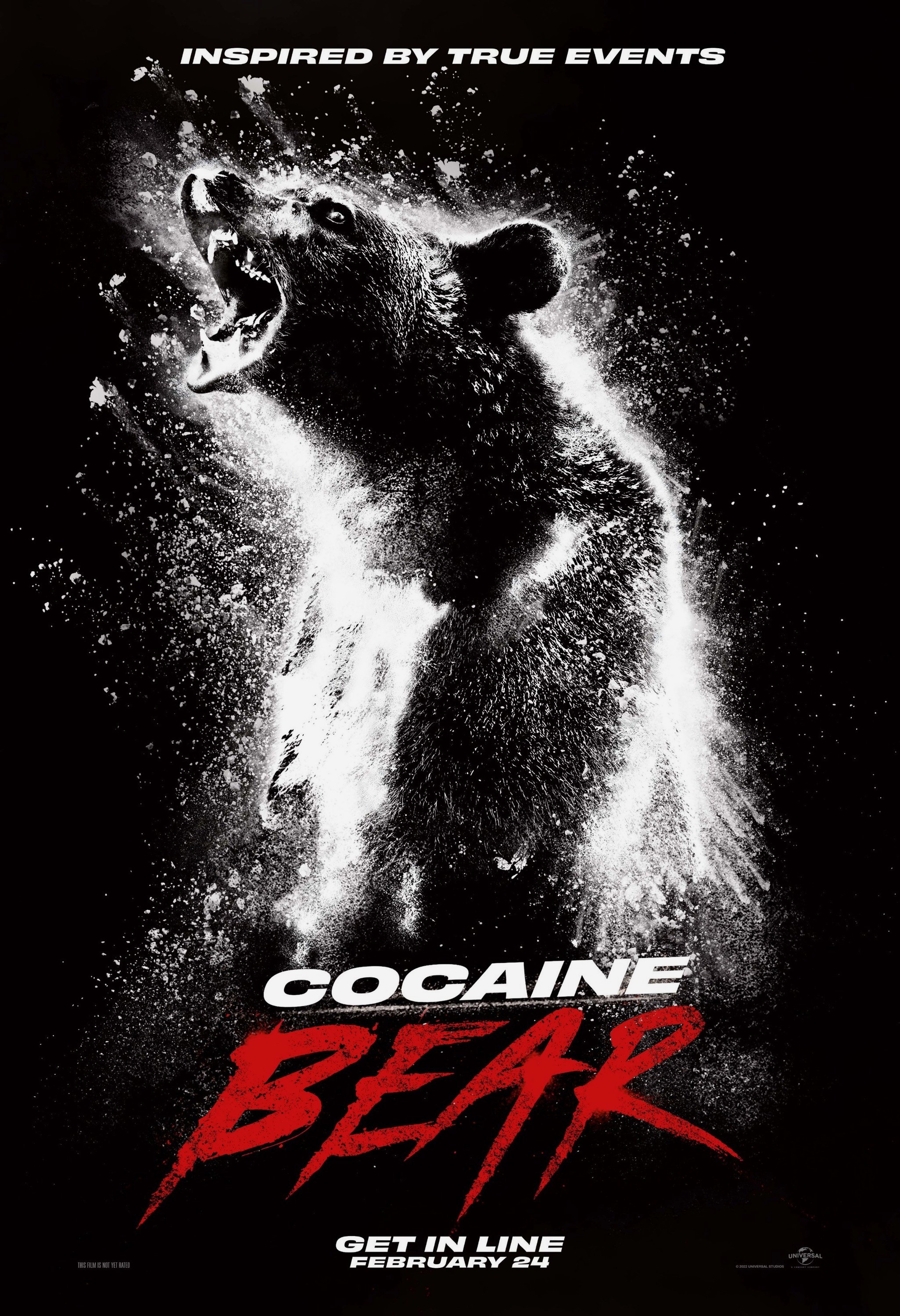
Cocaine Bear (2023) – Film Review

“What the Fuck Is Wrong With That Bear?!” – Beth

Partially inspired by an incident that took place in 1985, where lawyer-turned-drug smuggler Andrew Thornton took to the skies to drop blocks of cocaine over Knoxville, Tennessee, before leaping out of his aircraft carrying a duffel bag containing roughly £11 million worth, ultimately falling to his death when his parachute malfunctioned. A regional black bear was believed to have stumbled upon some of his stash, as two months later, a Georgia hunter discovered a bear carcass surrounded by the remains of a bag investigators later deemed to be Thornton’s. Although no deaths were reported as a result of the intoxicated animal, with a medical examiner concluding that the two-hundred-pound beast likely overdosed within minutes, dying from cerebral haemorrhaging and respiratory heart failure, the notorious story of the amusingly nicknamed; “Pablo Escobear,” was ripe for a cinematic adaptation given its utter absurdity, and the bluntly titled; Cocaine Bear, released in 2023, aimed (yet failed) to fill that void.

Plot Summary: When a duffel bag stuffed with around $14 million in cocaine falls from the sky in the aftermath of a 1980s drug smuggling excursion, a colossal, national park-roaming American black bear unconsciously devours much of the white powder, steering the animal on a bloody path of destruction as it becomes the most dangerous apex predator on the planet for the next few hours…

Directed by Elizabeth Banks (Movie 43 – Segment: Middleschool Date, Pitch Perfect 2, Charlie’s Angels), the title of Cocaine Bear was originally intended to be a temporary working title, but the producers eventually decided to release the film under that moniker as they couldn’t think of a title more fitting. To some extent, this bit of trivia serves as a representation of the film itself, as Cocaine Bear is exactly what it sounds like; a ludicrous, violent and corny comedic thriller that adapts a story almost too outlandish to believe. Of course, to create a more marketable flick, the filmmakers do make a string of alterations to the real story as, in reality, when the animal’s carcass was found, it had already been dead for around a month, in contrast to the rampage depicted in the film, which occurs shortly after the smuggler’s death. Moreover, investigators never reported any threatening or destructive behaviour ahead of its death, nor did the bear eat the entirety of the supply Thornton was thought to have smuggled, as officials deduced that an unknown individual had fled with a portion of the stash. Still, it is an amusing tale to bring to the silver screen, especially since animal experts have always been somewhat uncertain as to whether animals experience the same type of high that humans do from substances like alcohol or marijuana, despite some animals seemingly ingesting substances like catnip and hallucinogenic mushrooms for their recreational effects.

Featuring one of the last-ever performances from famed actor Ray Liotta, as the actor sadly passed away on May 26th, 2022, a mere week after he re-recorded some of his lines during the film’s post-production phase. The central cast of Keri Russell, Alden Ehrenreich, O’Shea Jackson Jr., Isiah Whitlock Jr. and Liotta himself are all serviceable in their various roles. While some of the cast portray relatively likeable yet significantly underdeveloped, hapless residents, others lend their acting skills to portraying scummy drug peddlers who ultimately earn their comeuppance when confronting the ravenous, cocaine-plugged beast. However, whilst much of the cast is well-versed in the comedy genre, one of Cocaine Bear‘s most significant shortcomings is undoubtedly its inconsistent, overly cartoonish humour throughout.

Aside from the CG effects of the titular bear, which adequately convey its size, strength and weight, the visuals of Cocaine Bear are rather bland, rarely employing distinctive shots or creative set design as the cinematography by John Guleserian predominantly largely relies on generic mid-shots, with much of the editing harbouring little rhythm and the bloodthirsty beast’s killings possessing minimal creativity, often having a severed limb merely dumped in front of the camera.

In terms of the original score, talented composer Mark Mothersbaugh’s soundtrack is sufficient yet rather sterile in the grand scheme, with the poorly-anointed tracks of Bear Attack, Bathroom Fight and Bear Dance being the only high points as Mothersbaugh attempts to integrate a selection of instruments from the ’80s to lend authenticity to the 1980s setting.

Bizarrely, although set in an unnamed national park in Knoxville, Tennessee, Cocaine Bear was truthfully shot in Ireland, with the crooked forest trails of the Irish outdoors appearing largely indistinguishable from that of the U.S. Very few Irish actors were cast, however, excluding extras, presumably to play into this implied American setting.

In summary, Cocaine Bear stumbles even as the lowbrow flick many (myself included) expected it to be, lacking entertainment value and a strong sense of satire in spite of the film leaving a peculiar cinematic legacy, with a slew of low-budget rip-offs emerging shortly after its release, each more absurd than the last, such as Cocaine Shark (2023) and Attack of the Meth Gator (2023). Thus, I’d suggest bypassing Cocaine Bear and simply scouring for a documentary on the event. Conversely, if you are ever passing through Lexington, Kentucky, perhaps consider visiting the Kentucky for Kentucky Mall, where the bear’s preserved body is actually on display, further corroborating the animal’s enchantingly strange legacy. Rating: 4/10.

cocaine_bear_xxlg

Shadow in the Cloud (2020) – Film Review

“I Saw… I Saw Something Move on the Right Wing…” – Maude Garrett

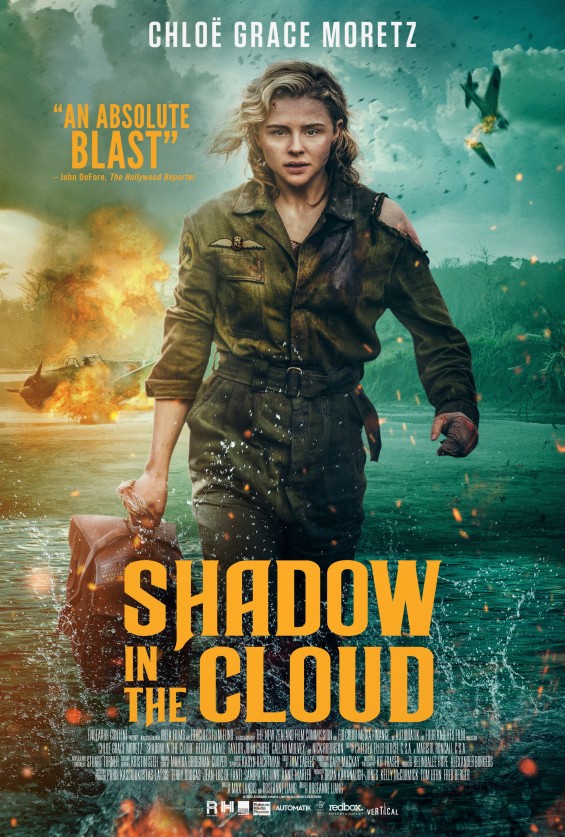
Shadow in the Cloud, released in 2020, is an action-thriller with a remarkably intriguing premise, playing into the fables of the mischievously dangerous creature known as the “Gremlin,’ a folkloric rodent that originated in the 20th century to explain malfunctions with aircraft operations, primarily during World War II. Depictions of these creatures have varied widely over the years, with their most well-known incarnation being in the 1984 horror-comedy classic; Gremlins. Before that film’s release, however, stories regarding the creatures often referenced them as the cause of the inexplicable technical and psychological tribulations many pilots faced during the Second World War, Shadow in the Cloud being one of those stories. Yet, despite this potential, aside from some impressive set design and the earnest attempt by its leading actress, Chloë Grace Moretz, to schlep the film as a ‘one-woman show,’ it’s largely a chore to make it through the entire runtime of Shadow in the Cloud, fleeting though it may be.

Plot Summary: In the throes of World War II, pilot officer, Maude Garrett, joins the all-male crew of the B-17 bomber, the Fool’s Errand, with a top-secret package. Caught off-guard by the presence of a woman on their military flight, the crew tests Maude’s every move. But, before they can enquire further about her assignment, Maude notices something sinister clinging onto the underside of their aircraft…

Co-written and directed by Roseanne Liang (Banana in a NutshellMy Wedding and Other Secrets), the somewhat clunky screenplay for Shadow in the Cloud was originally penned by Max Landis, but was later heavily rewritten during pre-production by Liang due to sexual harassment allegations made against Landis at the time. Liang and Moretz claim that Landis was distanced from the production, with his screenplay being rewritten several times before filming began. But, after watching the film, Landis argued that about 90-95% of the screenplay is still his.

Chloë Grace Moretz undertakes the role of the film’s protagonist, adept pilot, Maude Garrett, or at least, that’s how she introduces herself, as Maude’s true identity and the nature of her assignment is actually a mystery for much of the runtime. Nevertheless, Moretz does a great job carrying the acting load, while Maude receives a serviceable amount of characterisation. The rest of the crew, portrayed by Taylor John Smith, Callan Mulvey, Nick Robinson, Beulah Koale, Byron Coll, Joe Witkowski and Benedict Wall, are well-acted yet lack any real depth or distinct character traits, only serving to hammer home the film’s underlying feminist themes as masculine caricatures. So much so, that as soon as Maude steps aboard the aircraft, she’s immediately met with sexist wisecracks and condescending nicknames.

Given that the majority of the film takes place aboard an aircraft amidst the clouds, it’s understandable that much of Shadow in the Cloud‘s visuals are confined to Maude and the camera crammed into the ball turret on the underside of the aircraft after the crew shove her down there to keep her out of their way during take off. From that point on, almost every shot maintains a steady level of motion to match the constant turbulence of the aircraft in the thick of the vicious storms and enemy fighters that surround it. Simply put, whilst the cinematography by Kit Fraser isn’t anything unprecedented, it is exceptionally accurate to the film’s wavering setting.

However, the same cannot be said for the original score by Mahuia Bridgman Cooper, which is bewilderingly inappropriate for both the narrative and its time period, beginning as a melodious yet out-of-place synthetic score before transitioning into something far more chaotic and tumultuous by the third act, draining away much of the suspense through tracks, like True Stories and Dangerous Feelings. Similarly, the film’s stylistic choice of occasionally cutting away from Maude in the ball turret to see the other crew mates in a blackened space with kaleidoscopic lighting feels at odds with the remainder of the visuals, especially since it obscures much of the aircraft’s detailed set design.

On a more positive note, the film’s opening does feature a nifty animated sequence based on the cartoon shorts of Private Snafu, a series of 1940s adult-oriented instructional videos meant to educate enlisted personnel on army discretion, hygiene, combat readiness and daily life. While the designs of the gremlins in these shorts might appear playful, the design of the actual creature in Shadow in the Cloud leans into a more lifelike approach, admirably constructing a creature that possesses a grey-haired, monkey-like body structure with minor traits of bats and rats. Unfortunately, the visual effects for the creature often do the film more harm than good, as although certain shots of the gremlin are passable, almost all of the shots of Maude on the exterior of the aircraft via green screen look dreadful, likely suffering as a result of a stretched-thin effects budget.

In summary, whilst Shadow in the Cloud bears a fantastic premise, it’s continuously so poorly executed that it becomes difficult to appreciate it, forcing its audience to significantly suspend their disbelief even more than you’d expect for an action-centric creature-feature, frequently coming across as pulpy and overly dramatic. Thus, by the time Shadow in the Cloud trots out historical footage of real servicewomen alongside an inspiring pop song during the end credits, the film has essentially veered into self-parody in spite of the tremendous conviction Moretz conveys in her performance. Rating: 4/10.

shadow_in_the_cloud_ver2_xxlg

The Happytime Murders (2018) – Film Review

“Do You Have the Latest Issue of Puppet Pussy Party?” – Phil Philips

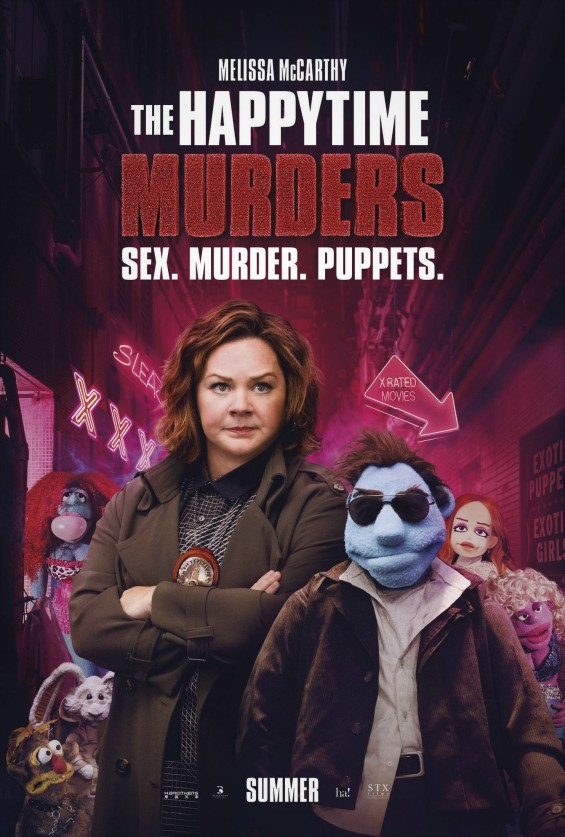
Released in 2018, The Happytime Murders was a long-in-development project from the adult-geared alternative arm of the Jim Henson Company, the famed production company behind The Muppet ShowFraggle RockDinosaurs and many other beloved, family-friendly projects. Yet, unlike those projects, The Happytime Murders squanders its imaginative premise on a witless and raunchy crime-comedy that blindly pushes buttons instead of attempting to tell an entertaining story, to the extent that even under the proficient direction of Brian Henson (The Muppet Christmas CarolMuppet Treasure Island), son of the late Jim Henson, the film never manages to escape its dreadfully lethargic humour or its foreseeable buddy-cop storyline.

Plot Summary: When the cast of a 1990s sitcom is murdered one by one at the hands of a mysterious figure, Phil Philips, once the Los Angeles Police Department’s first puppet police officer, now a weary private investigator, finds himself dragged into the case. But, as the investigation becomes more and more bewildering, Phil is forced to bury the hatchet with his former human partner, Detective Connie Edwards, in order to prevent more past-their-prime puppets from meeting a grisly end…

Curiously, before the film was released, Sesame Workshop, the non-profit organisation behind the cherished children’s television series; Sesame Street, actually tried to sue The Happytime Murders‘ marketing team on account of one of the film’s taglines; “No Sesame. All Street.” Claiming the film tarnished their child-friendly reputation. However, the suit was ultimately rejected. In many ways, this amusing piece of behind-the-scenes drama is more interesting than the actual narrative of The Happytime Murders, which primarily serves as a witty yet predictable detective mystery where Phil and his partner, Connie, are driven to scour for clues across the sunlit, puppet-populated metropolis of Los Angeles, in the hope of exposing the unbeknownst serial killer. Through this investigation, the film makes many attempts at humour, 90% of which falls short as most of the comedy lazily stems from adorable puppets merely cursing or enjoying more adult activities, such as smoking, sex or drinking alcohol. On a more positive note, the film does, at least, feature a few fragments of absorbing world-building, most notably with how puppets are considered second-class citizens compared to humans, hence why so many puppets eventually become addicts, numbing themselves to the misery of their lives, a detail that is clearly intended as underlying (and underdeveloped) social commentary.

As mentioned previously, The Happytime Murders is, at its core, a parody of classic buddy-cop crime-thrillers, with the alcoholic, blue-felt gumshoe, Phil Philips, skillfully portrayed by Bill Barretta, reluctantly pairing up with his abrasive former partner, Detective Connie Edwards, clumsily portrayed by Melissa McCarthy, after his thespian brother gets inexplicably murdered by an individual intent on wiping out the entire cast of the Happytime Gang, a prevalent ’90s sitcom. All of whom were puppets, aside from the token human cast member, Jenny, portrayed by Elizabeth Banks. And thanks to the spectacular puppetry on display, you quickly forget that Phil, one-half of this investigative tandem, is a glorified hand in a sock. Alas, the characterisation isn’t nearly as impressive as beyond some basic character traits and chucklesome one-liners, both members of the central duo lack depth and frequently come across as obnoxious, especially McCarthy. Regrettably, this issue also extends to the under-utilised supporting cast of Maya Rudolph, Leslie David Baker and Joel McHale.

Akin to many other puppeteering projects, all of the elevated sets utilised during production were built so that the puppeteers could stand on the ground and operate the puppets as if they were standing with straight arms. Yet, even with this information in mind, every set that appears on-screen feels like a real, lived-in location. Unfortunately, the rest of the visuals aren’t as remarkable, as the cinematography by Mitchell Amundsen is immensely bland, over-relying on over-lit close-ups and mid-shots that barely enrich the satire or mystery of the narrative.

Relatively tedious and generic, the bass-heavy original score by Christopher Lennert tries to reflect the jazzy scores of ’70s crime-thrillers yet rarely succeeds in forming any truly memorable tracks of its own. Similarly, songs like Sexy and I Know It and Low Rider seem almost arbitrary in their placements within the runtime, usually throwing off the tone of whatever scenes where they are featured.

In regard to the puppets themselves, it’s intriguing to note that a grand total of one hundred and twenty-five puppets were used during the film’s production, with around forty of those puppets being created specifically for the film. As a result, every puppet that emerges from scene to scene is visually unique, retaining its own colour, fabric, style, and personality. Once again, it’s just a shame that the gags and dialogue that emit from each felt character’s mouth are so sluggish, continuously giving off the impression that the film is trying far too hard to be risqué.

In summary, The Happytime Murders is a crime-comedy harbouring far too many lousy jokes, with the genuinely clever gags being few and far between. As such, the only thing that can be declared for certain when it comes to The Happytime Murders is the fact that with its countless scenes of drug-snorting and depraved puppet sex (not to mention an extremely drawn-out ejaculation sequence), it’s worth emphasising that this puppet-led comedy is not one for youngsters. Still, it’s not as if they’re missing out on much. Rating: low 4/10.

happytime_murders_ver2_xxlg

Jupiter Ascending (2015) – Film Review

“I Will Harvest That Planet Tomorrow Before I Let Her Take It From Me.” – Balem Abrasax

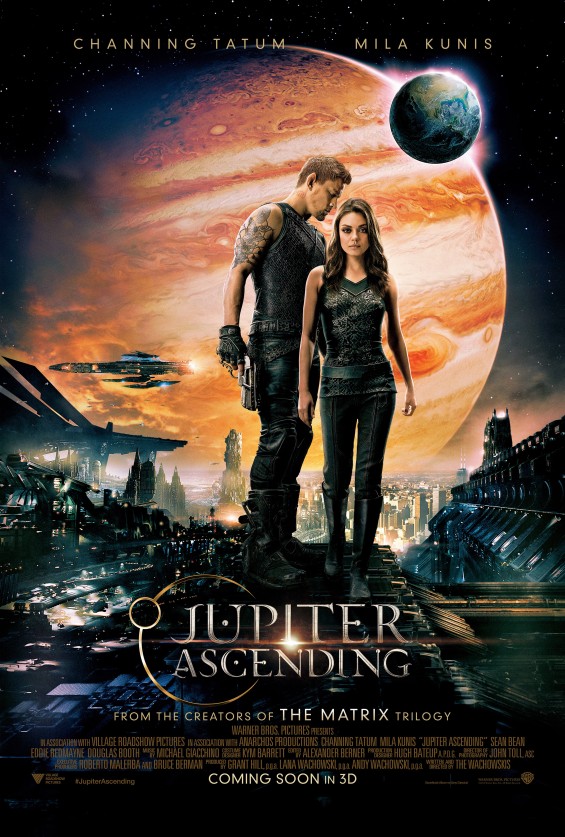
A sci-fi blockbuster from the writer-directors behind; Cloud AtlasV for Vendetta and The Matrix trilogy, Lana Wachowski and Lilly Wachowski, a.k.a. the Wachowskis. 2015’s Jupiter Ascending is a rarely exciting, often laughable science fiction flick that attempts to explore a number of interesting concepts yet frequently fails on almost every other front. Unquestionably the singular work of the Wachowskis, Jupiter Ascending exhibits many of the filmmakers’ worst tendencies, recounting a campy, overblown spectacle of a story that retains barely any of the visionary leadership that drove some of their earlier filmographies to be held in such high regard.

Plot Summary: Born under a night sky, with signs predicting she was destined for great things, Jupiter Jones dreams of the stars but awakens to the cold reality of a dead-end cleaning job in Chicago. But, when Caine Wise, a genetically engineered ex-military bounty hunter, arrives on Earth to track her down, Jupiter begins to realise what the universe has in store for her as she is marked next in line for a royal inheritance that could alter the balance of the cosmos…

Originally slated to release on July 25th, 2014, before the production slipped over six months to provide more time for the visual effect team to complete the elaborate effects. Jupiter Ascending possesses many attributes that commonly make for an entertaining sci-fi epic, with large-scale set pieces, thrilling action sequences and moments of world-building all appearing throughout its runtime. However, similar to The Matrix sequels, where the sheer scale of the storytelling seemed to overwhelm the Wachowskis, Jupiter Ascending frequently appears unfocused and carries little dramatic weight as it places all of its attention on exploring its vast universe, with the plot itself resembling planet-hopping stories like Dune and the Star Wars prequel trilogy, revolving around various factions grasping for power. It’s a serviceable story, to be sure, but it usually feels secondary to the world-building which, as previously mentioned, comes across as cluttered and forces countless characters to serve as exposition dumps for Jupiter, even if there are some interesting ideas at play, such as humans not originating from Earth and being sighted as cattle to species that consider themselves superior.

On a screenplay level, Jupiter Ascending is hardly revolutionary, depicting the protagonist, Jupiter Jones, as a young, seemingly insignificant woman who discovers she actually holds the key to extraordinary power. Yet, the screenplay rarely treats Jupiter as anything more than a damsel in distress, constantly needing to be protected by the fearless soldier turned bounty hunter, Caine Wise. As a result, the central duo of Mila Kunis and Channing Tatum deliver rather bland performances, occasionally wisecracking as they travel from location to location, continually in danger and continually underdeveloped, especially when they develop feelings for one another. In keeping with their surroundings, the supporting cast of Sean Bean, Eddie Redmayne, Douglas Booth and Tuppence Middleton turn in similarly lacklustre performances, with Redmayne’s performance as the antagonist, Balem Abrasax, being the true standout (unintentionally so), whispering some lines and shrieking others.

The visuals of Jupiter Ascending are one of the film’s best aspects, as the cinematography by John Toll captures the majesty of outer space in several creative ways, presenting the universe with much more colour and lavishness than many other sci-fi blockbusters. Speaking of other science fiction franchises, unlike Stark Trek or Battlestar Galactica, all of the spaceship designs throughout the film are pristine and elegant, almost comparable to floating cathedrals, as they maintain a golden colour scheme to play into the idea of the proprietors of said ships (and accompanying opulent costumes) belonging to a royal bloodline. Many of the interiors of the spaceships even appear inspired by European architecture, specifically Renaissance architecture, massively deviating from the grey, metallic interiors seen in most of the sci-fi genre. Sadly, however, it’s difficult to fully concentrate on the myriad of beautiful visuals due to the abysmal dialogue, which ranges from dull and overly expositional to unconsciously hilarious.

On another cynical note, the original score by Michael Giacchino is regrettably one of the composer’s weakest scores to date. Moving from thunderous, brassy statements to a deeply menacing voice choir that evokes memories of The Emperor’s Theme from Star Wars: Episode VI – Return of the Jedi, released in 1983, the soundtrack for Jupiter Ascending certainly fits within the science fiction genre, yet never feels distinguishable or greatly adds to the emotion/excitement playing out on-screen.

In terms of action, Jupiter Ascending makes the most of its few action sequences by having Caine Wise and the assorted adversaries he goes against cleverly utilise a selection of futuristic weapons and gadgets. In particular, one early sequence of Jupiter and Caine escaping an extraterrestrial attack squad in a chase above the twilight streets of Chicago is both eye-catching and exhilarating.

In summary, at its heart, Jupiter Ascending is a jumbled wish-fulfilment narrative whereby a despondent cleaner turns out to be the secret proprietor of Earth. And with so many heroes’ journey-type franchises existing nowadays, it is a bold stroke to make the ‘chosen one’ a respected monarch. But, on account of the sheer magnitude of the story and world-building, Jupiter Ascending quickly crumbles under its only weight, only being saved from total collapse by its impressive visual effects and stimulating action set pieces, subsequently failing to start what would have been yet another big-budget science fiction franchise. Rating: low 4/10.

jupiter_ascending-p914589

Action Point (2018) – Film Review

“What a Day! We Ran Out of Beer, Corn Dogs and Toilet Paper. In That Order.” – D.C. Carver

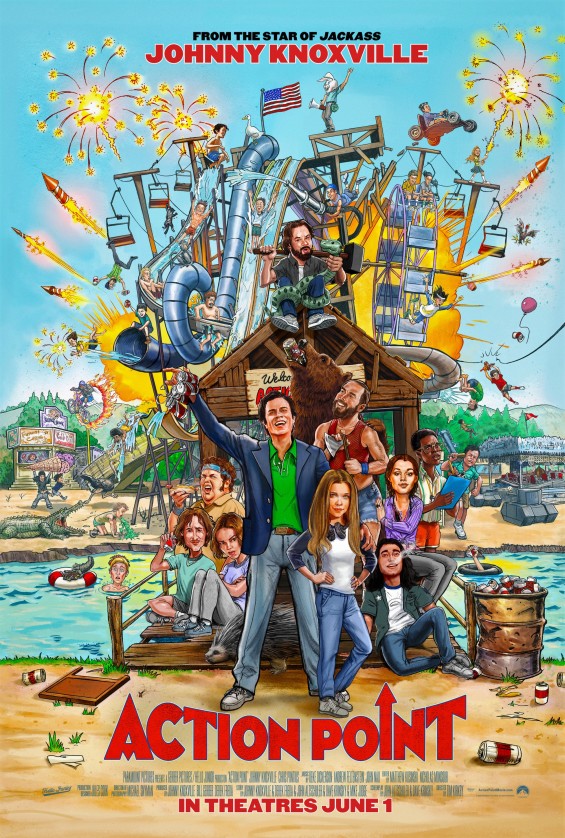
From Johnny Knoxville, co-creator of JackassAction Point, released in 2018, is loosely inspired by the now-defunct Action Park in Vernon, New Jersey, which first opened in 1979. The independently-funded theme park was considered by many to be one of the most dangerous entertainment destinations in the United States, as at least six people were known to have died as a result of incidents that occurred within the park. Founder and CEO Gene Mulvihill’s philosophy was that guests should be in control of their experience, envisioning a theme park where the guests controlled how fast/high they went, which is exactly what he created with Action Park. Consequently, the park closed in 1996 and later reopened under new ownership as Mountain Creek in order to disassociate itself from the former park’s reputation. Yet, in spite of all this fascinating history, Action Point is a rather poor attempt at adapting one of the world’s most dangerous theme parks for the silver screen, combing lowbrow humour with a flavourless (and largely invented) narrative to minimal effect.

Plot Summary: A low-rent yet moderately successful theme park with an assortment of hazardous attractions, Action Point was the crackpot dream of its owner and operator, D.C. Carver, who always believed that children enjoying themselves was more important than anything else. But, just as D.C.’s estranged teenage daughter comes to visit, a massive corporate theme park opens nearby, jeopardising the future of Action Point…

Action Park, the theme park that inspired Action Point, is actually the subject of multiple documentaries, including 2013’s The Most Insane Amusement Park Ever, and 2020’s Class Action Park, both of which go deep into the construction and history of the troubled entertainment destination. So, with two documentaries detailing the park along with a plethora of YouTube videos, it’s easy to see why the filmmakers behind Action Point thought the story would make for an excellent comedic biopic of Mulvihill. However, therein lies the first issue with the film; Action Point isn’t truthfully a biopic as its narrative is primarily fictional, with names of characters/locations getting changed to further fit this approach. To make things worse, director Tim Kirkby (The C World(Future) Cult ClassicLast Looks) repeatedly has trouble applying conventional story structure to the kind of reckless Jackass-esque stunts that populate the film, which only worked previously, thanks to their short-snippet, home-made allure.

While he may be looked down upon for his history as a daredevil who made his career off of getting hit in the crotch, many seem to forget that Johnny Knoxville is actually a competent actor, able to convey the emotion and empathy required for a role such as this. And although you never forget that you are watching Knoxville merely portray a character, he does a serviceable job of portraying D.C. Carver. Alternatively, the supporting cast’s performances are fairly inconsistent, as Eleanor Worthington-Cox, Chris Pontius and Dan Bakkedahl are sometimes bland and sometimes overly eccentric. Moreover, Action Point tries to integrate a subplot alongside the primary storyline around D.C.’s cracks at connecting with his fourteen-year-old daughter, yet this subplot seems like nothing but a saccharine afterthought on behalf of the screenwriter.

Attempting to match the hand-built qualities of Action Park, the large-scale set pieces throughout Action Point are suitably outlandish and precarious. The film even goes so far as to include the Cannonball Loop waterslide, one of the most notorious attractions of the original park. That attention to detail does not persist in every aspect of the film, however, as whilst Action Park was surrounded by trees and foliage, Action Point’s iteration of the disreputable theme park is simply an expansive patch of dirt, which feels cheap and artificial in comparison. Similarly, the cinematography by Michael Snyman is relatively dull, only retaining a handful of visually interesting shots.

Barely noticeable for the majority of the runtime, the original score by Deke Dickerson, Andrew Feltenstein and John Nau is flat and easily forgettable. Luckily, the film redeems its uninspiring score through its use of well-known punk-rock songs like Janie Jones and If the Kids Are Untied, which count towards the chaotic, out-of-control disposition of the park and its innumerable youthful guests.

As previously mentioned, despite appearing both risky and painful, all of the stunts throughout Action Point feel tremendously out of place, as the story frequently grinds to a halt to make way for a scene of a character getting injured. In fact, Johnny Knoxville claims to have sustained more injuries in this flick than in any other film of his career. These injuries included four concussions, a broken hand, a damaged meniscus, a lost orbital lamina, whiplash, stitches and even the loss of some of his teeth.

In summary, while Action Point was never going to be anything more than masochistic sequences built atop a flimsy plot, eighty-five minutes of Knoxville and his co-stars abusing themselves across a shoddy recreation of one of the most unsafe theme parks in the United States quickly becomes tiresome. And whilst ideas like an alcoholic bear may get a smile out of some, this box office flop just doesn’t hold a candle to the glory days of Jackass, whether that be the cinematic trilogy or the original television series. As such, I would advise just watching Jackass or any of the documentaries depicting the true story of Action Park over Action Point, as they are far more entertaining. Rating: 4/10.

action_point_xxlg

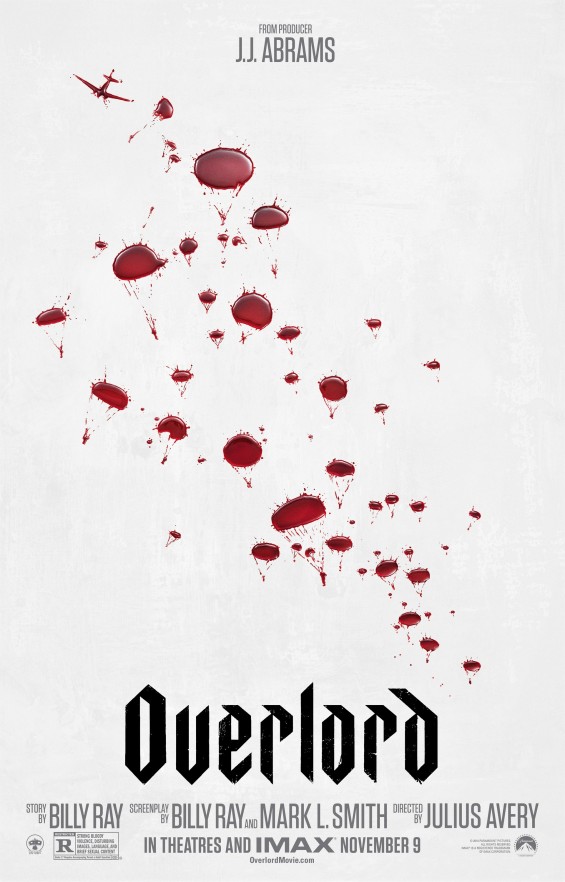
Overlord (2018) – Film Review

“Three Months Ago, I Was Cutting Grass On My Front Yard. The Mailman Shows up With a Letter From the Army. Now, I’m Here, and I Have No Idea Where I’m Going to End Up.” – Private. Edward Boyce

Initially thought to be the fourth instalment in the Cloverfield franchise, an anthology-like series featuring the projects of Cloverfield10 Cloverfield Lane and The Cloverfield Paradox. Producer J.J Abrams later confirmed at New York City CinemaCon in 2018 that the war-horror hybrid flick, Overlord, would not be part of the series, despite being produced under the same production company, Bad Robot Productions. In a similar vein to the Cloverfield franchise, however, Overlord frequently appears disjointed and underwhelming in its effort to combine many diverse genres and ideas in a World War II gore-fest.

Plot Summary: On the eve of D-Day, a squad of American paratroopers is dropped behind enemy lines with the mission of penetrating the walls of a fortified local church and destroying the radio-jamming tower inside. But, as the soldiers approach their target, they soon discover that the Nazis are conducting a series of ungodly experiments in a hidden laboratory beneath the church. Experiments that could change the tide of the Second World War…

Evidently inspired by the renowned video game multiplayer mode, Call of Duty: ZombiesOverlord, directed by Julius Avery (Son of a GunSamaritan), grounds its absurdist story around a real military operation; “Operation: Overlord,” a code name for the Allied mission for the Battle of Normandy, which launched the successful invasion of Nazi-occupied Europe. This procedure, alongside “Operation: Neptune,” would become known as D-Day. This connection to the factual history of World War II does add some depth to the narrative, in addition to playing into a number of conspiracy theories regarding Nazi experimentation and the classified missions many American soldiers embarked upon during the Second World War. However, a downside to this sort of approach is that Overlord is repeatedly in a tonal conflict with itself, as the first hour of the runtime is a largely straightforward war epic, whilst the final half-hour is a plethora of blood, bullets and superhuman, zombie-like creatures. As such, the film feels as if it’s split into two halves, both at odds with each other. Still, at least Overlord ditches the irritating use of storytelling mystery boxes, a J.J. Abrams staple.

While the performances of Jovan Adepo, Wyatt Russell, Mathilde Ollivier, John Magaro and Pilou Asbæk continually range from serviceable to immensely hammy. The dialogue and characterisation throughout Overlord are somehow much worse, often coming across as cheesy, and in the case of the characterisation, wildly inconsistent. For example, Private. Edward Boyce is initially portrayed as quiet, nervous and hesitant to kill. But, as the runtime continues, Boyce soon changes his disposition almost entirely to become confident and adept on the battlefield, having no issue killing others, all without any semblance of a character arc. Corporal. Lewis Ford suffers from a different issue as the squad’s ruthless leader, wanting to ensure that his unit completes its mission at any cost. Yet, his no-nonsense attitude and bleak outlook are never explained beyond the reasoning of ‘war changes people.’

Primarily relying on hand-held mid-shots and close-ups, many of Overlord‘s finest shots can be seen whenever the squad are outdoors amongst the burning fields and aircraft-filled skies of the small French village where their target resides. Outside of these outdoor shots, the cinematography by Laurie Rose isn’t all that impressive. However, the various sets and locations chosen for the film are rather impressive, appearing period-accurate and extremely unsanitary in regard to the undisclosed Nazi laboratory and connecting subterranean access tunnels.

When it comes to the original score by Jed Kurzel, tracks like Mist PatrolDevil DogsApproaching the Church and Re-Animation, do a respectable job of adding to the tension and brutality of many scenes, yet rarely feel distinguishable or noteworthy by themselves. The film’s end credits song; Bridging the Gap by Naz, is also a peculiar choice given that the well-known jazz-rap song doesn’t fit the time period, tone or even location of Overlord on account of its lyrical references to Mississippi and New York City.

On a more positive note, unlike many modern horror releases, Overlord actually features a reasonable amount of practical effects. One scene in which practical effects were utilised is the opening sequence, which sees soldiers leaping from a burning aircraft as it plummets to the ground. This thrilling moment was accomplished by rigging an aircraft-themed set on a tilting gimbal and then having stuntmen tumble through real flames via its back portion. Sadly, however, many of these effect-filled sequences are somewhat tainted by the film’s need to place CG enchantments on top of its practical effects. Most of which make many of the effects (including a gruesome scene in which a soldier’s neck snaps back so quickly bones pierce out of his chest) appear as if they were achieved purely through CGI.

In summary, when it was first announced many years ago, Overlord seemed practically destined for cult status, appealing to fanatics of war epics, zombie thrillers and gory, low-budget horror flicks alike. But, looking at it now, it’s clear that Overlord doesn’t fully dedicate itself to its bonkers premise, preferring to be a predominately solemn war piece instead of the outrageous, violent homage to the niche horror subgenre of Nazi zombies. As a result, whether it’s your first viewing or your fifth, it’s hard not to wonder how much stronger Overlord would’ve been should it have stuck the landing. Rating: low 4/10.

overlord_ver2_xxlg

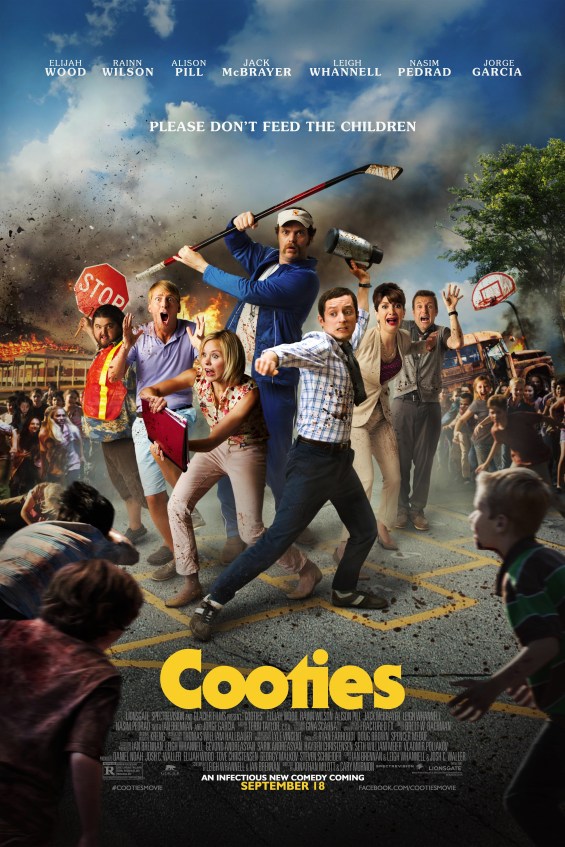
Cooties (2014) – Film Review

“Nap Time, Motherfuckers…” – Wade

For many, children can seem like loud, disease-infested monsters, and it’s not difficult to see why. There’s usually something leaking out their noses, their meals are often encrusted around their mouths, and they care little for social decorum or personal space. As such, it’s not too surprising that a horror-comedy like Cooties would come along in 2014 to take this waggish status to a more terrifying level, altering children into nimble monstrosities hungry for human flesh. Yet, in spite of how much potential a concept like this holds, Cooties ultimately squanders many of its favourable qualities, never fully committing to its absurd premise and the horror/humour it holds.

Plot Summary: When a mysterious virus originating from contaminated chicken nuggets hits an isolated elementary school, transforming the children within into a feral swarm of flesh-eating monsters. A group of misfit teachers are forced to band together as they attempt to flee the bloody, juvenile carnage…

Directed by Jonathan Milott and Cary Murnion (BushwickBecky), Cooties undoubtedly harbours a remarkable premise, and the screenplay effectively sets itself up as a hybrid of both comedy and horror in its first act, balancing conversational witticisms and light moments of characterisation, with violent sequences of teachers and parents being torn apart by the infected children. However, the screenplay quickly turns sour once the second act arrives, as a number of plot conveniences/inconsistencies arise to make the perilous situation of the central group of characters survivable. Moreover, as the virus spreads and the teachers become trapped inside the school, the story begins to feel rather generic as the screenplay moves between uninteresting plot points from the chintzy jokes that preceded them.

While the characters featured throughout Cooties aren’t what I’d describe as particularly memorable or unique, they are, at least, well-defined and have their respective witty moments. A fair portion of this character appeal could also be attributed to the cast, however, as Elijah Wood, Alison Pill, Rainn Wilson, Leigh Whannel, Jack McBrayer and Jorge Garcia all deliver excellent performances as self-centred educators who are evidently displeased with how their lives have turned out. For example, Clint (the protagonist), who formerly moved to New York City in an attempt to become a novelist, reluctantly finds himself back in his hometown of Fort Chicken, Illinois, as a substitute teacher. The only positive outcome of his return home is his reconciliation with his childhood crush, Lucy, who now works at the same school. But, any chance of sparking a connection with her is swiftly stomped out by P.E. teacher, Wade, her loathsome boyfriend. Presumably, leaving many audience members grateful they don’t lead a life as a downtrodden, small-town elementary school teacher.

Aside from the truly nauseating opening title sequence at a chicken farm, which is sure to turn many audience members into vegetarians. Thanks in part to its use of vile close-ups, sludgy green colour palette and singular chicken nugget stuffed with an ominous black gloop. The rest of Lyle Vincent’s cinematography is relativity drab, relying on monotonous mid-shots to depict the puerile chaos. Outside of a handful of moments where close-ups are effectively employed to display the fantastic practical effects, that is, including a darkly comedic sequence in which the infected children pull the hapless school principal apart, using his intestines as a skipping rope, soon thereafter.

Cooties‘ original score, composed by Kreng, a.k.a. Pepijn Caudron, is an interesting musical composition, a quirky mix of electronic horror and childlike innocence, much like the film itself. And whilst the score is occasionally too synth-heavy, which can seem a little odd given the film’s lack of 1980s influences. Cooties‘ soundtrack does make space for haunting vocals and violins where it can, blending comforting and madcap cues to create splendid tracks like Opening Titles and Rick’s Tape.

As previously mentioned, Cooties does appear fairly derivative following its first act, relying on no end of familiar tropes for the zombie subgenre. In addition to caving into an array of plot convinces, such as the sex-ed teacher, Doug, possessing a significant amount of knowledge on viruses and the human brain alike, so he can explain to the others that adults cannot be infected. Still, that isn’t where the writing-related issues cease, as towards the end of the third act (spoilers ahead in this section for those who wish to go in blind), the story becomes virtually aimless, providing no resolution as the characters scurry through the barren, nearby town of Danville until the credits roll. Of course, there is always the possibility that this sudden discontinuation was a result of the film’s limited budget, but it’s a less-than-satisfying way of concluding the narrative, nonetheless.

In summary, Cooties‘ screenplay is largely what drags the rest of the project down, appearing almost confined in its storytelling as if the screenwriters couldn’t reach beyond the typical traits of a zombie flick. Once the teachers hunker down inside a classroom, the story grinds to a tedious halt, merely observing the characters as they crawl through air ducts and suit up with school equipment to escape, scenes you’ve seen a thousand times before in other zombie-centric stories. But, what’s most disappointing, is that Cooties wastes such an inspired idea, as teachers surviving against a horde of infected children is an imaginative and amusing concept that could’ve easily made for an enjoyable, low-budget horror-comedy if it was executed skillfully. Rating: 4/10.

cooties-p1005972

The Forest (2016) – Film Review

“Do Not Stay After Dark.” – Michi

The Aokigahara forest, more commonly known as the “Suicide Forest” or the “Sea of Trees,” is a thirty-five-square-kilometre grove lying at the northwest base of Mount Fuji in Japan. The forest is often cited as the most widespread site for suicide in the country, given that in 2003, over a hundred bodies were discovered in the forest, exceeding the previous record of seventy-eight in 2002. The site became so heavily associated with suicide that a sign at the start of the main trail was later installed to urge suicidal visitors to contact a suicide prevention helpline. So, with all of this notoriety, it was merely a matter of time until a film would utilise the infamous location. Enter, 2016’s The Forest, a supernatural horror flick that sacrifices all of its compelling ideas and despairing real-world setting for cheap, predictable scares and an immensely uninteresting story.

Plot Summary: When orphan, Sara Price, receives a phone call from the Japanese authorities informing her that her twin sister, Jess Price, has disappeared and was last seen heading into the Aokigahara forest, Sara decides to travel to Japan to investigate her sister’s disappearance. But, after entering the notorious forest, accompanied by her Japanese guide, Michi, and American reporter, Aiden, Sara’s investigation begins to send her down a dark path of tormented souls and supernatural occurrences…

Whilst two other films were released before The Forest inspired by Aokigahara, those being; Shawn4Ever in 2012 and The Sea of Trees in 2015, neither film could be considered a horror. And this is what ultimately attracted director Jason Zada (Project Dead Zone) to the project, as Zada was surprised to learn that there had never been a horror film based on the ill-famed site. After discovering that the Aokigahara forest also has a strong association with demons in Japanese mythology, Zada’s interest in the project grew as this information opened the door for a more supernatural narrative. However, the story eventually selected for The Forest is hardly what I’d call engrossing, as while the first act sufficiently sets the story in motion, the narrative quickly devolves into Sara simply meandering through the forest getting sporadically interrupted by blaring jump-scares, many of which are easily foreseen.

Portraying twin sisters; Sara and Jess Price, Natalie Dormer delivers a compelling performance throughout The Forest by lending her acting talents to dual characters. Yet, she is frequently burdened by the screenplay’s lack of characterisation and stale dialogue, which is often as wooden as the trees in the forest. Moreover, the supporting cast of Taylor Kinney, Yukiyoshi Ozawa and Eoin Macken give understandably bland performances as their characters are given next-to-no development and little urgency when it comes to their decisions within the plot.

Since the Japanese government would not allow the filmmakers access to the Aokigahara forest for filming, the Tara National Forest in Serbia served as a suitable stand-in for the location. Aside from the forest itself, however, all of the scenes in Japan were shot on location, and this authenticity does come across on camera. Speaking of the camerawork, the cinematography by Mattias Troelstrup is serviceable, for the most part, as the film makes adequate use of the eerie forest backdrop by implementing a large number of environmental shots, lingering on the calming beauty of the forest in contrast to the tragedies that repeatedly occur within it.

Ominous yet forgettable, the original score by Bear McCreary fits the dreary tone of The Forest appropriately yet lacks anything to make itself distinguishable from other horror scores. Furthermore, whilst there are multiple fast-paced tracks, there is a surprising shortage of slow and moody pieces for a film set in a location like the Aokigahara forest. Nevertheless, I will give McCreary credit for integrating a children’s choir into the score, effectively blending the ghostly juvenile vocals with the rest of the instruments (most notably in the track; Into the Forest), almost as if the choir represents the siren call of the forest.

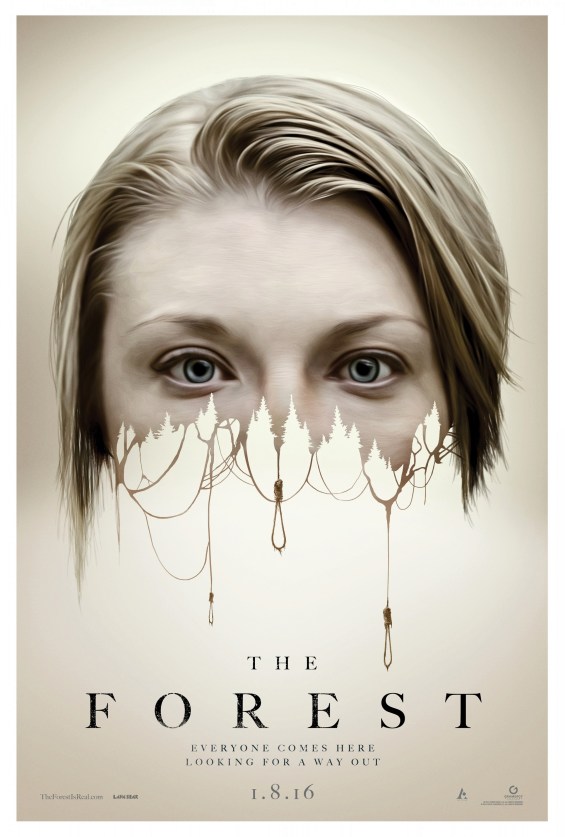
Interestingly, one of the promotional posters for The Forest features the top half of Natalie Dormer’s face with the bottom half removed, the dividing line between them forming a silhouette of treetops and dangling nooses. This imagery carries a clear resemblance to a photograph of an actual suicide victim once found within the Aokigahara forest; a bald man in such a decomposed state that his jaw had fallen off and strips of flesh were hanging from where it had once been. This photograph is also recreated in the film, albeit in a less grotesque form. Fortunately, outside of this scene, The Forest doesn’t contain much blood/gore, which I’d argue was a good decision on behalf of the filmmakers to remain respectful of the families who have lost loved ones to Aokigahara.

In summary, while The Forest offers Natalie Dormer a few chances to showcase her range through a dual role, it isn’t enough to offset the fact that The Forest is just not all that startling or interesting. Of course, these shortcomings could be attributed to Jason Zada being a music video director by trade, harbouring only one other horror flick in his filmography. But, regardless of the cause, it’s unfortunate, as I feel that given the right attention, the Aokigahara forest could make for a phenomenal setting for a minimalist horror, especially if it’s combined with a tasteful narrative that plays upon the site’s infamy. Rating: low 4/10.

forest_xxlg

Mortal Engines (2018) – Film Review

“Sixty Minutes Is All It Took to Bring Humanity to the Very Brink of Extinction. Mankind Mobilised, a New Age Arose. The Age of the Great Predator Cities…” – Professor Chudleigh Pomeroy

Based on the novel of the same name by Philip Reeve, the first entry in a string of young-adult novels, 2018’s Mortal Engines seemed like a blockbuster destined for success and an ensuing franchise upon its initial release, but, evidently, that was not the case. Carrying over much of the same crew behind The Lord of the Rings and The Hobbit trilogies, Mortal Engines has no shortage of eye-catching visuals and large-scale action set pieces, but the film lacks the interesting characters and engrossing story required to fuel a post-apocalyptic blockbuster of epic proportions.

Plot Summary: Thousands of years after human civilisation was destroyed by a cataclysmic event, mankind has adapted, and a new way of life has evolved. Gigantic roaming cities now wander the Earth, ruthlessly preying upon smaller municipalities to feed their enormous engines. One of these cities; the great traction city of London, is home to Tom Natsworthy, an apprentice historian, who eventually finds himself stranded and fighting for survival in the barren Outlands after encountering the evasive fugitive, Hester Shaw…

Directed by Christian Rivers, a prior storyboard and visual effects artist for both The Lord of the Rings and The Hobbit trilogies. Mortal Engines shares more than a few similarities with co-writer/producer Peter Jackson’s adaptations of J.R.R Tolkien’s high-fantasy novels. For instance, much like the trilogies set within Middle-Earth, Mortal Engines places a hefty emphasis on world-building, continuously introducing new characters, lore and pieces of futuristic technology to flesh out its post-apocalyptic world. However, the diverse mix of locations throughout the narrative is by far the most fascinating aspect of the fictional world. From the roaming city of the former British capital to Airhaven; a metropolis floating amongst the clouds, to the nefarious Rustwater Marshes; an expansive section of swampland where countless unethical exchanges take place. Every location presented during the runtime is far more memorable than any of the characters that traverse them.

Speaking of the characters, whether they derive from one of the monumental roaming cities or the desolate Outlands, the characters of Mortal Engines are exceptionally bland. Harbouring generic traits and obligatory backstories, the characters merely exist to push the story forward. The central cast of Hera Hilmar, Robert Sheehan, Jihae Kim, Ronan Raftery, Leila George and Hugo Weaving, don’t elevate the screenplay either, as their exaggerated British accents and equally exaggerated deliveries of corny and exposition-heavy dialogue make it difficult to care for any of them. Furthermore, by the time the third act arrives, we’re told that Hester and Tom have developed feelings for each other, a plot point that seems extremely far-fetched, considering that the pair share only a handful of conversations that aren’t directly related to the narrative.

Largely consisting of wide shots to establish the extensive amount of locations visited throughout the story, Simon Raby’s cinematography undoubtedly enriches the film by impressively capturing the scope of the world and the enormous cities that roam within it. Moreover, the steampunk aesthetic supplies a hefty dose of personality to the visualsparticularly whenever it comes to scenes set within the roaming city of London, as the rundown futuristic technology combined with British iconography, forms a striking visual meld. Contrarily, the post-apocalyptic landscape of the Outlands is devoid of life and colour, making the industrial levels of the motorised cities almost seem appealing in comparison.

The original score by Tom Holkenborg, a.k.a. Junkie XL, is, for the most part, action-dominated, with tracks, like The ChaseFirst Strike and No Going Back, all bleeding into one another due to their similarities. And, whilst the soundtrack never really drags, the score does become rather repetitive as Holkenborg struggles to innovate on the action-orientated tracks. Meaning that all of the action sequences essentially contain the same selection of interchangeable tracks, each blaring out pounding percussions and string ostinatos.

Although many of the action sequences are relatively uninspired, the visual effects throughout Mortal Engines cannot be faulted. The most blatant example of how remarkable the visual effects are can be seen with the CG character, Shrike, a cyborg assassin, portrayed by Stephen Lang. While the film’s visual effects company, Weta Digital, is well-known for developing exceptional motion capture characters, such as Gollum in The Lord of the Rings and Caesar in the most recent Planet of the Apes trilogy. In Mortal Engines, Shrike was created using alternative techniques to Weta Digital’s usual approach, as visual effects artists disregarded modern motion capture methods to instead employ traditional keyframe animation and accurately capture Lang’s subtle facial expressions. Nevertheless, much like many of the other characters within Mortal Engines, Shrike and his poignant relationship with protagonist, Hester Shaw, feels greatly underutilised, somewhat dampening the terrific CGI.

In summary, for a blockbuster that revolves around massive roaming cities, soaring airships and steampunk cyborgs, Mortal Engines is strangely forgettable. Whilst the film is visually creative, dynamic and propulsive, emotionally and thematically, it’s hollow and flat, barely giving a reason for its audience to be engaged. And, even though I understand that in the last few years, Peter Jackson seems to have turned his attention towards directing documentaries as opposed to big-budget blockbusters. I believe that Mortal Engines could’ve been improved should Jackson have helmed the project and given the screenplay a few more rewrites and lookovers, potentially capturing some of the magic that made his prior plunges into the mystical world of Middle-Earth so enthralling. Rating: high 4/10.

mortal_engines_ver2_xxlg