“What if You Could Prove That the Supernatural Was Merely a Manifestation of What Alreadly Exists in the Mind; the Subconscious?” – Professor Joepsh Coupland
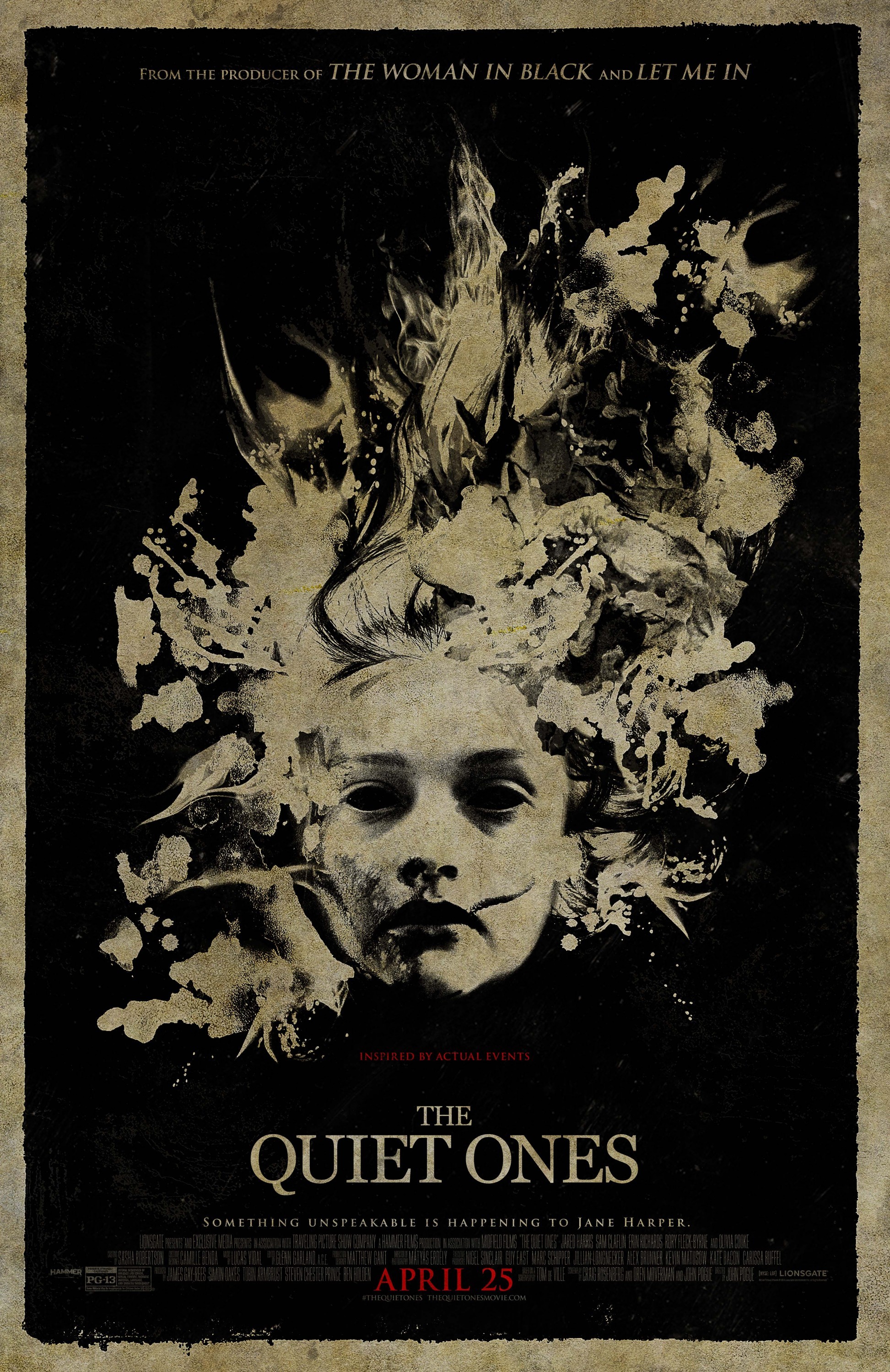
Shot in 2012 yet not released until 2014, The Quiet Ones is a 1970s-set, melancholic horror loosely based on the Philip Experiment, a 1972 parapsychology experiment conducted in Toronto, Ontario, made to determine whether living subjects can communicate with fictionalised ghosts through expectations of human will. Led by mathematical geneticist Dr. A.R. George Owen and overseen by psychologist Dr. Joel Whitton, their goal was to create a fictional character through a purposeful methodology and then ‘attempt’ to communicate with it through a séance. The created character was anointed; “Philip Aylesford,” referred to as “Philip” during the test. Although participants did report feeling a ghostly presence, table vibrations, breezes, unexplained echoes and eerie noises, matching responses to questions about Philip’s life, an apparition ultimately never appeared. Nevertheless, director John Pogue (Quarantine 2: The Terminal, Blood Brother, Deep Blue Sea 3) set out to take this real-world trial and twist it into an unnerving horror flick to, regrettably, minimal success.
Plot Summary: Summoning his top students to a secluded estate on the outskirts of Oxford in 1974, the unorthodox Professor Joseph Coupland proposes to the deeply troubled orphan Jane Harper that they perform a risky experiment to manifest the darkness within her. Operating under the theory that paranormal activity is triggered by negative human energy, Joseph and his team employ a series of tests to push the young woman to the brink of sanity. But, as the morally questionable experiment continues, the professor and his ambitious students soon realise they may have unwillingly released an unrelenting horror…
Heavily rewritten during production for budgetary reasons, The Quiet Ones does have a captivating piece of inspiration at its core, with the Philip Experiment being historically regarded as one of the most promiscuous and unsettling experiments of the 1970s, often playing into the configuration of conventional séances as Dr. A.R. George Owen sat his participants around a table, dimming the lights and requesting no communication between the group, even if the experiment has been criticised in recent years for lacking systematic management and clear results due to the unreliability of séances. Similar tests were conducted in the years following creating further make-believe characters, known as “Lilith” and “Humphrey,” producing near-identical results that were eventually deemed inconclusive. Regardless, it’s a bewitching real-world event for a horror flick, mashing up elements of science and the supernatural as frightening occurrences get underway, leading the researchers to admit their understanding of life and death isn’t as accurate as they once thought.
Portraying the zealous research team, Jared Harris, Sam Claflin, Olivia Cooke, Erin Richards and Rory Fleck Byrne are on all their A-game, with Harris being a particular highlight as the intelligent and self-assured Professor Joseph Coupland, portraying the character as equal parts unpredictable and oddly calming, it’s just a shame the character’s emotional backstory isn’t utilised to its full effect. In one of her first major roles, the then-upcoming actress, Olivia Cooke, is also a stand out, portraying Jane as an immensely tragic woman who has suffered from mental illness and uncanny events almost all of her life, being sent in and out of foster homes as a result of the malevolence enveloping her like a storm.
Continuously made to appear as if portions of the film were shot on ’70s-era cameras, The Quiet Ones is one of those horror flicks that feels as if it could have very easily been conceived as an entirely found-footage endeavour, but instead, the film uses the found-footage format sparingly, only employing the visual aesthetic at pivotal moments in the narrative. Most notably, during the scene with the Kirlian photography experiment (as seen through the lens of Brian’s 16mm camera), which was actually filmed by Sam Claflin himself, although not with an authentic 1970s camera, but with the contemporary camera of cinematographer Mátyás Erdély.
Comparable to how many of the film’s frights are your typical, lethargic jump-scares, such as windows slamming, doors knocking, beds breaking and chandeliers falling (each time, the deafening scare being preceded by an elongated silence), the orginal score by Lucas Vidal features the usual assortment of rackety, blaring tracks, like Not Scientific Proof and Bathtub Attack. Perhaps some of this audible bombardment was meant to conceal that there isn’t much depth to the story beyond the underlying theme of science and its relation to the supernatural.
In addition to The Quiet Ones, the infamous Philip Experiment also inspired the horror flick; The Apparition, released a few years prior in 2012, but that isn’t too surprising, given that a 2019 poll concluded that nearly half of the American populace believes that spirits and/or demons exist, despite overwhelming evidence that belief that life persists after death is declining.
In summary, The Quiet Ones is a horror flick that, in my opinion, is deserving of its largely overlooked status in the horror genre, as most of the film relies on cheap frights and visual trickery more than genuine dread to unnerve its audience. Though the film possesses an honourable cast, an appealing setting and an intriguing real-world influence, its rather lifeless execution holds it back. In essence, The Quiet Ones is much like the experiment in its narrative, throwing ideas into a beaker and praying it works as intended, yet it doesn’t achieve the desired outcome. Rating: low 5/10.



 Joe Baker - Film Reviews