Pet (2016) – Film Review

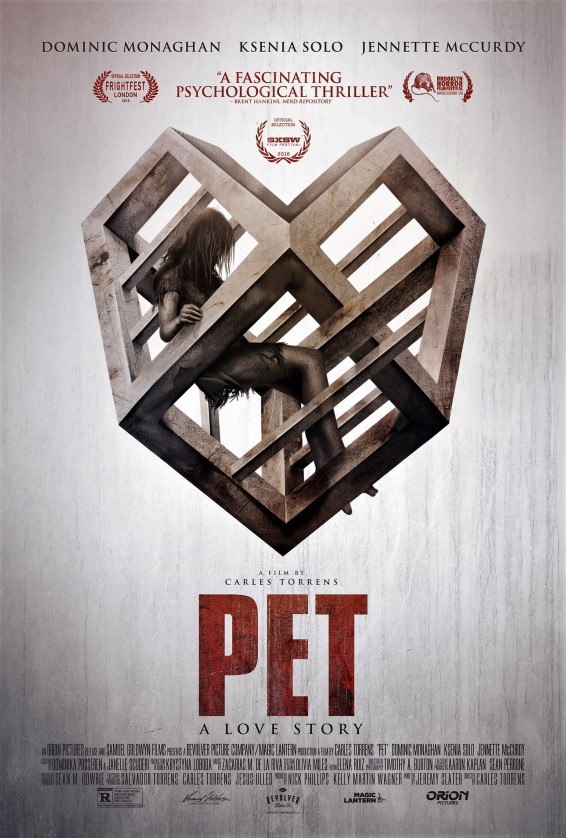
An unsettling indie horror firmly within the mould of the classic thriller; ‘The Collector,’ from 1965, 2016’s ‘Pet’ takes what could potentially be nothing but an exploitative horror and twists it into a unique story that continuously indulges in defying its audience’s expectations. And, although the film never manages to fully escape its various flaws by the end of its brief runtime, ‘Pet’ is able to achieve a nice balance between many of its best and worst aspects.

Plot Summary: After ‘Seth,’ a socially awkward recluse bumps into his old high school crush; ‘Holly,’ he subsequently becomes obsessed with her just as he was many years ago, ultimately leading him to abduct her and hold her captive beneath the animal shelter where he spends his working days, enclosing her in a cage just as he does with the canines above…

Directed by Carles Torrens (Apartment 143) and written by Jeremy Salter, the writer partly responsible for the disastrous ‘Fantastic Four’ reboot in 2015. ‘Pet’ was considered an utter failure upon its initial release, with the film only earning a box-office gross of around £8,000 on a total budget of £15,800, in addition to receiving a series of extremely mixed reviews from both critics and audiences alike. While this may be due to many fearing ‘Pet’ would be nothing but a grotesque ‘Captive Woman’ flick, ‘Pet’ is actually much more interested in going against the typical clichés many viewers will associate with this idea to delve into the ever-shifting power-dynamic between ‘Seth’ and ‘Holly,’ making for a pretty engrossing and unpredictable watch even if a level of disbelief is surely required as a result of the film’s many, many plot twists.

Much of what makes ‘Pet’ work can be attributed to its two leads, with Dominic Monaghan being hugely effective as ‘Seth,’ portraying him as a soft-spoken introvert who simply meanders his way through life with a small apartment and boring job, looking anyone (or anything) that could make his life truly worth living. And, whilst Monaghan is certainly capable of being intimidating when the story requires it, it is a shame that much of ‘Seth’s transformation from a wholly-reclusive loner to a plotting unhinged stalker feels very rushed. Then, of course, there’s ‘Holly’ portrayed excellently by Ksenia Solo, who is far from your usual helpless victim alluded to almost immediately through Solo’s sly performance and the unhealthy relationship that grows between her and ‘Seth’ as the story continues on. However, ‘Pet’ sadly still features a weak link amongst its cast, as Jennette McCurdy’s performance as ‘Holly’s best friend, ‘Claire,’ feels lacking in nearly every scene she’s in, despite her actual character serving a crucial role in the development of ‘Holly’s character.

A large majority of the cinematography by Timothy A. Burton is visually interesting, but unfortunately, many of the film’s shots are spoilt due to the overreliance on hand-held camerawork, with a number of shots being accomplished through hand-held for seemingly no reason. Nevertheless, the cinematography is varied enough to stop the story’s limited number of locations from becoming monotonous, especially when placed alongside the dramatic lighting and grimy set design.

Similarly, the original score by Zacarías M. de la Riva is competent, yet many tracks do feel more suited to something like a modern crime thriller than a disturbing psychological horror such as this, feeling especially out-of-place during any scenes that feature graphic violence. Furthermore, there are also a number of moments where the film implements its soundtrack during scenes that I personally feel would’ve been far more effective should they have been completely silent or possibly placed more emphasis on sound design.

The main issue ‘Pet’ suffers from is the inconsistency of its writing, as although its many subversions of the horror genre immediately put it on a level higher than a large majority of modern horror flicks that entirely rely on obnoxiously loud jump-scares. Much of the film’s characterisation is ruined as a result of clunky dialogue, whether that’s due to the actual line itself or its delivery, which is unfortunate as many of the film’s extended dialogue scenes are where the story has the most to chew on, developing its characters and their motivations while simultaneously implementing its signature theme of taking advantage of the opposite sex, even if this underlying theme is fairly surface level.

In short, whilst ‘Pet’ undoubtedly has its strengths, many of them do feel undermined by its weaknesses. From Jennette McCurdy’s weak performance to the peculiar dialogue and continuous reliance on hand-held camerawork, ‘Pet’s constant tension-building and subversion of classic horror tropes may not have been enough to draw in horror fans back in 2016, especially with the likes of ‘Don’t Breathe,’ ‘Hush’ and ‘The Autopsy of Jane Doe’ all releasing around the same time. Still, while I understand why ‘Pet’ was given so little attention, I do hope more genre fanatics stumble across this obscure horror, even if that doesn’t necessarily mean it’ll receive praise from all. Final Rating: 5/10.
pet_ver2_xxlg

The Void (2016) – Film Review

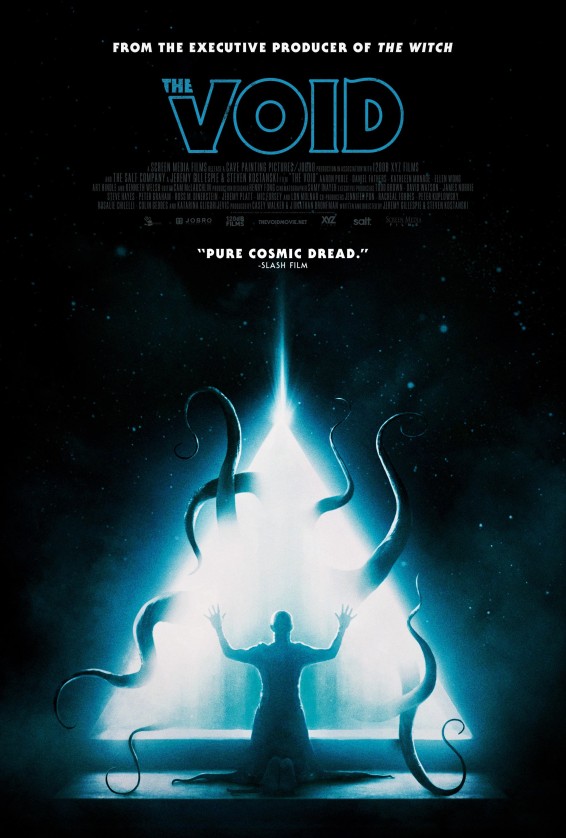
An excellent throwback to 1980s sci-fi and horror; ‘The Void,’ released in 2016 and directed by duo Jeremy Gillespie and Steven Kostanski, first began its life as a simple idea with two passionate minds behind it, as this surprisingly crowdfunded project makes remarkable use out of its thin budget, especially when considering the film’s many expensive-looking set pieces, displaying its huge array of fantastic creature designs and effects, colourful lighting and creative cinematography with enough confidence and innovation to keep any genre enthusiast enthralled.

Plot Summary: After ‘Sheriff Deputy Carter’ stumbles across a blood-soaked man limping down a deserted road, he quickly rushes him to a local hospital with a barebones, night shift staff. But, when a series of strange events occur within the hospital, seemingly linked to a group of cloaked figures standing just outside the building, ‘Carter’ decides to lead a mission into the hospital’s basement to find an exit, only to discover something far more concerning…

Even though ‘The Void’ did have a handful of producers on board more familiar with the horror genre, as mentioned previously, the film was primarily a crowdfunded project, earning most of its budget in addition to a limited theatrical release in 2017 as a result of its online community of donors and fans. And, it’s not exactly difficult to understand why many fanatics of sci-fi and horror alike were so interested in supporting the film, as immediately from the stylised intro any fan of 1980s cinema can tell ‘The Void’ is truly a love letter to everything ’80s, with the film’s narrative clearly taking heavy inspiration from classics, like ‘From Beyond,’ ‘Re-Animator,’ and, of course, virtually all of John Carpenter’s filmography. Yet, despite all of these influences, ‘The Void’ also manages to never feel overly derivative, even with the film’s plot sharing many similarities to the cult horror; ‘Prince of Darkness,’ from 1987.

The cast of ‘The Void’ is primarily comprised of unknown actors, which is by no means a bad thing, as the cast give solid performances across the board, even in spite of their fairly one-note characters, with Aaron Poole, Kathleen Munroe, Daniel Fathers, Mik Byskov, Evan Stern and Ellen Wong portraying the main group of staff and survivors trapped within the hospital’s walls quite well. But, the real stand out of the film has to be Kenneth Welsh as ‘Dr. Richard Powell,’ easily the compelling character of the story, who undergoes some enormous changes over the course of the runtime.

Samy Inayeh handles the film’s cinematography and handles it well, as whilst there are plenty of moments where the camerawork is far too reliant on hand-held shots, the film manages to even itself out over time with plenty of visually appealing ones. However, it’s the lighting and colour palette that are certainly the most visually impressive elements of the film, as ‘The Void’ jumps from harsh reds to cold blues almost from scene-to-scene, not only to add to the film’s unearthly atmosphere of dread, but also to help hide some of the film’s budgetary shortcomings. Furthermore, the story’s signature location of an empty hospital is a very distinct setting for a horror such as this, as the building seemingly becomes more unnatural and dilapidated the further the characters explore it.

For its original score ‘The Void’ actually had quite a large group of composers (five in total), who expertly crafted a classic 1980s synth score with undertones of dark horror, which greatly adds to both the film’s style and atmosphere. And, although the film’s soundtrack is usually more atmospheric than cinematic, tracks such as ‘Starless Night’ and ‘A Hole in the World,’ prove the score does have some memorability amongst its many foreboding tracks.

Partly due to the film’s budget and partly due to Gillespie and Kostanski wanting to use as little CGI as possible, ‘The Void’ is a science fiction flick that delights in its practical effects. Ensuring every creature design and the costumes and/or prosthetics that bring them to life are nothing but flawless, from their skin to their teeth to their various tentacles (of which the film seems to relish in), nearly every aspect of each creature looks truly spectacular, and its these otherworldly designs alongside the film’s over-the-top gore and buckets of blood that help create some genuinely disturbing moments.

In summary, I feel ‘The Void’ succeeds in being an enjoyable throwback to many people’s favourite decade for sci-fi and horror, with its astounding filmmaking and many impressive practical effects all resulting in plenty of thrills and chills. And, although some may argue the film lacks much in the way of originality, I’d argue otherwise, as I feel ‘The Void’ is less of a capsule for nostalgia and references for all things ’80s, and more of a tribute to what came before it, never quite matching up to many of the films from the time-period its referencing, but still raising the bar for indie filmmaking and crowdfunded projects in its best moments. Final Rating: 7/10.

the_void-p1096924

A Monster Calls (2016) – Film Review

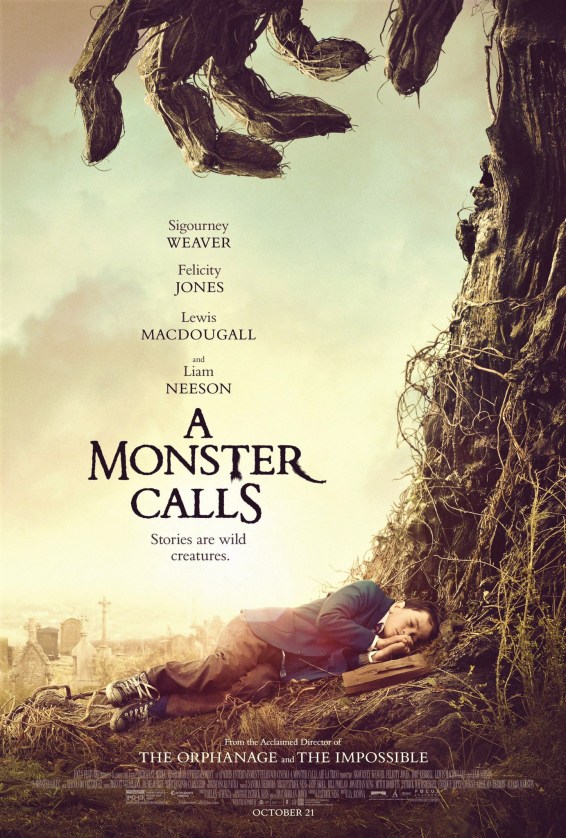
Based on the novel of the same name by Patrick Ness and directed by J. A. Bayona (The Orphanage, The Impossible, Jurassic World: Fallen Kingdom), 2016’s ‘A Monster Calls’ is far from being the simplistic creature-feature its title may imply. Instead, this imaginative and soul-stirring drama balances its mature themes and fairytale-esque elements to deliver an engrossing and incredibly moving story, which despite its many positive reviews, has mostly gone unmentioned by many film fanatics since its initial release.

Plot Summary: After realising his mother is dying from terminal cancer, twelve-year-old ‘Conor O’Malley’ struggles to accept that he soon may have to live in a world without his caring mum. Until, later that night, when ‘Conor’ is visited by a tree-like monster in what he believes to be a dream, ‘Conor’ sees an opportunity to save his mother as the creature tells the boy he will heal her after he listens to his three stories…

Focusing on heavy themes of family and loss, the film adaptation of ‘A Monster Calls’ follows its source material very closely, with only a few small differences. One of these alterations being some additional scenes that were written exclusively for the film, including one scene that takes place immediately after the ending of the novel. But, with the original author Patrick Ness writing the film’s screenplay, this accuracy shouldn’t be too surprising. However, interestingly, it wasn’t Ness who originated the story, as the novel was actually started by Siobhan Dowd, who, sadly left it unfinished after her death, leaving Ness to complete the novel in 2011, yet Dowd is still credited as the creator of the original idea during the film’s end credits.

While the film’s supporting cast of Felicity Jones, Sigourney Weaver, Toby Kebbell, and Liam Neeson as the voice of ‘The Monster,’ are all superb in their various roles, its Lewis MacDougall who takes on the lead role as ‘Conor’, which is by no means an easy feat considering his age, as ‘Conor’ is a fairly complex character, being a young boy dealing with a very difficult situation he doesn’t fully understand, unwilling to accept that is mother is in constant pain, and more than likely, won’t be able to recover from her sickness. ‘Conor’s young age also makes his outbursts of rage and sorrow more understandable, as nearly every viewer can probably recall the difficulty of attempting to control their emotions when they themselves were a child. The now-sought-after actor Tom Holland also has a small role in the film, as Holland actually served as the stand in for ‘The Monster’ on set, following his previous collaboration with Bayona on ‘The Impossible’ in 2012.

The film’s cinematography by Oscar Faura not only manages to capture the true scale of ‘The Monster’ at many points, but also allows for a large array of visually appealing shots, effectively utilising everything from extreme close-ups to aerial wide shots to increase the film’s spectacle. The film’s CG effects aren’t quite as impeccable, however, as there are a noticeable amount of CGI-heavy moments which have suffered (if only slightly) from the film’s age.

Although the story of ‘A Monster Calls’ is very powerful on itself, there is no denying it is greatly elevated by Fernando Velázquez’s original score, as many of the film’s accompanying tracks, such as ‘Dad Arrives’, ‘Big Dreams’, ‘The Truth,’ and certainly the film’s final track; ‘End Credits’, all massively help to evoke emotion in the viewer, inevitably adding up to the film’s gut-wrenching conclusion. Any fans of Bayona’s early filmography are also sure to enjoy the film’s quick throwback to the director’s horror roots, as the score becomes quite dread-inducing during the first scene with ‘The Monster,’ as ‘Conor’ is unsure of the creature’s intentions.

But, without a doubt the most impressive aspect of this adaptation has to be ‘The Monster’s stories, as every time ‘The Monster’ tells ‘Conor’ these fantastical tales, the film takes a dramatic shift from live-action into animation, bringing its stories to life through water-coloured drawings and sketches, which not only plays into ‘Conor’ and his mother’s flair for artistry, but these sequences are also when the film is at its most creative, having the camera fly through splurges of paint and water, engulfing the viewer in an array of magnificent colours and locations alike.

In summary, ‘A Monster Calls’ is truly a touching and prodigious film. Whilst perhaps not completely flawless in its execution, mostly due to its unexplored side characters and occasional piece of hand-held camerawork, I feel most would find it impossible to not relate to the story in someway, as it’s sublime performances, enchanting visuals, and beautiful original score all serve their purpose of complimenting the film’s narrative, which is just as captivating as it’s novel counterpart. And, for me, ‘A Monster Calls’ still reigns as my personal favourite film from J. A. Bayona, and I’m positive the film became (and will continue to be) a showcase for Patrick Ness as a talented screenwriter. Final Rating: 8/10.

monster_calls_xxlg

Moonlight (2016) – Film Review

Directed by Barry Jenkins (Medicine for Melancholy, If Beale Street Could Talk) and based on the unproduced stage play; ‘In Moonlight Black Boys Look Blue’ by Tarell Alvin McCraney. ‘Moonlight’ has been heavily praised since its initial release in 2016, being just one of the films from adored production company A24, who also brought us modern indie classics, like ‘Hereditary,’ ‘Waves,’ ‘Eighth Grade,’ ‘The Witch’ and ‘A Ghost Story,’ just to name a few. And, although ‘Moonlight’ may not be the company’s greatest film to date, it is certainly one of the finest examples of visual storytelling and subtle characterisation in recent memory.

Plot Summary: Through three different time periods, young adolescence, mid-teen and young adult, African-American; Chiron, grapples with his identity and sexuality as he grows up in Miami, his journey to manhood being guided by the kindness, support and love of the community that helped raise him…

In addition to receiving almost universally positive reviews, ‘Moonlight’ also won three Oscars for Best Picture, Best Screenplay and Best Supporting Actor in 2017. And, with the film only having a budget of around £1.1 million, ‘Moonlight’ has the lowest budget of any Best Picture winner since ‘Rocky’ in 1976, which cost only £820,000. However, even with this smaller budget, director Barry Jenkins and writer Tarell Alvin McCraney always had a clear vision as to what the film would be, as both men had similar childhood experiences living in Miami, with mothers who had both struggled with drug addiction. So, it was decided early on to replicate those experiences, with roughly 80% of the film being shot in the same neighbourhood the pair originally grew up.

Alex R. Hibbert, Ashton Sanders and Trevante Rhodes portray ‘Chiron’ across the three different time periods of his life, and all do a great job in spite of them not sharing many of the same mannerisms outside of ‘Chiron’s manner of speaking, yet this doesn’t stop the trio from still making ‘Chiron’s quiet and sheepish personality shine. The supporting cast of Mahershala Ali, Naomie Harris, Janelle Monáe and André Holland, are all also fantastic, but with all four being such skilled actors who have given few bad performances throughout their careers, it was unlikely this indie drama would ever be an exception, it’s just a shame their characters aren’t featured more within the narrative.

Despite a large amount of James Laxton’s cinematography consisting of shaky hand-held shots, the film’s camerawork does allow for plenty of movement, as the camera rarely remains still during conversations between characters, making many of the story’s dramatic moments far more visually interesting and giving each scene a consistent flow through the many revolving shots. Additionally, the film also utilises its cinematography to reflect ‘Chiron’s emotional state at many points, combining with the film’s original score for some very impactful story beats. All of this working in synch with the film’s bright colour palette and smooth editing, which both make superb use of the beautiful setting of Miami.

Another masterful and memorable aspect of ‘Moonlight’ is its original score by Nicholas Britell, as the film has a very diverse yet gentle score with tracks ranging from orchestral to more piano-focused, as Britell decided to ‘Chop and Screw’ the orchestra to create a new kind of sound, this technique can be seen throughout the tracks; ‘The Middle of the World,’ ‘Chiron’s Theme’ and ‘Chef’s Special,’ with director Barry Jenkins stating that he always wanted the film’s score to be distinctive, as he actively tried to avoid the cliché of Black-lead films featuring exclusively hip-hop soundtracks.

Much of ‘Moonlight’s story was also inspired by Barry Jenkins’ own childhood in Miami, where he was surrounded by lush green grass and stunning golden sunsets, yet also lived in a neighbourhood where some tragic events took place, declaring his childhood; “A Beautiful Struggle.” And, whilst the film’s slow pacing allows this story to be fully explored, this shouldn’t put viewers off, as the narrative doesn’t move along at a brutally slow pace, only slow enough to fully immerse its events/characters in realism. Then, of course, there is the film’s visual/minimalist storytelling, which is some of the best executed I’ve seen in a long-time, as the film hides many small visual/audio details for those paying close attention, presenting its themes of embracing yourself, addiction and masculinity in such a fashion that I feel different audience members will interpret the story in their own way.

In summary, ‘Moonlight’ is a prepossessing coming-of-age story, even if it isn’t one of the best films A24 has to offer, as while the film is still an incredibly entertaining and well-written drama with an equally well-crafted original score and some creative cinematography to boot. A24 simply has such a vast and exceptional range of indie films to choose from, as the production company is never hindered by genre, style or tone for projects they green-light. But, if you enjoy dramas or are a lover of Barry Jenkins’ other work, then ‘Moonlight’ will surely be a captivating watch followed by a fascinating discussion, just be sure to give the film your full attention. Rating: 8/10.

moonlight_ver2_xxlg

The Shallows (2016) – Film Review

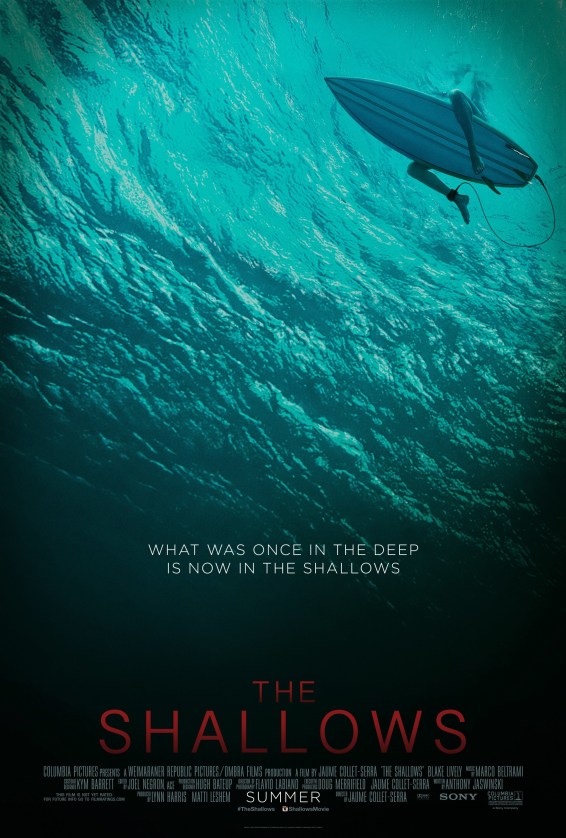
Ever since the release of the original blockbuster; ‘Jaws,’ in the summer of 1975, shark films have never quite managed to reach the same heights, with flops such as ‘Deep Blue Sea,’ ‘Bait,’ ’47 Meters Down,’ and ‘Shark Night’ feeling quite distant from reality, as they present the animals as nothing but bloodthirsty monsters that devour brain dead characters. And, while ‘The Shallows’ does feel like a slight improvement over many of these other flicks (mostly in regards to its protagonist), the film still falters at many turns.

Plot Summary: After losing her mother in an accident, medical student; ‘Nancy,’ dumps her responsibilities in Galveston and travels to Mexico, hitchhiking a ride to a hidden beach that her mother loved when she was young. But, following her discovery of a whale carcass whilst surfing, ‘Nancy’ is attacked by a great white shark, leaving her tired, bleeding and stranded on a small rock, with no sign of rescue…

Releasing in 2016 to great success, ‘The Shallows’ was one of the first major shark films released into cinemas in quite some-time, but as well as being a creature-feature, ‘The Shallows’ also serves as a modern-day survival-thriller along the same lines of ‘127 Hours Later,’ as ‘Nancy’ has to face not only the great white shark stalking her, but also hunger, thirst, weather, and, of course, the severe leg injury she receives when she first encounters the apex-predator. Yet, despite this focus making for a far more engaging experience, the narrative simultaneously tries its hand at character development, with ‘Nancy’ receiving plenty of characterisation in the film’s first act, which is sadly made less interesting as its delivered through some immensely corny dialogue.

Blake Lively, who is by no means a renowned actress, with only two films throughout her career featuring her in the top-billed cast, carries the film solo, and her commitment to this role is certainly admirable, as Lively gives a very intense performance as a result of ‘Nancy’ being in agonising pain for most of the runtime. Furthermore, Lively did most of her own stunts for the film aside from her character’s surfing. In fact, in one particular scene where ‘Nancy’ crushes a crab and then proceeds to eat it raw, Lively is actually eating a real crab that the production crew found dead on a nearby beach that morning, so her reactions of disgust are genuine, even though the crab initially being crushed was achieved through CGI. This is all made even more impressive by the fact that Lively was pregnant with her second child at the time of filming. 

Flavio Martínez Labiano’s cinematography does provide a handful of attractive and memorable shots when not focusing on the characters, these usually being when the shots revolve more around the shark lurking beneath the water, or when the camerawork effectively uses framing to display how far ‘Nancy’ is from safety. And, of course, with the film being shot off the Gold Coast of Australia (excluding a few scenes which were shot in a large water-tank), the film’s signature beach and crystal clear waves are always an alluring sight, which is a superb visual clash with the horror that lies within.

The original score by Marco Beltrami serves the story well enough, as the film’s soundtrack drifts from beautiful calming tracks, like ‘Paddle In’ and ‘Nancy and Dad Facetime,’ to much more tense tracks, such as ‘Main Title’ and ‘Towards the Dead Whale.’ However, its when the story shifts into full on threat that the score begins to feel extremely generic, most notably, the track; ‘Underwater Attack,’ which is barely distinguishable from any other thriller soundtrack as it doesn’t encapsulate either the beauty or isolation of the ocean as many of the other tracks do.

Unlike ‘Jaws’ or even ‘Deep Blue Sea’ during a few moments, ‘The Shallows’ exclusively uses CGI to bring its shark to life, which is unfortunate, as while there is clearly a huge level of detail put into the shark as director Jaume Collet Serra (Orphan, Unknown, Non-Stop) worked closely with the film’s visual effects artists to ensure a sense of realism in the shark’s design, having the team do thousands of hours of research. This all sadly goes to waste though due to the demands of the film’s screenplay, as the shark in ‘The Shallows’ rarely acts like a real animal, often feeling like just a hulking murderous monster whose CG effects drastically vary depending on the shot.

In summary, ‘The Shallows’ is a step-up from a number of other shark flicks, but even with its above-average filmmaking and solid performance from Blake Lively. The film still falls into many of the common issues shark films do, as the story favours the idea of using its shark as a monster of the ocean and that alone, and this on top of the film’s occasionally strange stylistic choices, shoddy CG effects and cheesy dialogue, result in the film becoming just another poor attempt at revitalising the great white shark as a cinematically enthralling antagonist. Final Rating: 4/10.

shallows_xxlg

Midnight Special (2016) – Film Review

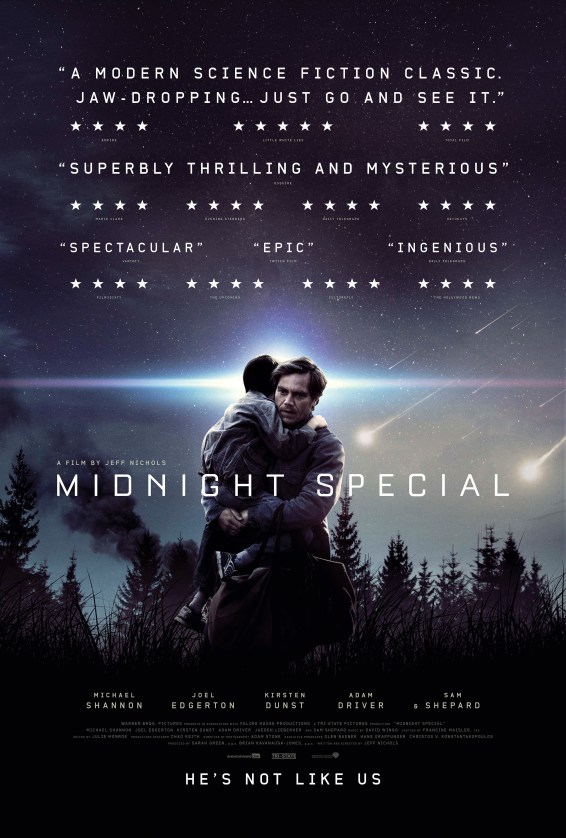
Written and directed by Jeff Nichols (Take Shelter, Mud, Loving), ‘Midnight Special’ may not be one of the most original or imaginative science fiction films to be released in recent years. Yet, regardless of its many recycled story elements and unexplored ideas, this low-budget sci-fi drama/thriller still manages to retain a sufficient amount of entertaining scenes, impressive CG effects and terrific performances to boot. All equalling to a fairly enjoyable experience, even if the film never quite reaches its full potential.

Plot Summary: ‘Alton Meyer’ is a boy unlike any other, a child with powerful abilities and strange weaknesses, alike. But, after ‘Alton’s abilities attract the attention of both an isolated cult and the U.S. government, ‘Alton’s father; ‘Roy,’ vows to protect his son as the two rival forces pursue the pair across the country…

Although ‘Midnight Special’ was Nichols’ first film made in conjunction with a large production company, Nichols wanted to ensure he had full creative control over the project just as he had previously with his low-budget indie films. So, despite Nichols originally considering making the film with an independent film studio rather than with Warner Bros. Pictures during his last meeting with the company, the producers actually agreed to all his demands, due to the small budget needed for the film. Meaning Nichols got his complete control, and the film was more successful at the box-office as a result of its wider release. This did, however, mean many audience members were left a little dissatisfied with the film, as ‘Midnight Special’ doesn’t follow the usual sci-fi clichés many would expect.

Michael Shannon leads the film as the concerned father; ‘Roy Meyer,’ and as per usual, excels in his role as this simple yet engaging character, wanting to protect his son at any cost, occasionally even at the expense of others. Playing into the age-old theme of doing anything to protect your child. Then there is also Jaeden Martell as ‘Alton’ himself, who considering his young age of twelve at the time of filming, delivers a competent performance, as even though ‘Alton’ may look like a normal child, he acts in a very robotic and eccentric manner. And, whilst this is completely intentional, this type of performance does sometimes make it quite difficult to resonate with ‘Alton’ as effectively as his father. The supporting cast of Joel Edgerton, Kirsten Dunst and Adam Driver, are all also great additions to the film, even though their characters don’t add much to the narrative.

Well-shot throughout, Adam Stone’s cinematography for ‘Midnight Special’ may not be some of the most astounding camerawork ever seen within the sci-fi genre, but due to the film mostly being set at night, the film does manage to enhance many of its already attractive shots through its dim lighting. In addition to the cinematography, the film also makes fantastic use of its many CG effects, with the majority of them being used quite sparsely to ensure they all appear as detailed as possible without going over budget.

The original score by David Wingo also isn’t too memorable when compared to some other scores composed for science fiction flicks, but it still greatly adds to the film. Alternating from slow piano-focused tracks to more electronic pulse-pounding tracks when necessary, the entire soundtrack is both atmospheric and suitably sci-fi, with my two personal favourite tracks; ‘Doak and Levi’ and ‘New World,’ being the perfect two examples of this change in tone when it comes to the score. The film also features a new rendition of the classic folk song; ‘Midnight Special,’ during its end credits, which is actually where the film gets its title.

Yet, in spite of its appealing cinematography and remarkable original score, the area where ‘Midnight Special’ falls flat is its story, as whilst many stories similar to this have been executed well in film before, most notably the sci-fi classic; ‘Starman,’ from 1984. ‘Midnight Special’ revels in not providing its audience with much information, keeping many aspects of ‘Alton’s character, his abilities, and the world the story takes place within a mystery. This is most evident when it comes to the (presumably) sinister cult known as ‘The Ranch,’ as while the cult does play a small role in the story, they remain mostly underdeveloped throughout the film, and as the runtime approaches its end, soon disappear entirely.

In summary, ‘Midnight Special’ is a sci-fi film that will appeal to a far more niche audience, as whilst a simple pitch of the plot may sound both familiar and interesting to many fans of the genre, it’s the way ‘Midnight Special’ goes about its story that will divide many viewers. If the film was to provide a little more backstory/exposition here and there, perhaps the story would’ve felt more fleshed out and matched with the brilliant efforts of its filmmaking. But, as it is, ‘Midnight Special’ feels like a bit of a wasted opportunity, as it remains a decent film that could’ve been so, so much more. Final Rating: high 6/10.

MIDNIGHT-SPECIAL-ONE-SHEET

The Autopsy of Jane Doe (2016) – Film Review

A twisted and unique indie horror that is certainly not for the squeamish, ‘The Autopsy of Jane Doe’ utilises it’s simple concept and individual location to the best of its ability, immersing its audience into its grim setting almost as if they are performing the autopsy themselves alongside the film’s characters. Whilst the film may still suffer from a couple of the same issues that plague many other modern horrors, ‘The Autopsy of Jane Doe’ manages to overcome most of its faults to evolve into a compelling slice of low-budget horror.

Plot Summary: While investigating the murder of a family, a small-town Sheriff and his team are puzzled with the discovery of a mysterious body buried underneath the crime scene. After bringing the corpse of the unnamed; ‘Jane Doe,’ to family coroners; ‘Tommy’ and ‘Austin Tilden,’ to determine her cause of death, the pair soon discover the corpse is harbouring a dark secret…

Directed by André Øvredal (Troll Hunter, Scary Stories to Tell in the Dark), ‘The Autopsy of Jane Doe’ may be slightly lacking in terms of budget, yet the film always manages to use this to its advantage by setting nearly the entirety of its story within the walls of the ‘Tilden Morgue and Crematorium.’ Through which, the film constantly retains its eerie atmosphere and even a partial feeling of claustrophobia. In addition to also keeping its audience entranced within its narrative through its signature mystery, as the questions of “Who was ‘Jane Doe?” and “How was She Killed?” remains on every viewers’ mind after the opening scene.

The main father and son duo portrayed by Brian Cox and Emile Hirsch both do a great job throughout the film, with the writing also contributing to the film’s engagement as their characters receive a decent amount of characterisation. Easily the most challenging (and respectfully most impressive) performance of the film has to be the ‘corpse’ herself; ‘Jane Doe,’ however, as while there were some prosthetics used during production, it may surprise many to know this role was actually portrayed by actress Olwen Catherine Kelly for the majority of the film, as André Øvredal felt it was necessary to have an actress in the role to help connect to the audience on a human level, eventually leading Kelly to be cast due to her knowledge of yoga, which helped her minimise both her breathing and slight body movements.

The cinematography by Roman Osin is admirable, implementing a number of attractive shots during the runtime. However, the film’s cinematography is still best utilised when it comes to the many gruesome close-ups, as the film never shies away from the “Autopsy” part of its title, displaying nearly every part of the autopsy from the initial exterior examination through to the interior examination, securing this film’s position as not one for the faint of heart when its comes to blood/gore (or nudity for that matter). The lighting throughout ‘The Autopsy of Jane Doe’ also benefits its story, as the film’s array of tense moments are only enhanced as a result of the morgue being shrouded in shadows.

Danny Bensi and Saunder Jurriaans handle the film’s original score, which in spite of its complete lack of memorability does help add to the film’s foreboding tone and blood-curdling atmosphere, as the score feels more like ominous ambience rather than a standard horror score, with the track; ‘Hair Cut,’ being the clearest example of this. The film also places a heavy emphasis on the song; ‘Open Up Your Heart and Let the Sun Shine In,’ a classic ’50s song, which repeatedly plays over the overly static radio within the morgue, resulting in the song quickly becoming one of the film’s creepiest aspects.

Whilst ‘The Autopsy of Jane Doe’ does avoid many of the usual horror clichés, the film, unfortunately, still suffers from the most common problem in horror; jump-scares. Despite relying far more on its atmosphere and occasional chilling visuals to place its audience on edge, the film still feels the need to spread a variety jump-scares throughout its tight runtime. In particular, within the film’s final act, which is when the film loses much of its originality in favour of becoming more generic and predictable.

In summary, ‘The Autopsy of Jane Doe’ is a fairly underrated gem in the realm of modern horror, surpassing many other films that attempt many similar ideas but usually end up feeling quite tasteless, such as the overlooked film; ‘Anatomy,’ from 2000, or the bizarre 2008 indie flick; ‘Deadgirl.’ So, although not completely perfect in its execution, ‘The Autopsy of Jane Doe’ still delivers on its setup of a tense and engrossing tale that also manages to make time for its characters in the process, and even though I personally don’t find Øvredal’s filmography impeccable, I believe this director has talent, and projects like ‘The Autopsy of Jane Doe’ prove he can be a worthy contributor to the horror genre. Final Rating: 7/10.

autopsy_of_jane_doe_xxlg

The Problem with Live-Action Disney Remakes – Film Discussion

In years recent years, Disney has noticeably been taking quite an aggressive approach to reimagining many of the company’s classic animated adventures into live-action blockbusters, which I personally feel is having a bad influence on the rest of the film industry in more ways than one…

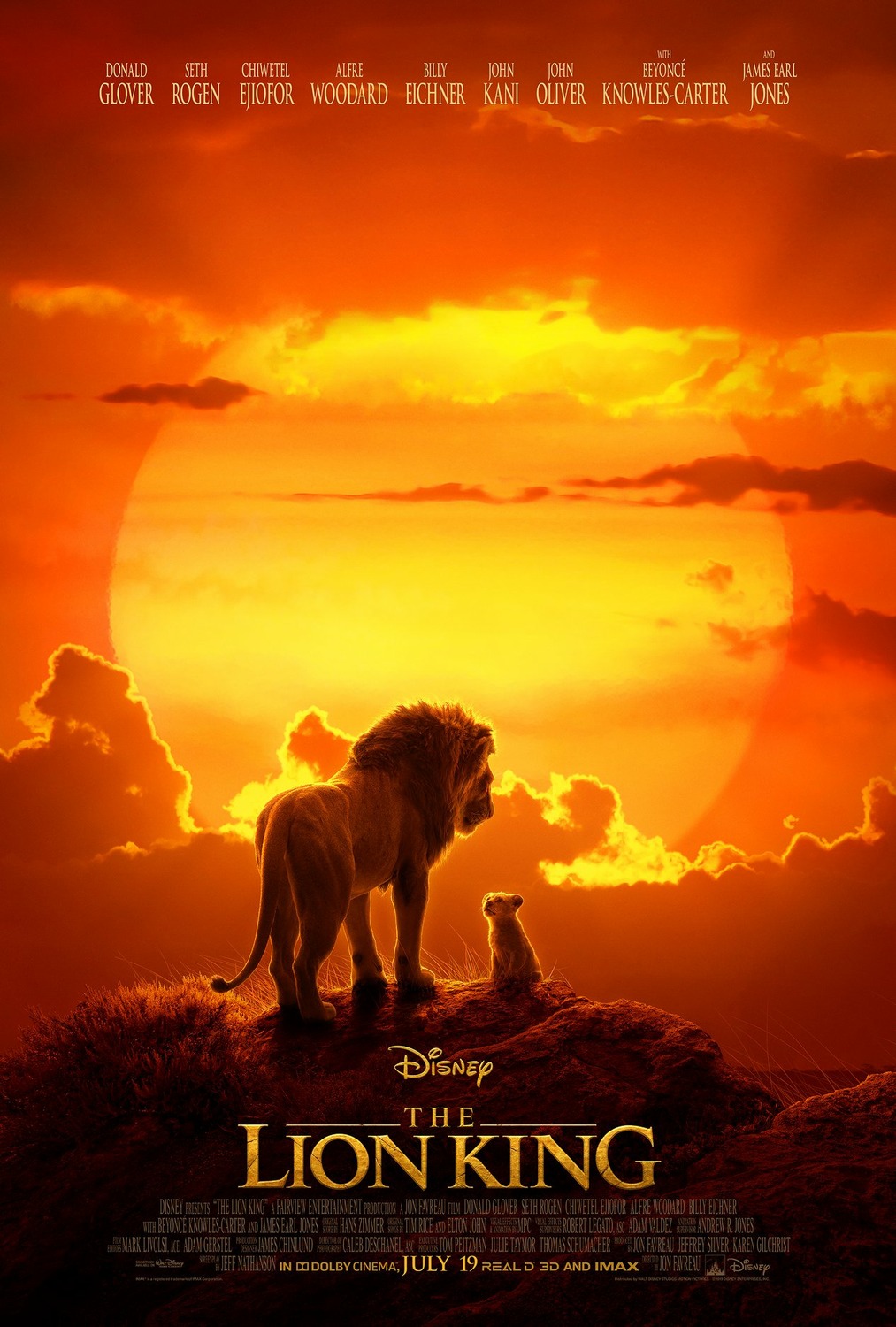
Despite Disney actually began the trend of remaking their classic films all the way back in 2010 with the semi-sequel/remake of ‘Alice in Wonderland,’ directed by Tim Burton. Disney didn’t begin to get truly rampant with its approach until the later successes of ‘Cinderella’ and ‘The Jungle Book’ in 2015 and 2016, respectively, with ‘Beauty and the Beast,’ ‘Dumbo’ and ‘Aladdin’ following not far behind, eventually leading to their most recent releases, that being ‘The Lion King’ and ‘Lady and the Tramp.’ Yet, whilst all of these films did receive mostly positive reviews from both critics and audiences upon their initial release, I personally have never understood why. As, for me, none of these remakes ever manage to really justify their existence, with each new film simply feeling like nothing more than a product, a money machine disguised as a film created purely to rinse profit out of Disney fans who desire to see their childhood classics recreated in a new light and, by this point, I just find it irritating.

Of course, remaking iconic films is nothing new for the film industry, with dreadful remakes, such as ‘RoboCop,’ ‘Ghostbusters’ and ‘Robin Hood,’ all being great examples of how taking a classic film and giving it a sleek modern aesthetic doesn’t automatically make it superior to the original. However, it’s the way Disney goes about executing their remakes that makes them even more frustrating, as even though most reimaginings may not differ too much from the original story, the majority of Disney remakes feel almost identical to their animated counterparts, featuring nearly all of the same scenes and dialogue, now just dragged down by much weaker visuals, vocal performances, and songs. This, in turn, also allows directors and writers to simply borrow material from previous filmmakers without having to innovate much themselves. Another issue I have with Disney converting their animated classics into live-action is that many of the original stories were always envisioned to be animated as they were being written, meaning when transferred into a different style of filmmaking, they usually are forced to rely on enormous amounts of CGI.

Although most audiences seemingly don’t take issue with Disney’s constant remakes, there are still some Disney fans who have spoken out about losing interest in Disney’s future live-action endeavours. In particular, I personally recall many weren’t looking forward to watching the ‘Aladdin’ remake around the time of its release, which I feel is understandable, as just from its trailer alone, it was clear that not only would the film intensely mirror the original, but it was obvious just from a glance that its visuals were also far, far duller, as the remake was lacking in both colour and style. Focusing more on being semi-realistic rather than fully engaging in its elements of fantasy (which, for a narrative revolving around a powerful genie who grants three magical wishes, feels like a huge mistake to me). Whilst the original ‘Aladdin’ may not be the most visually enthralling of Disney’s catalogue of family flicks, the classic style of 2D hand-drawn animation is still very pleasing to look at, even by today’s standards for CG animated films.

It may even surprise some to know that many of these bland remakes were actually directed by talented filmmakers like Jon Favreau and the previously mentioned Tim Burton. Yet, with each new film, every director’s unique style always seems to be stripped away or completely absent, as not only does each remake barely utilise any creative cinematography or editing, relying nearly entirely on CG effects to impress the audience. But usually inventive directors such as Guy Ritchie, who has made phenomenal use of his unique style of editing and humour in the past within his films, like ‘Snatch’ and ‘The Gentlemen,’ suffers as a result of how simply generic and even somewhat boring his reimagining of ‘Aladdin’ is, and while Disney may not be entirely to blame for this, I do believe the company would prefer to keep each remake fairly easy to digest in order to appeal to a wider audience.

In addition to both the visuals and directing, however, the cast of the original animated flicks were also a huge contributing factor to them becoming as beloved as they now are, with not only actors like Robin Williams as the original ‘Genie,’ of course, but also lesser-known actors such as Nathan Lane and Ernie Sabella as ‘Timon’ and ‘Pumbaa,’ to Jodi Benson and Pat Carroll as ‘Ariel’ and ‘Ursula,’ as all these voices not only gave the characters great comedic timing and a distinct tone, but they soon even became an extension of the characters themselves, making them recognisable purely through their voice. Whereas Disney’s newer remakes prefer to just take the much easier approach of simply casting the most relevant actors at the time and throwing them into an iconic role, and whilst actors, like Donald Glover and Chiwetel Ejiofor, will always be superb at their craft, forcing these performers into roles within ‘The Lion King’ simply due to their popularity will always make their vocal performance feel very out-of-place when in comparison with the original film.

The final area I find Disney remakes to be most lacking is the tampering of classic Disney songs, as although I’m personally not an enormous fan of musicals within the realm of live-action, I’ve always enjoyed many of the songs in Disney animated classics. As, not only do I feel these songs add to the characters and the story of each film immensely, but many classic Disney songs also manage to become iconic amongst themselves, with nearly any fan of animation more than likely know all the words to ‘Be Our Guest,’ ‘The Circle of Life,’ and ‘Under the Sea’ (just to name a few). But, when it comes to the remakes, once again, both the original score and songs feel far duller, even in spite of the legendary Hans Zimmer returning for ‘The Lion King’ remake to recreate many of his classic tracks. Still, a few of the reimaginings do at least attempt to throw in some original songs, which unfortunately end up being mostly forgotten due to them being overshadowed by the classic songs audiences are more familiar with.

In summary, it seems the influx of live-action Disney remakes won’t be stopping anytime soon, with ‘The Lion King’ racking in over £1 billion worldwide, Disney will most likely continue this remaking trend until their audience completely loses interest, as reimaginings of ‘Mulan,’ ‘Peter Pan,’ ‘The Little Mermaid,’ ‘Pinocchio,’ The Sword in the Stone’ and ‘Lilo and Stitch,’ as well as many, many more, are already set for release. Whilst the House of Mouse does still have a few original films on the horizon, Disney seems to be heading down a similar path to their paired animation company Pixar, that being one of laziness, relying mostly on their previous stories and franchises for profit rather than creating something new which, in turn, is also encouraging other production companies to do the same. So, if you share my opinion, perhaps sit out Disney’s next live-action release, stay at home, and just relive many of the beautifully animated stories from the past, as I honestly believe many of these films are timeless.

lion_king_ver2_xlg

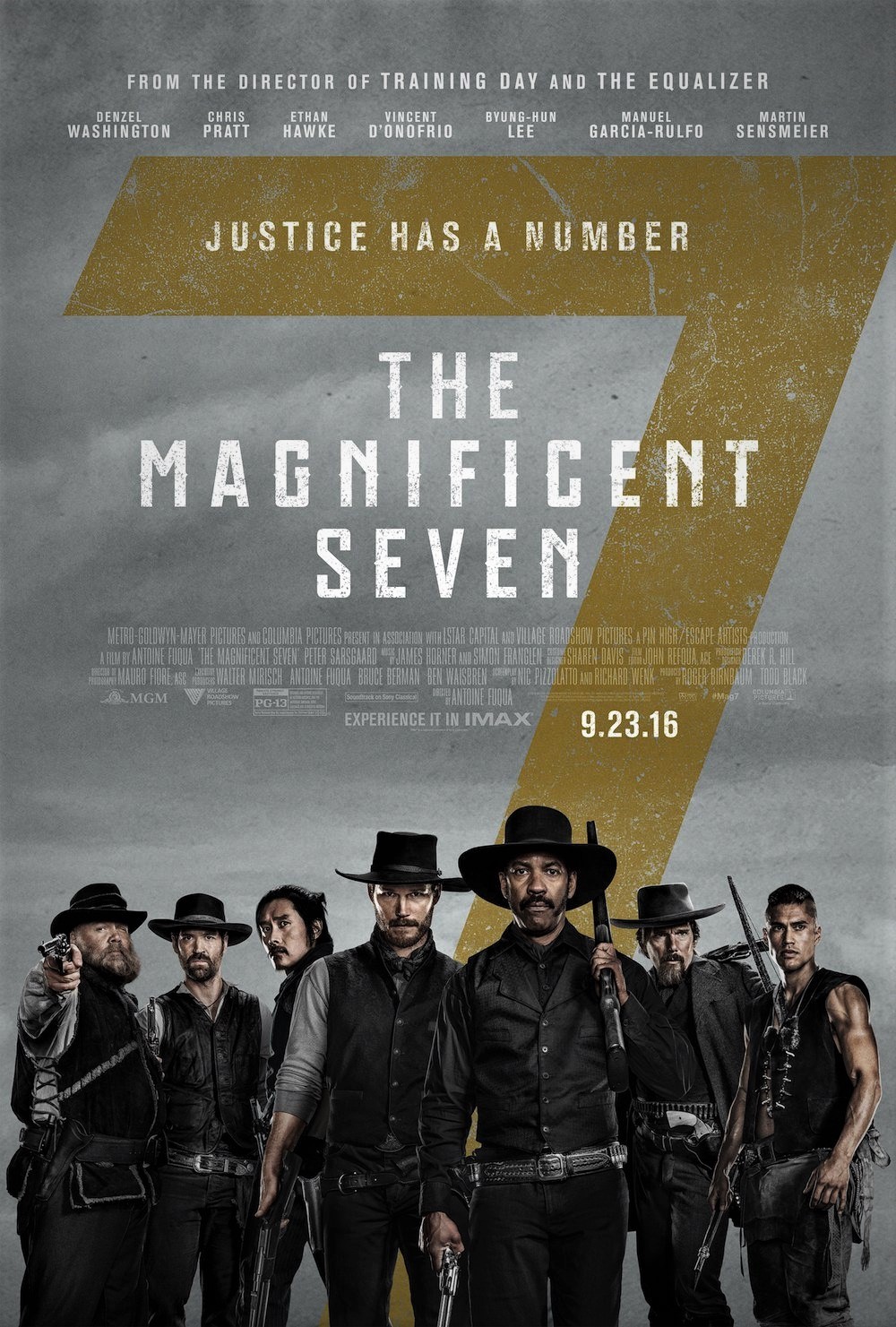
The Magnificent Seven (2016) – Film Review

After taking on a number of successful action flicks in recent years, such as ‘Training Day,’ ‘Olympus Has Fallen’ and ‘The Equalizer,’ director Antonie Fuqua brings this remake of the original 1960s ensemble western to the silver screen. Combining a superb cast with some explosive moments of action and plenty of highly detailed costumes and sets, ‘The Magnificent Seven’ manages to remain an entertaining remake of the beloved western classic despite its few faults.

Plot Summary: In 1897, seven gunmen from a variety of different backgrounds are brought together by a vengeful young widow in an attempt to protect her hometown of ‘Rose Creek’ from the private army of the destructive industrialist, ‘Bartholomew Bogue,’ and his men…

Other than a few changes to the names of its characters, the remake of ‘The Magnificent Seven’ follows a very similar storyline to the original film, which was essentially just a retelling of the iconic Japanese drama; ‘Seven Samurai,’ only now set in the Wild West. As, the remake avoids making any definite changes to the narrative in favour of simply just updating the story for a more modern audience, meaning the film has much faster pacing and more of a focus on creating thrilling action set pieces than the original, which is both a good and a bad thing, as whilst the film does still pay homage to many classic westerns, the film occasionally also adopts many of the issues that plague plenty of modern blockbusters today, the most notable of which being the film’s overabundance of cheesy and predictable dialogue.

Denzel Washington, Chris Pratt, Ethan Hawk, Vincent D’Onofrio, Byung-hun Lee, Manuel Garcia-Rulfo and Martin Sensmeier all give splendid performances as the line-up of ‘The Seven,’ each portraying a different personality and skill set between them. But, of course, similar to many other films lead by a group of characters rather than just a single protagonist. ‘The Magnificent Seven’ suffers from a lack of equal development for its cast as a result of Denzel Washington and Chris Pratt as ‘Chisolm’ and ‘Josh Faraday’ hogging most of the screen-time, with the film’s antagonist; ‘Bartholomew Bogue,’ portrayed by Peter Sarsgaard, also having a deficient intimidating presence when on-screen due to this.

Whilst the film’s cinematography never falls into the category of being exceedingly bland, the cinematography by Mauro Fiore is only above-average, as although the film does feature an array of attractive close-ups and wide shots alongside its many suitably barren locations, the film also has quite a heavy overreliance on shot-reverse-shot for the many conversations between characters. However, a smaller detail that I felt added to the film’s visual appeal (and realism) is definitely its use of nature surrounding/within its various locations, as the film’s main setting of ‘Rose Creek’ is littered with trees and tall grass rather than just continuous desert similar to many other westerns, with some areas of Baton Rouge, Louisiana, where filming took place, even having to be relandscaped to further resemble the Old West.

Being the last film composer James Horner contributed towards before he sadly passed away in an accident in 2015, the original score by him and Simon Franglen does suitably feel like the score of a traditional western for the majority of the film’s runtime. Although there are still a few tracks that feel fairly generic, the soundtrack redeems itself through the great tracks; ‘Rose Creek Oppression’ and ‘Seven Riders,’ in addition to also bringing back the original film’s theme composed by the late Elmer Bernstein for its end credits.

As the remake of ‘The Magnificent Seven’ focuses more on action over anything else (with the entire final act of the film essentially being one long action sequence) a lot of pressure lies on the film to live-up to this intent, which thankfully, it does, as all of the stirring moments throughout the story make fantastic use of their impressive stunt work and subtle CG effects. That being said, nearly all of the action scenes are also distinctly missing an element of both grittiness and violence, which can be fairly distracting. As despite many of ‘Bartholomew Bogue’s guns-for-hire being shot, stabbed and blown-up, blood is barely ever seen, and whilst I understand classic westerns also didn’t really revel in violence, I’ve always seen that as more of a restriction of the time-period rather than just a skimp to lower the film’s age-rating.

In summary, while ‘The Magnificent Seven’ may not fully deliver on the ‘Magnificent’ part of its title, the film is still is an enjoyable throwback to the westerns of old with plenty of exhilarating action set pieces to boot, as even when taking into account all of the remake’s issues and general lack of memorability, I’d still say the film is on the better side of reimagined classics in recent memory and is worth a watch if you’re a true western enthusiast or perhaps just desire to see a remake that doesn’t attempt to simply recreate the original shot-for-shot. Final Rating: 7/10.

magnificent_seven_ver5_xlg

Hidden Figures (2016) – Film Review

Based on the book of the same name by Margot Lee Shetterly, the film adaptation of ‘Hidden Figures’ serves as a compelling and entertaining delve into the past as it tells the true story of the mostly unknown women who helped push forward the space program. Through its brilliant performances from Taraji P. Henson and Kevin Costner (among the rest of the cast) alongside its magnificent writing, the film manages to keep its audience constantly invested in spite of its occasionally bland filmmaking.

Plot Summary: Katherine G. Johnson, Dorothy Vaughan, and Mary Jackson, three brilliant African-American women working at NASA during the 1960s cross all race and gender barriers within their workplace to follow their dreams and inspire generations, serving as the brain force to help send astronaut; John Glenn, into Earth’s orbit…

Despite focusing on three separate stories of three independent women, ‘Hidden Figures’ never feels unfocused, as each of the three protagonists receive a decent amount of development as well as at least one or more memorable scenes between them, as the film displays its main theme of female and Black empowerment proudly, without ever becoming overly cliché as it avoids many of the over-done tropes that other films built around the racist barriers of the ’60s can begin to rely on. For example, the film’s opening scene in which the trio of women are confronted by a white police officer, as this moment could’ve easily felt like overly familiar ground should it have been handled poorly, yet aside from some inappropriate stereotyping at first, the scene actually results in the three of them heading to NASA without any horrific racial ridiculing.

The three protagonists, portrayed by Taraji P. Henson, Octavia Spencer and Janelle Monáe, are all excellent throughout the film, as each of them remains determined and outgoing, despite the world’s many attempts to drag them down, always fighting against the unfair judgement of them simply for the way they look, repeatedly with a lack of preachy dialogue. Alongside them, the supporting cast of Kevin Costner, Jim Parsons, Kirsten Dunst, and Mahershala Ali are all great even if some of their characters are a little underutilised within the narrative. One of the reasons the performances within the film are as accurate as they are is, due to some of the cast actually being given the opportunity to meet with the story’s icons before production began. Most notably, Taraji P. Henson met with the real Katherine Johnson (who was ninety-eight years old at the time) after she signed onto the project.

The cinematography by Mandy Walker is serviceable overall, as while the film features a good number of attractive shots, they are dragged down by its many mundane ones. However, ‘Hidden Figures’ does actually make effective yet subtle use of colour throughout its runtime, as the film’s colour palette constantly reflects the mood within each scene, with many of the sets at NASA where calculations and preparations take place utilising mostly pure whites, greys, and silvers, which creates a sharp contrast to the warm/inviting colours of the ladies’ homes.

Hans Zimmer and Benjamin Wallfisch handle the original score for the film, which is an incredibly mixed bag. As, whilst the score does feature some decent tracks. such as ‘Katherine,’ ‘Mission Control,’ and ‘Hidden Figures,’ the soundtrack also features a number of pop songs by Pharrell Williams, which don’t fit the tone of the film or the story’s time-period. Usually resulting in it feeling very forced and sometimes even taking away from the film’s dramatic moments. This is most likely a result of Pharrell Williams overseeing all aspects of the film’s soundtrack, which I personally feel is a huge misstep as his style of music truly isn’t at all suited for a drama such as this.

In addition to portraying the female heroes of the real-life story as accurately as possible, the film also makes substantial use of its time period, as to keep the audience up-to-date with what knowledge the American public had at the time, ‘Hidden Figures’ occasionally cuts away to archive footage of rocket testings or then-president John F. Kennedy making public announcements, both of which are surprisingly effective despite not being used continuously. Personally, however, I still would’ve preferred a bigger presence of songs from the 1960s rather than the constant barrage of pop songs the film contains, as mentioned previously.

In summary, I feel ‘Hidden Figures’ is an important film many should experience, as whilst there has been an array of films based around the misogynistic/racist nature of the 1950s/1960s, ‘Hidden Figures’ is for sure a stand out through its engaging and thought-provoking narrative. Although films, like ‘Do the Right Thing’ and ‘BlacKkKlansman’ may be slightly more powerful with their message(s), I feel ‘Hidden Figures’ is fairly underrated when it comes to historical dramas, as the film is simultaneously both informing and touching. Final Rating: 7/10.

hidden_figures_ver2_xxlg