Gone Girl (2014) – Film Review

“Want to Test Your Marriage for Weak Spots? Add One Recession, Subtract Two Jobs. It’s Surprisingly Effective.” – Amy Dunne

An intricate and satisfying adaptation of the novel of the same name by Gillian Flynn, which went on to be a New York Times bestseller following its release in 2012, being hailed by many publications as a “Literary Masterpiece.” Gone Girl, released in 2014, flawlessly combines its maze-like plot with the distinct style of director David Fincher (SevenFight ClubThe Social Network) and a duet of astonishing performances from Ben Affleck and Rosamund Pike. Promptly resulting in an unmissable mystery-thriller that represents an exceptional pairing of filmmaker and source material, fully expressing Fincher’s cynicism regarding the current age of televised media and the darkness lurking just beneath the surface of contemporary life.

Plot Summary: On the occasion of his fifth wedding anniversary, former New York-based writer, Nick Dunne, returns home to find that his wife, Amy, has vanished. After reporting her disappearance to the authorities, the couple’s public portrait of a blissful marriage soon begins to crumble as the cases’ ever-growing media attention places Nick as the prime suspect, ultimately leading everyone to ask the same question; did Nick Dunne murder his wife?

Making her screenwriting debut, Gillian Flynn does an extraordinarily efficient job of streamlining her four-hundred-and-thirty-two-page novel, retaining its bifurcated structure and elaborate twists without significantly altering the story as a whole. Certainly, not an easy task as the very nature of Gone Girl‘s story requires the film to be constantly jumping through time, depicting the entire timeline of Nick and Amy’s marriage from their first encounter through to the total collapse of their love life, giving the audience a clear understanding of their individual personalities and relationship. And, through it all, Amy remains a consistent screen presence, continually popping up in flashbacks to her earlier, happier days living in New York City, where she led a life of luxury as a thriving children’s author. That is, until her relationship with Nick, a working-class Midwesterner, comes into focus, gradually draining Amy of her individuality, which is only worsened by the pair’s eventual layoffs and relocation to Nick’s hometown. Quickly spawning whispers of spousal neglect, infidelity and domestic violence, all of which are condensed for the sake of the film’s runtime yet never feel rushed.

Both Ben Affleck and Rosamund Pike are phenomenal throughout the film with not a single weak moment between them as Affleck, who has never been more ideally cast, delivers a captivating balancing act of a performance, fostering sympathy and the suspicion that his true self lies somewhere between shallow husband and heartless murderer. While Pike, who has actually had very few lead roles despite her extensive filmography, is continuously emphatic and commanding. What’s more, is that Gone Girl is a film that doesn’t aim to paint either of these two characters in a purely positive or negative light. Instead, Flynn frequently leaves it to the audience to decide which character (if any) they should be rooting for as the couple copes with the rapid decline of their marriage in dissimilar ways. The outstanding leads aside, Gone Girl also features a terrific supporting cast of Carrie Coon, Kim Dickens, Tyler Perry and Neil Patrick Harris, all of whom serve crucial roles within the story.

As ever, Fincher’s regular collaborators turn in work of an exceedingly high standard, with Jeff Cronenweth’s cinematography being unerringly well-placed in nearly every scene, bringing a drab, underlit look to Nick and Amy’s home, the police station and other North Carthage locations. And although Gone Girl does admittedly have quite the overreliance on mid-shots, Cronenweth’s intentionally controlled approach does lend itself well to creating many memorable shots, speaking less to visual flair and more to Fincher’s adroit style.

Along these same lines, the original score by Trent Reznor and Atticus Ross is a gloomy composition, invoking feelings of anxiety in the audience with subtle electronic pulses. Allegedly, Fincher’s musical brief to Reznor and Ross was based on a visit he took to a spa in which the accompanying melody was supposed to be relaxing, yet Fincher perceived it as unsettling. And, this undoubtedly comes across in Gone Girl‘s score, with tracks like What Have We Done to Each Other?With Suspicion and Technically, Missing, perfectly encapsulating this idea of a supposedly comforting soundtrack which, in truth, instills a sense of dread.

Similar to the novel it’s based upon, Gone Girl‘s story is also teeming with compelling underlying themes and social commentary covering a range of topics. On a broader level, however, the story is really about public perception and how televised media builds fabulations that quickly get subsumed as truth, as the American populace is willing to swallow whatever narrative is sold to them without question, a thought-provoking theme that the film never forgets to explore and build upon.

In summary, Gone Girl is a shining example of an adaptation that stays faithful to the source material whilst simultaneously injecting the narrative with its own style, not once letting the story drag or the suspense settle in its pursuit of transferring an acclaimed novel to the silver screen. Still, with a plethora of attractive visuals and tremendous performances (along with a handful of darkly comedic moments), I feel Gone Girl would’ve been a memorising film even in the absence of its engrossing central mystery. Rating: low 9/10.

gone_girl-p932779

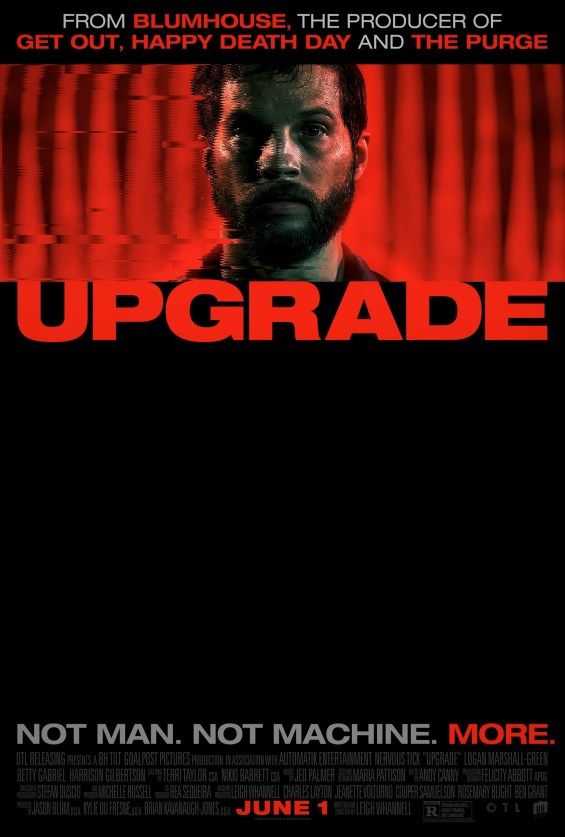
Upgrade (2018) – Film Review

“You Upgraded. Now, You’re Stronger, Faster, Better Than Everyone Else.” – Fisk

Recently gaining a large amount of traction through his reinterpretation of the horror classic; The Invisible Man in 2020, writer-director Lee Whannell first proved himself a talented filmmaker with Upgrade in 2018. A riveting sci-fi-thriller that combines elements of the acclaimed British television series; Black Mirror, 2002’s Minority Report and 1990s action flicks to construct a gripping yet dreary tale of revenge, morality and technology through detailed world-building and stimulating action sequences, promptly overcoming its handful of minor glitches.

Plot Summary: In the near future, technology controls almost every aspect of day-to-day life as the world relies on artificial intelligence to complete even the most basic of tasks. As a result, the old-school, tech-shy mechanic, Grey Trace, feels like a fish out of water in an ever-changing world. But, after a brutal assault leaves Grey paralysed and his beloved wife dead, he’s approached by the reclusive tech mogul, Eron Keen, who offers him a solution; the powerful microchip, STEM, that will bridge the gap between his mind and unresponsive limbs. Now able to walk again, Grey decides to seek revenge against the thugs who destroyed his life…

Originally titled; STEM, Upgrade was Whannell’s first project outside of the horror genre, best known beforehand for his collaborations with writer-director James Wan, co-writing and starring in both the Saw and Insidious series. And for being the first time Whannell has truly stepped out of Wan’s shadow, Upgrade immediately proves Whannell to be a more than capable director with a distinct style, a style that certainly wasn’t displayed in his directorial debut; Insidious: Chapter 3, three years prior. Upgrade also exhibits Whannell’s almost tongue-in-cheek approach to writing, with some scenes feeling as if they’ve been ripped straight from an ’80s buddy-cop comedy as Grey humorously argues with the artificial intelligence residing inside his head. This isn’t to say that the film is light-hearted, however, as Upgrade is, in reality, quite the opposite, never shying away from bloody, squirm-inducing violence, even with its surprisingly modest budget.

With regard to the cast, Logan Marshall-Green gives a remarkably ranged performance as the protagonist, Grey Trace, who is quickly established as a technophobe whose main devotions in life are mechanical tinkering and his beautiful wife, Asha Grey. That is before the seemingly unprompted assault leaves him crippled, alone and infuriated by his situation to the point of attempted suicide. Then, once receiving STEM, Grey begins to express far more concern regarding how much bodily control he’s handed over, with Marshall-Green’s performance becoming far more physically demanding as he slowly loses control of his own body. Harrison Gilbertson and Simon Maiden as Eron Keen and the voice of STEM, respectively, also play their parts well, with Maiden doing a particularly terrific job of providing STEM with a soothing yet simultaneously menacing voice.

One of the greatest components of Upgrade is by far its zestful cinematography by Stefan Duscio, as after obtaining STEM, the camera itself visually mirrors Grey’s newly acquired agility/coordination by wildly tilting with every movement Grey makes, keeping him in the centre of the frame at all times to provide the audience with a unique perspective without sacrificing visibility as a result. Furthermore, despite the story being set in America, Upgrade was actually filmed in Melbourne, Australia. This location was chosen in order to take advantage of the city’s gothic architecture, giving the film an expansive backdrop not too dissimilar to that of The Matrix sequels. However, unlike those films, Upgrade does occasionally run into the issue of its sci-fi world feeling slightly inconsistent between shots as the city’s slick, looming skyscrapers almost seem out-of-place when compared to the graffitied and dilapidated warehouses on street level, but perhaps that’s intentional.

Managing to be moody, suspenseful and tranquil (sometimes all at the same time), Jed Palmer’s original score is more than fitting for a film like Upgrade as the electronic score echoes films like Blade Runner during its quieter moments through tracks, such as Aftermath and A Better Place before the more action-orientated cues kick in, that is, with tracks like We Can’t Let Them Win and Control. The sound design throughout the film is equally excellent, with every thrust and slash hitting hard during the numerous, intense action sequences.

On that note, Upgrade‘s absurdly well-executed action set pieces are possibly some of the finest the sci-fi genre has seen in a long time. As not only does the camera ceaselessly track Grey, as previously mentioned, but the fight choreography is almost faultless. It’s also during these scenes that the cutting-edge technology of Upgrade‘s criminal underworld first appears, from bio-mechanically-implanted firearms to memory-retaining contact lenses and even a weaponised nanotech sneeze, “The Upgraded,” as they are nicknamed, are essentially seen as the next stage of human evolution, blatantly showing the audience the true extent to which humanity now relies on technology.

In summary, even though Upgrade is guilty of playing into some overly familiar ideas with its story being based around the well-trodden concept of artificial intelligence outmatching humanity. There are enough twists and turns within its narrative to ensure that the film will hold up upon multiple viewings, serving as an exciting and stylish sci-fi-thriller in addition to providing undeniable evidence that exchanging one genre for another is a risky yet rewarding road when it comes to certain filmmakers. Rating: 8/10.

upgrade-p1046488

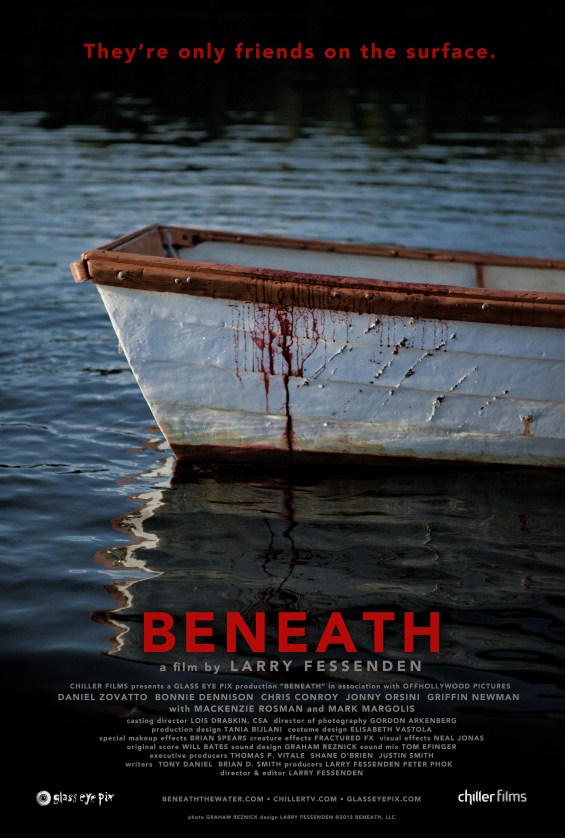
Beneath (2013) – Film Review

 “There’s Something Out There!” – Deb

Directed by Larry Fessenden (HabitWendigoDepraved) and distributed by the horror-centric production company, Chiller Films, a now-defunct television network responsible for many low-budget supernatural horrors, including Siren (2016), Animal (2014) and Dead Souls (2012). Beneath, released in 2013, may have sounded like an estimable idea during its conception, being pitched as a minimalist creature feature that explores the direful outcomes of human behaviour under the influence of extreme isolation and fear. As a result of its overemphatic performances, mindless screenplay and frequently mishandled visuals, however, whatever little tension and intrigue Beneath manages to build up is completely capsized by the time the end credits roll.

Plot Summary: Following their high school graduation, a group of friends decide to spend one last summer outing together at Black Lake before going their separate ways. But, when their rowboat is struck by an amphibious creature, subsequently killing a member of the group and destroying their oars, the five remaining friends find themselves trapped in the middle of the reservoir, contemplating whether one of them should be thrown overboard as a distraction…

While the original screenplay for the film had flashbacks that further developed the characters and explored their individual journeys throughout high school, Fessenden ultimately decided to remove them. This allowed the entire project to be shot in a mere eighteen days, which certainly shows, as Beneath is a largely dull affair, following the usual formula for a creature feature outside of one or two subversive moments. Given Fessenden’s past work, it would also make sense that the film could go so far as to suggest that the creature in the lake doesn’t actually exist and is, in reality, just a physical manifestation of the characters’ ulterior motives. Yet, regrettably, this is not the case, and Beneath opts to play things relatively straight, with the characters being devoured one by one in equally idiotic ways.

On a similar note, the title of the film doesn’t just refer to what lurks in the tranquil water, but is also a guide to where Beneath‘s substance lies with the film’s unbearable roster of characters, compromising of Johnny, a brooding, long-haired loner, Kitty, the rotating object of desire for practically every male character in the film, Matt, the golden-boy jock whose prospects seem to be going downhill since graduating, his younger, less athletic but more intelligent brother, Simon, along with Kitty’s best friend, Deb, and the hyperactive filmmaker, Zeke, each having a respective outburst as simmering high school grudges, rivalries and romantic betrayals factor into the survival stakes. But, on account of the exceptionally awful dialogue, the prospect of any tension within the story soon becomes virtually non-existent, even with the cast of Daniel Zovatto, Bonnie Dennison, Chris Conroy, Jon Orsini, Mackenzie Rosman and Griffin Newman sharing their fleeting moments of promise in a film brimming with atrocious performances. Moreover, the friendship between the characters feels so unnatural from the outset, considering their vastly different backgrounds and personalities.

Cinematographer Gordon Arkenberg tries his best at keeping the solitary setting of a stranded rowboat visually interesting, which beyond some oddly framed shots and sequences that can only be described as ‘visual disarray,’ is a goal he somewhat succeeds in, particularly whenever the camera is pointed towards the beautiful scenery, where the stillness of the lake accentuates the ominous threat of the creature prowling just beneath its surface. Nevertheless, these shots are soon defaced by harsh shadows and a bleached colour palette due to the whole film being shot with natural light. Judging by the editing, you would also be forgiven for thinking that Black Lake is the largest lake in America as the characters spend hours upon hours rowing with their broken oars (and eventually hands) only to make zero progress in a poor attempt of elongating the runtime.

Even though there is next to no emphasis placed on the original score by Will Bates, the score for Beneath is competent, if very forgettable, making a fair effort to enhance the supposed tension on-screen. Except for the semi-final track; Last Stand, that is, which sounds as if it’s from another soundtrack entirely, mimicking the score from a light-hearted romantic-comedy more than any horror flick.

As for the film’s main feature, the creature itself closely resembles the appearance of a giant anglerfish. And whilst I can respect this decision given the anglerfish is one of the most naturally frighting animals on the planet, this choice also displays a great deal of laziness on behalf of the filmmakers as taking what is already an intimidating-looking animal and simply enlarging it is a rather indolent approach to designing your marketable monstrosity. Having said that, the combination of animatronics and puppetry that brings the creature to life is impressive, despite its limited range of movements.

In summary, while some may get an ironic laugh out of this ninety-minute trainwreck, I feel most will agree that Beneath is above all else just a frustrating experience, with one of the film’s only positives being its commendable reliance on practical effects over CGI. But, truthfully, the effects alone don’t even come close to rectifying what are the film’s many, many other shortcomings, distinguishing Beneath from other films within the genre solely on how moronic and tiresome of a horror/thriller it is, paling in comparison to Fessenden’s other low-budget efforts. Rating: low 2/10.

beneath-p823208

Skyline (2010) – Film Review

“Like It or Not, This Is Happening. You Gotta Be Strong.” – Oliver

Spawning multiple direct-to-streaming sequels despite its discouraging box office return, 2010’s Skyline is, at best, a middling sci-fi-action blockbuster. Offering undeniable evidence that impressive visual effects alone can’t overcome a predictable storyline, cliché dialogue and vapid characters, with much of Skyline‘s runtime being dedicated to tedious indoor melodrama rather than the potentially exhilarating extraterrestrial invasion occurring just outside, ultimately making for a science fiction flick with few original ideas and very limited scope.

Plot Summary: In the wake of an unexpected pregnancy, Elaine and her boyfriend, Jarrod, travel to Los Angeles to convene with their old friend, now-successful entrepreneur, Terry, for a party-filled weekend getaway. But, the morning after their arrival, a cluster of strange lights descend over the city, drawing residents outside like moths to a flame as an extraterrestrial force threatens to wipe the entire human population off the face of the planet…

Predominantly visual effects artists, directors Colin and Greg Strause (Aliens vs. Predator: Requiem) financed Skyline almost entirely by themselves without the assistance of any major production company, with production only costing around £372,000, whilst the visual effects cost an additional £742,000. However, while it is commendable what the Brothers Strause achieved on such a low budget for a blockbuster-level film, Skyline eschews a creditable screenplay in order to focus purely on boundless CG spectacle. That is when the film doesn’t just consist of the characters hiding away in Terry’s penthouse, peeping through his conveniently installed telescope to observe the chaos transpiring on the streets below, which, whilst at first, may sound like an interesting way to experience an extraterrestrial incursion, in execution, is rather dull due to a severe lack of tension. An issue that its later sequels; Beyond Skyline (2017) and Skylines (2020), did somewhat rectify.

The film’s biggest downfall comes when we are introduced to the characters, as even when ignoring the apathetic performances from Eric Balfour, Scottie Thompson, Brittany Daniel, Donald Faison and David Zayas, the leading group of hideaways are simply no different to the characters of any other alien invasion story. Being given the absolute bare minimum of characterisation, every member of the group (including the two protagonists) feel incredibly underwritten and frequently comes across as unlikeable, even if the film attempts to keep its characters grounded in realism by representing them as agitated civilians hunkering down and utilising what little knowledge they obtain of the invaders to their advantage rather than foolishly sprinting outside and confronting the extraterrestrial force one-on-one.

When it comes to visuals, Michael Watson’s cinematography fulfils its purpose in showcasing the scale of the invasion across the world, but beyond that, the camerawork doesn’t get any more imaginative, primarily relying on hand-held mid-shots and close-ups, never attempting the utilise the claustrophobic penthouse setting (which, in reality, was part of co-director Greg Stause’s condo building) to its full effect. Another element that spoils the handful of pleasant visuals Skyline retains is the film’s use of blue lighting, as although the abnormal blue lights seen throughout the film are a crucial plot component (being the source that draws civilians outside before they are abducted), their constant usage does result in the film having a hefty overreliance on vexing lens flares. An irritation that even extends to the captions/end credits.

A mix of electronic and orchestral tracks, the original score by Matthew Margeson, unfortunately, has quite the shortage of memorability, with simplistic tracks like The EscapeThey’re Not Dead and Arrival being nothing but unremarkable. Still, credit where credit is due, the computerised segments of the score do produce an eerie noise that can easily unnerve those listening. While on the topic of audio, the film’s sound design is serviceable though nothing spectacular, with the aliens harbouring a daunting collection of screeches and grunts.

Featuring over one thousand visual effects shots, Skyline‘s main selling point is unmistakably its CG effects and subsequent action sequences, which are actually few and far between due to a large majority of the narrative taking place within one location. Luckily, the rare moments of excitement we do receive don’t squander the extraterrestrial force, from the oily, cephalopod-like, Harvesters, who possess the ability to purloin and utilise the brains of different species to revitalise themselves, to the towering brutes known as Tankers, who use their immense size and strength to tear through buildings. The hyper-advanced extraterrestrials are given some much-needed variety in their designs. Additionally, many of the alien spaceships were designed using the basis of low-altitude clouds, such as Stratocumulus to Cumulus, and are all brought to life through some solid CGI, especially when they are seen swallowing masses of the human population in one of the film’s most striking shots.

In summary, whilst the broad premise of Skyline has promise, the resulting film is fairly predictable. Not only because of its numerous faults, but because the film was fighting a losing battle right from its inception, with nearly every possible idea relating to the concept of an extraterrestrial invasion already being seen. From the original War of the Worlds in 1953 all the way up to the patriotic, all-American blockbuster; Independence Day in 1996, it’s an onerous task to fabricate new ways of writing an alien intrusion, further proved by the countless other extraterrestrial occupation stories that have freshly emerged. Rating: 4/10.

SKL_CMYK_TSR1SHT_AUG12.indd

Cargo (2017) – Film Review

“You Can’t Lose Hope.” – Etta

Based on the short film of the same name, which went on to be an online sensation following its release in 2013, garnering over thirteen million views on YouTube alone. Cargo takes a refreshingly character-driven approach to the post-apocalyptic genre differentiating itself from other films featuring flesh-devouring monstrosities through its secluded setting and Martin Freeman’s terrific lead performance. A combination that will surely satisfy most zombie fanatics, even if the genre’s more mainstream crowd could potentially be disappointed at the exclusion of decaying hordes of the undead, a true sense of dread and a lack of extravagant gore.

Plot Summary: After an epidemic spreads across Australia morphing humanity into flesh-eating monsters, Andy, along with his wife, Kay, and their infant daughter, Rosie, attempt to escape the Outback via the river, making their way to a presumably secure military base. But, when the trio stumble upon an abandoned yacht, Kay is bitten while searching the vessel for supplies, soon passing the virus onto her husband. Now, with his time running short, Andy has one mission; find a new home for his daughter…

Directed by Ben Howling and Yolanda Ramke, Cargo is not only Howling and Ramke’s first feature-length film, but is also Australia’s first-ever production spotlighted as a Netflix Original, released globally on the streaming service in 2017. And although Netflix has ventured into the post-apocalyptic genre before, with films like Ravenous (2017) and the television series; Z Nation, both Howling and Ramke wanted Cargo to be more than just a straightforward story of survival. Subsequently, this led the pair to intertwine an abundance of social commentary into their zombie-centric story, covering a range of topics from environmental fracking to the exploitation of Australia’s aboriginal peoples. However, in my opinion, the best element of Cargo is its central concept, as the idea of a father having only forty-eight hours to find a new life for his child is a plot enriched with dramatic potential. Moreover, the nocuous outbreak Andy finds himself within serves as the perfect backdrop to juxtapose the qualities one would look for in a capable (and devoted) guardian.

Speaking of the protagonist, Martin Freeman leads the cast brilliantly as Andy, portraying an affectionate father and husband who is determined to protect his family at all costs, an intention which, whilst honourable, often lands him and his loved ones in an even more treacherous spot as Andy refuses to accept when he is out of time. Freeman’s youthful co-star, Simone Landers, unfortunately, doesn’t fare quite as well, as her frail performance frequently results in poignant scenes feeling less sincere. Nevertheless, Thoomi is still an intriguing character, with her subplot concentrating on the demise of her father and the survival of a nearby native tribe, providing a vastly different perspective on the epidemic compared to Andy’s point of view.

Utilising the vegetation-splotched, sun-parched rural land of the Australian Outback flawlessly, the cinematography by Geoffrey Simpson is both varied and visually interesting, even if, in reality, the Australian wilderness where Cargo was shot threw everything it had at the production crew, with South Australia experiencing what was supposedly its worst weather in a century, with floods, power blackouts, torrential downpours and even a miniature cyclone all occurring during the five weeks of production. Yet, miraculously, the crew didn’t lose even a single day of filming, which was extremely fortunate for the filmmakers, given how the remote setting of the narrative is a crucial player in the film’s identity, its harsh and unforgiving nature hurling countless obstacles at our characters whilst, at the same time, offering them the means to survive.

Managed by four distinct composers, including Michael Hohnen, Daniel Rankine, Geoffrey Gurrumul Yunupingu and Johnathon Mangarri Yunupingu, the original score for Cargo substantially strengthens each scene’s emotional significance, almost as if the score is applying a proverbial highlighter to certain moments with sombre, tenuous tracks, such as The Grave and Goodbye, flourishingly pulling at the audience’s heartstrings more times than one.

Taking an alternate route to avoid comparisons to zombie designs of the 1960s and 1970s, most notably in classic horror flicks like Rabid (1977) and Night of the Living Dead (1968). Cargo strays away from many of the usual clichés associated with the undead, centring its zombie design around an orange pus-like substance that oozes from the infected’s facial orifices rather than the bleeding open wounds the living dead are commonly known for. This distinction is further emphasised through what we see of their behaviour, as the infected are presented as mindless animals more than they are man-eating monsters, requiring dark and damp areas to incubate during the daytime before feasting on whatever wildlife they can find once night falls. Quickly reminding the audience that what they are witnessing is a viral infection, hence why the infected are nicknamed; “Virals.”

In summary, even if Cargo‘s story could have been executed better with a motley of improvements, I feel Cargo is still a creditable entry into the realm of post-apocalyptic storytelling. Standing as a zombie flick with soul and pathos, which, in turn, makes the living dead formidable once again, not because of jump-scares or excessive bloodshed, but because of the film’s biggest drawcard; its sheer humanity. Recounting a story that largely revolves around the notion of human determination, witnessing just how far an individual will go to protect another in the bleakest of circumstances. Rating: 7/10.

cargo-poster-1

Hush (2016) – Film Review

“I Can Come in Any Time I Want, and I Can Get You Anytime I Want. But, I’m Not Going To. Not Until It’s Time.” – The Masked Man

Exceptionally gripping in the face of its simplicity, Hush, released in 2016, navigates the bloody waters of the home invasion subgenre to tremendous results. With only five characters and a single location to speak of, the performances and sound design of Hush are both key components in the film’s goal of establishing a disquieting tone, captivating its audience while simultaneously making them dread that the story they are witnessing on-screen could realistically transpire in the most peaceful of surroundings. Certifying Hush as a concise and well-executed horror/thriller, despite the film’s continuous cat-and-mouse pursuits growing a little tiresome by the third act.

Plot Summary: When Maddie, a deaf and mute author, moves to a secluded woodland house in the hope of living a peaceful, solitary life as she writes her second novel, she soon finds her isolated home the target of a deranged, masked killer…

Co-written, directed and edited by Mike Flanagan, this talented director has been the face of modern horror for many years, crafting chilling and original genre pieces, such as Oculus (2013), Before I Wake (2016) and the horror/drama mini-series; The Haunting of Hill House in 2018, in addition to adapting much of Stephen King’s iconic catalogue of horror literature, with 2017’s Gerald’s Game and 2019’s Doctor SleepHush, however, was one of the director’s earlier projects, with Flanagan conceiving the storyline whilst on a dinner date with his co-writer/leading actress Kate Siegel in 2014, not long before the pair married in 2016. To get a better understanding of the film, Siegel and Flanagan even role-played each scene in their house before writing them into the screenplay, enabling them to envision how the characters would react in the face of danger, a method that I feel ultimately paid off.

Although the lead role of Hush seems tailor-made for a hearing-impaired actress, Kate Siegel portrays Maddie divinely as a quick-witted heroine who keeps the audience on her side at all times. Continuously thinking on her feet, overcoming some of the obstacles associated with her disability, and using her hearing impairment to her advantage whenever possible, it’s easy to root for Maddie to triumph over her assailant. John Gallagher Jr. is also stellar as the mysteriously motivated antagonist, a character only ever referred to as the “Masked Man,” who, throughout the runtime, enjoys playing mind games with his victims, receiving some kind of fetishistic pleasure from toying with those he’s about to slaughter. In many ways, the Masked Man shares similarities to the horror icon, Michael Myers, with his motivation for killing never being stated and his costume consisting primarily of an unadorned white mask, which only adds to the character’s intrigue.

Whilst a substantial portion of the cinematography by James Kniest is hand-held, removing the possibility of Hush standing as one of Mike Flanagan’s most visually impressive films. The fluidity of Hush‘s camerawork does allow the audience to follow Maddie as she wanders through her contemporary home, the camera tracking her every movement as she enters and exits various rooms on impulse. However, a major shortcoming of the film’s visuals is certainly it’s lighting, as due to all of the narrative taking place at night, it makes sense that Hush would be quite gloomy lighting-wise. Yet, most shots are seemingly over-lit, considering the characters are supposed to be in a dense woodland area in the dead of night.

At times peaceful, at times aggressive, the original score for Hush, composed by The Newton Brothers, greatly enhances the story at many points as tracks, like MaddieIntruderAgainst the Glass and Crossbow, are all incredibly atmospheric. And, even if the score lacks a predominant track that could be regarded as the film’s theme in years to come, Hush‘s soundtrack still more than serves its purpose, especially when taking into account the film’s reliance on sound as opposed to a non-diegetic score.

Since the protagonist of Hush is both deaf and mute, the film contains less than fifteen minutes of dialogue. Therefore, with a runtime of around eighty-two minutes, Hush harbours more than seventy minutes of screen-time without a single word spoken. This setup provides Mike Flanagan with a perfect opportunity to play with sound in creative ways, removing the audio entirely (except for an ultrasound machine) in some scenes to put the audience into Maddie’s position and deliver a sudden jolt when appropriate, thus, avoiding the common horror cliché of having nonsensical, ear-piercing jump-scares for no apparent reason. Through the sound design, we also learn more regarding Maddie’s character, as she hears the echoing voice of her deceased mother whispering to her. Her voice usually aids Maddie in conjuring up endings for her novels, but, in this case, her mother’s ghostly voice lays out her options on how to approach her current, precarious situation.

In summary, Hush is a sharp, violent and finely-tuned horror/thriller that goes down familiar paths yet with flair and skill, never reinventing the wheel, but proving that the genres it’s drawing from still have firm legs. From the Masked Man toying with Maddie, as he steals her phone and sends pictures to her laptop to Maddie rapidly locking all of her windows and doors before the killer can enter, Hush is undoubtedly a compelling story with an excess of suspenseful moments, its superb sound design only adding to its appeal as the film regularly comes close to being a sensory-deprivation experience. Rating: 7/10.

hush_xxlg

Dredd (2012) – Film Review

“Negotiation’s Over. Sentence Is Death.” – Judge Dredd

A considerably overlooked film in terms of sci-fi-action flicks, 2012’s Dredd, written by Alex Garland and directed by Pete Travis (Vantage PointEndgameCity of Tiny Lights), centres on said character. Whose comic strip in the science fiction anthology series; 2000 AD, created by Kelvin Gosnell, Pat Mills and John Wagner, was one of the longest-running in the comic magazine’s history, being featured since its second issue in 1977. Merging futurism with law enforcement, Dredd and his fellow Judges are empowered to arrest, sentence and even execute criminals on the spot, and this modern, cinematic adaptation, fuelled by much of the same bombastic violence and sci-fi imagery, does a remarkable job of capturing the source material’s gritty spirit.

Plot Summary: In a dystopian future on the American East Coast lies the overpopulated and crime-ridden metropolis of Mega-City One, where officers have the authority to act as judge, jury and executioner. Within this city, the resolute Judge Dredd is assigned to assess rookie Cassandra Anderson, as the two are ordered to reach the top of an apartment complex and stop the nefarious crimelord, Ma-Ma, from manufacturing and distributing narcotics. But, as the duo enter the complex, they quickly find themselves trapped as Ma-Ma locks the building down, forcing Dredd and his newfangled partner to fight their way out, one level at a time…

Technically a reboot following the character’s first cinematic interpretation with Judge Dredd in 1995, which featured Sylvester Stallone as the titular character. Dredd is a far more faithful adaptation, as while Stallone may have looked the part, it was clear that the film itself thoroughly misunderstood the source material. Dredd, however, immediately thrusts its audience into a riveting and intense story, which considering how self-contained it is, also manages to fit a surprising amount of world-building in between, hinting towards the many other districts of Mega-City One we could’ve seen should the film have been a box office success rather than the commercial disappointment it sadly was, earning a little over £41 million on a budget of around £45 million.

Speaking only when necessary and never giving even the slightest hint of emotion, Karl Urban portrays protagonist Judge Dredd with extreme accuracy, as Dredd never breaks temperament or goes through a satisfying character arc. Instead, Dredd is simply a well-built, incorruptible officer with no time for low-life criminals (just as he is in the original comic strips), and Urban nails this portrayal, even with half of his head obscured by a helmet for the entirety of the runtime, illustrating Urban’s clear understanding of the role. Dredd’s partner, Cassandra Anderson, portrayed by Olivia Thirlby, is also a compelling character, demonstrating a benchmark of skill far below her superior yet possessing psychic abilities, which make her too valuable to dismiss. Lastly, there’s the film’s antagonist, Ma-Ma, who was originally written as an elderly woman before Lena Headey convinced Alex Garland to make her a middle-aged misandrist. And although the character doesn’t receive the same level of depth as Dredd or his rookie partner, Ma-Ma is still a convincing felon, as Headey portrays her as a ruthless individual living in an equally ruthless world.

Playing into the idea of Dredd‘s post-apocalyptic world being in constant disarray, the grimy set design of Dredd, along with its murky brown colour palette, presents the setting of Mega-City One (a.k.a. Johannesburg with a few CG enhancements) as a rundown municipality with similarly rundown technology. Correspondingly, the filthy hallways of the central apartment complex, Peach Trees, are always permeated with litter, aged sci-fi scrap and spray-painted surfaces. Moreover, the film is given a great sense of style through the energetic camerawork by Anthony Dod Mantle and the smooth integration of CG effects, which outside of a handful of moments where the film fully indulges in its graphic violence by flinging blood towards the camera, have aged admirably.

As you’d expect from a pessimistic sci-fi flick, the original score by Paul Leonard-Morgan is both rousing and brooding, with tracks like Mega-City One and You Look Ready all perfectly accompanying what’s on-screen through their heady mix of guitar riffs and thumping electronic beats, making for a score that has no filler, as every track flawlessly correlates with the fast-paced action.

Continuing to be true to the original comic strips, Dredd’s primary form of transportation, the Lawmaster Motorcycle, is faithfully recreated for the film, as the production team constructed a series of functional motorbikes for production. They achieved this by taking the chassis of standard motorbikes, extending them, adding custom fairings, and then fitting them with larger tires so they remained operable, a level of effort that I feel was certainly worth it, as Dredd’s renowned motorcycle is featured front and centre during the film’s thrilling opening sequence.

In summary, though many may see this sci-fi action-thriller as unadulterated style-over-substance and nothing more, Dredd is a film deeply committed to the genres it’s trying to represent. With thrilling action sequences, substantial world-building and impressive visual effects, all rooted in deadpan humour, Dredd is a more than entertaining ride. And, in a world full of compromised adaptations where self-indulgent directors/screenwriters make whatever changes they desire without much thought or consideration, Dredd is something of a triumph, as the film avoids the common misstep adaptations tend to take, where the cinematic adaptation ends up bearing little resemblance to its source material, aside from the title. Rating: low 8/10.

dredd-p689332

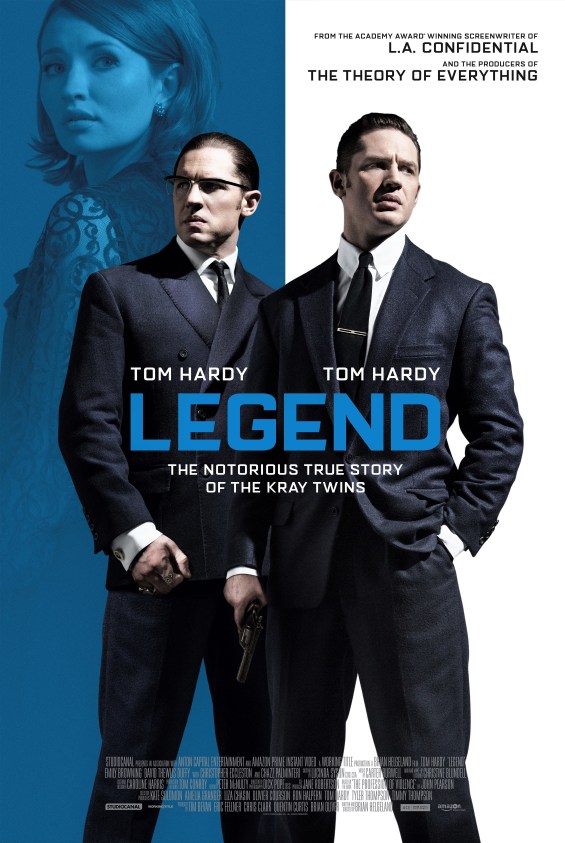
Legend (2015) – Film Review

“Me and My Brother, We’re Gonna Rule London!” – Ronald ‘Ronnie’ Kray

Recognised as some of the most notorious gangsters in British history, Ronald ‘Ronnie’ Kray and Reginald ‘Reggie’ Kray were identical twin brothers and the foremost perpetrators of organised crime in the East End of London during the 1960s. With the help of their gang, known as the Firm, the Krays were involved in numerous murders, armed robberies, protection rackets, arsons and assaults. And, in 1965, as West End nightclub owners, the Krays even mingled with politicians and prominent entertainers, subsequently becoming ’60s icons themselves before both brothers were ultimately arrested and sentenced to life imprisonment in 1967. Therefore, even if the twin crimelords were convicted murderers, their rise to power was ripe for a cinematic interpretation, and 2015’s Legend more than succeeds in converting the brothers’ riotous downfall into an enthralling biopic, thanks largely to Tom Hardy’s mesmerising dual performance.

Plot Summary: Identical twins, Ronald ‘Ronnie’ Kray and Reginald ‘Reggie’ Kray, have risen through the ranks of the criminal underworld in 1960s London, with Ronnie advancing the family business through violence and intimidation, while Reggie struggles to go legitimate with his girlfriend, Frances Shea. But, with Detective Superintendent Leonard Read hot on their heels, Ronnie’s unpredictable tendencies along with the slow disintegration of Reggie’s relationship, threaten to bring the brothers’ criminal empire tumbling to the ground…

Written and directed by Brian Helgeland (PaybackA Knight’s TaleMan on Fire), Legend is partially an adaptation of the true-crime book; The Profession of Violence: The Rise and Fall of the Krays Twins by John Pearson. I say ‘partly’ as the film (unlike the book) begins well into the Kray’s criminal career, steering clear of the twins’ East End childhood, their early days as boxers or their time spent behind bars during National Service. Even the pair’s beloved mother, Violet Lee Kray, is barely glimpsed outside of one or two scenes, seemingly unaware of her boys’ violent actions. And whilst this could be seen as a positive, as Legend doesn’t waste any of its runtime on frivolous flashbacks to the twins’ adolescence, it could also be seen as a negative, as I feel that witnessing the Kray’s childhood would’ve provided a clear view of their personalities before their rampant path of butchery began.

Taking on dual roles for the film, Tom Hardy had thirty-five filming days in which he had to portray both brothers, meaning Hardy would have to film scenes as the twin who had the most dialogue first, then return to hair and make-up to be transformed into the opposing twin. Originally, Hardy was only offered the role of Reggie, but Brian Helgeland was persuaded to let Hardy tackle the role of Ronnie, as well. I’d say this was for the best, as Tom Hardy taking on both roles not only adheres to the idea of the Krays being identical twins, but truly allows him to display his full acting range, continually upstaging himself as he switches from brother to brother on a dime. The rest of the cast, including Emily Browning, Taron Egerton, Paul Anderson, David Thewlis and Christopher Eccleston, is also marvellous in their supporting roles, whether they are in pursuit or service of the Krays.

Exceedingly lavish in its presentation, Legend often possesses the tone of an American gangster epic like Goodfellas and Casino, despite being so distinctly British, contrasting its bloodletting and depravity with elegant shots from cinematographer Dick Pope, in addition to plenty of wonderful set-dressing as the film was shot almost entirely on location, with very few sets used. The camerawork also allows for a few long takes, with Reggie and Frances’ first evening out together being one continuous five-minute and forty-second shot.

When it comes to the original score by Carter Burwell, tracks such as LegendElegy for Frances and Your Race is Run, serve their purpose effectively as part of the narrative. The main focus of Legend‘s soundtrack, however, is the film’s long list of recognisable songs, which further help cement the story within the 1960s time period. And whoever compiled this soundtrack clearly has a great deal of expertise in that area, not only in selecting songs that one would hope to hear from a film set in the swinging sixties like Green Onions and Cissy Strut, but also in selecting long-forgotten gems.

From costumes to vehicles to props, the production design throughout Legend is again nothing short of exceptional. To the extent that even Ronnie and Reggie’s tailored suits are almost indistinguishable from the suits the twins wore in real life. Additionally, the utilisation of digital compositing and body doubles for whenever two versions of Tom Hardy are required on-screen at one time rarely has a faulty moment, auspiciously tricking the audience at multiple points.

In summary, while most will agree that any glorification of real-world criminals is questionable, with Legend often having a mythologist and, at times, even romanticised approach to its low-life protagonists, the film is a well-crafted biopic, nonetheless. Through its retro style, brilliant production design and copious comedic moments, Legend is a solid crime-drama even in spite of its occasionally overblown scenes or on-the-nose song choices, such as Chapel of Love for Reggie and Frances’ wedding. But, the main reason to watch Legend is unquestionably the spectacular dual performance from Tom Hardy, who confidently steals every scene he appears in. Rating: 7/10.

legend-p1006732

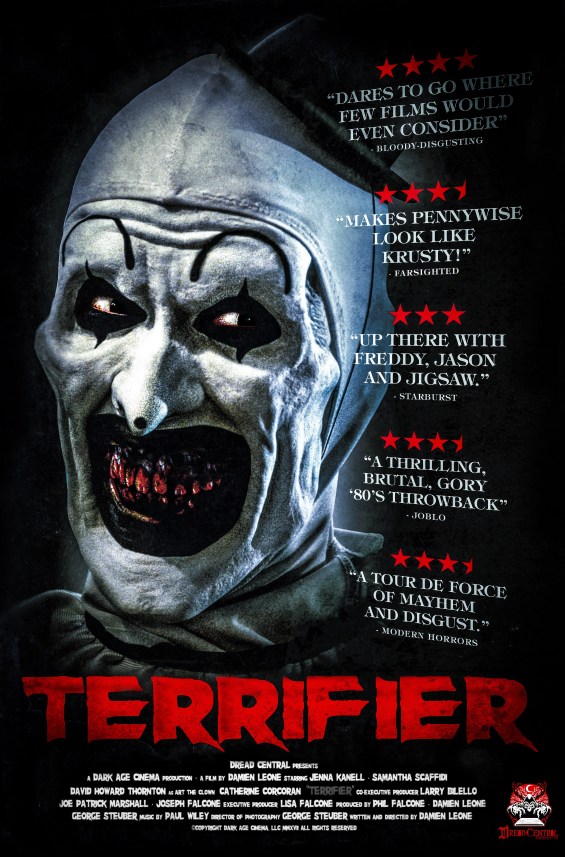
Terrifier (2016) – Film Review

“What? Did You Think He Was Gonna Hack Me up Into Little Pieces or Something?” – Dawn

Grisly, taut and seasonally atmospheric, Terrifier, released in 2016, aims to pay homage to the inexpensive slasher flicks of the 1980s, relishing in the same simplistic approach and over-the-top gore that classic horrors like Friday the 13th and Blood Harvest specialised in. And while the film does admittedly fall prey to many of the usual limitations low-budget horrors tend to have, Terrifier is preserved through a genuinely terrifying performance from David Howard Thornton as Art the Clown, in addition to plenty of fantastically gruesome effects and a willingness from writer-director Damien Leone (All Hallows’ EveFrankenstein vs. The Mummy) to push on-screen violence to its limit.

Plot Summary: On Halloween night, Tara Heyes and her best friend, Dawn, find themselves in the wrong place at the wrong time as they become the unfortunate marks of Art the Clown, a demented serial killer with a morbid sense of humour…

With coulrophobia (the name allocated to the fear of clowns) being one of the most common phobias in the world, it makes sense that the horror genre would try to capitalise on this widespread fear of individuals with white face paint, comical horns and oversized shoes. And if there’s one area Terrifier more than thrives in, it’s fully realising this common phobia as Art the Clown is consistently frightening. The film jumps from moments of complete silence as Art stares down his victims to Art violently murdering the poor souls, showering the sadistic clown’s black and white costume with blood. Terrifier isn’t actually Art the Clown’s first appearance, however, as Damien Leone first introduced the character in his second short film, which not only shared the Terrifier title, but is practically the same storyline just condensed into a brief twenty-minute runtime.

Regarding the characters, the conceited Dawn, somewhat sensible Tara Heyes, and loyal sister, Victoria Heyes, portrayed by Catherine Corcoran, Jenna Kanell and Samantha Scaffidi, respectively, all serve an important purpose within the narrative. Yet, the characters themselves never attain a status beyond generic slasher victim, and although each of the actress’ screams of terror sound as suitably realistic as a director could hope for, the delivery of some lines (specifically from the supporting cast) feels rather clunky. But, the true star of the film is undoubtedly David Howard Thornton as Art the Clown, as Thornton ceaselessly stays in character as the psychotic, clown-dressed murderer, portraying Art as a fun-loving mime whose killings involve a combination of predatory sadism and joyful glee. So much so, that Art will make many audience members nervous purely due to his unpredictability, as the character’s manic actions make it almost impossible to predict what he’ll do next.

On a technical level, Terrifier is top-notch considering its thin budget, as whilst the cinematography by George Steuber is far from groundbreaking, the film has a reasonable amount of creative shots, the majority of which are enhanced by the film’s highly saturated colour palette, thin layer of granularity and scenes primarily lit by natural light, providing the film with an authentic low-budget ’80s appeal. And, as previously mentioned, Terrifier does not hold back when it comes to brutality and depravity, certifying the film as one not for the faint of heart as the gore effects are gut-churning and grotesque, with the amount of labour and detail that has gone into each effect being more than deserving of applause, especially when once again acknowledging the film’s budget, which is estimated to have been around £73,000.

The original score by Paul Wiley is a triumphant blend of 2010 and 1980s horror scores, with tracks such as In Pieces and Clown Car standing as daunting and metallic-sounding pieces similar to many modern horror scores, whereas tracks like Kill Horn and the film’s central theme, simply titled; Terrifier Theme, are reminiscent of the original Halloween score in more ways than one, which by no means a poor comparison when it comes to unnerving horror soundtracks.

These connections to past genre films continue further into the film’s visuals as Damien Leone inserts many explicit nods and visual tributes to everything from Psycho (1960) to Hostel (2005) to everything in-between. And, whilst some may not like when a film relies so heavily on pastiche, it never feels overdone in Terrifier, as the film strikes a satisfying balance between throwbacks and unique ideas, occasionally playing with the conventions of slashers by adding some twists to the killer and final girl dynamic, which will most definitely catch some audience members off-guard.

In summary, Terrifier has plenty of entertainment value should you fit into the film’s principal audience as this modern slasher is an unabashed reminder of the bloodthirsty horror films that populated the 1980s, a.k.a. the kind of nasty flicks that were banned during the video-nasty era. The film has its issue, undeniably, most notably with its shortage of interesting characters and often oversimplified story. But, Terrifier does make the most of its foreboding atmosphere and unsettling killer. While watching, it also quickly becomes clear that Damien Leone wants Art the Clown to join the ranks of Jason Voorhees and Michael Myers as a horror icon in the future, which I think is more than feasible given his appearance in Terrifier, so I’d say it really depends on how the horror community feel about the film years down the line. Rating: high 6/10.

terrifier-p1080489

Hellraiser (1987) – Film Review

“Oh, No Tears, Please. It’s a Waste of Good Suffering!” – Pinhead

Written, directed and based on the novella; The Hellbound Heart by Clive Barker (NightbreedLord of Illusions), 1987’s Hellraiser is truly a fiendishly unique vision. Offering a discomfiting and sadistically smart alternative to mindless gore, this classic horror rarely has a tiresome moment, utilising its outstanding practical effects and an onslaught of intriguing ideas to great effect, to the point where the film sequentially became a victim of its own success, becoming so influential that it not only spawned a decades’ worth of poor imitations, but even its own series of continuously disappointing sequels. Nevertheless, it can’t be denied that the original Hellraiser is an unforgettable excursion into a netherworld of monsters, murder and disloyalty.

Plot Summary: When Kirsty’s father, Larry, and stepmother, Julia, move into Larry’s childhood home, Julia discovers the newly resurrected, partially-formed body of her brother-in-law, Frank, a sexual deviant who lost his physical form after solving a supernatural puzzle box which summons a group of multi-dimensional demon sadists known as the Cenobites. Now, to reclaim his body, Frank convinces Julia, his one-time lover, to lure unsuspecting men back to the house so he can use their blood to revitalise himself and escape the clutches of the demonic beings pursuing him…

One of the central concepts of the Hellraiser franchise; a seemingly innocuous puzzle box that is, in reality, a gateway to Hell, has its basis in the urban legend of The Devil’s Toy Box, which concerns a six-sided cube constructed of inward-facing mirrors. According to the legend, individuals who enter the structure will undergo disturbing phenomena that will simultaneously grant them a revelatory experience while permanently warping their minds. This story has heavy ties to the idea of insanity, which is certainly prevalent throughout Hellraiser, as the film, similar to the rest of Clive Barker’s work, is very surreal in nature. However, unlike the rest of Barker’s work, the budget for Hellraiser was astonishingly low at around £730,000. Whilst this was most likely due to Barker’s lack of filmmaking experience (only having directed two short films at the time), Hellraiser quickly earned over £14 million, immediately cementing Barker as a promising writer and director in addition to establishing Hellraiser as a series we’d still see years down the line.

The superb cast of Andrew Robinson, Clare Higgins, Sean Chapman and Ashley Laurence all effectively serve their purpose within the narrative, as Hellraiser admirably values its characters more than many other horror films, developing each of the family members, so they feel both genuine and distinct from one another, ensuring the pivotal plot threads of adultery and Julia’s subsequent guilt remain riveting. Then, of course, there is Doug Bradley as the film’s icon, Pinhead, who, despite being kept in the background for a majority of the runtime, gives a solid performance, especially considering Pinhead, like the rest of the Cenobites, has very limited dialogue and screen-time.

Speaking of iconography, while Hellraiser no doubt has its fair share of recognisable shots, much of this iconic imagery isn’t due to the cinematography by Robin Vidgeon, but more so because of the film’s masterful creature, costume and prop design. As the camerawork itself, although dynamic, often just falls back on conventional close-ups and mid-shots, with the occasional zoom or tilt thrown in to further magnify the effects on-screen.

For the original score, Clive Barker originally wanted the experimental electronic music group, Coil, to compose music for the film. But, when that notion was rejected, the film’s editor Tony Randel, suggested composer Christopher Young as a replacement. And truthfully, I feel this was for the better, as Young’s score perfectly lends itself to the dreamlike, otherworldly tone of the film, with the opening theme; Hellraiser, standing as a grand orchestral piece with a dark, fairytale-like undertone, whilst tracks like Resurrection and The Lament Configuration have an unnerving, almost gothic quality to them.

Yet, it’s undoubtedly the artful designs of Hellraiser that make the film so unique, with the grotesque and somewhat fetishistic designs of Pinhead and the other Cenobites being particularly striking as Barker drew inspiration for their diverse looks from punk fashion, catholicism and visits he took to S&M clubs in New York and Amsterdam. Interestingly, in spite of the character’s reputation, in the novella, Pinhead is present but is not the lead Cenobite. The Female Cenobite, the Chatterer and the Engineer, all have more prominent roles, but as a result of the visually impressive yet extremely restrictive prosthetic make-up for the respective characters, Pinhead took point on account of Doug Bradley’s prosthetics allowing for the most facial movement, promptly resulting in Pinhead becoming the face of the horror franchise.

In summary, Hellraiser is truly one of the most gruesome, captivating and indelible horror films of the 1980s, even though it’ll no longer leave audiences chilled to the bone, just as it did way back when. Despite rarely receiving the attention it deserves, Hellraiser is not only an exceptionally eerie slice of ’80s pop culture, but an important entry in the history of cinema, as not only did the film force ostentatious critics to accept that the horror genre could have artistic weight, but it also pushed the boundaries of practical effects, with many of its costumes, animatronics and prosthetic make-up effects even outshining today’s CG efforts. Rating: 8/10.

hellraiser_xxlg