The Void (2016) – Film Review

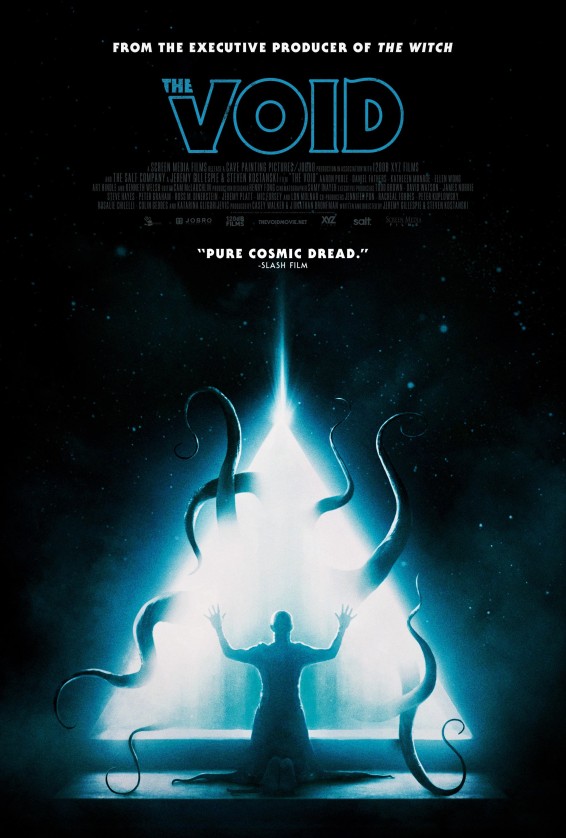
An excellent throwback to 1980s sci-fi and horror; ‘The Void,’ released in 2016 and directed by duo Jeremy Gillespie and Steven Kostanski, first began its life as a simple idea with two passionate minds behind it, as this surprisingly crowdfunded project makes remarkable use out of its thin budget, especially when considering the film’s many expensive-looking set pieces, displaying its huge array of fantastic creature designs and effects, colourful lighting and creative cinematography with enough confidence and innovation to keep any genre enthusiast enthralled.

Plot Summary: After ‘Sheriff Deputy Carter’ stumbles across a blood-soaked man limping down a deserted road, he quickly rushes him to a local hospital with a barebones, night shift staff. But, when a series of strange events occur within the hospital, seemingly linked to a group of cloaked figures standing just outside the building, ‘Carter’ decides to lead a mission into the hospital’s basement to find an exit, only to discover something far more concerning…

Even though ‘The Void’ did have a handful of producers on board more familiar with the horror genre, as mentioned previously, the film was primarily a crowdfunded project, earning most of its budget in addition to a limited theatrical release in 2017 as a result of its online community of donors and fans. And, it’s not exactly difficult to understand why many fanatics of sci-fi and horror alike were so interested in supporting the film, as immediately from the stylised intro any fan of 1980s cinema can tell ‘The Void’ is truly a love letter to everything ’80s, with the film’s narrative clearly taking heavy inspiration from classics, like ‘From Beyond,’ ‘Re-Animator,’ and, of course, virtually all of John Carpenter’s filmography. Yet, despite all of these influences, ‘The Void’ also manages to never feel overly derivative, even with the film’s plot sharing many similarities to the cult horror; ‘Prince of Darkness,’ from 1987.

The cast of ‘The Void’ is primarily comprised of unknown actors, which is by no means a bad thing, as the cast give solid performances across the board, even in spite of their fairly one-note characters, with Aaron Poole, Kathleen Munroe, Daniel Fathers, Mik Byskov, Evan Stern and Ellen Wong portraying the main group of staff and survivors trapped within the hospital’s walls quite well. But, the real stand out of the film has to be Kenneth Welsh as ‘Dr. Richard Powell,’ easily the compelling character of the story, who undergoes some enormous changes over the course of the runtime.

Samy Inayeh handles the film’s cinematography and handles it well, as whilst there are plenty of moments where the camerawork is far too reliant on hand-held shots, the film manages to even itself out over time with plenty of visually appealing ones. However, it’s the lighting and colour palette that are certainly the most visually impressive elements of the film, as ‘The Void’ jumps from harsh reds to cold blues almost from scene-to-scene, not only to add to the film’s unearthly atmosphere of dread, but also to help hide some of the film’s budgetary shortcomings. Furthermore, the story’s signature location of an empty hospital is a very distinct setting for a horror such as this, as the building seemingly becomes more unnatural and dilapidated the further the characters explore it.

For its original score ‘The Void’ actually had quite a large group of composers (five in total), who expertly crafted a classic 1980s synth score with undertones of dark horror, which greatly adds to both the film’s style and atmosphere. And, although the film’s soundtrack is usually more atmospheric than cinematic, tracks such as ‘Starless Night’ and ‘A Hole in the World,’ prove the score does have some memorability amongst its many foreboding tracks.

Partly due to the film’s budget and partly due to Gillespie and Kostanski wanting to use as little CGI as possible, ‘The Void’ is a science fiction flick that delights in its practical effects. Ensuring every creature design and the costumes and/or prosthetics that bring them to life are nothing but flawless, from their skin to their teeth to their various tentacles (of which the film seems to relish in), nearly every aspect of each creature looks truly spectacular, and its these otherworldly designs alongside the film’s over-the-top gore and buckets of blood that help create some genuinely disturbing moments.

In summary, I feel ‘The Void’ succeeds in being an enjoyable throwback to many people’s favourite decade for sci-fi and horror, with its astounding filmmaking and many impressive practical effects all resulting in plenty of thrills and chills. And, although some may argue the film lacks much in the way of originality, I’d argue otherwise, as I feel ‘The Void’ is less of a capsule for nostalgia and references for all things ’80s, and more of a tribute to what came before it, never quite matching up to many of the films from the time-period its referencing, but still raising the bar for indie filmmaking and crowdfunded projects in its best moments. Final Rating: 7/10.
the_void-p1096924

Tarantula (1955) – Film Review

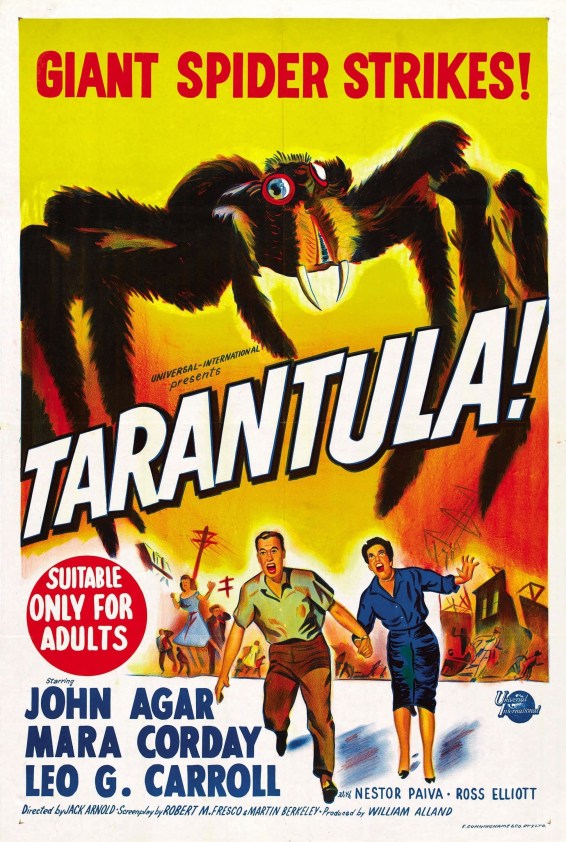
Before the horror genre truly began capitalising on the common phobia of creepy crawlies with films like ‘Arachnophobia,’ ‘Itsy Bitsy,’ ‘Kingdom of the Spiders,’ and ‘Eight Legged Freaks,’ the 1955 sci-fi-horror classic; ‘Tarantula,’ terrified audiences with its marvellous creature effects and continuously unnerving atmosphere. Ensuring the film would go on to be the exemplary for future monster flicks, despite featuring many of the usual problems plaguing creature-features at the time.

Plot Summary: In a remote facility in the Arizona desert, ‘Professor Gerald Deemer’ is conducting a series of experiments in the hopes of finding a way to increase the world’s food supply, injecting growth hormones into various animals to greatly increase their size. But, when a tarantula escapes from the isolated laboratory, still growing at a exponential rate due to the formula, the giant arachnid begins to wreak havoc on a nearby town…

Directed by the late Jack Arnold (With These Hands, Creature from the Black Lagoon, The Incredible Shrinking Man), ‘Tarantula’ was just one of the many science fiction flicks Arnold undertook throughout his career, and in a similar fashion to many of his other stories revolving around horrifying creatures, ‘Tarantula’ was part of the 1950s wave of sci-fi and horror films crafted around the newfound fear of nuclear radiation following World War II. Yet, while we now know ‘Tarantula‘ did greatly help in creating the ‘giant animal’ subgenre, there is an argument to be made that if not for the release of ‘The Beast from 20,000 Fathoms’ just a year prior, ‘Tarantula’ may not even exist, as general audiences only gained interest in creature-features on account of that film’s success.

The late John Agar portrays the film’s square-jawed hero, ‘Dr. Matt Hastings,’ and just like a large majority of male protagonists in ’50s sci-fi, ‘Dr. Hastings’ is charismatic enough to carry the film in spite of the actual character receiving very little development over the course of the runtime. And, as expected, ‘Tarantula’ also includes a romantic subplot between ‘Dr. Hastings’ and secondary protagonist, ‘Stephanie Clayton,’ portrayed by Mara Corday, which although made palatable by Agar and Corday, still feels pretty forced. However, one of the film’s biggest missed opportunities is certainly ‘Professor Gerald Deemer’ portrayed by the late Leo G. Carroll, as whilst Carroll gives a decent performance here, the story sadly pushes his character into the background and nearly entirely ignores the suffering his character later endures after injecting himself with his formula, making his character’s inclusion seem quite superfluous.

Despite the many creature effects throughout ‘Tarantula’ clearly being the film’s main focus, the cinematography by the late George Robinson does have its share of attractive shots even with the film’s lack of colour and camera movement alike due to the technological restrictions of the time-period, as any wide-shots displaying the vast Arizona desert or the fictional town of ‘Desert Rock’ are fairly appealing, and occasionally, even add to the film’s tense atmosphere as the uneven rocky landscape alongside the film’s dim lighting allows the giant arachnid to often lurk unseen.

The original score by the late Herman Stein and the late Henry Mancini is a thunderous and sometimes overly dramatic score, feeling very much like a soundtrack taken from films of the 1950s for better, and for worse. And, while both composers are often uncredited for their work on the film, ‘Tarantula’ is far from the first time Herman Stein has collaborated with director Jack Arnold, providing scores (and having much of his music reused) for a number of his films.

But, of course, ‘Tarantula’ will always be best known for its effects, which are in all fairness the film’s best attribute, as whilst many fondly remembered science fiction and horror films of the 1950s relied on models, costumes and stop-motion to bring their strange creatures to life, many of these filmmaking techniques can feel very dated and tacky by today’s standards for films brimming with CGI. This isn’t the case with ‘Tarantula’s effects, however, as the way the film brings its signature creature to life is quite innovative, as the filmmakers actually used a real tarantula shot separately from the rest of the film, before it was then enlarged and composited/projected onto the desert locations. This clever technique allows the spider to move naturally, and was not only state-of-the-art for the era, but is still quite impressive now, as the matte effect is usually impeccable aside from one or two shots where some of the tarantula’s legs seem to phase through the environment.

In summary, just like many other films released around the time of the 1950s/1960s, ‘Tarantula’ does have its entertainment value, but is also much slower-paced and far more simplistic than many of the sci-fi blockbusters and epic creature-features we’d see released today. Yet, whilst its characters are a little uninspired and the film is more about spectacle than anything else, ‘Tarantula’ definitely has its moments, and, even if just for the effects alone, I think it deserves its place as a ’50s classic, flaws and all. Final Rating: 6/10.

tarantula_poster_05

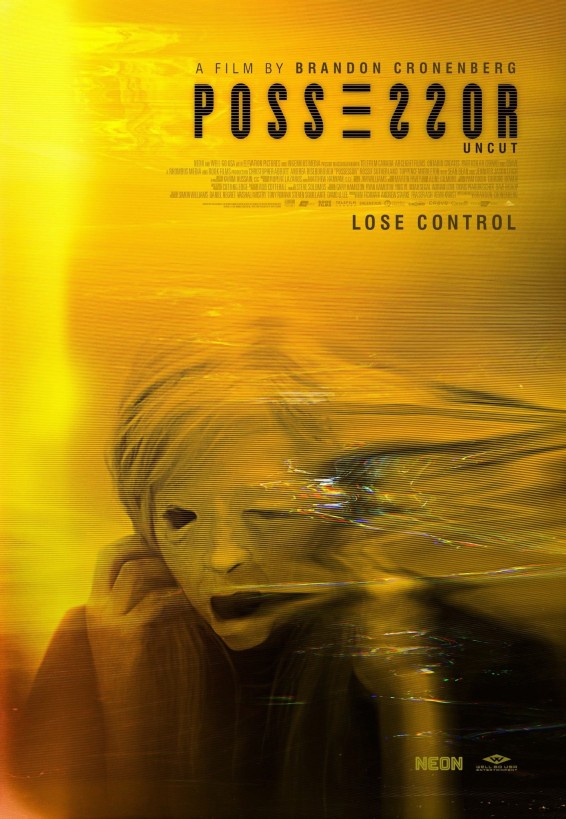
Possessor (2020) – Film Review

Following his 2012 directorial debut with ‘Antiviral,’ Brandon Cronenberg, son of legendary sci-fi-horror director David Cronenberg, crafts a captivating sci-fi thriller with 2020’s ‘Possessor,’ a film that deals with heavy underlying themes of identity loss and sexual discomfort, all whilst displaying its story through some truly spectacular cinematography and lighting. And, even though Brandon’s second sci-fi/arthouse outing doesn’t quite reach the high bar set by his father’s work, ‘Possessor’ is still more than successful as a surreal and layered science fiction flick with outbursts of strong, bloody violence.

Plot Summary: After many years of working as a corporate agent utilising brain-implanted technology to inhabit other people’s bodies and force them to commit assassinations for the benefit of the company. ‘Tasya Vos’ struggles to suppress her violent memories and urges, soon causing her to completely lose control when taking over the mind of a new subject, whose identity now threatens to destroy her own…

Debuting at Sundance Film Festival in early 2020, ‘Possessor’ has quickly gone down as one of the best low-budget releases of that year. Or, at least, this version of the film has, as according to writer-director Brandon Cronenberg, there was an alternate screenplay for ‘Possessor’ which drastically differed from the version that was released. So much so, that Brandon stated it could possibly become a second film later down the line, encompassing all of the material that didn’t quite make it into the first, which was primarily inspired by two pieces of media, the first being the 1971 novel; ‘Physical Control of the Mind: Toward a Psycho-Civilised Society’ by José Delgado, and the second being the short film; ‘Please Speak Continuously and Describe Your Experiences as They Come to You,’ written and directed by David Cronenberg.

Andrea Riseborough gives a fantastically cold performance throughout the film as ‘Tasya Vos,’ making it clear within only a few minutes that ‘Tasya’ is deeply suffering from the effects of her job, as each time she steps into the life of a new subject, she remerges different, finding it harder and harder to untangle her true identity from the one she just inhabited. And, it probably goes without saying that as a sci-fi focused on entering other people’s bodies, the story does explore sexual desire/sexual discomfort, never shying away from scenes of ‘Tasya’ being entranced with her new body after taking over the mind of ‘Colin Tate,’ portrayed by Christopher Abbott. Who, also gives a superb performance as the unfortunate host chosen to execute the company’s assassination, continuously switching between two personalities before eventually becoming devoid of all emotion as minds conflict.

‘Possessor’s cinematography by Karim Hussain also rarely ceases to impress, as nearly every shot is both attractive and memorable, with many shots leaning into the narrative’s themes in addition to providing a closer look at the heavily detailed gore effects through an array of extreme close-ups. The innovative camerawork is also enhanced by the film’s terrific use of colour, as the lighting and colour palette swiftly alters from bright yellows to dark blues to eye-piercing reds. But, this isn’t where ‘Possessor’s filmmaking peaks, as it can’t be denied that the film is at its best whenever it visualises ‘Tasya’ and ‘Colin’ mentally battling for control of ‘Colin’s body, as the film visually displays this interesting concept of a psychic battle on the astral plane through a range of editing techniques and creative yet strange practical effects. The scene in which ‘Tasya’ first enters ‘Colin’s mind is particularly astounding, as the film displays the fake bodies of the two main cast members, which then melt entirely into liquid flesh.

Many of the film’s bizarre visuals are also elevated to a great extent by Jim Williams’ original score, as ‘Possessor’s synth-esque soundtrack keeps the film’s eerie atmosphere present throughout the runtime, capturing the story’s surreal tone and constantly building tension through its atmospheric feel until we arrive at the story’s thrilling climax. My two personal favourite tracks; ‘Reborn in the Mind of Another’ and ‘A False Reputation,’ aren’t exactly distinctive, but both tracks do help tremendously in this regard.

The leading issue ‘Possessor’ suffers from is its lack of world-building, as supposedly the film takes place in an alternate version of the year 2008, but aside from one short scene where we see ‘Colin’s day-to-day job as a data miner, which does at least serve as a comment on the paranoia of corporate overlords and their nefarious activities, the world of ‘Possessor’ receives very little development and can often feel inconsistent when it comes to its technological advances.

In summary, ‘Possessor’ is the perfect hybrid of sci-fi, character study and body horror, as whilst its lack of world-building and compelling side characters do stop the film from reaching its true potential, ‘Possessor’ (along with Brandon’s previous film), definitely prove that Cronenberg’s son has a talent for telling harrowing and violent stories, all the while never forgetting to integrate intriguing concepts and ideas. And, with Brandon pushing for most of ‘Possessor’s effects to be completed in-camera rather than with CGI, the two directors may be even more alike than I first thought. Final Rating: low 8/10.

possessor_ver3_xxlg

Hotel Artemis (2018) – Film Review

Easily one of the most overlooked and commercially underwhelming films of 2018, ‘Hotel Artemis’ is one of those rare releases that feels very unsuited to the genre it’s actually a part of, as whilst this enclosed story set within the walls of an illegal hospital is certainly interesting, ‘Hotel Artemis’ also bizarrely serves as a science fiction flick. Boasting plenty of futuristic technology alongside its snappy dialogue, charismatic performances and gorgeously designed central location, it’s just a shame that this neo-noir thriller doesn’t always know what to do with the above.

Plot Summary: In the riot-torn, near future of Los Angeles, 2028. Disgruntled thieves and criminals make their way to ‘Hotel Artemis,’ a secret members-only hospital operated by ‘The Nurse,’ a no-nonsense doctor who tends to their injuries under the condition that anyone who enters the hotel sticks to the set rules. But, after ‘The Nurse’ receives word the notorious crime lord; ‘The Wolf King,’ is in bound with a gunshot wound, ‘The Nurse’ is forced to break her own rules as the hotel is thrown into violent chaos…

Written and directed by Drew Pearce, ‘Hotel Artemis’ is actually Pearce’s directorial debut, as before this film Pearce had exclusively worked as a screenwriter, writing blockbusters, such as ‘Iron Man 3’ and ‘Mission Impossible: Rogue Nation,’ as well as the ‘Fast and Furious’ spin-off; ‘Hobbs & Shaw,’ later down the line. This might explain why ‘Hotel Artemis’ is as compellingly written as it is, as in spite of its quick pacing and very limited number of locations, the film manages to squeeze a fair amount into its extremely tight runtime, exploring some of the world outside of the hotel in addition to developing many of the hotel’s criminal inhabitants, all the while, the film remains tense as a result of the interactions between the characters and the impending arrival of ‘The Wolf King.’

Jodie Foster leads the cast as ‘The Nurse,’ her first acting role since the sci-fi film; ‘Elysium’ in 2013, and her all too rare screen presence is a pleasure to see again, as she gives a convincingly mournful performance, portraying ‘The Nurse’ as an elderly women refined to the sanctuary of her work following the tragic death of her son. Then there are also the criminals, assassins and thieves (and hotel security), portrayed by Sterling K. Brown, Sofia Boutella, Dave Bautista, Charlie Day, Zachary Quinto and Jeff Goldblum, who are all enjoyable to watch as the various scum of the futuristic Los Angeles, and all receive a fair amount of development although many characters don’t receive a payoff.

The film’s greatest strength is without a doubt its setting, as the penthouse floor of ‘The Artemis’ is rich with atmosphere as the hotel’s set design and set dressing is reminiscent of the art deco style of hotels of the 1930s, almost giving the impression its a building from day’s past. From the velvet cushions to the green slightly teared wallpaper, ‘Hotel Artemis’ is a very memorable location, it’s just unfortunate the film attempts to weave in sci-fi wires and screens, etc. The cinematography by Chung-hoon Chung also greatly adds to the film’s visuals, as the film keeps its shots and colourful lighting as diverse as possible and avoids utilising too much hand-held camerawork.

Cliff Martinez’s original score is another superb element of the film, as the soundtrack features plenty of noteworthy tracks, like ‘It Smells Like Somebody Died in Here,’ ‘Hands Off the Gooch,’ ‘I Only Kill Important People’ and ‘Don’t Cross My Line,’ all of which elevate both the tension and style of the film. ‘Hotel Artemis’ also integrates a few songs from the 1970s, such as ‘California Dreamin’ and ‘Helpless,’ which whilst catchy, further adds to the idea of the film seeming out-of-place as a science fiction flick, but then I suppose without the link to that genre we wouldn’t have the rest of this fantastically computerised score.

As mentioned many times before, the biggest flaw of ‘Hotel Artemis’ for me is its near future setting, as due to many of the film’s characters feeling like modern-day criminals in their actions and personalities, it soon becomes clear that with just a few small alterations the entire narrative could really be switched to fit within a modern time-period, making the sci-fi aspects ultimately pointless. However, with the idea of a hotel for criminals already being explored with the ‘Continental Hotel’ in the ‘John Wick’ series, it’s possible that these characteristics were introduced as a way of avoiding too many similarities with that franchise.

In summary, whilst some characters may not quite get the resolution they deserve and a number of concepts do feel undercooked, ‘Hotel Artemis’ is still a tense and engaging story with many exciting moments of action in-between. Although I personally would only recommend the film to viewers who specifically enjoy intense sci-fi-thrillers, it is a pity that ‘Hotel Artemis’ mostly received lukewarm reviews and was an utter box-office failure, because there is clearly a level of effort put into the film, and I do feel it’s worth a watch should it seem appealing. Final Rating: low 7/10.

hotel_artemis_xxlg

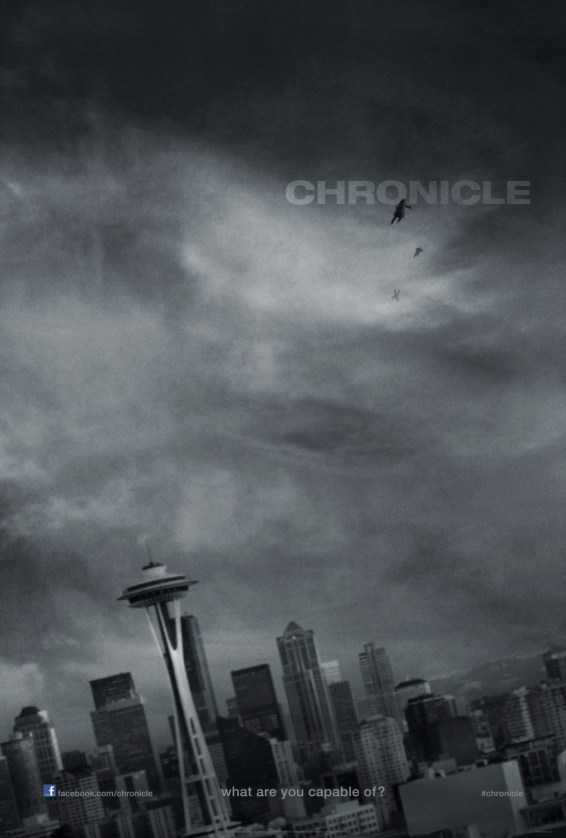
Chronicle (2012) – Film Review

In spite of its short runtime and novice director, ‘Chronicle’ is both a unique and refreshing take on the found-footage subgenre. Diverting from the usual teen horror stories that have completely overtaken the found-footage style for a more sci-fi-esque narrative, which overcomes its gimmicky camerawork and occasionally dated CG effects through riveting moments of action, fast-paced direction and charismatic performances from its young cast.

Plot Summary: After three high school friends venture into a mysterious hole which travels deep beneath the Earth, they reemerge with incredible telekinetic abilities, with introverted; ‘Andrew.’ becoming the most powerful of the three. But, as ‘Andrew’ struggles to cope with his mother’s terminal illness and his father’s alcoholic abuse towards him, his friends ‘Matt’ and ‘Steve’ soon realise ‘Andrew’s abilities are beginning to consume him…

Directed by the infamous Josh Trank (Fantastic Four, Capone) and written by Max Landis, best known for his work on Netflix’s ‘Bright’ and ‘Dirk Gently’s Holistic Detective Agency.’ ‘Chronicle’ takes a lot of inspiration from modern superhero blockbusters, which in a way is ironic, as cast members Dane DeHaan and Michael B. Jordan would later go on to star in big-budget superhero films, with DeHaan portraying ‘Harry Osborn/The Green Goblin’ in ‘The Amazing Spider-Man 2’ and Jordan going on to portray ‘Johnny Storm’ in the ‘Fantastic Four’ remake as well as the threatening antagonist; ‘Killmonger,’ in 2018’s ‘Black Panther.’ So, for DeHaan and Jordan, ‘Chronicle’ essentially served as the jumping off point for their future careers.

Before filming actually began on ‘Chronicle,’ director Josh Trank had actors Dane DeHaan, Alex Russell and Michael B. Jordan live in a house together for fifteen days, and it’s due to this (in addition to Landis’ teenage-accurate writing) that you do feel a genuine bond between the three, as the group of friends act like real teenagers, reckless and immature yet not totally unlikeable, which was an important area to succeed in as a large majority of the story early on leans on their antics as they share banter and test how far their abilities can truly go. However, even with all three characters having quite diverse personalities, it’s ‘Andrew’ who really steals the film as a character. As, his descent into hysteria serves as a compelling character arc within the story, and is well-executed aside from one or two lines nearing the end of the runtime, which are reminiscent of a cheesy supervillain quote from an early 2000s blockbuster.

While the film’s cinematography by Matthew Jensen does begin as your standard affair for a found-footage flick, when it comes to the film’s final act it can be quite difficult to tell where (or what) the camera is actually supposed to be, as its during the final act the characters fully embrace their abilities, allowing them to fly, tear through buildings, make objects float with ease and even throw vehicles, with many of their impowered actions being seen through various CCTV footage or onlookers’ floating phones and tablets, resulting in a fairly chaotic conclusion in spite of its creativity.

Also, as a result of its found-footage style, ‘Chronicle’ lacks an original score, yet the film still features many songs through sources within the world of the film itself like radios and phones. And, while the film does have a more realistic feel because of this, the film’s constant overreliance on glitchy transitions have the complete opposite effect, as the overuse of glitches soon becomes just as irritating as it is distracting considering ‘Andrew’ is often filming through a contemporary camera.

Sadly, in the years since it’s release, much of the CGI throughout ‘Chronicle’ hasn’t aged well, as while some of the CG effects still hold up, there is such a huge number of effects seen within the film that it would’ve been difficult for all of them to remain unblemished. These dated CG visuals might also relate to the film’s budget of £8.9 million, which may seem like a large amount, but is actually quite thin when taking into account what is required of it. The film’s budget also played a part in where it was filmed, as ‘Chronicle’ was primarily shot in Cape Town, South Africa, with American designed vehicles needing to be shipped over for the production, even though the story takes place in Seattle.

In summary, whilst the film has its issues like many other found-footage flicks, ‘Chronicle’ is certainly an underappreciated entry in the subgenre, excelling in many different ways. And, since the film’s initial release, there have been plenty of rumours regarding a sequel, with Max Landis constantly being attached and then unattached as its writer. But, I think it’s pretty evident now that we’ll probably never see a sequel to this underrated science fiction story, which I believe is a good thing, as although the film does have some concepts which could be further explored, I feel the story of ‘Andrew’s psychotic downfall will always be the main focus of ‘Chronicle,’ and without his character, it would seem incomplete. Final Rating: 7/10.

chronicle-teaser-poster

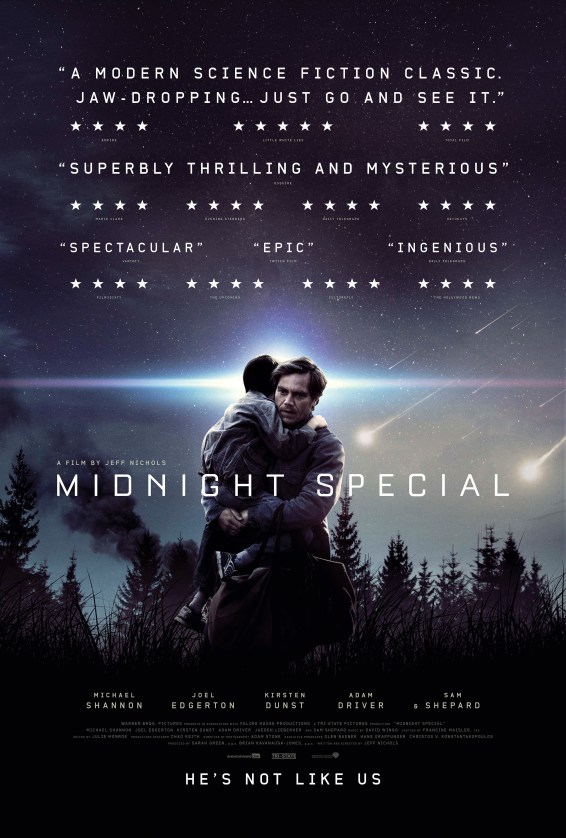
Midnight Special (2016) – Film Review

Written and directed by Jeff Nichols (Take Shelter, Mud, Loving), ‘Midnight Special’ may not be one of the most original or imaginative science fiction films to be released in recent years. Yet, regardless of its many recycled story elements and unexplored ideas, this low-budget sci-fi drama/thriller still manages to retain a sufficient amount of entertaining scenes, impressive CG effects and terrific performances to boot. All equalling to a fairly enjoyable experience, even if the film never quite reaches its full potential.

Plot Summary: ‘Alton Meyer’ is a boy unlike any other, a child with powerful abilities and strange weaknesses, alike. But, after ‘Alton’s abilities attract the attention of both an isolated cult and the U.S. government, ‘Alton’s father; ‘Roy,’ vows to protect his son as the two rival forces pursue the pair across the country…

Although ‘Midnight Special’ was Nichols’ first film made in conjunction with a large production company, Nichols wanted to ensure he had full creative control over the project just as he had previously with his low-budget indie films. So, despite Nichols originally considering making the film with an independent film studio rather than with Warner Bros. Pictures during his last meeting with the company, the producers actually agreed to all his demands, due to the small budget needed for the film. Meaning Nichols got his complete control, and the film was more successful at the box-office as a result of its wider release. This did, however, mean many audience members were left a little dissatisfied with the film, as ‘Midnight Special’ doesn’t follow the usual sci-fi clichés many would expect.

Michael Shannon leads the film as the concerned father; ‘Roy Meyer,’ and as per usual, excels in his role as this simple yet engaging character, wanting to protect his son at any cost, occasionally even at the expense of others. Playing into the age-old theme of doing anything to protect your child. Then there is also Jaeden Martell as ‘Alton’ himself, who considering his young age of twelve at the time of filming, delivers a competent performance, as even though ‘Alton’ may look like a normal child, he acts in a very robotic and eccentric manner. And, whilst this is completely intentional, this type of performance does sometimes make it quite difficult to resonate with ‘Alton’ as effectively as his father. The supporting cast of Joel Edgerton, Kirsten Dunst and Adam Driver, are all also great additions to the film, even though their characters don’t add much to the narrative.

Well-shot throughout, Adam Stone’s cinematography for ‘Midnight Special’ may not be some of the most astounding camerawork ever seen within the sci-fi genre, but due to the film mostly being set at night, the film does manage to enhance many of its already attractive shots through its dim lighting. In addition to the cinematography, the film also makes fantastic use of its many CG effects, with the majority of them being used quite sparsely to ensure they all appear as detailed as possible without going over budget.

The original score by David Wingo also isn’t too memorable when compared to some other scores composed for science fiction flicks, but it still greatly adds to the film. Alternating from slow piano-focused tracks to more electronic pulse-pounding tracks when necessary, the entire soundtrack is both atmospheric and suitably sci-fi, with my two personal favourite tracks; ‘Doak and Levi’ and ‘New World,’ being the perfect two examples of this change in tone when it comes to the score. The film also features a new rendition of the classic folk song; ‘Midnight Special,’ during its end credits, which is actually where the film gets its title.

Yet, in spite of its appealing cinematography and remarkable original score, the area where ‘Midnight Special’ falls flat is its story, as whilst many stories similar to this have been executed well in film before, most notably the sci-fi classic; ‘Starman,’ from 1984. ‘Midnight Special’ revels in not providing its audience with much information, keeping many aspects of ‘Alton’s character, his abilities, and the world the story takes place within a mystery. This is most evident when it comes to the (presumably) sinister cult known as ‘The Ranch,’ as while the cult does play a small role in the story, they remain mostly underdeveloped throughout the film, and as the runtime approaches its end, soon disappear entirely.

In summary, ‘Midnight Special’ is a sci-fi film that will appeal to a far more niche audience, as whilst a simple pitch of the plot may sound both familiar and interesting to many fans of the genre, it’s the way ‘Midnight Special’ goes about its story that will divide many viewers. If the film was to provide a little more backstory/exposition here and there, perhaps the story would’ve felt more fleshed out and matched with the brilliant efforts of its filmmaking. But, as it is, ‘Midnight Special’ feels like a bit of a wasted opportunity, as it remains a decent film that could’ve been so, so much more. Final Rating: high 6/10.

MIDNIGHT-SPECIAL-ONE-SHEET

Edge of Tomorrow (2014) – Film Review

Exceeding expectations in more ways than one and combining the star-power of both Tom Cruise and Emily Blunt, ‘Edge of Tomorrow’ is an explosive summer blockbuster which reimagines the comedy classic; ‘Groundhog Day,’ into a thrilling sci-fi flick to fantastic results. Directed by Doug Liman (Swingers, The Bourne Identity, American Made) and based on the Japanese manga; ‘All You Need is Kill’ by Hiroshi Sakurazaka, ‘Edge of Tomorrow’ or ‘Live Die Repeat,’ as it’s now commonly dubbed, manages to succeed in nearly every aspect an exciting science fiction film would need to.

Plot Summary: When an alien race invades Earth and releases an unrelenting assault unbeatable by any military unit in the world. ‘Major William Cage,’ an officer who has never seen a day of combat, is unceremoniously dropped into the frontline. Getting killed within minutes, ‘Cage’ now finds himself thrown into a time-loop forcing him to live out the same battle over-and-over again. But, with each reset, ‘Cage’ learns to defend himself with the help of Special Forces soldier; ‘Rita Vrataski,’ who, together, hatch a plan to defeat the creatures, permanently…

Taking inspiration from sci-fi war epics, such as ‘Aliens,’ ‘Starship Troopers,’ and ‘Independence Day,’ in addition to the previously mentioned; ‘Groundhog Day.’ ‘Edge of Tomorrow’ may have initially had disappointing box-office returns when it released in 2014, but mostly through word-of-mouth, the film has since continued on to become a modern science fiction classic, keeping itself distinct through its signature ‘resetting the day’ idea and couple of amusing moments in between its action-packed story.

For a large majority of the film, Tom Cruise actively plays against his usual type, as ‘Major William Cage’ is essentially the complete opposite of his character; ‘Ethan Hunt,’ from the ‘Mission Impossible’ franchise, with most of the character’s screen-time being spent dying continuously in horrific (yet also somewhat comedic) ways, alongside his genuinely cowardly and untrained demeanour. Cruise also bounces off his co-star Emily Blunt very well throughout the film, with Blunt portraying the complete opposite of Cruise’s character as ‘Rita Vrataski,’ a hard-as-nails soldier, who is a skilled as they come. And, whilst a romantic subplot can sometimes derail a film’s story, ‘Edge of Tomorrow’ manages to pull its off, mostly due to the chemistry between its heroic duo.

Although the film’s cinematography by Dion Beebe does heavily rely on hand-held camerawork, this hand-held approach does remarkably add to many scenes within the film. Replicating the chaos of the constant war that surrounds ‘Cage’ as he tries different tactics in an attempt to survive on the battlefront, not to say that the cinematography doesn’t still allow for the occasional attractive shot, however. Much of the film’s CG visuals are also up-to-par, excluding the ‘Exo-Suits,’ of course, which are actually practical costumes for the most part. This was done so the suits would appear more real to the audience, which does stop the film from feeling too CGI-heavy during many of the film’s action sequences, even if the suits did weigh between eighty-five to ninety-pounds on set.

The original score by Christophe Beck is certainly no where near as memorable as the film itself, being a mostly typical soundtrack for a action blockbuster with little charm or even a slight sci-fi twist to help the score stand out. This, unfortunately, even applies to the best track of the score; ‘Solo Flight,’ which does at least utilise what sounds like metal-clanging audio effects to add a little more impact wherever it can.

The film’s main issues mostly revolve around two particular areas, firstly, the designs of the alien creatures known as ‘Mimics,’ as whilst the CG effects that bring the creatures to life do look superb, the creatures feel a little too similar to video game enemies, as their different breeds are only distinct by colour, being either red or blue, with the remainder of their design being almost identical. While this is slightly redeemed by their unique sound design, it can become difficult to even tell the creatures apart when they are in large groups. My other complaint with the film is with its final act, as whilst the narrative throughout most of the runtime remains engaging and rousing. The film’s final portion ends up becoming a little more generic after losing its signature time-looping concept.

In summary, since even my first viewing of ‘Edge of Tomorrow’ I’ve always been impressed by this science fiction flick, as while the film isn’t flawless and does still suffer from its cloned creature designs and weak final act. ‘Edge of Tomorrow’ is still a far more enjoyable and enthralling sci-fi than many may initially think. Even though the film didn’t thrive at the box-office on its release, it seems with its recent change in marketing to “Live Die Repeat,” many more sci-fi fanatics have now stumbled across this underrated gem, and with a blockbuster as riveting and surprisingly clever as this one is, I feel it can always be praised further. Final Rating: low 8/10.

rFSStxPT5CBiDWUotReCvRXltQk

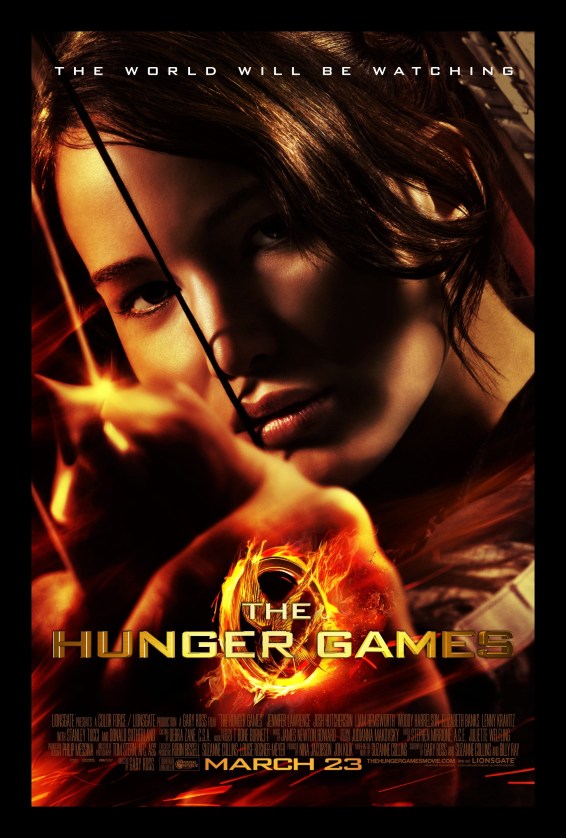
The Hunger Games (2012) – Film Review

While nowadays ‘The Hunger Games’ may be known as an iconic blockbuster franchise, there was a time when most were unfamiliar with ‘Katniss’ and the sovereign state of ‘Panem.’ That until the first adaptation of the novel series by Suzanne Collins was released in 2012, kicking-off a new film franchise which would receive bigger and bigger budgets with each entry. Yet, even with all this success, this science fiction series has always had more issues than most care to admit, which is mostly why I’ve never found as much enjoyment in this franchise as many others.

Plot Summary: In a dystopian future, ‘Katniss Everdeen’ volunteers to take her younger sister’s place in ‘The Hunger Games,’ a televised competition in which two teenagers from each of the twelve districts are chosen at random to fight to the death in a forest arena. Now, ‘Katniss’ and her male counterpart; ‘Peeta,’ find themselves pitted against larger, more fearsome opponents, some of whom have been training their entire lives for this moment…

Alongside the ‘Harry Potter’ series, ‘The Hunger Games’ is one of the main films responsible for creating the rise of teen adaptations in recent years, such as ‘Divergent,’ ‘The Maze Runner,’ ‘Ender’s Game’ and ‘The Host,’ just to name a few. However, similar to many of these other franchises, ‘The Hunger Games’ has always suffered, in my opinion, from attempting too much at one time, as whilst the world the story takes place within is certainly interesting, many ideas and elements feel fairly undercooked or even completely unexplored due to a lack of time, in particular, the aspect of ‘Districts’ within the story, or even the centric “Hunger” part of the film’s title, which along with the many intriguing side characters, is barely developed during the runtime.

Mostly known for her work on indie films at the time, Jennifer Lawrence leads the cast as ‘Katniss Everdeen,’ and while many of the performances she has given throughout her career do tend to flip-flop in quality. She is mostly solid in her role as the film’s protagonist, serving as a likeable character through her actions in addition to also being a strong female icon for young girls. The rest of the cast of Josh Hutcherson, Woody Harrelson, Elizabeth Banks and Liam Hemsworth all give passable performances, despite not being given much to do in this first entry of the series aside from support ‘Katniss.’

The cinematography by Tom Stern is definitely the weakest element of the film, being almost chaotic at points, the cinematography relies nearly entirely on hand-held camerawork. Almost giving the impression the filmmakers had some kind of a phobia of utilising tripods, as aside from the initial moment of ‘Katniss’ entering ‘The Hunger Games,’ I felt the hand-held approach was very necessary, and resulted in plenty of shots losing their alluring potential. Although not often, occasionally, the cinematography even slips in-and-out of focus mid-scene, which alongside the CG effects (which also range drastically throughout the film), can be quite distracting.

Despite James Newton Howard’s original score not becoming as iconic or as beloved as many other signature scores from blockbuster franchises, like ‘Star Wars,’ ‘Jurassic Park’ or the previously mentioned; ‘Harry Potter’ series. Tracks such as ‘The Hunger Games,’ ‘Entering the Capital’ and ‘Rue’s Farewell,’ all serve the narrative well, adding to the drama and tension throughout the film, even if they aren’t some of the most distinctive tracks this talented composer has to offer.

Although ‘The Hunger Games’ doesn’t develop its world as much as I would’ve have personally preferred, there is one detail I did admire within the world of the film. This being the visual contrast between the poverty-stricken and starving ‘District 12’ and the wealthy and futuristic ‘Capitol,’ even if this more futuristic setting allows for more outlandish sci-fi dangers like genetically-engineered hornets and dogs. This alternate version of Earth even plays into the costume design within the film, as many of the wealthy citizens of ‘The Capitol’ wear colourful (and even bizarre) suits, dresses, hats and/or make-up, which excellently displays the difference in opulence throughout the film’s fictional world, purely through clothing.

In summary, ‘The Hunger Games’ does have its entertainment value here-and-there, but just like many other blockbuster franchises, I feel many hardcore fans of the novels and films alike do seem to overlook the flaws this adaptation and its sequels have. From its cheesy and predictable dialogue, to its unexplored story aspects and its absence of both realistic violence and innovative filmmaking. ‘The Hunger Games’ is certainly not the worst sci-fi adaptations has to offer, but it’s still far from the best. If you’re a passionate fan of the novels then I’m sure you’ll thoroughly enjoy this adaptation, but if your just looking for an exciting science fiction flick, maybe look towards some older franchises or possibly even the gruesome Japanese thriller; ‘Battle Royale,’ which shares many of the same ideas. Final Rating: 5/10.

hunger_games_ver24_xxlg

Hot Tub Time Machine (2010) – Film Review

Taking heavy inspiration from the smash-hit comedy: ‘The Hangover’ released a year prior, this 2010 comedy revels in its absurdist tone and nonsensical plot right from its earliest scenes, as despite featuring some very dull cinematography and a completely forgettable original score to boot, ‘Hot Tub Time Machine’ does manage to escape some of its flaws due to the unique story and amusing moments it’s ludicrous title would imply.

Plot Summary: When a group of friends impulsively decide to take their low-life pal; ‘Lou,’ back to the ‘Kodiak Valley Ski Resort’ after a potential suicide attempt, a place that was once their hotspot for thriving party-filled weekends. The group soon find themselves being sent back in time to 1986 after a drunken dip into their malfunctioning hot tub, allowing them to relive one of the best weekends of their entire lives…

Although comedy as a genre has always been quite divisive, ‘Hot Tub Time Machine’ is a film that values its comedy over anything else, as the film continuously throws in as many jokes and references as it possibly can throughout its runtime. Most of which do come at the expense of messing with the film’s structure and pacing (regardless of how comical some of them actually are), as the film goes about its narrative mostly by jumping from comedic scene to comedic scene with most of the character’s different shenanigans having minuscule impact on the others, resulting in the film feeling mostly like a collection of individual comedy skits, with little connection between them aside from their numerous riffs on ’80s pop culture.

At a first mention, John Cusack seems like a slightly odd choice for a straight comedy, in my opinion, as the actor while talented (and even quite amusing at points during the film) usually specialises more in dramas, thrillers and occasionally, even romance over comedies. Whereas the rest of the cast of Rob Corddry, Craig Robinson, Clark Duke, Chevy Chase, are all very experienced within the realm of comedy, which is most likely why many of the film’s funniest moments belong to their characters. The film even features a short appearance from a young Sebastian Stan as the angsty teenager; ‘Blaine,’ many years before his breakout role as ‘Bucky Barnes/The Winter Soldier’ in the Marvel Cinematic Universe.

Similar to many other modern comedies, ‘Hot Tub Time Machine’ nearly always places far more of an emphasis on its comedic writing rather than its cinematography, usually resulting in a large majority of the film’s camerawork being fairly bland. In the case of ‘Hot Tub Time Machine’s cinematography by Jack N. Green, this means having a variety of scenes shot through hand-held camera, in addition to a few moments where shots can make some of the rooms within the ski resort feel far more like sets than they should, usually leave a lot to be desired in terms of visuals.

The original score by Christophe Beck is immensely generic (even in spite of it barely being utilised throughout the film). But, while the score’s lack of memorability is a missed opportunity, it certainly isn’t its biggest; as with the film being set within the 1980s, I felt it was a pretty obvious choice to have a synth/rock soundtrack which would meld perfectly with the long list of famed ’80s songs that also populate the film, the most notable of which definitely being; ‘Safety Dance,’ when the group first realise they have arrived in the past.

However, even if ‘Hot Tub Time Machine’ doesn’t always make the most of its time-period, the film does at least have an interesting location, as the ‘Kodiak Valley Ski Resort,’ the temporary home of the music festival; ‘Winterfest ’86,’ allows for plenty of visually pleasing locations when covered in the snow, ice and vibrant coloured lights alike. Yet, sadly, this still doesn’t manage to make up for what is easily the film’s biggest misstep, as whilst I would say ‘Hot Tub Time Machine’ lands more jokes than it misses, the film does overly rely on gross-out humour for sure, having a number of scenes where simply having a character getting covered in urine/faeces (or something even worse) is the entirety of the joke, which obviously fails to do anything other than disgust its audience through its pathetic idea of comedy.

In summary, even though I personally feel that ‘Hot Tub Time Machine’ is far more problematic than many other modern comedies, I appreciate the film’s effort to scale-up the preposterous nature of many other comedies, taking its ridiculous story concept and managing to make it work better then many would initially think. But, just like many other films within this genre, the bland filmmaking on display and simply unnecessary amounts of gross-out humour leave it a very mixed bag for me, with that said, I could still see the film being enjoyable for anyone in search of a raunchy comedy for a Saturday night with friends. Final Rating: 5/10.

hot_tub_time_machine_xlg

Dawn of the Planet of the Apes (2014) – Film Review

The second outing of the revamped ‘Planet of the Apes’ series and, in my opinion, the best of the most-recent trilogy. ‘Dawn of the Planet of the Apes’ takes place a decade after the previous film, now taking the story into an apocalyptic world where humans and intelligent apes co-exist. Featuring another spectacular performance from Andy Serkis as ‘Caesar’ as well as a much larger role for the vicious ape; ‘Koba,’ this time around (now portrayed by Toby Kebbell), this thrilling and propulsive sci-fi blockbuster is sure to keep its audience glued to the screen.

Plot Summary: Many years after ‘Caesar’s escape from captivity and the outbreak of ‘Simian Flu’ that followed, the clan of intelligent apes and chimps now resident within the Muir Woods just outside a derelict San Francisco. Living a peaceful existence amongst themselves until a group of human survivors journey into their territory in order to find a solution to their colonies’ lack of power, soon leading both sides to consider the possibility of war…

Giving directorial control over to Matt Reeves (The Pallbearer, Cloverfield, Let Me In), Reeves would write and direct both this film and the following entry in the series; ‘War for the Planet of the Apes,’ allowing Reeves to really give a sense of continuity within the story and style (not to say the sequel doesn’t retain continuity from the first film). Yet, what makes this sequel stand out when placed against the first entry in the trilogy is its narrative focus, as ‘Dawn of the Planet of the Apes’ continuously builds tension throughout its runtime, with much of the film leaning on the two species as they balance on the brink of a war that could desolate both parties.

Andy Serkis leads the motion capture cast of apes once again as ‘Caesar,‘ developing his character even further after the first film as ‘Caesar‘ now cares for the clan of apes alongside his newly-found family, and just like the first film, Serkis once again manages to make an animalistic ape a far more interesting and likeable character than would initially seem possible. It’s the criminally underrated actor Toby Kebbell who shines most within the film, however, as the sequel provides the war-mongering ape; ‘Koba,’ with a much larger role, having the ape serve as the film’s main antagonist. In addition to the apes, the film also features a number of human characters, portrayed by Jason Clarke, Keri Russell and Gary Oldman, who are all great in spite of their limited screen-time.

Whilst ‘Rise of the Planet of the Apes’ did feature plenty of attractive shots, Michael Seresin’s cinematography is actually an improvement over the previous entry, as the sequel manages to utilise its dim lighting and the overgrown/dilapidated cityscape of San Francisco to fantastic results. The cinematography also helps add too much of the film’s action, as despite the film only containing two action set pieces, both scenes manage to feel like an excellent payoff to the large amount of build up before them. Yet, personally, I believe one of the most impressive aspects of the film has to be its practical sets, from the overcrowded ‘Human Colony’ to the decrepit streets of San Francisco, nearly all of the film’s sets are breathtaking in both size and detail, with the ‘Ape Village’ being the clearest example of this superb craftsmanship.

Capturing the bleak and ominous tone of the story flawlessly, the original score by Michael Giacchino is also continuously brilliant, and personally, I feel it’s very underrated. As, immediately from the stylish opening sequence which informs the audience of all of the events that have taken place prior to this film, the backing track; ‘Level Plaguing Field,’ really elevates the scene’s emotional impact, with the later tracks; ‘Past Their Primates,’ ‘Along Simian Lines,’ and the 1968 country-rock song; ‘The Weight,’ continuing this trend. 

Although it could go without saying, the visual effects throughout are the film are fantastic, while still perhaps not as pristine as ‘War for the Planet of the Apes’s effects, the CG visuals do still hold up very well since 2014 and contain an immense amount of detail in areas. In fact, the company that created the apes, Weta Digital, were even brought back to bring to life a variety of other animals for the film including deers, horses, and even a grizzly bear, each sharing the same high level of detail.

In summary, ‘Dawn of the Planet of the Apes’ is another remarkable instalment in this new series, upping the stakes and visuals from the previous film alongside continuing the story in a meaningful and entertaining fashion. This science fiction sequel is certainly worth a watch, and whilst I would recommend watching the entire trilogy in order to experience the full story of ‘Caesar’ as a character, if you have limited time or perhaps don’t usually enjoy sci-fi, then I’d say the middle chapter of this ape-led trilogy is truly the most exciting and memorable of the three. Final Rating: 8/10.

dawn_of_the_planet_of_the_apes_ver6_xxlg