Cats (2019) – Film Review

Despite ‘Cats’ being well-known as one of the longest-running stage shows in West End/Broadway history, it is also widely acknowledged that the cat-centric musical is empty spectacle and not much else. This along with many other reasons, may explain why the adaptation of the musical we received in late 2019 has since gone on to be regarded as one of the worst musicals ever put to film, as director Tom Hooper (The King’s Speech, Les Misérables, The Danish Girl) utterly squanders an enormous budget and a talented cast in exchange for a paper-thin plot, a constant bombardment of irritating songs, and some truly horrendous CG effects that will leave most audience members begging to be put out of their misery.

Plot Summary: A tribe of cats known as ‘The Jellicles’ yearly meet for a ‘Jellicle Ball,’ in which, they decide which of their group will ascend to the ‘Heaviside Layer’ and return to a new life. But, on this year, the mysterious napoleon of crime; ‘Macavity,’ has other, more sinister plans…

Ever since it was first announced that Oscar-winning director Tom Hooper would be adapting the iconic feline-focused musical, the film has become such joke-fodder that it’s hard to see past the countless number of memes mocking the film’s dreadful visuals or comedic moments, which is a shame. Not because the film we received is even remotely entertaining, of course, but because the adaptation we almost received could’ve been fantastic, as originally, animation house, Amblimation, planned to adapt the musical into an animated film before the project was shelved following the company’s closure. This idea of translating ‘Cats’ into a traditionally animated film remained all the way to Hooper coming on board to direct, and, in my opinion, also makes considerably more sense considering the original musical is based on the 1939 poetry collection; ‘Old Possum’s Book of Practical Cats’ by T. S. Eliot, a book brimming with whimsical sketches of various cats from a variety of backgrounds.

Newcomer Francesca Hayward, stands-out as one of the film’s few redeeming aspects, as her character; ‘Victoria,’ serves as an audience surrogate, her empathy occasionally shining through as she is rapidly introduced to character after character, until we uncover which ‘Jellicle’ cat will be chosen to ascend. The rest of the film’s prominent cast, however, including Jennifer Hudson, Taylor Swift, James Corden, Jason Derulo, Idris Elba, Judi Dench, Rebel Wilson, Ian McKellen, and many more, range from extraordinarily cringe-worthy to subpar, although their performances are further hindered by the screenplay’s lack of characterisation and dramatic moments.

Whilst the film’s cinematography by Christopher Ross does a successful job of upgrading the beige setting of the stage show into a vibrant, neon-lit approximation of old London, allowing for a handful of visually pleasing shots, it’s impossible for ‘Cats’ to claw itself away from the rest of its distracting visuals. That not only includes the obvious, but also much of the film’s set design, as several of the locations the cats enter are supposed to appear as if they are far larger than the characters in order to display each cast member as cat-sized, the drawback here being that there is usually no consistency with these scaled-up sets between shots.

Moving onto the music, Andrew Lloyd Webber, creator of the original musical, actually handled the film’s original score in addition to writing a couple of songs exclusively for the film. And, while songs, like ‘Jellicle Songs for Jellicle Cats,’ ‘The Old Gumbie Cat,’ ‘The Rum Tum Tugger’ and ‘Skimbleshanks: The Railway Cat,’ may bring a smile to fanatics of the stage show, in the film, these songs only come across as infuriating as they are so frequent, barely making time for anything else, aside from one or two atrocious cat puns.

Lastly, there is the appearance of the cats themselves, by far the most discussed/mocked element of the entire film, and for good reason, as the uncanny part-human, part-CG appearances of the furred critters appear extremely unnatural and very under-polished. So much so, that a mere two days after the film’s initial release, Universal Pictures announced that they would be releasing an updated version of: ‘Cats’ with enhanced CGI. Whilst this is partly a result of Tom Hooper’s broad direction, an article published the following year by The Daily Beast featured multiple visual effects artists who worked on the film, each claiming they had little-to-no time to finish the film’s huge array of effects, with some artists even having to sleep under their desks to get the film completed on time, at least, if said article is truthful.

In summary, even though I’m personally not an admirer of Tom Hooper’s filmography, Hooper is not a wholly incompetent director, but ‘Cats’ is undeniably, an absolute catastrophe of a fantasy-musical from beginning-to-end. Quickly being placed amongst the one hundred worst films of all-time on IMDb and forcing the plans for its sequel (and spin-off television series) to be immediately scrapped, ‘Cats’ is possibly one of the biggest cinematic failures of the past decade, as its copious number of flaws massively overshadow what few, if any, redeeming factors the film had left, resulting in an insufferable viewing experience that’ll make most film buffs feel remorse for everyone involved in this embarrassing production. Final Rating: high 1/10.

cats_xxlg

Easy A (2010) – Film Review

Taking inspiration from romantic coming-of-age comedies, like ‘Sixteen Candles,’ ‘Clueless,’ and ‘Mean Girls,’ ‘Easy A’ released in 2010, certainly has its ups and downs, as despite Emma Stone leading the film with an extremely lively and charismatic performance, it’s hard to ignore the film’s immensely corny tone and many, many moments of humour that fall completely flat. Still, for those looking for a light-hearted morality tale about how a small lie can ramify out of control, ‘Easy A’ should suffice.

Plot Summary: After being prompted by her best friend to spill details of her boring weekend, ‘Olive Penderghast,’ a clean-cut seventeen-year-old high-schooler, decides to spice things up by telling a little white lie about losing her virginity. But, when the high school busybody overhears their conversation and spreads it all over campus, ‘Olive’ suddenly becomes popular for all the wrong reasons…

Written by Bert V. Royal and directed by Will Gluck (Friends with Benefits, Annie, Peter Rabbit), ‘Easy A’ doesn’t strive too far from what we usually expect to see in our teenage romantic-comedies, taking place primarily in high school and focusing on the rippling effects of ‘Olive’s constant lies and her growing popularity after she fully embraces her new persona as the school tart. And, while I wouldn’t call ‘Easy A’s portrayal of an American high school realistic per se, many of the teenage characters we meet throughout the story are purposely represented as over-the-top stereotypes or even just one-note jokes through the film’s witty writing, which does vary from being hilarious to tiresome, depending on the scene.

Possibly being the biggest role of her career at the time of the film’s release, Emma Stone’s performance is undoubtedly the film’s finest aspect, as Stone truly brings her all to the role, portraying ‘Olive’ with such self-assurance that she elevates the game of every actor/actress around her. Harbouring perfect comic timing and a strong yet not irritating playful attitude that ensures ‘Olive’ will remain a likeable and intelligent character for audience members to follow. Then there is the supporting cast of Amanda Bynes, Penn Badgley, Stanley Tucci, Patricia Clarkson, Thomas Haden Church and Lisa Kudrow, who all attain at least one or two amusing moments even if many of their characters serve little-to-no purpose within the actual narrative.

With its story being set in California, ‘Easy A’ does utilise it’s West Coast setting for a handful of attractive wide shots. But, aside from these few shots, nearly all of the film’s cinematography by Michael Grady fails to display anything overly interesting or creative. However, with that said, the film does flaunt its opening titles in a pretty imaginative fashion, having every cast/crew credit placed inside the shots themselves, whether that’s on the ground where characters are walking or placed on signs above the character’s heads, which is a fairly inventive way to avoid having each piece of text simply appear at the bottom of the screen.

Although the original score by Brad Segal is barely noticeable, ‘Easy A’ fills a large majority of its short runtime with a huge assortment of various pop songs, from ‘Change of Seasons’ to ‘Cupid Shoot Me,’ ‘Trouble Is a Friend,’ ‘Bad Reputation,’ and, of course, ‘Pocketful of Sunshine’ by Natasha Bedingfield, which essentially becomes a running joke within the film as a result of the song’s catchy nature. Yet, regardless of how widespread or beloved many of these songs may be, the sheer amount of licensed music that appears in the film is almost overwhelming, and when combined with the film’s editing, soon begins to feel quite choppy when rushing from song to song.

While the plot of ‘Easy A’ does parallel the romantic novel; ‘The Scarlet Letter,’ in more ways than one, ‘Easy A’ isn’t exactly a film that’s subtle about its influences. So, just as the film embraces its similarities to that story with ‘Olive’ continuously mentioning both the novel and film in addition to wearing the scarlet letter; ‘A,’ on her clothes, ‘Easy A’ also takes clips from many of the films it is directly inspired by. In particular, when it comes to John Hughes’ iconic filmography, as everything from ‘The Breakfast Club’ to ‘Ferris Bueller’s Day Off,’ to the previously mentioned; ‘Sixteen Candles,’ is not only referenced but eventually, even sampled into the film during a clip montage, which, while unique, I couldn’t but think is a just a clever tactic of escaping criticisms regarding the film’s lack of originality in some areas.

In summary, whilst ‘Easy A’ owes an enormous debt to older (and in all honesty, better) teenage romantic-comedies, it is enjoyable in bit-size chunks, particularly for those who are fond of Emma Stone. As, in many ways, ‘Easy A’ was unknowingly a showcase for the actress, alluding to her future career in Oscar-winning films, such as ‘La La Land’ and ‘The Favourite.’ And, even though I’m certain it’s underlying cheesiness and subplots that feel like afterthoughts will annoy some, in my opinion, ‘Easy A’ has its moments, but it’s unlikely to leave a strong impression. Final Rating: low 6/10.

easy_a_xxlg

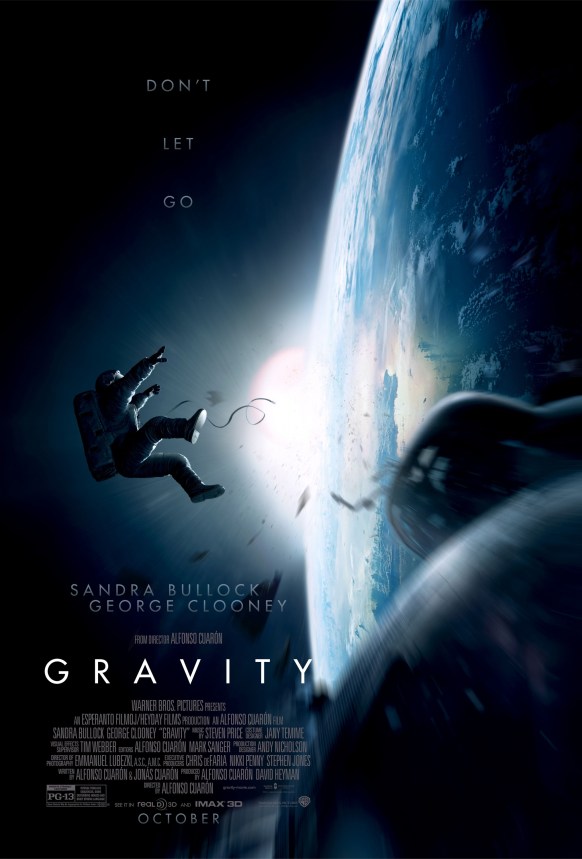
Gravity (2013) – Film Review

A survival drama set almost entirely in the unfathomable abyss of outer space, 2013’s ‘Gravity’ is equal parts tense and beautiful. Taking over four years to produce and winning numerous Oscars back in 2014 for everything from its effects to its cinematography to its sound editing, ‘Gravity’ serves as not only the long-awaited follow-up to director Alfonso Cuarón’s previous sci-fi film; ‘Children of Men,’ but also as one of the most immersive films to ever take place in the hostile, inhospitable vacuum of space.

Plot Summary: On her very first mission aboard the NASA space shuttle; ‘The Explorer,’ novice biomedical engineer; ‘Dr. Ryan Stone,’ and her accompanying seasoned astronaut; ‘Matt Kowalski,’ come face-to-face with an irrevocable disaster during a routine spacewalk when a barrage of debris from a crippled Russian satellite inflicts devastating damage to their shuttle, leaving them both stranded in orbit…

Co-written by Alfonso Cuarón and his son Jonás Cuarón, ‘Gravity’ is many ways less of a science fiction flick than it is a film grounded in real-world science, as it quickly becomes clear whilst watching ‘Gravity’ that the pair did their research into the fundamentals of space, presenting the narrative almost as if it’s based on a true story oppose to relying on flashy explosions to morph the film into a generic sci-fi blockbuster. Yet, interestingly, author Tess Gerritsen actually filed suit against Warner Bros. Pictures following ‘Gravity’s release, claiming the film was unofficially based on her novel and that she was entitled to a screen credit and a fair percentage of the film’s profits, but this was never proven to be true, even if both stories do share many similarities.

With around 80% of the film being shot on a green screen or consisting of CGI, there were plenty of opportunities for the performances throughout ‘Gravity’ to be underwhelming. And, yet, this is not the case, as Sandra Bullock and George Clooney both give brilliant performances here, with Bullock in particular impressing not only due to her acting chops, but also her memorisation skills, as with Alfonso Cuarón bringing his signature lengthy takes into ‘Gravity,’ Bullock had to memorise long combinations of precise movements in order to hit her marks for each shot, often even having to coordinate her movements with those of the wire rig and the camera, which is no easy task.

Brimming with many, many stunning shots, in addition to the previously mentioned one-takes. ‘Gravity’s cinematography by Emmanuel Lubezki rarely ceases to amaze, as the film wastes no time in capturing the audience’s attention by jumping straight into the story with its opening scene, which begins with the camera travelling from an establishing shot of Earth over to ‘Dr. Stone’ detaching from a structure all without a single cut, which in total, lasts around twelve and a half minutes. That being only one aspect of the impressive camerawork ‘Gravity’ displays, another being the film’s excellent use of P.O.V. shots which place the audience directly into ‘Dr. Stone’s space suit, further adding to the film’s tense atmosphere. Furthermore, all of the film’s cinematography is greatly elevated by the magnificent lighting, editing and CG effects, which back it up.

As a result of ‘Gravity’s realistic approach, for a large majority of the film’s ninety-nine-minute runtime there is little sound heard aside from dialogue, this places a lot of pressure on the film’s original score by Steven Price, which luckily, manages to strike the perfect balance between terror and wonder, as tracks, like ‘Above Earth,’ ‘Debris,’ and ‘Don’t Let Go,’ push the score into becoming a remarkable exploration of the absolute isolationism of outer space. Gradually building up with pulsing electronic beats and gloomy vocals, until it eventually expands in intensity and volume, capturing the fear of what lies beyond the stars just as it does with the beauty.

The most common criticism ‘Gravity’ has faced since its release is that the film is focused more on spectacle than anything else, as while all of ‘Gravity’s large-scale set pieces are usually beyond thrilling, some shots do feel as if they were implemented purely for the sake of 3D and IMAX screenings, which is difficult to ignore. This alongside the film’s lack of development in some areas does leave ‘Gravity’ a little devoid of memorability, when compared to some other iconic films set within the vast emptiness of space, e.g. ‘Ad Astra,’ ‘2001: A Space Odyssey’ and ‘Moon.’

In summary, whilst ‘Gravity’ may not live up to the immensely positive reviews it has received in recent years, it is still a captivating piece of science fiction and a true marvel of filmmaking. It’s just for me personally, I find the actual filmmaking process and behind-the-scenes material of ‘Gravity’ far more interesting than the story itself, perhaps that’s due to its underdeveloped characters or another element entirely. Regardless, I feel even with its issues, ‘Gravity’ will remain a testament to what can truly be achieved with modern technology when it comes to film. Final Rating: 7/10.

gravity_xxlg

Searching (2018) – Film Review

Although some may see ‘Searching’ as nothing more than a gimmick, as this hyper-modern found-footage thriller utilises (and in many ways refines) the same format as the low-budget 2015 horror; ‘Unfriended,’ and its 2018 sequel; ‘Unfriended: Dark Web.’ ‘Searching’ has much more to offer than just having its narrative play out over a computer screen, as first-time co-writer and director Aneesh Chaganty constructs an engrossing story around this seldom concept, focusing on the disappearance of a teenage girl and the unfolding drama that follows.

Plot Summary: When ‘David Kim’s sixteen-year-old daughter; ‘Margot,’ goes missing, a local investigation is opened and a detective is assigned to the case. But, after thirty-seven hours pass without a single lead, ‘David’ decides to search the one place he believes his daughter holds all her secrets, her laptop…

Shot in only thirteen days yet taking over two years to complete due to the large amount of prep, editing and animation work. The fundamental idea of ‘Searching’ may have already been attempted with the previously mentioned ‘Unfriended’ franchise among some other horror flicks, but what makes the film stand out is its story, as ‘Searching’ veers away from the usual paranormal scares of most found-footage films to focus on a missing persons case, which does better fit this style of filmmaking, in my opinion, a subgenre now commonly known as “Cyber-Horror.” Furthermore, the film’s protagonist being ‘Margot’s father provides ‘Searching’ with a strong emotional core, as nearly every parent can relate to the fear of their child going missing. On top of this, the film also manages to weave in an overarching theme about the dangers of social media, giving the film quite an impactful message in spite of how many times it’s been covered in cinema.

Considering John Cho is best known for his comedic roles, it has to be said that Cho does a phenomenal job throughout the film as ‘David Kim,’ portraying a realistic depiction of a panicked father’s online movements as he desperately tries to track down his daughter, and the film provides us with plenty of dramatic moments to really let us feel ‘David’s pain. This is an even greater achievement when taking into account that Cho spends the majority of his screen-time just sitting in front of a computer screen looking ever so slightly right of the camera. Unfortunately, ‘David’s daughter portrayed by Michelle La isn’t as impressive, but this may also be due to her dialogue, as many scenes involving ‘Margot’ seem to be quite trite in nature. Lastly, there is Debra Messing as ‘Detective Vick,’ who is serviceable in her role as a firm detective investigating ‘Margot’s disappearance.

The cinematography of ‘Searching’ is interesting enough in itself, even without the story’s central mystery, as the film’s camerawork was actually handled by three different cinematographers. The first being the film’s standard cinematographer Juan Sebastian Baron whenever the film is shot through iPhones and GoPro cameras, and the second being the film’s virtual cinematographers Nick Johnston and Will Merrick, who help give the film a more dynamic feel by controlling the movement of the camera whenever we are looking through a computer screen, drawing the eyes of the audiences to specific areas and details. But, of course, as the film is primarily on a screen or shot through a phone, beautiful shots are basically nonexistent. It’s also not uncommon for the film’s editing to feel overly intense at points, appearing as if it’s trying far too hard to build tension.

In a surprising turn for a found-footage flick, ‘Searching’ does actually have an original score composed by Torin Borrowdale, the film’s soundtrack heavily leans into the story’s technological focus, being an electronic score with a strong emphasis on building tension or a creating a calming window of relief. And, while the opening track; ‘New User,’ is immensely corny, later tracks, such as ‘No Reception,’ ‘San Jose Missing Persons,’ and ‘Search by Image,’ do greatly add to the impact of certain scenes.

Additionally, whilst all of the computer systems, programs, apps, and websites we see during the runtime aren’t the actual versions, but instead templates that were recreated from scratch and then animated. The sheer amount of detail and realism that goes into each second of screen-time we spend on the computer screen simply can’t be ignored, as ‘Searching’ never implements hilariously fake websites into its story, like “iGram,” “Search,” and other dreadful knock-offs we’ve seen in similar films. Instead, both ‘David’ and ‘Margot’s laptops feel like real devices, having their message/Email inboxes overflowing and many real-world apps and websites, like Google and YouTube, open at one time.

In summary, ‘Searching’ may still be a gimmick film in a multitude of ways, but I feel for those who can look past the film’s occasionally cheesy moments and, in all honesty, fairly bland characters beyond their basic motivations. ‘Searching’ is still an engaging thriller/mystery with enough propulsion and small clues to keep most viewers invested, further ironing out the kinks in this obscure subgenre so when it all comes together, it’s with a most pleasurable snap. Final Rating: 7/10.

searching_ver2_xxlg

Steve Jobs (2015) – Film Review

The third film to be based on the real-life story of tech-designer Steve Jobs, following ‘Pirates of Silicon Valley’ in 1999 and ‘Jobs’ in 2013, ‘Steve Jobs’ is a gripping drama which interestingly chooses to take place over the time-span of three iconic product launches, focusing on much of the backstage drama of Jobs’ life as he attempts to revolutionise the world of technology and eventually become the C.E.O. of Apple Inc. Making for the best cinematic interpretation of Steve Jobs’ life story as of yet, despite the film lacking in memorability in a few key areas.

Plot Summary: Steven Paul Jobs has always been known a major player in the digital revolution of the 1980s and 1990s, his passion and ingenuity being the driving force behind the digital age we currently inhabit. But, whilst his commitment to revolutionise the technological landscape was more than commendable, it was also sacrificial, as Jobs’ work often took a toll on his family life…

Directed by Danny Boyle (Trainspotting, 28 Days Later, Slumdog Millionaire), ‘Steve Jobs’ was actually considered a box-office failure upon its initial release, with the film being pulled from over two-thousand cinemas after just two weeks. And, while I can’t say this is too surprising, as a biopic focused around the story of a computer designer does sound dull at a first mention. In execution, ‘Steve Jobs’ is anything but boring, as the film’s sharply written screenplay makes for a very captivating watch, and draws many parallels to ‘The Social Network’ from 2010, which is no coincidence, as both films were written by Aaron Sorkin. Furthermore, David Fincher was once attached to direct the film following his previous collaboration with Sorkin on ‘The Social Network,’ but Fincher was eventually dropped in favour of Boyle after he demanded a higher salary.

First and foremost, ‘Steve Jobs’ is definitely an actor’s film, as the performances outweigh nearly every other aspect of the film aside from perhaps the writing, with Kate Winslet, Seth Rogen, Michael Stuhlbarg, and Jeff Daniels all delivering tremendous portrayals of these real-life figures. With Michael Fassbender portraying the titular man himself, and although Fassbender is quite far physically from Jobs’ appearance (with Fassbender going the extra mile to wear brown eye-contacts to achieve a closer look), Fassbender impresses as usual, presenting Steve Jobs as a brilliant success when it comes to his products, but a significant failure when he tries to communicate with the people in his life. And, refreshingly, the film is never afraid to delve into Jobs’ many personality flaws.

Due to the film playing out over the course of three different product launches, beginning with the Macintosh in 1984 and ending with the unveiling of the iMac in 1998, the three time-periods are cleverly represented through the cinematography by Alwin H. Küchler, with each segment being shot on 16mm, 35mm, and digital to illustrate the advancement in Apple’s technology across the sixteen years of Jobs’ depicted life. And, with the camera constantly tracking the actors as they walk through ever-changing locations, the camerawork really helps to make the film more engaging. Director Danny Boyle even integrates some of his signature ‘Trainspotting’ style with the film’s editing, displaying flashbacks through snappy quick cuts and projection-like images which appear stretched over the walls behind those in frame.

From ‘It’s Not Working’ to ‘Child (Father),’ ‘Russian Roulette,’ and ‘1998. The New Mac,’ the original score by Daniel Pemberton is a perfect mixture of minimalist electronic and grand orchestral tracks, encapsulating both the technological achievements of Jobs’ career as well as the spectacle of each one of unveilings. Unfortunately, the one moment the film’s soundtrack falters is an important one, as the film’s very last scene is sadly spoilt by the use of the pop song; ‘Grew Up at Midnight,’ which feels immensely out-of-place when compared to the remainder of the film’s score.

Whilst ‘Steve Jobs’ is well-written on all regards, with much of the film’s dialogue being continuously witty and humorous in addition to playing into Jobs’ God complex and smug nature. However, with that said, a large amount of the film’s writing also relies on tech-specific dialogue, with everything from circuit boards to graphical interfaces and binary code all being casually mentioned in conversations, which, I imagine, could be fairly confusing for some viewers depending on how familiar they may be with that terminology.

In summary, ‘Steve Jobs’ is certainly one of the better biographies in recent years. Although I’m sure many will still be disinterested in the film purely for its main focus, the film does have a lot to offer and, in my opinion, not only excels past the previous films based on the story the late tech-designer, but also the novel; ‘Pirates of Silicon Valley,’ which the screenplay actually takes heavy inspiration from. And, even in spite of several of Jobs’ associates claiming the film doesn’t represent the man they knew, just like Mark Zuckerberg in ‘The Social Network,’ this version of Jobs is very much a creation of its writer, and what a sensational creation it is. Final Rating: 8/10.

steve_jobs_xxlg

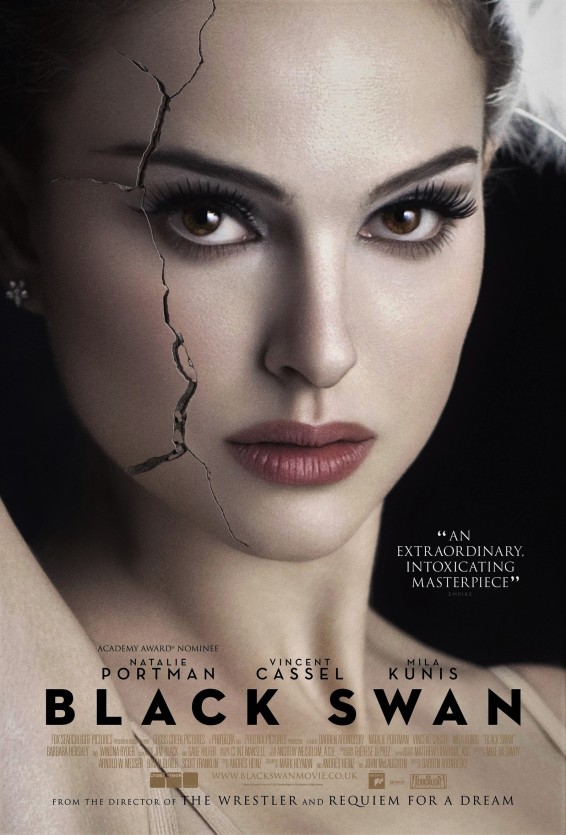
Black Swan (2010) – Film Review

Fantastically deranged at all times, ‘Black Swan,’ directed by Darren Aronofsky (Requiem for a Dream, The Wrestler, Mother!), is for many, the pinnacle of the director’s filmography, as the film’s combination of numerous genres soon evolves into an incredibly unique experience that leaps onto the stage in an effort to impress, with its gorgeous lighting, dreamlike atmosphere and occasionally grotesque visuals all elevating the film’s twisted tale of a dancer obsessed with achieving her dreams. And, whilst the film does trip over itself once or twice, its faults are few and far between.

Plot Summary: When ‘Nina,’ a ballerina for the New York ballet company discovers she has been chosen for the lead role in the company’s production of ‘Swan Lake,’ she struggles to maintain her sanity as her rival dancers, eccentric casting director and obsessive mother twist her perception of reality, forcing ‘Nina’ to prove herself worthy of the duel role and be the example for both the ‘White’ and ‘Black Swan.’

Although the film was never marketed as such, director Darren Aronofsky has always maintained that ‘Black Swan’ is first and foremost a psychological horror film, as the story delves into themes of mental illness and obsession, in addition to displaying many graphic sequences of what is essentially ‘body horror.’ And, yet, the film also somehow manages to never feel restrained to just one genre, which is what keeps it so compelling. This experimental nature might also explain why it took around ten years to be greenlit, as Aronofsky made many changes to the original screenplay in an attempt to get the film funded, with his original hopes for a budget of around £22 million being drastically lowered to roughly £9 million in the end.

The phenomenal lead performance from Natalie Portman nabbed the actress an Oscar back in 2010, and throughout the film, it quickly becomes clear as to why she won, as Portman flawlessly portrays ‘Nina’ as a committed and talented dancer being crushed by the pressure of the role she is undertaking. Portman even went to the extent of altering her voice (which had been continuously criticised by directors in the past for its childish qualities), as Aronofsky requested that for the role of ‘Nina,’ Portman would need to regress backwards and make her voice more childlike. Furthermore, Portman not only lost over twenty pounds for the role, but at least 95% of the dancing seen within the film was performed by Portman herself, with the professional ballerina Sarah Lane acting as her body/dance double for the complex en-pointe work. All of this is without mentioning the excellent supporting cast of Mila Kunis, Vincent Cassel, Barbara Hershey and Winona Ryder, whose performances all add to the film’s surrealist feel.

Matthew Libatique handles the cinematography, which despite relying far too heavily on hand-held shots during some scenes, also makes for some truly astonishing visuals, at points, as the film’s cinematic lighting alongside the grand gothic influence that the film borrows from cult horrors and other arthouse films, most notably, the stylised supernatural horror; ‘Suspiria,’ released in 1977, grant the film a very distinct and striking look. Aronofsky’s trademark of camerawork also creeps its way into the film, as there are a number of moments throughout the runtime where the camera tracks ‘Nina’ from behind as she walks through various locations, giving the cinematography a great sense of movement, not too dissimilar to leaping across a stage.

The original score by Clint Mansell also suitably feels like a score composed for a ballerina recital, as ‘Black Swan’s orchestral soundtrack is mostly a variation on Pyotr Ilyich Tchaikovsky’s ‘Swan Lake’ ballet, the only difference being that the notes are played backwards in a distorted manner. This makes the entire score feel very extravagant and almost overly dramatic, as tracks like ‘Nina’s Dream,’ ‘A Swan is Born’ and ‘Perfection,’ add to both the tragedy and beauty of the story.

As previously mentioned, due to its many scenes of graphic (and frankly disturbing) moments of mutilation, ‘Black Swan’ is far from an easy watch, as while the film doesn’t feature any ‘gore’ per se, all of the scenes of ‘Nina’s harmful acts towards herself feel more grounded in realism as a result of how minimal they are, with all of the skin-picking and dancing injuries she endures being reminiscent of a real disorder, known to medical professions as “Dermatillomania,” a disorder primarily related to skin scratching and/or skin picking.

In summary, even though many believe ‘Black Swan’ to be Aronofsky’s best effort, ‘Requiem for a Dream’ will always be my personal favourite film from the distinctive director as in spite of ‘Black Swan’s beautiful visuals and captivating narrative, the film also feels like it isn’t quite reaching its full potential, mostly due to its overuse of hand-held camerawork and unexplored characters and ideas. Regardless, this arthouse horror sustains its entertainment value, for the most part, and just like many other arthouse films, can be interpreted very differently from person to person. Final Rating: high 7/10.

black_swan_ver7_xxlg

About Time (2013) – Film Review

Written and directed by Richard Curtis (Love Actually, Pirate Radio), ‘About Time’ would go on to be the final outing for Curtis as a director, as after this time-travelling drama’s release in 2013, Curtis would return to exclusively being a screenwriter, which I feel is probably for the best. As, whilst ‘About Time’ does manage to keep itself afloat thanks to its captivating writing and wonderful performances, the film is often let down by its fairly bland presentation and apparent disinterest in exploring its unique time-travelling concept, ensuring the film’s eventual confusion with many of the other romantic-dramas seen in recent years.

Plot Summary: At the age of twenty-one, the timid; ‘Tim Lake,’ is informed by his father that men in their family have the unique ability to travel through time. Although this ability is restricted to the window of their own lives, it can be used to undo any past mistakes, so ‘Tim’ decides to use his newly found ability to escape his current lonely existence, visiting all of his past loves to find the one who could be his future…

Due to Richard Curtis writing a number of iconic rom-coms from ‘Love Actually’ to ‘Four Weddings and a Funeral’ and ‘Bridget Jones’ Diary,’ in the past, it comes as no surprise that ‘About Time’s screenplay is certainly its finest aspect. As, in many scenes, the film chooses to push ‘Tim’s time-travelling ability aside in favour of delivering sincere character moments, playing into the story’s theme of life itself being the greatest experience. Yet, while I do like both of these ideas, it’s a shame that the film barely touches upon the great deal of consequence time-travelling can have, as scenes focusing on time paradoxes and the butterfly effect could’ve made for some of the film’s most impactful story beats. Sadly, they are incredibly sparse and only appear when the story necessitates them.

The main couple of ‘Tim’ and ‘Mary’ portrayed by Domhnall Gleeson and Rachel McAdams do share a good amount of chemistry and have plenty of charming moments together, as ‘Tim’ tries desperately to impress ‘Mary’ by recalling everything he remembers about her from his past encounters. The supporting cast of Lydia Wilson, Lindsay Duncan, Tom Hollander, and Margot Robbie, are also great, as each member of the cast serves an important purpose within the narrative whether big or small. But, it’s Tim’s father, portrayed by Bill Nighy, who is the true emotional core of the film outside of ‘Tim’s love life, with Nighy doing a fantastic job as usual.

Despite visuals never being the main focus of rom-coms, the cinematography by John Guleserian is the film’s worst element, as even somewhat creative shots are rarely seen throughout the runtime, with the film usually just relying on mid-shots or close-ups to enhance the drama. The film’s colour palette doesn’t help in this regard either, as the pale colours almost present the film as if each scene is an extension of a photo framed in the family’s home, which is ingenious if that was the filmmakers’ attention, yet I’m not entirely sure it was. ‘Tim’s time-travelling ability, however, is a little more visually interesting in spite of its simplicity, as the film makes use of rapid editing to cut between many different events during ‘Tim’s life, a straightforward but understandable method of displaying how ‘Tim’ is flicking through his memories.

Although ‘About Time’s cinematography is lacking, the original score by Nick Laird-Clowes is far more enthralling, as the film’s soundtrack utilises ticking clocks and heart beating sound effects to relate to the story’s aspect of time travel. And, when focusing more on the story’s characters, the score switches things up to be piano-focused, depicting a variety of experiences of life such as joy, heartbreak, reflection and confusion. ‘About Time’ also features a number of recognisable songs similar to much of Richard Curtis’ other work, all of which, luckily, never distract from the story.

While ‘About Time’ does eventually continue on to cover a fair number of years throughout the character’s lives, much of the early portion of the film leans on ‘Tim’ trying to ignite the spark with ‘Mary,’ and with Rachel McAdams,’ previously portraying the titular character in ‘The Time Traveler’s Wife’ from 2009, this should seem like familiar ground. However, unlike McAdams’ character in that romantic sci-fi flick, ‘Mary’ is never made aware of ‘Tim’s time-bending secret, which might make some viewers a little uncomfortable regarding the absence of honesty in their relationship.

In summary, ‘About Time’ is enjoyable, it just doesn’t quite live up to its interesting ideas or nearly two-hour runtime. Unfortunately, whilst the film’s many humorous and heartwarming moments do excel, the story’s huge missed opportunities are always ever-present, and the mostly dull cinematography and colour palette simply can’t be ignored, and even though I would personally only recommend ‘About Time’ to those who have a sweet-tooth for light-hearted romantic-dramas, I can’t deny that the film is heartfelt, with a fragile sort of sincerity at its centre. Final Rating: 6/10.

about_time_xlg

The Invitation (2015) – Film Review

A fairly subdued but very effective thriller, ‘The Invitation,’ released in 2015, builds-up an almost absurd amount of tension over the course of its ninety-nine-minute runtime, maintaining the intrigue within its plot whilst also constantly defying the audience’s expectations. Although the film does eventually devolve into generic slasher territory for its final act, this indie thriller utilises its confined location and fantastic performances so effectively that it soon overcomes the majority of its flaws.

Plot Summary: After ‘Will’ and his girlfriend ‘Kira’ accept a formal invitation to a dinner party in the Hollywood Hills hosted by his ex-wife; ‘Eden,’ and her new husband, ‘Will’ begins to feel unsettled as his ex-wife seems overly eager to reunite with friends she lost contact with over two years ago. But, as the dinner party continues, ‘Will’ is presented with mounting evidence that their hosts have a more sinister agenda…

Directed by Karyn Kusama (Girlfight, Jennifer’s Body, Destroyer), ‘The Invitation’ is a low-budget film in the best possible way, as the director and writers had complete creative control over the project due to it being produced without any involvement from major production companies. This is more than likely why the film lacks any unnecessary jump-scares or a forced cliffhanger ending to serve as sequel/prequel bait. Instead, the story has strong underlying themes of past trauma, as the protagonist ‘Will,’ along with his ex-wife; ‘Eden,’ both share a dark past which looms over their present-day lives.

Logan Marshall-Green portrays ‘Will’ very well, as the excellent character-writing combined with Marshall-Green’s performance make ‘Will’ feel like not only a realistic character, but also somewhat of a stand-in for the audience themselves. As upon ‘Will’s arrival at the party, he immediately suspects that something is wrong, as he analyses the small yet strange details of their hosts. But, obviously, it’s also understandable as to why the other guests question or even just deny his claims, as his traumatic background makes him appear almost jealous that his ex-wife has moved on from their past in search of happiness. The rest of the cast of Tammy Blanchard, Emayatzy Corinealdi, John Carroll Lynch and Toby Huss (just to name a few), are all also stellar in their respective roles.

Everything from the film’s colour palette to its lighting to its cinematography by Bobby Shore, all visually display the contrast between the story’s cosy setting and the tension and discomfort that is building throughout the narrative, as the film’s visuals are intentionally quite dim and warm in order to relate to the idea of the lavish house being a safe environment, when, in reality, something far more ominous is at work, which in a way is also visually represented through the darkness of the night creeping its way into the house via the windows. Additionally, the film’s huge amount of variety when it comes to its camerawork helps to make ‘The Invitation’ a more engrossing experience, as with the film mostly relying on its structure of every combination of characters slinking away into the next room for a conversation, it manages to avoid becoming tiresome as a result of its cinematography and score.

Speaking of the soundtrack, the original score by Theodore Shapiro goes a long way to accentuate the feeling of foreboding that the story protrudes, as the soundtrack only utilises solitary stringed instruments. This minimalist approach works perfectly, as the subtlety is reflective of both the story itself and the dimmed-down visuals, really driving a knife through the viewer through the simple use of a violin. The two tracks; ‘Into the Canyon’ and ‘I’m Actually Early,’ are brilliant examples of this, but, in all honesty, the score features so many wonderful tracks, that its difficult to pick between them.

Spoilers ahead in this section for those who wish to go in blind. But, when it’s finally revealed that the goal of the dinner party is to murder all the guests present for the purpose of pleasing a malevolent cult, the film does lose much of its charm, as the short scene we see of the guests being shot one-by-one doesn’t feel like a truly rewarding payoff considering how long the build-up actually was. However, the film does still make an attempt to develop the cult, and it quickly becomes clear that the group share many similarities to real-world groups, with the two most obvious influences being ‘Heaven’s Gate,’ and, of course, Charles Manson and ‘The Manson Family.’

In summary, ‘The Invitation’ is quite the underappreciated gem, as the film makes great use of its thin budget to craft a slow-burning yet layered thriller. While there are a few minor plot threads left lingering, the film does give enough clues/hints for keen-eyed viewers to find, and aside from perhaps the lacklustre climax, I personally have very few gripes with ‘The Invitation,’ and I would recommend it to anyone in search of a tense and entrancing story with equally entrancing filmmaking. Final Rating: low 8/10.

invitation_ver2_xxlg

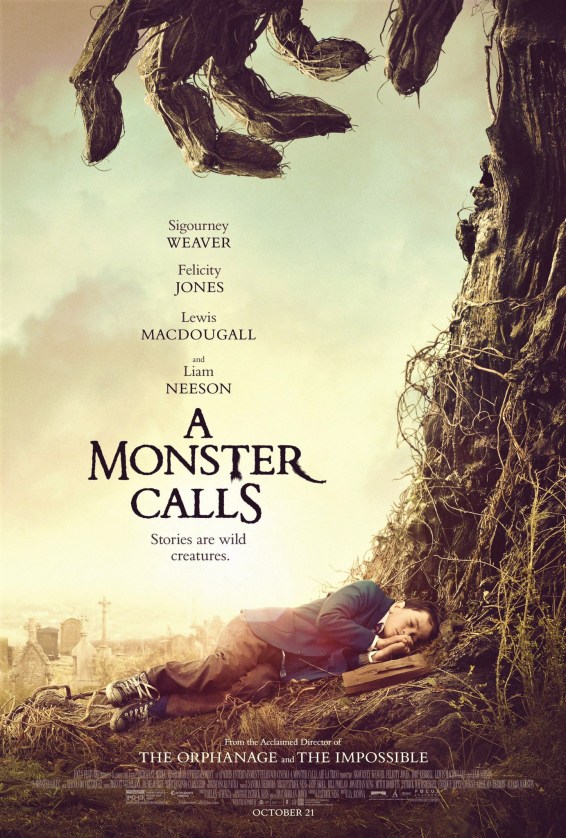
A Monster Calls (2016) – Film Review

Based on the novel of the same name by Patrick Ness and directed by J. A. Bayona (The Orphanage, The Impossible, Jurassic World: Fallen Kingdom), 2016’s ‘A Monster Calls’ is far from being the simplistic creature-feature its title may imply. Instead, this imaginative and soul-stirring drama balances its mature themes and fairytale-esque elements to deliver an engrossing and incredibly moving story, which despite its many positive reviews, has mostly gone unmentioned by many film fanatics since its initial release.

Plot Summary: After realising his mother is dying from terminal cancer, twelve-year-old ‘Conor O’Malley’ struggles to accept that he soon may have to live in a world without his caring mum. Until, later that night, when ‘Conor’ is visited by a tree-like monster in what he believes to be a dream, ‘Conor’ sees an opportunity to save his mother as the creature tells the boy he will heal her after he listens to his three stories…

Focusing on heavy themes of family and loss, the film adaptation of ‘A Monster Calls’ follows its source material very closely, with only a few small differences. One of these alterations being some additional scenes that were written exclusively for the film, including one scene that takes place immediately after the ending of the novel. But, with the original author Patrick Ness writing the film’s screenplay, this accuracy shouldn’t be too surprising. However, interestingly, it wasn’t Ness who originated the story, as the novel was actually started by Siobhan Dowd, who, sadly left it unfinished after her death, leaving Ness to complete the novel in 2011, yet Dowd is still credited as the creator of the original idea during the film’s end credits.

While the film’s supporting cast of Felicity Jones, Sigourney Weaver, Toby Kebbell, and Liam Neeson as the voice of ‘The Monster,’ are all superb in their various roles, its Lewis MacDougall who takes on the lead role as ‘Conor’, which is by no means an easy feat considering his age, as ‘Conor’ is a fairly complex character, being a young boy dealing with a very difficult situation he doesn’t fully understand, unwilling to accept that is mother is in constant pain, and more than likely, won’t be able to recover from her sickness. ‘Conor’s young age also makes his outbursts of rage and sorrow more understandable, as nearly every viewer can probably recall the difficulty of attempting to control their emotions when they themselves were a child. The now-sought-after actor Tom Holland also has a small role in the film, as Holland actually served as the stand in for ‘The Monster’ on set, following his previous collaboration with Bayona on ‘The Impossible’ in 2012.

The film’s cinematography by Oscar Faura not only manages to capture the true scale of ‘The Monster’ at many points, but also allows for a large array of visually appealing shots, effectively utilising everything from extreme close-ups to aerial wide shots to increase the film’s spectacle. The film’s CG effects aren’t quite as impeccable, however, as there are a noticeable amount of CGI-heavy moments which have suffered (if only slightly) from the film’s age.

Although the story of ‘A Monster Calls’ is very powerful on itself, there is no denying it is greatly elevated by Fernando Velázquez’s original score, as many of the film’s accompanying tracks, such as ‘Dad Arrives’, ‘Big Dreams’, ‘The Truth,’ and certainly the film’s final track; ‘End Credits’, all massively help to evoke emotion in the viewer, inevitably adding up to the film’s gut-wrenching conclusion. Any fans of Bayona’s early filmography are also sure to enjoy the film’s quick throwback to the director’s horror roots, as the score becomes quite dread-inducing during the first scene with ‘The Monster,’ as ‘Conor’ is unsure of the creature’s intentions.

But, without a doubt the most impressive aspect of this adaptation has to be ‘The Monster’s stories, as every time ‘The Monster’ tells ‘Conor’ these fantastical tales, the film takes a dramatic shift from live-action into animation, bringing its stories to life through water-coloured drawings and sketches, which not only plays into ‘Conor’ and his mother’s flair for artistry, but these sequences are also when the film is at its most creative, having the camera fly through splurges of paint and water, engulfing the viewer in an array of magnificent colours and locations alike.

In summary, ‘A Monster Calls’ is truly a touching and prodigious film. Whilst perhaps not completely flawless in its execution, mostly due to its unexplored side characters and occasional piece of hand-held camerawork, I feel most would find it impossible to not relate to the story in someway, as it’s sublime performances, enchanting visuals, and beautiful original score all serve their purpose of complimenting the film’s narrative, which is just as captivating as it’s novel counterpart. And, for me, ‘A Monster Calls’ still reigns as my personal favourite film from J. A. Bayona, and I’m positive the film became (and will continue to be) a showcase for Patrick Ness as a talented screenwriter. Final Rating: 8/10.

monster_calls_xxlg

Moonlight (2016) – Film Review

Directed by Barry Jenkins (Medicine for Melancholy, If Beale Street Could Talk) and based on the unproduced stage play; ‘In Moonlight Black Boys Look Blue’ by Tarell Alvin McCraney. ‘Moonlight’ has been heavily praised since its initial release in 2016, being just one of the films from adored production company A24, who also brought us modern indie classics, like ‘Hereditary,’ ‘Waves,’ ‘Eighth Grade,’ ‘The Witch’ and ‘A Ghost Story,’ just to name a few. And, although ‘Moonlight’ may not be the company’s greatest film to date, it is certainly one of the finest examples of visual storytelling and subtle characterisation in recent memory.

Plot Summary: Through three different time periods, young adolescence, mid-teen and young adult, African-American; Chiron, grapples with his identity and sexuality as he grows up in Miami, his journey to manhood being guided by the kindness, support and love of the community that helped raise him…

In addition to receiving almost universally positive reviews, ‘Moonlight’ also won three Oscars for Best Picture, Best Screenplay and Best Supporting Actor in 2017. And, with the film only having a budget of around £1.1 million, ‘Moonlight’ has the lowest budget of any Best Picture winner since ‘Rocky’ in 1976, which cost only £820,000. However, even with this smaller budget, director Barry Jenkins and writer Tarell Alvin McCraney always had a clear vision as to what the film would be, as both men had similar childhood experiences living in Miami, with mothers who had both struggled with drug addiction. So, it was decided early on to replicate those experiences, with roughly 80% of the film being shot in the same neighbourhood the pair originally grew up.

Alex R. Hibbert, Ashton Sanders and Trevante Rhodes portray ‘Chiron’ across the three different time periods of his life, and all do a great job in spite of them not sharing many of the same mannerisms outside of ‘Chiron’s manner of speaking, yet this doesn’t stop the trio from still making ‘Chiron’s quiet and sheepish personality shine. The supporting cast of Mahershala Ali, Naomie Harris, Janelle Monáe and André Holland, are all also fantastic, but with all four being such skilled actors who have given few bad performances throughout their careers, it was unlikely this indie drama would ever be an exception, it’s just a shame their characters aren’t featured more within the narrative.

Despite a large amount of James Laxton’s cinematography consisting of shaky hand-held shots, the film’s camerawork does allow for plenty of movement, as the camera rarely remains still during conversations between characters, making many of the story’s dramatic moments far more visually interesting and giving each scene a consistent flow through the many revolving shots. Additionally, the film also utilises its cinematography to reflect ‘Chiron’s emotional state at many points, combining with the film’s original score for some very impactful story beats. All of this working in synch with the film’s bright colour palette and smooth editing, which both make superb use of the beautiful setting of Miami.

Another masterful and memorable aspect of ‘Moonlight’ is its original score by Nicholas Britell, as the film has a very diverse yet gentle score with tracks ranging from orchestral to more piano-focused, as Britell decided to ‘Chop and Screw’ the orchestra to create a new kind of sound, this technique can be seen throughout the tracks; ‘The Middle of the World,’ ‘Chiron’s Theme’ and ‘Chef’s Special,’ with director Barry Jenkins stating that he always wanted the film’s score to be distinctive, as he actively tried to avoid the cliché of Black-lead films featuring exclusively hip-hop soundtracks.

Much of ‘Moonlight’s story was also inspired by Barry Jenkins’ own childhood in Miami, where he was surrounded by lush green grass and stunning golden sunsets, yet also lived in a neighbourhood where some tragic events took place, declaring his childhood; “A Beautiful Struggle.” And, whilst the film’s slow pacing allows this story to be fully explored, this shouldn’t put viewers off, as the narrative doesn’t move along at a brutally slow pace, only slow enough to fully immerse its events/characters in realism. Then, of course, there is the film’s visual/minimalist storytelling, which is some of the best executed I’ve seen in a long-time, as the film hides many small visual/audio details for those paying close attention, presenting its themes of embracing yourself, addiction and masculinity in such a fashion that I feel different audience members will interpret the story in their own way.

In summary, ‘Moonlight’ is a prepossessing coming-of-age story, even if it isn’t one of the best films A24 has to offer, as while the film is still an incredibly entertaining and well-written drama with an equally well-crafted original score and some creative cinematography to boot. A24 simply has such a vast and exceptional range of indie films to choose from, as the production company is never hindered by genre, style or tone for projects they green-light. But, if you enjoy dramas or are a lover of Barry Jenkins’ other work, then ‘Moonlight’ will surely be a captivating watch followed by a fascinating discussion, just be sure to give the film your full attention. Rating: 8/10.

moonlight_ver2_xxlg