“Eventually, a Man’s Gotta Decide if He’s Gonna Do What’s Right. That Choice Cost Me More Than I Bargained For…” – Jonah Hex
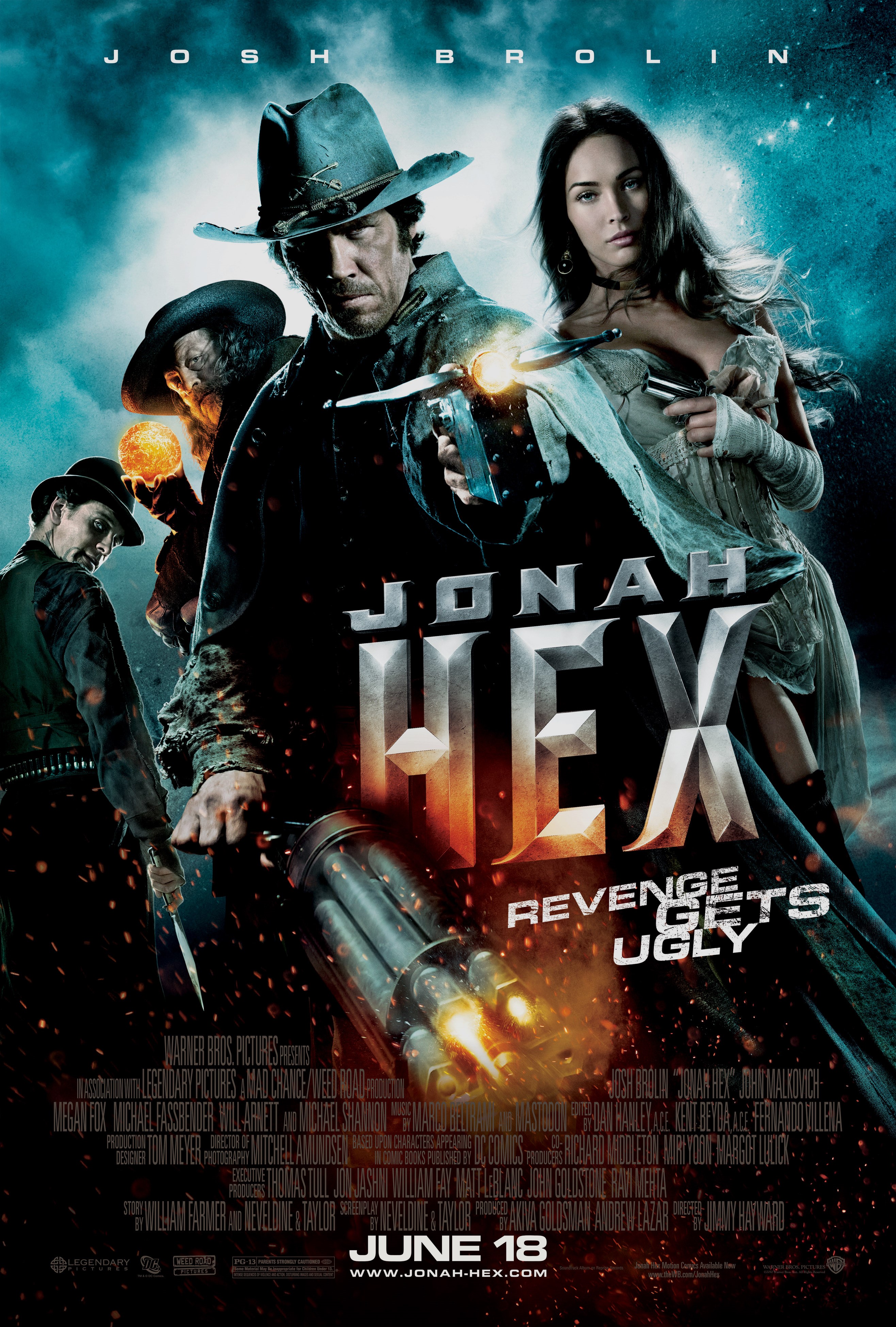
Debuting in 1972 in the All-Star Western comic book series, published by DC Comics, Jonah Woodson Hex is a gruff anti-hero created by writer John Albano and artist Tony DeZuniga. A surly, cynical bounty hunter whose face is scarred on the right side, and who, despite his reputation and disposition, is bound by a code of honour to protect and avenge the innocent across an alternate version of the United States during the 19th Century. This stern gunslinger would eventually make his way to the silver screen in 2010 with Jonah Hex, with Josh Brolin portraying the titular character and director/former animator Jimmy Hayward (Horton Hears a Who!, Free Birds) at the helm, to regrettably dreary results.
Plot Summary: After defying the unhinged Confederate General Quentin Turnbull during the Civil War, Jonah Hex is forced to watch as his family is brutally murdered in front of him. Years later, now a disfigured bounty hunter inexplicably gifted with the ability to speak to the dead, Jonah is forced into action once again to stop Turnbull and his band of Confederate extremists from unleashing a devastating assault on the Union during their Independence Day celebration…
Combining multiple comic book storylines into one to explain Jonah’s personal vendetta and facial disfigurement, depicting him as a Confederate soldier who refused an order to torch a hospital, which led to his former general and Confederate comrades murdering his family, burning down his home and branding his face. However, unlike Jonah’s more grounded portrayal in the comics, this adaptation gave Jonah the otherworldly ability to temporarily resurrect and communicate with the dead following his traumatic ordeal. While this change adds a unique, supernatural element to Jonah’s world, differentiating it from other westerns, the film ultimately fails to justify its inclusion beyond a few memorable moments.
On top of its occasionally corny dialogue, Jonah Hex rarely lets the performances of Josh Brolin, John Malkovich, Megan Fox and Michael Fassbender surpass any of their prior work, with Brolin mumbling and scowling his way through the runtime, rarely becoming more than a witty, gravelly-voiced gunslinger archetype. Due to the fast-paced narrative, certain potentially interesting aspects of the characters are also skimmed over, most notably during one scene where Jonah converses with a Black weaponsmith, who essentially forgives Jonah for fighting for the Confederacy during the Civil War. This scene is problematic for several reasons, but the foremost being that it neglects Jonah’s original intention for joining the Confederacy; aiming to protect his homeland, which then clashed with the institution of slavery. This inner conflict eventually led him to desert his post and surrender to the Union Army at Fort Charlotte in 1863, an aspect of the character that has been thoughtfully explored in the past, but not in this instance.
Another weak point of Jonah Hex is the cinematography by Mitchell Amundsen, as the film frequently feels inadequately constructed, with haphazard framing and lighting, particularly during the action sequences. Whilst the intense colour palette, period-accurate set pieces and CG effects are sometimes impressive, the general aesthetic is overly dark and excessively stylised. That said, the inventive opening sequence is perhaps the finest visual component of the film as it employs cell-shaded animation to introduce this iteration of the titular bounty hunter.
For the rock-heavy original score of Jonah Hex, screenwriter William Monahan drew inspiration from the heavy metal band Mastodon, specifically their 2006 album Blood Mountain. So much so, he personally reached out to the band to ask them to contribute to the soundtrack. Due to the film’s plummeting budget, however, most of the cast and crew had to take pay cuts, and Mastodon was no exception, recording the score for essentially no payment. Initially, composer John Powell was brought on to collaborate with Mastodon to refine the score, but after the film underwent extensive reshoots and re-edits, Powell had to leave the project for other commitments and was replaced by Marco Beltrami, whose musical sensibilities differed from Powell’s. As a result, Mastodon had to collaborate with Beltrami on a new score, which caused considerable frustration amongst the band.
Interestingly, although Jonah Hex was the first comic book adaptation to feature Josh Brolin, it certainly wasn’t the last, as the well-established actor would later portray the villainous tyrant Thanos in the Marvel Cinematic Universe, the murderous gangster Dwight McCarthy in Sin City: A Dame to Kill For (2014) and the time-travelling cyborg trooper Cable in Deadpool 2 (2018), all of which received a much more positive reception than Jonah Hex. So, it’s encouraging to see that this one negative experience didn’t completely diminish Brolin’s interest in projects based on printed media.
In summary, while Jonah Hex is widely regarded as a horrendous blockbuster owing to its negative critical reception and disappointing box-office performance, which left the character’s reputation tarnished for many years following its release before Johnathon Schaech took on the role in the DC television series, Legends of Tomorrow, which brought together a myriad of heroes, villains and creatures from DC Comics, I have never considered the film to be as terrible as many claim. Even if it’s apparent that the film went through multiple revisions and faced a series of misguided decisions and conflicting ideas, I think there are far worse blockbusters out there than Jonah Hex, many of which lack the allure of a traditional western setting. Rating: 4/10.


Not a character I’ve ever heard of. Still, a decent cast can’t save a lousy script!
LikeLiked by 1 person